An Assessment of Changes in Open-Field and Elevated Plus-Maze
Behavior Following Heat Stress in Rats
Rakesh Kumar Sinha
*1and Amit Kumar Ray
21Dept. of Biomedical Instrumentation, Birla Institute of Technology, Mesra, Ranchi, Jharkhand 835 215; 2School of
Biomedical Engineering, Institute of Technology, Banaras Hindu University, Varanasi 221 005, India
Received 8 May 2004; revised 18 May 2004; accepted 24 May 2004
ABSTRACT
This paper presents the effect of high environmental heat on behavior of the male Charles Foster rats. Eighty rats were divided into three groups, subjected to (i) acute heat stress; (ii) chronic heat stress and (iii) handling control group. Animals were exposed to the hot environment in a biological oxygen demand incubator at 38 ± 1ºC (relative humidity 45-50%) for four hours of continuous single exposure for acute heat stress and one hour daily for 21 days for chronic stress. The assessment of behavior was performed just after the stress for acute stress group and for chronic stress group, on 1st, 7th, 14th and
21st day of stress in open-field (OF) and Elevated plus-maze (EPM) apparatus. Following acute heat
exposure, a significant increase in immobilization with decrease in rearing, grooming, and ambulation behavior was seen in OF. While in EPM, a highly significant increase in transfer latency with decrease in percentage time on open arms and number of arms crossed were recorded. During chronic heat stress, in OF, decrease in immobilization (1st, 7th and 14th day) and ambulation (1st and 7th day) was
observed with significant increase in rearing (1st day) and grooming behavior (1st and 7th day). On the
other hand, in EPM, significant decreases in number of arms crossed (1st, 7th and 14th day) and
transfer latency (1st day) were recorded with increase in percentage time on open arms (1st and 7th
day). However, no behavioral changes were observed on 21st day that show the adaptations of animals
to the chronic exposure to the hot environmental conditions. Iran. Biomed. J. 8 (3): 127-133, 2004
Keywords:Heat stress, Behavior, Open-field (OF), Elevated plus-maze (EPM)
INTRODUCTION
T
hermal environment is one of the natural conditions where all organisms require to perform their activities. The important physiological response of man and animals to hot environmental conditions is their ability to function in wide range of temperature, but keeping the body temperature constant [1]. On the basis of describing the threshold values for exposure to hot environment [2], it was observed that the specific changes of body temperature of ±4ºC from normal, could impair both physical and mental task [3]. The physiological responses to the thermal stress vary widely among individuals as well. Even so, the animal’s basic physiological relationships among thermal environments are well-established, but the relationship between thermal environment and psychological activities still have to establish.Environmental heat produces stress to the animals by causing discomfort and irritation, and some degree of psychomotor disturbances. Characteristic changes in behavior, adrenal system and disturbances in higher nervous activities following acute heat stress and hyperthermia have been studied earlier at different ambient temperatures [4-9]. Recent studies indicate that the intensity, duration and the adaptations to the hot environment play an important role in change of many physiological processes and determine the level of thermoregulatory activity [10, 11], which influences the performance of all animals including man. However, there are few behavioral studies in a clinical valid animal model of heat stress. In chronic exposure to hot environment, where adaptations of pathophysiological variables are reported [12], the characteristic changes in behavior on different stages of heat exposure have not been
*Corresponding Author ; Tel: (+91-6542) 279622; E-Mail: [email protected]; Abbreviations: CRH, corticotropin
studied properly.
The present investigation was undertaken to perform systematic experimental assessment of changes in the behavioral activities in an animal model induced by acute as well as chronic exposure to hot environmental stress.
MATERIALS AND METHODS
Subjects. All experiments were performed on eighty male Charles Foster rats of 300-350 grams weight, aged above six months, obtained from Central Animal House, Institute of Medical Science, Banaras Hindu University, Varanasi (India). Rats were housed individually in polypropylene cages (25 cm × 13 cm × 12 cm) on 12L:12D (light during 7.00 A.M. to 19.00 P.M.) cycle at 24 ± 1ºC with food and water ad libitum.
Heat stress model. Rats were subjected to hot environmental stress according to the method described earlier [11], in a well-ventilated, thermostatically controlled Biological Oxygen Demand incubator maintained at 38 ± 1ºC (relative humidity 45-50%). Acute Heat Stress: Twenty rats were divided into two equal groups and continuously exposed to hot environment for four hours (8.00 A.M. to 12.00 P.M.) in the incubator for a single day. Behavior of the subjects were analyzed just after the exposure to high environmental heat in one group while the other group was used for evaluation of corticosterone level.
Chronic heat stress. Two groups of ten rats were exposed to hot environment for one hour daily from 7.00 A.M. to 8.00 A.M., for 21 days. One group of rats was used to analyze the changes in behavior, if any, on day 1, 7, 14 and 21 of the experiment, between 11.00 A.M. to 12.00 P.M. Other similarly exposed groups of rats were used for the analysis of plasma corticosterone level.
Control. Forty rats were divided into four similar groups. Two groups were similarly processed and handled as acute heat stress group and another two groups were processed as chronic stress groups. These groups of rats served as the controls for their respective stressed groups.
Behavioral activity monitoring. In the present study, the changes in behavior following acute and chronic heat stress in rats were evaluated by open-field (OF) and Elevated plus-maze (EPM) methods [13].
Open-field. The field was a circular arena [13] with the outer diameter being 84cm. Peripherally there were 16 squares. The inner concentric circle of 56cm diameter contained 8 squares. The 100-W frosted bulb was placed 1m above the field, an otherwise dark room during the activity testing. The behavioral parameters of each rat were tested in wake condition in OF for 3 minutes by placing the animal at the center of the apparatus are: (i)
Immobilization: Rats had eyes open, holding its
head against the gravity but without any head, body or limb movements. (ii) Grooming: Rhythmic paw movements over the face and/or head for face washing might include episodes of biting and cleaning of paws. (iii) Rearing: Standing still on upright on its hind limb only. (iv) Ambulation:
When all the four limbs were in one particular square (central or peripheral) of the OF.
Elevated plus-maze. The maze [13] had two open arms (50 cm × 10 cm) and at right angle to it, two closed arms (50 cm × 10 cm × 40 cm), with the roof uncovered; an open central crossing (10 cm × 10 cm) and was rising to a height of 50 cm. The behavioral parameters of each rat were tested for 5 minutes in wake condition in EPM by placing them at the end of an open arm are: (i) Transfer Latency: Time taken (in seconds) by the animal to move from the outer end of the open arm to either of two closed arms. (ii) % Time in open arms: The percentage of total testing time spent in the open arm. (iii) % Time at central crossing: The percentage of total testing time spent at the crossing of open and crossed arms. (iv) Number of crossing of the arms: The number of times the animal crosses the centre for going one arm to any other of the three arms.
Other parameters. Three known stress markers were used to find out the extent of stress occurred in rats following whole body exposure to high environmental heat (38 ± 1ºC).
(A) Body temperature. Change in body temperature has been used as important criterion for stress reaction in animals [14]. For acute stress group, body temperature was recorded before and just after the exposure to hot environmental heat while in chronic group, the body temperature was recorded on the day of behavioral analyses between 10.00 A.M. to 11.00 A.M. and compared with the body temperature of control group of rats. A six-channel telethermometer (Aplab, India) with a thermistor probe (Yellow Spring Co., U.S.A.) was used to record the core temperature of rats.
Table 1. Effect of chronic heat exposure on the body temperature and fecal pellet counts during chronic exposure to hot environment. Data are represented as Mean (± S.E.) and compared (**P<0.01) with the control group.
Body temperature (ºC) Pellet count (number)
Control (n = 20) Stress (n = 20) Control (n = 20) Stress (n = 20)
1st Day 37.25 (0.09) 37.42 (0.07) 2.2 (0.46) 3.8 (0.43)** 7th Day 37.45 (0.03) 37.62 (0.15) 1.4 (0.22) 2.8 (0.41)** 14th Day 37.38 (0.10) 37.85 (0.16) 1.4 (0.22) 2.0 (0.35) 21st Day 37.42 (0.17) 38.20 (0.15)** 1.6 (0.36) 1.4 (0.21)
(B) Fecal pellets. Fecal pellets excreted by animals during the incubation period were counted on the day of behavioral analysis for chronic stress. For acute exposure group, pellet count was recorded on the day of experiment during four hours of incubation.
(C) Plasma corticosterone level. The changes in the level of plasma corticosterone was assayed and estimated with the spectrofluorometric method as described earlier [15]. Anesthetized (Pentobarbital, 35 mg/kg i.p.) rats were decapitated and trunk blood was collected into polypropylene tubes containing heparin. Plasma was separated by centrifugation and assayed immediately. The change in the plasma corticosterone level was compared with their respective control groups of rats.
Statistical analysis. All data were statistically analyzed by software (MS EXCEL-98) and were tested manually. The student’s t-test was performed to compare the data from stressed groups to their respective control groups of rats.
RESULTS
Assessment of stress due to acute heat exposure.
The results showed that acute heat exposure significantly increases (∆T = 2.32 ± 0.08ºC) the body temperature (P<0.01) in the rats. The observations of body temperature of control rats after subjecting them in incubator at room temperature, also show that the rise in body temperature of animals were not because of just putting them in the incubator, but due to high incubator temperature, which was set at 38 ± 1ºC for the stressed groups. Student’s t-test conducted on the pellets released during four hours of acute heat stress at 38 ± 1ºC showed that the pellet count was significantly high (P<0.01) in comparison to the control rats (∆=3.8±0.31). The statistical analysis also revealed that plasma corticosterone level after acute heat stress was significantly increased in rats (P<0.01).
Assessment of stress due to chronic heat exposure. Student’s t-test of data presents insignificant changes in the corticosterone level in blood plasma (∆ = 3.75 ± 0.23 µg/100 ml) following 21 days of chronic heat exposure to high environmental heat in comparison to the control group of rats. The pellets released during different stages of chronic heat stress at 38 ± 1ºC by rats are shown in Table 1. The results indicate highly significant rise in pellet released in rats on first day of chronic stress. However, the increase in pellet released was gradually reduced latter on. Apart from that, no significant change in body temperature was recorded during chronic stress till 14th day (Table 1). While, the rise in body
temperature was recorded only on 21st day as
student’s t-test shows significant increase in the mean rectal temperature (P<0.01) of rats on 21st day
of chronic heat stress.
Behavior analysis acute stress. The data of behavioral analysis following acute heat stress with respect to the control group (Table 2), show significant changes in animal behavior in OF and EPM. In OF, highly significant increase in
Table 2. Behavioural activity of the control and acute heat stress group of rats. Data are presented as Mean (± S.E.). Behavioral activity recorded in acute heat exposure group was compared (*P<0.05, **P<0.01) to the control group of rats.
Control (n = 10)
Stress (n = 10) Open-field:
Immobilization (sec) 24.8 (3.41) 112.9 (3.18)** Rearing (number) 9.6 (0.62) 3.4 (0.46)** Grooming (number) 7.9 (0.73) 4.8 (0.26)*
Ambulation (squares):
Peripheral (number) 60.4 (3.79) 40.6 (2.20)* Central (number) 9.8 (0.68) 5.4 (0.35)* Total (number) 74.0 (2.28) 47.5 (2.19)*
Elevated plus-maze:
Transfer latency (sec) 15.9 (1.05) 24.90 (0.62)** % Time open arm 17.89 (0.82) 9.17 (1.07)* % Time centre 6.47 (0.65) 5.78 (1.11) No. arms crossed (number) 6.81 (0.32) 3.20 (0.44)*
immobilization (P<0.01) accompanied with decrease in rearing (P<0.01), grooming (P<0.05), and ambulation behavior such as in peripheral squares (P<0.05), central squares (P<0.05) and total squares (P<0.05) were observed. On the other hand, the highly significant increase in transfer latency (P<0.01) and, decrease in percentage time on open arms (P<0.05) and number of arms crossed (P<0.05) were recorded in EPM.
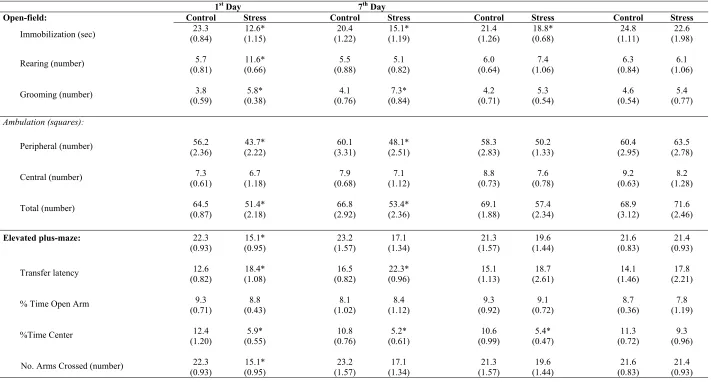
Chronic stress. The data of behavioral analysis of control as well as chronic heat stressed animals are presented in the Table 3.
Open-field. Student’s t-test shows a significant decrease in immobilization (P<0.05) and ambu-lation in peripheral (P<0.05) and total squares (P<0.05), while increase in rearing (P<0.01) and grooming (P<0.05) behavior on the first day of stress were analyzed. On 7th day, significant
decrease in immobilization (P<0.05) and increase in grooming (P<0.05) were recorded in OF. Apart from these changes, the ambulation in peripheral (P<0.05) and total squares (P<0.05) was also found decreased. However, on fourteenth day of chronic exposure to hot environmental heat, the only change in behavior in OF was the significant decrease in immobilization behavior (P<0.05).
Elevated plus-maze. Student’s t-test shows significant changes in behavior in EPM on first day of chronic stress as significant decrease in transfer latency (P<0.05) and number of arms crossed (P<0.05) accompanied with significant increase in percentage of time on open arms (P<0.05) were analyzed. While on seventh day, significant increase in percentage time on open arms (P<0.05) and decrease in number of arms crossed (P<0.05) were recorded. Relatively rare changes in behavior in EPM was observed as only significant decrease in number of arms crossed (P<0.05) was observed on fourteenth day.
Changes in immobilization behavior in OF and number of arms crossed in EPM were observed more pronounced and prolonged at different stages of chronic exposure to hot environmental stress. However, change in behavior on OF or EPM were analyzed insignificant on day 21 of the chronic heat exposure.
DISCUSSION
The study of three established stress markers of heat stress such as body temperature, fecal pellets
released and plasma corticosterone level showed that heat exposure at 38ºC for four hours produces significant changes in these parameters. On the other hand, rats exposed at this temperature for 21 days show adaptational changes in these stress indices. The changes in stress indices in the present report also resemble the clinical symptoms as suggested by Sharma et al. [12]. With consideration of findings in changes in stress indices; in the present study, the changes in behavior due to acute and chronic exposure to hot environment are analyzed in OF and EPM apparatus.
The behavioral changes produced by acute heat stress were found strikingly similar to those reported by Menon & Dandiya [6] in rats. Prolonged single exposure to high environmental heat induced increase in immobilization in OF and transfer latency in EPM. Along with these changes, decrease in rearing, grooming and ambulation also revealed that the acute heat exposure caused fatigue and altered excitability of nervous system. Thus, subjects were showing augmented mobility on OF ambulation testing. Later on, in EPM, animals prefer to stay in the closed arms of the apparatus that may be due to search of protective shelter and eventually they were found to fall in the state of drowsiness, resulted in decrease in number of arms crossed and percent time spent on open arms. Thus, following acute heat stress, behavioral abnor-malities were found persisting for longer period.
While on the other hand, rats were found hyperactive and showing aggressiveness on first day of behavioral testing during chronic exposure to high environmental heat. Unlike to acute exposure group, rats were found with significantly increased rearing and grooming behavior in OF. Due to animals spent more time in rearing and grooming, a minor decrease in ambulation behavior was also observed. Further, in EPM, rats showed increased activity with decreased time of transfer latency and found to spend more time on open arms that is a reversed observation compared to the animals underwent for four hours of prolonged heat exposure. More or less similar results were found on 7th day of experiment during chronic exposure to
hot environment. However, the results of behavioral analysis on 14th and 21st days indicated adaptations of the animals to the stressful environment and show very less or rare changes in behavior in OF and EPM.
Different kinds of stress are known to alter the brain neurohormones and neuronal activities. In series of evaluation of behavioral changes following different modes of stress, past reports presented that
Table 3. Behavioral activity of for chronic heat stressed rats (n = 10) compared with the respective control rats (n = 10) in open-field and elevated plus-maze apparatus on 1st, 7th, 14th and 21st
day of stress. Data are presented as Mean (± S.E.). Behavioral activity recorded following chronic heat exposure was compared (*P<0.05) to the respective control group of rats.
1st Day 7th Day
Open-field: Control Stress Control Stress Control Stress Control Stress
Immobilization (sec) (0.84) 23.3 (1.15) 12.6* (1.22) 20.4 (1.19) 15.1* (1.26) 21.4 (0.68) 18.8* (1.11) 24.8 (1.98) 22.6
Rearing (number) 5.7
(0.81) (0.66) 11.6* (0.88) 5.5 (0.82) 5.1 (0.64) 6.0 (1.06) 7.4 (0.84) 6.3 (1.06) 6.1
Grooming (number) 3.8
(0.59)
5.8* (0.38)
4.1 (0.76)
7.3* (0.84)
4.2 (0.71)
5.3 (0.54)
4.6 (0.54)
5.4 (0.77)
Ambulation (squares):
Peripheral (number) 56.2
(2.36) (2.22) 43.7* (3.31) 60.1 (2.51) 48.1* (2.83) 58.3 (1.33) 50.2 (2.95) 60.4 (2.78) 63.5
Central (number) 7.3
(0.61)
6.7 (1.18)
7.9 (0.68)
7.1 (1.12)
8.8 (0.73)
7.6 (0.78)
9.2 (0.63)
8.2 (1.28)
Total (number) 64.5
(0.87)
51.4* (2.18)
66.8 (2.92)
53.4* (2.36)
69.1 (1.88)
57.4 (2.34)
68.9 (3.12)
71.6 (2.46)
Elevated plus-maze: 22.3
(0.93)
15.1* (0.95)
23.2 (1.57)
17.1 (1.34)
21.3 (1.57)
19.6 (1.44)
21.6 (0.83)
21.4 (0.93)
Transfer latency 12.6
(0.82) (1.08) 18.4* (0.82) 16.5 (0.96) 22.3* (1.13) 15.1 (2.61) 18.7 (1.46) 14.1 (2.21) 17.8
% Time Open Arm 9.3
(0.71)
8.8 (0.43)
8.1 (1.02)
8.4 (1.12)
9.3 (0.92)
9.1 (0.72)
8.7 (0.36)
7.8 (1.19)
%Time Center 12.4
(1.20)
5.9* (0.55)
10.8 (0.76)
5.2* (0.61)
10.6 (0.99)
5.4* (0.47)
11.3 (0.72)
9.3 (0.96)
No. Arms Crossed (number) 22.3
(0.93) (0.95) 15.1* (1.57) 23.2 (1.34) 17.1 (1.57) 21.3 (1.44) 19.6 (0.83) 21.6 (0.93) 21.4
swimming exercise [16] and physical exercise [13, 17] have induced changes in brain neurohormonal turnover and neural activities. Hot environment is also well known to produce changes in brain neurohormone levels [10, 12]. Enhancement of 5-HT synthesis is very well understood in prolonged exposure and short term single exposure to hot environmental stress; but it is not known whether 5-HT or other neurohormonal changes bring about changes in animal behavior as shown in the present study. On the same time, it is very difficult to find out that which neurohormonal changes were responsible for particular type of behavioral changes.
The body temperature of the animals is maintained within fairly narrow limit [18] by thermoregulatory mechanisms that rely on large number of graded physiological and behavioral responses depend on thermal nature of the environment. It has also been well established that biochemical and cellular mechanisms are highly temperature sensitive [19, 20]. Stress is known to stimulate limbic areas of brain and pathways projecting from these areas to the hypothalamus, stimulates corticotropin releasing hormone (CRH) secretion into pituitary-adrenal axis. It also stimulates various other neural pathways in the brain [21, 22]. Aside that, CRH not only stimulates pituitary to increase the corticotropin secretion, but also increase the sympathetic outflow to adrenals resulting in increased output of both cortical and medullary hormones [23] that may cause behavioral abnormalities in the subjects. Similar to the present finding, increase in plasma corticosterone level has been reported in hot environmental condition [4]. With the same time, it has been agreed that an exposure to one hour per day for 21 days resulted in physiological adjustment and adaptation to hot environment [8, 12], which also reflects in the observations in the behavioral parameters in the present study.
Thus, it can be concluded that behavioral changes in rats following acute and chronic exposure to high environmental heat are well correlated with the changes in physiological variables. The data from this study also suggest that acute heat stress induce basic difference in emotionality and behavioral monitoring at different stages of chronic heat stress show adaptation to the hot environment. Therefore, the monitoring and assessment of behavioral activities under heat stress can be considered as useful parameter in psychophysiological monitoring.
ACKNOWLEDGEMENTS
The authors are grateful to the Coordinator, School of Biomedical Engineering, Institute of Technology, Banaras Hindu University, Varanasi (India) for providing laboratory facilities for carrying out this study. Authors are also very thankful to Prof. B. M. Karan, Head of the department, Electrical and Electronics Engineering and Prof. B.N. Das, Head of the department, Biomedical Instrumentation for their help and providing technical assistance to prepare this paper in the present form.
REFERENCES
1. Lind, A.R. (1963) A physiological criterion for setting thermal environmental limits for everyday work. J. Appl. Physiol. 18: 51-56.
2. Ramsey, J.D. (1975)Heat stress standards: OSHA’s advisory committee recommendations. Natl. saf.
News 89-95.
3. Astrand, P.O. and Rodahl, K. (1970) Textbook of work physiology. McGraw-Hill Book Company, New York, USA.
4. Itoh, S. and Nishimura, Y. (1963) Influence of chronic heat exposure on the adrenocortical secretion. Jpn. J. Physiol. 13: 182-186.
5. Kotby, S. and Johnson, H.D. (1967) Rat adrenal cortical activity during exposure to a high (34º) ambient temperature. Life Sci. 6: 1121-1132. 6. Menon, M.K. and Dandiya, P.C. (1969)Behavioural
and brain neurohormonal changes produced by acute heat stress in rats: influence of psychopharma-cological agents. Eur. J. Pharmacol. 8: 284-291. 7. Dubois, M., Sato, S., Lees, D.E., Bull, J.M., Smith,
R., White, B.G., Moore, H. and Macnamara, T.E. (1980) Electroencephalographic changes during whole body hyperthermia in humans.
Electroencephalogr. Clin. Neurophysiol. 50:
486-495.
8. Cure, M. (1989) Plasma corticosterone response in continuous versus discontinuous chronic heat exposure in rat. Physiol.Behav. 4: 1117-1122. 9. Morimoto, T., Nagao, H., Sano, N., Takahashi, M.
and Matsuda, H. (1991) Electroencephalographic study of rat hyperthermic seizures. Epilepsia 32(3):
289-293.
10. Dey, P.K. (1998) Modification of dopamine receptor agonist mediated behavioral responses in rats following exposure to chronic heat stress.
Biomedicine 18 (1): 41-47.
11. Dey, P.K. (2000) Involvement of endogenous opiates in heat stress. Biomedicine 20 (2): 143-148. 12. Sharma, H.S., Westman, J. and Nyberg, F. (1998) Pathophysiology of brain edema and cell changes following hyperthermic brain injury. In: Progress in
Brain Research (Sharma, H.S. and Westman, J. eds.), Elsevier, Amsterdam, Vol. 115: 351-412. 13. Sarbadhikari, S.N., Dey, S. and Ray, A.K. (1996)
Chronic exercise alters EEG power spectra in an animal model of depression. Ind. J. Physiol.
Pharmacol. 40 (1): 47-57.
14. Selye, H. (1976) Stress in Health and disease. Butterworths, Bostan, London.
15. Nicholson, W.E. and Van Loon, G.R. (1973) Some practical innovations in the biological assay of adrenocorticotropic hormone (ACTH). J. Lab. Clin.
Med. 81: 803-808.
16. Dey, S. and Singh, R.H. (1992) Modification of apomorphine-induced behavior following chronic swim exercise in rats. Neuroreport 3: 497-500. 17. Dey, S. (1994) Physical exercise as a novel
antidepressant agent: possible role of serotonine receptor subtypes. Physiol. Behav. 55:323-329. 18. Boulant, J.A. (1991) Thermoregulation. In: Fever:
Basic mechanism and management (Mackowlak, P.
ed.), Raven Press, New York: 1-22.
19. Rao, G.S., Abraham, V., Fink, B.A., Margulies, N. and Ziskin, M.C. (1990) Biochemical changes in the developing rat central nervous system due to hyperthermia. Teratology 41: 327-332.
20. Cervós-Navarro, J., Sharma, H.S., Westman, J. and Bongcam-Rudloff, E. (1998) Glial reaction in the central nervous system following heat stress. In:
Progress in Brain Research (Sharma, H.S. and
Westman, J. eds.), Elsevier, Amsterdam, Vol 115: 241-274.
21. Koob, G.F. and Bloom, F.E. (1985) Corticotropin releasing factor and behaviour. Fed. Proc. 44:
259-263.
22. Monteiro, F., Abraham, M.E., Sahaksri, S.D. and Mascarenhas, J.F. (1989) Effect of immobilization stress on food intake, body weight and weights of various organs in rat. Ind. J. Physiol. Pharmacol.
33 (3): 186-190.
23. Tache, Y. and Gunion, M. (1985) Corticotropin-releasing factor: Central action to influence gastric secretion. Fed. Proc. 44: 255-258.