36(3), Fall 2017, pp. 145-174- ISSN: 2008-8191 DOI: 10.22099/jtls.2017.24841.2223
Process-oriented Listening Instruction:
A study of Iranian EFL Teachers’ Stated and Actual Practices
Mohammad Zohrabi
Assistant Professor University of Tabriz [email protected]
Amir Shokrzadeh M.A.
University of Tabriz [email protected]
Abstract
Research on teacher cognition concerning listening instruction has not been sufficiently touched upon. The present case study aimed to investigate Iranian EFL teachers' stated practices, their perceptions of how effective those practices are, and their actual classroom practices of two casual process-oriented listening instructional approaches namely, strategy-based instruction (SBI) and metacognitive instruction (MCI). To this end, a mixed methods design was utilized. Five experienced EFL teachers were required to be observed and to fill a self-report questionnaire. The findings from the questionnaire revealed teachers' relative but insufficient use of the two process-oriented approaches. Regarding the effectiveness of the process-oriented approaches, the majority of the techniques were perceived by the teachers as effective. Also, the result of the observation showed that process-oriented approaches were conspicuously absent in the teachers' actual classroom practices. Finally, pedagogical implications for EFL teachers, teacher educators, and material developers concerning how best to teach listening are discussed.
Keywords: actual classroom practices, metacognitive instruction (MCI),
process-oriented approaches, stated practices, strategy-based instruction (SBI), teacher cognition
Received: 15/03/2017 Accepted: 09/12/2017
Research about how to teach listening has yielded positive outcomes over the past decade mainly by proposing process-oriented approaches to teaching listening. According to Vandergrift (2004), listening instruction has shifted its focus from product-oriented listening (listening to learn) to process-oriented listening (learning to listen). In process-oriented listening, instruction teachers guide learners on how to listen by enhancing learners' strategy knowledge and strategy use. In other words, learners are assisted to explore and extend their capabilities to achieve an overall listening development (Field, 2008; Goh, 2010; Vandergrift, 2010). This runs contrary to product-oriented listening instruction in which memorizing the details in listening, repeating them, and answering comprehension questions are fundamental (Vandergrift & Goh, 2012).
It is widely agreed that process-oriented listening instruction promotes learners’ listening proficiency (e.g., Graham & Macaro, 2008; Graham, Santos, & Vanderplank, 2008, 2011; Mareschal, 2007; Vandergrift, 2003, 2007; Vandergrift & Tafaghodtari, 2010; Yeldham & Gruba, 2016), yet, little is known about whether teachers employ this kind of listening instruction. What is more, although teacher cognition research has provided substantial new insights into what EFL teachers believe and do in practice, very few studies have gathered evidence of what teachers do in the classroom for listening (Graham, 2017).
To address this gap, this study explores Iranian EFL teachers’ stated practices, their perceptions of how effective those practices are, and their actual classroom practices of process-oriented listening instruction. The two research questions that addressed this issue were as follows.
1. What are the EFL teachers’ stated practices and perceptions regarding process-oriented listening instruction?
2. What are the EFL teachers’ actual classroom practices regarding process-oriented listening instruction?
Literature Review
Two general listening instructional approaches that take a process orientation are the strategy-based listening instruction (SBI) and metacognitive listening instruction (MCI). In what follows, these two approaches are reviewed.
Strategy-based Listening Instruction (SBI)
The term SBI was first used by Mendelsohn (1994) for a listening course that centered on teaching listening strategies. According to Mendelsohn (2006), in an SBI listening course explicit teaching of listening strategies will become the organizing principle and learners will be taught how to use the strategies to facilitate listening comprehension. However, it does not mean, by any means, that only strategies will be taught. Learners' employment of a range of listening strategies is a key feature of SBI that differentiates it from traditional listening classes and makes it be more process-oriented. Concerning how traditional listening instruction differs from recent process-oriented ones, Mendelsohn (2006, p. 75) noted:
Most common listening classes took the form of having learners listen and answer questions, without teaching them how to go about it, i.e., testing their listening rather than teaching them to listen. This meant that a traditional listening course, if such a component of the second language (L2) course curriculum existed at all, took the form of a substantial amount of listening followed by questions, but with no attempt at training the learners how to go about getting at the meaning.
validated a group of such strategies grounded in cognitive theory and classified them into three main groups as cognitive, metacognitive, and social/affective.
Cognitive strategies allow learners to manipulate the material or the input to be learned. They include the language learning strategies of identification, grouping, retention, etc. Cognitive strategies may be restricted in use to a specific skill area or type of activity. According to O'Malley and Chamot (1990, p. 45), common cognitive strategies that have been discussed in the literature for listening comprehension are:
1. Rehearsal, or repeating the names of items that have been heard; 2. Organization, or grouping and classifying words, terminology, or
concepts according to their semantic or syntactic attributes; 3. Inferencing, or using information in oral text to guess meanings
of new linguistic items;
4. Summarizing, or intermittently synthesizing what one has heard to ensure the information has been retained;
5. Deduction, or applying rules to understand language;
6. Imagery, or using visual images (either generated or actual) to follow and remember new verbal information;
7. Transfer, or using known linguistic information to facilitate a new learning task; and
8. Elaboration or linking ideas contained in further information or integrating new ideas with known information.
1. Selective attention for particular aspects of a learning task, as in planning to listen for keywords or phrases;
2. Planning the organization of either written or spoken discourse; 3. Monitoring or reviewing attention to a task, monitoring
comprehension for information that should be remembered, or monitoring production while it is occurring; and
4. Evaluating or checking comprehension after completion of a receptive language activity, or evaluating language production after it has taken place.
Social/affective strategies serve to control emotions and initiate or increase interaction with another person. For example, learners apply specific techniques to lower their anxiety level, cooperate with classmates, or question the teacher for clarification. According to O’Malley and Chamot (1990, p. 45), the strategies that would be useful in listening comprehension are:
1. Cooperation, or working with peers to solve a problem, pool information, check notes, or get feedback on a learning activity; 2. Questioning for clarification, or eliciting from a teacher or peer
additional explanation, rephrasing, or examples; and
3. Self-talk, or using the mental control to assure oneself that a learning activity will be successful or to reduce anxiety about a task.
In practice, SBI takes two forms of instruction as either direct or embedded.
A substantial body of literature on second language listening pedagogy has shown that SBI enables learners to become more efficient and autonomous listeners (e.g., Flowerdew & Miller, 2005; Lynch & Mendelsohn, 2002; Rost, 2002; Vandergrift, 2004; Yeldham, 2016). Recently, listening strategy instruction has been expanded to include newer metacognitive aspects of learning how to listen to the name metacognitive listening instruction.
Metacognitive Listening Instruction (MCI)
Metacognitive listening instruction (MCI) was proposed by Vandergrift (2004, 2007) and Goh (1997, 2008) as a development of SBI. The metacognitive approach focuses on learners' development of autonomy, self-appraisal, self-management, and self-regulation. The contribution of this approach lies in its potential to provide systematic support for learners to attain long-term listening development using creative process-based activities both within and beyond the classroom. In this sense, listening is taught holistically.
At the center of MCI, rests the concept of metacognition which was first posed by John Flavell (1976) and was first applied to language learning by Wenden (1987). Metacognition is defined as "one's knowledge concerning one's cognitive processes and products or anything related to them. It embraces one's awareness of ongoing planning, monitoring, evaluation and orchestration of these processes". (Flavell, 1976, p. 232)
classroom, hence, may not sufficiently support learners in developing the metacognitive aspects of learning. Although a range of strategies is explicitly taught in SBI, their metacognitive rationale is often taken for granted. Thus, metacognitive aspects of learning, both within and beyond the classroom are less likely to be developed. Additionally, SBI is devoid of a variety of structural support, since strategy instruction is the primary focus. Moreover, listeners learn how to listen often individually without the opportunity to share knowledge and discuss their experiences with others (Vandergrift & Goh, 2012). Very briefly put, MCI is SBI but with a broader scope and a direct metacognitive focus. To draw attention to the distinction between these two approaches, Cross and Vandergrift (2015) explain that:
Care needs to be taken to avoid misinterpreting and misrepresenting other listening researchers' work regarding both terminology and conceptualization because it misinforms those who read such content uncritically and inaccuracies can be perpetuated. For instance, metacognitive instruction involves a range of activities designed to enable listeners to experience, develop knowledge of, and reflect on the social-cognitive processes of listening comprehension. It does not encompass interventions solely involving the explicit teaching of strategies, be they metacognitive or other. The explicit teaching of strategies refers to strategy instruction [SBI], a strand of listening theory and research that has a narrower focus. (p.88)
learners who seek help from a peer, or those who ask questions for clarification are putting their metacognitive awareness into action. This is according to Vandergrift and Goh (2012), ‘metacognition in action.' In light of this, Vandergrift and Goh (2012) have proposed a metacognitive framework for listening instruction that serves two important functions, namely, self-appraisal and self-management. Self-appraisal refers to one's knowledge about his or her cognitive abilities. Self-management refers to the regulation of cognitive aspects of problem-solving (Paris & Winograd, 1990). In simpler terms, within the context of listening instruction, the former is referred to as metacognitive knowledge and the latter as strategy use. There are three dimensions of metacognitive knowledge that L2 listeners develop within a metacognitive framework (Flavell, 1979). The first dimension is personal knowledge that refers to the knowledge of strengths and weaknesses or other factors that influence the way individuals learn to listen. The second dimension, task knowledge, deals with the purpose, the nature and the demands of listening tasks. The third dimension is strategy knowledge that refers to knowledge about effective strategies to learn or accomplish a listening task. The three dimensions of metacognitive knowledge lead to the ability to self-manage or, in practice, they lead to effective strategy use which refers to individual’s use of appropriate strategies or deployment of specific actions to make learning more efficient, more enjoyable, more self-regulated, or more transferable to new situations (Vandergrift & Goh, 2012). MCI addresses these aspects of cognition through a pedagogical sequence that increase learner awareness about the listening process. Vandergrift and Goh (2012, p.127) defined the metacognitive pedagogical sequence as:
planning, predicting, monitoring, evaluation, directed attention, selective attention, and problem-solving.
When accompanied by teacher scaffolding and when integrated with efficient listening tasks, the metacognitive pedagogical sequence enables learners to learn how to listen on their own (Vandergrift & Goh, 2012). Vandergrift's (2004) metacognitive cycle represents the five stages in the metacognitive pedagogical sequence. They include pre-listening (planning/predicting stage), first verification stage, second verification stage, final verification stage and reflection/goal-setting stage.
To meet the goals and objectives of MCI, Goh (2008) described two types of activities. The first type is called ‘integrated experiential listening tasks’ that are mainly carried out with course books or materials that their teachers have prepared, and typically focus on extraction of information and construction of meaning. These activities enable learners to become aware of various processes that are involved in L2 listening, to experience social-cognitive processes of listening comprehension and apply what they have learned to contexts beyond the classroom, be it to, use appropriate strategies during listening, explore their own self-concept as listeners or get an insight into factors that influence their individual performance in different listening tasks. According to Vandergrift and Goh (2012, p.128), three main subcategories of these activities are:
- Metacognitive pedagogical sequence activities, in which learners
are guided at specific stages in a lesson sequence to orchestrate listening strategies to facilitate successful comprehension,
- Self-directed listening activities in which learners work with a set
of prompts to make pre-listening preparations, monitor and evaluate and reflect on their performance.
- Post-listening perception activities in which learners work
essential that perception activities be carried out after learners have completed a listening comprehension task, at the post-listening stage because at this stage learners no longer feel the anxiety that often occurs during real-time listening.
The second type is ‘guided reflections on listening.' Here, learners are directed to be consciously involved in teacher-led reflection activities that target to pull learners' implicit knowledge about L2 listening and in the meantime inspire them to make new knowledge as they understand their own listening experiences. Learners are guided to think back to events that have taken place and also to plan as a way of managing their learning. According to Vandergrift and Goh (2012, p. 128), there are four main subcategories of them as follows.
- Listening diaries which are used to guide learners to think aloud
that is to reflect on a specific listening experience and record their responses to issues related to the three dimensions of metacognitive knowledge.
- Anxiety and motivation charts by which learners record changes
in their anxiety and motivation levels for various listening tasks they do in and outside of class.
- Process-based discussions in which learners discuss ways of
addressing listening problems, improving listening proficiency, and strategy use.
- Self-report checklist which is used by learners to evaluate their
knowledge and performance by referring to a list of preselected items of metacognitive knowledge about L2 listening.
As reflection tasks just mentioned may seem tedious to learners after a while, a challenge for teachers is redesigning new formats in a language course where these activities take place (Goh, 2008).
the metacognitive, process-based approach to teaching second language listening and reported a growing learner awareness of the metacognitive processes. They discussed that this approach is promising for the teaching of L2 listening. Cross (2009) also showed the effectiveness of regular practice using the pedagogical sequence as significant gains in listening comprehension scores of the participants were observed. Likewise, the findings of a study by Rahimi and Katal (2013) showed the effectiveness of metacognitive awareness of listening strategies. The researchers also suggested that MCI can be an alternative to traditional teaching listening. In another study, Latifi, Tavakoli, and Dabaghi (2014) found that learners who were taught via the metacognitive pedagogical sequence showed a better listening comprehension ability. In another study with young language learners, Goh and Taib (2006) strongly indicated that metacognitive instruction had contributed to listeners' improvement in listening test scores. In this study, the learners demonstrated some understanding of strategy knowledge and strategy use as well as the nature and the demands of listening.
As it was pointed out earlier, little is known about the extent to which EFL teachers employ SBI and MCI. Indeed, very few studies have reported teachers' stated and actual practices for listening. Among the few studies that have been done, a recent one is by Liao and Yeldham (2015), who investigated 36 Taiwanese EFL teachers' approaches to teaching listening using a questionnaire and semi-structured interviews. The participants were experienced high school teachers who were selected through opportunity sampling. The results suggested that the teachers seemed to lack awareness of strategy based approaches and tended to use product-oriented ones.
between the teachers’ perception and knowledge of listening and their actual classroom practices.
Furthermore, Graham, Santos, and Francis-Brophy (2014) investigated the stated beliefs and stated practices of 115 EFL teachers in England. A comprehensive questionnaire targeting the key issues from the listening literature was developed for this study. Responses to the questionnaires indicated that active listening for the teachers meant efficient task completion and identification of discrete pieces of information in the listening. Responses also showed lack of prediction, verification, and other metacognitive strategies. In general, lack of a process-oriented approach was revealed.
Siegel (2013) in another study observed and recorded the listening portions of 10 EFL university teachers in Japan. The transcribed data from 30 lessons were analyzed to be matched with many categories that were defined before the data collection. Finally, the findings revealed the highest rate of ‘listening as a test of comprehension.' This is what Field (2008) has called the "comprehension approach" in which listening comprehension is tested by a variety of questions without being taught how to listen. Meanwhile, nearly half of the lessons (12 of 30) targeted metacognitive strategies as well.
Categories of Analysis
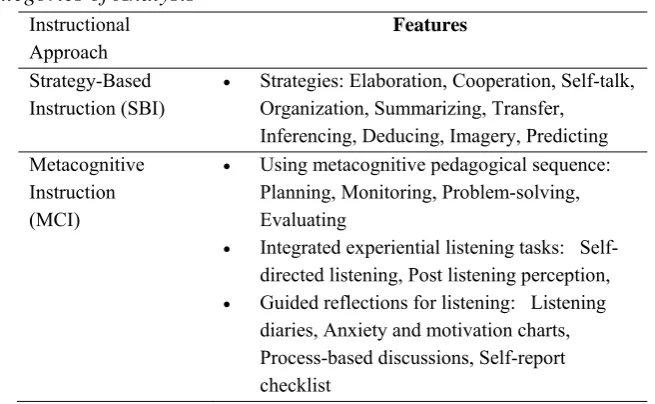
contribute to the interpretation of the data. The categories of analysis are illustrated in Table 1.
Table 1.
Categories of Analysis
Instructional Approach
Features
Strategy-Based Instruction (SBI)
Strategies: Elaboration, Cooperation, Self-talk, Organization, Summarizing, Transfer,
Inferencing, Deducing, Imagery, Predicting Metacognitive
Instruction (MCI)
Using metacognitive pedagogical sequence: Planning, Monitoring, Problem-solving, Evaluating
Integrated experiential listening tasks: Self-directed listening, Post listening perception, Guided reflections for listening: Listening
diaries, Anxiety and motivation charts, Process-based discussions, Self-report checklist
Method Design of the Study
This study was a case study with a mixed-methods descriptive design. The ‘case' in this study constitutes five EFL teachers teaching English to upper intermediate or advanced students. A mixed-methods approach was chosen because it allows easier and more comprehensive interpretation of findings of the issue of teachers' stated and actual practices. Cross and Vandergrift (2015) state that:
the questionnaire and qualitative data come from classroom observation. (p.87)
Participants
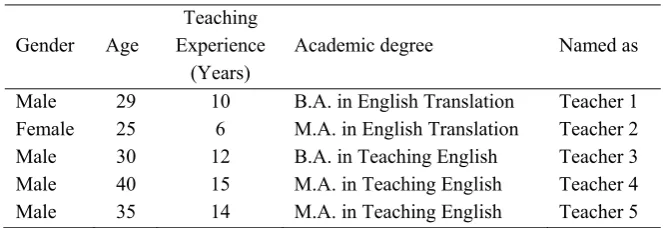
The participants in this study were five Iranian EFL teachers (one female & four males) teaching in a private language institute, in Tehran, Iran where classes meet twice a week for eight weeks. Each session lasted 100 minutes and about 30 minutes of each session were spent on listening. The instructional materials used by the teachers were American English File course books which emphasize a balance of skills. The
teachers ranged in age from 25 to 40 They all hold BA and/or MA in English language teaching. They were selected based on their experience in teaching English for upper intermediate and advanced learners. It was assumed that about five years of teaching English was the minimal criterion for selecting our participants (Tsui, 2003). Table two illustrates the details about the teachers’ features.
Table 2.
Characteristics of the Participants
Gender Age
Teaching Experience (Years)
Academic degree Named as
Male 29 10 B.A. in English Translation Teacher 1 Female 25 6 M.A. in English Translation Teacher 2 Male 30 12 B.A. in Teaching English Teacher 3 Male 40 15 M.A. in Teaching English Teacher 4 Male 35 14 M.A. in Teaching English Teacher 5
Instruments
scale (e.g., Never, Rarely, Sometimes, Often, and Always) and for the ‘how effective’ section a 4-point Likert scale (e.g., Very ineffective, Ineffective, Effective, Very Effective) were used.
The questionnaire items were developed based on the basic attributes of the SBI and MCI drawing on important exercises and methods in the field. Additionally, two instructors who had taught the listening course at university for more than twelve years validated and confirmed the items. Then, the researchers piloted the questionnaire among sixty-one teachers incorporating the instructors’ comments on the items. The Cronbach alpha reliability statistic was then calculated for both the ‘how often’ and the ‘how effective’ section of the questionnaire. Cronbach reliability coefficient for the former section was 0.86 and for the latter 0.84. Some of the items were modified and some of them were deleted totally based on the feedback obtained from the language instructors’ comments, pilot study, and the item analysis. These were done in order to avoid destroying item reliability and validity. In this way we came up with about twenty items altogether, i.e. some ten for one approach and some ten for the other one. The final version of the questionnaire items are included in the Appendix.
Data Collection
Data Analysis
First, the audio recordings were transcribed, and the transcripts were entered into MAXQDA 11 for the facilitation of coding, categorizing, and analyzing. The transcripts were coded by the researchers based on the categories of analysis. Additionally, the emerging practices of the teachers were encrypted. The total number of the coded instances was 358. The coding of the transcripts was then reviewed by a colleague who was an EFL professional. There were no considerable variations between the researchers' coding and the reviewer's coding because the additional contextual background from the lesson transcripts helped to resolve those minor variations through discussion. Finally, the frequency of the coded instances of SBI and MCI was calculated and then converted to percentages. Furthermore, to analyze the questionnaire responses, the frequency of teachers’ responses to close-ended items of the questionnaires were calculated.
Results
The results are organized according to the two research questions in two sections.
Results for the First Research Question
Table 3.
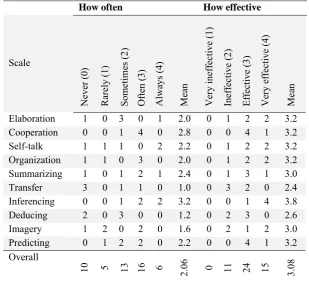
Distribution of SBI scores on the questionnaire
How often How effective
Scale Neve r (0 ) Rarely (1 ) So metimes (2 ) O ften (3) Alwa ys (4 ) Mea n Very i neffective (1) Ine ffective ( 2) Ef fectiv e (3 ) Ver y e ffective (4 ) Mea n
Elaboration 1 0 3 0 1 2.0 0 1 2 2 3.2 Cooperation 0 0 1 4 0 2.8 0 0 4 1 3.2 Self-talk 1 1 1 0 2 2.2 0 1 2 2 3.2 Organization 1 1 0 3 0 2.0 0 1 2 2 3.2 Summarizing 1 0 1 2 1 2.4 0 1 3 1 3.0 Transfer 3 0 1 1 0 1.0 0 3 2 0 2.4 Inferencing 0 0 1 2 2 3.2 0 0 1 4 3.8 Deducing 2 0 3 0 0 1.2 0 2 3 0 2.6 Imagery 1 2 0 2 0 1.6 0 2 1 2 3.0 Predicting 0 1 2 2 0 2.2 0 0 4 1 3.2 Overall
10 5 13 16 6 2.06 0 11 24 15 3.08
SBI: Strategy-based Instruction
As shown in Table 3, teachers’ stated practices of SBI varied regarding how often each listening strategy was prompted or taught. Except the three strategies of transfer, deducing and imagery, the mean of all strategies was equal to or higher than the midpoint of the scale (Mean≥2). As can be seen, also the overall mean was 2.06 which shows that the teachers sometimes encourage their students to use these listening strategies. The highest mean score was 3.2 for inferencing strategy. That is, the teachers stated that they encourage their students to use this strategy more often.
mean of all strategies was equal to or higher than three (Mean≥3). That is, the strategies are mostly perceived by the teachers as effective. Besides, inferencing was recognized the most effective strategy by the teachers (Mean=3.8).
Table 4.
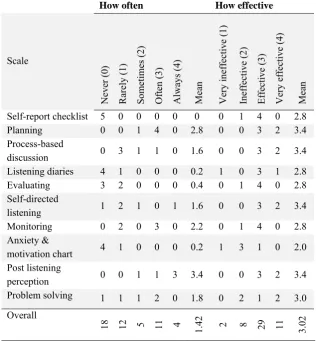
Distribution of MCI scores on the questionnaire
How often How effective
Scale Neve r (0 ) Rarely (1 ) So metimes (2 ) O ften (3) Alwa ys (4 ) Mea n Very i neffective (1) Ine ffective ( 2) Ef fectiv e (3 ) Ver y e ffective (4 ) Mea n
Self-report checklist 5 0 0 0 0 0 0 1 4 0 2.8 Planning 0 0 1 4 0 2.8 0 0 3 2 3.4 Process-based
discussion 0 3 1 1 0 1.6 0 0 3 2 3.4 Listening diaries 4 1 0 0 0 0.2 1 0 3 1 2.8 Evaluating 3 2 0 0 0 0.4 0 1 4 0 2.8 Self-directed
listening 1 2 1 0 1 1.6 0 0 3 2 3.4 Monitoring 0 2 0 3 0 2.2 0 1 4 0 2.8 Anxiety &
motivation chart 4 1 0 0 0 0.2 1 3 1 0 2.0 Post listening
perception 0 0 1 1 3 3.4 0 0 3 2 3.4 Problem solving 1 1 1 2 0 1.8 0 2 1 2 3.0 Overall
18 12 5 11 4 1.42 2 8 29 11 3.02
MCI: Metacognitive Instruction
MCI practices were rarely or, at best, sometimes done. An exception was the ‘post listening perception’ that was stated to be done more often.
Also, regarding the teachers' perceptions of how effective MCI is, we can see that with some exceptions the majority of the practices are mostly perceived by the teachers as effective. One exception was the use of ‘anxiety and motivation charts' that was perceived by the teachers the least effective or somewhat ineffective (Mean=2).
Results for the Second Research Question
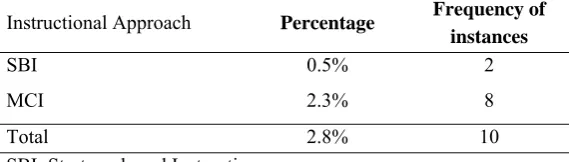
In this section, the results obtained from the classroom observations are presented quantitatively and descriptively with example quotes from the transcriptions of the teachers’ verbal output. Table 5 shows the teachers’ actual classroom practices of SBI and MCI.
Table 5.
Teachers’ Actual Classroom Practices
Instructional Approach Percentage Frequency of instances
SBI 0.5% 2
MCI 2.3% 8
Total 2.8% 10
SBI: Strategy-based Instruction MCI: Metacognitive Instruction
solving afterward. Although planning is one stage of MCI, it is not sufficient to meet the aims of the metacognitive pedagogical sequence if it is done once or without subsequent monitoring or verification.
A large proportion of the teachers' actual practices apart from the 2.8% process-oriented practices included question-answer from the listening. The questions ranged from very detailed questions to questions about the main idea of the listening. There were also instances of questions about students' personal views on the topic of the listening. Here is an example of a question-answer chain after listening which includes very detailed questions asked by Teacher 2.
T: Here we are going to listen to a conversation between some friends. Let’s listen to the conversation.
---Listening played for the first time---
T: So how many people are talking together? S: ...
T: What are the names of those people? S: ...
T: What happens at first? Who starts speaking? And who comes to the office first?
S: ...
T: Who comes to Allie’s office? S: ...
T: Who was Nicole? S: ...
T: What about Mark? Why is Mark in the office?
Some teachers also started with general questions after listening for the first time and then repeated the listening to ask further detailed questions. Here is an example from Teacher 4.
S: ...
T: How did she learn the techniques? S: ...
S: ...
T: Listen again and answer the first one
To sum up, As the quantification of the process-oriented instances and the overall classroom practices of the teachers showed, the listening instruction was limited to listening to an audio followed by comprehension questions. It also included discussions related to the topic of the listening to encourage students to communicate. Under this account, it can be seen that there is a lack of process orientation to teach listening.
Discussion
The findings of this study reveal Iranian EFL teachers’ stated practices, their perceptions of how effective those practices are, and their actual classroom practices regarding process-oriented listening instruction which is commonly characterized by SBI and MCI.
The stated practices of the teachers show that SBI practices are sometimes incorporated. That is, the teachers sometimes encourage their students to use listening strategies. The reported practices of the teachers also show that MCI practices are rarely or at best sometimes incorporated. In general, the teachers' stated practices are expressions of relative but insufficient use of process-oriented approaches (SBI & MCI). This is in agreement with Graham, Santos, and Francis-Brophy (2014), who reported in their study that teachers’ stated practices did not indicate their recognition of the importance of metacognitive strategies.
techniques to serve as useful means for overall listening development (e.g., Cross, 2009; Goh and Taib, 2006; Vandergrift & Tafaghodtari, 2010).
Regarding the actual classroom practices of the teachers, as revealed by the observation, there was a definite lack of process-oriented listening instruction. This finding corresponds to a few research studies reporting results from classroom observation of listening. For instance, Siegel (2013) said that process-oriented techniques that are new to listening methodology occurred less often. Sebina and Arua (2014) also reported that junior secondary school teachers in Botswana did not focus on process, instead, they asked their students to answer comprehension questions based on what they had listened to. Likewise, Liao and Yeldham (2015) reported the dominance of a test-oriented approach rather than a process-oriented approach among the Taiwanese high school teachers. Taken together, these findings show that little time is allocated to teaching about the process of listening and how to listen (Goh, 2010).
Meanwhile, it is noteworthy to mention two pedagogical implications derived the result. First, it became clear to some extent, that the teachers were not successful at prioritizing process-oriented practices in the classroom although they perceived them as valid. The reason for this might be, as Siegel (2013) argues, teachers’ lack of pedagogic knowledge and resources about process-oriented listening instruction. Thus, it is important that teachers be pedagogically trained, have access to new research articles, and also receive the resources they need to accomplish their work. Doubtlessly, teachers’ critical self-inquiry on how to teach listening is also necessary because according to Lazaraton and Ishihara (2005), teachers' examination of their perceptions and practices may prompt more informed instructional decisions which lead to newer and more consistent practices.
the textbook. In effect, the lack of a process-orientation in teachers’ actual classroom practices can be attributed to the listening materials in the textbook that are devoid of a strategy-based approach and a metacognitive focus. Ableeva and Stranks (2013), state that listening materials although provide a wide range of opportunities to listen, they overemphasize product-oriented listening activities to the detriment of process-oriented ones.
To improve the current situation of teaching listening, teachers should be informed of their pedagogical perceptions and practices. The role of teacher educators is significant in this regard. Teacher educators can plan training sessions to equip teachers with techniques and resources in teaching listening with a strategy-based and metacognitive focus. They can evaluate student teachers' practicum performance and highlight differences between the kinds of instructional decisions that student teachers make while teaching listening (Loughran & Berry, 2005). Furthermore, material developers can create age-specific activities that activate learners' strategy use and provide metacognitive learning opportunities both within and beyond classroom context.
This study investigated Iranian EFL teachers' stated and actual practices of process-oriented listening instruction through a small-scale case study using a small number of teachers in a specific context Therefore, it can be surmised that the results of the present research can be barely be generalizable. Meanwhile, in spite of the fact that the questionnaire items were revised and modified based on the pilot study results and the two language instructors’ comments, their validity was not tested through statistical processes.
for future research is to explore teachers’ perceptions of process-oriented listening instruction along with those of the learners. In particular, it is instructive to explore areas in which teachers and learners' perceptions of process-oriented listening instruction converge. Moreover, evaluating EFL textbooks regarding how much they facilitate strategy-based and metacognitive instruction seems to be a promising line of research. Last, but not least, it also seems necessary to conduct a large-scale study with more participants including a wide range of teachers from pre-service to those with the most experience.
Conclusion
The primary goal of the study was to explore Iranian EFL teachers' stated and actual classroom practices of process-oriented listening instruction. The case study results obtained yield some evidence that little time is allocated to teaching about ‘learning to listen.' In other words, very little of the research regarding the process-oriented teaching of listening has been transformed into classroom practices of the teachers who participated in this study. Meanwhile, the study shed light on areas in which EFL teachers' practices need improvement. Typically, the listening portion of the classrooms does not have the element of teaching as such, but it has a lot of testing including comprehension questions being asked in forms like multiple choice, true/false, or open-ended questions.
References
Ableeva, R., & Stranks, J. (2013). Listening to another language– research and materials. In B, Tomlinson (Ed.), Applied linguistics and materials development (pp. 199-211). London: Bloomsbury.
Cross, J. D. (2009). Effects of listening strategy instruction on news videotext comprehension. Language Teaching Research, 13(2),
151-176.
Cross, J., & Vandergrift, L. (2015). Guidelines for designing and conducting L2 listening studies. ELT Journal, 69(1), 86-89.
Dörnyei, Z. (2007). Research methods in applied linguistics: Quantitative, Qualitative, and mixed methodologies. Oxford:
Oxford University Press.
Field, J (2008). Listening in the Language Classroom. Cambridge:
Cambridge University Press.
Flavell, J. H. (1976). Metacognitive aspects of problem-solving. In L. B. Resnick (Ed.), The Nature of Intelligence (pp. 231-235). Hillsdale, NJ:
Erlbaum.
Flavell, J. (1979). Metacognition and cognitive monitoring: A new era of cognitive developmental inquiry. American Psychologist, 34, 906–
911.
Flowerdew, J., & Miller, L. (2005). Second language listening: Theory and practice. Cambridge: Cambridge University Press.
Goh, C. (1997). Metacognitive awareness and second language listeners.
ELT Journal, 51(4), 361-369.
Goh, C. (2008). Metacognitive instruction for second language listening development theory, practice and research implications. RELC Journal, 39(2), 188-213.
Goh, C. (2010). Listening as process: learning activities for self-appraisal and self-regulation. In N. Harwood (Ed.), English language teaching materials: Theory and practice (pp. 179-206). Cambridge:
Goh, C., & Taib, Y. (2006). Metacognitive instruction in listening for young learners. ELT Journal, 60(3), 222-232.
Graham, S., & Macaro, E. (2008). Strategy instruction in listening for lower intermediate learners of French. Language Learning, 58(4),
747–783.
Graham, S., Santos, D., & Vanderplank, R. (2008). Listening comprehension and strategy use: A longitudinal exploration.
System, 36(1), 52–68.
Graham, S., Santos, D., & Vanderplank, R. (2011). Exploring the relationship between listening development and strategy use.
Language Teaching Research, 15(4), 435–456.
Graham, S., Santos, D., & Francis-Brophy, E. (2014). Teacher beliefs about listening in a foreign language. Teaching and Teacher Education, 40, 44-60.
Graham, S. (2017). Research into practice: Listening strategies in an instructed classroom setting. Language Teaching, 50(1), 107-119.
Latifi, M., Tavakoli, M., & Dabaghi, A. (2014). The effect of Metacognitive Instruction on improving listening comprehension ability of Intermediate EFL Learners. International Journal of Research Studies in Language Learning, 3(6), 67-78.
Lazaraton, A., & Ishihara, N. (2005). Understanding Second Language Teacher Practice Using Microanalysis and Self‐Reflection: A Collaborative Case Study. The Modern Language Journal, 89(4),
529-542.
Liao, C. Y. W., & Yeldham, M. (2015). Taiwanese high school EFL teachers’ perceptions of their listening instruction. The Asian Journal of Applied Linguistics, 2(2), 92-101.
Loughran, J., & Berry, A. (2005). Modelling by teacher educators.
Teaching and teacher education, 21(2), 193-203.
Mareschal, C. (2007). Student perceptions of a self-regulatory approach to second language listening comprehension development.
(Unpublished doctoral dissertation). University of Ottawa, Canada. Mendelsohn, D. (1994). Learning to listen. San Diego, CA: Dominie
Press.
Mendelsohn, D. (2006). Learning how to listen using learning strategies. In E. Uso-Juan & A. Martinez-Flor (Eds.), Current trends in the development and teaching of the four language skills (pp. 75–89).
Berlin: Mouton de Gruyter.
O'Malley, J. M., & Chamot, A. U. (1990). Learning strategies for second language acquisition. Cambridge: Cambridge University Press.
Paris, S. G., & Winograd, P. (1990). How metacognition can promote academic learning and instruction. In B. F. Jones & L. Idol (Eds.),
Dimensions of thinking and cognitive instruction (pp. 15–51).
Hillsdale, NJ: Erlbaum.
Rahimi, M., & Katal, M. (2013). The impact of metacognitive instruction on EFL learners’ listening comprehension and oral language proficiency. Journal of Teaching Language Skills, 5(2), 69-90.
Rost, M. (2002). Teaching and researching listening. UK: Longman.
Sebina, B., & Arua, A. E. (2014). From Perception and Knowledge to Classroom Practice: Teaching Listening Comprehension to Setswana
Speakers of English in Junior Schools in Botswana. International Journal of Listening, 28, 1-18.
Siegel, J. (2013). Exploring L2 listening instruction: examinations of practice. ELT Journal, 68(1), 22-30.
Tsui, A. B.M. (2003). Understanding Expertise in Teaching. Cambridge:
Cambridge University Press.
Vandergrift, L. (2003). Orchestrating strategy use: Toward a model of the skilled second language listener. Language Learning, 53(3), 463–
496.
Vandergrift, L. (2007). Recent developments in second and foreign language listening comprehension research. Language Teaching, 40(3), 191-210.
Vandergrift, L. (2010). Researching listening to applied linguistics. In B. Paltridge & A. Phakiti (Eds.), Companion to research methods in applied linguistics (pp. 160-173). London: Continuum.
Vandergrift, L., & Tafaghodtari, M. H. (2010). Teaching L2 learners how to listen does make a difference: An empirical study. Language Learning, 60(2), 470-497.
Vandergrift, L., & Goh, C. C. (2012). Teaching and learning second language listening: Metacognition in action. New York:
Routledge.
Wenden, A. (1987). Metacognition: An expanded view of the cognitive abilities of L2 learners. Language Learning, 37(4), 573–594.
Yeldham, M., & Gruba, P. (2016). The development of individual learners in an L2 listening strategies course. Language Teaching Research, 20(1), 9-34.
Yeldham, M. (2016). Second Language Listening Instruction: Comparing a Strategies‐Based Approach With an Interactive, Strategies/Bottom‐Up Skills Approach. TESOL Quarterly, 50(2),
Appendix: Questionnaire Items Strategy-based Instruction (SBI) Items
1 I encourage my students to link ideas contained in the
listening or integrate new ideas with known information. Elaboration
2
I encourage my students to work with peers to solve a problem, check notes, or get feedback on a listening activity.
Cooperation
4
I encourage my students to find and apply a strategy to reduce their anxiety about a listening task. For example, talking to themselves.
Self-talk
7
I encourage my students to group and classify words or concepts according to their meanings or grammatical features.
Organization
9
I encourage my students to intermittently summarize what they hear to ensure the information has been retained.
Summarizing
10 I encourage my students to use known linguistic
information to facilitate a new listening task. Transfer
11
I encourage my students to use information in text to guess the meaning of the new words or find answers to their questions.
Inferencing
15 I encourage my students to apply rules to the
understanding of the listening input. Deducing
17
I encourage my students to use visual images (either generated or actual) to understand and remember new verbal information.
Imagery
19
Before listening, I encourage my students to predict the type of information and the possible words they may hear in the listening.
Predicting
Metacognitive Instruction (MCI) Items
3 I give my students a checklist to self-report their feelings, difficulties, strategies, etc. related to listening.
Self-report checklist
5
I conduct a group work/whole class brainstorming activity asking my students to predict what they will hear in the listening.
Planning
6
I conduct a class discussion or small group discussions in which my students discuss ways of solving listening problems, improving listening proficiency and strategy
use.
8
I encourage my students to keep a listening diary in which they think aloud (i.e., list listening skills they learned, difficulties they had and strategies or solutions they will use in future, etc.)
Listening diaries
12
After listening, I encourage my students to think back to how they listened and about what might do differently next time.
Evaluating
13
I assign listening homework for my students and guide them to set goals, prepare to listen, evaluate themselves and prepare how to listen next time.
Self-directed listening
14
I encourage my students to continually monitor their comprehension while listening (e.g., check if their predictions are correct)
Monitoring
16
I ask my students to draw diagrams to show changes in their anxiety and motivation levels for various listening tasks they do in and outside of class.
Anxiety & motivation chart
18
After listening for a required number of times, I select a segment of the listening and identify language features (word forms, pronunciation, stress, etc.) that seems difficult for students.
Post-listening perception
20
I encourage my students to solve their listening problems by the help of their background knowledge or experience, the context of listening and their peers.