An Evaluation of Effective mass (m
*/m
o) of Electron in n
Inversion Layer (2D-electron gas)
PRASANT KUMAR SINGH,SHYAMJEE MISHRA1 and L. K. MISHRA
Department of Physics,
Magadh University, Bodh-Gaya-824234, Bihar, India 1
Department of Physics, M. V. College, Buxar, Bihar, India.
(Received on : January 29, 2012)
ABSTRACT
Using two theoretical models (Ando formalism and Vinter formalism) an evaluation of effective mass (m*/mo) of electron as
a function of Ns (concentration of electrons) in n-channel
inversion layer has been performed. Our theoretical result of (m*/mo) decreases with Ns as per experimental observation.
However, the theoretical values evaluated from Ando formalism are in better agreement with the experimental data
Keywords: Effective mass, n-channel inversion layer, Quasi-particle, Electron Concentration.
INTRODUCTION
In this paper, we have presented the method of evaluation of effective mass (m*/mo) as a function of concentration of electron in n-channel inversion layer Ns. Inversion layer is a two-dimensional system. As we know that in two dimensional system, electrons are confined to move within a plane placed in vacuum, the Fourier transform V (q) of electron-electron interaction is given by 2πe/qis contrast to
4πe/qin three dimension.
The electron-electron interaction affects various properties of the
two-dimensional electron gas. Among them are the quasi-particle properties such as effective mass and the g factor. These quantities have attracted much attention because these are directly observable experimentally. The g-factor was first obtained by Fang and Stiles1 in n-channel inversion layer on Si (100) and was found to be enhanced from the bulk value close to 2. Smith and Stiles2 determined the effective mass in the same system and showed that effective mass first enhanced then decreased with the electron concentration.
with Landau Fermi liquid theory3 in which the so-called f function players a central role. Random phase approximation4 has been used to calculated f-function as a function of electron concentration. In this approximation the quasi particle energy of an electron with a spin (±1) and valley index v is obtained from the total energy by taking the functional derivative with respect to the Fermi function. The quasi particle energy is related with the Green’s function and the dielectric function is obtained by further taking propagator πq, ω. The f function is obtained by further taking the functional derivative of quasi particles energy with respect to Femi derivation function. One obtains
and
with respect to f function.
Such scheme for two dimensional system was given by Suzuki and Kawamoto5 and Ting, Lee and Quninn.6
m* and g* were also calculated from different approximation schemes.7-14 In these approximation schemes, one treats the self-energy shift to the lower order by screened Culoumb interaction, taking the image effect in the electron-electron interaction by neglecting the dynamical screening and replacing εq, ω by εq, o. One also determines the difference of exchange interactions of up and down spin electron in the vicinity of the Fermi surface where the effective mass is determined by virtual excitation of electron hole pairs and plasmons with wide range of energy. The effective mass were also calculated with the renormalization constant Z which is defined as
Z 1 ,
(1)
Where ΣH, ω is the self-energy evaluated to the lower order in the dynamically screened interaction.
1
Z 1
(2)
The subscripts D and R refer to the results obtained by the Dyson equation8 and Rice’s approximation9 written in the following equation respectively
Ek εk Σk, ε k
(3a)
and
Ek εk Σk, E k
(3b) with
εk ħ
(3c)
Since Z varies from 0.3 to 0.8 in the density range 1011-1013 cm-2 in the n-channel inversion layer on the Si (100) surface therefore the different between m and m
are important. A density functional formulation15,16 has also been used to calculate the effective mass and the g-factor.
extrapolation of the renormalization factor Z and the single particle effective mass m* to the infinite system size. They showed that in the range 1≤ rs ≤ 10, one gets a lower renormalztion factor Z and the higher effective mass m*>m compared to the perturbative random phase approximation value.18,19 Here r πna2B"
is the Wigner-Seitz density parameter, n is the density and a ħ/me is the Bohr radius. Similar type of calculation was also performed by R. Asgari and B. Tanatar.20 They calculated many body effective mass as a function of rs for 0(rs≤8) for quasi two dimensional electron as (Q2D) confined in a GaAs/A1GaAs triangular quantum well. Their results show that effective mass enhancement is smaller in the Dyson equation calculation than in the OSA (On Shell Approximation). When results, were compared with the experimental data of Tan et al.21,22 our draws the following conclusions:
(a) RPA and the local field factors beyond the RPA are similar in the weak coupling (rs≤1).
(b) Theoretical calculations in the strong coupling region are not so close to experimental data.
De Palo et.al23 have a similar calculations in the same range of coupling strengths.
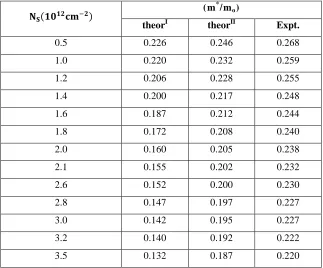
In this paper, we have evaluated (m*/m0) of electrons as a function of Ns (concentration of electrons in n-channel inversion layer). We have used two theoretical formalism (Ando formalism) and (Vinter formalism). Experimental results show that (m*/m0) of electron decrease with Ns. The evaluated results in both formalism indicate that (m*/m0) decrease with Ns.
However, the value calculated under Ando formalism are in better agreement with the experimental data.
2.0 Mathematical Formula used in the Evaluation
One starts with the quasi particle enerty24,25 E k of an electron with a spin σ (±1) and valley index v
E୴k εk 2πi dω εq, ω GVq ୴ k q, εk ω
୯
(4)
with ε(k) = ħk/2m. Green function is given by
G k, E
(5)
n (k) is the Fermi distribution function. ε q, ω is the dielectric function, given by
ε q, ω 1 Vq Π q, ω
(6)
with
Π q, ω ∑ ୢ
ଶ୧∑ G୴ ሺሻk, EG
୴
ሺሻk q, E ω
୩ ୴
(7)
Vq (2πe
k)
* + Fq
(8)
where
k) k) k)/2
(9)
Here k) is the dielectric constant of
semiconductor and k) is that of insulator.
space is filled with semiconducting medium and other half z<0 is filled with insulating medium.
F (q) is the form factor given by26
Fq
dzgzgz 1 ౩
౩ౙ e
|ᇲ
|
1 ౩
౩ౙ e
|ᇲ
|
(10)
g (z) is the charge distribution for inversion27
gz
z
e
(11)
Where b is the adjustable parameter. The Landau f-function is obtained by taking the functional derivative of equation (4) with respect to nk1!
f;ᇲᇲk, k fk, k δᇲδᇲfk, k (12)
Then one gets m
m 1
m
2πħ dθf;ᇲᇲθcosθ
ᇲ ᇲ
(13) and
g
g 1
m
2πħ2 dθfℓθ 14
Where fθ fk1, k1! with k = k' = kF and k.k '= kF2cosθ. The effective mass m* and effective g factor g* are defined as usual by
ħ
E6k|#
(15)
with
Ek$ Ek$
1
2 g 8 σµH 16
H is a weak magnetic field and µ is the
Bohr magneton.
In the density function formalism15,16 the quasi particle effective mass is given by
כ
భ dz
כ; ౦ nz dznz (17)
Where m*(z (z);z) is the effective mass of the homogeneous three dimensional electron gas mop is an isotropic mass defined by
m%& 2m'
m ( 3 * (18)
mt and ml are transverse and longitudinal mass respectively.
One also calculates effective mass of 2D electron gas by calculating quasi particle excitation energy δε)* (k) which is
the quasi particle energy measured from the chemical potential μ of the interacting system by solving self-consistency the Dyson equation.28,29
δεQP εK ω ω δε R
rel
QP
K R k K
( )= +
∑
( , ) / = ( ) /hWhere
R R k R R k k
rel rel
F rel
( , )ω =
∑
( , )ω − ( , )∑
∑
0(19)
This is called on shell approximation (OSA). Once the QP (quasi particle) excitation energy is known, the effective mass m*(k) can be calculated by means of the relationship ħ + + (20)
Table T1
An Evaluated results of effective mass (m*/mo) of electron in n-channel inversion layer on Si (100)
surface as a function of concentration of electron in the inversion layer NS. The calculation has been
performed with the help of two theoretical models theorI and theorII and are compared with experimental results
ۼ܁ሺ
܋ܕି
ሻ (m
* /mo)
theorI theorII Expt.
0.5 0.226 0.246 0.268
1.0 0.220 0.232 0.259
1.2 0.206 0.228 0.255
1.4 0.200 0.217 0.248
1.6 0.187 0.212 0.244
1.8 0.172 0.208 0.240
2.0 0.160 0.205 0.238
2.1 0.155 0.202 0.232
2.6 0.152 0.200 0.230
2.8 0.147 0.197 0.227
3.0 0.142 0.195 0.227
3.2 0.140 0.192 0.222
3.5 0.132 0.187 0.220
Table T2
Theoretical results of renormalization function Z and effective mass (m*/mo) calculated from VMC
(Variational quantum Monte Carlo)31 and pertubative RPA calculation32 as a function of rs
rs ZVMC Z RPA (m *
/mo)V M C (m
*
/mo)R P A
1 0.627 0.663 1.267 1.025
3 0.348 0.442 1.398 1.116
5 0.225 0.348 1.547 1.168
8 0.165 0.272 1.686 1.195
Table T3
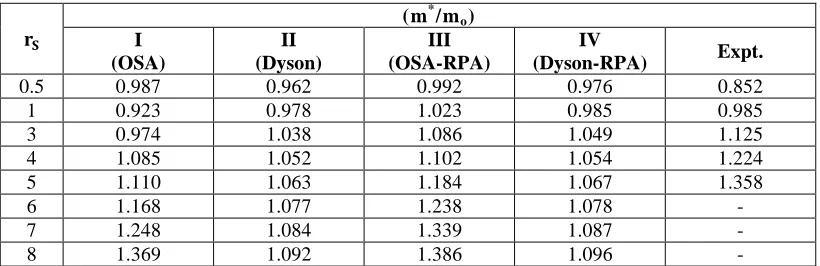
Many-body effective mass (m*/mo) as a function of rs for a Q2D electron gas confined in a
GaAs/AlGaAs triangular quantum well with four theoretical I (OSA), II (Dyson), III (OSA-RPA) and IV (Dyson-RPA). Theoretical results20 were compared with experimental data21,22
ܚ܁
(m*/mo) I
(OSA)
II (Dyson)
III (OSA-RPA)
IV (Dyson-RPA) Expt.
0.5 0.987 0.962 0.992 0.976 0.852
1 0.923 0.978 1.023 0.985 0.985
3 0.974 1.038 1.086 1.049 1.125
4 1.085 1.052 1.102 1.054 1.224
5 1.110 1.063 1.184 1.067 1.358
6 1.168 1.077 1.238 1.078 -
7 1.248 1.084 1.339 1.087 -
8 1.369 1.092 1.386 1.096 -
Table T4
Experimental results of effective mass of electrons or band mass of electron (m*) of two dimensional system32-34
Systems Effective mass or band mass of electron (m*)
HxGa1-x/GaN x = 0.13 0.215 ± 0.006 m0
Undoped AlGaN/GaN hetrostructures 0.2 ± 0.01 m0
Modulation doped In0.65 Ga0.35 As/ n0.52Al0.48As
single quantum well 0.05869 m0
DISCUSSION OF RESULTS
In this paper, we have presented a method of evaluation of effective mass
(m*/mo) of electron in n-channel inversion layer on Si (100) surface as a function of concentration of electrons in the inversion layer NS. The calculation has been performed with the help of two theoretical
evaluated results decreases with NS as per experimental observations. Vinter for formalism (theoI)8,9 is based on a model in which a semiconductor, with a dielectric constant KSC fills the half space z>0 and other half space z<0 is filled with an insulating medium of dielectric constant Kins. Using the dielectric function ε(q,ω)
given by equation (6) one obtains the effective mass equation (13). By computing Eq. (13) as a function of NS, one obtains the values of (m*/mo) as a function of NS shown in table T1. On the other hand the Ando formalism is a density functional formalism. In the density functional formalism the density distribution of an interacting electron gas under an external field can be obtained by a one body Schrödinger type equation containing an exchange correlation potential in addition to the usual Hartree potential and external potential. One can take the exchange correlation potential Uxc. The exchange correlation potential is obtained by a functional derivative of the exchange correlation part of the ground state energy
E,>nR@Ais not known and is replaced by a
product nR@ E,>nR@A in the usual local
approximation where E,n is the
exchange-correlation energy per electron of a uniform electron gas with the density n. In this approximation U, R@ becomes the
exchange-correlation part of the chemical potential µ, of the uniform electron gas. In
the density function formalism the quasi-particle effective mass is given by equation (17) and (18).
In Table2, we have shown the theoretical results of the renormalization factor z and effective mass (m*/mo) calculated from VMC (Variational quantum Monte Carlo)30 and perturbative RPA31
calculations as a function of rs (Winger-Seitz density parameter) in the calculation, it appears that in the range 1 ≤ rs ≤ 10, one
gets a lower renormalization factor Z and a higher effective mass (m*/mo) compared to the perturbative random phase approximation value. In table T3, we have reported32 the many-body effective mass (m*/mo) as a function of rs for a Q2D electron gas confined in a GaAs/AlGaAs triangular quantum well with four theoretical formalism I (OSA), II (Dyson), III (OSA-RPA) and IV (Dyson-(OSA-RPA). Theoretical results20 were compared with the recent experimental data.21,22 After comparison it appears that III (OSA-RPA) and IV (Dyson-RPA) are in right trend with experimental data although the values are quite less. In table T4, we have given experimental results of effective mass or band mass of electrons of some two dimensional systems.33-35 These results show that band mass of electron m*/mo (bare mass) in hetro -structures and quantum well systems. These results are very similar to QMC results36 of 2D electron gas for rs = 1.
REFERENCES
1. F. F. Fang. and P. J. Stiles, JETP Lett. 31,208 (1980).
2. J. L. Smith. and P. J. Stiles, Sov. Phys. JETP, 5,361 (1982).
3. L. D. Landau, Sov. Phys. JETP 3, 920 (1957).
4. P. Nozieres and D. Pines., Phys. Rev. IIL, 442 (1958).
5. M. Suzuki and S. Kawamoto., J. Phys. Soc. Japan 30, 325 (1975).
7. J. F. Janak, Phys. Rev. 178, 1416 (1970). 8. F. J. Olkawa, Surf. Sci. 98,350 (1980). 9. T. M. Rice, Ann. Phys. (N.Y.) 31, 100
(1961).
10. J. Hubbard, Proc. R. Soc. London Ser A 240, 539 (1957).
11. J. Hubbard, Proc. R. Soc. London Ser A 243, 336 (1958).
12. B.K. Lundqvist, Phys. Londons, Mater, 6, 196 (1967).
13. A. W. Overhauser, Phys., Rev. B.18, 2884 (1978).
14. M. B. Pogrebinski, Sov. Phys. Semicond. 31, 372 (1987).
15. B. Vinter, Surf. Sci. 110, 947 (1988). 16. B. Vinter, Surf. Sci. 118, 248 (1990). 17. M. Holtzmann, T. Alm, P. Schuck and
R. Cote., Phys. Rev. B 79, 041308 (R) (2009).
18. H. J. Schulze, P. Schnck and N. Van Giai, Phys. Rev. B 61, 8026 (2000). 19. R. Asgari, B. Davondi, M. Polini, G. F
Giulani M. P. Tosi, and G.Vignale; Phys. Rev. B 71, 045323 (2005).
20. R. Asgari and B. Tanatar, Pramana Journal of Phys. 70, 285 (2008).
21. Y. W. Tan, D. H. Kobe, D. M. Lee, J. O. Sofo and M. Randeria. , Phys. Rev. Lett. (PRL) 94, 016405 (2005).
22. Y. W. Tan, D. H. Kobe, D. M. Lee, J. O. Sofo and M. Randeria., Phys. Rev. B 73,
045334 (2006).
23. S. De. Palo, A. Griffin, A. N. Bloch, R. Minas and R. M. Quick., Phys. Rev. Lett. (PRL) 94, 226405 (2005).
24. T. Ando, A. B. Fowler and F. Stern., Rev. Mod. Phys. 54, 437 (1984).
25. T. Ando, J. Phys. Soc. Japan 5,2978 (1981).
26. F. F. Fang and W. E. Howard, Phys. Rev. 174, 823 (1966).
27. F. F. Fang, A. B. Fowler and A. Hartstein, Surf. Sci. 73, 269 (1978). 28. S. Yarlagadda and G. F. Gialiani, Phys.
Rev. B 61, 12556 (2000).
29. H. M. Bohm and K. Schorkhuser, J. Phys. Condens. Matter 12, 2007 (2000). 30. M. Holtzmann, Phys. Rev. B 68, 046707
(2003).
31. G. F. Giuliani and G. Vignali. ‘Quantum Theory of the electron liquid (Cambridge University Press, Cambridge, 2005). 32. R. Asgari, Phys. Rev. B 74, 155319
(2006).
33. C. R. Elsass, Appl. Phys. Lett. 74, 3528 (1999).
34. A. M. Kurakin, J. Appl. Phys. 105, 073703 (2009).
35. P. N. Hai, Material Science and Engineering 43, 82, 218 (2001).