V
OLUMEN
O.
7
(2017),
I
SSUEN
O.
10
(O
CTOBER)
ISSN
2231-5756
A Monthly Double-Blind Peer Reviewed (Refereed/Juried) Open Access International e-Journal - Included in the International Serial Directories
Indexed & Listed at:
Ulrich's Periodicals Directory ©, ProQuest, U.S.A., EBSCO Publishing, U.S.A., Cabell’s Directories of Publishing Opportunities, U.S.A., Google Scholar, Open J-Gage, India [link of the same is duly available at Inflibnet of University Grants Commission (U.G.C.)],
Index Copernicus Publishers Panel, Poland with IC Value of 5.09 (2012) & number of libraries all around the world.
V
OLUMEN
O.
7
(2017),
I
SSUEN
O.
10
(O
CTOBER)
ISSN
2231-5756
INTERNATIONAL JOURNAL OF RESEARCH IN COMMERCE, IT & MANAGEMENT
CONTENTS
Sr.
No.
TITLE & NAME OF THE AUTHOR (S)
Page
No.
1
.
POSITIVE MENTAL ATTITUDE: LEARNING FROM THE LIFE OF SWAMI VIVEKANAND: A DESCRIPTIVE STUDY
JASPREET BAJAJ, Dr. ANJU AHUJA & Dr. MARKANDAY AHUJA
1
2
.
REVIVAL OF INDIAN ECONOMY THROUGH RECONSTITUTION OF INFRASTRUCTURE DEVELOPMENT IN INDIA
Dr. RAJA ROY CHOUDHURY, MRUNAL ARUN MULE & Dr. VIJETA CHAUDHARY
5
3
.
MANAGING CAREER ASPIRATIONS – A CONCEPTUAL INSIGHT
SOUMYA PRAKASH B S & Dr. MANASA NAGABHUSHANAM
8
4
.
ECONOMIC IMPACT OF FINANCIAL INCLUSION ON FARMERS IN SOUTH GUJARAT REGION
DHARMESH U THAKOR & Dr. RAMAKANTA PRUSTY
11
5
.
PROSPECTS OF SPECIAL ECONOMIC ZONES IN INDIAN ECONOMY: A COMPARATIVE STUDY
VIVEK SHUKLA & Dr. SOMESH KUMAR SHUKLA
16
6
.
EXAMINING MEDIATING EFFECT OF TRUST BETWEEN STORE IMAGE AND LOYALTY IN GROCERY SPECIALTY
STORES IN HYDERABAD
ISHFAQ HUSSAIN BHAT & Dr. SAPNA SINGH
24
7
.
ENSURING QUALITY AND EXCELLENCE IN INSTITUTIONS OF HIGHER LEARNING WITH SPECIAL REFERENCE
TO THE STATE OF ODISHA
Dr. RASHMI MISHRA
27
8
.
HUMAN RESOURCE INFORMATION SYSTEM, HUMAN RESOURCE PERFORMANCE AND MODERATING
EFFECT OF NATIONAL AND INTERNATIONAL BANKS OF BANK EMPLOYEES IN QATAR
Dr. RENJU MATHAI & Dr. A. THANGARAJA
34
9
.
AN ASSESSMENT OF PRODUCTIVE EFFICIENCY OF THE SELECT PRIVATE SECTOR NON-BANKING FINANCE
COMPANIES IN INDIA
Dr. N. DEEPA & Dr. V. THILAGAVATHI
39
10
.
IMPACT OF CAPITAL STRUCTURE ON PROFITABILITY OF PHARMACEUTICAL SECTOR IN INDIA - AN
EMPIRICAL STUDY
Dr. GURMEET SINGH & KOMAL B SIDHNANI
44
11
.
AN ANALYSIS OF DEVELOPMENT EXPENDITURE DURING THE PRE REFORM AND POST REFORM PERIOD IN
INDIA
Dr. P. NATARAJAN & S. RAJARAJESWARI
49
12
.
IMPACT OF ADVERTISEMENT AMONG CONSUMERS ON GOLD JEWELLERY PURCHASE IN COIMBATORE CITY
V.VIDHYA & Dr. S. P. VIJAYAKUMAR
53
13
.
TRUST IN FINANCIAL MOBILE APPS – A PARTIAL LEAST SQUARE REGRESSION APPROACH
Dr. K.UMA DEVI
59
14
.
RELEVANCE OF E-COMMERCE IN MODERN BUSINESS SCENARIO: A STUDY
Dr. ANIRUDDHA SARKAR
62
15
.
EFFECTS OF TECHNOLOGICAL CHANGES IN THE PERFORMANCE OF HR DEVELOPMENT
Dr. A. VENNILA
68
16
.
AN INQUIRY INTO IMPACT OF TQM IMPLEMENTATION ON EMPLOYEE PERFORMANCE AT WORKING IRON
AND STEEL FIRMS OF KARNATAKA
K C PRASHANTH
71
17
.
JOB SATISFACTION OF BANK EMPLOYEES – AN INVESTIGATION INTO THE RELATIONSHIP WITH THEIR
ATTITUDE TOWARDS CHANGE
KAMAL RAJ MOHAN
77
18
.
THE IMPACTS OF NPA ON INDIAN ECONOMY
GHEESA LAL & Dr. MANISH BADLANI
80
19
.
UNDERSTANDING GST THROUGH COMPARISON WITH PREVIOUS INDIRECT TAXATION SYSTEM
GUNEEV BRAR
85
20
.
PRODUCT PERFORMANCE OF LIFE INSURANCE COMPANIES IN INDIA: A LITERATURE REVIEW AFTER 2000
Dr. SASMITA SAHOO
89
V
OLUMEN
O.
7
(2017),
I
SSUEN
O.
10
(O
CTOBER)
ISSN
2231-5756
INTERNATIONAL JOURNAL OF RESEARCH IN COMMERCE, IT & MANAGEMENT
CHIEF PATRON
Prof. (Dr.) K. K. AGGARWAL
Chairman, Malaviya National Institute of Technology, Jaipur
(An institute of National Importance & fully funded by Ministry of Human Resource Development, Government of India)
Chancellor, K. R. Mangalam University, Gurgaon
Chancellor, Lingaya’s University, Faridabad
Founder Vice-Chancellor (1998-2008), Guru Gobind Singh Indraprastha University, Delhi
Ex. Pro Vice-Chancellor, Guru Jambheshwar University, Hisar
FOUNDER PATRON
Late Sh. RAM BHAJAN AGGARWAL
Former State Minister for Home & Tourism, Government of Haryana
Former Vice-President, Dadri Education Society, Charkhi Dadri
Former President, Chinar Syntex Ltd. (Textile Mills), Bhiwani
FORMER CO-ORDINATOR
Dr. S. GARG
Faculty, Shree Ram Institute of Business & Management, Urjani
ADVISOR
Prof. S. L. MAHANDRU
Principal (Retd.), Maharaja Agrasen College, Jagadhri
EDITOR
Dr. R. K. SHARMA
Professor & Dean, Bharti Vidyapeeth University Institute of Management & Research, New Delhi
CO-EDITOR
Dr. BHAVET
Faculty, Shree Ram Institute of Engineering & Technology, Urjani
EDITORIAL ADVISORY BOARD
Dr. S. P. TIWARI
Head, Department of Economics & Rural Development, Dr. Ram Manohar Lohia Avadh University, Faizabad
Dr. CHRISTIAN EHIOBUCHE
Professor of Global Business/Management, Larry L Luing School of Business, Berkeley College, USA
Dr. SIKANDER KUMAR
Chairman, Department of Economics, Himachal Pradesh University, Shimla, Himachal Pradesh
Dr. JOSÉ G. VARGAS-HERNÁNDEZ
Research Professor, University Center for Economic & Managerial Sciences, University of Guadalajara,
Guadala-jara, Mexico
Dr. M. N. SHARMA
Chairman, M.B.A., Haryana College of Technology & Management, Kaithal
Dr. TEGUH WIDODO
Dean, Faculty of Applied Science, Telkom University, Bandung Technoplex, Jl. Telekomunikasi, Indonesia
Dr. M. S. SENAM RAJU
Professor, School of Management Studies, I.G.N.O.U., New Delhi
Dr. D. S. CHAUBEY
Professor & Dean, Research & Studies, Uttaranchal University, Dehradun
Dr. CLIFFORD OBIYO OFURUM
Professor of Accounting & Finance, Faculty of Management Sciences, University of Port Harcourt, Nigeria
Dr. KAUP MOHAMED
V
OLUMEN
O.
7
(2017),
I
SSUEN
O.
10
(O
CTOBER)
ISSN
2231-5756
INTERNATIONAL JOURNAL OF RESEARCH IN COMMERCE, IT & MANAGEMENT
Dr. VIRENDRA KUMAR SHRIVASTAVA
Director, Asia Pacific Institute of Information Technology, Panipat
SUNIL KUMAR KARWASRA
Principal, Aakash College of Education, ChanderKalan, Tohana, Fatehabad
Dr. MIKE AMUHAYA IRAVO
Principal, Jomo Kenyatta University of Agriculture & Tech., Westlands Campus, Nairobi-Kenya
Dr. SYED TABASSUM SULTANA
Principal, Matrusri Institute of Post Graduate Studies, Hyderabad
Dr. BOYINA RUPINI
Director, School of ITS, Indira Gandhi National Open University, New Delhi
Dr. NEPOMUCENO TIU
Chief Librarian & Professor, Lyceum of the Philippines University, Laguna, Philippines
Dr. SANJIV MITTAL
Professor & Dean, University School of Management Studies, GGS Indraprastha University, Delhi
Dr. ANA ŠTAMBUK
Head of Department of Statistics, Faculty of Economics, University of Rijeka, Rijeka, Croatia
Dr. RAJENDER GUPTA
Convener, Board of Studies in Economics, University of Jammu, Jammu
Dr. SHIB SHANKAR ROY
Professor, Department of Marketing, University of Rajshahi, Rajshahi, Bangladesh
Dr. ANIL K. SAINI
Professor, Guru Gobind Singh Indraprastha University, Delhi
Dr. SRINIVAS MADISHETTI
Professor, School of Business, Mzumbe University, Tanzania
Dr. NAWAB ALI KHAN
Professor & Dean, Faculty of Commerce, Aligarh Muslim University, Aligarh, U.P.
MUDENDA COLLINS
Head, Operations & Supply Chain, School of Business, The Copperbelt University, Zambia
Dr. EGWAKHE A. JOHNSON
Professor & Director, Babcock Centre for Executive Development, Babcock University, Nigeria
Dr. A. SURYANARAYANA
Professor, Department of Business Management, Osmania University, Hyderabad
P. SARVAHARANA
Asst. Registrar, Indian Institute of Technology (IIT), Madras
Dr. MURAT DARÇIN
Associate Dean, Gendarmerie and Coast Guard Academy, Ankara, Turkey
Dr. ABHAY BANSAL
Head, Department of Information Technology, Amity School of Engg. & Tech., Amity University, Noida
Dr. YOUNOS VAKIL ALROAIA
Head of International Center, DOS in Management, Semnan Branch, Islamic Azad University, Semnan, Iran
WILLIAM NKOMO
Asst. Head of the Department, Faculty of Computing, Botho University, Francistown, Botswana
Dr. JAYASHREE SHANTARAM PATIL (DAKE)
Faculty in Economics, KPB Hinduja College of Commerce, Mumbai
SHASHI KHURANA
Associate Professor, S. M. S. Khalsa Lubana Girls College, Barara, Ambala
Dr. SEOW TA WEEA
Associate Professor, Universiti Tun Hussein Onn Malaysia, Parit Raja, Malaysia
Dr. OKAN VELI ŞAFAKLI
Associate Professor, European University of Lefke, Lefke, Cyprus
Dr. MOHENDER KUMAR GUPTA
V
OLUMEN
O.
7
(2017),
I
SSUEN
O.
10
(O
CTOBER)
ISSN
2231-5756
INTERNATIONAL JOURNAL OF RESEARCH IN COMMERCE, IT & MANAGEMENT
Dr. BORIS MILOVIC
Associate Professor, Faculty of Sport, Union Nikola Tesla University, Belgrade, Serbia
Dr. LALIT KUMAR
Faculty, Haryana Institute of Public Administration, Gurugram
Dr. MOHAMMAD TALHA
Associate Professor, Department of Accounting & MIS, College of Industrial Management, King Fahd University
of Petroleum & Minerals, Dhahran, Saudi Arabia
Dr. V. SELVAM
Associate Professor, SSL, VIT University, Vellore
Dr. IQBAL THONSE HAWALDAR
Associate Professor, College of Business Administration, Kingdom University, Bahrain
Dr. PARDEEP AHLAWAT
Associate Professor, Institute of Management Studies & Research, Maharshi Dayanand University, Rohtak
Dr. ALEXANDER MOSESOV
Associate Professor, Kazakh-British Technical University (KBTU), Almaty, Kazakhstan
Dr. ASHOK KUMAR CHAUHAN
Reader, Department of Economics, Kurukshetra University, Kurukshetra
YU-BING WANG
Faculty, department of Marketing, Feng Chia University, Taichung, Taiwan
SURJEET SINGH
Faculty, Department of Computer Science, G. M. N. (P.G.) College, Ambala Cantt.
Dr. MELAKE TEWOLDE TECLEGHIORGIS
Faculty, College of Business & Economics, Department of Economics, Asmara, Eritrea
Dr. RAJESH MODI
Faculty, Yanbu Industrial College, Kingdom of Saudi Arabia
Dr. SAMBHAVNA
Faculty, I.I.T.M., Delhi
Dr. THAMPOE MANAGALESWARAN
Faculty, Vavuniya Campus, University of Jaffna, Sri Lanka
Dr. SHIVAKUMAR DEENE
Faculty, Dept. of Commerce, School of Business Studies, Central University of Karnataka, Gulbarga
SURAJ GAUDEL
BBA Program Coordinator, LA GRANDEE International College, Simalchaur - 8, Pokhara, Nepal
FORMER TECHNICAL ADVISOR
AMITA
FINANCIAL ADVISORS
DICKEN GOYAL
Advocate & Tax Adviser, Panchkula
NEENA
Investment Consultant, Chambaghat, Solan, Himachal Pradesh
LEGAL ADVISORS
JITENDER S. CHAHAL
Advocate, Punjab & Haryana High Court, Chandigarh U.T.
CHANDER BHUSHAN SHARMA
Advocate & Consultant, District Courts, Yamunanagar at Jagadhri
V
OLUMEN
O.
7
(2017),
I
SSUEN
O.
10
(O
CTOBER)
ISSN
2231-5756
INTERNATIONAL JOURNAL OF RESEARCH IN COMMERCE, IT & MANAGEMENT
CALL FOR MANUSCRIPTS
We invite unpublished novel, original, empirical and high quality research work pertaining to the recent developments & practices in the areas of Com-puter Science & Applications; Commerce; Business; Finance; Marketing; Human Resource Management; General Management; Banking; Economics; Tourism Administration & Management; Education; Law; Library & Information Science; Defence & Strategic Studies; Electronic Science; Corporate Gov-ernance; Industrial Relations; and emerging paradigms in allied subjects like Accounting; Accounting Information Systems; Accounting Theory & Practice; Auditing; Behavioral Accounting; Behavioral Economics; Corporate Finance; Cost Accounting; Econometrics; Economic Development; Economic History; Financial Institutions & Markets; Financial Services; Fiscal Policy; Government & Non Profit Accounting; Industrial Organization; International Economics & Trade; International Finance; Macro Economics; Micro Economics; Rural Economics; Co-operation; Demography: Development Planning; Development Studies; Applied Economics; Development Economics; Business Economics; Monetary Policy; Public Policy Economics; Real Estate; Regional Economics; Political Science; Continuing Education; Labour Welfare; Philosophy; Psychology; Sociology; Tax Accounting; Advertising & Promotion Management; Management Information Systems (MIS); Business Law; Public Responsibility & Ethics; Communication; Direct Marketing; E-Commerce; Global Business; Health Care Administration; Labour Relations & Human Resource Management; Marketing Research; Marketing Theory & Applications; Non-Profit Or-ganizations; Office Administration/Management; Operations Research/Statistics; Organizational Behavior & Theory; Organizational Development; Pro-duction/Operations; International Relations; Human Rights & Duties; Public Administration; Population Studies; Purchasing/Materials Management; Re-tailing; Sales/Selling; Services; Small Business Entrepreneurship; Strategic Management Policy; Technology/Innovation; Tourism & Hospitality; Transpor-tation Distribution; Algorithms; Artificial Intelligence; Compilers & Translation; Computer Aided Design (CAD); Computer Aided Manufacturing; Computer Graphics; Computer Organization & Architecture; Database Structures & Systems; Discrete Structures; Internet; Management Information Systems; Mod-eling & Simulation; Neural Systems/Neural Networks; Numerical Analysis/Scientific Computing; Object Oriented Programming; Operating Systems; Pro-gramming Languages; Robotics; Symbolic & Formal Logic; Web Design and emerging paradigms in allied subjects.
Anybody can submit the soft copy of unpublished novel; original; empirical and high quality research work/manuscript anytime in M.S. Word format after preparing the same as per our GUIDELINES FOR SUBMISSION; at our email address i.e. [email protected] or online by clicking the link online submission as given on our website (FOR ONLINE SUBMISSION, CLICK HERE).
GUIDELINES FOR SUBMISSION OF MANUSCRIPT
1. COVERING LETTER FOR SUBMISSION:
DATED: _____________
THE EDITOR
IJRCM
Subject: SUBMISSION OF MANUSCRIPT IN THE AREA OF______________________________________________________________.
(e.g. Finance/Mkt./HRM/General Mgt./Engineering/Economics/Computer/IT/ Education/Psychology/Law/Math/other, please specify)
DEAR SIR/MADAM
Please find my submission of manuscript titled ‘___________________________________________’ for likely publication in one of your journals.
I hereby affirm that the contents of this manuscript are original. Furthermore, it has neither been published anywhere in any language fully or partly, nor it is under review for publication elsewhere.
I affirm that all the co-authors of this manuscript have seen the submitted version of the manuscript and have agreed to inclusion of their names as co-authors.
Also, if my/our manuscript is accepted, I agree to comply with the formalities as given on the website of the journal. The Journal has discretion to publish our contribution in any of its journals.
NAME OF CORRESPONDING AUTHOR :
Designation/Post* :
Institution/College/University with full address & Pin Code :
Residential address with Pin Code :
Mobile Number (s) with country ISD code :
Is WhatsApp or Viber active on your above noted Mobile Number (Yes/No) :
Landline Number (s) with country ISD code :
E-mail Address :
Alternate E-mail Address :
Nationality :
V
OLUMEN
O.
7
(2017),
I
SSUEN
O.
10
(O
CTOBER)
ISSN
2231-5756
INTERNATIONAL JOURNAL OF RESEARCH IN COMMERCE, IT & MANAGEMENT
NOTES:
a) The whole manuscript has to be in ONE MS WORD FILE only, which will start from the covering letter, inside the manuscript. pdf. version is liable to be rejected without any consideration.
b) The sender is required to mention the following in the SUBJECT COLUMNof the mail:
New Manuscript for Review in the area of (e.g. Finance/Marketing/HRM/General Mgt./Engineering/Economics/Computer/IT/ Education/Psychology/Law/Math/other, please specify)
c) There is no need to give any text in the body of the mail, except the cases where the author wishes to give any specific message
w.r.t. to the manuscript.
d) The total size of the file containing the manuscript is expected to be below 1000 KB.
e) Only the Abstract will not be considered for review and the author is required to submit the complete manuscript in the first instance.
f) The journal gives acknowledgement w.r.t. the receipt of every email within twenty-four hours and in case of non-receipt of acknowledgment from the journal, w.r.t. the submission of the manuscript, within two days of its submission, the corresponding author is required to demand for the same by sending a separate mail to the journal.
g) The author (s) name or details should not appear anywhere on the body of the manuscript, except on the covering letter and the cover page of the manuscript, in the manner as mentioned in the guidelines.
2. MANUSCRIPT TITLE: The title of the paper should be typed in bold letters, centeredand fully capitalised.
3. AUTHOR NAME (S) & AFFILIATIONS: Author (s) name, designation, affiliation (s), address, mobile/landline number (s), and email/al-ternate email address should be given underneath the title.
4. ACKNOWLEDGMENTS: Acknowledgements can be given to reviewers, guides, funding institutions, etc., if any.
5. ABSTRACT: Abstract should be in fully Italic printing, ranging between 150 to 300 words. The abstract must be informative and eluci-dating the background, aims, methods, results & conclusion in a SINGLE PARA. Abbreviations must be mentioned in full.
6. KEYWORDS: Abstract must be followed by a list of keywords, subject to the maximum of five. These should be arranged in alphabetic order separated by commas and full stop at the end. All words of the keywords, including the first one should be in small letters, except special words e.g. name of the Countries, abbreviations etc.
7. JEL CODE: Provide the appropriate Journal of Economic Literature Classification System code (s). JEL codes are available at www.aea-web.org/econlit/jelCodes.php. However, mentioning of JEL Code is not mandatory.
8. MANUSCRIPT: Manuscript must be in BRITISH ENGLISH prepared on a standard A4 size PORTRAIT SETTING PAPER. It should be free
from any errors i.e. grammatical, spelling or punctuation. It must be thoroughly edited at your end.
9. HEADINGS: All the headings must be bold-faced, aligned left and fully capitalised. Leave a blank line before each heading.
10. SUB-HEADINGS: All the sub-headings must be bold-faced, aligned left and fully capitalised.
11. MAIN TEXT:
THE MAIN TEXT SHOULD FOLLOW THE FOLLOWING SEQUENCE:
INTRODUCTION REVIEW OF LITERATURE
NEED/IMPORTANCE OF THE STUDY STATEMENT OF THE PROBLEM OBJECTIVES
HYPOTHESIS (ES)
RESEARCH METHODOLOGY RESULTS & DISCUSSION
FINDINGS
RECOMMENDATIONS/SUGGESTIONS
CONCLUSIONS LIMITATIONS
SCOPE FOR FURTHER RESEARCH
REFERENCES
APPENDIX/ANNEXURE
V
OLUMEN
O.
7
(2017),
I
SSUEN
O.
10
(O
CTOBER)
ISSN
2231-5756
INTERNATIONAL JOURNAL OF RESEARCH IN COMMERCE, IT & MANAGEMENT
12. FIGURES & TABLES: These should be simple, crystal CLEAR, centered, separately numbered & self-explained, and the titles must be above the table/figure. Sources of data should be mentioned below the table/figure. It should be ensured that the tables/figures are
referred to from the main text.
13. EQUATIONS/FORMULAE: These should be consecutively numbered in parenthesis, left aligned with equation/formulae number placed at the right. The equation editor provided with standard versions of Microsoft Word may be utilised. If any other equation editor is utilised, author must confirm that these equations may be viewed and edited in versions of Microsoft Office that does not have the editor.
14. ACRONYMS: These should not be used in the abstract. The use of acronyms is elsewhere is acceptable. Acronyms should be defined on its first use in each section e.g. Reserve Bank of India (RBI). Acronyms should be redefined on first use in subsequent sections.
15. REFERENCES: The list of all references should be alphabetically arranged. The author (s) should mention only the actually utilised references in the preparation of manuscript and they may follow Harvard Style of Referencing. Also check to ensure that everything that you are including in the reference section is duly cited in the paper. The author (s) are supposed to follow the references as per the following:
•
All works cited in the text (including sources for tables and figures) should be listed alphabetically.•
Use (ed.) for one editor, and (ed.s) for multiple editors.•
When listing two or more works by one author, use --- (20xx), such as after Kohl (1997), use --- (2001), etc., in chronologically ascending order.•
Indicate (opening and closing) page numbers for articles in journals and for chapters in books.•
The title of books and journals should be in italic printing. Double quotation marks are used for titles of journal articles, book chapters, dissertations, reports, working papers, unpublished material, etc.•
For titles in a language other than English, provide an English translation in parenthesis.•
Headers, footers, endnotes and footnotes should not be used in the document. However, you can mention short notes to elucidate some specific point, which may be placed in number orders before the references.PLEASE USE THE FOLLOWING FOR STYLE AND PUNCTUATION IN REFERENCES:
BOOKS
•
Bowersox, Donald J., Closs, David J., (1996), "Logistical Management." Tata McGraw, Hill, New Delhi.•
Hunker, H.L. and A.J. Wright (1963), "Factors of Industrial Location in Ohio" Ohio State University, Nigeria.CONTRIBUTIONS TO BOOKS
•
Sharma T., Kwatra, G. (2008) Effectiveness of Social Advertising: A Study of Selected Campaigns, Corporate Social Responsibility, Edited by David Crowther & Nicholas Capaldi, Ashgate Research Companion to Corporate Social Responsibility, Chapter 15, pp 287-303.JOURNAL AND OTHER ARTICLES
•
Schemenner, R.W., Huber, J.C. and Cook, R.L. (1987), "Geographic Differences and the Location of New Manufacturing Facilities," Jour-nal of Urban Economics, Vol. 21, No. 1, pp. 83-104.CONFERENCE PAPERS
•
Garg, Sambhav (2011): "Business Ethics" Paper presented at the Annual International Conference for the All India Management Asso-ciation, New Delhi, India, 19–23UNPUBLISHED DISSERTATIONS
•
Kumar S. (2011): "Customer Value: A Comparative Study of Rural and Urban Customers," Thesis, Kurukshetra University, Kurukshetra.ONLINE RESOURCES
•
Always indicate the date that the source was accessed, as online resources are frequently updated or removed.WEBSITES
V
OLUMEN
O.
7
(2017),
I
SSUEN
O.
10
(O
CTOBER)
ISSN
2231-5756
INTERNATIONAL JOURNAL OF RESEARCH IN COMMERCE, IT & MANAGEMENT
ENSURING QUALITY AND EXCELLENCE IN INSTITUTIONS OF HIGHER LEARNING WITH SPECIAL REFERENCE
TO THE STATE OF ODISHA
Dr. RASHMI MISHRA
READER IN SOCIOLOGY
NKC CENTRE FOR DEVELOPMENT STUDIES
BHUBANESWAR
ABSTRACT
Education is one of the significant factors instrumental to the development of a country. It should be transformed to the needs of the time and changing scenario of the world. It provides an opportunity to critically reflect upon the social, economic, cultural, moral and spiritual issues facing humanity. India needs more efficient and educated people to drive our economy forward. Higher education in India is undergoing rapid changes. To develop India as an education hub or to become a prosperous partner in global economy, India has to qualitatively strengthen education in general and higher education with research and development in particular. This paper is mainly focused on the higher education system in India with special reference to the state of Odisha. This paper aims to identify emerging issues and challenges in the field of Higher Education.
KEYWORDS
excellence in higher learning institutions, quality of higher learning.
INTRODUCTION
he quest for knowledge, truth and value has been the original reason for the pursuit of education throughout history. Education being a multipurpose process not only inculcates social, economic and cultural awareness in humanity but is also an important medium for grasping and promoting life enhancing values among human beings. The progress in any area of knowledge and expertise has created an interest among nations to scrutinize the educational system in the country’s educational practices. History indicates that the nations of the Far East such as China and Japan influenced by Confucianism and India with a unique system of its own have been in pursuit of knowledge, truth and value since the early days of civilization. Higher Education imparts in-depth knowledge and understanding so as to advance the students to new frontiers of knowledge in different walks of life (subject domains)
Higher Education is of vital importance for the country, as it is a powerful tool to build knowledge based society of the 21st Century. The major challenge India has
after independence is the rapid industrialization of the agricultural based economy. This process required by creating a huge infrastructure in higher and technical education, industries and research laboratories covering a wide range of disciplines and hence creating a pool of talented people who can address the future challenges and making the India a self-reliant nation. Highly skilled people, high quality research and development are required to compete with productive quality of global companies. Under these circumstances, the higher education system should identify the emerging challenges and respond them in a systematic manner. The 12th plan continues to maintain focus on higher education in the country, in order to make it more relevant to the global needs. The knowledge Commission
of India (2005-08) has rightly observed that: “Our system of higher education needs a systematic overhaul, so that India can educate much larger numbers without diluting academic standards. Indeed, this is essential because the transformation of economy and society in the 21st Century would depend on the spread and the
quality of education among our people. It is only an inclusive society that can provide the foundations for a knowledge society. The objectives of reform and change in our higher education system must be expansion, excellence and inclusion”.
The knowledge society’s development is a prerequisite of developed India and for building a knowledge society we need a very good higher education system. Dr. A.P.J. Abdul Kalam, Former President of India, while speaking on capacity building in higher education for the 21st Century (June 27, 2008), observed that-
“The 21st century is about the management of all the knowledge and information we have generated and the value addition we bring to it. We must give our
students the skills with which they find a way through the sea of knowledge that we have created and continue with lifelong learning. Today we have the ability, through technology, to really and truly teach ourselves to become the lifelong learners. This is required for sustained economic development”.
The following are the predominant concepts of higher Education:
• Higher Education as production of qualified human resources. In this view, higher education is seen as a process in which the students are counted as products absorbed in the labour market. Thus higher education becomes input to the growth and development of business and industry.
• Higher Education as training for research career. In this view, higher education is preparation of qualified scientists and researchers who would continuously develop the frontiers of knowledge. Quality within this view is more about research publications and transmission of academic rigour to do quality research. • Higher Education as efficient management of teaching provisions. Many strongly believe that teaching is the core of educational institutions. This higher education institutions focus on efficient management of teaching learning provisions by improving the quality of teaching, enabling higher competition rate among students.
• Higher Education as a matter of extending life chances: It this view higher education is seen as an opportunity to participate in the development processes of individual through a flexible continuing education mode. Interestingly all these four concepts of higher education are not exclusive. If we look at activities, we will realise that teaching, research and extension are three main functions of higher Education.
India’s higher education sector at present faces multiple challenges. It is often characterized by poor quality and unequal access. The access to higher education is low with regional disparities.
THE OBJECTIVES OF HIGHER EDUCATION IN THE STATE
• Provide greater opportunities of access to Secondary and higher education with equity to all the eligible persons and in particular vulnerable section. • Expand access by supporting existing institutions, establishing new institutions, aimed at removing regional and other imbalances that exist at present. • Initiate policies and programmes for strengthening research and innovation and encourage institutions, public or private to engage in stretching the frontiers
of knowledge.
• Promote the quality of higher education by investing in infrastructure and faculty, promoting academic reforms improving governance and institutional restructuring;
• Expand vocational education and skill development
QUALITY ISSUES IN HIGHER EDUCATION IN ODISHA
Although the State of Odisha ranks fairly well in higher education as compared to other states but the expansion of higher education system in the State has been uneven and unplanned. Odisha has a population of 4, 19, 47,358 (census 2011), which gives a density of population of 270 persons (2011) from 236 (2001). Most of the population of the State is concentrated in the rural areas with the urban population constituting only 17 per cent of the total. The sex ratio in the State has improved from 972 to 979 during 2001 to 2011. The SC population constitutes (17.1 %) and ST (22.8%) of the total population. The literacy percentage is 72.9 for
V
OLUMEN
O.
7
(2017),
I
SSUEN
O.
10
(O
CTOBER)
ISSN
2231-5756
INTERNATIONAL JOURNAL OF RESEARCH IN COMMERCE, IT & MANAGEMENT
Odisha as against 73.0 at the national level. In the State, there has been an unprecedented rise in number of educational institutions with burning issues in the quality aspects of Higher Education which needs to be addressed so as to improve the quality of educational provisions.
Promotion of Quality in Education can be achieved through a focus on performance, curriculum reforms, better human resource management, schemes to pro-mote high quality research and technology assisted monitoring mechanism (11th 5 Yr. Plan). These parameters have been replicated during XII Plan Period.
Out of 17 Universities in Odisha, 10 are State/ Public Universities, 01 Central University, 01 National Law University 2 Deemed Universities and 3 private Universities established through State Act.
• LEVEL-WISE ENROLMENT
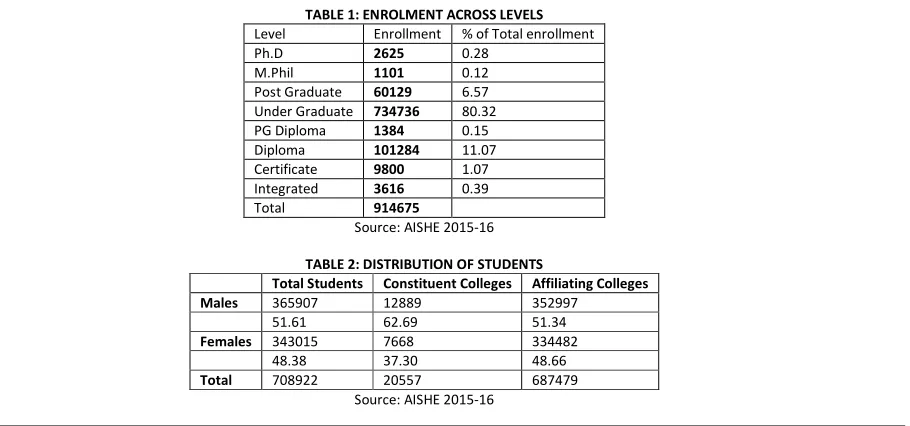
The highest numbers of students are seen enrolled at Under Graduate level (80.32%) in the state of Odisha. On the other hand, next to Under Graduate, 11.07 % students are enrolled in Diploma and 6.57% in Post-Graduation(Table-1). The female enrolment in colleges is comparatively lower (48.38%) than male enrolment (51.61%) [Table-2].
• GROSS ENROLMENT RATIO IN HIGHER EDUCATION (18-23 YEARS)
The population for 18-23 years of age group is 14 million in India and Odisha constitutes 3.30 % of the total population of this age group. The Gross Enrolment Ratio (GER) in Higher education in India is 24.5%, which is calculated for 18-23 years of age group (2015). GER for male population at all India level is 25.4 % as compared to 23.5 % for females and the Gender Parity Index (GPI) of GER for the country has come out to be 0.92 and 0.83 for Odisha. The corresponding Gross enrolment ratio for the state of Odisha are 21.5% for male, 17.8% for female and 19.6% at aggregate level. The GER of our State is comparatively higher than the West Bengal (17.7%), Assam (15.4%),Bihar(14.3%),Chhatisgarh(15.1%),but lower than the states viz. A.P.(30.8%),Kerala(30.8%),Karnataka(26.1%).As a matter of fact the gross enrolment ratio in Odisha is comparatively lower than the all India level. Concerted efforts are to be made to increase the GER.
Among Teaching and Non-Teaching Staff, share of ST and OBC are low in comparison to
Student share. Across the caste category, representation of SC, ST and OBC in the Non-Teaching Staff is higher than Teaching Staff. Share of SC is maximum among the Non-Teaching Staff.
STUDENT TEACHER RATIO (PTR) IN UNIVERSITIES AND COLLEGES
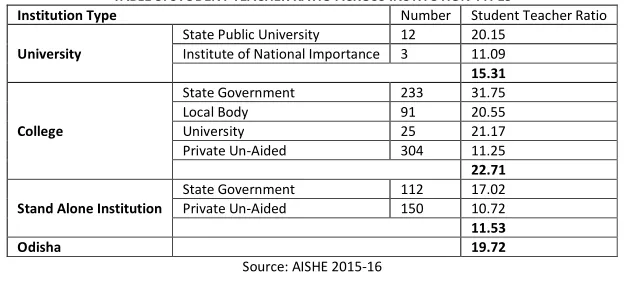
The student teacher ratio is 19.72 in the state of Odisha irrespective of institutions. Institution wise the above ratio is 15.31 and 22.71 in universities and responded colleges respectively (Table-3).
StudentTeacher Ratio (PTR) in Universities and Colleges are 33.35 and 21.56 respectively at All India Level, which comes to 22.03 with inclusion of Stand Alone Institutions. Student Teacher Ratio across the selected states indicates that PTR is 15.06 in AP, 22.25 in Chhatisgard, 17.72 in Haryana, 19.75 in Himachal Pradesh, 13.39 in Karnataka, 34.83 in West Bengal as compared to 19.72 in Odisha (Table-4).
UNEMPLOYED BY EDUCATION LEVEL
The percentage of unemployed students having PG and above level education is the highest (42.86%) followed by Dip. /Cert. below grad. (29.03%) and Graduate level (23.08%) (Table-5, NSS 66th Round). The percentage of unemployed increased to 66.67% for students having PG and above level education compared to a decline in case of graduate and Dip. /Cert. below grad. (Table-5a NSS 68th Round).
LABOUR FORCE PARTICIPATION
Out of the total young population (18-23 years), a substantially higher percentage (45.41%) participated in the labour force as compared to studying (21.11%) and neither (33.48%). Such magnitudes have almost remained same with 44.68,20.87 and 34.45 percentage respectively (NSS 68th Round). Across the gender, the labour force participation rate is much higher in case of male than female population. Again among the young population, the percentage of labour force partici-pation in rural areas is much higher than urban areas. However, in case of studying category the percentage of urban young population is higher than rural. The labour force participation rate of young ST and SC population is considerably higher and participation rate in studying is lower compared to other social category of young population (Table-5).
GROWTH IN ENROLMENT AT UG AND PG
The growth rate is not encouraging in case of Medical Science followed by Agriculture and Science (Table-6).
Most of the Universities have set up their campuses in the surrounding areas of urban areas. Many departments in these institutions are running either without adequate faculty members or not well qualified staff. Most of the staff in private universities/colleges have poor motivation and are underpaid. This is heavily deteriorating the quality of Higher Education and appropriate steps can help to get rid of such a situation.
ENSURING QUALITY IN HIGHER LEARNING
A.
STRENGTHENING HUMAN RESOURCES
The quality of teaching depends upon the skill and ability of teachers. They have multiple roles to play in the areas of teaching, research, consultancy and extension work besides the management of the institution. Therefore, it is necessary to enhance their efficiency as a precondition for improving the quality of teaching. Only persons of high calibre should be given teaching positions through impartial and objective recruitment process. The University should develop a monitoring system for the performance of the teachers. It is important that good teachers should be recognised and rewarded.
• In the Universities and Colleges, the human resources component assumes highest importance.
• For a long time, there have been vacancies both in teaching and non-teaching positions in different universities and colleges, which has become a hindrance in providing quality education in these institutions.
• The UGC prescribes the minimum staff position in a P.G. Department i.e. one Professor, two Readers and three/four Lecturers. At least this minimum strength has to be ensured to run the academic programmes as per the mandate and the workload.
• New Post-Graduate Departments must be opened in the universities to provide educational facilities to cope with the market-driven economy. The UGC during the XI and XII Plan have sanctioned teaching and non-teaching positions for opening new Departments for some Universities in the State, but these could not be filled-up due to want of State Government concurrence. Thus, before the proposals are submitted by the Universities to the UGC, this has to be routed through the Government. Hence, a better coordination between the Universities and the State Government on this issue is suggested.
• In many universities in Odisha Self-Financing courses are being offered to cater to the needs of the students and through this process aiming at augmenting the resources of the universities as well as the colleges. Steps are to be initiated to convert these Self-Financing courses into regular P.G. Departments of the University.
• The teaching and non-teaching staffs play their role in teaching, research and extension activities. Thus, the vacant positions must be filled-up on priority basis. This is also a condition stipulated under RUSA.
• In the Universities where financial assistance under UGC-DRS Special Assistance Programme has been sanctioned to P.G. Departments, the minimum staff strength has to be ensured.
• The student-teacher ratio should be maintained in colleges and universities for better academic output.
V
OLUMEN
O.
7
(2017),
I
SSUEN
O.
10
(O
CTOBER)
ISSN
2231-5756
INTERNATIONAL JOURNAL OF RESEARCH IN COMMERCE, IT & MANAGEMENT
• The colleges in Odisha do not have sanctioned posts of Principals and managed by Principals in-charge. With regular Principals against sanctioned posts in office, there would be better governance in the colleges. Thus, posts of Principals have to be created on priority basis.
• To avail financial assistance from the UGC the minimum requirements have to be ensured in autonomous colleges. Most of the autonomous colleges are facing difficulty in getting the autonomous status extended in the absence of required teaching staff, infrastructural facilities, required NAAC accreditation and research publications by the teachers.
• The promotion of teachers is an important issue, which gives incentive and initiative for doing a better job. Thus, the promotional prospects of the teachers should have to be looked into through the Career Advancement Scheme or other promotional schemes.
FACULTY DEVELOPMENT
Faculty being the single most critical factor responsible for the overall quality, large number of faculty positions remain perennially vacant, may be due to either procedural restrictions/ fund constraint.
A new trend in teacher’s appointment has appeared to reduce the financial burden on the Government. Instead of regular appointments the Government appoints faculty either as a part time or yearly contractual basis with reduced salary. It has severely affected the morale in academic profession. This lack of accountability means that teaching and research performance is seldom measured. In the same institution, there are different categories of staff. All these categories do the same teaching job but have huge differences in salary structure and other facilities. This leads to frustration among the teachers who are underpaid.
• To ensure the quality of higher education sector, regular selections should be made through open competition on All India basis.
• Selection of teachers and non-teachers is to be made through PSC, SSB and staff selection commission. There should a restriction on appointment by the College Management.
• Filling of all vacant posts and posting of regular Principals as well as teaching, non-teaching staff and demonstrators. • Attract and Retain best talent as faculty Resources.
• There must be a provision of teacher’s training on regular basis. They must be equipped with new teaching methods such as use of technology in the class rooms. Such type of training will enable teachers to keep themselves in touch with the latest development in their respective fields.
• Qualification at entry level is more or less same. Initiatives are to be taken to enhance and to improve the qualification of teachers by allowing them to pursue post-doctoral /advanced studies with financial benefits as and when they complete the study.
• Mandatory induction training for Teachers immediately after appointment is to be made.
• Most of the institutions face the financial scarcity though receives grants from State Government. If State Government keeps on pressurizing them to gener-ate their own funds and financial resources, then there will be no difference between a Privgener-ate and Government Institute. Thus, Stgener-ate Government should come forward to provide substantial amount of funding so that institute can offer high quality education at affordable fee structure and all sections of society can have access to higher education.
PEDAGOGICAL PRACTICES
• To make short duration training (7 to 10 days) in every two years and 3 to 4 weeks training in every three years.
• Academic Staff Colleges are to undertake training programmes in diverse field of higher education to the benefits of the higher education institutions /col-leges. Presently there are only two Academic Staff Colleges, one at Utkal University and the other at Sambalpur University. Efforts need to be made to establish more Academic staff colleges to facilitate training to teachers.
CAPACITY BUILDING AND CAPACITY ENHANCEMENT
• Keeping in time the market requirement, upgrading the faculty Resources. FDP/ periodical & Pre Service Training may be made on contemporary changes.
B. CURRICULUM DEVELOPMENT
a) Promoting skill based education through National Skills Qualifications framework (NSQF) b) Improve Student Courses and Choice Based Credit system
c) Technology assisted participatory teaching- learning process
d) In conformity with National Goal and Economic Policy (contribute significantly to manpower requirements)
With regard to curriculum, it is suggested that it should be revised by UGC centrally in every 4 years so that uniformity can be maintained throughout the country. The curriculum must have scope to accommodate 10 to 15 percent of the courses as per the local/regional requirements.
CURRICULUM DESIGN
i. A State Policy framework is to be prepared
ii. Model Syllabus for all the colleges in all subjects with the help of Experts iii. Examination/Valuation Reforms
iv. e-library system Opening of new subjects i. Sports activities ii. Performing Arts etc. iii. NSS
iv. Outreach services
C. QUALITY PROMOTION
Majority of the faculties lacking holistic knowledge of academia are ignorant to the changing objectives of higher education. As a result, they are not in a position to boost the young souls. The carrying out responsibilities without social accountability is a common deficiency found in the faculty. There is a lot of scope to empower and motivate the faculty through different faculty development programmes.
i. Award/recognition to the teachers for their outstanding contribution to the subject, evaluation/feedback by the students, promotion of e- learning prac-tices, development of model/ smart classroom with modern teaching aids and learning materials and teaching through electronics mode.
ii. Making the curriculum Global in the globalization era is a challenge. There is a big crunch of the skilled human resource in the country. Higher Education is expected to skill the youth to make them the productive human resource. The young generation interested in mere degree should be molded with the skills to make them a productive human resource. As a result, the curriculum is badly in need of professionalization through different add on courses.
TEACHING MATERIAL
i. Updated teaching materials/lesson plans are to be developed by the eminent teachers of different institutions by unit/chapter wise assigned by UGC and must be moderated at the national level and available in the website for easy access of the students.
ii. Practical manuals are to be revised in every 4 years, new case studies, field studies may be assigned in each year.
V
OLUMEN
O.
7
(2017),
I
SSUEN
O.
10
(O
CTOBER)
ISSN
2231-5756
INTERNATIONAL JOURNAL OF RESEARCH IN COMMERCE, IT & MANAGEMENT
ACADEMIC REFORMS
In the University system, the courses offered assume importance. In most of the Universities, the courses offered are archaic, rigid and irrelevant to the contem-porary needs. Thus, it is imperative that our courses and programmes have to be redesigned to keep pace with time. The curriculum should be at par with inter-national standards. The absence of a challenging contemporary and employment-oriented syllabus is the biggest impediment in the serious pursuit of scholarship by the students.
Each University and College must have a Placement Assurance Cell for facilitating campus interviews as employability has been an important dimension of quality education in the contemporary world.
STUDENTS/LEARNERS
• Formation of State Level Eligibility Test(SLATE) • Personality Development of Students
• Vocationalisation /Professionalisation of Higher Learning
Today the learner still believes in the examination performance rather than the learning experience. Thus institutions should come forward to empower the present learners.
EXAMINATION REFORMS
The reforms in the examination system have been a subject of serious debate and discussion for long. It was rightly observed way back in 1902 by the Indian University Commission: “The greatest evil from which the University education in India suffers is that teaching is subordinate to examination”. Thus, different education commissions have suggested reforms in the examination process.
Along with the university written and practical tests the institute can generate the innovative testing methods suitable for the learners.
• For different university examinations, there must be a single question booklet containing both subjective and objective type questions to test the ability of the students.
• Examinations must be conducted as per schedule and results are published on time.
EXTENSION
Activities of NSS and NCC are to be made so that the institutes are able to bring the society and the institute together.
CONSULTANCY
The institutes have every opportunity to sell their expertise and generate funds.
RESEARCH ACTIVITIES
i. Innovative, fundamental and action research are to be taken by the teachers with enhance support by UGC and other R&D institutions/corporate bodies etc. collaborative research work, micro project, sponsoring national level projects with collaborative centres at various universities/research institutions. Assured scholarship (UGC/University) to all students of PG, M.Phil., Ph.D. pursuing the degree.
RESEARCH AND DEVELOPMENT CELL
Apart from teaching, research is an important responsibility of any educational institution. To strengthen a research culture in the universities and colleges, the following suggestions are worth considering:
a) Every university and college must have a R&D Cell to monitor the research activities and coordinate between the university and the industry, and between the university and the funding agencies.
b) The teachers must be given facilities to undertake research and publish their research findings. c) Collaborative Research Programme/Activities
d) Streamlining/Functioning of academic staff colleges and Research Institutes
e) Collaboration with Industries/corporate bodies to create job opportunities and for research activities
f) Research, the yardstick to measure the quality status to solve the problems of the society is the major objective of higher education today. As a result, it is the responsibility of the institution to promote research activities by the faculty and the students. It is the responsibility of the institution to enable the faculty to undertake research projects, publish research papers not only in their specialised subjects but also in the interdisciplinary subjects useful to the society.
MANDATORY ACCREDITATION
That would evolve adequate norms & standards and approaches to assessment (NAAC’s Quality Reviewed Rubric -2013 -14) • Subject/Faculty Accreditation & institutional Accreditation, both should be made mandatory, IQAC- strengthening this Unit. • Networking of different faculties (Inter- disciplinary)
• Semester system of Examination & Valuation Reform; Grading etc. • Building strategic partnership with Industry or Academic Bodies.
• New Activities like Summer School, Internship should be taken up. Even short term courses should be introduced for inter-disciplinary studies.
INTERNATIONALISATION
• People with international exposures should be engaged/invited. • Encourage International Collaboration
• Initiate Joint Research Projects
• Encourage faculty & Student Exchange Programme • Admit overseas students through e-admission
INDUSTRY – ACADEMIC COLLABORATION
V
OLUMEN
O.
7
(2017),
I
SSUEN
O.
10
(O
CTOBER)
ISSN
2231-5756
INTERNATIONAL JOURNAL OF RESEARCH IN COMMERCE, IT & MANAGEMENT
industry. Some top Universities in the USA are private universities set up by industrialists who had a vision and who could foresee the benefits of investing in the education system. The industry-academic interaction and collaboration has been felt necessary in the fields of both curriculum as well as research.
We need to accelerate industry-academia collaboration for sustainable development so that we protect the resources for the future, while promoting prosperity in the current generations. Universities and industry are the main pillars and also engines which propel the economy. We need to work on the synergies to promote sustainability of the national economy and also the global economy. There are two main aspects, namely, the focus on human resources development and coop-eration in research and development. Between university and industry, there are so many ways of coopcoop-eration. There is a lot of knowledge and experience in different areas. The industry-academic should join together on issues like governance, faculty development, curriculum development, infrastructure development, collaborative researches and development.
Establishment of research centers of excellence in various areas of local relevance must be pursued and these should be affiliated with the existing universities and institutions of national importance.
INFRASTRUCTURE AND NEW COLLEGES
As a step towards rural upliftment, the State Government has opened a number of colleges in rural areas. But these colleges are functioning without proper infrastructure and under staffing. These colleges do not possess full-fledged faculty, library, class rooms and other facilities. Even in some cases colleges are running in a private building or they are sharing building with other government institutions. Infrastructure is an important factor in enabling institutions to have an appropriate teaching learning environment.
• Joint Inspection by the Government and the academic body at the time of recognition of colleges • Adequate Infrastructure as per OEA
• Streamlining of autonomous colleges
• Reviving College Development Council/Academic Staff College/Distance
INFRASTRUCTURE SUPPORT
1. Construction of new buildings for class rooms/laboratories/computer centres/ libraries etc. 2. Provision for accommodation of students (hostels for boys /girls/SC/ST/OBC students) 3. Provision for toilet facilities for both boys and girls, drinking water facility
4. Upgrading library facilities with provision for reading rooms, facilities for subscribing journals, periodicals, computerization of library, digital library etc. The credit of infrastructure improvements in the institutes mainly goes to the quality awareness of the academia created by the NAAC. However, the adequacy and maintenance of both the hard and the soft infrastructure are both at challenge and opportunity for generating the best practices. The major portion of the institutional budget is spent on repairing the furniture.
Central funding for the same must be vigorously pursued to strengthen the existing and planned research centers. The student should be given a chance to participate in problem solving, seating arrangements are to be made which facilitates more academic socialization and compensating weakness. The student should be given opportunity to be involved in teaching process as facilitators. Tools and techniques are to be developed for improving quality of education. Midterm assessment of progresses, monitoring and accelerating the LTM vision for any change is to be made. There should be review of existing curricula in terms of quality of life and knowledge based society. Content is to be developed for understandings of social, economic and environmental sustainability through multi-disciplinary approach. There should be fostering lifelong learning skills for creative and critical thinking, emphasizing cooperation and collaboration, not competi-tion and promoting knowledge applicacompeti-tions in agriculture and industry. Models and incentivize adopcompeti-tion of ICT are to be in pedagogy and there should be incen-tivize research in universities, while creating an enabling environment in terms of lesser teaching hours for researchers, greater budgets and access to better infrastructure. Increase the number and quality of research scholars through the launch of innovative programs, provision of attractive fellowships and enhanced industry collaboration facilitating entry of high-quality foreign universities and private universities through the PPP mode.
Model colleges will act as guide post for other Government and Aided colleges. There should be innovation in curriculum design and transformation, introduction of interdisciplinary programme and examination reform.
All plans for expansion must have a major thrust on enhancing quality of education. Hence due care must be taken for developing skills of teachers for enhancing teaching-learning transaction, high quality research and development, creating conducive academic environment, improving the learning infrastructure, putting technology enabled learning into practice wherever possible, reforming examination systems, need-based revision of curriculum, etc.
Assessment and Accreditation of higher education institutions is a trend experienced throughout the world. This ensures that quality is not compromised in any higher educational institution. In Odisha most of the universities have not been re-assessed or re-accredited after the accreditation period is over. Moreover, the RUSA funding depends on the NAAC accreditation. The following steps are to be urgently initiated:
• The Universities and Colleges must be instructed to go for fresh accreditation or reaccreditation at the earliest as it is mandatory in nature for availing financial assistance from the UGC and the MHRD under RUSA.
• Every college and university must have an Internal Quality Assurance Cell (IQAC) to assess the performance of different branches of administration, the teaching departments and other facilities and take remedial measures as per requirement.
TABLE 1: ENROLMENT ACROSS LEVELS Level Enrollment % of Total enrollment
Ph.D 2625 0.28
M.Phil 1101 0.12
Post Graduate 60129 6.57 Under Graduate 734736 80.32
PG Diploma 1384 0.15
Diploma 101284 11.07
Certificate 9800 1.07
Integrated 3616 0.39
Total 914675
Source: AISHE 2015-16
TABLE 2: DISTRIBUTION OF STUDENTS
Total Students Constituent Colleges Affiliating Colleges
Males 365907 12889 352997
51.61 62.69 51.34
Females 343015 7668 334482
48.38 37.30 48.66
Total 708922 20557 687479
V
OLUMEN
O.
7
(2017),
I
SSUEN
O.
10
(O
CTOBER)
ISSN
2231-5756
INTERNATIONAL JOURNAL OF RESEARCH IN COMMERCE, IT & MANAGEMENT
TABLE 3: STUDENT TEACHER RATIO ACROSS INSTITUTION TYPESInstitution Type Number Student Teacher Ratio
University
State Public University 12 20.15 Institute of National Importance 3 11.09
15.31
College
State Government 233 31.75
Local Body 91 20.55
University 25 21.17
Private Un-Aided 304 11.25
22.71
Stand Alone Institution
State Government 112 17.02
Private Un-Aided 150 10.72
11.53
Odisha 19.72
Source: AISHE 2015-16
TABLE 4: STUDENT TEACHER RATIO ACROSS SELECTED STATES AND INSTITUTION TYPES
State State Public University State Government College Local Body College University College Total
ANDHRA PRADESH 66.03 20.75 10.54 12.75 15.06
CHHATISGARH 20.17 40.89 13.69 11.08 22.25
HARYANA 22.12 42.81 19.41 9.29 17.72
HIMACHAL PRADESH 31.25 39.28 11.55 42.63 19.75
KARNATAKA 14.56 21.78 13.56 12.37 13.39
ODISHA 20.15 31.75 20.55 21.17 19.72
West Bengal 23.39 34.92 67.21 64.19 34.83
Source: AISHE 2015-16
TABLE 5: LABOR FORCE PARTICIPATION BY GENDER/LOCATION/SOCIAL CATEGORY
18-23 yrs. Labour Force Participation Studying Neither
Total 45.41% 21.11% 33.48%
Male 71.54% 26.17% 2.28%
Female 21.79% 16.53% 61.68%
Rural 48.38% 16.75% 34.86%
Urban 37.70% 32.42% 29.89%
ST 58.28% 9.55% 32.16%
SC 46.95% 18.57% 34.49%
OBC 44.65% 20.51% 34.84%
Others 37.01% 31.29% 31.69%
Source: NSS 66h round.
TABLE 5A: LABOR FORCE PARTICIPATION BY GENDER/LOCATION/SOCIAL CATEGORY
18-23 yrs Labour Force Participation Studying Neither
Total 44.68% 20.87% 34.45%
Male 72.81% 25.22% 1.97%
Female 17.78% 16.89% 65.33%
Rural 47.58% 17.04% 35.38%
Urban 35.36% 32.81% 31.83%
ST 60.92% 7.95% 31.13%
SC 48.03% 14.59% 37.38%
OBC 40.82% 22.82% 36.36%
Others 35.82% 32.57% 31.61%
Source: NSS 68th round
TABLE 6: FACULTY WISE GROWTH IN ENROLMENT AT UG AND PG
2014-15 (UG+PG) 2015-16 (UG+PG) Growth (%)
Agriculture 172350 192753 11.84
Arts 9204026 9506338 3.28
Commerce 3856488 4185628 8.53
Law 311800 341190 9.43
Management 1045125 1086891 4.00
Medical Science 845876 976660 15.46
Science 4283784 4713636 10.03
Total 19719449 21003096 6.51
V
OLUMEN
O.
7
(2017),
I
SSUEN
O.
10
(O
CTOBER)
ISSN
2231-5756
INTERNATIONAL JOURNAL OF RESEARCH IN COMMERCE, IT & MANAGEMENT
REFERENCES
1. Agarwal R et al. Higher Education and Quality Improvement: A challenge for India. Indian Journal of Applied Research 2014; 4(10).
2. Jandhyala B.G. Tilak, Absence of Policy and Perspective in Higher Education. Economic and Political Weekly Vol. 39, No. 21 (May 22, 2004), 2159-2164 3. MHRD: Ministry of Human Resource Development (2015,2016), All India survey of Higher Education, Department of Higher Education, MHRD, New Delhi. 4. National Knowledge Commission (NKC) 2007, 48. For similar assessments from various angles, see Kapur and Mehta 2004; Tilak 1997 and 2004; Agarwal
2006; Singh 2004.