An Overview of the Challenges of Decentralized Agricultural
Extension Practice in Developing Countries: The Case of Eritrea
Gebremichael Kibreab Habtom, PhD
Department of Management and Public Administration, College of Business and Social Sciences, P.O. Box 12492, Adi-Keih, Eritrea
E-mail: [email protected] Fax: 291-1-126422; Tel: 291-1-7146534
This study, analyzes the challenges of decentralized agricultural extension system in Eritrea from political and organizational perspectives in relation to the major issues of responsiveness, accountability, efficiency, effectiveness, extension system coordination and capacity of service providers. The data for this study was taken from a study conducted in June 2017 in the Ministry of Agriculture. The study used both survey and case study methodologies. The study seeks to answer the following research question: what political and organizational factors have an effect on the delivery of extension services in a decentralized system? In this study, it is found that institutional, technical and managerial capacities have a great effect on the delivery of decentralized extension services. In Eritrea, there are capacity gaps among local government working units to deliver effective and efficient extension services that ensure participation of stakeholders and accountability of service providers. Agricultural extension has not yet developed enough capability to mobilize all stakeholders- research, farmer, input agency, private sector, NGO, finance institutions and professional body to sustain efficient and effective practice. Local institutions taking on responsibility for agricultural extension services require investment in institution building-staff development, facilities and management systems because decentralization cannot be created or accelerated by policy decisions alone.
Key Words: Agriculture, extension, decentralization, accountability, effectiveness, efficiency, responsiveness, Eritrea.
INTRODUCTION
Eritrea is an East African country, which is bordered with Ethiopia in the south, with Sudan in the north and the west, with Djibouti in the southeast, and with the Red Sea in the east. Eritrea got independence from Ethiopia in 1993 after 30 years of armed struggle. Eritrea’s population is estimated to be 5.2 million, with an average life expectancy of 60.4 years and a literacy rate of 67.5% (UNDP Report, 2009).
Agriculture is the most important sector in Eritrea’s economy in terms of food and nutrition security, employment, income, raw materials for industry and exports to regional and international markets. It is a large sector that currently employs, on a full-time basis about 70% of the Eritrean people. It has the potential to sustain its reputation as the primary driver of economic growth and poverty eradication. It accounts 24% of the country’s Gross Domestic Product (GDP) and almost all rural employment (GoSE, 2006).
A combination of adverse factors, such as: erratic rainfall,
rotational land-holding system, traditional farming
methods, inadequate research and extension services both in terms of expertise and resources; insufficient credit facilities; pest and disease infestation and inadequate supply of inputs; degradation of the natural vegetation cover and associated soil erosion are induced low agricultural production in Eritrea. As a result, agricultural output has barely exceeded 80% of annual food requirement even in relatively good years of adequate rainfall and bumper harvest, which are punctuated by cyclical periods of drought and precariously low input.
The major issues of decentralized agricultural extension system in Eritrea are related to coordinating the system, ensuring adequate coverage of rural populations, ensuring quality of services, and building capacity of service providers. There is a gap in the resources capacity of Local
Research Article
Governments to deliver extension, participation of stakeholders in the extension provision and accountability of stakeholders in the extension services provision and other areas. According to Nagel (1997) extension stakeholders include research institutions, commercial organizations (input distributors, food processors, and
retailers) public service organizations, support
organizations and farmers. With regard to agriculture,
these organizations provide advisory services,
consultation, loans/credit provision, inputs distribution, training and marketing. Peterson (1997) further described that the institutional factors affecting the operation of extension services as including the presence of organizations, both private and public who support agriculture and thus facilitate the role of the extension organization such as credit, input and seed supplies, price incentives, marketing channels and human resource constraints determine the impact of the information that extension agents convey to farmers. While extension agents can adjust their advice, given the overall policy climate, the value of the information is diminished when the terms of trade are tilted against agriculture, rural infrastructure investment is inadequate, and farmers have irregular input supplies due to absent input markets (Axinn, 1988).
The goals of extension include the transferring of knowledge from researchers to farmers, advising farmers in their decision making and educating farmers on how to make better decisions, enabling farmers to clarify their own goals and possibilities, and stimulating desirable agricultural developments (van der Ban and Hawkins, 1996). The objective of this study is, therefore, to analyze the challenges of the decentralized agricultural extension system in Eritrea from political and organizational perspective in relation to the expected outcome of extension services. It seeks to answer the following research question: what political and organizational factors have an effect on the delivery of agricultural extension services in a decentralized administration system? It is believed that in most developing countries decentralized extension services are affected by political and organizational factors such as institutional capacity, accountability, stakeholder participation, agricultural policies, resource mobilization, etc.
Conceptual Framework for the Analysis of Decentralized Agricultural Extension Practice
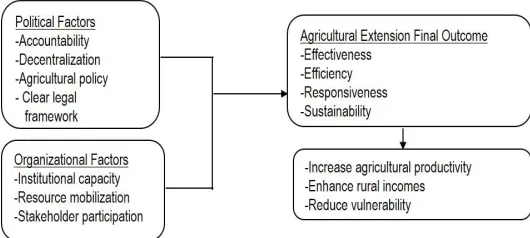
The conceptual framework adopted (figure 1) has livelihood security focus outcomes and goals for extension systems to contribute more to improving livelihood security of farmers through good participation, accountability, institutional capacity building and resources mobilization. The conceptual framework takes into account the political and organizational factors. The political factors that affect extension services include the level of decentralization, agricultural policies, accountability, and the presence of a clear legal framework (Parker, 1995; Swanson and Samy,
2004; Lai and Cistulli, 2005). On the other hand, the organizational factors that affect extension services
include institutional capacity building, resource
mobilization, and presence of well-developed institutions at local level (Swanson and Samy, 2004; Lai and Cistulli, 2005). The final outcomes of the extension services are
effectiveness, efficiency, responsiveness and
sustainability in the use of resources, which ultimately raises agricultural productivity, enhances rural income and reduces vulnerability.
Figure 1. Conceptual framework for the analysis of decentralized agricultural extension practice
Source: Adopted from Semwenda (2016)
Stakeholder participation and accountability are important elements for the success of decentralized extension practice. Participation is about including influence and share control over setting priorities, making policies, allocating resources and ensuring access to public goods and services, and therefore essential elements in decentralized extension system (Rivera and Qamar, 2003). A proper system of accountability in decentralized extension is also important in order to ensure that, there is proper resource mobilization (World Bank, 2004). It is believed that strong accountability mechanism will support the decision making of extension organization at the local level because it provides stakeholders with a good knowledge of the extension programme (Rivera and Alex, 2004a). In addition to accountability and participation, institutional capacity is the most important aspect for effective delivery of extension services in developing countries (United Nations, 2005). It has been noted that in most developing countries extension services have serious shortage of trained managerial and technical staff to carry out responsibilities for extension. The World Bank (2000) highlights the fact that the lack of managerial ability at the local level is a major limitation to extension decentralization in developing countries in general, and in Africa in particular.
Review of Relevant Literature
Agricultural Extension Practice in Developing Countries
is not increasing (in some cases, even declining)
contributing towards household food insecurity,
malnutrition and poverty. The ever-increasing decline in agricultural production has been attributed to a number of factors, one of which has been inappropriate and/or
ineffective dissemination of technologies
(Anandajayasekeram, et. al., 2008). In developing countries agricultural extension services are under increasing pressure to become more effective, more responsive to clients, and less costly to government. Most agricultural extension systems in developing countries have their origins in state-run, centrally managed systems which focused on linear technology transfer from researchers through extension agents to farmers. This model was derived from Roger’s (1962) diffusion of innovation theory. Innovation originates from scientists; extension agents transfer innovations; and farmers apply the innovations they receive from extension agents
(Russell et al. 1989). The model constitutes the traditional
government run agricultural extension system, which is a top-bottom approach, where extension agent’s package ideas developed and tested by researchers into messages and farmers are told what to do. The model gives little attention to farmers in terms of what their farming needs are or what they require for the extension organization to meet those needs. Experience has shown that the supply driven approaches have serious limitations. Some of these limitations are: the top-bottom approach does not bring about sustainable development because it neither builds on local farming experiences nor does it promote farmer empowerment; in many developing countries, the supply-driven approaches, results low adoption rates of new
technologies and insignificant overall productivity
increases; and with the supply driven approaches extension workers are still unable to cover the vast number of farmers in need of service (Pretty &Chambers, 1993; Scoones &Thompson, 1994). These limitations have led to critical assessments of public sector extension as failing to fulfil its role in promoting agriculture-based growth. Extension services must be oriented to markets and overcome the exclusive focus on production that ignored market demand and profitability. Varied extension services are needed to help farmers remain competitive and profitable, diversify production, produce for niche markets, and move to higher-value products and more value-added
production (Oladele et al. 2004). FAO (1997) reported that
all national governments should develop and periodically review their agricultural extension policy, which should include the goals of agricultural extension, the responsible agencies and personnel, the clientele to be served, the broad programmatic areas to be addressed, and other relevant guidelines.
Extension program quality depends fundamentally on good linkages with other programs-specialized training for extension agents and farmers, technical backstopping by subject matter specialists and information services, other extension services (mass media, fairs), and other
development programs (credit programs, market
development programs, input supply). Some of these linkages can be maintained at the local level, but many require higher level coordination to ensure efficiency and quality support.
For a long time, development of agriculture in developing countries mainly consisted of farmers and communities being told what to do, often by institutions and agents who have not taken sufficient time to understand their real needs and practices. It has been argued that a key factor for successful extension services in developing countries is the giving to local people a substantial influence over their local political systems and developmental activities (World Bank, 2000; Swanson and Samy, 2004).The World Bank (2000) noted that decentralized political institutions should be well established and strongly supported by local and central government to promote decentralized agricultural extension systems. Building local government capacity is a prerequisite for decentralizing extension services, because local governments (especially in Africa) often do not have the technical and managerial capacity to take on responsibility for managing technology programs. Local institutions taking on responsibility for extension might require investments in staff development, facilities, and management systems. Policy makers must allow time-perhaps several years-for local institutions to develop this capacity and experience needed for effective program management. In most developing countries extension services have serious shortage of trained managerial and technical staff to carry out responsibilities for extension. Staff employed lack competence and motivation due to poorly defined human resource development and management systems (United Nations, 2005).
World Bank (2000) highlights the fact that the lack of managerial ability at the local level is a major limitation to extension decentralization in developing countries in general, specifically in Africa. A major problem in developing countries is allocation of inadequate resources, including funds and qualified extension staff to deliver extension services (Anderson & Feder, 2004). Several authors (Sulaiman, 2003; Garforth, 2004; Tossou and Zinnah, 2005; United Nations, 2005), noted that extension staff need additional knowledge to do with communication and facilitation, networking, critical thinking, problem solving and human relation in new environment. Leeuwis & Van de Ban (2004) further noted that learning could be enhanced in extension organizations by involving staff in decision-making and through delegation.
Models for the Delivery of Agricultural Extension Services
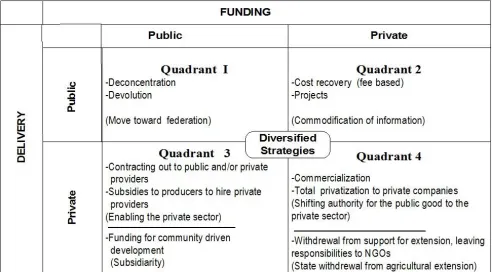
central authority to branch offices or institutes, as well as the shifting of staff from national to provincial, district or sub-district levels (e.g. Iran), and to devolution of authority to lower levels of government (Bolivia, Colombia, Mexico, Philippines, Indonesia, Uganda and Tanzania) (Rivera & Qamar, 2003). In quadrant 1 agricultural extension services are financed and delivered by the government. Government employees (civil servants) provide extension services to the farmers free of charge and the service is financed through government tax. Pure tax-based financing systems have high financial accessibility because they do not involve user fees at point of use. However, in many developing countries tax-based financing systems are constrained by limited tax bases, because of that a small share of the total government budget is allocated to agricultural extension services. Tax based financing system shifts also the locus of decision making from service receivers (farmers/producers) to the government, limits service receivers choice and sovereignty
Generally, public investment in extension is justified when the general public benefits more than the extension client, when government can provide services more cheaply or better, when extension services directly facilitate other programs, or when the private sector does not provide needed services (van den Ban, 2000).These conditions apply when there are positive externalities to innovation or market failure in service provision. Market failure is often due to: unorganized demand (small farmers do not recognize potential benefits, have limited purchasing power, and are not organized to access services) or unorganized supply (few individuals or institutions are capable of providing technical services or there is limited opportunity for private firms to charge for provision of easily disseminated information). The most important externalities are: positive environmental (e.g., Byerlee, 1998; Mullen, Vernon & Fishpool, 2000) and health (human, livestock and crop) impacts of appropriate technology use; improvements in political stability and poverty reduction resulting from improved equity in access to information; and improved national security, economic development and food security resulting from increased
agricultural productivity, competitiveness and
sustainability (e.g., Thirtle, Lin & Piesse, 2002). Consumers often benefit more from increases in productivity than do farmers.
Quadrant 2 represents change toward partial privatization-whether through subsidies to producers who then are obligated to seek agricultural extension services from private providers, through grants to producer organizations or entities at local levels. Fee based services are expected to increase resources available for extension services and would allow governments to expand or upgrade the network of agricultural extension services at village and community levels. Quadrant 3 refers to systems where the producer pays directly to the provider for services rendered. In quadrant 3 public financing is combined with
a private delivery of extension services. Agricultural extension services are contracted out to private service providers. Compared to quadrant 1, in this system the farmers/producers have more options for the choice of service providers. There are also more opportunities for autonomy, and competition among providers. Quadrant 4 applies to situations where governments have either commercialized their public sector agricultural extension services, or have otherwise transferred these services in total to the private sector.
The central rectangle refers to situations where governments employ several strategies (e.g., devolution, partial privatization, and/or cost-recovery measures to foster extension activities for agricultural development). This phenomenon should not be confused with "institutional pluralism" that refers to the fact that various sectors are engaged in extension provision.
Briefly, quadrant 1 indicates a partial or total shift of authority from the central authority to lower levels of authority or sub-government in the form of deconcentration and devolution. Deconcentration is a way of shifting authority to branch offices or regional institutes. Devolution is also a way of shifting the funding and delivery of extension services to the state level (Brazil, Mexico) or to the municipal/district level (Bolivia, Colombia, and The Philippines) (Rivera & Qamar 2003).
Quadrant 3 involves public-private partnerships. It aimed at joining effort to exploit better each partner’s areas of strengths. These types of mechanism are increasingly becoming effective means of conducting advanced
research, commercializing new technologies, and
deploying new products for the benefit of small scale resource-poor farmers, food insecure consumers and
other marginalized groups in developing countries (Lele, et
al. 2010). They commonly involve collaboration between
Figure 2. Public sector agricultural extension reforms since the 1980s
Source: Rivera & Qamar (2003) Agricultural extension, rural development and the food security challenge. FAO, Rome.
grants to communities directly for them to undertake development projects. This World Bank initiative seeks to motivate communities to take ownership for their own development. Still, the community projects are not necessarily (and in fact the cases are few) for developing extension services.
In quadrant 2 the strategy is fee-based extension service. User financing mechanisms are a means of obtaining private financing to cover at least a portion of the cost of public extension services. Mechanisms include levies, direct user charges, or subsidies for services procured by users (Anderson & Feder, 2003). An example of cost-recovery for extension services is Ecuador's Program for Modernization of Agricultural Services (Rivera & Qamar, 2003); however, this program involves both the public and the private sector in the financing and delivery of services and therefore incorporates reform measures associated with the lower-left quadrant. Again, this is an example of a mixed system and, indeed, Ecuador's approach to extension involves subsidizing as well as cost-recovery programs. User charges are more feasible for highly commercial operations, for more sophisticated producers, and for services that provide a clear and immediate benefit. Latin America has seen extensive experimentation with co- financing and private extension service provision
(e.g., Keynan, et al. 1997; Dinar and Keynan, 2001), and
small-scale farmers in various countries have indicated a willingness to pay for extension services that meet their needs (e.g., Gautam, 2002; Holloway & Ehui, 2001). This quadrant underscores the fact of agricultural information's commoditization (Buttel, 1991).
Quadrant 4 refers to countries that have totally commercialized (NewZealand) or privatized (England and Wales; The Netherlands) their public sector agricultural extension services (Rivera & Qamar, 2003).This quadrant also includes those countries that selected to withdraw completely from provision of extension services and support for extension education, and generally shifted authority to national and international NGOs (Peru). This quadrant reflects the general withdrawal of some countries during the late 1980s and throughout the 1990s from public sector involvement in goods and services and the consequent shift of authority to the private sector or third-sector organizations (Ibid). State withdrawal from service provision might entail total abandonment of some programs or shifting of service responsibilities to others-requiring commercial farmers to arrange their own services; encouraging producer organizations to provide services; or promoting private extension by input suppliers (not withstanding potential conflicts of interest in the content of advice), produce buyers, NGOs, environmental groups, or others (Anderson & Feder, 2003).
The central rectangle in figure 2 refers to diversified
strategies – strategies that employ multiple "mixed"
A pluralistic institutional framework would promote the advancement of "mixed economies," whereby public and private sectors cooperate more closely. Pluralism creates complementarity and synergy in the use of resources for extension by different donors and there are a number of lessons to be learned from these strategic determinations and their varied experiences. There is evidence that high rates of adoption of improved agricultural technologies occur when government organizations, NGOs, and private organizations form partnerships in extending agricultural
technologies to famers (Ojha, et al. 2001). Pluralistic
extension, however, requires an institutional setting with an established legal framework, the document that provides a clear division of responsibility between different levels of government departments and other participants (Semwenda, 2016).
In addition to the above, SSA countries have adopted different agricultural extension service models to achieve their objectives. They have tried to maintain an optimum mix of institutional pluralism between grassroots associations, the NGO, the private for profit, farmers’ associations, government ministries and department of agriculture, universities and agricultural research centers. The models that have been practiced by SSA countries include (Oladele, 2011): rural development, extension program, and farmer field school in Angola; participatory management approach and farmer field school in Benin and Burkina Faso; national agricultural extension and
research program support project in Cameron;
participatory demonstration, training extension system and farmer field school in Ethiopia; pluralistic extension system including, ministry, private companies, NGOs and farmer field school in Nigeria, Ghana, Kenya and Malawi; participatory demonstration and training extension system, farmer field school, modified training and visit extension system in Mali; famer field school, and government led pluralistic extension in Mozambique and Cote d’ Ivoire; farmer field school, and pluralistic extension system in Rwanda and Senegal; farmer field school, university based extension system, and pluralistic extension system in Tanzania; participatory extension system, and farmer field school in Zambia and Swaziland; unified agricultural extension system, pluralistic extension system including, ministry, private companies, and NGOs in Lesotho; ministry, university, and community based approaches, and cyber extension system in South Africa; farming system approach, national master plan for arable agriculture and dairy development in Botswana; ministry based approach, commercialized extension system and community participation approach in Zambia, Madagascar and Mauritius; and pluralistic, national agriculture advisory service and farmer field school in Uganda. Existing models are typically a general or modified training and visit model housed in the Ministry of Agriculture, although many countries are using multiple models with pluralistic service providers. The increasing number of players and stakeholders makes the issues of coordination and regulation crucial, and underlines the need for the
government to remain involved in extension in order to ensure food security, regulating food quality and safety, and environmental conservation, among others.
It has been observed that no single political or institutional strategy is dominant in the reform of public sector agricultural extension. . As shown in figure 2, decentralization, pluralism, cost sharing, cost recovery, participation of stakeholders in development initiatives and the decisions and resources that affect them are the key elements in current agricultural extension systems transition (Rivera and Qamar 2003). Several scholars (Schwartz and Kampden 1992; Ameur 1994; Dinar 1996;
Holden et al. 1996; Umali-Deininger 1997; Zijp 1998)
suggested that governments should find an appropriate ‘mix’ of public and private funding and delivery mechanisms for extension, to achieve differing agricultural goals and to serve diverse target populations.
MATERIALS AND METHODS
Research Design
The data for this study was taken from a study conducted in June 2017 in the Ministry of Agriculture under the supervision of Eritrean Center for Organizational Excellence, which was financed by the European Union. The study used both survey and case study methodologies. The case study and survey methods are not mutually exclusive; hence, one could have a case study within a survey or a survey complementing a case study (Hakim, 1987; Dancey & Reidy, 1999). A key strength of the case study method is that the use of multiple sources and techniques in the data gathering process, e.g. documents review, interviews, focus group discussions and observations. We used survey to examine the challenges of the decentralized agricultural extensions system in Eritrea. Questions related to this paper included: demographic information on individuals, political and organizational factors that have an effect on extension such as the level of decentralization, the presence of well-developed institutions at the local level, the presence of a
clear legal framework, stakeholder participation,
institutional capacity building, resource mobilization, accountability, effectiveness and efficiency of extension services, responsiveness, and sustainability in the use of resources.
Source of Data
extension staff). Furthermore, questionnaires were distributed to 132 respondents, of which 12 questionnaires were missing. The respondents completely filled and returned 120 questionnaires. Secondary data also collected from the documents, publications, and annual reports of the MoA; reports of the World Bank, and FAO. The secondary data was collected from various sources inter alias relevant books and journals, international and national agricultural reports, published and unpublished documents. The rationale for using multiple sources of data is the triangulation of evidence. Triangulation is a combination of research methodologies in the study of the same phenomena (Habtom, 2014). It increases the reliability of the data and the process of gathering information. Triangulation helps also to analyse and
compare data collected through interviews,
questionnaires, observations and secondary sources.
Sample size
The samples for the study were taken from the staff of the
MOA at Head Quarter’s office and NARI at Halhale. Out of
415 employees of the Ministry of Agriculture (MoA) 132 employees were selected. The study used systematic and stratified sampling. The employees were selected randomly from each stratum (departments, divisions and units of the MoA). The samples include employees of
extension service department, regulatory service
department, national agricultural research institute, agricultural planning and policy division, administration and finance division, and national animal and plant health laboratory. From each stratum proportional samples were randomly selected.
Methods of Data Analysis
Likert scale is used for measuring attitudes of Agricultural staff at the MoA. In Likert scale analysis each item has a weight attached to it or a score attached to it. A person’s score on the final attitude scale is simply the sum of the weight of the alternative he/she has checked. Weights are usually as assigned so that high score indicates favourable attitudes. The identified attitudes were weighted as follows:
Respondent’s Attitude
Liker Scale Assigned
The Mean is computed as follows:
𝑋̅ = ∑ 𝑥 𝑛
Where:
Ineffective (INE)
1 𝑋̅ =Mean
Weakly Effective (WEF)
2 =
Summation
Fairly Effective (FEF)
3 X= Nominal
value of response Effective
(EFF)
4 N= Number
of items Highly
Effective (HEF)
5
𝑋̅ = 1 + 2 + 3 + 4 + 5 5
=15 5 = 3.00
Using this as upper limit any item with a mean score of 3.00 or above will be regarded as effective and the one below 3.0 will be regarded as not effective. The mean score (Xs) of each item will be completed by multiplying the frequency of each response pattern with it’s appropriate nominal value and dividing with number of respondents to the item. It can be summarized as follows:
𝑋𝑆
̅̅̅̅ =∑ 𝐹𝑁 𝑁𝑟
Where:
𝑋𝑆
̅̅̅̅ = Mean score
= Summation
F = Frequency of each response mode N = Likert nominal value
Nr = Number of respondents to an item
For the data analysis information was drawn from the entire questionnaire, interviews and supporting documents to present a view of the factors that are relevant for the study. The data were interpreted and organized into different themes based on the conceptual description of ideas which were expressed by respondents during discussions. Collected institutional data, survey data and numerical data from observation were reviewed for accuracy, completeness and consistency and entered into the Statistical Package for Social Science (SPSS) version 16. Data were coded and statistically analyzed, descriptive statistics such as frequencies and percentages were calculated to determine distribution and relation of the study variables. Results were displayed in the form of Tables.
RESULTS
In this section, qualitative and quantitative research methodologies were used in data analysis. The results were presented in percentages and absolute figures (see tables 1 to 10). The study used questioner, interview, observation and secondary data sources to investigate the key study variables, which include the political and organizational factors that affect agricultural extension services. The results of the study variables were interpreted through descriptive and deductive data analysis techniques.
Demographic Characteristics of Respondents
41% of the respondents have more than 31 years of work experience and about 38% are above 50 years old. This indicates that most of the respondents have a deep knowledge and understanding of the current situation of the MoA. They were in a position to provide honest and credible information about the MoA functions and
responsibilities, challenges and opportunities,
weaknesses and strengths as well. Education wise about 60% of the respondents have B.A degree and above (i.e.,
48% BSc and 12% MSc) and the sample includes division heads, unit heads, agricultural extension workers, National Animal and Plant Health Laboratory staff, administration and finance staff, project coordinators, planning and statistics staff, National Agricultural Research Institute (NARI) researchers, regulatory service department staff, forestry and wildlife authority staff, and public relations, legal service and internal audit staff.
Table 1. Socio-Demographic Characteristics of Respondents
No. % No. % No. %
Sex: Work Experience Position
Male 85 71 1-5 years 15 13 Division Head 7 6
Female 35 29 6-10 years 16 13 Unit Head 21 18
Total 120 100 11-15 years 14 12 Agri. Extension Worker 25 21
Age: 16-20 years 12 10 NPAHL 10 8
20-30 years 23 19 21-25 years` 123 11 Administration & Finance 11 9
31-40 years 24 20 26-30 years 14 12 Project Coordinator 3 3
41-50 years 28 23 31-35 years 10 8 Planning & Statistics 5 4
Above 50 years 45 38 36-40 years 12 10 Researchers 14 12
Education: 41-45 years 14 12 Regulatory Service 10 8
High school complete 6 5 Above 45 years 13 11 Forestry & Wildlife Authority 8 7
Certificate 6 5 Public Relations 4 3
Diploma 37 30 Legal service 1 1
B.A. /B.Sc. Degree 57 48 Internal Audit 1 1
Master’s Degree 14 12
Ph.D. 0 0
Source: Field data, June 2017
A total of 120 questionnaires were collected. To substantiate the data collected through questionnaire, personal interviews were conducted with department, division and unit heads at the MoA, and focus group discussions were conducted with employees of the MoA. The results were amassing; there were a lot of discussions and debates, opinions and suggestions with regards to the functions, responsibilities and organization of the agricultural extension practice in Eritrea.
Analysis of Eritrea’s Agricultural Policy
Agricultural policy is one of the political factors that affect extension services. Eritrea’s agricultural policies are reviewed from secondary sources (published and unpublished government documents) and primary sources obtained from interviews and focus group discussions. Eritrea’s agriculture policies emphasis on enhancing per unit productivity, ensuring food security, commercial agriculture, export orientation, human development, environment sustainability, better quality of life and rural poverty alleviation. In Eritrea, the Ministry of Agriculture (MoA) is mandated to perform five strategic functions: [1] strategic planning of the sector (involving policies, sector plans, performance monitoring and impact evaluation); [2] managing and developing MoA resources (comprising good governance in terms of accounting for and managing public funds, [3] human resource development and human
resource management; [4] promotion and development of agriculture (including technical backstopping, demand driven provision of services etc.); and [5] agricultural research (focusing on basic and applied research and dissemination of results); and regulation of the sector (by
setting and enforcing standards and statutory
responsibilities).
Figure 3. Strategic functions of the Ministry of Agriculture Source: GoSE (2006).
management of natural resources; and supplying raw
materials to domestic industries and expanding
agricultural/ livestock exports. This would be sustained through the support of the private sector and in particular the small holders who are responsible for over 90% of agricultural outputs. To this end the environment of agricultural extension has been changing with more focus on food and nutrition security, poverty alleviation, entry of new actors such as the private sector and NGOs in the delivery of extension services, changed research and development paradigms and bottom-up approaches for
end user involvement in decision-making
(Anandajayasekeram, et. al., 2008). In Eritrea the goal of agriculture extension goes beyond implementing the national agricultural development goals of achieving food security, improving rural livelihoods, and natural resource management; it includes also fostering state ties with farming communities to maintain and strengthen the societal coherence and support base. The provision of extension services in Eritrea has different views among farmers, planners, economists and practitioners among others. While farmers view extension as a form of assistance to help improve their know-how, efficiency, productivity, profitability, and contribution to the good of their family, community, and society, the politicians, planners, and policy makers consider it as policy instrument to increase agricultural production, to achieve national food security, and at the same time, help alleviate rural poverty.
The Government of the State Eritrea (GoSE) is trying to transform its agriculture from traditional farming system into modern irrigated commercial farming system in line with developed market-lead economy, supported by a comprehensive array of government provided services such as, policy and strategic planning, research, extension, regulatory and human resource development while the private sector is undertaking agricultural production, processing, marketing and other services. The main strategies to develop the agricultural sector in Eritrea include promoting full and supplementary irrigated agriculture; promoting the development of water harvesting and groundwater recharging schemes;
increase agricultural productivity through crop
intensification, crop/ livestock diversification and crop livestock integration; promoting modern production technologies and effective farmers’ advisory services; ensuring the availability of farm support services and inputs; promoting agro-processing, storage facilities and efficient post-harvest management; and promoting greater equity by enhancing gender participation, giving equal access to all kinds of assets and economic opportunities.
The FGD participants noted that successful realization of the policy vision of the government of Eritrea requires a skilled labor force in a wide range disciplines for both planning and program design at central government level and program implementation at local government level in order to provide effective delivery of services to farmers
and agribusinesses. In addition, farmers themselves need regular training and constant access to new knowledge and agricultural practices and technologies. The FGD participants further stated that those people involved in agriculture should be provided adequate information and ideas in order to develop agriculture that will meet complex demand patterns, reduce poverty, and preserve or enhance ecological resources; and the role of the government should be to establish suitable coordination and to develop quality control mechanisms, which safeguard interests of farmers in a pluralistic extension system.
The GoSE is committed to decentralized administration system, which is intended to be participatory, grassroots and focused on demand generated by citizens. It is believed that a key factor necessary for successful extension decentralization in developing countries is the giving to local people a substantial influence over their local political systems and developmental activities (World Bank, 2000; Swanson and Samy, 2004). The World Bank (2000) claimed that if decentralized political institutions are well established and strongly supported by local and central government, decentralization of agricultural extension programs for farmers can proceed with confidence. Extension officials in Eritrea further noted that the basis for extension work is in the regions, sub-regions and villages; experience tells us that all training and visit programs are area specific which address the needs of a specific villages or cluster of villages, and such activities start and end-up at the region level, and reports coming to the head quarters office. From the policy perspective and development of the national extension plan, delivering technical assistance in planning and plan-consolidation can be seen as the main role of agricultural extension department at national level. In the agricultural sector the general aim of the system is to facilitate the better use of Eritrea’s natural resources and enhance farmers’ potential for improved agricultural production by empowering them to take an active role in decision making processes for the long–term sustainable development of agriculture. It is believed that local workers are better able to identify problems and opportunities, more likely to use area –and culture-specific solutions and better able to match supply decisions to local situations. Delegation of authority to local governments can influence also the incentives for competition between jurisdictions to provide improved public goods. The nature of the social environment within which such spaces for local discretion are created is thus likely to be a critically important factor in the realization of the policy vision of the GoSE.
Analysis of Agricultural Extension Practices in Eritrea
poverty and improve food security in Eritrea. It conducts systematic and organized communication with farming communities and among farmers’ in order to give them a helping hand. Its objectives are particularly oriented to a better insight into farming practices, clear formulation of farmer's wishes and identification of their problems and
looking for solutions (Havrland et al. 2000).The
decentralized publicly funded and implemented system of agricultural extension system in Eritrea, however, is blamed for its less effectiveness due to budgetary, material and human resource limitations. As can be seen from table 2, agricultural extension services are rated low with
regards to responsiveness to farmers and agro-enterprise needs (rated 2.21 out of 5.00 Likert scale), in accessibility of quality agricultural input to farmers at affordable price (rated 2.48), in agricultural engineering services (2.58), in livestock services (rated 2.95), in maintaining of linkages between National Agricultural Research Institute (NARI), Agriculture Extension Services and Farmers (rated 2.58), and in creating linkage between agro processing enterprises and agricultural extension services (rated 2.21). But there are positive results for crop protection and production inspection of agricultural extensions services, which are rated 3.10 (i.e., above average).
Table 2. Agricultural Extension Services Dimensions INE WEF FEF EFF HEF XS
There is decentralized agricultural extension service responsive to farmers and agro enterprises’ needs.
40 30 35 15 0 2.21
Farmers have timely access to quality agricultural inputs (e.g. seeds, fertilizers, pesticides, herbicides, etc.) at affordable price
15 45 50 8 2 2.48
How do you rate the agricultural engineering services? 16 39 45 20 0 2.58
How do you rate the livestock services? 6 24 60 30 0 2.95
How do you rate crop protection and produce inspection services? 8 12 70 20 10 3.10
How effective is the linkage between NARI, Agriculture Extension Services and Farmers.
10 55 35 15 5 2.58
There is improved investment climate for agricultural commercialization 25 56 33 6 0 2.17
There is a tax policy that supports an efficient commercial agricultural system. 30 45 20 25 0 2.33
There are competitive agricultural value chains that increase value added and benefits smallholder farmers and agro enterprises.
55 35 20 10 0 1.88
There is a good linkage between agro processing enterprises and agricultural extension services in Eritrea
45 50 15 10 0 2.21
Source: Field data, June 2017
The respondents pointed out that: the linkage between NARI, Agricultural Extension Services and Farmers is less effective (54%); livestock services, crop protection and produce inspection services are fairly effective (75%); agricultural engineering services are fairly effective (54%); and farmers' timely access to quality agricultural inputs at affordable price are fairly effective (49%).
According to the survey results 45% and 30% of the respondent’s perceived poverty and high rates of inputs respectively were the major barriers to promote/adopt the improved agricultural technologies. They stated that the farmers were poor and they were not in a position to purchase modern inputs. Whereas 15% and 10% of the respondents reported that lack of resources and illiteracy among the farmers were the reasons for the low adoption and dissemination of improved technologies among farmers.
The respondents noted that agricultural extension should be reoriented to provide more demand-based and sustainable services, taking account of the diversity, perceptions, knowledge and resources of users. Farmers should participate fully in agricultural extension service development recognizing that farmers’ involvement in identifying farming problems and the needed solutions is an essential strategy for sustainable development.
“By making extension more demand driven, and more
accountable to farmers, participatory approaches can
help to ensure that services are relevant and responsive to local conditions and meet the real needs of users. Making farmers influential and responsible clients rather than
passive beneficiaries of the extension service
improves sustainability, both of the benefits of investment
in new technology, and of the service itself.
Participatory methods can increase farmer ownership of the technologies promoted by extension management, especially when the methods are developed, at least in part, by the clients themselves and are based on technologies which they have seen to be effective. At the same time, when the value of the service is clear to them,
farmers are willing to contribute to its support,
reducing the dependence on public funds for meeting recurrent costs” (excerpts from FGD with Agricultural Extension Department Staff, March 2017)..
promote demand driven agricultural extension system. The respondents stated that poor marketing services and facilities and transport in rural areas pose a large constraint to agricultural commercialisation in Eritrea. There is a need for the strengthening of agribusiness linkages along the major agricultural commodity value chains, and support to farmers’ cooperatives and organisations to improve marketing and value additions.
In the focus group discussion (FGD) the participants examined the four reform options for agricultural extension service delivery system in Eritrea: (i) Public delivery and public finance which essentially comprises the traditional government agricultural extension that continues to persist although with greatly diminished outreach and constrained by a lack of sufficient funding; (ii) Public delivery and private finance whereby government staff is contracted by private agencies to deliver extension services; (iii) Private delivery and private finance whereby commercial entities provide their suppliers with the extension services required to improve their technical efficiency. This mode of delivery is prevalent in commodity out-grower schemes and highly commercialized high-value agriculture; and (iv) Private delivery and public finance which entails the outsourcing of responsibility for extension delivery to private sector providers such as NGOs, commercial organizations, etc. Despite its limitations the FGD participants opted for the first option-public delivery and public finance. They have stated that the private sector and NGOs are not well developed in Eritrea. The private sector does not have the financial capacity and technical expertise to step immediately into all areas that Government is withdrawing from, so in many cases a phased transition is required.
It has been argued that options ii and iii are not feasible in Eritrea because extension services are provided free of charge. Charging for extension service, in Eritrea, will diminish latent commercial demand for agricultural extension information and farmers willingness for extension services. The public-good nature of many extension services makes cost recovery at the individual beneficiary level difficult. To overcome these problems the public extension system has to be strengthened both in financial and human resource requirements. The government has a comparative advantage in the provision
of extension services. Government can use national radio and television to broadcast targeted programs with extension content and can encourage also partnerships with local farmer organizations to increase farmers’ awareness.
Public investment in extension is justified when the general public benefits more than the extension client, when government can provide services more cheaply or better, when extension services directly facilitate other programs, or when the private sector does not provide needed services (van den Ban, 2000). Market failure in the private provision of extension services often occurs due to unorganized demand (small farmers do not recognize potential benefits, have limited purchasing power, and are not organized to access services) or unorganized supply (few individuals or institutions are capable of providing technical services or there is limited opportunity for private firms to charge for provision of easily disseminated information).Therefore, care must be taken to design the transition in a way that provides assurances to the private sector that the government is truly ceasing its direct interventions; otherwise entrepreneurs will not venture into those areas.
Regional Agricultural Branch Offices
As can be seen from table 3, regional branch offices are rated fairly effective in the implementation of appropriate strategies and programs to achieve agricultural extension objectives. But this does not mean that regional branch offices have the capacity to provide all agricultural extension services effectively. Local agricultural staff lacks the requisite technical and managerial capacity to provide services that are relevant to the needs of farmers. It is widely noted that the underpayment of public servants is a source of capacity weakness throughout the agricultural sector and a serious impediment to the effectiveness of organizational performance. In the focus group discussion agricultural extension staff stated that the funds allocated for agricultural extension services are not sufficient and they are not able to mobilize funds to fill shortfalls. Due to this extension services are less effective and responsive to farmers’ need.
Table 3.Regional Branch Offices INE WEF FEF EFF HEF XS
Implement appropriate strategies to achieve objectives. 5 23 62 23 7 3.03
Accept responsibility to facilitate program implementation 15 27 35 25 18 3.03
Seek advice and consider divergent opinions. 5 15 40 48 12 3.39
Adequacy of agricultural extension services at region level. 10 30 35 40 5 3.00
Source: Field data, June 2017
Table4, further shows that regional branch offices are less effective in planning and monitoring of agricultural
activities, and in nurturing communication and
collaboration network with MoA head quarter’s office. Adequacy of financial resources and access to information
poor knowledge (22%), illiteracy (18%) among the
farmers/resist to adopt improved technologies,
communication problem (10%), lack of literatures (7%), lack of in-services training (6%) on improved technologies, farmers cooperation regarding training/field days (4%) and
poverty (8%). Similar study conducted by Chizari et al.
(1998), in Peshawar district in Pakistan, had shown that
lack of teaching equipment, dispersion among the farmers, lack of linkages between research centers and extension organizations, illiteracy among farmers and lack of up-to-date information to farmers were the major obstacles for extension agents.
Table 4. Zoba Branch Offices INE WEF FEF EFF HEF XS
Staff capacity in planning and monitoring 10 50 40 20 0 2.58
Clarity of communication and collaboration network with MoA HQ office and Zoba branch offices.
20 40 45 15 0 2.46
Adequacy of financial resources to achieve stated agricultural objectives 35 45 30 6 4 2.16
Access to information and communication technology 30 50 25 15 0 2.21
Source: Field data, June 2017
In the focus group discussion the participants emphasized on the importance of regular training for agricultural extension staff. Training is the basis for effective extension services, the rapid changes occurring in the extension environment demands in-service training for extension workers to develop the knowledge, skills and attitudes, which are necessary to meet an increasing set of diverse demands for the present days. Majority (56%) of the extension agents stated that they need training in improved crop management followed by (14%) in computer, (15%) in integrated pest management, (10%) in orchard management and (5%) in extension education, office management and planning respectively. According to World Bank (2000), training of extension staff improves the competencies of staff and promotes the attitude change required for decentralization reforms, since it is essentially required to meet the needs of extension staff in the new environment (Sulaiman, 2003; Garforth, 2004).
The respondents note that enhanced technical and management capacity will improve the motivation, confidence and attitudes of agricultural staff. Regional agricultural staff must have adequate capacity and technology to assist farmers with improved crop varieties, planting techniques, efficient input use, market conditions, and more effective production management techniques.
Besides this they must be knowledgeable in
communication and facilitating, problem-solving and critical thinking skills, teamwork and human relations in order to effectively interact with farmers and other stakeholders.
Local Government Capacity
Capacity building in agricultural extension is the process whereby relevant stakeholders and organizations unleash, strengthen, create, adapt and maintain capacity over time, usually with the objective of assuring sustainable agricultural growth and improving the lives of the stakeholders (Eremie, 2006). It requires the acquisition of individual skills and institutional capacities as well as development of opportunities to put these skills and networks of productive use in the transformation of the agricultural sector from the shackle of peasantry to a
modern one. According to Issa, et al., (2010) capacity is
defined asthe ability of people, organization and society as a whole to manage their affairs to achieve set goals. The existence of capacity is indicated by the functional presence of one or combination of the following: viable institutions and related organizations; commitment and vision of leadership, financial and material resources; and skilled human resources (ibid). As can be seen from table 5, local government units have rated low in capacity: in policy analysis, policy monitoring and integrated planning (rate 2.13); in the facilitation and implementation of national programs (rate 2.43); in the collection and analysis of data of strategic importance for agricultural development (rated2.46); and in the coordination of development partner investments in line with the agricultural development strategy (rate 2.42). This indicates that there is a capacity gap between planning and policy implementation at regional and district levels. The central government must provide technical,
administrative, logistical, financial support and highly
qualified staff to the lower levels of government to ensure effective program implementation. Several studies
(Sharma, et al., 2001; Saviroff and Lindarte, 2002; Tapa
and Ojha, 2002) show that enhanced technical and management capacity helps improve the motivation, confidence and attitudes of extension staff.
It has been observed that capacity is not only about skills and procedures; it is also about incentives and governance. Capacity development at local government level should include staff training, informal learning, enhancing skill in the use of information and communication technology, promoting research and extension linkage, emphasizing on staff motivation and commitment; and introduction of career development opportunities.
Effectiveness
Table 5. Local Government Capacity INE WEF FEF EFF HEF XS
Local government units have the capacity in policy analysis, policy monitoring, and integrated planning
33 51 24 12 0 2.13
Local government officials facilitate implementation of national programs and provide advisory service to program managers
20 50 35 9 6 2.43
Local administration units collect and analyse data of strategic importance of agricultural development strategy implementation as needed and in synergy with existing data collection systems
30 40 25 15 10 2.46
Local administration units coordinate development partner investments and programs to be in line with implementation of the agricultural development strategy.
25 45 30 15 5 2.42
Source: Field data, June 2017
Table 6. Effectiveness NEF WEF FEF EFF HEF XS
Existence of a system of monitoring to determine that goals and desirable social ends of the programs/projects are attained and delivered to targeted number of beneficiaries.
9 36 60 15 0 3.18
Performance is compared against pre-established targets, performance standards, indicators or benchmarks.
15 60 35 10 0 2.50
More emphasis on ends and goals, rather than means and procedures. 10 45 50 15 0 2.42
The performance of MoA is judged by its outcomes- what it achieved- rather than by its inputs- what it swallows up.
15 45 50 10 0 2.63
The MoA derives clear objectives and goals from their definition of service and regulatory, and developmental functions.
20 26 54 15 5 2.16
Source: Field data, June 2017
table 6 this is rated effective ( 3.18 out of 5.00 Likert scales); (b) comparison of performance against pre-established targets, performance standards, indicators or benchmarks, this is rated less effective (2.50); (c) emphasis on ends and goals rather than means and procedures, rated less effective (2.42); (d) performance is judged by outcomes- what has achieved- rather than by inputs- what has swallowed up, rated less effective (2.63); and (e) goals and objectives are clearly derived from definition of services, regulatory and developmental functions, rated less effective (2.16). The results indicated that either performance is not measurable or goals are not specific/clearly defined.
The FGD participants stated that the effectiveness of agricultural extension services, in Eritrea, are hampered by poor access to agricultural inputs by the majority of smallholder farmers due to high costs of inputs, poor markets, poor infrastructure, limited access to credit, poor communication facilities, limited market information, limited access to technology (e.g. high-yielding seed, pesticides, fertilizer); limited interface with other service
providers, inadequate participatory approaches in
agricultural research in terms of making the process demand driven, and untimely availability of inputs..
It is worthwhile to note that the MoA should develop performance measures by clearly stating organizational objectives and the relationship between inputs and outputs; workload and productivity; outcomes of products and services; service quality and client satisfaction. The argument, here is that the public needs to know what the MoA is doing and how its work is performed. The Ministry
needs also to understand for itself how the working units are performing their task and what the results are. The Ministry should develop published standards by which the public can judge whether the MoA is performing satisfactorily and even doing a good job. The MoA should enhance also public reporting systems on the overall performance of the Ministry. This involves providing information to the public/farmers on the performance of regulatory services, NARI and agricultural extension services.
There are good reasons for expecting annual reports from all extension service agencies. These reports should be informative, explaining to the public why the agency exists, what it does, and what it has been making. The annual reports would act as confidence builders in public agencies, boost the moral of both public servants and clients, and fill in gaps in public relations to counterbalance ill-informed criticism and demonstrate what public goods and services governments provide. Reports are also necessary for internal management purposes, contributing to effective supervision, decision making and audit. They provide baseline information for decision making and retrospective review of performance.
Efficiency
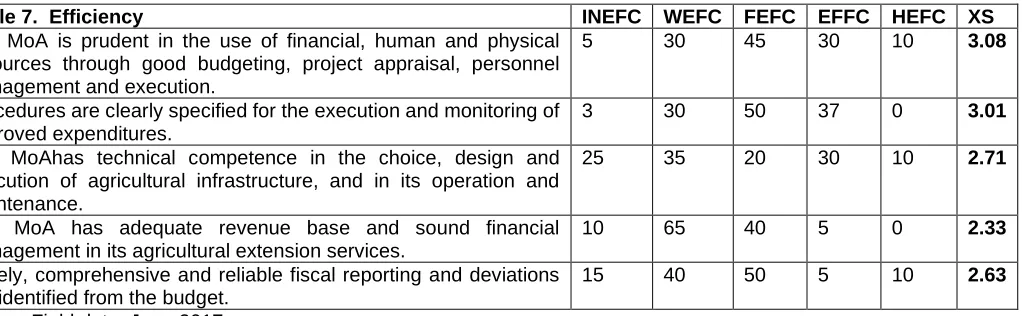
Table 7. Efficiency INEFC WEFC FEFC EFFC HEFC XS
The MoA is prudent in the use of financial, human and physical resources through good budgeting, project appraisal, personnel management and execution.
5 30 45 30 10 3.08
Procedures are clearly specified for the execution and monitoring of approved expenditures.
3 30 50 37 0 3.01
The MoAhas technical competence in the choice, design and execution of agricultural infrastructure, and in its operation and maintenance.
25 35 20 30 10 2.71
The MoA has adequate revenue base and sound financial management in its agricultural extension services.
10 65 40 5 0 2.33
Timely, comprehensive and reliable fiscal reporting and deviations are identified from the budget.
15 40 50 5 10 2.63
Source: Field data, June 2017
through five factors: (a) prudence in the use of financial, human and physical resources, as can be seen in table 7, this is rated efficient (3.08); (b) existence of clearly specified procedures for the execution and monitoring of approved expenditures, rated efficient (3.01); (c) technical competence in the design and execution of agricultural infrastructure, in its operation and maintenance, rated less efficient (2.71); (d) existence of adequate local revenue base and sound financial management for agricultural extension services, rated less efficient (2.33); and (e) existence of reliable and comprehensive fiscal reporting system and identification of deviations from budget, rated less efficient (2.63).
Inadequacy of local revenue base and sound financial management for agricultural extension is another area where the respondents rate the agricultural extension system less efficient. Fiscal restraints would result scaling back public programs or improving cost-effectiveness (Beynon, et. al., 1998). Scaling back public programs might involve: reducing coverage to specifictarget farmer groups, reducing intensity of coverage (less frequent visits, fewer services), devolving service provision to private organizations or requiring cost sharing by users (Wilson,1991). Extension officers usually scale down field activities when funds are not adequate to cover recurrent costs and field operations and this directly affects the availability and quality of extension services. Insufficient funding for the delivery of extension services, inability to fully mobilize funds, failure to cost effectively deliver services and meet farmers’ needs are evidence of weak institutional capacity (Parker, 1995). In Madagascar, for instance, insufficient funding and inaccessibility to credit by farmers constituted a major problem to extension
services (Saliu et al. 2009). Agricultural agencies should
solicit adequate fund to be able to organize staff training programs and embark on farmer outreach programs. Regional agricultural branch offices should raise funds also by introducing fee-for-service or cost-sharing arrangements, where farmers are made to pay all or part of the cost of services they receive from public extension agents. For instance, in Nigeria the farmers’ association resolved its financial problems by introducing “demand-driven, cost-recovery” extension system as an alternative to public sector extension in a number of districts (Carney,
1998). A case study of Columbian extension
decentralization showed also improvement when the fund for extension organization was doubled (World Bank, 2000). A major problem in developing countries is allocation of inadequate resources, including funds and qualified extension staff to deliver extension services (Anderson and Feder, 2004). A lesson can be learned from the experience of Uganda that extension services are funded in partnership with government agencies, farmer’s organizations and some non-governmental organizations
(Saliu et al. 2009). It has been noted that fund mobilization
through shared responsibility among all the stakeholders would enhance continuous and sustainable agricultural extension programmes.
Accountability
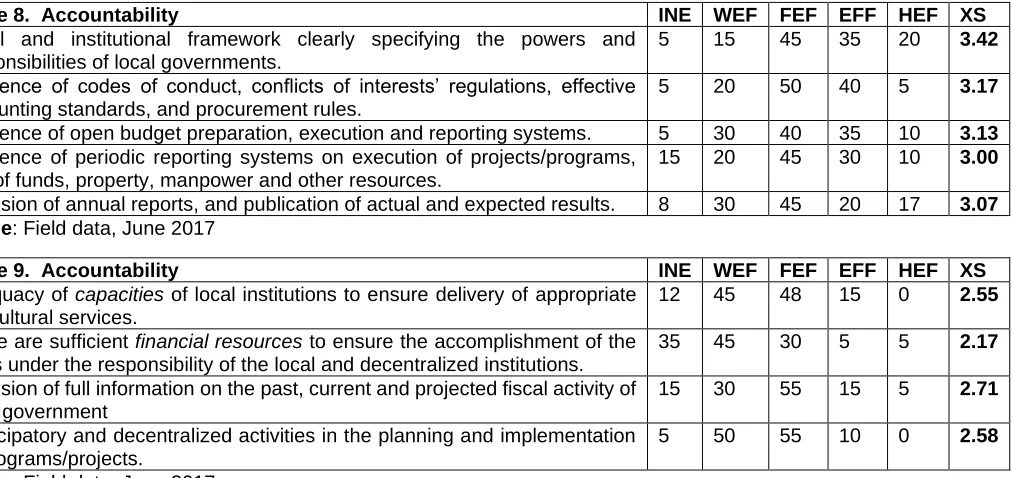
Accountability in government bureaucracies has
traditionally focused on the use of inputs rather than what they actually produce or achieve. Under the new reforms, outputs, outcomes, and impact become the primary focus
of processes and accountability measures. An
accountability mechanism provides stakeholders with the information necessary to identify new needs, understand who is benefiting from extension and real impact of the programme. Three key means of how accountability can be ensured in decentralized extension organizations includes political and legal oversight, institutional competition and administrative mechanisms (Swanson and Samy, 2004). In relation to the political and legal oversight, authority with committed leadership and well-defined legislative and regulatory frameworks can ensure a high level of accountability in extension organizations.