A green and efficient friendly process for synthesis of drug against dormant version of the Mycobacterium tuberculosis H37Ra
A green and efficient friendly process for synthesis of
drug against dormant version of the
Mycobacterium
tuberculosis
H37Ra
Younes Abrouki
1*, Abdelkader Anouzla
2, Hayat Loukili
3, Abdelkarim Abrouki
4, Rabiaa Lotfi
5,
Ahmed Rayadh
6, My Abdellah Bahlaoui
7, Driss Zakarya
8, Mohamed Zahouily
9, Saïd Sebti
101,2,3,4,5,6,7,8,9Department of Research, Faculty of Science and Technology, University Hassan II, Mohammedia,
Morocco
10Department of Chemistry, Faculty of Science Ben M'Sik, University Hassan II, Casablanca, Morocco.
The objective of this study is the synthesis of (2E,6E)-2,6-bis(4-nitrobenzylidene)cyclohexanone by the cross-aldol condensation between 4-nitrobenzaldehyde and cyclopentanone catalyzed by modified fluorapatite in aqueous media and the reaction conditions were optimized by the response surface methodology. This process is an important protocol for the synthesis of drug against dormant version of the Mycobacterium tuberculosis H37Ra. The work-up procedure is simplified by simple filtration with high yield and by-products of usual undesirable reaction are not observed.
Keywords: (2E,6E)-2,6-bis(4-nitrobenzylidene) cyclohexanone, Anti-Tuberculosis Drug, Mycobacterium tuberculosis H37Ra, Modified Fluorapatite, Cross-aldol condensation.
INTRODUCTION
According to the World Health Organization (WHO), in 2014, 9.6 million people fell ill with tuberculosis (TB) and 1.5 million died from the disease (World health organization, 2015). The main cause of TB is Mycobacterium tuberculosis H37Rv (Bifani et al., 2000). Indeed, another strain inoffensive for Mycobacterium tuberculosis named Mycobacterium tuberculosis H37Ra, remaining dormant in the host's cells and may be waking up and getting active again (Stein et al., 2008). In this context, the Indian authors are showed that the (2E,6E)-2,6-bis(4-nitrobenzylidene) cyclohexanone presented an activity against Mycobacterium tuberculosis H37Ra (Singh et al., 2009).
Cross-aldol condensation is an important protocol for the synthesis of various bis-(arylmethylidene) cycloalkanones (Riadi et al., 2010). This reaction is classically carried out using strong acid or base (Salehi et al., 2004). Indeed, different organometallic complexes, Lewis acid are found to be able to catalyze this reaction (Abaee et al., 2009). However, most of the above-mentioned process generated
a large amount of toxic waste and involved tedious separation procedures since the reactions were homogeneous and the catalysts were destroyed or discarded on the work-up procedure (Abaee et al., 2006).
Recently, because of increased environmental concerns and strong economic driver in chemical research and industry, great efforts have been made on heterogeneous catalysis, which allows the catalyst for easy isolation and recycling. Thus, solid catalysts have drawn considerable attention in organic synthesis due to their advantages such as environmental compatibility, reusability, high selectivity, simple operation, non-corrosiveness and low cost (Abrouki et al., 2002).
*Corresponding author: Younes Abrouki, Department of Research, Faculty of Science and Technology, University Hassan II, Mohammedia, Morocco. Email: [email protected]
Research Article
Table 1. Study field and coded factors
Natural variable Unit Coded variables X1 and X2
-1 0 +1
Reaction time h 3 4 5
Catalyst weight mg 200 400 600
In spite of global research efforts, we describe in this paper, an efficient friendly process for modeling and synthesis of (2E,6E)-2,6-bis(4-nitrobenzylidene) cyclohexanone a drug against dormant version of the Mycobacterium tuberculosis H37Ra using Response Surface Methodology (RSM).
MATERIALS AND METHODS
General procedure.
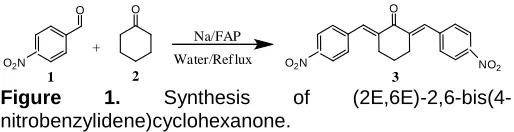
The general procedure for synthesis of (2E,6E)-2,6-bis(4-nitrobenzylidene)cyclohexanone is reported in Figure 1, as follows: To a flask containing a mixture by taking 2:1 mole ratios of 4-nitrobenzaldehyde 1 and cyclopentanone 2 in aqueous media, the Na/FAP catalyst was added and the mixture was stirred at reflux. Hot water (2×20 mL) was added, followed by simple filtration.
O
O O
+
Water/Ref lux Na/FAP
1 2 3
O2N O2N NO2
Figure 1. Synthesis of
(2E,6E)-2,6-bis(4-nitrobenzylidene)cyclohexanone.
After filtration and extraction with hot water, the solution was concentrated and purified by silica gel chromatography. The Na/FAP catalyst was reactivated by drying at 150 °C, and washed with acetone, then calcined at 600 °C for 1 h. The crude product 3 was identified by melting point, IR, 1HNMR, 13C NMR and elemental
analysis; IR (KBr).
Preparation and characterization of catalysts
The fluorapatite (FAP) have been prepared by reaction between diammonium phosphate, calcium nitrate and ammonium fluoride in presence of ammonia (Zahouily et al., 2003). The FAP obtained was calcined at 900°C before use. The structure of this catalyst was confirmed by X-ray diffraction, infrared spectra and chemical analysis. The surface area of calcined FAP was determined by the BET method and found to be S=15.4 m2g−1. The total pore
volume was calculated by the BJH method (VT=0.058
cm3g−1).
The modified fluorapatite (Na/FAP) has been prepared by impregnation of the FAP with a solution of sodium nitrate followed by calcination at 900°C (Solhy et al.,2003). The
surface area of the new catalyst Na/FAP was determined by the BET method as 5.4 m2g−1 and the total pore volume
obtained by the BJH method is 0.0032 cm3g−1. Statistical analysis
The software STATGRAPHICS-Plus was used for regression analysis and analysis of variance (ANOVA). The Response surfaces and the contour plots were developed using the fitted quadratic polynomial equation obtained from regression analysis, holding two of the independent variables at a constant value corresponding to the stationary point and changing the other two variables. Confirmatory experiment was carried out to validate the equation, using combinations of independent variables which were not part of the original experimental design but within the experimental region.
RESULTS AND DISCUSSION
The synthesis of anti-tuberculosis drug (2E,6E)-2,6-bis(4-nitrobenzylidene)cyclohexanone by Cross-aldol condensation between 4-nitrobenzaldehyde and cyclopentanone catalyzed using Na/FAP in aqueous media was carried out and optimized using the Central Composite Design (CCD) and Response Surface Methodology (Abrouki et al., 2013).
The CCD helps in investigating linear, quadratic, cubic and cross-product effects of the two reaction condition variables on the reaction yield.
The two independent variables studied were reaction time (X1) and catalyst weight (X2). Table 1 lists the range and
levels of the four independent variables studied.
By using a central composite design, a correlation between the reaction condition variables to the reaction yield was developed. Table 2 shows the complete design matrix and reaction yield at various reaction condition variables. Selection of the levels was based on our preliminary study.
This design consists of a 2k factorial (coded to the usual
±1 notation) augmented by 2*k axial points (±α, 0), (0, ±α), and 2 centre points (0, 0). The value of α for rotatability depends on the number of points in the factorial portion of the design, which is given in Eq. (1):
α = (NF)1/4 (1)
A green and efficient friendly process for synthesis of drug against dormant version of the Mycobacterium tuberculosis H37Ra Table 2. Experimental design and results
Order Coded units of variable Reaction yield X1 X2
01 +1 +1 96
02 +1 -1 53
03 -1 +1 73
04 -1 -1 33
05 +1.41421 0 85 06 -1.41421 0 54 07 0 +1.4142 87 08 0 -1.4142 28
09 0 0 77
10 0 0 76
Table 3. Regression variance analysis of the model
Source of
variation Coefficient
Sum of
Squares ν Mean square Fexp Significance test Regression - 4816.8625 05 0963.3725 05224.36 ***
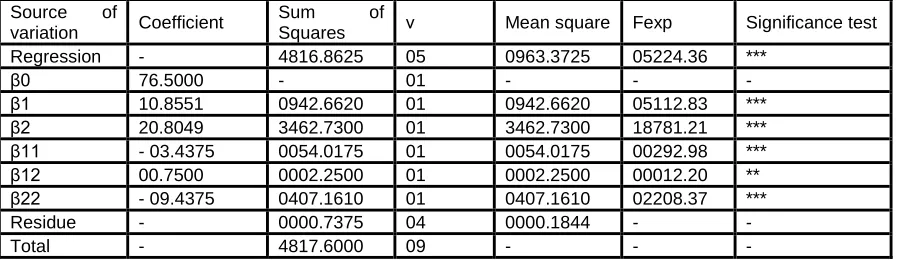
β0 76.5000 - 01 - - - β1 10.8551 0942.6620 01 0942.6620 05112.83 *** β2 20.8049 3462.7300 01 3462.7300 18781.21 *** β11 - 03.4375 0054.0175 01 0054.0175 00292.98 *** β12 00.7500 0002.2500 01 0002.2500 00012.20 ** β22 - 09.4375 0407.1610 01 0407.1610 02208.37 *** Residue - 0000.7375 04 0000.1844 - - Total - 4817.6000 09 - - - *** : p ≤ 0,01 ; ** : p ≤ 0,025 ; * : p ≤ 0,05 ; NS : No significant; F0.01(5, 4)=15.52.
there are two factors, the NF number is equal to 22 (=4)
points, while α is equal to (4)1/4 (=1.41421) according to
Eq. (1). The complete design matrix of the experiments conducted and results are given in Table 2.
In table 2 we can show, the reaction yield obtained was in the range from 28 to 96%. Experimental error was determined from run 9 to 10 at the center point of the design.
The experimental data obtained by following the above procedure were analyzed by the response surface methodology using the following second-order polynomial equation 2:
Y = β0 + β1X1 + β2X2 + β11X12 + β22X22 + β12X1X2 (2)
Where Y is the response (reaction yield); Xi and Xj are the
coded independent variables and β0, βi, βii and βij are
intercept, linear, quadratic and interaction constant coefficients, respectively.
A regression analysis was performed to fit the response function and predict the outcome of reaction yield with a simple equation. The model is expressed by equation 3 which takes their coded value.
Y = 76.5 + 10.8551*X1 +20.8049*X2 - 3.4375*X12
-9.4375*X22 + 0.75*X1X2 (3)
The summary of the analysis of variance (ANOVA) result is shown in Table 3. The regressors or term incorporated in the model are those statistically tested to be significant. The ‘Prob > F′ value indicates the probability equals the proportion of the area under the curve of the F-distribution that lies beyond the observed F value.
The small probability values called for the rejection of the null hypothesis, in other words, the particular term significantly affected the measured response of the system.
In this case, the linear terms (X1 and X2), the squared
terms (X12 and X22) and the interaction term (X1X2) have
P-values less than 0.05, indicating that they are significantly different from zero at the 95% confidence level. On the other hand, from this ANOVA the model F-value of 5225.16 implied that the model was significant. Values of Prob.> F0.01(5, 4)=15.52 less than 0.01 indicated that the
model terms was significant. The coefficient of determination, R2 for the model was 99.98%. This
indicates that only 0.02% of the total variability was not explained by the regressors in this model. The high R2
value specifies that the model obtained will be able to give a convincingly good estimate of response of the system in the range studied.
Table 4. Comparative study for synthesis of product 3 using different catalysts
Entry Catalyst Reaction parameters Yield (%) 1 InCl3.4H2O 110°C/24h 93%
2 KOH EtOH/12h 87%
3 DBSA MeOH/H2O/Reflux/12h 80%
4 KF/Al2O3 MeOH/Reflux/Ultrasound/2h30min 60%
5 Cu(OTf)2 Solvent free/80°C/8h 93%
6 I2 CH2Cl2/9h30min 89%
7 Na/FAP H2O /Reflux/5h 96%
response is shown in Figure 2. By looking at this figure, we see that the reaction time and the catalyst weight have a positive effect on the reaction yield.
Fig. 2. Influence of each independent variable on the reaction yield
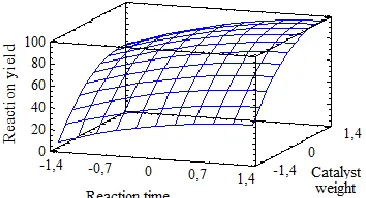
Figure 3 show the interaction between independent variables in three-dimensional surface plots. The geometric representation of the reaction yield for this product according to the reaction time and the catalyst weight is shown in Figure 4.
Analysis of the contour plot shows that when the reaction time and the catalyst weight increase together or when the reaction time increases and the catalyst weight remaining unchanged and or when the catalyst weight increases and the reaction time remaining unchanged, then the reaction yield increases up to 95% in the experimental field.
Fig. 3. Response surface graphs for synthesis of anti-tuberculosis drug
The main objective of this research is to determine the best reaction conditions for synthesis of (2E,6E)-2,6-bis(4-nitrobenzylidene)cyclohexanone. Then, using
above-mentioned methodology for experimental design, the ranges of the parameters required to obtain optimum conditions were determined.
In this optimization study, reaction yield was chosen as the objective function. Furthermore, optimum conditions are often calculated in the presence of some constraints, which ensure them to be more realistic.
If the model used in the optimization study is an empirical one, high and low levels of the process parameters in the experimental design are considered, inevitably, as explicit constraints, in order to avoid extrapolation. Thus, the optimization problem for response is defined by equations 4 and 5:
Maximize: Y = high reaction yield (4) −αi<Xi<+αi i=1,2 (5)
The investigation of contour plot (Figure 4) and the equation 3 showed that, if X1=1 and X2=0.75; the value
predict from the results using response surface model is 95%.
Fig. 4. Contours of estimated response surface for synthesis of anti-tuberculosis drug
A green and efficient friendly process for synthesis of drug against dormant version of the Mycobacterium tuberculosis H37Ra
From table 4, it can be seen for example in the presence of InCl3 catalyst, it is necessary that this condensation
should be heated to 110°C for 24 hours. In addition, we also note that the synthesis of product 3 catalyzed by P-Dodecylbenzenesulfonic acid DBSA under refluxing methanol–water mixture (1:1) for 12 hours give a yielding 80%. However, these methods have some drawbacks such as use of costly catalysts and toxic reagents and special catalyst preparation.
Comparison of the results obtained by our catalytic processes with some of those reported shows the efficiency of this method because of shorter reaction times, high yields. The high reactivity and specificity of our Na/FAP coupled catalyst to their easy separation of the catalyst by simple filtration, which reduces the environmental problems makes it attractive alternatives to homogenous base reagents.
CONCLUSION
The optimization for synthesis of (2E,6E)-2,6-bis(4-nitrobenzylidene)cyclohexanone catalyzed by modified Fluorapatite with sodium nitrate in aqueous media has been studied using central composite design. The model equation for the optimization of the reaction conditions for this synthesis was established. From this equation, it was possible to forecast the optimal reaction conditions for synthesis of this anti-tuberculosis drug in high yield. This process brings advantages, such as high catalytic activity and easy separation of the catalyst by simple filtration, use of non-toxic and inexpensive catalysts and especially, elimination of salts and by-product pollutants. This new solid base catalyst becomes then a practical alternative to soluble bases.
REFERENCES
Abaee MS, Mojtahedi MM, Forghani S, Ghandchi NM, Forouzani M, Sharifi R, Chaharnazm BA (2009). Green, inexpensive and efficient organocatalyzed procedure for aqueous aldol condensations. J. Braz. Chem. Soc. 20: 1895-1900.
Abaee MS, Mojtahedi MM, Sharifi R, Zahedi MM, Abbasi H, Heidar KT (2006). Facile synthesis of bis(arylmethylidene)cycloalkanones mediated by lithium perchlorate under solvent-free conditions. Iran. J. Chem. Soc. 3: 293-296.
Abrouki Y, Anouzla A, Loukili H, Lotfi R, Rayadh A, Bahlaoui MA, Sebti S, Zakarya D, Zahouily M (2013). Central composite experimental design applied to the catalytic carbon-sulfur bond formation by fluorapatite catalyst. Am. J. Appl. Chem. 1: 22-27.
Abrouki Y, Zahouily M, Rayadh A, Bahlaouan B, Sebti S (2002). A natural phosphate and doped-catalyzed Michael addition of mercaptans to α,β-unsaturated
carbonyl compounds. Tet. Lett. 43: 8951-8953.
Bifani P, Moghazeh S, Shopsin B, Driscoll J, Ravikovitch A, Kreiswirth BN (2000). Molecular Characterization of Mycobacterium tuberculosis H37Rv/Ra: Variants: Distinguishing the Mycobacterial Laboratory Strain, J. Clin. Microbiol. 38: 3200-3204.
Das B, Thirupathi P, Mahender I, Reddy KR (2006). Convenient and facile cross-Aldol condensation catalyzed by molecular iodine: An efficient synthesis of α,α’-bis(substituted-benzylidene)cycloalkanones. J. Mol. Catal. 247: 182-185.
Deng G, Ren T (2003). Indium Trichloride Catalyzes Aldol-Condensations of Aldehydes and Ketones. Synth. Commun. 33: 2995-3001.
Li J, Su W, Li N (2005). Copper Triflate-Catalyzed Cross-Aldol Condensation: A Facile Synthesis of α,α’-Bis(Substituted Benzylidene)Cycloalkanones. Synth. Commun. 35: 3037-3043.
Li JT, Yang WZ, Chen GF, Li TS (2003). A Facile Synthesis of α,α’-bis(Substituted Benzylidene) Cycloalkanones Catalyzed by KF/Al2O3 Under
Ultrasound Irradiation. Synth. Commun. 33: 2619-2625. Riadi Y, Mamouni R, Azzalou R, Boulahjar R, Abrouki Y, El Haddad M, Routier S, Guillaumet G, Lazar S (2010). Animal bone meal as an efficient catalyst for crossed-aldol condensation. Tetrahedron Lett. 51: 6715-6717. Salehi P, Dabiri M, Zolfigol MA, Fard MB, (2004). Silica
sulfuric acid as an efficient and reusable reagent for crossed-aldol condensation of ketones with aromatic aldehydes under solvent-free conditions. J. Braz. Chem. Soc. 15: 773-776.
Sheikhhosseini E, Ahmadi SA, Sadeghi S (2014). P-Dodecylbenzenesulfonic acid (DBSA), a Brønsted acid-Surfactant Catalyst for Synthesis of α,α’-bis(substituted benzylidene)cycloalkanones with Electron-Withdrawing Substituent in Aqueous Media. J. Appl. Chem. Res. 8: 25-30.
Singh N, Pandey J, Yadav A, Chaturvedi V, Bhatnagar S, Gaikwad AN, Sinha SK, Kumar A, Shukla PK, Tripathi RP (2009). A facile synthesis of α,α'-(EE)-bis(benzylidene)-cycloalkanones and their antitubercular evaluations. Eur. J. Med. Chem. 44: 1705-1709.
Solhy A, Smahi A, El Badaoui H, Elaabar B, Amoukal A, Tikad A, Sebti S, Macquarrie DJ (2003). Efficient hydration of nitriles to amides catalysed by sodium nitrate modified fluorapatite. Tet. Lett. 44: 4031-4033. Stein R, Jeon BY, Kwak JY, Song MK, Patron JP, Jorg S,
Roh K, Cho SN, Kaufmann SHE (2008). Mutation in the Transcriptional Regulator PhoP Contributes to Avirulence of Mycobacterium tuberculosis H37Ra Strain. Cell Host Microbe. 3: 97-103.
World health organization (2015). Global tuberculosis report. 20th ed. ISBN 978 92 4 156505 9; pp 192.
Accepted 15 July, 2017
Citation: Abrouki Y, Anouzla A, Loukili H, Abrouki A, Lotfi R, Rayadh A, Bahlaoui MA, Zakarya D, Zahouily M, Sebti S (2017). A green and efficient friendly process for synthesis of drug against dormant version of the Mycobacterium tuberculosis H37Ra. International Research Journal of Chemistry and Chemical Sciences, 4(1): 049-054.