International Journal for Mathematics Teaching and Learning 2017, Vol. 18.2, 257 - 272
257
Designing Algebraic Tasks for 7-Year-Old Students –
a Pilot Project Inspired by Davydov’s
Learning Activity
Concept
Inger Eriksson
Stockholm University
Anders Jansson
Stockholm University
The issue of this article is to identify and discuss what conditions may be necessary to build into tasks to make it likely for students to be involved in an algebraic Learning Activity inspired by Davydov. Data from a pilot study was used in which a group of students (N=28) in grade 1 (7-year-olds) were invited to participate in discussions and laborations of how to decide whether two or more variables are equal or not, and making unequal “variables” equal by the help of measurement, abstract symbols and relational material. Three tasks were designed and from the analysis we will highlight five requirements for tasks that have the potential to enable students to engage in an algebraic learning activity.
The focus of this article is task design and students’ engagement in solving algebraic problems, drawing on Daniil B. Elkonin’s and Vasilii V. Davydov’s mathematical program (the Davydov program) and the principles of learning activity.
Background
International Journal for Mathematics Teaching and Learning 2017, Vol. 18.2, 257 - 272
258
The aim of this article is to identify and discuss what conditions may be necessary to build into the tasks to make it likely for students to be involved in an algebraic learning activity, based on data from a pilot study. The main focus is student engagement in a learning activity, while a minor emphasis is placed on the content and students’ learning outcomes.
The article is structured as follows: first we outline the theoretical framework that underpins the pilot project and this article. Second, the methodological considerations and pilot project are briefly presented. Third, we describe the three tasks that were developed during the project and also provide a narrative description of their use in the classroom during the students’ first school semester. Fourth, we discuss the findings and ultimately provide some conclusions.
Theoretical Framework
The theoretical foundation of the pilot project was, as mentioned above, the learning activity and other ideas from the Davydov program as presented in various texts (Davydov, 2008; Repkin, 2003; Schmittau, 2003, 2004, 2005; Schmittau & Morris, 2004; Sophian, 2007).
Learning Activity and Learning Tasks
The Davydov program can be regarded as a concrete example of what is described as
developmental teaching in the Vygotskian tradition (Davydov, 2008). In order to realise developmental teaching, students must be jointly engaged in a learning activity. Thus, developmental teaching and the learning activity are fundamental theoretical frameworks for the Davydov program. The term ‘developmental teaching’ ‘reflects the essential theoretical proposition formulated by Vygotsky /…/ that teaching should take a leading role in relation to mental development’ (Chaiklin, 2002:169). The core idea of developmental teaching is the need for a teaching practice in which theoretical, or higher order, thinking can emerge and develop through participation in a specially organised activity. Through specially organised learning actions, students can first master the generalised ways of reconstructing concrete concepts, norms, and values and at the same time master the relevant theoretical knowledge. Theoretical thinking is to be understood in relation to empirical thinking, where empirical thinking is a result of everyday experience and concrete operations, while theoretical thinking, in a Vygotskian perspective, requires that the ‘core principles’ or ‘conceptual relations’ that constitute a specific type of knowing or phenomenon be discerned and understood through learning actions in a content-rich practice (Chaiklin, 2002; Davydov, 2008; Schmittau, 2004). When students can discern the specific core principle of a concept and its conceptual relationships, symbol, or model, they then can identify concrete instances of the relevant theoretical knowledge. This is described as ascending from the abstract to the concrete (Davydov, 2008).
International Journal for Mathematics Teaching and Learning 2017, Vol. 18.2, 257 - 272
259
manner. However, the teacher cannot simply present the problem and tell the students to solve it. In order for the students to become involved in or establish a learning activity, they must develop the motivation to identify and transform the problem into a learning task and search for tools that can help them solve the problem through joint action (Davydov, 2008; Rubtsov, 2013; Zuckerman, 2004). In a learning activity, the problem must be framed as a specially constructed situation that hinders the students from using familiar solutions but is still intriguing enough that they will attempt to solve it using joint action. As Repkin (2003:27) explains, “new modes of actions are needed”. In this way, problems can create a situation that in a Vygotskian perspective will allow students to work in the zone of proximal development (Vygotsky, 1963). Initially, the students analyse the identified problem based on familiar solutions – what they already know. When it becomes apparent to them that they cannot solve the problem in that way, they therefore must find new ways to solve it. Thus, the students are invited to transform the problem into a learning task that implicitly forces them to look for new methods or new tools as for example, symbolic models with which to solve the problem. The final actions that constitute a learning activity are related to reflection and evaluation (Kinnard & Kozulin, 2008). The teacher encourages the students to argue for their solutions, first without assessing them. The discussion does not end until the students have reached a conclusion that they find correct or functional (Davydov, 2008; Schmittau, 2005; Sophian, 2007).
From an activity theoretical perspective it is possible to differentiate between a teaching activity and learning activity (se e.g., Eriksson & Lindberg, 2016). In a teaching activity the students may pursue the tasks provided by the teacher but without transforming them to their joint task. The teacher can plan for a learning activity to occur, but its realisation is dependent on the development of students’ joint agency in the process. Thus, a learning activity is not a fixed given entity but rather a fragile process. Furthermore, a learning activity not only aims to enable students to reconstruct knowledge that was historically developed in society, but also to be part of the reconstruction of, as Davydov (2008, p. 117) says, “…historically formed capacities (reflection, analysis, and thought experiment) that are the basis of theoretical consciousness and thinking.”
The historically developed human needs to measure “the world”, to make comparisons, and to make unequal quantities equal is at the core of the mathematical program for students during the primary years (Kinnard & Kozulin, 2008). This provides a historical and cultural basis for the conceptualisation of numbers, equivalence, and units for measurement (Dougherty, 2004; Schmittau, 2005; Schmittau & Morris, 2004; Sophian, 2007; Veneciano & Dougherty, 2014). Thus, the Davydov program consists of a series of deliberately sequenced problems of measurement that require students to go beyond prior problem-solving methods and tools in order to develop theoretical generalisations based on their actions in a joint activity (Davydov, 2008; Kinnard & Kozulin, 2008; Schmittau, 2004, 2005; Sophian, 2007; Zuckerman, 2004, 2011).
Methods
As mentioned, the data for this article is taken from a pilot project: The Development of Mathematical Thinking – expanded tasks in primary education. A team of teachers and researchers1 decided to collaboratively conduct a pilot study inspired by the Davydov program and using the idea of the learning activity.
1
International Journal for Mathematics Teaching and Learning 2017, Vol. 18.2, 257 - 272
260
One of the aims of the study was to collaboratively design tasks that would make it possible to introduce students to algebraic reasoning, especially the equals sign and the concept of equality. Furthermore, the research team was interested in indicators of emerging algebraic reasoning among the students (Adolfsson Boman et al., 2013).
In alignment with the Davydov program, this pilot project was framed within the tradition of cultural historical activity theory (CHAT), following Vygotsky (1963) and Leont’ev (1978). Within CHAT, knowledge and learning are seen as the results of human effort, embedded in special activities, and only accessible analytically through the analysis of sign- and tool-mediated actions, including gestures and other bodily signals (Radford 2012, 2013). A CHAT perspective not only includes descriptive results but also provides a framework for formative interventions (Engeström 2011), focusing on what knowledge and possible learning unfold during the activity and how the interventions can be iteratively adjusted. The concept of formative interventions is a form of developmental work research and can be seen as a combination of action research (e.g., Elliott 1991) and design-based research (Anderson & Shattuck, 2012; Brown, 1992; Cobb, at al 2003) or developmental research (van der Acker, 1989). In formative interventions, the researchers must be extremely sensitive to the evolving practice and its participants. That is, a formative intervention is not only about testing an idea or a solution – instead, the aim is to collaboratively transform the entire activity in relation to the identified values, demands, contradictions, and institutional frames (Engeström 2011; Eriksson, 2015). Thus, the pilot project was planned as an explorative and formative interventional study in which the principles of the Davydov program and learning activity functioned as guiding tools.
The Pilot Project – Data Production
The pilot project was scheduled for the first semester of one group of 28 first-graders – class 1A – who started their schooling in the autumn of 2012. The teacher – (Ms Marianne Adolfsson Boman) of class 1A – was the local project manager and bore the main responsibility for testing and adjusting the tasks that were developed by the research team. The teacher in the parallel class – 1B – taught her students using conventional methods, following the same textbook that had been used in the school for some years and thereby serving as a reference.
In addition to the tasks that were developed and tested, the data used in the article consist of five recorded, planning meetings and one follow-up discussion with Ms Adolfsson Boman, as well as video-recorded interviews with 16 of the 28 students, which were performed in November. The students were interviewed in groups of four. During the interviews, the students were given algebraic expressions, such as A + B = C. On the table in front of the students, there were many symbolic materials that the students could use. This setting enabled the analysis of sign- and tool-mediated actions, including gestures and other bodily signals.
In total, the bulk of the data consists of various documentation items (videos and/or photographs of the lessons held during the autumn), students’ work, and a follow-up interview with all the students in both Ms Adolfsson Boman’s class and the parallel class.
The Pilot Project – Task Design
International Journal for Mathematics Teaching and Learning 2017, Vol. 18.2, 257 - 272
261
worksheets, or presented as problems (in written or manual form) to be solved. Most tasks of this type can only be completed individually. Furthermore, this type of task is aimed at training specific operational routines, such as addition (4+3= ) or finding a missing number (4+ = 7). One common characteristic of these types of tasks is that they introduce the students (directly or indirectly) to the type of calculation they are supposed to work with (see e.g., Stigler & Hiebert, 1999). If we were to establish a learning activity in which the students had to identify a learning task, we would need to understand tasks in a totally different way.
In a previous project (the Lidingö project), also inspired by Davydov’s work, a model was developed for a type of task that we named a key task, indicating a task that is open-ended and ambiguous and can thus act as a starting point for a learning activity (Adolfsson Boman, et al., 2013, Eriksson & Lindberg, 2007). Furthermore, a key task is a task that has the capacity to allow students to jointly establish, with the teacher, an activity in which student (and teacher) knowing is allowed to develop gradually. A key task can be used as a didactical starting point, and how the task develops is related to what the students do or do not do and know or do not know. How the task develop is not determined by the teacher alone but in collaboration with the students. A key task has the potential to be transformed into a learning task, especially if the problem that is built into the task is rich of possible contradictions. A key task is, furthermore, a task in which student agency is of great importance, which is in line with the principles of the learning activity.
Because, in line with the DE-program, we had decided to introduce the concept of equals signs not though arithmetic and the manipulation of everyday countable objects but rather through algebraic symbols and principles, the key tasks needed to allow students to successively explore the general principles of equality and the content of the equal sign.
Results - Three Key Tasks
In this section, we provide a narrative description of the three key tasks that were used during the semester. The first two are only briefly described in order to leave space for the third task.
The Lidingö project was designed based on Davydov’s (2008) work. Further, few examples given in some articles by Jane Schmittau, was used as inspiration in the design of the key-tasks. The content was decided to concern students’ understanding of equivalence in an algebraic form.
By developing number from the measurement of quantities, Davydov’s curriculum also breaks with the common practice of beginning formal mathematical study with numbers. Observing that culturally and in individual development, the concept of quantity is prior to that of number, he indicted the rush to number as a manifestation of ignorance of the real origins of concepts. (Schmittau, 2005, p. 18)
International Journal for Mathematics Teaching and Learning 2017, Vol. 18.2, 257 - 272
262
The First Key Task: the Dice Game
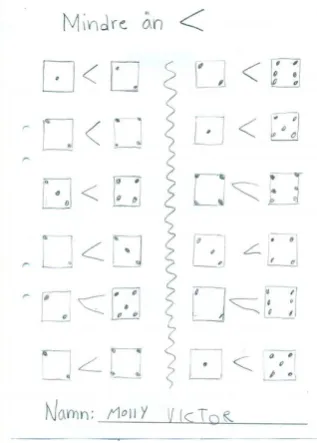
In the discussions of the concept of equality and the equals sign, one of the researchers suggested that Ms Adolfsson Boman could start with the signs for less than (<) and greater than (>) through a game with dice. In this game, the students are given only the sign for less than and are told to draw their throws on a worksheet so that the sign is correct.
Figure 1. This is a completed worksheet on which the students have drawn their throws so that the less than sign tells the truth. If they had thrown doubles, they threw again.
Sooner or later, some of the students will throw doubles. This is a situation that opens up for a teacher-initiated discussion: “What shall we do now?” “Can we use the less than sign?” “Is there another sign that we can use?”
The group of teachers in the project saw this as a perfect start for mathematics education for the first-graders in Ms Adolfsson Boman’s class. Because the teachers believed that the students, at least from pre-school, were familiar with the equals sign and its function, this game was not considered to be a key task. However, the students’ responses were unexpected. The first time that some of the students threw doubles and Ms Adolfsson Boman’s stopped and asked them “Can you use the less than sign now?” All the students shouted, “No!” However, when the she asked if they knew another sign that they could use, they said that they did not. “Well, what shall we do now,” Ms Adolfsson Boman’s asked. The students solved the problem: “We’ll throw again!” After a while, one of the students suggested that they could use another version of the less than sign but draw it in the opposite way – with these two signs together (< >), you have a sign that shows that the numbers are equal on both sides. It was not until later that two students said that they knew a sign for showing equality – the equals sign. The student drew two long parallel lines on the whiteboard.
International Journal for Mathematics Teaching and Learning 2017, Vol. 18.2, 257 - 272
263
long as the students’ found new aspects to learn, including helping to create new variations of the Dice Game task.
This task did provide the students the opportunity to explore and test their understanding of equality with a familiar tool – dice. At the same time, the teacher had the opportunity to explore the students’ understanding of equality following the students’ use of the symbols. Furthermore, the different expansions that the students suggested also gave the teacher signals regarding the various students’ levels of agency and their different methods of reasoning in a mathematical situation.
The Second Key Task: the Long Ago Country
One additional aspect of the Davydov tradition is the idea of creating a situation that draws upon the historical development of measuring things and determining equivalences. The second key-task was inspired by Dagmar Neuman’s (1986) mathematical program “The Long Ago Country”. Neuman is one of the few Swedish researchers inspired by Davydov
very early on. Neuman’s program was developed around a fantasy world where mathematics does not exist; in the Long-Ago Country, there are neither digits nor numbers. Because Neuman’s program is directed towards an arithmetic understanding, we adjusted it in relation to an algebraic situation, so instead of aiming at the students’ developing a need for numbers, Ms Adolfsson Boman adjusted it to prompt a need for deciding equivalences or un-equivalences without the need for numbers. In the Long-Ago Country, the King’s servants were paid with gold sand and fine oils. The Treasurer was responsible for these payments. In the given situation the servants never believed that they were paid equally. Thus, there were some problems to be solved – how to measure, how to compare, and if necessary, how to make equivalences. The students were invited to help the Treasurer. The students approached this problem in different ways. The starting point was when two servants had been paid with gold sand in two different bottles.
Ms Adolfsson Boman explained, in our discussions, that the students believed that the servants had been paid unequally. The students had to give examples of how to determine whether the Treasurer had been unfair. On a bench, there stood a cup, and in a half-closed cupboard, there was another cup of the same model. “We can use this,” one student suggested. “We count how many cups of gold sand each servant has,” said another. Ms Adolfsson Boman said, “But we can’t do that, we have no numbers”. One student suggested that they had to compare the cups. Ms Adolfsson Boman drew an image of two cups on the white board and asked what sign they could use if the cups were equal. The students suggested the equals sign. (Interview with Ms Adolfsson Boman 30 January 2013)
Sometimes, it seemed clear that the amount of gold sand or fine oil the servants received was distributed very unequally, but when the students found a way to measure the gold sand or the fine oil, they could see that even if it appeared unequal, it might actually be equal. In other situations, they could explore the opposite situation: even though the payments seemed equal, this was not always so. In this task, students also had the opportunity to develop an understanding of measurements and units. Together with the teacher, the students explored different ways of symbolising the different volumes they were working with. Furthermore, they could use the equals sign and the signs for less than and greater than.
International Journal for Mathematics Teaching and Learning 2017, Vol. 18.2, 257 - 272
264
Also, because the setting was “before the time of numbers”, the students had to find another solution (in this case, they drew lines on the board – also a cultural historical tool).
The Third Key Task: Algebraic Expressions
The third key task was designed with the help of relational materials – Cuisenaire rods. These rods, created by a Belgian teacher Georges Cuisenaire, consist of a set of ten differently coloured rods. Each colour represents a certain length ranging from 1 centimetre to 10 centimetres.
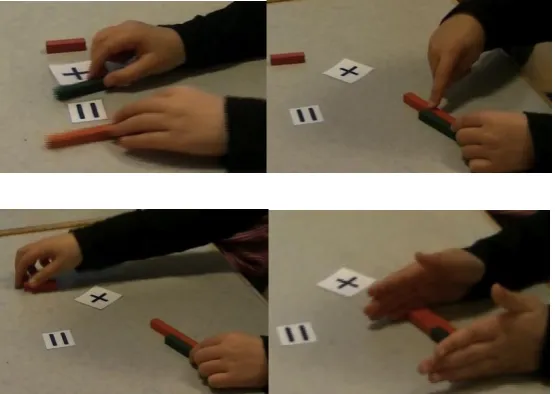
The teacher Ms Adolfsson Boman introduced the rods as a way to allow students to discuss various equalities, using one rod as the rod to be measured and using two or more other rods to make an equal quantity. Ms Adolfsson Boman suggested that they could name the rods by using the letters A, B, and C instead of the colours when they described the equalities they had constructed. During the discussion, the teacher asked the students “Which rod of yours is A?” After a while, the students suggested the rods could be named with other letters, and some of the students suggested that they could use their own initials – so William used W to denote one of the rods he used in an expression.
Figure 2. A yellow rod and a green rod used to express what equals a brown rod.
At the end of November, 16 of 28 students in Ms Adolfsson Boman’s class were interviewed. At the time of the interview, the students had only worked with the rods three or four times (approx. 2 hours in total). During the interview, the students were shown a card with the written algebraic expression A=B+C and asked if it was possible to write like this.
The students immediately responded that they could explain if they could use the Cuisenaire rods, the equal sign and the sign for addition (the table was full of various symbols on small cards and various materials, including the rods; see Figure 3).
Fia: Yes [with emphasis] it is… but then, we need to show with these [leans forward and pats the bag of Cuisenairerods].
International Journal for Mathematics Teaching and Learning 2017, Vol. 18.2, 257 - 272
265
Figure 3. The first setting of the interview – the card A=B+C and the Cuisenaire rods.
Fia’s words can be regarded as an indicator of her understanding that the written expression A=B+C could be represented by the rods and the sign cards.
The other students do as Fia does but with different-coloured rods. They take a longer rod to represent A and two shorter but different-coloured rods to represent B+C.
Student: “A black equals a yellow and a red … Firstly, I will name the black A and the yellow B and the red C. (Video-interview, 2012-11-16)
Figure 4. A girl demonstrating the expression and proving that it is correct.
International Journal for Mathematics Teaching and Learning 2017, Vol. 18.2, 257 - 272
266
When we show another expression M+N=P, a boy first starts to place the rods following the earlier expression A=B+C, but when he starts to read the expression to us, he notices the problem and rearranges the rods and the symbols for plus and equals.
Figure 5. A boy discovers a problem and succeeds in correcting it.
The first-graders (6-7 years old) could evidently transfer from a situation in which they had created different equalities with the Cuisenaire rods and named them with letters, to a situation in which they were presented with an algebraic expression in written form. The written expression was not experienced as abstract by these young students. They saw the expressions as models that could have different manifestations.
We also interviewed a group of students from the parallel class who had been following the textbook the teachers normally used. This textbook also introduces students to the equals sign and the signs for less than and greater than. When we showed them the same algebraic expression, A=B+C, and asked them “Is it possible to write like this?” the students answered that it looked like the alphabet, so it must be possible to write like that. The symbols for the plus and equals signs were not discussed or questioned. None of the students in the parallel class related the expression to mathematics.
In a follow-up interview in January, all but one of Ms Adolfsson Boman’s 28 students showed the ability to use and talk about equalities and the equals sign in a way that was in line with an algebraic understanding. In an algebraic understanding, the equals sign expresses a relationship, but according to many researchers, students often interpret it as a request to perform an action, for instance, to add or subtract two numbers (Cobb, 1987; Falkner & Falkner, 1999; Kieran, 1981). In the parallel class, one-third (of 28) showed abilities that matched those of the students in Ms Adolfsson Boman’s class. The other gave answers that indicated uncertainty. Most students showed an understanding of the equals sign as a symbol that requests an action.
The way in which the teacher used the Cuisenaire rods (representationally and not as a representation of base ten, as it is often the case) invited the students to explore both internal relationships and what could be described as an external relationship: internal when elaborating their “own” expression and external since they collectively attempted to represent the same algebraic expression using different combinations of rods. This work also gave the students the chance to further develop their understanding of the equals sign and algebraic relationships. They were also able to extend their mathematical reasoning to include proofs.
Discussion – Necessary Requirements for Tasks
International Journal for Mathematics Teaching and Learning 2017, Vol. 18.2, 257 - 272
267
for tasks that have the potential to enable students to engage in an algebraic learning activity.
A task should be designed to enable the joint extension of the content via unfolding, rather than several small, disparate items.
Because we did not use the full program and its carefully designed sequence of tasks that constitute the Davydov program, it was necessary to find a way to both supply the students with content-rich situations in which they could identify a problem and, at the same time, not predetermine a specific learning trajectory. That is, we wanted to enable student agency in terms of their courses of action (Waermö, 2016; Zittoun, 2009), enabling the task to unfold in different directions depending on their emerging understanding. We believe that a task must continue to be expanded as long as it is obvious that student joint actions maintain a zone of proximal development regarding the actual content (Rubtsov, 1991, 2013; Stetsenko, 1999). The task is useful as long as the students jointly identify new learning tasks to explore. Each task needs to have an inner contradiction(s) and the teacher needs to evoke the contradictions to sustain students’ collaborative work (Davydov, 2008). We have named the tasks that have the potential to function in this way ‘key tasks’ (Eriksson & Lindberg, 2007). Because the joint realisation of a learning activity is vulnerable (Davydov, 2008), the concept of key tasks could be useful as an intermediate design concept when attempting to identify a task that invites students to, jointly with the teacher, establish and participate in an activity in which student and teacher knowing develops gradually (Rubtsov, 1991, 2013).
The design of the task and its development should be related to what the students do or do not do and know or do not know. How the task develops is not solely
determined by the teacher but by the teacher in collaboration with the students.
The process of designing tasks that can enable students to engage in a learning activity is not restricted to carefully planning and analysing tasks before starting work in the classroom. The design of tasks is a process that continues based on the actual work in the classroom. The teacher must be attentive to the students’ work in order to discern new and/or unexpected ways for the content of the task to be further developed. Doing this also requires attentiveness to possible contradictions. As in the Dice Game, a task that was not initially designed to be a key task in the pilot project but in collaboration with the students, Ms Adolfsson Boman saw potential that was not planned for. The teachers expected the students to be familiar with the equals sign from their experience in preschool. However, from the classroom situation, it was evident that their earlier use of the equals sign did not transfer to the new situation. The students experienced the built-in contradiction as possible to solve in a totally different – and unexpected way. This gave Ms Adolfsson Boman indications about the students’ understanding of the sign. Thus, the task was expanded to a key task that over the course of a few weeks, was developed in different ways.
The task is designed to introduce a situation containing a problem that hinders the students from using familiar solutions but is still intriguing enough for them to try to solve using joint action.
International Journal for Mathematics Teaching and Learning 2017, Vol. 18.2, 257 - 272
268
using familiar solutions to solve the problem. The main contradiction was established since the given situation was a country were no numbers existed. In this key task, the aim was not to understand the equals sign but to identify different ways of deciding whether volumes of gold sand or fine oil in different containers were equal or not. The students were familiar with comparing volumes if containers were the same and it was possible to compare visually. In this situation, the students needed to identify the problem as one of measurement and units.
There are different perspectives regarding the functions of tools and representations. Tools can be regarded as mediators between the phenomenological world and the conceptual world, or, according to Radford, “artefacts do much more than mediate: they are a constitutive part of thinking and sensing” (2013, p. 8). Hence, our interaction with tools, artefacts, and cultural material should be considered as more than auxiliary elements. Tools influence cognition, and for the purpose of this chapter, they impact on mathematical knowledge. Development of mathematical ideas and concepts has been closely associated with development of technology that, according to Abramovich (2001), can be interpreted as cultural tools in contemporary educational practices. (Leung & Bolite-Frant, 2015: 191)
The tasks must contain problems that are content-rich and culturally and historically relevant.
The idea of measuring as core content in mathematics is thoroughly developed in the Davydov program and Vygotsky’s work (Schmittau, 2005). In our pilot project, the idea of using measurement as a source of content was therefore not a difficult choice in the design of the key tasks. However, if teachers want to design key tasks in relation to other content in mathematics or other subjects, the issue of how to find sources for content-rich and culturally and historically relevant problems with many possible contradictions, is of vital importance (see also Eriksson & Lindberg, 2016).
All human activities are understood as historically developed, with layers of traditions, rules, and values built into them, mostly in a tool-mediating form (Stetsenko & Arievitch, 2002. Thus, the key to and perhaps the most generative idea in activity theory is related to mediating tools (Wertsch, 1998). Tools are culturally and historically developed in relation to human beings’ efforts to master the world in different ways, perhaps for problem solving or exploration in relation to trading, crafts, learning, playing, etc. When attempting to accomplish various activities, some culturally mediating tools are always involved. The tools we use are tangible, intangible, or both tangible and intangible in various combinations. Our most powerful tools are our language and symbols. By developing and using tools, we also build on our experience of how to solve problems. This means that human knowledge is built into the tool-mediated activities we engage in and is thus also constantly changing and transforming. Consequently, the implications for teaching are that instead of viewing knowledge as inert facts or concepts to be learned (often memorised) or as empirical procedures to be learned (often by repetitive exercise), knowledge can be regarded as built into our tool-mediated activities.
International Journal for Mathematics Teaching and Learning 2017, Vol. 18.2, 257 - 272
269
Students can discern the specific core principle of a concept and its conceptual relations, symbol, or model by identifying concrete instances of the theoretical knowledge.
In the Algebraic Expressions key task, students managed to transfer from a situation in which they had created equalities with the Cuisenaire rods and named them with letters, to a situation in which they were presented a written algebraic expression. They were able to represent the written expression A=B+C with the rods and sign cards. Furthermore, there were also examples of students proving or correcting their expression through their senses and material activity with the rods. The multimodal character of thinking in terms of action and objectification is evident in the students’ work, which is written expression, verbal expressions, the organisation and reorganisation of the rods and sign cards, and gestures. From a cultural historical perspective, concepts may be regarded as cultural codifications of human labour and thus as intrinsically multimodal (Radford, 2014). Radford argues that concepts, in order to become objects of thought and consciousness, must be set in motion, and thus, their multimodal nature is actualised in sensuous and material activity. Importantly, the students’ work with concepts in relation to the rods can, from a cultural-historical perspective, be seen as part of sensuous cognition, in line with Radford (2014). The rods are not merely stimulating concrete materials but a dimension of sensuous cognition that can be regarded as both ideational and material, in line with, for example Illyenkov (1977).
Conclusions
The pilot project aimed to explore some of the task-design principles of the Davydov program and the learning activity, without a full-blown implementation of the program. From interviews and tests, we found that the students, during their first semester, developed the ability to reason regarding equality and algebraic expressions in a rather robust way. When analysing the tasks used in the pilot project, we can see that even if the students’ understanding of equality and the equal sign developed positively, the task could be further elaborated upon and expanded. However, we can conclude that it may be helpful to develop single tasks inspired by the Davydov program and the learning activity. That is, the teacher can take advantage of the research and experiments that Davydov and Elkonin began more than 50 years ago and many researchers, both in Moscow and elsewhere, have continued to develop.
International Journal for Mathematics Teaching and Learning 2017, Vol. 18.2, 257 - 272
270
is to be learned, but at the same time, they must be engaged in qualifying work in which learning is an outcome. Thus, the teacher must ensure that the students can work in a zone of proximal development (Davydov, 2008).
It is against the background of issues such as this that the requirements identified in this article should be understood. The requirements that we have identified are, of course, not exhaustive or even proven to be sufficient to guide teachers who want to design teaching in line with the Davydov program. Furthermore, we would like to acknowledge the vast knowledge concerning task design that has been developed over the last few decades (see, e.g., Watson & Ohtani, 2015). There are many researchers who, in relation to various traditions, have established ambitions and models to address issues similar to the Davydov program. In the future, these various approaches must be compared and discussed. The French tradition, with its roots in Brousseau’s work on the Theory of Didactical Situations (Brousseau, 1997), is one example showing many similarities with the Davydov program and learning activity theory. Furthermore, there is growing interest in task design framed by activity theory traditions, which must also be taken into account (Radford, 2013).
Acknowledgments
This project was made possible thanks to Stockholm University, and the principal and the teachers of Skärsätra School, Lidingö.
References
Adolfsson Boman, M., Eriksson, I., Hverven, M., Jansson, A. & Tambour, T. (2013). Att introducera likhetstecknet i ett algebraiskt sammanhang (Introducing the equal sign within an algebraic context).
Forskning om undervisning och lärande, 10, 29-49.
Anderson, T., & Shattuck, J. (2012). Design-based research: A decade of progress in education research?
Educational Researcher, 41(1), 16–25.
Adams, P. (2008). Considering 'best practice': The social construction of teacher activity and pupil learning as performance. Cambridge Journal of Education, 38(3), 375-392.
Brousseau, G. (1997). Theory of didactical situations in mathematics: Didactique des mathématiques, 1970– 1990. In N. Balacheff, M. Cooper, R. Sutherland & V. Warfield. Dordrecht: Kluwer Academic Publishers.
Brown, A. L. (1992). Design experiment: Theoretical and methodological challenges in creating complex interventions in classroom settings. The Journal of the Learning Sciences, 2(2), 141-178.
Chaiklin, S. (2002). A developmental teaching approach to schooling. In G. Wells & G. Claxton (Eds).
Learning for life in the 21st century. Oxford, UK: Blackwell Publishers.
Cobb, P. (1987). An investigation of young children’s academic arithmetic contexts. Educational Studies in Mathematics, 18, 109-124.
Cobb, P., Confrey, J., diSessa, A., Lehrer, R., & Schauble, L. (2003). Design experiments in educational research. Educational Researcher, 32, 9-13.
Davydov, V. V. (2008). Problems of developmental instruction: A theoretical and experimental psychological study. New York: Nova Science Publishers, Inc.
Dougherty, B. (2004). Early algebra: Perspectives and assumptions. For the Learning of Mathematics, 24(3), 28-30.
Elliot, J. (1991). Action research for educational change. Milton Keynes: Open University Press.
Eriksson, I. (2015). Constitution of objects in DWR activity. In T. Hansson (Ed.) Contemporary approaches to activity theory.Interdisciplinary perspectives on human behavior. USA: IGI Global. (pp. 304-321). Eriksson, I. & Lindberg, V. (2016). Enriching ‘learning activity’ with ‘epistemic practices’ - enhancing
International Journal for Mathematics Teaching and Learning 2017, Vol. 18.2, 257 - 272
271
Eriksson, I. & Lindberg, V. (2007). Matematikundervisningens innehåll (The content of mathematical education). Avrapportering av ett kollaborativt forskningsprojekt om att utveckla redskap och innehåll i arbetet med att realisera strävansmålen i matematik. Lärarhögskolan i Stockholm.
Engeström, Y. (2011). From design experiments to formative interventions. Theory & Psychology,21(5), 598 - 628.
Falkner, L. & Falkner, K. P. (1999). Children’s understanding of equality: A foundation for Algebra.
Teaching Children Mathematics, 6(4), 232-237.
Harn, B., Parisi, D. & Stoolmiller, M. (2013). Balancing fidelity with flexibility and fit: What do we really know about fidelity of implementation in schools? Exceptional Children, 79(2), 181-193.
Hattie, J. (2009). Visible learning: A synthesis of over 800 meta-analyses relating to achievement. London: Routledge.
Illyenkov, E. V. (1977). The concept of the ideal. Philosophy in the USSR: Problems of dialectical materialism (pp. 71-99). Moscow: Progress.
Kieran, C. (1981). Concepts associated with the equality symbol. Educational Studies in Mathematics, 12, 317-326
Kinard, J. T., & Kozulin, A. (2008). Rigorous mathematical thinking: Conceptual formation in the mathematics classroom. Cambridge: Cambridge University Press.
Leontʹev, A. N. (1978). Activity, consciousness, and personality. Englewood Cliffs, NJ: Prentice-Hall.(Original work published 1975)
Leung, A., & Bolite-Frant, J. (2015). Designing mathematics tasks: The role of tools. In A. Watson & M. Ohtani, (Eds), Task design in mathematics education: An ICMI study 22. Berlin: Springer.
Neuman, D. (1989). Räknefärdighetens rotter (The roots of counting) Stockholm: Utbildningsförlaget Radford, L. (2012). On the development of early algebraic thinking. PNA, 6(4), 117-133.
Radford, L. (2013). Sensuous cognition. In D. Martinovic, V. Freiman, & Z. Karadag (Eds.), Visual mathematics and cyber learning (pp. 141-162). New York: Springer.
Radford, L. (2014). The progressive development of early embodied algebraic thinking. Mathematics Education Research Journal, 26(2), 257-277.
Repkin, V.V. (2003). Developmental teaching and learning activity. Journal of Russian and East European Psychology, 41(5) 10-33.
Rubtsov, V. (1991). Learning in children: Organization and development of cooperative actions. NY, Nova Science Publishers, Ins.
Rubtsov, V. (2013). The concept of joint activity as a unit of activity theory. Presented ISCAR summer school.
Schmittau, J. (2003). Cultural-historical theory of mathematics education. In A. Kozulin, B. Gindis, V. S. Ageyev & S. Miller (Eds) Vygotsky’s educational theory in cultural context (pp. 225-245). Cambridge University Press.
Schmittau, J. (2004). Vygotskian theory and mathematics education: Resolving the conceptual-procedural dichotomy. European Journal of Psychology of Education, XIX (I), 19-43.
Schmittau, J. (2005). The development of algebraic thinking. A Vygotskian perspective. ZDM, 37(1), 16-22. Schmittau, J. & Morris, A. (2004). The development of algebra in the elementary mathematics curriculum of
V.V. Davydov. The Mathematics Educator, 8(1), p. 60-87.
Sophian, C. (2007). The origins of mathematical knowledge in childhood. Lawrence Erlbaum Associates. Stetsenko, A. (1999). Social interaction, cultural tools, and the zone of proximal development: In search of a
synthesis. In M. Hedegaard, S. Chaiklin, S. Boedker, & U. J. Jensen (Eds.), Activity theory and social practice (pp. 235-253). Aarhus: Aarhus University Press.
Stetsenko, A. & Arievitch, I. (2002). Teaching, Learning, and Development: A Post-Vygotskian Perspective. In G. Wells & G. Claxton (Eds). Learning for Life in the 21st Century: Sociocultural Perspectives on the Future of Education (pp. 84-96). Oxford, UK: Blackwell Publishers Ltd.
Stigler, J. & Hiebert, J. (1999). The teaching gap. Best ideas from the world’s teachers for improving education in the classroom. New York: The Free Press.
Van den Akker, J. (1998). The science curriculum: Between ideals and outcomes. In B. Fraser & K. Tobin (Eds.), International Handbook for Science Education. Dordrecht, The Netherlands: Kluwer Academic Publishers.
Veneciano, L. & Dougherty, B. (2014). Addressing priorities for elementary school mathematics. For the Learning of Mathematics, 34, 1.
Vygotskij, L. (1963/1934). Learning and mental development at school age. In B & J Simon (Eds)
International Journal for Mathematics Teaching and Learning 2017, Vol. 18.2, 257 - 272
272
Watson, A. & Ohtani, M. (red.) (2015). Task design in mathematics education: An ICMI study 22. Berlin: Springer.
Waremö, M. (2016). Enculturation into inclusion, protecting what ‘is’, and changed acting: Exploring children’s break-time table tennis playing. Learning Culture and Social Interaction.
Wertsch, J. V. (1998). Mind as action. New York: Oxford University Press.
Wiliam, D. (2011). Embedded formative assessment. Bloomington, IN: Solution Tree Press.
Zittoun, T. (2009). Dynamics of life-course transitions – A methodological reflection. In J. Valsiner, P. C. M. Molenaar, M. C. D. Lyra, & N. Chaudhary (Eds.), Dynamic process methodology in the social and developmental sciences (pp. 405–430). New York: Springer.
Zuckerman, G. (2004). Development of reflection through learning activity. European Journal of Psychology of Education, XIX (1), 9-18.