S&T Collaboration Platform for Higher Education Institutions and Industry: a
Case Study of Wenzhou, China
Feiyu Chen, Chong Wu, Weining Yang, Wei Zhang
Harbin Institute of Technology 92 West Dazhi Street, Harbin, China e-mail: [email protected]
http://dx.doi.org/10.5755/j01.ee.24.5.2591
Collaboration between higher education institutions and industry seems to have become increasingly important for the industrialized countries. To realize the maximized profits through such collaborations, it is important to have a fruitful and healthy collaboration. S&T collaboration platform in Wenzhou, China, is a new fashioned form. This paper analyzes the collaboration relationship and explores the influence of collaboration on private SMEs. Based on a survey of 523 private SMEs and 61 higher education institutions, the results indicate that private SMEs can improve economic performance through the collaborations with higher education institutions on the platform. Furthermore, the economic performance of private SMEs is positively related with the collaborated projects. In other words, the number of the collaboration projects is one of the factors that affect the economic performance (i.e. the more collaboration, the better economic performance). The results have also revealed that SMEs that choose different collaboration models on the platform will produce different effects on the economic performances of enterprises. In addition, the major barriers to the collaboration have been analyzed from two perspectives in this study. Among all the collaboration barriers between universities and private SMEs, “Lack of efficient communication channel” and “Unreasonable transfer cost for the R&D achievements of universities” have been identified as the most important factors. Meanwhile, the performances of the five communication mechanisms (i.e. coordination mechanism, supervision mechanism, transmission mechanism, propaganda mechanism and guarantee mechanism) have also been examined with the aim of devising policies and proposing a possible solution to improve the collaboration efficiency between higher education institutions and industry.
Keywords: Higher education institutions-Industry collaboration, S&T collaboration platform, Higher education institutions, Universities, Communication mechanisms.
Introduction
Collaboration between industry and higher education institutions plays an increasingly important role in the economic development of European countries as well as in China, a new industrialized country (Guan & Brockhoff, 1994). In the new industrialized countries, particularly, as the economy and technological capabilities improve, higher education institutions are expected to play a role in supporting indigenous enterprises towards a move into more dynamic industries (Mathews & Hu, 2007; Mazzoleni & Nelson, 2007; Wu, 2007). In today’s highly competitive environment, the ability to keep up with technological progress and continuous innovation is vital for the survival and growth of an enterprise. Nonetheless, it is very difficult for enterprises, especially for SMEs, to develop new technologies and entirely rely on their own capabilities; this is due largely to the limited expertise and resources (Sungjoo & Gwangman, 2010). Motohashi (2005) finds that SMEs which are active in high-technology sectors achieve higher productivity via higher education institution-industry collaboration.
There is widespread recognition that collaboration between higher education institutions and industry should be strengthened and improved in order to meet the growing demand for enterprise development (Richard et
al., 2005). According to Li (2000), collaboration between industry and higher education institutions is helpful to reduce the cost of R&D as well as the risks, and promoting the higher education institutions and enterprises to share resources and achieve complementary capability. Through the collaboration with higher education institutions, enterprises can also reduce uncertainty from the innovation process, expand markets, as well as gain new expertise and skills, which will in turn allow them to keep up with the development of scientific knowledge (Hagedoorn et al., 2000; Lee, 2000; Fritsch & Lukas, 2001). For most countries, such collaborations have become more and more important to the economic development of the area. For instance, the number of such collaboration in Canada has increased twice from 1980 to 1995 (Godin & Gingrasr, 2000).
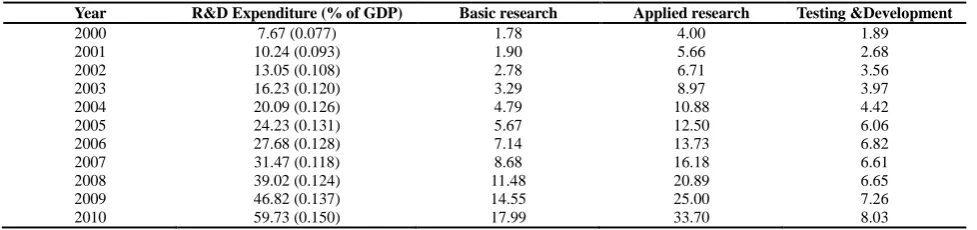
from 7.67 billion RMB in 2000 to 59.73 billion RMB in 2010, an increase of nearly 8 times within 11 years. Chinese higher education institutions conduct both basic research and applied research. Table 2 indicates that the expenditure supporting applied research is larger than that supporting basic research and testing research. This trend becomes more and more obvious in recent years. In 2010, the applied research expenditure has accounted 56.4 % of the total, which indicates the emphasis of the applied
research in China. According to Dasgupta and Paul (1994), higher education institutions are primarily driven to create new knowledge and to provide education, while, private enterprises are focused on capturing valuable knowledge that can be leveraged for competitive advantages. However, higher education institutions today should take more responsibilities to transfer S&T achievements to the industry in answer to the rapid market demands (Spyros et al., 2008).
Table 1
R&D information of six countries
Country R&D Expenditure/GDP (%) The Average Annual Rate of Growth (%)
2002 2009
China 1.07 1.70 24.02
USA 2.66 2.90 6.59
Japan 3.17 3.36 2.04
UK 1.82 1.86 4.48
France 2.23 2.26 3.20
Germany 2.49 2.82 3.34
Source: China Statistical Yearbook on Science and Technology (2011)
Table 2
Distribution of higher education institutions R&D expenditure
Year R&D Expenditure (% of GDP) Basic research Applied research Testing &Development
2000 7.67 (0.077) 1.78 4.00 1.89
2001 10.24 (0.093) 1.90 5.66 2.68
2002 13.05 (0.108) 2.78 6.71 3.56
2003 16.23 (0.120) 3.29 8.97 3.97
2004 20.09 (0.126) 4.79 10.88 4.42
2005 24.23 (0.131) 5.67 12.50 6.06
2006 27.68 (0.128) 7.14 13.73 6.82
2007 31.47 (0.118) 8.68 16.18 6.61
2008 39.02 (0.124) 11.48 20.89 6.65
2009 46.82 (0.137) 14.55 25.00 7.26
2010 59.73 (0.150) 17.99 33.70 8.03
Source:China Statistical Yearbook on Science and Technology (2011) Unit: Billion RMB
In fact, most countries have tried their best to promote and strengthen the collaboration between industry and higher education institutions (Etzkowitz & Leydesdorff, 2000). Accordingly, a large number of researchers coming from different countries have paid great attention on this research. Hall et al., (2001) reveal and analyze barriers inhibiting industry from collaborating with higher education institutions. Bruneel et al., (2010), investigate the factors which diminish the barriers to the collaboration between industry and higher education institutions. Rees (1991) also suggests that there is great potential for many countries to increase collaborations between industry and higher education institutions.
Although the collaboration between higher education institutions and industry is conducive to reducing the cost of R&D, decentralizing risks, and making these organizations share resources, most researchers agree that because of the lack of direct connections between higher education institutions and industry on a lot of R&D projects, the economic return for most collaborated projects is unsatisfactory. According to the statistics, in China, about 85 % of R&D projects aiming at industrial production fail to make it to the market.
In China, the government has made great efforts to encourage universities and enterprises to enhance the collaboration to meet the growing market demand, such as
the S&T collaboration platform of Wenzhou, China. Meanwhile, more and more Chinese enterprises begin to increase the higher education institution-industry collaborations, and these collaborations accordingly will create a great impact on the development of the enterprise. This paper, with special reference to Wenzhou, China, explores the influence of higher education institution- industry collaborations on the SMEs in China.
In order to examine the effect of the collaboration, this paper proposes the two following hypotheses:
H1: Private SMEs can improve economic performance through the collaboration on the platform.
H2: Different collaboration models will bring about different economic performances on SMEs.
The five collaboration models on the platform are also discussed in this paper as well as the major barriers to the collaborations and the five communication mechanisms are examined in order to propose suggestions to improve the collaboration efficiency.
Methodology
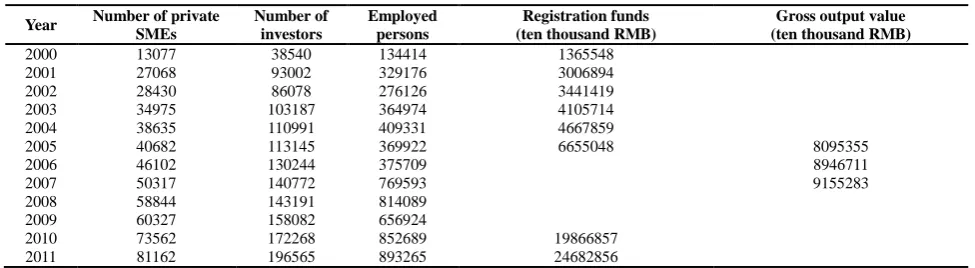
private SMEs increase almost six times from 2000 to 2011, and the number of investors and registration monetary has risen sharply. In 2011, the total amount of SMEs has reached more than 300,000. According to statistic year books, private SMEs in Wenzhou have produced 10 % of the total clothing, 20 % of the total shoes, 60 % of the total razor, 65 % of the locks, 80% of the glasses, 90 % of the metal lighter and 90 % of the watercolor pens for China. Low-voltage electrical equipments, hardware, auto parts, ceramic products also occupy a remarkable market share. Accordingly, Wenzhou is the most active private economic city. Therefore, this study takes Wenzhou as a sample.
A survey of Chinese manufacturing industries in Wenzhou was conducted in 2009. With the help of Wenzhou Science and Technology Bureau, questionnaires were sent to 680 private SMEs, 69 universities and other types of institutes including technical secondary schools, junior colleges, vocational technical institutes, etc. in
Wenzhou Area (see Table 4). People surveyed were working in the enterprise related departments or at the technology transfer office of higher education institutions. They participated and answered a questionnaire about their innovation and collaboration situation from 2006 to 2008.
Before the mass survey, pilot tests were conducted in some enterprises. According to their feedback, the questionnaire was revised to improve its clarity. As a result of mass survey, the response rates were relatively higher than most similar studies in Western countries with 89.1 % and 94.2 % for private SMEs and higher education institutions respectively. Our corresponding effective response rates are 86.3 % and 93.8 %.
There are numerous measurement methods about economic performance indicators of SMEs. In this paper, the SMEs’ economic performance is measured by the average sales per person and the average profits per person.
Table 3
Distribution of private SMEs in Wenzhou
Year Number of private SMEs
Number of investors
Employed persons
Registration funds (ten thousand RMB)
Gross output value (ten thousand RMB)
2000 13077 38540 134414 1365548
2001 27068 93002 329176 3006894
2002 28430 86078 276126 3441419
2003 34975 103187 364974 4105714
2004 38635 110991 409331 4667859
2005 40682 113145 369922 6655048 8095355
2006 46102 130244 375709 8946711
2007 50317 140772 769593 9155283
2008 58844 143191 814089
2009 2010 2011
60327 73562 81162
158082 172268 196565
656924 852689 893265
19866857 24682856
Source: Wenzhou Statistical Yearbook (2011)
Table 4
Distribution of higher education institutions in Wenzhou
Type Number Name
University 16 Tsinghua University, Zhejiang University, Tianjin University, Wenzhou University, Harbin Institute of Technology, Northwestern Polytechnical University …
Technical Secondary School &
Junior College 23
Wenzhou Radio & Television College, Zhejiang DongFang Vocational & Technical College, Wenzhou University Oujiang College …
Vocational Technical Institute 30 Wenzhou Vocational & Technical College, Zhejiang Industry & Trade Vocational College, Wenzhou University City College …
Significance of S&T Collaboration Platform
for Higher Education Institutions and Private
SMEs
Most researchers suggest that the best choice for private SMEs to promote innovation is to establish collaborations with higher education institutions, and this method has become more and more attractive (Li, 2000). Table 5 shows that in China, the funds for higher education institutions usually come from government support or enterprises investment. From 2003 to 2010, financial support from government is higher than that from enterprises. But the funds from enterprises have increased year by year, and have reached 19.85 billion RMB, which indicates a frequent and benignly collaboration between SMEs and higher education institutions. Table 6 shows that the expenditures
Table 5
Sources of R&D funds in higher education institutions
Source of R&D funds in higher
education institutions 2003 2004 2005 2006 2007 2008 2009 2010
Enterprises funds 5.83 7.45 8.89 10.12 11.03 13.49 17.17 19.85
Government funds 8.77 10.88 13.31 15.15 17.77 22.55 26.22 35.88
Source: China Statistical Yearbook on Science and Technology (2011); Unit: Billion RMB
Table 6
Data of collaboration between SMEs and higher education institutions
Expenditures purchasing domestic R&D achievements (billion RMB)
Patents transferred from universities (item)
Turnover of Patents Transferred (million RMB)
China 22.14 1810 359.43
Eastern China 10.78 1062 255.85
Middle China 2.37 424 53.39
Western China 8.99 324 50.18
Source: China Statistical Yearbook on Science and Technology (2011)
Collaboration Platforms of Higher Education Institutions
According to statistics, there are many collaboration forms between SMEs and higher education institutions in China, such as the , the directly contact between SMEs and higher education institutions, collaboration led by local government, R&D achievement transaction by social agents, collaboration platforms of higher education institution, etc. The first three forms are all relatively traditional collaboration forms. Although they prevail for a long time, there are still some shortages.
In China, the collaboration platform conducts R&D achievements transfer between SMEs and higher education institutions. Its function is similar to technology transfer offices of universities in western countries. However, compared with technology transfer offices, collaboration platform has the government support.
Technology transfer office is a common form of S&T achievements transfer in higher education institutions in
the USA (Dylan & Magnus, 1999). Currently, there are more than 200 universities that have established their own R&D achievements transfer office in the USA; since 1985, British technology group has lost their monopoly control to the knowledge patents, and then many universities began to set up technology management organizations to promote R&D achievements transfer. In China, more and more higher education institutions begin to set up their own collaboration platform. Lots of top universities in China set up R&D achievements transfer office in Wenzhou, such as Tsinghua University, Zhejiang University, Harbin Institute of technology, etc.
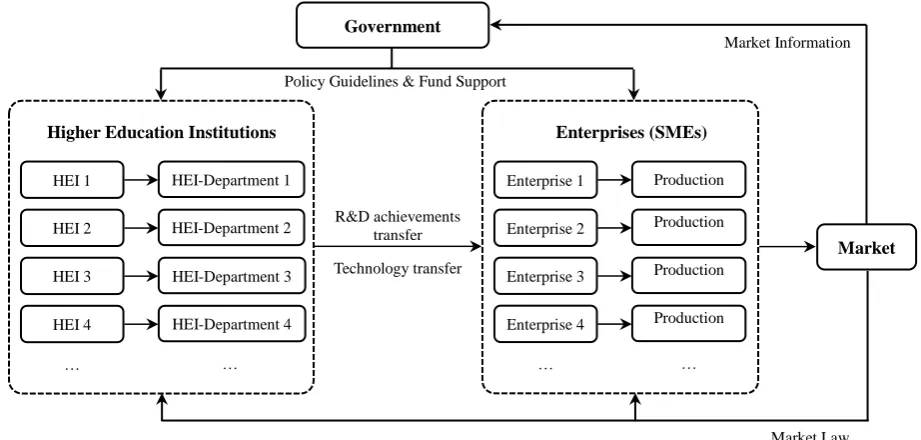
Compared with the traditional collaboration forms, platform takes some advantages. Characteristics of this S&T achievements transfer will be analyzed through the case studies in Wenzhou. The relationship between higher education institutions, SMEs and local government can be represented in Figure 1.
Figure 1. The framework of S&T collaboration platform for private SMEs and Higher education institutions in Wenzhou
Market Government
HEI 1 HEI-Department 1
Higher Education Institutions
HEI 2 HEI-Department 2
HEI 3 HEI-Department 3
HEI 4 HEI-Department 4
… …
Enterprise 1 Production
Enterprises (SMEs)
Enterprise 2 Production
Enterprise 3 Production
Enterprise 4 Production
… …
R&D achievements transfer
Technology transfer Policy Guidelines & Fund Support
Market Law Market Information
This framework reflects the real connections of S&T collaboration platform between private SMEs and higher education institutions in Wenzhou. The framework encompasses both the relationship within the collaboration and the role of government. On the one hand, higher education institutions transfer their R&D achievements and technologies, which are mainly financially supported and guided by government, to enterprises. On the other hand, SMEs rely on both R&D achievements and technology from higher education institutions as well as on their own in-house R&D. In addition, the government also plays an intermediate role in the whole process. Local government provides supporting measures for the collaboration platform, such as offices for higher education institutions and arrangements for their employees’ accommodation in Wenzhou. With the help of this platform, private SMEs can seek partnership with any higher education institutions, and each higher education institution can look for collaboration with any private SMEs. Higher education institution offices are windows to SMEs and will always be regarded as “a small collaboration platform” to sell its R&D achievements. Meanwhile, the related departments of higher education institutions which include R&D achievement transfer office, industrial research laboratory, S&T achievement commercialization department, etc. are all involved in the R&D achievement and technology transfer.Obviously, the collaboration platform is a complicated network rather than a simple linear structure, which endows more choices and flexibility to both private SMEs and higher education institutions because both parties can choose proper themes to collaborate in accordance with their own special condition. In addition, private SMEs and higher education institutions can cooperate with multi-entities involved on this platform, through which the efficiency has been improved significantly. R&D achievement commercialization is realized on this platform. Higher education institutions take full advantage of their science and technology strength to develop new
technologies, transfer these new technology to the collaboration platform and then private SMEs add commercialized value to these technologies, using advanced technology to product, thus a commercialization process is completed (Motohashi & Kazuyuki, 2005). Furthermore, when these products enter the marketplace, accordingly, the related market information (for example, technology novelty, customer satisfaction, economic performance of the products, etc.) is fed back to the related government departments. That will help government make the policies and suggestions for further collaborations. Meanwhile, the market performance (including the market demand of the new product and the customer satisfaction) is also fed back to the higher education institutions and enterprises. Based on this information, SMEs and higher education institutions will make their own decision respectively for the current transfer as well as for further collaborations.
On the collaboration platform, five collaboration models and major barriers to the collaborations are examined in this study with the purpose to make policies and suggestions to improve the collaboration efficiency.
Analysis of Economic Performance of Collaboration on the Platform
In order to test hypothesis H1: “Private SMEs can improve economic performance through the collaborations with higher education institutions on the platform”, the private SMEs were divided into the following two groups: enterprises with collaborations and enterprises without collaborations. To guarantee that the two groups are identical except for the collaboration conditions, a stratification and random sampling technique was used in this survey. (In addition, these data were derived from the pilot tests). Meanwhile, an independent sample T-test was used between the two groups. J1 represented the average sales per person and J2 the average profits per person. J1 and J2 were used as economic performance indicators of SMEs.
Table 7
Comparison of economic performances for the two groups of enterprises by T-test
Performance Group with collaboration
Group without
collaboration T-value Significance
Average sale per person (J1) 231.62 184.68 2.142 S (0.044)
Average profit per person (J2) 24.48 20.65 2.109 S (0.047)
Unit: Thousand Yuan in RMB
The results in Table 7 show that there are significant differences in respect to both J1 and J2 between the two groups. Also, the figures of J1 and J2 for the group with collaboration are higher than those without collaborations. It indicates that the economic performances of the enterprises with collaborations are better than those without collaborations, and there are significant differences between them in the statistical terms. Consequently, the results support Hypothesis 1. The analysis result is expected to be in accord with the purpose of the collaborations.
Hypothesis 1 (“Private SMEs can improve economic performance through the collaborations on the platform”) is proposed on the basis of the expectation that the
collaborations with higher education institutions could improve the development of enterprises and bring significant influence on economic performance. In other words, Hypothesis 1 is equal to the fact that the more collaborations between higher education institutions and private SMEs, the better economic performance of enterprises.
The correlation coefficients between collaborated projects and economic performance are calculated and the results are shown in Table 8.
and economic performance. It can also be found that economic performance is positively correlated with the collaborated projects. This finding is consistent with the results in Table 7, where economic performances of the
enterprises with collaborations are better than those of the enterprises without collaborations. Accordingly, the result again supports the Hypothesis 1.
Table 8
Pearson correlation analysis between collaborated projects and economic performances
Economic performance Pearson Correlation Coefficients S/NS
J1 0.380* S
J2 0.260* S
The values in the table are correlation coefficients (p-values).
*. Correlation is significant at the 0.05 level (two-tailed).
Analysis of Collaboration Models and Barriers
of Collaboration Platforms
Distribution of Collaboration Models
On the collaboration platform for the private SMEs and higher education institutions, the five collaboration models are identified as follows (Peter & Fusfeld, 1982):
(1) MODEL I: SMEs purchase R&D achievements directly from higher education institutions;
(2) MODEL II: SMEs develop R&D achievements in collaboration with higher education institutions;
(3) MODEL III: SMEs entrust R&D tasks to higher education institutions;
(4) MODEL IV: SMEs establish R&D organizations with higher education institutions;
(5) MODEL V: SMEs employ technological personnel from higher education institutions.
Table 9 shows the respective choices that private SMEs and higher education institutions hold towards these five collaboration models. All the private SMEs and higher education institutions surveyed have had collaborations on the platform. In order to compare the economic performances of the five collaboration models respectively, this paper selects some special enterprises as the study object. These enterprises only chose one collaboration model. Therefore, seen from the perspectives of two subjects of the collaboration platform, the results indicate the differences as well as pros and cons of these five models.
Table 9
Distribution of different collaboration models
Model Private SMEs (N = 523) Higher education institutions (N = 61)
Number (%) Ranking Number (%) Ranking
MODEL I 99 (19%) 3 9 (14.8%) 4
MODEL II 198 (37.9%) 1 23 (37.7%) 1
MODEL III 38 (7.3%) 4 4 (6.6%) 5
MODEL IV 16 (3%) 5 10 (16.4%) 3
MODEL V 146 (28%) 2 12 (19.7%) 2
From the perspective of private SMEs, MODEL IV ranks last among all the models because most private SMEs are not capable of setting up R&D organizations with higher education institutions due to the limitation of capital and scale, Furthermore, few enterprises choose MODEL I or MODEL III with 19 % and 7.3 % respectively in the overall proportion because on one hand, the lack of relevant information and effective communication makes it difficult for the enterprises in China to directly absorb and commercialize technology developed by higher education institutions; on the other hand, the research in the Chinese higher education institutions mainly focuses on the theory other than the practical experience. Therefore, the R&D achievements are rather knowledge-oriented than market-oriented. As a result, the enterprises can’t guarantee the market value of the achievements even if they purchase R&D achievements directly from higher education institutions or entrust tasks to higher education institutions.
From the perspective of higher education institutions, MODEL III accounts for the least proportion among all with only 6.6 %. Different from enterprises, higher education institutions focus on the technology itself and pay little attention to the actual application and market efficiency in their research and development. If entrusted by
the enterprises to be fully responsible for the technology research and development, the higher education institutions are unable to ensure whether their achievements will meet the needs of the enterprises and achieve the expected market objectives. Therefore, there are some difficulties in adopting this model. Meanwhile, similar to that of private SMEs, universities seldom choose MODEL I, with the proportion accounting for 14.8 %.
It can be seen from Table 9 that most private SMEs and higher education institutions show preference to MODEL II, with 37.9 % and 37.7 % respectively. In this collaboration model, the objectives of enterprises as well as higher education institutions are identical, including both technological concerns and market concerns. In addition, both sides of the cooperation can realize mutual complements in resources on their own superiority (Mansfield & Lee, 1996). Furthermore, MODEL II represents a process of two-way learning and two-way benefits (Bougrain & Haudeville, 2002).
the comparison on economic performances of the five collaboration models by ANOVA.
The formula is as follows:
Profit Growth Rate per Person = (N1 - N2)/ N2
where N1: is the average profits per person with collaboration.
N2: is the average profits per person without collaboration.
Table 10
Comparison of economic performances of the five collaboration models by ANOVA
Sum of Squares df Mean Square F Sig.
Between Groups 28.155 4 7.039 40.397 0.000
Within Groups 85.727 492 0.174
Total 113.882 496
It can be seen from Table 10 that the Column Sig. indicates the likelihood of an F-ratio, the size that obtained by chance. In Table 10, there is a probability of 0.000 that an F-ratio would occur by chance. Because the observed significance value is less than 0.05, we can see that there is significant effect of the economic performance. In other words, there are significant differences with respect to Profit Growth Rate per Person among the five collaboration models. From the above results, it is evident that private SMEs choose different collaboration models which will produce different effects on economic performances of enterprises. Thus, the hypothesis H2: “Different collaboration models will bring about different economic performances on SMEs” makes sense.
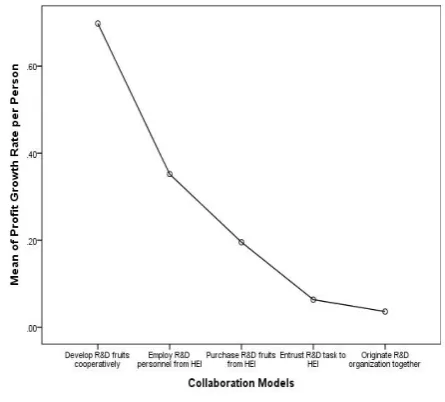
In Table 11, each group of participants is compared to all of the remaining groups. In the same way, the growth rate of the profit per person is used as the indicator of economic performance of private SMEs. For each pair of groups, the difference between group means and the standard error of that difference are displayed. And then, the group of MODEL II is compared to the remaining groups and there are significant differences. (Sig. are all less than 0.05), and so is the result of group of MODEL V. The other three groups only respectively have significant differences with the two groups of MODEL II and MODEL V and there are non-significant differences between the rest three groups. According to the means plots (See Figure 2), we can see that MODEL II and
MODEL V have greater positive effects on the economic performance of private SMEs. Meanwhile, the effect of the other three models is not so significant in the improvement of the economic performance of private SMEs. These results are in consistent with the findings in Table 9, where the respective choices of collaboration models by private SMEs and higher education institutions have been described.
Figure 2. Means Plots
Table 11
Multiple comparisons of economic performances of the five collaboration models
(I) collaboration models (J) collaboration models Mean Difference (I-J) Std. Error Sig.
MODEL II MODEL V 0.34623* 0.04554 0.000
MODEL I 0.50270* 0.05138 0.000
MODEL III 0.63470* 0.07393 0.000
MODEL IV 0.66204* 0.10849 0.000
MODEL V MODEL II -0.34623* 0.04554 0.000
MODEL I 0.15646* 0.05435 0.004
MODEL III 0.28847* 0.07602 0.000
MODEL IV 0.31580* 0.10993 0.004
MODEL I MODELII -0.50270* 0.05138 0.000
MODEL V -0.15646* 0.05435 0.004
MODEL III 0.13201 0.07966 0.098
MODEL IV 0.15934 0.11247 0.157
MODEL III MODEL II -0.63470* 0.07393 0.000
MODEL V -0.28847* 0.07602 0.000
MODEL I -0.13201 0.07966 0.098
MODEL IV 0.02733 0.12440 0.826
MODEL IV MODEL II -0.66204* 0.10849 0.000
MODEL V -0.31580* 0.10993 0.004
MODEL I -0.15934 0.11247 0.157
MODEL III -0.02733 0.12440 0.826
Analysis of Barriers to Collaboration
From the above research, we can see that the collaboration models of purchasing R&D achievements directly from higher education institutions is not favored by neither private SMEs nor higher education institutions, while other models have certain limitations too. Therefore, it is necessary to analyze the factors that affect the operation of the collaboration platform. To ensure that the platform brings a two-way success for private SMEs as well as higher education institutions, this paper is to analyze the factors of the operation from two perspectives. At first, from the perspective of private SMEs, the main factors can be categorized as follows:
(1) SMEs Barrier Factor I: Lack of efficient communication channel to the R&D achievements of higher education institutions;
(2) SMEs Barrier Factor II: Unreasonable transfer
cost for the R&D achievements of higher education institutions;
(3) SMEs Barrier Factor III: Immature technology of R&D achievements of higher education institutions;
(4) SMEs Barrier Factor IV: Difficulty in the commercialization of the R&D achievements of higher education institutions;
(5) SMEs Barrier Factor V: Unclear property rights of the R&D achievements;
(6) SMEs Barrier Factor VI: No superiority over the same kind of R&D achievements in other countries;
(7) SMEs Barrier Factor VII: Uncertainty of market perspective of the R&D achievements;
(8) SMEs Barrier Factor VIII: Weak process monitoring and guarantee for the market value of R&D achievements.
Table 12
Distribution of barriers to collaborations (Private SMEs)
Barriers Private SMEs (N = 523)
Number (%) Ranking
SME Barrier Factor I 315 (60.2 %) 1
SME Barrier Factor II 267 (51.1 %) 2
SME Barrier Factor III 227 (43.4 %) 4
SME Barrier Factor IV 233 (44.6 %) 3
SME Barrier Factor V 67 (12.8 %) 7
SME Barrier Factor VI 121 (23.1 %) 6
SME Barrier Factor VII 135 (25.8 %) 5
SME Barrier Factor VIII 51 (9.8 %) 8
Remarks: Each responding enterprise can select three items at most as its major barriers.
The survey results displayed in Table 12 show that for those SMEs with collaboration experience on the collaboration platform, SME Barrier Factor I ranks first with a proportion of 60.2 % which, therefore, is identified as the most important barrier. And other factors ranking behind take up similar proportions, with SME Barrier Factor II accounting for 51.1 %, SME Barrier Factor IV 44.6 %, and SME Barrier Factor III 43.4 %. The following is the analysis of causes of the above results.
First of all, the major barrier is the lack of efficient communication channel to the R&D achievements of higher education institutions (SMEs Barrier Factor I). According to the survey, the reason why many private SMEs fail in cooperating with higher education institutions lies in the fact that enterprises do not maintain a good communication with higher education institutions and do not acquire a clear understanding of the research progress and development, which brings up uncertainty for the future and low confidence in the improvement to strength the enterprise technology through R&D achievements, eventually leading to the abortion of the cooperation. It can clearly be seen that a good communication mechanism is essential to the collaboration platform.
Secondly, unreasonable transfer cost for the R&D achievements of higher education institutions (SME Barrier Factor II) is another major barrier. The cost has always been one of the stumbling blocks that private SMEs have to face. Private SMEs have low profit margins and have various taxes and charges to pay, so they have
limited funds for the technological innovation. In addition, it is difficult for these private SMEs to raise funds from society in China. Due to the limited funds, private SMEs have to budget strictly in the collaboration with higher education institutions.
Thirdly, SME Barrier Factor III&IV are also important barriers that impede the cooperation between private SMEs and higher education institutions. The reason lies in the fact that the R&D achievements developed by higher education institutions are not in accordance with the market demand. Project researchers pay little attention to the survival factors of technology, namely, its application, market competition, the cost and so on. The causes discussed above lead to the result that on one hand enterprises are eager for practical technology; on the other hand, a large number of R&D achievements of higher education institutions are unable to be utilized. In China, it is estimated that currently the transformation rate of R&D achievements in national scientific research institutions and higher education institutions is less than 20%, while R&D achievements that eventually realize industrialization account for less than 5 %.
From the perspective of universities, similarly, many factors affect their collaboration with private SMEs, which have been identified in this study as follows.
(1) HEI Barrier Factor I: Lack of efficient communication channel to SMEs;
(3) HEI Barrier Factor III: Unclear property rights of the R&D achievements;
(4) HEI Barrier Factor IV: Lack of protection and guarantee for R&D achievements;
(5) HEI Barrier Factor V: Lack of effective publicity
for enterprises;
(6) HEI Barrier Factor VI: Lack of understanding of enterprises;
(7) HEI Barrier Factor VII: Poor commercialization of R&D achievements.
Table 13
Distribution of barriers to collaborations (Higher education institutions)
Barriers Higher education institutions (N = 61)
Number (%) Ranking
HEI Barrier Factor I 38 (62.3 %) 1
HEI Barrier Factor II 35 (57.4 %) 2
HEI Barrier Factor III 6 (9.8 %) 5
HEI Barrier Factor IV 9 (14.8 %) 4
HEI Barrier Factor V 3(4.9 %) 6
HEI Barrier Factor VI 2(3.2 %) 7
HEI Barrier Factor VII 18(29.5 %) 3
Remarks: Each higher education institution surveyed can select three items at most as its major barriers.
We can see from Table 13 that among all the barriers, HEI Barrier Factor I ranks first with 62.3 %, which is identical to that in the survey of private SMEs. Moreover, a more striking one is HEI Barrier Factor II with 57.4 % followed by HEI Barrier Factor VII with 29.5 %, HEI Barrier Factor IV with 14.8 %, and HEI Barrier Factor III with 9.8 %. From the perspective of higher education institutions, the lack of efficient communication channel to SMEs is the most important barrier in the bilateral cooperation. Because technology development must depend on the enterprises’ demand, without efficient communication in the research and development process, higher education institutions are unable to understand the needs of enterprises. Without adequate market research, R&D achievements developed thereof will be of no practical significance and not favored by enterprises despite their high technology.
What’s more, most higher education institutions take the cost as a tremendous barrier to the collaboration. Meanwhile, for various reasons, higher education institutions lack confidence on the achievements that they have developed and are unable to guarantee their commercialization. Furthermore, some follow-up work for the transfer of R&D achievements to enterprises should not be ignored, such as the property ownership issue. In China, few regulations concerning about the technological transfer clearly identify the interest attribution of the technological invention. Accordingly, it is not surprising for us to see a low transformation rate.
In summary, many barriers on the S&T collaboration platform for private SMEs and higher education institutions keep the platform from a good development and disallow enterprises to obtain what they need and benefit from the collaboration. Therefore, it is necessary to explore how to improve the operation mechanism of the collaboration platform.
Preliminary Analysis of Operation Mechanism
of Collaboration Platform
The collaboration platform is a carrier for R&D achievements transfer, the key of which lies in the reasonable operation. From above survey, we can see that both private SMEs and higher education institutions regard
the inefficient communication channels as the biggest barrier in the collaboration. Therefore, it is obvious that good communications between enterprises and higher education institutions are decisive to the successful transfer of R&D achievements between them.
Table 14
Performance of five communication mechanisms
Private SMEs
Mechanism 1st
(%)
2nd (%)
3rd (%)
Total (%)
Rank Weighting score
Weighting rank
Coordination 51.8 18.6 12.1 82.5 1 326.9 1
Supervision 8.9 15.1 19.6 43.6 4 109.4 4
Transmission 20.5 23.9 10.3 54.7 3 184.5 2
Propaganda 6.5 9.8 19.1 35.4 5 81 5
Guarantee 11.2 30.5 36.9 78.6 2 123.4 3
Invalid 1.1 2.1 2 5.2
Total (%) 100 100 100
Higher education institutions
Mechanism 1st
(%)
2nd (%)
3rd (%)
Total (%)
Rank Weighting score
Weighting rank
Coordination 40.4 15.4 30.9 86.7 1 279.1 1
Supervision 3.6 9.2 18.5 31.3 5 64.1 5
Transmission 19.7 28.7 26.2 74.6 2 210.8 3
Propaganda 5.5 20.4 13.8 39.7 4 102.5 4
Guarantee 30.8 26.3 10.6 67.7 3 243.5 2
Invalid 0 0 0 0
Total (%) 100 100 100
mechanisms that urgently need to be improved are the coordination mechanism, the transmission mechanism and the guarantee mechanism. Learning from the results of this survey, we should take this current situation into consideration and improve the communication mechanisms of the collaboration platform from the following aspects.
Coordination mechanism
The collaboration between enterprises and higher education institutions is not only a process of R&D achievement transfer, but also a competition of interests, in which either side of the collaboration is hoping to obtain the maximum benefit. Therefore, the collaboration platform should play the role of coordination to balance the interests of both sides and help to achieve a balanced interest point at which the two sides are able to get what they need respectively and profit jointly through the collaboration. Meanwhile, both sides should get a good understanding of the collaboration content and process through the coordination so as to achieve an orderly and smooth process of the collaboration.
Transmission mechanism
The communication between enterprises and higher education institutions plays an important role in the collaboration process. The great bilateral communication will establish a bridge between the two sides and help them understand each other better, which can also achieve the maximum result. The collaboration platform should be responsible for the information transmission between the two sides in the collaboration, namely, the timely transmission of the specific information so as to ensure that both sides keep abreast of the process and circumstances of the research and the development process.
Guarantee mechanism
Enterprises and universities tend to ignore the follow-up work after the transfer of R&D achievements. Therefore, it is necessary for the collaboration platform to track the situation after the transfer, such as the application of the achievements developed by higher education
institutions. For the follow-up tasks, the collaboration platform should timely coordinate both sides and assist them to solve the emerging problems. These actions are not only the interest guarantee of both sides, but also the initiatives that will promote another bilateral collaboration.
Supervision mechanism
To ensure a smooth and successful collaboration, the platform should always pay attention to the collaboration progress and supervision from both sides, which can be regarded as a guarantee for the success of the collaboration as well as a protection of the bilateral interests. Special emphasis should be put on the quality supervision and the efficiency of research and development. The supervision mechanism guarantees a successful collaboration between higher education institutions and enterprises, moreover, enables the two sides to complete the collaboration in accordance with their preconcert plan.
Propaganda mechanism
Both the enterprises and higher education institutions will be very cautious in selecting partners, for an excellent partner is a guarantee for success. Especially for universities, the reputation and prestige are intangible assets and advantage that will attract partners from different areas. Therefore, the collaboration platform should conduct detailed publicity of the strengths and dominant professionals of the higher education institutions so as to equip enterprises with ideas about research field of the universities and help them to select appropriate universities as partners according to their own specific situation.
Conclusions
Collaboration between industry and higher education institutions plays a significant role in the economic development and provides enterprises with strategic advantages. In this view, higher education institutions not only play a role as the creators of new technology, but also a role of the providers of much high-quality professional personnel as well as the intermediary between the economy and society. This study explores the collaborative relationship between higher education institutions and industry and researches the influence of the collaboration between higher education institutions and private SMEs in Wenzhou, China.
The main research results indicate that although the traditional collaboration forms prevail for a longtime, the collaboration platform of higher education institution, a relatively new-fashioned and perfect collaboration form, definitely has competitive advantages. Through collaboration with higher education institutions on the platform, the economic performance of private SMEs is positively related with the collaborated projects. In other words, the number of the collaboration projects is one of the factors that affect economic performance (i.e. the more collaborations, the better economic performance). Accordingly, it means that private SMEs can improve economic performance through collaborations with higher education institutions on the platform.
The results also reveal that there are five collaboration models between higher education institutions and private SMEs on the platform. The calculation results show that different collaboration models lead to different economic performances of SMEs, i.e. private SMEs that choose different collaboration models on the platform will have different effects on the economic performances of the enterprises. Meanwhile, Collaboration Model II & V have
greater positive effects on the economic performance of private SMEs than the other three models. This finding is in consistent with the results of the questionnaire survey about the collaboration experience of private SMEs.
Among all the barriers to the collaboration between higher education institutions and private SMEs, “Lack of efficient communication channel” and “Unreasonable transfer cost for the R&D achievements of higher education institutions” have been identified as the most important factors. This indicates that there are serious problems in the information channels between higher education institutions and enterprises. It is necessary to develop an effective communication channel between the collaboration partners.
Successful collaborations not only depend on a strong research capacity, but also need good communications between enterprises and higher education institutions, which is decisive to the successful transfer of R&D achievements between them. In the views of both enterprises and higher education institutions, the top three mechanisms that urgently need to be improved are the coordination mechanism, the transmission mechanism and the guarantee mechanism. For the collaboration between the universities and enterprises, the communication mechanism of the collaboration platform is decisive to the whole process and success of the collaboration.
Acknowledgement
Support for this work was provided by the National Natural Science Foundation of China (71271070), the Doctoral Research Foundation of Education Department of China (20050213037), and the Foundation of New Century Educational Talents Plan of Chinese Education Ministry, China (NCET-0171).
References
Alan, P., & Liu, L. (1992). The Wenzhou Model of Development and China’s Modernization. Asian Survey, 32(8), 696. http://dx.doi.org/10.2307/2645363
Bruneel, J., Este, P. D., & Salter, A. (2010). Investigating the Factors that Diminish the Barriers to University–Industry Collaboration. Research Policy, 39(7), 858-868. http://dx.doi.org/10.1016/j.respol.2010.03.006
Bougrain, F., & Haudeville, B. (2002). Collaboration and SME Internal Research Capacities. Research Policy, 31, 735-747. http://dx.doi.org/10.1016/S0048-7333(01)00144-5
Dasgupta, P., & Paul, A. D. (1994). Towards A New Economics of Science. Research Policy, 23, 487-522. http://dx.doi.org/10.1016/0048-7333(94)01002-1
Dylan, J. E., & Magnus K. (1999). Creating A Bridge between University and Industry in Small European Countries: the Role of the Industrial Liaison Office. R&D Management, 29, 47-56. http://dx.doi.org/10.1111/1467-9310.00116 Etzkowitz, H., & Leydesdorff, L. (2000). The Dynamics of Innovation: From National Systems and ‘mode 2’ to a Triple
Helix of University-Industry-Government Relations. Research Policy, 29, 109-123. http://dx.doi.org/10.1016/ S0048-7333(99)00055-4
Fritsch, M., & Lukas, R. (2001). Who Cooperates on R&D. Research Policy, 30, 297-312. http://dx.doi.org/10.1016/ S0048-7333(99)00115-8
Guan, J. C., & Brockhoff, K. (1994). Stochastic Factors Affecting the Diffusion of a Technological Innovation. Journal of System Science and System Engineering, 3(3), 241-256.
Godin, B. Y., & Gingrasr, Y. (2000). The Place of universities in the System of Knowledge Production, Researc Policy, 29, 273-278. http://dx.doi.org/10.1016/S0048-7333(99)00065-7
Hagedoorn, J., Link, A. N., & Vonortas, N. S. (2000). Research Partnerships. Research Policy, 29, 567-586. http://dx.doi.org/10.1016/S0048-7333(99)00090-6
Hall, B. H., Link, A. N., & Scott, J. T. (2001). Barriers Inhibiting Industry from Partnering with Universities: Evidence from the Advanced Technology Program. The Journal of Technology Transfer, 26, 87-98. http://dx.doi.org/10.1023/A:1007888312792
Hill, E. W., & Brennan, J. F. (2000). Methodology for Identifying the Drivers of Industrial Cluster: The Foundation of Regional Competitive Advantage. Economic Development Quarterly, 14, 65-96. http://dx.doi.org/10.1177/08912 4240001400109
Li, J. Z. (2000). The Reason and Organization of R&D Cooperation. Science Research Management, 21(1), 106-112 (in Chinese).
Lee, S. Y. (2000). The Sustainability of University-Industry Research Collaboration: An Empirical Assessment. Journal of Technology Transfer, 25(2), 111-133. http://dx.doi.org/10.1023/A:1007895322042
Mathews, J. A., & Hu, M. C. (2007). Enhancing the Role of Universities in Building National Innovative Capacity in Asia: The Case of Taiwan. World Development, 35, 1005-1020. http://dx.doi.org/10.1016/j.worlddev.2006.05.012
Mazzoleni, R., & Nelson, R. R. (2007). Public Research Institutions and Economic Catch-up. Research Policy, 36, 1512-1528. http://dx.doi.org/10.1016/j.respol.2007.06.007
Motohashi, K. (2005). University–industry Collaborations in Japan: The Role of New Technology-Based Firms in Transforming the National Innovation System. Research Policy, 34, 583-594. http://dx.doi.org/10.1016/ j.respol.2005.03.001
Mansfield, E., & Lee, J. Y. (1996). The Modern University: Contributor to Industrial Innovation and Recipient of Industrial R&D Support. Research Policy, 25(7), 1047-1058. http://dx.doi.org/10.1016/S0048-7333(96)00893-1
Peter, J. L., & Fusfeld, D. R. (1982). Moral Hazards in Teams. Bell Journal of Economics, 13(2), 324-340. http://dx.doi.org/10.2307/3003457
Richard, C. M. Y., Guan, J. C., & Mok, C. K. (2005). Collaboration between Industry and Research Institutes/Universities on Industrial Innovation in Beijing, China. Technology Analysis & Strategic Management, 17(3), 339-353. http://dx.doi.org/10.1080/09537320500211466
Rees, J. (1991). State Technology Programs and Industry Experience in the United States. Review of Urban and Regional Development Studies, 3, 39-59. http://dx.doi.org/10.1111/j.1467-940X.1991.tb00078.x
Sungjoo, L., & Gwangman, P. (2010). Open Innovation in SMEs—An Intermediated Network Model. Research Policy, 39(2), 290-300. http://dx.doi.org/10.1016/j.respol.2009.12.009
Spyros, A., Ursina, K., & Martin, W. (2008). University-Industry Knowledge and Technology Transfer in Switzerland: What University Scientists Think About Co-operation with Private Enterprises. Researc Policy, 37, 1865-1883. http://dx.doi.org/10.1016/j.respol.2008.07.005
Wu, W. (2007). Cultivating Research Universities and Industrial Linkages in China: The Case of Shanghai. World Development, 35, 1075-1093. http://dx.doi.org/10.1016/j.worlddev.2006.05.011
Feiyu Chen, Chong Wu, Weining Yang, Wei Zhang
Aukštojo mokslo institucijų ir pramonės bendradarbiavimo platforma: Wenzhou pavyzdys Kinijoje
Santrauka
Pramonės ir aukštojo mokslo institucijų bendradarbiavimas atrodo tampa vis svarbesniu daugelyje šalių. Aukštojo mokslo institucijos atlieka ne tik naujos technologijos kūrėjų vaidmenį, bet taip pat ir labai kvalifikuoto profesionalių personalo tiekėjų vaidmenį. Šiandieninėje, labai konkurencingoje aplinkoje, įmonės gebėjimas eiti kartu su technologine pažanga ir nuolatinėmis naujovėmis yra gyvybiškai svarbus jai išlikti ir tobulėti. Nepaisant to, įmonėms, ypač mažoms ir vidutinio dydžio (MVĮ), labai sunku plėtoti naujas technologijas tik pasikliaunant savo galimybėmis. Taip yra dažniausiai dėl ribotos kompetencijos ir lėšų. Kai kurie tyrinėtojai nustatė, kad aukštosios technologijos srityje, aktyvios MVĮ pasiekia didesnį našumą bendradarbiaudamos su aukštojo mokslo institucijomis. Yra plačiai pripažįstama, kad bendradarbiavimas tarp aukštojo mokslo institucijų ir pramonės turėtų būti stiprinamas ir tobulinamas, kad atitiktų didėjantį įmonių plėtros poreikį. Bendradarbiavimas tarp pramonės ir aukštojo mokslo institucijų
padeda mažinti mokslinių tyrimų ir projektavimo-konstravimo darbų (plg. angl. research and development) kaštus, taip pat riziką. Jis skatina aukštojo
mokslo institucijas ir įmones dalintis resursais ir įgyti papildomų galimybių. Bendradarbiaudamos su aukštojo mokslo institucijomis, įmonės taip pat gali sumažinti inovacijų metu atsiradusius neaiškumus, plėsti rinkas, taip pat gauti naujos patirties ir įgūdžių, palaikyti mokslo žinių siekį. Daugelyje šalių toks bendradarbiavimas tampa vis svarbesniu ekonominei plėtrai. Šiame darbe nagrinėjamas Kinijos (naujos pramoninės šalies) pavyzdys. Siekiama ištirti santykius tarp aukštojo mokslo institucijų ir pramonės, taip pat išnagrinėti bendradarbiavimo įtaką MVĮ Wenzhou mieste, Kinijoje.
biurais, jų darbuotojų aprūpinimas gyvenamuoju plotu Wenzhou. Aukštojo mokslo institucijos yra įtrauktos į šią bendradarbiavimo platformą. Naudodamosios platforma, privačios MVĮ gali siekti partnerystės su bet kuria aukštojo mokslo institucija, o kiekviena aukštojo mokslo institucija gali ieškoti bendradarbiavimo su bet kuria privačia MVĮ. Aukštojo mokslo institucijų biurai yra „langai“, skirti MVĮ, ir visada yra laikomi „maža bendradarbiavimo platforma“ skirta parduoti jos R&D pasiekimus. O su aukštojo mokslo institucijomis susiję skyriai, kurie apima R&D pasiekimų perdavimo biurą, pramoninių tyrimų laboratoriją, MT pasiekimų komercializacijos skyrių ir t. t., yra įtraukti į R&D pasiekimų ir technologijų perdavimą. Akivaizdu, kad bendradarbiavimo platforma yra sudėtinga sistema, o ne paprasta linijinė struktūra, kuri suteikia daugiau pasirinkimo ir lankstumo ir privačioms MVĮ, ir aukštojo mokslo institucijoms. Abi pusės gali rinktis tinkamą temą ir bendradarbiauti laikantis tam tikrų numatytų ir susitartų sąlygų. Be to, privačios MVĮ ir aukštojo mokslo institucijos gali bendradarbiauti su daugeliu šioje platformoje dalyvaujančių objektų. Dėl šios priežasties labai padidėja jų efektyvumas. R&D pasiekimų komercializacija yra realizuojama šioje platformoje. Todėl aukštojo mokslo institucijos gauna privalumų taikant technologijas ir plėtojant mokslo pasiekimus. Šios naujos technologijos yra perkeliamos į bendradarbiavimo platformą, o vėliau, privačios MVĮ šioms technologijoms suteikia komercializacijos vertę, panaudodamos gaminiui pažangią technologiją ir tokiu būdu užbaigdamos komercializacijos procesą. Paminėtina ir tai, kad, kai šie gaminiai patenka į prekybą, susijusi su rinka informacija (pvz.: technologinis naujumas, vartotojo pasitenkinimas, gaminių ekonominiai duomenys ir t. t.) grąžinama į valdžios skyrių. Tai leidžia valdžiai kurti politiką ir pasiūlymus būsimam bendradarbiavimui. O rinkos veiklos informacija ( įskaitant rinkos poreikį naujam gaminiui ir vartotojo pasitenkinimą ), taip pat sugražinama į aukštojo mokslo institucijas ir įmones. Remiantis šia informacija, MVĮ ir aukštojo mokslo institucijos priima sprendimus dėl esamo perdavimo, taip pat ir dėl būsimojo bendradarbiavimo.
Naudojant nepriklausomo pavyzdžio T-testo ir Pearson koreliacijos statistinę analizę, nustatyta, kad bendradarbiaujant platformoje su aukštojo
mokslo institucijomis, privačių MVĮ ekonominė veikla yra teigiamai susijusi su bendradarbiavimo projektais, kitaip tariant, bendradarbiavimo projektų skaičius yra vienas iš veiksnių, kurie daro įtaką ekonominei veiklai ( t. y., kuo daugiau bendradarbiavimo, tuo geresnė ekonominė veikla). Taigi, tai reiškia, kad privačios MVĮ gali pagerinti ekonominę veiklą bendradarbiaudamos platformoje su aukštojo mokslo institucijomis.
Iš rezultatų matyti, kad platformoje, tarp aukštojo mokslo institucijų ir privačių MVĮ, egzistuoja penki bendradarbiavimo modeliai: pirkti R&D
pasiekimus tiesiai iš aukštojo mokslo institucijų, plėsti R&D pasiekimus bendradarbiaujant su aukštojo mokslo institucijomis, patikėti R&D užduotis
aukštojo mokslo institucijoms, įkurti R&D organizacijas su aukštojo mokslo institucijomis, įdarbinti technologinį personalą iš aukštojo mokslo institucijų.
Remiantis ANOVA, iš skaičiavimo rezultatų matyti, kad skirtinguose bendradarbiavimo modeliuose MVĮ ekonominė veikla yra skirtinga. Tai reiškia, kad privačios MVĮ renkasi skirtingus bendradarbiavimo modelius platformoje. Todėl ekonominė veikla yra taip pat skirtinga. Lyginant modelius matyti, kad bendradarbiavimo modeliai: „plėtoti R&D pasiekimus bendradarbiaujant“ ir „įdarbinti R&D personalą iš Aukštojo mokslo institucijų“ darė didesnę teigiamą įtaką privačių MVĮ ekonominei veiklai nei kiti trys modeliai. Šis rezultatas atitinka anketinės apklausos apie privačių MVĮ bendradarbiavimo patirtį rezultatus. Iš anketinės apklausos galima daryti išvadą, kad nesvarbu ar tai būtų privačios MVĮ, ar aukštojo mokslo institucijos, dauguma jų renkasi modelį „plėtoti R&D pasiekimus bendradarbiaujant su aukštojo mokslo institucijomis“ (atitinkamai 37.9 % ir 37.7 %). Šiame bendradarbiavimo modelyje įmonių, taip pat ir aukštojo mokslo institucijų tikslai yra identiški, įskaitant ir technologinį, ir rinkos aspektą. Taip pat abi bendradarbiavimo šalys gali papildyti viena kitą lėšomis pagal būtinybę. Be to, šis modelis atskleidžia abipusio mokymosi proceso abipusę naudą.
Žvelgiant iš privačios MVĮ perspektyvos, pagrindinius veiksnius galima suskirstyti į šias kategorijas: 1) efektyvios komunikacijos kanalo su aukštojo mokslo institucijų R&D pasiekimais trūkimas; 2) nepagrįsti aukštojo mokslo institucijų R&D pasiekimų perkėlimo kaštai;
3) nepribrendusi aukštojo mokslo institucijų R&D pasiekimų technologija; 4) sunkumai komercinant aukštojo mokslo institucijų R&D pasiekimus; 5) neaiškios R&D pasiekimų nuosavybės teisės;
6) VMĮ barjero veiksnys VI: nėra jokio pranašumo prieš tokios pačios rūšies R&D pasiekimus kitose šalyse; 7) netikrumas dėl R&D pasiekimų perspektyvos rinkoje;
8) silpnas proceso kontroliavimas ir garantavimas dėl R&D pasiekimų rinkos vertės. Iš aukštojo mokslo institucijų perspektyvos:
1) efektyvaus komunikacijos kanalo su MVĮ trūkumas;
2) nepagrįsti aukštojo mokslo institucijų R&D pasiekimų perkėlimo kaštai; 3) neaiškios R&D pasiekimų nuosavybės teisės;
4) R&D pasiekimų apsaugos ir garantijų trūkumas; 5) efektyvios reklamos įmonėms trūkumas; 6) įmonių supratimo trūkumas;
7) blogas R&D pasiekimų komercializavimas.
Iš visų bendradarbiavimo barjerų tarp aukštojo mokslo institucijų ir privačių MVĮ, „efektyvaus komunikacijos kanalo trūkumas“ ir „nepagrįsti aukštojo mokslo institucijų R&D pasiekimų perkėlimo kaštai“ buvo nustatyti kaip svarbiausi veiksniai. Tai rodo, kad informaciniuose kanaluose tarp aukštojo mokslo institucijų ir įmonių egzistuoja rimtų problemų, todėl tarp bendradarbiaujančių partnerių būtina sukurti efektyvų komunikacijos kanalą.
Platformos bendradarbiavimo mechanizmą sudaro penki aspektai, tai: koordinavimo, priežiūros, perdavimo, propagandos ir garantavimo
mechanizmai. Siekiant suprasti penkių mechanizmų veiklą ir surasti aspektus, kuriuos reikia gerinti bendradarbiavimo platformos veikloje, šiame darbe
panaudojama įvertinimo Likert-tipo vertinimo skale technika (iš privačių MVĮ ir iš aukštojo mokslo institucijų perspektyvų). Rezultatai rodo, kad
daugiau nei 80 % privačių MVĮ ir aukštojo mokslo institucijų (privačios MVĮ - 82.5%; aukštojo mokslo institucijos - 86.7 %) tiki, kad koordinavimo mechanizmo veikla tikrovėje nėra gera. Imant atskirai, 51.8 % stebėtų įmonių ir 40.4 % aukštojo mokslo institucijų mano, kad šio mechanizmo veikla yra blogiausia. Pagal įvertinimo balus, galima matyti, kad ir įmonių, ir aukštojo mokslo institucijų požiūriu dabar egzistuoja daug problemų. Pirmieji trys
mechanizmai, kuriuos reikia skubiai pertvarkyti yra: koordinavimo, perdavimo ir garantavimo mechanizmai. Įvertinus šios apklausos rezultatus, reikia
konkrečiai išnagrinėti dabartinę situaciją ir priimti sprendimus kaip pagerinti bendradarbiavimo platformos komunikacijos mechanizmus.
Raktažodžiai: Aukštojo mokslo institucijų-pramonės bendradarbiavimas, MT bendradarbiavimo platforma, privačios MVĮ, Aukštojo mokslo institucijos,
komunikacijos mechanizmai.