Inzinerine Ekonomika-Engineering Economics, 2019, 30(1), xx–xxx Inzinerine Ekonomika-Engineering Economics, 2019, 30(1), 81–93
The Role of Training Practice in Improving Organizational Performance in
Selected Countries of the Danube Region
Agnes Slavic, Nemanja Berber
University of Novi Sad
Segedinski str. 9-11, 24000 Subotica, the Republic of Serbia E-mail. [email protected], [email protected]
http://dx.doi.org/10.5755/j01.ee.30.1.17857
The training and development of employees (T&D) represents one of the most important and basic HR activities, which are a source of creating sustainable change in behaviour and understanding employees. Through the acquisition of new knowledge, skills and abilities (KSA), employees are likely to become more productive and achieve better results. Based on the above-mentioned, this paper aims to explore the relationships between certain aspects of T&D and organizational performance, and the effects of employee training and development (importance of training, effectiveness of training) on organizational performance (productivity and service quality). The methodology used in the research is based on data obtained during the Cranet 2015/16 international survey of HR practices. In order to explore the training and development practices in selected countries of the Danube Region, the authors used descriptive statistics, Spearman’s correlation, and hierarchical multiple regression. The results of the theoretical and empirical exploration led to the conclusion that organizations which have more developed T&D activities achieve higher level of productivity and service quality. Also, no statistically significant differences were detected between countries in the selected region regarding the relation between T&D and the observed organizational performance.
Keywords: Human Resource Management; Employee Training; Productivity; Service Quality; Danube Region; Cranet.
Introduction
Modern economy is full of challenges, thereby creating new and unpredictable business conditions. In order to cope with new pressures, organizations must have well-trained employees with suitable and necessary skills, knowledge and abilities (Konings & Vanormelingen, 2015). At an organizational level, human resource management (HRM) and its T&D activities are the primary source for talent development. Through the acquisition of the new and improvement of existing knowledge, skills and abilities (KSA), employees will become more productive and achieve better organizational results (Berber & Slavic, 2016; Morley et al., 2016; Antonietti, 2016; De Grip & Sauermann, 2013). Although numerous studies have been conducted on this topic, most of them focused on the exploration of the relationship between certain training techniques and performance, as opposed to the whole training approach. Also, there is little empirical evidence of this issue in the literature (Agarwal et al., 2009). There is a need for exploring the relationship between the T&D programs (the whole program, from the level of training costs, implemented training techniques, and evaluation of training effectiveness) and organizational performance.
Based on the above-mentioned, the authors have formulated the following research problem and aim. The research problem is proposed as the investigation of the importance of employee training and development in contemporary organizations and relations between employees’ training and organizational performance. Therefore, this paper aims to increase the understanding of
the role of certain aspects of employees T&D in improving organizational performance.
The main goal of this research is to explore and determine the relationship between two aspects of employee training and development (importance of training and effectiveness of training) and organizational performance (measured by productivity and service quality) in the Danube Region.
In correspondence with this main objective, the specific objectives are, as follows:
Determination of the connections between the importance of employees’ training practice and training effectiveness, and organizational performance measured by productivity and service quality;
Exploration of the differences between the countries in question regarding the relations between organizational performance and T&D practices.
The methodology used in the research used data obtained from the Cranet 2015/16 international survey of HR practices and is based on the implementation of several statistical techniques in order to provide a comparative overview of the training and development in selected countries of Danube Region. In the statistical analysis, the descriptive analysis, Spearman’s correlation, and hierarchical multiple regression were used. The authors collected responses from the members of HR departments in 1089 organizations from Slovakia, Croatia, Slovenia, Hungary, and Serbia (i.e. from selected countries of the Danube Region).
Agnes Slavic, Nemanja Berber. The Role of Training Practice in Improving Organizational Performance in Selected…
concerning the specific business context and the elements of national culture. Also, contemporary organizations seek to achieve more sophisticated and more evidence-based related HR activities, regarding organizational performance, which will be performed by connecting training practices and organizational performance. The expected results will show the correlations between a given training practice and performance, as well as highlight specifically which of these training practices ensures the greatest increase in productivity and service quality. That is an additional practical and managerial benefit of the research.
Theoretical Background
HRM, as a process of managing people, seen as a factor for gaining competitive advantage and overall organizational success (Bowen & Ostroff 2004; Chadwick & Dabu 2009; Savaneviciene & Stankeviciute 2013; Radosevic et al., 2014; Albrecht et al., 2015), consists of several activities, including HR planning, staffing, pay and benefits, T&D, performance management, etc. T&D represents one of the most important and basic HR activities, that helps new or existing staff to acquire new knowledge, skills and abilities (KSA), and become more productive (Berber & Slavic, 2016). T&D does not only refer to current job competencies, but rather changes in people’s behaviour and possibilities for being able to cope with numerous challenges at work and in private life. Savaneviciene and Stankeviciute (2017) stated that human resource development should be implemented using different HRM practices, with training programs, aimed at development of capacities for more sustainable development in the long-run, ranking among the most important issues.
Grossman and Salas (2011) claimed that employees are increasingly required to develop a wide, mutable set of skills that are essential to the success of their organizations. Effective management of the employees’ training is becoming a key element in achieving organizational success. HRM has developed different very sophisticated practices and programs for this area, whose cost amounts to approximately 4–5, % of the annual pay budget (Morley et al., 2016). Hence, the need arises for the scientific measuring of the training efficiency in order to determine whether the training has achieved its proposed goal and purpose.
The Importance of T&D
Training is a systematically prepared and implemented process through which employees acquire skills and abilities that are necessary for successful job performance (Ivanchevic, 2010, p. 394.). Organizations can follow many paths to secure a skilled and competitive human force. One of the most direct ways is to focus on the training and development of HRM activity (Poor et al., 2012). The more advanced the company’s training policy is, and the more efficiently it invests in T&D, the more likely it is to position itself better on the market (Stavrou & Brewster, 2005). Organizing training programs for employees is usually motivated by the following objectives: improvement of quality, increase of output quantity, improved usage of the capacity of enterprises, reduction of the number and costs of accidents at work,
prevention of obsolescence of employees’ skills and knowledge (Ivanchevic, 2010, p. 425). It is crucial that the training program is created so as to ensure that it will meet the needs and demands of the employees (Sherman & Freas, 2004) and be effective, as well as prevent or alleviate the potentially negative performance (Gravina & Siers, 2011) or contribute to conflict resolution at the workplace (Anderson et al., 2009). In addition, training can be implemented as a tool for career teaching (Parker et al., 2008), and as a means to warrant sustainable leadership development (Boyatzis et al., 2006).
The changing nature of employability skills shows strong movement from the basic skills concepts towards the increasingly work-oriented interpretation. The concept of employability skills linked those skills to job readiness and holding down employment. Today, the work-oriented focus is increasingly linking the impact of employability skills to organizational outcomes, which, in turn, are linked to workers’ career mobility and wage gains (Sung et al., 2013). This serves as an additional reason why organizations must develop and implement sophisticated training programs, as well as monitor this process in terms of importance and effectiveness. According to Nikandrou et al. (2008), training evaluation is a significant element in regard to training program effectiveness.
The expansion of training in organizations reflects its potential use as a means to advance the development of human capital, in fact, the entire enterprise, through the increase of the performance. Despite the growing popularity of the training and its supporters, who claim that training affects performance improvement of both the employees and the organization, the literature provides little empirical evidence on the effects of this practice (Agarwal et al., 2009). This lack of evidence raises doubts, especially concerning the justification of the significant investment in T&D programs. The need has arisen for a comprehensive empirically examination of this process and its effects (Gray et al., 2011).
Inzinerine Ekonomika-Engineering Economics, 2019, 30(1), 81–93 Higher investment in training means that organizations
accept the idea that investment in human potentials may provide the whole organization with better business results and ultimately, lead to a better competitive position on the market. On the other hand, it is expected that organizations using systematic evaluation of the training programs will provide training that is well-developed, better implemented, and more cost efficient, since these organizations also perform control after the training and monitor its results.
Relationship between T&D and Organizational
Performance
Another important issue in T&D literature and practice is the relationship between employees’ training practice and performance. Many researches have proven this connection as positive and significant (Morley et al., 2016; Antonietti, 2016; De Grip & Sauermann, 2013; Grossman & Salas, 2011; Newman et al., 2011; Sepulveda, 2010; Chong, 2008; Dearden et al., 2006; Groot, 1999; Bartel, 1994). It is confirmed that training programs can help employees in achieving KSAs and, on that basis, ever higher performance. Thus, T&D activities of the HRM are increasingly considered as vital for contemporary business. The resource-based-view, as a HRM approach, is a suitable framework that discloses an adequate relationship between the strategy, HRM and performance. According to the theory, training provides human resource strategic value, because the practice makes human resources as rare and unique sources, i.e. it transfers the strategy of the company to the employees, in order to understand the mission and the values of the organization (Nunez-Cacho et al., 2012; Perez Montes & Vazquez, 2006). Consequently, competencies, skills and knowledge that are transferred to the training programs, designed, in fact, to serve the needs of a company, have the potential to create resources that are able to generate sustainable competitive advantage (Barney, 1991).
Several researches have proven the proposed idea on positive relationship between training of employees and organizational performance. According to Morley et al., (2016) better-developed training practice positively contributes to the organizational performance (expressed by service quality, productivity, profitability and rate of innovations) in the CEE region. These authors explored the role of the training practice in improving organizational performance in eight Central and Eastern European countries, on the sample of 1147 organizations from Bulgaria, Serbia, Slovenia, Hungary, Lithuania, Slovakia, Czech Republic, and Estonia. They found that the internationalization of the market on which organizations operate, had significantly positive influences on the companies’ training practice in the CEE region. It was proven that companies focusing on the international market used more extensive and effective training practice, and therefore, gained higher business results. Utrilla Nunez-Cacho, Grande, and Lorenzo (2015) explored the effects of coaching employees on organizational performance. They obtained their research in Spain on 498 enterprises by using structural equations modelling. A total of 91 % of those companies conducted the coaching as a training method for employee development and increase of individual and organizational performance, sales growth, and productivity. The authors found that coaching was a useful
tool for development of professionals in the organization, but also for organizational performance, sales growth and productivity.
Grossman and Salas (2011, p. 104) state that “effective training can yield higher productivity, improved work quality, increased motivation and commitment, higher morale and teamwork, and fewer errors, culminating in a strong competitive advantage”. Hansson (2007) studied the data from 5824 private‐sector organizations from 26 countries of the world to examine the determinants of training and relationship between employees’ training and profitability. The author established that the training importance (percentage of wage bills spent on training) is weakly associated with past performance and that the incidence of training is strongly associated with a firm's past performance. This means that the companies’ decision on investment in employee training programs is more likely to be “a consequence of a forward‐looking investment decision” (p. 323–324).
Some researchers discussed another noteworthy issue, namely, the influence of the context on T&D and performance relationship. Nikandrou et al. (2008) conducted an in-depth examination into the relationship between T&D and firm performance directly and concerning the influences of different national and organizational environments. They concluded that certain cultural (performance orientation) and institutional (percentage of GDP spent for education) factors impacted on the relationship between T&D and firm performance. In the case of age composition in organizations, McNamara et al. (2012) explored the effects of two training-related measures (i.e. average days spent on training an employee per year and the extent of concentration) on three aspects of organizational performance: level of productivity, rate of innovation, and rate of turnover for organizations in Anglo, Germanic, Nordic, and Eastern European cultures. The analysis of the 2004 Cranet survey data indicates that both training-related measures positively affected the level of productivity in Anglo-Saxon nations, but that the effect of extent of concentration was smaller for organizations with older age profiles.
Agnes Slavic, Nemanja Berber. The Role of Training Practice in Improving Organizational Performance in Selected…
Based on the presented research results, the authors of this paper decided to explore the role of training practice in improving organizational performance. For the purpose of this research, data for organizations from the Danube Region was used, which is of key importance, given that all the countries used for analysis are emerging markets, with developing HRM practice and strong influence of Western Europe economy and practices. Also, in a number of the listed researches, the authors failed to explore the influences of certain training methods, which are mostly used in organizations. Therefore, the present authors used several training techniques to explore the relations with productivity and service quality, not simply the creation of the training process in organizations. Further, it was decided to explore the influence of national-level factors on T&D-performance relation. The authors included a percentage of GDP spent for education per country to explore the differences between five countries in the sample, since the national spending on training may influence the T&D–performance relationship at the organizational level. As the percentage of GDP on education increases, it is expected that both the formal educational attainment and the supply of skilled workers increase, which could result in less workplace training at organizational level (Nikandrou et al., 2008). At this point, cultural dimensions related to T&D, such as performance orientation from the GLOBE project, are not available for the majority of the countries from the sample. The authors found no other cultural dimension related to the T&D, thus it was not included at this level of analysis.
Research Methodology
Research Hypotheses
Based on the theoretical background, three hypotheses are proposed for this research:
H1: Importance of training practice (expressed by the ratio of the annual training budget in the total payroll costs) will have a positive relationship with organizational performance (measured by productivity and service quality) in the Danube Region.
H2: Effectiveness of training (expressed by systematic evaluation of training practice and training needs, and the usage of the appraisal data to inform training and development decisions) will have a positive relationship with organizational performance (measured by productivity and service quality) in the Danube Region.
H3: Extensiveness of training practice (expressed by the number of days that employees spend on training) will have a positive relationship with organizational performance (measured by productivity and service quality) in the Danube Region.
H4: The usage of different techniques for employees’ training will have a positive relationship with organizational performance measured by productivity and service quality in the Danube Region.
H5: Institutional effect in the national context (percentage of GDP spent for education) moderates the relation between the employees’ training and development practices and organizational performance measured by productivity and service quality in the Danube Region: the
higher level of the expenditure on education, the weaker the relationship between the T&D practices and organizational performance.
Instrument – Questionnaire
The analysis of employees’ training practice in the Danube Region was based on the worldwide data of the Cranet international network of business schools. This international organization under the patronage of the Cranfield School of Management from UK organizes comparative researches on the policies and practices of human resource management, using a standardized questionnaire (Berber et al., 2014). The survey is undertaken approximately every four years. The purpose of the research is to provide high quality data for academics, public and private sector organizations, as well as HRM students, and to create new knowledge about HRM practices in different countries of the world.
The questionnaires are filled in by the HRM managers in organizations with more than 50 employees. Despite the limitations of the survey method and the methodological constrains, the Cranet network’s surveys have been providing large-scale empirical data since 1990 and contributing meaningfully both to the description and understanding of the developments of HRM practices in a continuously growing number of countries (Karoliny et al., 2009, p. 20). The questionnaire consists of six sections: HRM activity in organization, staffing practices, employee development, compensation and benefits, employee relations and communication, organizational details.
For the purpose of this research, the author used the data from the latest research period of the Cranet, 2015/2016, with an emphasis on the third part of the questionnaire, employee development. The questionnaire contained closed-ended questions and respondents were asked to make their choice from sets of alternative, pre-formulated answers largely covering the specific areas of HRM to be studied (Berber & Slavic, 2016a). The survey concentrated on 'hard data', percentages, ratio etc. and avoided, as far as possible, attitudinal information. To reduce respondent and cross-country bias, very few open-ended questions were included. The translation-retranslation technique was used for in every survey round (Morley et al., 2016, p. 415).
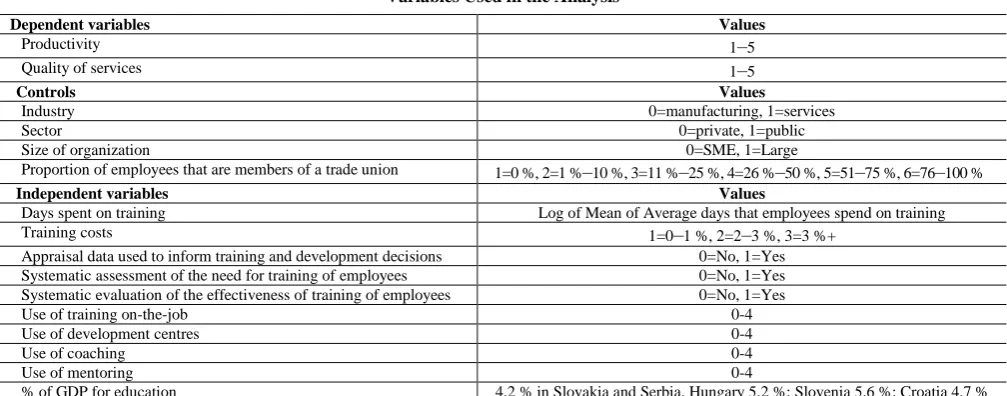
Variables
Inzinerine Ekonomika-Engineering Economics, 2019, 30(1), 81–93
Table 1
Variables Used in the Analysis
Dependent variables Values
Productivity 1–5
Quality of services 1–5
Controls Values
Industry 0=manufacturing, 1=services
Sector 0=private, 1=public
Size of organization 0=SME, 1=Large
Proportion of employees that are members of a trade union 1=0 %, 2=1 %–10 %, 3=11 %–25 %, 4=26 %–50 %, 5=51–75 %, 6=76–100 %
Independent variables Values
Days spent on training Log of Mean of Average days that employees spend on training
Training costs 1=0–1 %, 2=2–3 %, 3=3 %+
Appraisal data used to inform training and development decisions 0=No, 1=Yes
Systematic assessment of the need for training of employees 0=No, 1=Yes
Systematic evaluation of the effectiveness of training of employees 0=No, 1=Yes
Use of training on-the-job 0-4
Use of development centres 0-4
Use of coaching 0-4
Use of mentoring 0-4
% of GDP for education 4,2 % in Slovakia and Serbia, Hungary 5,2 %; Slovenia 5,6 %; Croatia 4,7 %
Source: Authors’ analysis based on Cranet 2015/2016 data
Description of the Sample
The sample of the research of the training practices in the Danube Region consists of five countries – Serbia (160 organizations), Hungary (273 organizations), Croatia (171 organizations), Slovakia (267 organizations) and Slovenia (218 organizations) – a total of 1089 organizations in the whole sample. Table 2 presents main characteristics of national economies of the countries.
Table 2
Main Characteristics of National Economies
2016 CRO HU SLOK SLOV SRB
GDP (%) 3,2 2,2 3,3 3,1 2,8
Unemployment (% ) 13,4 5,1 9,7 8,0 15,3
Inflation (%) -0,6 0,4 -0,5 -0,2 1,3
GDP per capita 11000 11300 14600 18500 4400
Source: Eurostat
The responses rate was around 20 % for all countries, varying from 15 to 25 %.
The sample consisted of 51,4 % of SMEs and 48,6 % of large companies. Private sector companies were predominantly present in the sample, with 72 %, while public sector companies made 25,4 % of the sample. The not-for-profit and mixed sector made up 2,6 % of the total sample. Table 2 presents the data on the business sector of organizations. It is evident that the largest share of organizations performs their business in the service sector – trade, telecommunications, IT and other information services, financial and insurance activities, etc.
Table 3
Sample of Organizations - Industry
Main sector of industry Frequency Percent Valid
Percent
Agriculture, hunting, forestry,
fishing, mining and quarrying 38 3,5 4,0
Manufacture of food, beverages, textiles, wood and paper, coke and refined petroleum, and related products
67 6,2 7,0
Main sector of industry Frequency Percent Valid
Percent
Manufacture of chemicals, pharmaceuticals, and medicinal chemical products
28 2,6 2,9
Manufacture of basic metals and metal products, plastic and other non-metallic products
39 3,6 4,1
Manufacture of computer, electronic products, electrical equipment
26 2,4 2,7
Manufacture of machinery and
equipment 40 3,7 4,2
Manufacture of transport
equipment 17 1,6 1,8
Other manufacturing 42 3,9 4,4
Electricity, gas, steam, and water supply, waste management
38 3,5 4,0
Construction 28 2,6 2,9
Wholesale and retail trade 93 8,5 9,7
Transportation and storage 37 3,4 3,9
Accommodation and food service activities, publishing, broadcasting activities
24 2,2 2,5
Telecommunications, IT and
other information services 88 8,1 9,2
Financial and insurance
activities 82 7,5 8,6
Accounting, management, architecture, engineering, scientific research, and other administrative and support service
28 2,6 2,9
Public administration and
compulsory social security 75 6,9 7,8
Education 34 3,1 3,6
Human health services, residential care and social work activities
49 4,5 5,1
Other industry or services 84 7,7 8,8
Total 957 87,9 100,0
Missing 132 12,1
Total 1089 100,0
Agnes Slavic, Nemanja Berber. The Role of Training Practice in Improving Organizational Performance in Selected…
Almost 80 % of the organizations from the Danube Region have an HR department in their organizational structure, and 62 % of them have a written general HRM strategy and particular HR strategy for T&D of employees.
Results of the analysis
The importance of training in the five analysed countries was presented through the ratio of the annual training budget in the total payroll costs. The effectiveness of training in the five analysed countries is presented through the systematic evaluation of training practice in organizations, the usage of the appraisal data to inform decisions for T&D process, and assessment of the training needs (Table 4). Table 4 presents the data on the usage of systematic evaluation of training effectiveness (SE). More than 50 % of the organizations from Croatia, Serbia and Slovakia perform such evaluation, while in Slovenia and Hungary, evaluation is used in 48 % and 32 % of organizations, respectively. Apart from SE, Table 4 presents the data on the percentage of organizations that perform training need assessment (NA). In the total
sample, 67,3 % of the organizations perform training need assessment. In the case of Serbian organizations, more than 80% of them perform this kind of assessment. The shares in all the countries are above 60 %, only in Hungary that figure is significantly lower, with 49 %. In the case of the usage of appraisal data to make decisions of T&D process, most of the companies in the observed countries use them.
In the case of the exploration of the importance of T&D, Table 4 showed that most of the organizations from the Danube Region invested in training between 0 % and 3 % (63 % of the whole sample) of their annual compensation budget. This is an indicator which shows how much organizations invest in their learning and training activities. It is obvious that in the analysed region those investments are at a very low level, since the average in Europe, especially in the CEE is approximately 4 % (Morley et al., 2016), while in some of the more developed countries it can reach up to or over 10 %. The smallest amount of investment in training is seen in countries of former Yugoslavia, in Croatia and Serbia. More than 3 % is invested mainly in Slovakia and Slovenia.
Table 4
Percentage of the Usage of Systematic Evaluation (SE) of Training Effectiveness, Training Need Assessment (NA), Appraisal Data (AD), and the Annual Payroll Costs Spent on Training (Training Importance)
Training effectiveness Training importance
AD NA SE 0-1% 2–3 % 3%+
Croatia 69.0 65,7 53.8 51,7 18,3 30,0
Hungary 55.2 49,3 31.6 26,1 52,2 21,6
Serbia 68.6 81,1 58.2 37,1 25,2 37,7
Slovakia 65.6 74,7 55.3 28,3 9,6 62,0
Slovenia 64.6 73,2 47.9 34,6 24,6 40,8
Total 63.9 67,3 48.1 33,6 29,7 36,8
Source: Authors’ analysis based on Cranet 2015/2016 data
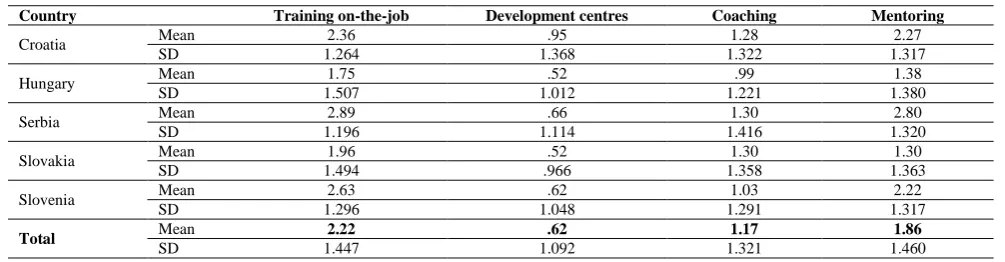
Table 5 shows that the most often used T&D techniques are Mentoring (M=1,86), On-the-job training (M=2,22), and Coaching (M=1,17). Serbia and Slovenia showed the highest level of the usage of the on-the-job
training (2,89 and 2,63, respectively). This is the case in the rest of the explored countries, too. Development centres and International working assignments are used to a minor degree.
Table 5
The Level of the Usage of Training Techniques per Country
Country Training on-the-job Development centres Coaching Mentoring
Croatia Mean 2.36 .95 1.28 2.27
SD 1.264 1.368 1.322 1.317
Hungary Mean 1.75 .52 .99 1.38
SD 1.507 1.012 1.221 1.380
Serbia Mean 2.89 .66 1.30 2.80
SD 1.196 1.114 1.416 1.320
Slovakia Mean 1.96 .52 1.30 1.30
SD 1.494 .966 1.358 1.363
Slovenia Mean 2.63 .62 1.03 2.22
SD 1.296 1.048 1.291 1.317
Total Mean 2.22 .62 1.17 1.86
SD 1.447 1.092 1.321 1.460
Inzinerine Ekonomika-Engineering Economics, 2019, 30(1), xx–xxx
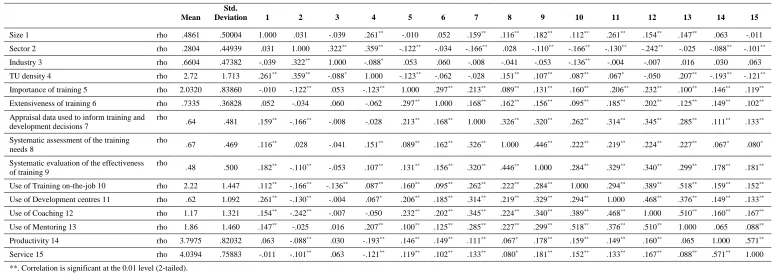
Table 6
Means, Standard Deviations and Correlations between Observed Variables
Source: Authors’ analysis based on Cranet 2015/2016 data
Mean
Std.
Deviation 1 2 3 4 5 6 7 8 9 10 11 12 13 14 15
Size 1 rho .4861 .50004 1.000 .031 -.039 .261** -.010 .052 .159** .116** .182** .112** .261** .154** .147** .063 -.011
Sector 2 rho .2804 .44939 .031 1.000 .322** .359** -.122** -.034 -.166** .028 -.110** -.166** -.130** -.242** -.025 -.088** -.101**
Industry 3 rho .6604 .47382 -.039 .322** 1.000 -.088* .053 .060 -.008 -.041 -.053 -.136** -.004 -.007 .016 .030 .063
TU density 4 rho 2.72 1.713 .261** .359** -.088* 1.000 -.123** -.062 -.028 .151** .107** .087** .067* -.050 .207** -.193** -.121**
Importance of training 5 rho 2.0320 .83860 -.010 -.122** .053 -.123** 1.000 .297** .213** .089** .131** .160** .206** .232** .100** .146** .119**
Extensiveness of training 6 rho .7335 .36828 .052 -.034 .060 -.062 .297** 1.000 .168** .162** .156** .095** .185** .202** .125** .149** .102**
Appraisal data used to inform training and development decisions 7
rho
.64 .481 .159** -.166** -.008 -.028 .213** .168** 1.000 .326** .320** .262** .314** .345** .285** .111** .133**
Systematic assessment of the training needs 8
rho
.67 .469 .116** .028 -.041 .151** .089** .162** .326** 1.000 .446** .222** .219** .224** .227** .067* .080*
Systematic evaluation of the effectiveness of training 9
rho
.48 .500 .182** -.110** -.053 .107** .131** .156** .320** .446** 1.000 .284** .329** .340** .299** .178** .181**
Use of Training on-the-job 10 rho 2.22 1.447 .112** -.166** -.136** .087** .160** .095** .262** .222** .284** 1.000 .294** .389** .518** .159** .152**
Use of Development centres 11 rho .62 1.092 .261** -.130** -.004 .067* .206** .185** .314** .219** .329** .294** 1.000 .468** .376** .149** .133**
Use of Coaching 12 rho 1.17 1.321 .154** -.242** -.007 -.050 .232** .202** .345** .224** .340** .389** .468** 1.000 .510** .160** .167**
Use of Mentoring 13 rho 1.86 1.460 .147** -.025 .016 .207** .100** .125** .285** .227** .299** .518** .376** .510** 1.000 .065 .088**
Productivity 14 rho 3.7975 .82032 .063 -.088** .030 -.193** .146** .149** .111** .067* .178** .159** .149** .160** .065 1.000 .571**
Service 15 rho 4.0394 .75883 -.011 -.101** .063 -.121** .119** .102** .133** .080* .181** .152** .133** .167** .088** .571** 1.000
**. Correlation is significant at the 0.01 level (2-tailed).
Inzinerine Ekonomika-Engineering Economics, 2019, 30(1), xx–xxx The role of employee training in reaching
organizational performance (in this case, productivity and service quality) is explored by the Spearman’s correlation and hierarchical multiple regression. According to the data in Table 6, there are statistically significant correlations between the importance of training practice expressed by the ratio of the annual training budget in the total payroll costs and the companies ‘organizational performance measured through the productivity and service quality (rho=0,146 and rho=0,119). Training extensiveness expressed by the number of days spent on training has positive statistically significant correlations with productivity (rho=0,149) and quality of services (rho=0,102). Training effectiveness measured by training evaluation, assessment of training needs, and the usage of appraisal data for decision on T&D also have positive statistically significant relations with organizational productivity rate (rho=0,178; rho=0,067; rho=0,111,
respectively) and the level of service quality (rho=0,181; rho=0,080; rho=0,133, respectively). All training techniques showed positive statistically significant correlations with the levels of organizational performance measured by service quality and productivity. Only in the case of mentoring did the authors fail to find significant correlations with the level of productivity (rho=0.065; p>0.05). All variables showed weak, but positive and statistically significant, correlations with the level of productivity and service quality.
In order to test the relationship of each independent variable with the level of productivity and service quality, the authors used hierarchical multiple regression with moderator. The analyses were conducted in steps. In Step 1, the control, moderator, dependent and independent variables were entered into the model. In Step 2, interactions were added between the independent variables and moderator.
Table 7
Hierarchical Multiple Regression – Model Summary
Model Produ ctivity
R R
Square Adjuste d R Square Std. Error of the Estimate Change Statistics Durbin-Watson R Square
Change F Change df1 df2
Sig. F Change
1 ,382 ,146 ,124 ,76632 ,146 6,617 14 541 ,000
2 ,414 ,171 ,136 ,76127 ,025 1,799 9 532 ,066 1,994
Model Service quality
R R
Square Adjusted R Square Std. Error of the Estimate Change Statistics Durbin-Watson R Square
Change F Change df1 df2
Sig. F
Change
1 ,365 ,133 ,111 ,73232 ,133 6,122 14 559 ,000
2 ,397 ,158 ,122 ,72775 ,025 1,782 9 550 ,069 1,997
Source: Authors’ analysis based on Cranet 2015/2016 data
According to data in Table 7, following the interactions between moderator (% of GDP spent on education at national level) and independent variables, the R square change for dependent ‘Productivity’ was 0,025, which means that the independent variables explained an additional 2,5 % of the variance in productivity. Based on the results of the F test, this change in R square was not significant (F(9,532) = 1,799, p>0,05). In the case of services, the R square change was 0,025 after including interactions between moderator (% of GDP spent on education at national level) and independent variables, meaning that the independent variables explained an additional 2,5% of the variance in service quality. According to the results of the F test, this change in R square was also not significant (F (9,550) = 1,782, p>0,05). It can thus be concluded that the introduction of the interactions between moderator variables and independents did not alter the coefficient of determination of the model to a significant degree. Therefore, these interactions will not be considered in the continuation of the analysis. The Durbin-Watson statistics of 1,994 for the productivity model and 1,997 for the service quality model is within the acceptable range of 1,5 to 2,5, points towards there being no auto-correlation in a regression model. In the analysis, the authors paid attention to the problems of multicollinearity. VIF coefficients were within the acceptable levels (they were between 1 and 2).
Table 8
ANOVA Test for the Proposed Models
Model Productivity
Sum of
Squares df
Mean
Square F Sig.
1
Regression 54,402 14 3,886 6,617 ,000
Residual 317,699 541 ,587
Total 372,101 555
Model Service quality
Sum of
Squares df
Mean
Square F Sig.
1
Regression 45,963 14 3,283 6,122 ,000
Residual 299,786 559 ,536
Total 345,749 573
Source: Authors’ analysis based on Cranet 2015/2016 data
According to the data in Table 8, both models are statistically significant, in the case of productivity and service quality. The F-ratio in the ANOVA table showed that the overall regression model is a good fit for the data. The independent variables statistically predict the dependent variable ‘productivity’ F(14, 541) = 3,886, p<.001, and ‘service quality’ F(14,559) = 6,122, p<,001.
Inzinerine Ekonomika-Engineering Economics, 2019, 30(1), 81–93 trade union density (less people in the union) has a
statistically significant relationship with the level of productivity. The percentages of GDP spent on education at national level do not have a significant relationship with the level of productivity. This variable was used as a moderator to explore differences between the countries from the sample, regarding the relationships between T&D practices and productivity. In the case of service quality, the percentage of GDP spent on education pointed to the
positive statistically significant relationship with service quality. If a country spends a higher share of its GDP on education, it will have a higher level of organizational productivity. Training importance, measured by a percentage of the annual payroll costs spent on training, was not found to have a significant relationship with productivity or service quality. Therefore, the authors’ Hypothesis 1 was not supported by the findings.
Table 9
Coefficients of the Regression Model for Dependent: Productivity
Model
Unstandardized Coefficients
Standardized
Coefficients t Sig.
B Std. Error Beta
1
(Constant) 3,438 0,145 23,766 0,000
Size 0,054 0,07 0,033 0,78 0,436
Sector 0,074 0,097 0,038 0,763 0,446
Industry -0,066 0,074 -0,039 -0,895 0,371
Proportion of employees that are members of a trade union -0,088 0,022 -0,187 -3,916 0,000
% of GDP for education -0,055 0,072 -0,033 -0,768 0,443
Training importance 0,035 0,041 0,037 0,854 0,393
Days spent on training 0,228 0,097 0,099 2,35 0,019
Appraisal data used to inform training and development decisions -0,148 0,079 -0,084 -1,861 0,063
Systematic assessment of the need for training 0,095 0,087 0,05 1,095 0,274
Systematic evaluation of the effectiveness of training 0,233 0,078 0,14 2,991 0,003
Use of Training on-the-job 0,066 0,03 0,106 2,227 0,026
Use of Development centres 0,081 0,032 0,115 2,487 0,013
Use of Coaching 0,059 0,031 0,099 1,926 0,050
Use of Mentoring -0,038 0,03 -0,065 -1,271 0,204
Source: Authors’ analysis based on Cranet 2015/2016 data
Table 10
Coefficients of the Regression Model for Dependent: Productivity
Model
Unstandardized Coefficients
Standardized
Coefficients t Sig.
B Std. Error Beta
1
(Constant) 3.64 0.135 26.933 0,000
Size -0.12 0.065 -0.077 -1.839 0.066
Sector -0.11 0.089 -0.061 -1.239 0.216
Industry 0.109 0.07 0.067 1.545 0.123
Proportion of employees that are members of a trade union -0.037 0.021 -0.083 -1.749 0.081
% of GDP for education 0.314 0.067 0.196 4.656 0,000
Training importance 0.011 0.039 0.012 0.288 0.774
Days spent on training 0.198 0.09 0.092 2.204 0.028
Appraisal data used to inform training and development decisions -0.037 0.075 -0.022 -0.49 0.624
Systematic assessment of the need for training 0.102 0.081 0.058 1.261 0.208
Systematic evaluation of the effectiveness of training 0.271 0.074 0.172 3.675 0,000
Use of Training on-the-job 0.034 0.028 0.059 1.228 0.220
Use of Development centres 0.061 0.031 0.092 2.006 0.045
Use of Coaching 0.066 0.029 0.116 2.265 0.024
Use of Mentoring -0.041 0.028 -0.075 -1.472 0.142
Source: Authors’ analysis based on Cranet 2015/2016 data
In the case of the appraisal data used to inform training and development decisions, systematic assessment of the need for training, and systematic evaluation of the effectiveness of training (which present training effectiveness), only the systematic evaluation of the implemented training showed positive statistically significant relationship with both performance measures. Therefore the Hypothesis 2 was partially proven.
The data in Tables 9 and 10 indicates that extensiveness of the training practice (expressed by the number of days that employees spend on training) have a positive relationship with organizational performance (measured by productivity and service quality). Hypothesis 3 was thus confirmed.
In the case of the training techniques used, the usage of training on-the-job, development centres, and coaching have positive statistically significant relationships with the productivity, while service quality has positive relations with development centres and coaching. The level of usage of mentoring was not found to have relationships with firm performance. Based on these findings, Hypothesis 4 was partially confirmed.
Agnes Slavic, Nemanja Berber. The Role of Training Practice in Improving Organizational Performance in Selected…
the model only by 0,025 in both cases, and the change was not statistically significant. Based on the results, the authors drew several conclusions and formulated implications for the theory and practice.
Discussion and Conclusions
Training and development of employees is seen as an important measure in improving the intellectual capital of employees and the competitiveness of modern organizations. The aim of this paper was to explore and detect the relations between several elements of employees’ T&D practices and organizational performance. The authors chose to analyse the Danube Region, since HRM in this region is still underexplored and quite particular, given the different economic and political development paths of the relevant countries. Based on the proposed model, the obtained research results, and exploration of the practice of T&D in the Danube Region, several conclusions were drawn.
It was found that more than half of organizations from Croatia, Serbia and Slovakia performed systematic evaluation of training effectiveness, while in Slovenia and Hungary, such evaluation is performed in 48 % and 32 % of the organizations, respectively. In the total sample, 67 % of the organizations perform training need assessment. Regarding the Serbian organizations, more than 80 % of them perform this kind of assessment. While shares in all the countries are above 60 %, Hungary is the only state where this figure is 49 %. In the case of the usage of appraisal data to make decisions for T&D processes, more than 60 % of the companies in each of observed countries use them. Again, only in the case of Hungary is this rate lower, at 55 % of the organizations using appraisal information for T&D processes.
Most of the studied organizations from the Danube Region invest in training less than 3 % of their annual compensation budget. This is in line with previous researches, where Karoliny et al. (2009) found that 55 % of organizations from Hungary spent up to 2 % of their annual payroll costs on training, whereas in the CEE region, this percentage is around 60 % of organizations (Karoliny et al., 2009, p. 30). The smallest amount of investment in training is seen in the countries of former Yugoslavia. Some higher training costs are seen in organizations from Slovakia.
Regarding the techniques for T&D, organizations from the sample countries in the Danube Region mostly use on-the-job training and mentoring, as methods for training and developing their employees’ competences and skills.
Training importance, measured in the form of a share of the annual payroll costs spent on training, was not found to have significant relationship with productivity or service quality in our sample. The hypothesis, according to which training importance has statistically significant relations with performance (H1), was not supported by the findings. The potential explanation for this outcome may be that the level of investment in training is not a predominant factor for successful training practices, since there are other key issues, such as evaluation of training needs, training effectiveness, employees' readiness for training and development process, training extensiveness, etc. What
matters is not simply the costs of paying for training, but having the right approach towards training.
The authors further established that there are statistically significant relations between the systematic evaluation of training practice and organizational performance measured through the productivity and service quality. This is in line with previous researches of Cranet data, from 2008/2010 period, where the authors concluded the same by using the Man Whitney test for organizations from CEE (Morley et al., 2016) and hierarchical linear modelling for the EU sample (Nikandrou et al., 2008). In the case of analysis of training needs and the usage of appraisal data, the authors have not found significant relations with performance. Based on these results, Hypothesis 2, stating that the effectiveness of training (expressed by three mentioned variables) will have a positive relationship with organizational performance (measured by productivity and service quality) in the Danube Region, is partially proven.
The extensiveness of the training practice (expressed by the number of days that employees spend on training) has a positive relationship with organizational performance (measured by productivity and service quality). Hypothesis 3 was confirmed, given that these results are in line with previous researches on this topic (Morley et al., 2016; Nikandrou et al., 2008).
As for Hypothesis 4, namely that the usage of different techniques for employees’ training will have a positive relationship with organizational performance measured by productivity and service quality in the Danube Region, is also partially proven, since the authors found relations between training on the job, development centres and coaching in the case of the regression model for productivity, and between the development centres and coaching in the case of service quality model.
Finally, Hypothesis 5, which proposed that the percentage of GDP spent on education in a country will moderate the relationship between T&D practices and organizational productivity and service quality. Although in the previous researches, this moderator was significant (Nikandrou et al., 2008; Aycan, 2003), in the case of the selected countries and their data, this does not hold true, the authors found no significant changes after entering interaction between the moderator and other variables into the model. H5 was therefore not confirmed. This finding can be explained by pointing out that, as all of the observed countries invest a similar share of GDP in education, there are no significant differences between them regarding their organizational level relations between T&D practices and productivity and service quality.
Inzinerine Ekonomika-Engineering Economics, 2019, 30(1), 81–93 this development period, most of the countries started on
their own path of development.
Some of the findings from previous researches are now confirmed on the Danube countries’ sample, whereas some of them are not. The novelty of this paper lies in providing a deeper analysis on the relationship between the effectiveness of training, the methods for employees’ training (coaching and development centres), and the level of training costs and organizational performance measured by productivity and service quality. In general, organizations that have a more developed T&D approach are likely to have a higher level of performance. Also, the authors emphasize the importance of exploring the evaluation of the training, as the last part of the training program, in which managers may gain an insight into the real value of the training, i.e. whether the training approach enabled employees to boost their performance. New researches would be helpful in exploring various techniques for training evaluation and their relations with performance.
The practical implications of this paper may be quite important for HR managers of the companies operating in the Danube Region. If there is a need to improve organizational performance, i.e. productivity and service quality, HR mangers must systematically evaluate the effectiveness of their training practice, and provide employees with more days of training. In order to improve productivity, it is advisable to use training on-the-job, development centres, and coaching, as training methods. However, if the aim of the organizations is to improve service quality, the authors encourage the use of coaching and development centres, as a training method. Also, HR managers ought to pay more attention to training costs measurement, because those are the costs of the organization derived from the annual pay budget. Since the coaching, development centres and on-the-job training showed positive relations with productivity, HR managers should analyse these techniques and develop more effective training programs.
It must be conceded that this research has certain limitations. One such limitation may be the Cranet
methodology, since the used sample might not be representative in all selected countries of the Danube Region. The second limitation is linked to the nature of variables used in the Cranet research. In an attempt to reduce this effect, the authors tried to avoid possible mistakes, recoded several variables, and tested the model, the data and the fit between the model and the data. The third limitation is connected to the explanation of the obtained results, since HRM practices that are considered suitable in one context may be less so in another. There are national-level factors (cultural dimensions, legal framework, economic and political context), sector-level factors (market growth, environmental concerns, and technological changes) and organizational-level factors (size, technology, ownership, and some structural features), which may contribute to distinctive forms of HRM in different organizations (Nikandrou et al., 2008; McNamara et al., 2012). While exploring this topic, the authors made an effort to find some national or instructional level variable to detect particular differences, but in this case, they found no more moderator variables that are closely connected with the T&D – performance relation. Most of the cultural dimension could not be used, since there are no calculated dimension (for example, the GLOBE dimension of performance orientation that is related to the T&D practice, is calculated only for Hungary and Slovakia).
The future research recommendations are related to the development of a model of effective training and development of practice for the countries of the Danube Region – concerning the business context and the elements of national and organizational culture, which are considered to be of critical importance in comparative researches in HRM, especially in this region. New researches and explorations in this area ought to include variables of national culture, organizational culture, and some other HR practices, given that training and development of employees is closely connected to performance measurement, compensation level-wages, and career development, and may significantly influence the employee-level and organizational level performance, as well.
References
Agarwal, R., Angst C. M., & Magni M. (2009). The performance effects of coaching: a multilevel analysis using hierarchical linear modelling. International Journal of Human Resources Management, 20(10), 2110–2134. https://doi.org/10.1080/09585190903178054
Albrecht, S. L., Bakker, A. B., Gruman, J. A., Macey, W. H. & Saks, A. M. (2015). Employee engagement, human resource management practices and competitive advantage: An integrated approach. Journal of Organizational Effectiveness: People and Performance, 2(1), 7–35. https://doi.org/10.1108/JOEPP-08-2014-0042
Anderson, V., Rayner, C., & Schyns, B. (2009). Coaching at the sharp end: the role of line managers in coaching at work. London: Chartered Institute of Personnel and Development.
Antonietti, R. (2016). From outsourcing to productivity, passing through training: microeconometric evidence from Italy. Industry and Innovation, 23(5), 407–425. https://doi.org/10.1080/13662716.2016.1139444
Aycan, Z. (2003). Human Resource Management in Cultural Context. Paper presented at the 7th International Human Resource Management Conference, Limerick, Ireland.
Bartel, A. P. (1994). Productivity gains from the implementation of employee training programs. Industrial Relations: a Journal of Economy and Society, 33(4), 411–425. https://doi.org/10.1111/j.1468-232X.1994.tb00349.x
Agnes Slavic, Nemanja Berber. The Role of Training Practice in Improving Organizational Performance in Selected…
Berber, N., & Slavic, A. (2016a). Human Resource (HR) Outsourcing in European Compensation Management in the Light of CRANET Research. Acta Polytechnica Hungarica, 13(3), 207–225.
Berber, N., Stangl Susnjar, G., Slavic, A., & Baosic, M. (2014). Relationship between corporate social responsibility and human resource management-as new management concepts–in Central and Eastern Europe. Inzinerine Ekonomika - Engineering Economics, 25(3), 360–369.http://dx.doi.org/10.5755/j01.ee.25.3.4222
Bilanakos, C., Green, C. P., Heywood, J. S., & Theodoropoulos, N. (2016). Do dominant firms provide more training?. Journal of Economics & Management Strategy, 26(1), 67–95. https://doi.org/10.1111/jems.12177|
Bowen, D.E., & Ostroff, C. (2004). Understanding HRM–firm performance linkages: The role of the "strength" of the HRM system. Academy of Management Review, 29(2), 203–221. https://doi.org/10.2307/20159029
Boyatzis, R. E., Smith, M. L., & Blaize, N. (2006). Developing sustainable leaders through coaching and compassion. Academy of Management Learning & Education, 5(1), 8–24.
Chong, E. (2008). Managerial competency appraisal: A cross-cultural study of American and East Asian managers. Journal of Business Research, 61(3), 191–200. https://doi.org/10.1016/j.jbusres.2007.06.007
De Grip, A., & Sauermann, J. (2013). The effect of training on productivity: The transfer of on-the-job training from the perspective of economics. Educational Research Review, 8, 28–36. https://doi.org/10.1016/j.edurev.2012.05.005 Dearden, L., Reed, H., & Van Reenen, J. (2006). The impact of training on productivity and wages: Evidence from British
panel data. Oxford Bulletin of Economics and Statistics, 68(4), 397–421. https://doi.org/10.1111/j.1468-0084.2006.00170.x
Esteban-Lloret, N. N., Aragon-Sanchez, A., & Carrasco-Hernandez, A. (2016). Determinants of employee training: impact on organizational legitimacy and organizational performance. The International Journal of Human Resource Management, 1–22, on line first. https://doi.org/10.1080/09585192.2016.1256337
Government expenditure on education. (2017). Eurostat. http://ec.europa.eu/eurostat/statistics-explained/index.php/ Government_expenditure_on_education accessed on 11/12/2017.
Gravina, N., & Siers, P. (2011). Square Pegs and Round Holes: Ruminations on the relationship between performance appraisal and performance management. Journal of Organizational Behavior Management, 31(4), 277–287. http://dx.doi.org/10.1080/01608061.2011.619418
Gray, D. E., Ekinci, Y., & Goregaokar, H. (2011). A Five-dimensional Model of Attributes: Some precursors of executive coach selection. International Journal of Selection and Assessment, 19(4), 415–428. https://doi.org/10.1111/j.1468-2389.2011.00569.x
Groot, W. (1999). Productivity effects of enterprise-related training. Applied Economics Letters, 6(6), 369–371.
Grossman, R., & Salas, E. (2011). The transfer of training: what really matters. International Journal of Training and Development, 15(2), 103–120. https://doi.org/10.1111/j.1468-2419.2011.00373.x
Hansson, B. (2007). Company-based determinants of training and the impact of training on company performance: Results from an international HRM survey. Personnel Review, 36(2), 311–331. https://doi.org/10.1108/00483480710726163 Ivancevic, J. M. (2010). Human Resource Management, 11th International Edition. New York: McGraw-Hill/Irwin . Karoliny, Z., Farkas, F., & Poor, J. (2009). In focus: Hungarian and Central Eastern European characteristics of human
resource management—An international comparative survey. Journal for East European Management Studies, 14(1), 9–47.
Konings, J., & Vanormelingen, S. (2015). The impact of training on productivity and wages: firm-level evidence. Review of Economics and Statistics, 97(2), 485–497.
McNamara, T. K., Parry, E., Lee, J., & Pitt-Catsouphes, M. (2012). The effect of training on organizational performance: differences by age composition and cultural context. The International Journal of Human Resource Management, 23(6), 1226–1244. http://dx.doi.org/10.1080/09585192.2011.561253
Morley, M. J., Slavic, A., Poor, J., & Berber, N. (2016). Training practices and organisational performance: A comparative analysis of domestic and international market oriented organisations in Central & Eastern Europe. Journal for East European Management Studies, 21(4), 406–432. http://dx.doi.org/10.5771/0949-6181-2016-4-406 Newman, A., Thanacoody, R., & Hui, W. (2011). The impact of employee perceptions of training on organizational
commitment and turnover intentions: a study of multinationals in the Chinese service sector. The International Journal of Human Resource Management, 22(8), 1765–1787. http://dx.doi.org/10.1080/09585192.2011.565667 Nikandrou, I., Apospori, E., Panayotopoulou, L., Stavrou, E. T., & Papalexandris, N. (2008). Training and firm
performance in Europe: the impact of national and organizational characteristics. The International Journal of Human Resource Management, 19(11), 2057–2078. http://dx.doi.org/10.1080/09585190802404304
Noe R. A., Hollenbeck J. R., Gerhart B., & Wright P. M. (2006). Human Resource Management: Gaining a Competitive Advantage. Boston: McGraw-Hill/Irwin.
Inzinerine Ekonomika-Engineering Economics, 2019, 30(1), 81–93
Perez, S., Montes, J. M., & Vazquez, C. (2006). Human resource management as a determining factor in organizational learning. Management Learning, 37(2), 215–239.
Poor, J., Stangl Susnjar, G., Slavic, A., & Karoliny, Zs. (2012).Training Practice in Central and Eastern European Companies Based on Cranet Research. (Chapter 3.7). In: Illes, Cs. B. (ed.) SMEs' Management in the 21st Century – Challenges and Solutions, (pp. 271-283).Częstochowa, Poland: Częstochowa University of Technology.
Radosevic, M., Baosic, M., Caric, M., Jovanovic, V., Beric, D., Bojic, Z., & Avramovic, N. (2014). Implementation of Business Process Reengineering in Human Resource Management. Inzinerine Ekonomika-Engineering Economics, 25(2), 211–222. http://dx.doi.org/10.5755/j01.ee.25.2.4590
Salas, E., Tannenbaum, S. I., Kraiger, K., & Smith-Jentsch, K. A. (2012). The science of training and development in organizations: what matters in practice. Psychological Science in the Public Interest, 13(2), 74–101. http://dx.doi.org/10.1177/1529100612436661
Savaneviciene, A., & Stankeviciute, Z. (2013). Relabelling or new Approach: theoretical insights regarding Personnel Management and Human Resource Management. Inzinerine Ekonomika - Engineering Economics, 24(3), 234–243. http://dx.doi.org/10.5755/j01.ee.24.3.1618
Savaneviciene, A., & Stankeviciute, Z. (2017). Smart Power as a Pathway for Employing Sustainable Human Resource Management. Inzinerine Ekonomika - Engineering Economics, 28(2), 198–206. https://doi.org/10.5755/j01.ee. 28. 2.17645
Sepulveda, F. (2010). Training and productivity: evidence for US manufacturing industries. Oxford Economic Papers, 62(3), 504–528. https://doi.org/10.1093/oep/gpp028
Serbia: Education spending, percent of GDP. (2017). http://www.theglobaleconomy.com/Serbia/Education_spending/ accessed on 11/12/2017.
Sherman, S., & Freas, A. (2004). The wild west of executive coaching. Harvard Business Review, 82(11), 82–93.
Slavic, A., & Berber, N. (2016). The evolution of HRM in Serbia: the analysis based on two successive Cranet researches. 8th International Conference: An Enterprise Odyssey: Saving the Sinking Ship Through Human Capital. Zagreb: Faculty of Economics and Business, 281–290.
Stangl Susnjar, G., Slavic, A., Berber, N., & Lekovic, B. (2016). The Role of Human Resource Management in Small and Medium Sized Companies in Central-Eastern Europe. In: J. Ateljevic and J. Trivic (Eds), Economic Development and Entrepreneurship in Transition Economies - Issues, Obstacles and Perspectives (pp.205–229). Springer International Publishing Switzerland.
Stavrou, E. T. (2005). Flexible work bundles and organizational competitiveness: a cross‐national study of the European work context. Journal of Organizational Behavior, 26(8), 923–947.
Stavrou, E. T., & Brewster, C. (2005). The configurational approach to linking strategic human resource management bundles with business performance: myth or reality? Management Revue, 16(2), 186–201.
Sung, J., Chi Man Ng, M., Loke, F., & Ramos. C. (2013). The nature of employability skills: empirical evidence from Singapore. International Journal of Training and Development, 17(3), 176–193. https://doi.org/10.1111/ijtd.12008 Utrilla Nunez-Cacho, P., Grande, F. A., & Lorenzo, D. (2015). The effects of coaching in employees and organizational
performance: The Spanish Case. Intangible Capital, 11(2), 166–189. http://dx.doi.org/10.3926/ic.586