R E S E A R C H
Open Access
Convergence analysis for the equilibrium
problems with numerical results
Sarawut Suwannaut and Atid Kangtunyakarn
**Correspondence:
[email protected] Department of Mathematics, Faculty of Science, King Mongkut’s Institute of Technology Ladkrabang, Bangkok 10520, Thailand
Abstract
In this paper, we propose an iterative scheme modified from the work of Cenget al. (Nonlinear Anal. Hybrid Syst. 4:743-754, 2010) and Plubtieng and Punpaeng (J. Math. Anal. Appl. 336(1):455-469, 2007) to prove the strong convergence theorem for approximating a common element of the set of fixed points of nonspreading mappings and a finite family of the set of solutions of the equilibrium problem. Using this result, we obtain the strong convergence theorem for a finite family of
nonspreading mappings and a finite family of the set of solutions of equilibrium problem. Moreover, in order to compare numerical results between the combination of the equilibrium problem and the classical equilibrium problem, some examples are given in one- and two-dimensional spaces of real numbers.
Keywords: nonspreading mapping; quasi-nonexpansive mapping; the combination of equilibrium problem
1 Introduction
Throughout this paper, letCbe a nonempty closed convex subset of a real Hilbert space Hwith the inner product·,·and the norm·. We denote weak convergence and strong convergence by the notations ‘’ and ‘→’, respectively. We useRto denote the set of real numbers andFix(T) to represent the set of fixed points ofT, whereT is a mapping from Cinto itself.
In , Kohsaka and Takahashi [] introducedthe nonspreading mappingT in Hilbert spaceHas follows:
Tu–Tv≤ Tu–v+u–Tv, ∀u,v∈C. (.)
In , it was shown by Iemoto and Takahashi [] that (.) is equivalent to the follow-ing equation:
Tu–Tv≤ u–v+ u–Tu,v–Tv, for allu,v∈C.
Many researchers proved the strong convergence theorem for a nonspreading mapping and some related mappings in Hilbert space; see for example [–].
LetB:C→H.The variational inequality problemis to find a pointu∈Csatisfying the following inequality:
Bu,v–u ≥, (.)
for allv∈C. Moreover,VI(C,B) is used to denote the set of solutions of (.).
Let:C×C→Rbe a bifunction.The classical equilibrium problemforis to find u∈Csatisfying the following inequality:
(u,v)≥, ∀v∈C. (.)
We useEP() to represent the set of solution of (.).
Let the bifunctionsatisfy the following conditions for solving the equilibrium prob-lem.
(A) (u,u) = for allu∈C;
(A) is monotone,i.e.,(u,v) +(v,u)≤for allu,v∈C; (A) for eachu,v,w∈C,
lim t→+
tw+ ( –t)u,v≤(u,v);
(A) for eachu∈C,v→(u,v)is convex and lower semicontinuous.
In , Blum and Oettli [] showed that the classical equilibrium problem (.) cov-ers monotone inclusion problems, saddle point problems, variational inequality prob-lems, minimization probprob-lems, Nash equilibria in noncooperative games, vector equilib-rium problems, and certain fixed point problems.
Let={i}i=,,...,Nbe a finite family of bifunctions fromC×CtoR. The system of equi-librium problem for is to determine common equilibrium points for={i}i=,,...,N, that is, the set
EP() =u∈C:i(u,v)≥,∀v∈C,∀i∈, , . . . ,N. (.)
The problem (.) extends (.) to a system of such problems covering various forms of feasibility problems []. Several iterative algorithms are proposed to solve the equilibrium problems and a finite family of equilibrium problems; see, for instance, [–].
Example . Let={i}i=,,...,N be a finite family of bifunctions fromC×CtoR, where the bifunctionsiare defined by
i(u,v) =i(v–u)(v+ u– ), for everyu,v∈R.
For eachi= , , . . . ,N, it is obvious that thei(x,y) satisfy (A)-(A). Then we obtain
EP() = N
i=
EP(i) ={}.
space:
⎧ ⎪ ⎪ ⎪ ⎪ ⎪ ⎨ ⎪ ⎪ ⎪ ⎪ ⎪ ⎩
z=z∈H,
un=TFm βnT
Fm– βn · · ·T
F βnT
F βnzn,
vn=PC(I–snA)un,
zn+=αnγf(Wnzn) + (I–αnB)WnPC(I–rnA)vn, ∀n∈N.
(.)
Under some appropriate conditions, they proved that{zn},{vn}, and{un}converge strongly toq=P(γf+ (I–B))(q), where=
∞
i=Fix(Si)∩VI(C,A)∩
m
k=EP(Fk) andf is a
con-tractive mapping onH.
Over the past few years, many researchers have started working on the methods for finding a common solution of a finite family of equilibrium problems in Hilbert space; see, for instance, [–].
In , Suwannaut and Kangtunyakarn [] introducedthe combination of equilibrium problemwhich is to findu∈Csuch that
N
i=
aii
(u,v)≥, ∀v∈C, (.)
where i :C×C→R are bifunctions andai∈(, ) with N
i=ai = , for everyi=
, , . . . ,N. The set of solutions (.) is denoted byEP(Ni=aii).
Ifi=, for alli= , , . . . ,N, then the combination of equilibrium problem (.) re-duces to the classical equilibrium problem (.).
Moreover, they obtain Lemma . as shown in the next section.
Example . For everyi= , , , let the bifunctionsi:R×R→R, be given by
(u,v) = (v–u)(v+u– ),
(u,v) = (v–u)(v+ u– ),
(u,v) = (v–u)(v+ u– ), ∀u,v∈R.
For alli= , , , it is obvious that thei(u,v) satisfy (A)-(A). Let a=, a= and
a=, thus we have
i=
aii(u,v) =
(v–u)(v+ u– ).
This implies that
EP
i=
aii
=
i=
EP(i) ={}.
Remark . For alli= , , . . . ,N, let the mappingAi:C→H be defined byi(u,v) =
u,v∈C, andi= , , . . . ,N, thenEP(i) =VI(C,Ai). Hence we have
EP N
i=
aii
= N
i=
EP(i) = N
i=
VI(C,Ai).
After we have studied research related to equilibrium problems, we obtain the following question.
Question Is it possible to prove strong convergence theorem for a finite family of equi-librium problem using different method from the result of Penget al.[], Piri [] and references therein?
Inspired and motivated by the work of Iemoto and Takahashi [], Suwannaut and Kang-tunyakarn [] and related research, we propose an iterative scheme modified from the work of Plubtieng and Punpaeng [] and Cenget al. [] to prove the strong conver-gence theorem for approximating a common element of the set of fixed points of a non-spreading mapping and a finite family of the set of solutions of equilibrium problems using Lemma . and a different method from the work of Penget al.[] and Piri [] and ref-erences therein. Moreover, some examples are given in order to compare the numerical results between the combination of the equilibrium problem and the classical equilibrium problem.
2 Preliminaries
We now recall the following definition and well-known lemmas.
Definition .
(i) Ais strongly positive operator onHif there exists a constantβ> such that
Au,u ≥βu, ∀u∈H.
(ii) T is a nonexpansive mapping if
Tu–Tv ≤ u–v, ∀u,v∈C.
(iii) For everyu∈H, there is a unique nearest pointPCuinCsuch that
u–PCu ≤ u–v, ∀v∈C.
Such an operatorPCis called the metric projection ofHontoC.
Lemma .([]) For a given w∈H and u∈C,
u=PCw ⇔ u–w,v–u ≥, ∀v∈C.
Lemma .([]) Each Hilbert space H satisfies Opial’s condition,i.e.,for any sequence
{un} ⊂H with unu,the inequality
lim inf
n→∞ un–u<lim infn→∞ un–v
holds for every v∈H with v=u.
Lemma .([]) Let{un}be a sequence of nonnegative real numbers satisfying
un+≤( –βn)un+ηn, ∀n≥,
whereαnis a sequence in(, )and{ηn}is a sequence such that
() ∞n=βn=∞,
() lim supn→∞ηn βn ≤or
∞
n=|ηn|<∞. Thenlimn→∞un= .
Lemma .([]) Let H be a real Hilbert space.Then the following results hold:
(i) For allu,v∈Handt∈[, ],
tu+ ( –t)v=tu+ ( –t)v–t( –t)u–v,
(ii) u+v≤ u+ v,u+v,for eachu,v∈H.
Lemma .([]) Let H be a Hilbert space,let C be a nonempty closed convex subset of H and letAbe a mapping of C into H.Then,forα> ,
FixPC(I–αA)
=VI(C,A),
where PCis the metric projection of H onto C.
Lemma .([]) AssumeAis a strongly positive linear bounded operator on a Hilbert space H with coefficientβ> and <δ<A–.ThenI–δA ≤ –δβ.
Lemma .([]) Let C be a nonempty closed convex subset of H.Then a mappingT :C→ C is nonspreading if and only if
Tu–Tv≤ u–v+ u–Tu,v–Tv, for all u,v∈C.
Remark . IfT is a nonexpansive mapping andu–Tu,v–Tv ≥, for everyu,v∈C, thenT is a nonspreading mapping.
Lemma . Let C be a nonempty closed convex subset of a real Hilbert space H and let T :C→C be a nonspreading mapping withFix(T)=∅.Then we have the following state-ments:
(i) Fix(T) =VI(C,I–T);
(ii) for everyu∈Candv∈Fix(T),
Proof To prove (i), letx∗∈Fix(T). Thenx∗=Tx∗. Since
v–x∗, (I–T)x∗= , ∀v∈C,
we havex∗∈VI(C,I–T), from which it follows thatFix(T)⊆VI(C,I–T). Next, we showVI(C,I–T)⊆Fix(T).
Letx˜∈VI(C,I–T). This implies that
v–x, (I˜ –T)x˜≥, ∀v∈C. (.)
Letx∗∈Fix(T). Then, by Lemma ., we obtain
Tx˜–Tx∗≤x˜–x∗+ x˜–Tx,˜ x∗–Tx∗=x˜–x∗. (.)
Observe that
Tx˜–x∗=x˜–x∗– (I–T)x˜
=x˜–x∗– x˜–x∗, (I–T)x˜+(I–T)x˜. (.)
From (.), (.), and (.), we get
(I–T)x˜≤x˜–x∗, (I–T)x˜≤,
which yieldsx˜∈Fix(T). ThereforeVI(C,I–T)⊆Fix(T).
To prove (ii), letu∈Candv∈Fix(T). SinceT is a nonspreading mapping and we have Lemma ., we get
Tu–Tv≤ u–v+ u–Tu,v–Tv=u–v. (.)
Thus we have
Tu–v=u–v– (I–T)u
=u–v– u–v, (I–T)u+(I–T)u. (.)
From (.) and (.), we obtain
(I–T)u≤u–v, (I–T)u. (.)
From (i) and Lemma ., we have
v∈Fix(T) =VI(C,I–T) =FixPC
I–λ(I–T). (.)
By the nonexpansiveness ofPC, (.), and (.), we get
PCI–λ(I–T)u–v=PCI–λ(I–T)u–PCI–λ(I–T)v
=(u–v) –λ(I–T)u– (I–T)v
=(u–v) –λ(I–T)u
=u–v– λu–v, (I–T)u+λ(I–T)u
≤ u–v–λ(I–T)u+λ(I–T)u
=u–v–λ( –λ)(I–T)u
≤ u–v,
which implies thatPC(I–λ(I–T))u–v ≤ u–v.
Lemma .([]) Let C be a nonempty closed convex subset of a real Hilbert space H.For i= , , . . . ,N,leti:C×C→Rbe bifunctions satisfying(A)-(A)with
N
i=EP(i)=∅.
Then
EP N
i=
aii
= N
i=
EP(i),
where ai∈(, )for every i= , , . . . ,N andNi=ai= .
Lemma .([]) Let C be a nonempty closed convex subset of H and letbe a bifunction of C×C intoRsatisfying(A)-(A).Let t> and u∈H.Then there exists w∈C such that
(w,v) +
tv–w,w–u ≥, ∀v∈C.
Lemma .([]) Assume that:C×C→Rsatisfies(A)-(A).For t> ,define a map-ping St:H→C as follows:
St(x) =
w∈C:(w,v) +
tv–w,w–u ≥,∀v∈C
,
for all u∈H.Then the following hold:
(i) Stis single-valued;
(ii) Stis firmly nonexpansive,i.e.,for eachu,v∈H,
St(u) –St(v)≤St(u) –St(u),u–v;
(iii) Fix(St) =EP();
(iv) EP()is closed and convex.
Remark .([]) From Lemma ., it is easy to see thatNi=aiisatisfies (A)-(A). By using Lemma ., we obtain
Fix(St) =EP N
i=
aii
= N
i=
EP(i),
whereai∈(, ), for eachi= , , . . . ,N, and N
3 Strong convergence theorem
Theorem . Let C be a nonempty closed convex subset of a real Hilbert space H.LetF be anα-contractive mapping on H and letAbe a strongly positive linear bounded operator on H with coefficientγ¯ and <γ <αγ¯.LetT :C→C be a nonspreading mapping.For every i= , , . . . ,N,leti:C×C→Rbe a bifunction satisfying(A)-(A)with:=Fix(T)∩ N
i=EP(i)=∅.Let{Zn},{Yn},and{Vn}be sequences generated byZ∈H and
⎧ ⎪ ⎪ ⎨ ⎪ ⎪ ⎩
N
i=aii(Vn,y) +ϕny–Vn,Vn–Zn ≥, ∀y∈C,
Yn=θnPCZn+ ( –θn)Vn,
Zn+=δnγF(Zn) + (I–δnA)PC(I–ψn(I–T))Yn, ∀n∈N,
(.)
where{δn},{θn},{ϕn},{ψn} ⊂(, ), <ai< ,for all i= , , . . . ,N.Suppose the conditions (i)-(vi)hold.
(i) limn→∞δn= and ∞
n=δn=∞;
(ii) <τ≤θn≤υ< ,for someτ,υ> ;
(iii) ∞n=ψn<∞;
(iv) <≤ϕn≤η< ,for some,η> ;
(v) Nn=ai= ;
(vi) ∞n=|δn+–δn|<∞, ∞
n=|θn+–θn|<∞, ∞
n=|ψn+–ψn|<∞, ∞
n=|ϕn+–ϕn|<∞.
Then the sequences{Zn},{Yn},and{Vn}converge strongly to q=P(I–A+γF)q.
Proof The proof of this theorem is divided into five steps. Step . Claim that{Zn}is a bounded sequence.
Sinceδn→ asn→ ∞, without loss of generality, we assumeδn<A, for everyn∈N. SinceNi=aiisatisfies (A)-(A) and
N
i=
aii(Vn,y) +
ϕn
y–Vn,Vn–Zn ≥, ∀y∈C,
by Lemma . and Remark ., we haveVn=TϕnZnandFix(Tϕn) =
N
i=EP(i).
From Lemma . and Lemma .(i), we obtain
Fix(T) =FixPCI–ψn(I–T).
Letz∈. By the nonexpansiveness ofPCandTϕn, we have
Yn–z ≤θnPCZn–z+ ( –θn)TϕnZn–z ≤ Zn–z. (.)
From Lemma ., Lemma .(ii), and (.), we obtain
Zn+–z
≤δnγF(Zn) –Az+I–δnAPC
I–ψn(I–T)Yn–z
≤δnγF(Zn) –F(z)+δnγF(z) –Az+ ( –δnγ¯)Yn–z
= –δn(γ¯–γ α)Zn–z+δnγF(z) –Az
≤max
Z–z,
γF(z) –Az
¯ γ –γ α
.
By induction, we obtainZn–z ≤max{Z–z,γFγ¯(–zγ α)–Az},∀n∈N. It shows that{Zn} is bounded and so are{Vn}and{Yn}.
Step . Show thatlimn→∞Zn+–Zn= . By the definition ofZnand Lemma ., we obtain
Zn+–Zn
≤δnγF(Zn) –F(Zn–)+γ|δn–δn–|F(Zn–)
+I–δnAPC
I–ψn(I–T)Yn–PC
I–ψn–(I–T)
Yn–
+(I–δnA)PC
I–ψn–(I–T)
Yn–
– (I–δn–A)PC
I–ψn–(I–T)
Yn– ≤δnγ αZn–Zn–+γ|δn–δn–|F(Zn–)
+ ( –δnγ¯)I–ψn(I–T)
Yn–
I–ψn–(I–T)
Yn–
+|δn–δn–|APC
I–ψn–(I–T)
Yn–
≤δnγ αZn–Zn–+γ|δn–δn–|F(Zn–)+ ( –δnγ¯)
θnZn–Zn–
+|θn–θn–|PCZn–+ ( –θn)Vn–Vn–+|θn–θn–|Vn–
+ψn(I–T)Yn– (I–T)Yn–+|ψn–ψn–|(I–T)Yn–
+|δn–δn–|APC
I–ψn–(I–T)
Yn–. (.)
Using the same method as in [] (Step of Theorem .), we have
Vn–Vn– ≤ Zn–Zn–+
|ϕn–ϕn–|Vn–Zn. (.)
Substitute (.) into (.) to get
Zn+–Zn
≤δnγ αZn–Zn–+γ|δn–δn–|F(Zn–)+ ( –δnγ¯)
Zn–Zn–
+|θn–θn–|PCZn–+ –θn
|ϕn–ϕn–|Vn–Zn+|θn–θn–|Vn–
+ψn(I–T)Yn– (I–T)Yn–+|ψn–ψn–|(I–T)Yn–
+|δn–δn–|APC
I–ψn–(I–T)
Yn–
≤ –δn(γ¯–γ α)Zn–Zn–+ ( +γ)|δn–δn–|K+ |θn–θn–|K
+
where K =maxn∈N{Vn,F(Zn),Vn–Zn,PCZn,(I –T)Yn,APC(I –ψn(I – T))Yn}. From (.), the conditions (i), (iii), (v), and Lemma ., we have
lim
n→∞Zn+–Zn= . (.)
Step . Prove thatlimn→∞Vn–Zn=limn→∞PC(I–ψn(I–T))Zn–Zn= . To claim this, letz∈. SinceVn=TϕnZnandTϕnis a firmly nonexpansive mapping, we
have
z–TϕnZn =T
ϕnz–TϕnZn
≤ Tϕnz–TϕnZn,z–Zn
=
TϕnZn–z +Z
n–z–TϕnZn–Zn ,
from which it follows that
Vn–z≤ Zn–z–Vn–Zn. (.)
By the definition ofZn, Lemma ., Lemma .(ii), and (.), we get
Zn+–z
=δn
γF(Zn) –APC
I–ψn(I–T)
Yn
+PC
I–ψn(I–T)
Yn–z
≤PCI–ψn(I–T)Yn–z
+ δn
γF(Zn) –APCI–ψn(I–T)Yn,Zn+–z
≤ Yn–z+ δnγF(Zn) –APC
I–ψn(I–T)YnZn+–z ≤θnPCZn–z+ ( –θn)Vn–z
+ δnγF(Zn) –APC
I–ψn(I–T)YnZn+–z ≤θnZn–z+ ( –θn)
Zn–z–Vn–Zn
+ δnγF(Zn) –APC
I–ψn(I–T)YnZn+–z
=Zn–z– ( –θn)Vn–Zn
+ δnγF(Zn) –APC
I–ψn(I–T)YnZn+–z,
which implies that
( –θn)Vn–Zn≤
Zn–z+Zn+–z
Zn+–Zn
+ δnγF(Zn) –APC
I–ψn(I–T)
YnZn+–z.
From (.), the conditions (i) and (ii), this yields
lim
By Lemma . and Lemma .(ii), we get
Zn+–z
≤PCI–ψn(I–T)Yn–z
+ δn
γF(Zn) –APCI–ψn(I–T)Yn,Zn+–z
≤ Yn–z+ δnγF(Zn) –APC
I–ψn(I–T)
YnZn+–z
=θnPCZn–z+ ( –θn)Vn–z–θn( –θn)PCZn–Vn
+ δnγF(Zn) –APC
I–ψn(I–T)YnZn+–z ≤ Zn–z–θn( –θn)PCZn–Vn
+ δnγF(Zn) –APC
I–ψn(I–T)
YnZn+–z,
from which it follows that
θn( –θn)PCZn–Vn≤
Zn–z+Zn+–z
Zn+–Zn
+ δnγF(Zn) –APC
I–ψn(I–T)
YnZn+–z.
From (.), the conditions (i) and (ii), this implies that
lim
n→∞PCZn–Vn= . (.)
Since
PCZn–Zn ≤ PCZn–Vn+Vn–Zn,
using (.) and (.), we have
lim
n→∞PCZn–Zn= . (.)
Since
Yn–Zn ≤θnPCZn–Zn+ ( –θn)Vn–Zn,
by (.) and (.), thus we obtain
lim
n→∞Yn–Zn= . (.)
Observe that
Zn–PC
I–ψn(I–T)Yn
≤ Zn–Zn++Zn+–PC
I–ψn(I–T)Yn
=Zn–Zn++δnγF(Zn) –APC
I–ψn(I–T)
which implies by (.) and the condition (i) that
lim
n→∞Zn–PC
I–ψn(I–T)Yn= . (.)
Since
Zn–PC
I–ψn(I–T)Zn
≤Zn–PC
I–ψn(I–T)Yn+PC
I–ψn(I–T)Yn–PC
I–ψn(I–T)Zn
≤Zn–PC
I–ψn(I–T)
Yn+I–ψn(I–T)
Yn–
I–ψn(I–T)
Zn
≤Zn–PC
I–ψn(I–T)Yn+Yn–Zn+ψn(I–T)Yn– (I–T)Zn,
by (.), (.), and the condition (iii), we obtain
lim
n→∞Zn–PC
I–ψn(I–T)Zn= . (.)
Step . Show thatlim supn→∞γF(q) –Aq,Zn–q ≤, whereq=P(I–A+γF)q.
First, take a subsequence{Znk}of{Zn}such that
lim sup n→∞
γF(q) –Aq,Zn–q
= lim k→∞
γF(q) –Aq,Znk–q
.
Since{Zn}is bounded, we can assume thatZnk ωask→ ∞. By (.), it follows that
Unk ωask→ ∞.
Assumeω∈/Fix(T). SinceFix(T) =Fix(PC(I–ψnk(I–T))), we haveω=PC(I–ψnk(I–
T))ω. By the nonexpansiveness ofPC, the condition (iii), (.), and Opial’s condition, we get
lim inf
k→∞ Znk–ω<lim infk→∞
Znk–PC
I–ψnk(I–T)
ω
≤lim inf
k→∞Znk–PC
I–ψnk(I–T)
Znk
+PCI–ψnk(I–T)
Znk–PC
I–ψnk(I–T)
ω
≤lim inf k→∞
Zn
k–PC
I–ψnk(I–T)
Znk
+I–ψnk(I–T)
Znk–
I–ψnk(I–T)
ω
≤lim inf k→∞
Znk–PC
I–ψnk(I–T)
Znk
+Znk–ω+ψnk(I–T)Znk– (I–T)ω ≤lim inf
k→∞ Znk–ω.
This is a contradiction. Then we have
ω∈Fix(T). (.)
By continuing the same argument as in [] (Step of Theorem .), we obtain
ω∈
N
i=
From (.) and (.), we getω∈. SinceZnk ωask→ ∞, by Lemma . we can
conclude that
lim sup n→∞
γF(q) –Aq,Zn–q
= lim k→∞
γF(q) –Aq,Znk–q
=γF(q) –Aq,ω–q
≤. (.)
Step . Finally, claim that the sequence{Zn}converges strongly toq=P(I–A+γF)q.
By Lemma ., Lemma ., and Lemma .(ii), we obtain
Zn+–q
=δn
γF(Zn) –Aq+ (I–δnA)
PCI–ψn(I–T)Yn–q
≤(I–δnA)
PCI–ψn(I–T)Yn–q
+ δn
γF(Zn) –Aq,Zn+–q
≤( –δnγ¯)Yn–q+ δnγF(Zn) –F(q)Zn+–q
+ δn
γF(q) –Aq,Zn+–q
≤( –δnγ¯)
θnPCZn–q+ ( –θn)Vn–q
+ δnγ αZn–qZn+–q+ δn
γF(q) –Aq,Zn+–q
≤( –δnγ¯)Zn–q+δnγ α
Zn–q+Zn+–q
+ δn
γF(q) –Aq,Zn+–q
,
which implies that
Zn+–q
≤( –δnγ¯)+δnγ α –δnγ α
Zn–q+ δn –δnγ α
γF(q) –Aq,Zn+–q
=
–δn(γ¯–γ α) –δnγ α
Zn–q+
δn(γ¯–γ α) –δnγ α
δnγ¯
(γ¯–γ α)Zn–q
+
¯ γ–γ α
γF(q) –Aq,Zn+–q
.
From (.), the condition (i), and Lemma ., we can conclude that {Zn} converges strongly toq=P(I–A+γF)q. By (.) and (.), we see that{Vn}and{Yn}converge strongly toq=P(I–A+γF)q. This completes the proof.
The following corollaries are direct results from Theorem ..
:C×C→Rbe a bifunction satisfying(A)-(A)with:=Fix(T)∩EP()=∅.Let
{Zn},{Yn},and{Vn}be sequences generated byZ∈H and
⎧ ⎪ ⎪ ⎨ ⎪ ⎪ ⎩
(Vn,y) +ϕny–Vn,Vn–Zn ≥, ∀y∈C, Yn=θnPCZn+ ( –θn)Vn,
Zn+=δnγF(Zn) + (I–δnA)PC(I–ψn(I–T))Yn, ∀n∈N,
(.)
where{δn},{θn},{ϕn},{ψn} ⊆(, ).Suppose the conditions(i)-(vi)hold.
(i) limn→∞δn= and ∞
n=δn=∞;
(ii) <τ≤θn≤υ< ,for someτ,υ> ;
(iii) ∞n=ψn<∞;
(iv) <≤ϕn≤η< ,for some,η> ;
(v) ∞n=|δn+–δn|<∞, ∞
n=|θn+–θn|<∞, ∞
n=|ψn+–ψn|<∞, ∞
n=|ϕn+–ϕn|<∞.
Then the sequences{Zn},{Yn},and{Vn}converge strongly to q=P(I–A+γF)q.
Proof Put=i, for alli= , , . . . ,N. Using Theorem ., the desired result is obtained.
In , Plubtieng and Punpaeng [] introduced the general iterative method for an equilibrium problem and a nonexpansive mapping in Hilbert spaces. LetS be a nonex-pansive mapping onHwithFix(S)∩EP(F)=∅. With an initial valuez∈H, the sequences {zn}and{vn}are generated by
⎧ ⎨ ⎩
F(vn,y) +ϕ
ny–vn,vn–zn ≥, ∀y∈H,
zn+=αnγf(zn) + (I–αnA)Svn, ∀n∈N,
(.)
where{rn} ⊂(,∞) andαn⊂[, ] satisfy some appropriate conditions. Then{zn}and
{vn}converge strongly to a pointz, wherez=PFix(S)∩EP(F)(I–A+γf)(z).
Later, in , Cenget al.[] studied the iterative scheme for equilibrium problem and an infinite family of nonexpansive mappings. Let <γ α<γ˜. Let {αn} and{γn}be se-quences in (, ). Starting withz∈H, the sequences{zn}and{un}are generated by the following iterative scheme:
⎧ ⎪ ⎪ ⎨ ⎪ ⎪ ⎩
F(un,y) +r
ny–un,un–zn ≥, ∀y∈H,
vn= ( –γn)zn+γnWnun, zn+=αnγf(vn) + (I–αnA)Wnvn,
(.)
whereWnis aW-mapping generated by an infinite family of nonexpansive mappings and infinite real numbers. Then, under some suitable conditions, the sequences{zn}and{un} converge strongly toz∗=P∞
n=F(Tn)∩EP(φ)f˜(z
∗), wheref˜=I–θ(A–γf).
(i) We investigate the iterative algorithm for a nonspreading mapping instead of using a nonexpansive mapping.
(ii) We study the general iterative method by using the sequence
Yn=θnPCZn+ ( –θn)Vn.
Corollary . Let C be a nonempty closed convex subset of a real Hilbert space H.LetF be anα-contractive mapping on H and letA:H→H be a strongly positive linear bounded operator with coefficientγ¯and <γ <αγ¯.LetT :C→C be a nonspreading mapping with Fix(T)=∅.Let{Zn}be the sequence generated byZ∈H and
Zn+=δnγF(Zn) + (I–δnA)PC
I–ψn(I–T)PCZn, ∀n∈N, (.)
where{δn},{ψn} ⊆(, ).Suppose the conditions(i)-(vi)hold.
(i) limn→∞δn= and∞n=δn=∞;
(ii) ∞n=ψn<∞;
(iii) ∞n=|δn+–δn|<∞, ∞
n=|ψn+–ψn|<∞.
Then the sequence{Zn}converges strongly to q=PFix(T)(I–A+γF)q.
Proof Takei= , for everyi= , , . . . ,N. Then we haveVn=PCZn, for everyn∈N. The result of Corollary . can be obtained by Theorem ..
4 Applications
By means of our main result, we obtain the strong convergence theorem for a finite family of nonspreading mappings and a finite family of equilibrium problems in the setting of Hilbert space. To prove this, the following definitions, remarks, and lemmas are needed.
Definition . A mappingT isquasi-nonexpansiveif
Tx–p ≤ x–p, for everyx∈Candp∈Fix(T).
Remark . IfT :C→Cis nonspreading withFix(T)=∅, thenT is quasi-nonexpansive.
Example . Let an inner product·,·:R×R→Rbe defined byu,v=u·v=uv+
uvand a usual norm · :R→Rbe given byu=
u+u, for allu= (u,u),v=
(v,v)∈R. LetI= [, ] and letT :I→Ibe defined by
Tu=
u+
, u+
, for allu= (u,u)∈I.
First, we show thatT is a nonspreading mapping. For everyu,v∈I, we obtain
Tu–Tv=
u+
, u+
–
v+
, v+
=
(u–v),
(u–v)
=
(u–v)
+
(u–v)
and
u–Tu,v–Tv
=
(u,u) –
u+
, u+
, (v,v) –
v+
, v+
=
u–
, u–
,
v–
, v–
=
u–
, u–
·
v–
, v–
=
u–
v–
+
u–
v–
=(u– )(v– )
+
(u– )(v– )
≥.
This yields
u–v+ u–Tu,v–Tv ≥ u–v
=(u–v,u–v)
= (u–v)+ (u–v)
>
(u–v)
+
(u–v)
=Tu–Tv. (.)
ThenT is a nonspreading mapping and we observe thatFix(T) ={}, where= (, ). For everyu∈I×Iand∈Fix(T), from (.), we have
Tu–T≤ u–+ u–Tu,–T
=u–.
ThereforeT is a quasi-nonexpansive mapping.
The following example shows that the converse of Remark . does not hold.
Example . LetI= [, ] and letT :I→Ibe defined by
Tu= ⎧ ⎨ ⎩
(u+ ,u+ ) ifu∈(, ]×(, ], (u
,
u
) ifu∈[, ]×[, ].
First, show thatT is quasi-nonexpansive for allu∈I.
Observe thatFix(T) ={}ifx∈(, ]×(, ] andFix(T) ={}ifu∈[, ]×[, ], where
For anyu∈(, ]×(, ], we have
u+
, u+
– (, )=
u–
, u–
=
(u– ,u– )
=
(u,u) – (, )
<u–.
For everyu∈[, ]×[, ], we obtain u , u – (, )= u , u =
(u,u)
<u.
ThereforeT is a quasi-nonexpansive for allu∈I. Chooseu= (,) andv= (,), we have
T , –T , = , – , = , = + = .
Thus we get
u–v+ u–Tu,v–Tv
= , – , + , –T , , , –T , =(, )+ , – , , , – , = + – , – · – , – = + – , – · , = – = .
Hence we have
Tu–Tv>u–v+ u–Tu,v–Tv.
Remark . LetCbe a nonempty closed convex subset of a real Hilbert spaceHand let T :C→Cbe a quasi-nonexpansive mapping withFix(T)=∅. Then we have the following statement:
(i) Fix(T) =VI(C,I–T);
(ii) for everyu∈Candv∈Fix(T),
PC
I–λ(I–T)u–v≤ u–v, whereλ∈(, ).
Definition .([]) Let Cbe a nonempty convex subset of a real Banach space. Let
{Ti}N
i=be a finite family of (nonexpansive) mappings ofCinto itself. For eachj= , , . . . ,
letαj= (αj,α
j
,α
j
)∈I×I×IwhereI= [, ] andα
j
+α
j
+α
j
= . Define the mapping
S:C→Cas follows:
U=I,
U=αTU+αU+αI,
U=αTU+αU+αI,
U=αTU+αU+αI,
.. .
UN–=αN–TN–UN–+αN–UN–+αN–I,
S=UN =αNTNUN–+αNUN–+αNI.
This mapping is called theS-mappinggenerated byT,T, . . . ,TNandα,α, . . . ,αN.
Lemma .([]) Let C be a nonempty closed convex subset of a real Hilbert space H. Let{Ti}Ni=be a finite family of nonspreading mappings of C into itself withNi=Fix(Ti)=∅ and letαj= (αj,α
j
,α
j
)∈I×I×I where I= [, ],α
j
+α
j
+α
j
= ,α
j
,α
j
∈(, )for all
j= , , . . . ,N– andαN ∈(, ],αN ∈[, ),αj∈(, )for all j= , , . . . ,N.Let S be the S-mapping generated by T,T, . . . ,TN andα,α, . . . ,αN.ThenFix(S) =
N
i=Fix(Ti)and S is a quasi-nonexpansive mapping.
Theorem . Let C be a nonempty closed convex subset of a real Hilbert space H.Let F :C→C be an α-contractive mapping, let A:C→C be a strongly positive linear bounded operator with coefficientγ¯and <γ<γα¯.For i= , , . . . ,N,¯ leti:C×C→Rbe a bifunction satisfying(A)-(A).LetTi:C→C,for i= , , . . . ,N be a finite family of non-spreading mappings with:=Ni=Fix(Ti)∩Ni¯=EP(i)=∅.Letρj= (αj,α
j
,α
j
)∈I×I×I,
j= , , . . . ,N,where I= [, ],αj+αj+αj = ,αj,αj ∈(, )for all j= , , . . . ,N– and
αN ∈(, ],αN∈[, ),αj ∈(, )for all j= , , . . . ,N,and let S be the S-mapping gener-ated byT,T, . . . ,TNandρ,ρ, . . . ,ρN.Let{Zn},{Yn},and{Vn}be sequences generated by Z∈H and
⎧ ⎪ ⎪ ⎨ ⎪ ⎪ ⎩
N¯
i=aii(Vn,y) +ϕny–Vn,Vn–Zn ≥, ∀y∈C,
Yn=θnPCZn+ ( –θn)Vn,
Zn+=δnγF(Zn) + (I–δnA)PC(I–ψn(I–S))Yn, ∀n∈N,
where{δn},{θn},{ϕn},{ψn} ⊆(, ), <ai< ,for all i= , , . . . ,N.¯ Suppose the conditions (i)-(vi)hold.
(i) limn→∞δn= and ∞
n=δn=∞;
(ii) <τ≤θn≤υ< ,for someτ,υ> ;
(iii) ∞n=ψn<∞;
(iv) <≤ϕn≤η< ,for some,η> ;
(v) Nn¯=ai= ;
(vi) ∞n=|δn+–δn|<∞, ∞
n=|θn+–θn|<∞, ∞
n=|ψn+–ψn|<∞, ∞
n=|ϕn+–ϕn|<∞.
Then the sequences{Zn},{Yn},and{Vn}converge strongly to q=P(I–A+γF)q.
Proof Using Remark ., Lemma ., and the same method as in Theorem ., we have
the desired conclusion.
Remark . Theorem . can be considered as an improvement of Theorem . in the
result of Tian and Jin [] in the sense that some conditions are not assumed.
(i) Tω:= ( –ω)I+ωT,ω∈(,),
(ii) Tis demi-closed onH,
whereTis a quasi-nonexpansive mapping onH.
5 Examples for equilibrium problems and numerical results
In this section, the numerical examples are given for supporting Theorem .. Using these examples, we see that our iteration for the combination of equilibrium problem converges faster than our iteration for the classical equilibrium problem.
Example . Let the mappingsA:R→R,F :R→R, be defined by
Ax=x ,
Fx=x
, for allx∈R.
For everyi= , , . . . ,N, leti: [, ]×[, ]→RandT : [, ]→[, ] be de-fined by
Tx=x+ ,
i(x,y) =i(y–x)(y+ x– ), for allx,y∈[, ].
Put ai= i +NN, for everyi= , , . . . ,N. Let γ =, δn=n,θn= nn+,ϕn= nn+, and
ψn=n for everyn∈N. Let the initial values be defined as in the following cases:
(i) Z= ,N= , andn= ,
(ii) Z= andn=N= .
Then, for both cases, the sequences{Zn},{Yn}, and{Vn}converge strongly to . Solution. It is obvious thatT is a nonspreading mapping andFix(T) ={}. Sinceai=i+
NN, we obtain
N
i=
aii(x,y) = N
i=
i+
NN
whereμ=Ni=(i+NN)i. It is clear that
N
i=aiisatisfies all conditions in Theorem . andEP(Ni=aii) =Ni=EP(i) ={}. Then we have
Fix(T)∩ N
i=
EP(i) ={}.
Observe that
≤ N
i=
aii(Vn,y) +
ϕn
y–Vn,Vn–Zn
=μ(y–Vn)(y+ Vn– ) +
ϕn
(y–Vn)(Vn–Zn)
⇔ ≤μϕn(y–Vn)(y+ Vn– ) + (y–Vn)(Vn–Zn)
=μϕny+ (μVnϕn+Vn–Zn– μϕn)y
+ μϕnVn–Vn– μϕnVn+VnZn. (.)
LetG(y) =μϕny+ (μVnϕn+Vn–Zn– μϕn)y+ μϕnVn–Vn– μϕnVn+VnZn.G(y) is a quadratic function ofywith coefficientsa=μϕn,b=μVnϕn+Vn–Zn– μϕn, and c= μϕnVn–Vn– μϕnVn+VnZn. Determine the discriminantofGas follows:
=b– ac
= (μVnϕn+Vn–Zn– μϕn)– (μϕn)
μϕnVn–Vn– μϕnVn+VnZn
= μϕn– μϕnVn– μϕnVn+Vn+ μϕnVn+ μϕnVn+ μϕnZn– VnZn
– μϕnVnZn+Zn
= (Vn– μϕn+ μϕnVn–Zn).
From (.), we haveG(y)≥, for everyy∈R. IfG(y) has at most one solution inR, thus we have≤. This implies that
Vn=
Zn+ μϕn + μϕn
, (.)
whereμ=Ni=(i+NN)i. Putδn=n,θn=nn+,ϕn=n+n ,ψn=n,∀n∈N. It is clear to
see that the sequences{δn},{θn},{ϕn}, and{ψn}satisfy all conditions in Theorem .. For everyn∈N, from (.), we rewrite (.) as follows:
⎧ ⎨ ⎩
Yn=nn+P[,]Zn+ ( –nn+)+μn n+
(Zn+ μnn+),
Zn+=nZn+ (I–nA)P[,](I–n(I–T))Yn, ∀n∈N.
(.)
From Theorem ., we can conclude that the sequences{Zn},{Yn}, and{Vn}generated by (.) converge strongly to .
For case (i), withN= , we haveμ= . Then (.) becomes
Vn=
Zn+ ϕn + ϕn
Table 1 The values of{Vn},{Yn}, and{Zn}withZ1= 50
n N= 1 N= 10
Vn Yn Zn Vn Yn Zn
1 23.272727 28.618182 50.000000 20.600006 26.480004 50.000000 2 4.119192 5.455988 8.797980 3.535267 4.893445 8.288890 3 2.287423 2.989653 4.394114 1.973077 2.636539 3.963461 4 1.631883 2.025784 2.715111 1.446758 1.794880 2.404095 5 1.331444 1.556406 1.916346 1.219216 1.405203 1.702781 6 1.178502 1.307023 1.499805 1.109733 1.208492 1.356631 7 1.096153 1.168453 1.271738 1.053976 1.104708 1.177182 8 1.050342 1.089475 1.143282 1.024666 1.048632 1.081587 9 1.024377 1.043831 1.069769 1.009019 1.018015 1.030010 10 1.009539 1.017314 1.027423 1.000654 1.001320 1.002186
(a)N= (b)N=
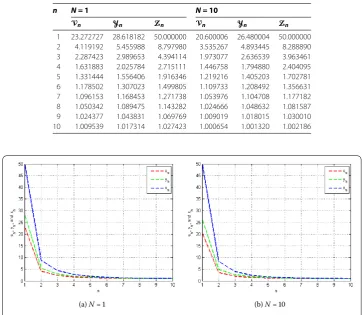
Figure 1 The convergence of{Vn},{Yn}, and{Zn}with initial valueZ1= 50.
Then we have ⎧ ⎨ ⎩
Yn=nn+P[,]Zn+ ( –nn+)+n n+
(Zn+ nn+),
Zn+=nZn+ (I–nA)P[,](I–n(I–T))Yn, ∀n∈N.
(.)
From Corollary ., we can conclude that the sequences{Zn},{Yn}, and{Vn}generated by (.) converge strongly to .
Table and Figure show the values of sequences{Zn},{Yn}, and{Vn}in two cases.
Remark .
(i) From Table and Figure , the sequences{Zn},{Yn}, and{Vn}converge to , where
{}=Fix(T)∩Ni=EP(i).
(ii) For case (i), Corollary . guarantees the convergence of{Zn},{Yn}, and{Vn}.
(iii) For case (ii), the convergence of{Zn},{Yn}, and{Vn}can be guaranteed by
Theorem ..
(iv) The iteration (.) for the combination of equilibrium problem converges faster than the iteration (.) for the classical equilibrium problem.
Example . LetRbe the two-dimensional space of real numbers with an inner product ·,·:R×R→Rdefined byu,v=u·v=u
v+uvand a usual norm · :R→R
given byu=u
+u, for allu= (u,u),v= (v,v)∈R. Let the mappingsA:R→
R,F :R→Rbe defined by
Au= u , u ,
Fu= u , u
, for allu= (u,u)∈R.
For everyi= , , . . . ,NandI= [, ], leti:I×I→RandT :I→Ibe defined by
Tu=
u+
, u+
,
i(u,v) =i(v–u)·(v+ u–), for allu= (u,u),v= (v,v)∈I,
where= (, ). Letγ = ,δn=
n,θn=
n
n+,ϕn= n
n+, andψn=
n for everyn∈N.
It is clear thatT is a nonspreading mapping andFix(T) ={}, where= (, ). Putai=
i +NN, for everyi= , , . . . ,N. It is obvious that
N
i=aiisatisfies all con-ditions in Theorem . andEP(Ni=aii) =
N
i=EP(i) ={}, where= (, ). Then we have
Fix(T)∩ N
i=
EP(i) ={}.
Then, by Theorem ., the sequencesZn= (Zn,Zn),Yn= (Yn,Yn), andVn= (Vn,Vn) con-verge strongly to{}.
Remark . From Example ., puttingρ=Ni=(
i+NN)i, we obtain
≤ N
i=
aii(Vn,y) +
ϕn
y–Vn,Vn–Zn
=ρ(y–Vn)·y+ Vn– (, )
+
ϕn
(y–Vn)·(Vn–Zn)
=ρy–Vn,y–Vn
·y+ Vn– ,y+ Vn–
+
ϕn
y–Vn,y–Vn
·Vn–Zn,Vn–Zn
=ρy–Vn
y+ Vn–
+y–Vn
y+ Vn–
+
ϕn
y–Vn
Vn–Zn+y–Vn
Vn–Zn
=
ρy–Vn
y+ Vn–
+
ϕn
y–Vn
Vn–Zn
+
ρy–Vn
y+ Vn–
+
ϕn
y–Vn
Vn–Zn
⇔ ≤ρϕn
y–Vn
y+ Vn–
+y–Vn
+ρϕn
y–Vn
y+ Vn–
+y–Vn
Vn–Zn
=ρϕn(y)+
ρVnϕn+Vn–Zn– ρϕn
y
+ ρϕnVn–
Vn– ρϕn
Vn+VnZn
+ρϕn(y)+
ρVnϕn+Vn–Zn– ρϕn
y
+ ρϕnVn–
Vn– ρϕn
Vn+VnZn
=G(y) +G(y), (.)
whereG(y) =ρϕn(y)+ (ρVnϕn+Vn–Zn– ρϕn)y+ ρϕnVn– (Vn)– ρϕn(Vn)+ V
nZnandG(y) =ρϕn(y)+(ρVnϕn+Vn–Zn–ρϕn)y+ρϕnVn–(Vn)–ρϕn(Vn)+ V
nZn. ThenG(y) andG(y) are quadratic functions with coefficientsa=ρϕn,b=
ρV
nϕn+Vn–Zn– ρϕn, andc= ρϕnVn– (Vn)– ρϕn(Vn)+VnZn, anda=ρϕn,
b= ρVnϕn+Vn–Zn– ρϕn, andc= ρϕnVn– (Vn)– ρϕn(Vn)+VnZn, respectively. Determine the discriminantofGas follows:
= (b)– ac
=ρVnϕn+Vn–Zn– ρϕn
– ρϕn
ρϕnVn–
Vn– ρϕn
Vn+VnZn
=Vn– ρϕn+ ρϕnVn–Zn
.
From (.), ifG(y)≥,∀y∈R, it has at most one solution inR, thus≤. It follows
that
Vn=Z
n+ ρϕn + ρϕn
. (.)
Next, we determine the discriminantofGas follows:
= (b)– ac
=ρVnϕn+Vn–Zn– ρϕn
– ρϕn
ρϕnVn–
Vn– ρϕn
Vn+VnZn
=Vn– ρϕn+ ρϕnVn–Zn
.
From (.), ifG(y)≥,∀y∈Rand it has at most one solution inR, then≤. This
yields
Vn=Z
n+ ρϕn + ρϕn
. (.)
Putδn=n,θn=nn+,ϕn=nn+,ψn=n, for alln∈N. It is obvious that the sequences{δn},
{θn},{ϕn}, and{ψn}satisfy all conditions in Theorem .. For everyn∈N, from (.) and (.), the iterative scheme (.) becomes
⎧ ⎨ ⎩
Yn=nn+PCZn+ ( –nn+)Un,
Zn+=nZn+ (I–nA)PC(I–n(I–T))Yn, ∀n∈N,
(.)
whereZn= (Zn,Zn),Yn= (Yn,Yn), andVn= (Vn,Vn) = (
Z n+ρϕn +ρϕn ,
Let the initial values be defined as in the following cases.
(i) Z= (Z,Z) = (–, ),N= , andn= ,
(ii) Z= (Z,Z) = (–, )andn=N= .
For case (i), withN= , we haveρ= . Then, from (.) and (.), we obtain
Vn=Z
n+ ϕn + ϕn
and
Vn=Z
n+ ϕn + ϕn
.
Then we have ⎧ ⎨ ⎩
Yn=nn+PCZn+ ( –nn+)Vn,
Zn+=nZn+ (I–nA)PC(I–n(I–T))Yn, ∀n∈N,
(.)
whereZn= (Zn,Zn),Yn= (Yn,Yn), andVn= (Vn,Vn) = (
Zn+ϕn +ϕn ,
Zn+ϕn +ϕn ).
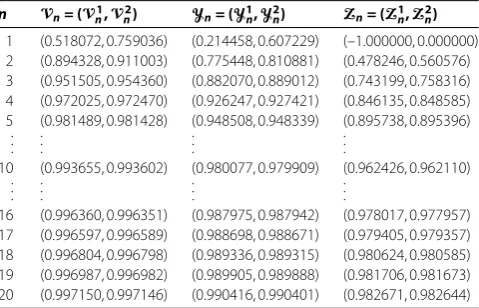
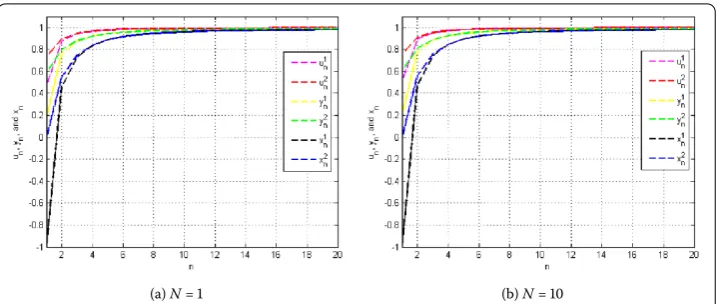
Tables and and Figure show the values of the sequences{Zn},{Yn}, and{Vn}in the two cases.
Table 2 The values of{Vn},{Yn}, and{Zn}withZ1= (–1, 0) andN= 1
n Vn= (Vn1,Vn2) Yn= (Yn1,Y2n) Zn= (Z1n,Z2n)
1 (0.473684, 0.736842) (0.178947, 0.589474) (–1.000000, 0.000000) 2 (0.880767, 0.899610) (0.761533, 0.799220) (0.463450, 0.548246) 3 (0.944343, 0.947678) (0.873506, 0.881086) (0.731833, 0.747902) 4 (0.967678, 0.968228) (0.920665, 0.922015) (0.838391, 0.841141) 5 (0.978604, 0.978548) (0.944718, 0.944575) (0.890502, 0.890217)
. . .
. . .
. . .
. . .
10 (0.992787, 0.992723) (0.979067, 0.978881) (0.961231, 0.960887) .
. .
. . .
. . .
. . .
16 (0.995890, 0.995878) (0.987473, 0.987437) (0.977477, 0.977412) 17 (0.996158, 0.996149) (0.988232, 0.988203) (0.978908, 0.978856) 18 (0.996393, 0.996386) (0.988903, 0.988879) (0.980164, 0.980121) 19 (0.996601, 0.996595) (0.989499, 0.989479) (0.981276, 0.981241) 20 (0.996785, 0.996780) (0.990033, 0.990017) (0.982268, 0.982239)
Table 3 The values of{Vn},{Yn}, and{Zn}withZ1= (–1, 0),N= 20
n Vn= (Vn1,Vn2) Yn= (Yn1,Y2n) Zn= (Z1n,Z2n)
1 (0.518072, 0.759036) (0.214458, 0.607229) (–1.000000, 0.000000) 2 (0.894328, 0.911003) (0.775448, 0.810881) (0.478246, 0.560576) 3 (0.951505, 0.954360) (0.882070, 0.889012) (0.743199, 0.758316) 4 (0.972025, 0.972470) (0.926247, 0.927421) (0.846135, 0.848585) 5 (0.981489, 0.981428) (0.948508, 0.948339) (0.895738, 0.895396)
. . .
. . .
. . .
. . .
10 (0.993655, 0.993602) (0.980077, 0.979909) (0.962426, 0.962110) .
. .
. . .
. . .
. . .
(a)N= (b)N=
Figure 2 The convergence of{Vn},{Yn}, and{Zn}with initial valueZ1= (–1, 0) for both cases.
Remark .
(i) Tables and , and Figure show that the sequences{Zn},{Yn}, and{Vn}converge
to, where{}={(, )}=Fix(T)∩Ni=EP(i).
(ii) For case (i), Corollary . guarantees the convergence of{Zn},{Yn}, and{Vn}.
(iii) For case (ii), the convergence of{Zn},{Yn}, and{Vn}can be guaranteed by
Theorem ..
(iv) The iteration (.) for the combination of equilibrium problem converges faster than the iteration (.) for the classical equilibrium problem.
Competing interests
The authors declare that they have no competing interests.
Authors’ contributions
Both authors contributed equally and significantly to this research article. Both authors read and approved the final manuscript.
Acknowledgements
The authors appreciated the referees providing valuable comments improving the content of this research paper. This research is supported by the Research Administration Division of King Mongkut’s Institute of Technology Ladkrabang.
Received: 31 January 2014 Accepted: 19 July 2014 Published:15 Aug 2014
References
1. Kohsaka, F, Takahashi, W: Fixed point theorems for a class of nonlinear mappings related to maximal monotone operators in Banach spaces. Arch. Math.91, 166-177 (2008)
2. Iemoto, S, Takahashi, W: Approximating common fixed points of nonexpansive mappings and nonspreading mappings in a Hilbert space. Nonlinear Anal.71, 2082-2089 (2009)
3. Kurokawa, Y, Takahashi, W: Weak and strong convergence theorems for nonspreading mappings in Hilbert spaces. Nonlinear Anal.73, 1562-1568 (2010)
4. Osilike, MO, Isiogugu, FO: Weak and strong convergence theorems for nonspreading-type mappings in Hilbert spaces. Nonlinear Anal.74, 1814-1822 (2011)
5. Liu, H, Wang, J, Feng, Q: Strong convergence theorems for maximal monotone operators with nonspreading mappings in a Hilbert space. Abstr. Appl. Anal. (2012). doi:10.1155/2012/917857
6. Deng, BC, Chen, T, Li, FL: Viscosity iteration algorithm for aρ-strictly pseudononspreading mapping in a Hilbert space. J. Inequal. Appl.2013, 80 (2013)
7. Blum, E, Oettli, W: From optimization and variational inequalities to equilibrium problems. Math. Stud.63(14), 123-145 (1994)
8. Combettes, PL, Hirstoaga, SA: Equilibrium programming in Hilbert spaces. J. Nonlinear Convex Anal.6(1), 117-136 (2005)
9. Ceng, LC, Al-Homidan, S, Ansari, QH, Yao, JC: An iterative scheme for equilibrium problems and fixed point problems of strict pseudo-contraction mappings. J. Comput. Appl. Math.223, 967-974 (2009)