Volume 2008, Article ID 573832,7pages doi:10.1155/2008/573832
Research Article
Language Model Adaptation Using Machine-Translated
Text for Resource-Deficient Languages
Arnar Thor Jensson, Koji Iwano, and Sadaoki Furui
Department of Computer Science, Tokyo Institute of Technology, 2-12-1 Ookayama, Meguro-ku, Tokyo 152-8552, Japan
Correspondence should be addressed to Arnar Thor Jensson,[email protected]
Received 30 April 2008; Revised 25 July 2008; Accepted 29 October 2008
Recommended by Martin Bouchard
Text corpus size is an important issue when building a language model (LM). This is a particularly important issue for languages where little data is available. This paper introduces an LM adaptation technique to improve an LM built using a small amount of task-dependent text with the help of a machine-translated text corpus. Icelandic speech recognition experiments were performed using data, machine translated (MT) from English to Icelandic on a word-by-word and sentence-by-sentence basis. LM interpolation using the baseline LM and an LM built from either word-by-word or sentence-by-sentence translated text reduced the word error rate significantly when manually obtained utterances used as a baseline were very sparse.
Copyright © 2008 Arnar Thor Jensson et al. This is an open access article distributed under the Creative Commons Attribution License, which permits unrestricted use, distribution, and reproduction in any medium, provided the original work is properly cited.
1. INTRODUCTION
The state-of-the-art speech recognition has advanced greatly for several languages [1]. Extensive databases both acoustical and text have been collected in those languages in order to develop the speech recognition systems. Collection of large databases requires both time and resources for each of the target language. More than 6000 living languages are spoken in the world today. Developing a speech recognition system for each of these languages seems unimaginable, but since one language can quickly gain political and economical importance a quick solution toward developing a speech recognition system is important.
Since data, for the purpose of developing a speech recognition system, is sparse or nonexisting for resource-deficient languages, it may be possible to use data from the other resource-rich languages, especially when available target language sentences are limited which often occurs when developing prototype systems.
Development of speech recognizers for resource-deficient languages using spoken utterances in a different language has already been reported in [2], where phonemes are identified in several different languages and used to create or aid an acoustic model for the target language. Text for creating the language model (LM) is on the other hand
assumed to exist in a large quantity and therefore sparseness of text is not addressed in [2].
Statistical language modeling is well known to be very important in large vocabulary speech recognition but cre-ating a robust language model typically requires a large amount of training text. Therefore it is difficult to create a statistical LM for resource deficient languages. In our case, we would like to build an Icelandic speech recognition dialogue system in the weather information domain. Since Icelandic is a resource deficient language there is no large text data available for building a statistical LM, especially for spontaneous speech.
Table1: Datasets.
Corpus set Sentences Words Unique words
ST 1500 8591 805
SD 300 1870 342
Eval 660 3767 554
recognition transcripts and aligns each with the same or similar story in another language. Using this parallel corpus a statistical MT system is trained. The MT system is then used to translate a text in order to aid the LM used to recognize the same or similar story in the original language. LM adaptation with target task machine-translated text is addressed in [5] but without speech recognition experiments. A system that uses an automatic speech recog-nition system for human translators is improved in [6] by using a statistical machine translation of the source text. It assumes that the content of the text translated is the same as in the target text recognized. The above mentioned systems all use statistical machine translation (MT) often expensive to obtain and unavailable for resource-deficient languages.
MT methods other than statistical MT are also available, such as rule based MT systems. A rule based MT system can be based on a word-by-word (WBW) translation or sentence-by-sentence (SBS) translation. WBW translation only requires a dictionary, already available for many language pairs, whereas rule based SBS MT needs more extensive rules and therefore more expensive to obtain. The WBW approach is expected to be successful only for closely grammatical related languages. In this paper, we investigate the effectiveness of WBW and SBS translation methods and show the amount of data for the resource-deficient language required to par these methods.
In Section 2, we explain the method for adapting lan-guage models.Section 3explains the experimental corpora.
Section 4 explains the experimental setups. Experimental results are reported inSection 5followed by a discussion in Sections6, and7concludes the paper.
2. ADAPTATION METHOD
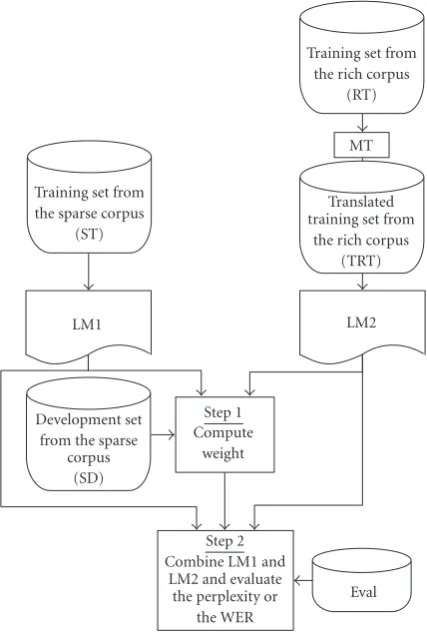
Our method involves adapting a task-dependent LM that is created from a sparse amount of text using a large translated text (TRT), whereTRTdenotes the machine translation of the rich corpus (RT), preferably in the same domain area as the task. This involves two steps shown graphically in
Figure 1. First of all the sparse text is split into two, a training text corpus (ST) and a development text corpus (SD). A language model LM1 is created from ST, and LM2 from
TRT. TheTRT can either be obtained from SBS or WBW translation. The SDset is used to optimize the weight (λ) used in Step 2. Step 2 involves interpolating LM1 and LM2 linearly using the following equation:
Pcomb
ωi|h=λ·P1
ωi|h+ (1−λ)P2
ωi|h, (1)
wherehis the history.P1is the probability from LM1 andP2
is the probability from LM2.
Training set from the sparse corpus
(ST)
LM1
Development set from the sparse
corpus (SD)
Training set from the rich corpus
(RT)
MT
Translated training set from
the rich corpus (TRT)
LM2
Step 1 Compute
weight
Step 2 Combine LM1 and
LM2 and evaluate the perplexity or
the WER
Eval
Figure1: Data diagram.
The final perplexity or word error rate (WER) value is calculated using an evaluation text set or speech evaluation set (Eval) which is disjoint from all other datasets.
3. EXPERIMENTAL CORPORA
3.1. Experimental data: LM
The weather information domain was chosen for the Ice-landic experiments and translation from English (rich) to Icelandic (sparse) using WBW and SBS. For the experiments, the Jupiter corpus [7] was used. It consists of unique sentences gathered from actual users’ utterances. A set of 2460 sentences were manually translated from English to Icelandic and split intoST, SD, andEval sets as shown in
Table 1. 63116 sentences were used asRT.
Table2: Translated datasets.
Corpus set Sentences Words Unique words
TRTWBW 62962 440347 3396
TRTSBS 62996 406814 7312
Table3: BLEU evaluation of theSBSand theWBWmachine trans-lators.
Translation method
BLEU
1-gram 2-gram 3-gram 4-gram Average
WBW 0.47 0.28 0.19 0.15 0.27
SBS 0.58 0.42 0.32 0.26 0.39
Table4: Icelandic phonemes in IPA format.
Vovel /i, i,ε, a,y, œ, u, , au, ou, ei, ai, œy / Consonant / p, ph, t, th, c, ch, f, v, ð, s, , ç,
, m, n, l, r /
The dictionary was then used to translate RT WBW into TRTWBW. Another translationTRTSBS was created by SBS machine translation using [8]. Names of places were identified and then replaced randomly with Icelandic place names for bothTRTWBWandTRTSBS, since the task is in the weather information domain.Table 2shows some attributes of the WBW and SBS translated Jupiter texts. The reason why the number of sentences inTable 2does not match the number of sentences found in theRTset is because of empty translations. The reason why the unique words in Table 2
are more than double forTRTSBScompared toTRTWBW is because Icelandic is a highly inflected language and the SBS translation system can cope with those kinds of words as well as word tenses and words articles to some extent whereas the WBW translation system copes poorly.
A 1-gram, 2-gram, 3-gram, and 4-gram translation evaluation using BLEU [9] was performed on 100 sentences created from both the SBS and the WBW machine transla-tors, using two human references.Table 3shows the BLEU evaluation results. The SBS machine translation outbeats the simple WBW translation as expected. It is a known fact that even human translators do not get full mark (1.0) using the BLEU evaluation [9]. The evaluation still results in 0.15 and 0.26 for WBW and SBS, respectively, using 4-gram evaluation.
3.2. Experimental data: acoustic model
A biphonetically balanced (PB) Icelandic text corpus was used to create an acoustic training corpus. A text-to-phoneme translation dictionary was created for this purpose based on [10] using 257 pronunciation rules. The whole set of 30 Icelandic phonemes used to create the corpus, consisting of 13 vowels and 17 consonants, are listed in IPA format inTable 4.
Some attributes of the PB corpus are given in Table 5. The acoustic training corpus was then recorded in a clean environment to minimize external noise. Table 6 describes some attributes of the acoustic training corpus.
Table5: Some attributes of the phonetically balanced Icelandic text corpus.
Attribute Text corpus
No. of sentences 290
No. of words 1375
No. of phones 8407
PB unit Biphone
No. of unique PB units 916
Average no. of words/sentence 4.7 Average no. of phones/word 6.1
Table6: Some attributes of the Icelandic acoustic training corpus.
Attribute Acoustic corpus
No. of male speakers 13
No. of female speakers 7
Time (hours) 3.8
Table7: Some attributes of the Icelandic evaluation speech corpus.
Attribute Evaluation speech corpus
No. of utterances 4000
No. of male speakers 10
No. of female speakers 10
Time (hours) 2.0
Table8: Experimental setup.
Experiment no. TRTcorpus Vocabulary
Experiment 1 None VST
Experiment 2 None VST+VTRTWBW
Experiment 3 TRTWBW VST
Experiment 4 TRTWBW VST+VTRTWBW
Experiment 5 None VST+VTRTSBS
Experiment 6 TRTSBS VST
Experiment 7 TRTSBS VST+VTRTSBS
Experiment 8 TRTWBW+TRTSBS VST+VTRTWBW+VTRTSBS
25-dimensional feature vectors consisting of 12 MFCCs, their delta, and a delta energy were used to train gender-independent acoustic model. Phones were represented as context-dependent, 3-state, left-to-right hidden Markov models (HMMs). The HMM states were clustered by a phonetic decision tree. The number of leaves was 1000. Each state of the HMMs was modeled by 16 Gaussian mixtures. No special tone information was incorporated. HTK [11] version 3.2 was used to train the acoustic model.
3.3. Evaluation speech corpus
32 34 36 38 40 42 44 46 48 50
Wo
rd
er
ro
r
ra
te
(%
)
1 2 3 4 5 6 7 8 9 10 11 12 13 14 15
×102
Number of ST sentences Experiment 1
Experiment 2
Experiment 3 Experiment 4
Figure2: Word error rate results using thebaselinefrom Experi-ment 1 and the interpolated WBW machine-translated results from Experiment 2, Experiment 3, and Experiment 4.
each speaker since several utterances were deemed unusable. Some attributes of the corpus are presented inTable 7. None of the speakers in the evaluation speech corpus is included in the acoustic training corpus described inSection 3.2.
4. EXPERIMENTAL SETUP
In total, eight different experiments were performed. The experimental setup can be viewed inTable 8. Experiment 1 used no translation and its vocabulary consisted only from the unique words found in theST set, creatingVST, and is therefore considered as thebaseline. Experiments 2 to 4 used WBW machine-translated data. Experiment 2 used noTRT corpus but used the unique words found inTRTWBW, creat-ing the vocabularyVTRTWBW. This was done in order to find the impact of including only WBW translated vocabulary. Experiment 3 used the WBW machine-translated corpus along with theVSTvocabulary. Experiment 4 used the WBW MT along with the combined vocabulary from the ST and
TRTcorpora.
Experiments 5 to 8 used SBS machine-translated data. Experiment 5 used no TRT corpus but used the unique words found in TRTSBS, creating the vocabulary VTRTSBS. This was done in order to find the impact of including only SBS translated vocabulary. Experiment 6 usedTRTSBS
as the TRT corpus without adding translated words to the vocabulary. Experiment 7 used the SBS MT along with the combined vocabulary found from theSTandTRTcorpora. Experiment 8 used both information from the SBS and WBW MT. Using WBW translated data along with SBS MT can be done since the dictionary used to create the WBW MT was created using the SBS MT.
TheSTset size varied from 100 to 1500 sentences for all the experiments. In the following textSTn corresponds to
32 34 36 38 40 42 44 46 48 50
Wo
rd
er
ro
r
ra
te
(%
)
1 2 3 4 5 6 7 8 9 10 11 12 13 14 15
×102
Number of ST sentences Experiment 1
Experiment 5 Experiment 6
Experiment 7 Experiment 8
Figure3: Word error rate results using thebaselinefrom Experi-ment 1 and the interpolated SBS machine-translated results from Experiment 5, Experiment 6, Experiment 7, and Experiment 8.
a subset of theST set wheren is the number of sentences used. Experiments with noST set included,ST0, was also
performed on Experiment 4, Experiment 7, and Experiments 8. All LMs were built using 3-grams with Kneser-Ney smoothing. The WER experiments were performed three times with different, randomly chosen sentences, creating each ST and SD set, in order to increase the accuracy of the results. An average WER was calculated over the three experiments. This increases accuracy when comparing different experiments especially when the ST set is very sparse. The vocabulary changed for eachSTandSDset and the values for words and unique words inTable 1reflect only one of the three cases. The words and vocabulary sizes for the other two cases were very similar to the one reported inTable 1. Perplexity and out-of-vocabulary (OOV) results reported in this paper also correspond only to the case with
ST andSDsets found in Table 1. Each experiment had the interpolation weights optimized on theSDcorpus.
The speech recognition experiments were performed using Julius [12] version “rev.3.3p3 (fast).”
5. RESULTS
Table9: Perplexity results.
STn
Experiment no. ST0 ST100 ST500 ST1000 ST1500
Experiment 1 NA 30.7 26.4 26.3 26.5
Experiment 3 NA 29.4 26.0 26.1 26.3
Experiment 6 NA 26.6 25.3 25.3 25.4
Experiment 2 NA 58.2 34.2 31.9 30.8
Experiment 4 664.6 50.2 32.6 30.7 29.9
Experiment 5 NA 88.9 43.5 37.7 35.3
Experiment 7 287.0 61.1 38.4 34.1 32.5
Experiment 8 274.8 61.6 38.5 34.4 32.6
Table10:OOVrate (%) with corresponding vocabulary sizes inside parentheses.
STn
Vocabulary ST0 ST100 ST500 ST1000 ST1500
VSTn NA 14.0 6.8 5.5 4.6
(0) (190) (451) (614) (805)
VSTn+VTRTWBW
26.8 8.4 4.8 4.0 3.4
(3396) (3501) (3638) (3755) (3911)
VSTn+VTRTSBS 9.2 4.4 2.6 2.5 2.2
(7312) (7353) (7432) (7500) (7597)
VSTn+VTRTWBW +VTRTSBS
9.0 4.4 2.6 2.4 2.2
(8432) (8470) (8546) (8613) (8707)
when theST set is small but converges quickly as moreST sentences are added.
The WER results from Experiment 5, Experiment 6, Experiment 7, and Experiment 8 along with thebaselinein Experiment 1, are shown inFigure 3. When noSTsentences are present and only SBS or SBS and WBW machine-translated data is used, Experiment 7 and Experiment 8 give WER of 56.5% and 56.8%, respectively. When 100ST sentences are added to the system and interpolated with the
TRTcorpus in Experiment 7, the WER is 41.9%. Experiment 8 gives a 42.0% WER when 100ST sentences are added to the system. As more ST sentences are added, the relative improvement reduces. When 1500 ST sentences are used, the WER in Experiment 7 gives 32.5% compared to 32.7% when the baselineis used. When the translated vocabulary is alone added, Experiment 5 does not give any significant improvement over the baseline. When the vocabulary is fixed to the ST set and TRTSBS is used as the TRT set, Experiment 6 gives a small improvement over thebaseline. WhenST composes of 1500 sentences, the interpolation in Experiment 6 gives a WER of 32.6%. Each experiment was performed three times with differentSTandSDset, and the average WER calculated, as explained before. For example, Experiment 7 shown inFigure 3gives WER 41.8%, 41.9%, and 42.1%, with an average of 41.9%, when 100STsentences are used.
When the WER results are more carefully investigated we are able to find out how many more ST sentences are needed for Experiment 1 to par Experiment 7. When 100
STsentences are used for Experiment 7 then around 150ST sentences in addition are needed for Experiment 1 to par the WER result of Experiment 7. When 500 ST sentences are used for Experiment 7 then around 300 ST sentences in addition are needed for Experiment 1 to par the WER results. When 1000ST sentences are used for Experiment 7 then around 200ST sentences in addition are needed for Experiment 1 to par the WER results in Experiment 7.
Perplexity and OOV results are shown in Tables 9
and 10, respectively, for some ST values. The perplexity results for Experiment 1, Experiment 3, and Experiment 6 should be compared together since the vocabulary is the same for those experiments, VST. Experiment 2 and Experiment 4 have the same vocabulary,VSTcombined with
VTRTWBW and should be compared together. For the same
reason Experiment 5 and Experiment 7 should be compared together having the same vocabulary, VST combined with
VTRTSBS. As shown in Table 9, all perplexity results get
improved when aTRTcorpus is introduced and interpolated with the corresponding ST set. The OOV rate shown in
Table 10is reduced by adding the unique words found in the
6. DISCUSSION
The improvement of the Icelandic LM with translated English text/data was confirmed by reduction in WER by using either WBW or SBS MT. Experiment 1 should be compared with the other experiments since Experiment 1 does not assume any foreign translation. When thebaseline in Experiment 1 is compared with the interpolated results using WBW MT in Experiment 4, we get a WER 49.6% reduced to 46.6% respectfully, a 6.0% relative improvement when using 100 ST sentences. The relative improvement reduces as more ST sentences are added to the system and converges to thebaselinewhen 500STsentences are added to the system. Neither Experiment 2 nor Experiment 3 gives any significant improvement over the baseline. This along with the results in Experiment 4 suggests that when WBW translated data is available, both the translated corpus and its vocabulary should be added to the system when theST sentences are sparse.
The reason why Experiment 8 is not outperforming Experiment 7 is most likely because Experiment 8 is using unique words found in the TRTWBW corpus in addition to the unique words found in Experiment 7. As Table 10
shows, around 1100 new words are added to the vocabulary in Experiment 8 compared to Experiment 7 for all ST set conditions without reducing the OOV rate significantly. Therefore the perplexity rate increases making the speech recognition process more difficult. The unique words found in TRTWBW are therefore not contributing toward better results if vocabulary fromTRTSBSis used.
When the baseline is compared with the interpolated results using SBS MT in Experiment 7, we get a WER 49.6% reduced to 41.9% respectfully, a 15.5% relative improvement when 100 ST sentences are added to the system. Improvements by merging the vocabulary from the
TRTSBS and VST is confirmed by comparing Experiment 6
and Experiment 7 for allSTsets. The WER improvement of the SBS MT over the WBW MT is confirmed for all theST sets as the BLEU evaluation results in Section 3.1suggests. This can be seen by comparing Experiment 4 in Figure 2
with Experiment 7 inFigure 3. The improvement is as well confirmed with perplexity results when Experiment 3 and Experiment 6 are compared inTable 9. When the vocabulary is kept the same as in the case of Experiment 1, Experiment 3, and Experiment 6 the proposed methods always outperform the baseline perplexity results.
7. CONCLUSIONS
The results presented in this paper show that an LM can be improved considerably using either WBW or SBS translation. This especially applies when developing a pro-totype system where the amount of target domain sentences is very limited. The effectiveness of the WBW and SBS translation methods was confirmed for English to Icelandic for a weather information task. The convergence point of these methods with the baseline was around 400 and 1500 manually collected sentences for the WBW and the SBS translation methods respectfully. In order to get significant
improvement, a good (high BLEU score) MT system is needed. The WBW translation is especially important for resource-deficient languages that do not have SBS machine translation tools available. It is believed that a high BLEU score can be obtained with WBW MT for very closely related language pairs and between dialects. Confirming the effectiveness of the WBW and the SBS translation methods for other language pairs is left as future work, as is applying the rule based WBW and SBS translation methods to a larger domain, for example broadcast news. Future work also involves an investigation of other maximum a posteriori adaptation methods such as [13] and methods like the ones described in [14–16] that selects a relevant subset from a large text collection such as the World Wide Web to aid sparse target domain. These methods assume that a large text collection is available in the target language but we would like to apply these methods to extract sentences from theTRT corpus. Since the acoustic model is only built from 3.8 hours of acoustic data which gives rather poor results we would like to either collect more Icelandic acoustic data or use data from foreign languages to aid current acoustic modeling.
ACKNOWLEDGMENTS
The authors would like to thank Dr. J. Glass and Dr. T. Hazen at MIT and all the others who have worked on developing the Jupiter system. They also would like to thank Dr. Edward W. D. Whittaker for his valuable input. Special thanks to Stefan Briem for his English to Icelandic machine translation tool and allowing to use his machine translation results. This work is supported in part by 21st Century COE Large-Scale Knowledge Resources Program.
REFERENCES
[1] M. Adda-Decker, “Towards multilingual interoperability in automatic speech recognition,” Speech Communication, vol. 35, no. 1-2, pp. 5–20, 2001.
[2] T. Schultz and A. Waibel, “Language-independent and language-adaptive acoustic modeling for speech recognition,” Speech Communication, vol. 35, no. 1-2, pp. 31–51, 2001. [3] S. Khudanpur and W. Kim, “Using cross-language cues
for story-specific language modeling,” in Proceedings of the International Conference on Spoken Language Processing (ICSLP ’02), vol. 1, pp. 513–516, Denver, Colo, USA, Septem-ber 2002.
[4] W. Kim and S. Khudanpur, “Cross-lingual latent semantic analysis for language modeling,” inProceedings of IEEE Inter-national Conference on Acoustics, Speech, and Signal Processing (ICASSP ’04), vol. 1, pp. 257–260, Montreal, Canada, May 2004.
[5] H. Nakajima, H. Yamamoto, and T. Watanabe, “Language model adaptation with additional text generated by machine translation,” inProceedings of the 19th International Conference on Computational Linguistics (COLING ’02), vol. 2, pp. 716– 722, Taipei, Taiwan, August 2002.
Speech Recognition and Understanding (ASRU ’05), pp. 121– 126, San Juan, Puerto Rico, November-December 2005. [7] V. Zue, S. Seneff, J. R. Glass, et al., “JUPITER: a
telephone-based conversational interface for weather information,”IEEE Transactions on Speech and Audio Processing, vol. 8, no. 1, pp. 85–96, 2000.
[8] S. Briem, “Machine Translation Tool for Automatic Trans-lation from English to Icelandic,” Iceland, 2007,http://www .simnet.is/stbr/.
[9] K. Papineni, S. Roukos, T. Ward, and W. Zhu, “BLEU: a method for automatic evaluation of machine translation,” in Proceedings of the 40th Annual Conference of the Association for Computational Linguistics (ACL ’02), pp. 311–318, Philadel-phia, Pa, USA, July 2002.
[10] E. Rögnvaldsson, Islensk hljodfraedi, Malvisindastofnun Haskola Islands, Reykjavik, Iceland, 1989.
[11] S. Young, G. Evermann, T. Hain, et al., “The HTK Book (Version 3.2.1),” 2002.
[12] A. Lee, T. Kawahara, and K. Shikano, “Julius—an open source real-time large vocabulary recognition engine,” inProceedings of the European Conference on Speech Communication and Technology (EUROSPEECH ’01), pp. 1691–1694, Aalborg, Denmark, September 2001.
[13] M. Bacchiani and B. Roark, “Unsupervised language model adaptation,” inProceedings of IEEE International Conference on Acoustics, Speech, and Signal Processing (ICASSP ’03), vol. 1, pp. 224–227, Hong Kong, April 2003.
[14] R. Sarikaya, A. Gravano, and Y. Gao, “Rapid language model development using external resources for new spoken dialog domains,” inProceedings of IEEE International Conference on Acoustics, Speech, and Signal Processing (ICASSP ’05), vol. 1, pp. 573–576, Philadelphia, Pa, USA, March 2005.
[15] A. Sethy, P. Georgiou, and S. Narayanan, “Selecting relevant text subsets from web-data for building topic specific language models,” in Proceedings of the Human Language Technology Conference of the North American Chapter of the Association of Computational Linguistics (HLT-NAACL ’06), pp. 145–148, New York, NY, USA, June 2006.