Psychogenic antecedents and apparel
customization: moderating effects of gender
Su‑kyung Seo
1and Chunmin Lang
2*Introduction
Lately, the external market factors, such as the rapidly changing economic environment, intensive competition, globalization, and accelerated technology advance, have contrib-uted to the market instability (Lee and Moon 2015). Meanwhile, consumers’ needs and tastes have been more miscellaneous and distinct than ever before, making it harder for fashion forecasts (Kang and Park-Poaps 2010). Consumers with a greater purchase power started expressing their individuality through purchasing personalized products (Lee and Moon 2015). In addition, with the increasing need for high-quality products, the center of competition in the fashion industry is shifting from low-priced products to the diversity of high-quality items (Song and Sakao 2017).
Abstract
The impact of gender is critical in consumer behavior; however, gender differences have been overlooked in consumer studies. The purpose of this study is to examine how behavior‑inducing psychogenic needs (i.e., need for uniqueness, self‑promotion, and social identity) influence the way individuals perceive apparel customization, lead‑ ing to buying intention of customized apparel products. Further, to identify whether gender plays a moderating role in the relationships between those psychogenic needs and the perception of apparel customization. The conceptual model was tested by conducting an online survey of 338 samples from college students in the United States. Structural equation modeling (SEM) was utilized for hypotheses testing. The structural multi‑group model was conducted and path coefficient comparisons were made to test the moderating effects of gender. The results indicated that need for uniqueness and social identity are strong determinant factors in eliciting positive perceptions of customization, ultimately resulting in buying intention of customized apparel products; however, the effects of self‑promotion was not significant. The results also illustrated that differences exist in antecedents toward customization perception between genders. Both genders are commonly motivated by need for uniqueness. However, males are more driven by social identity and need for uniqueness, whereas females are more inspired by self‑promotion. The results offer managerial implications by provid‑ ing retailers with consumers’ behavior toward fashion customization based on gender differences.
Keywords: Apparel customization, Need for uniqueness, Self‑promotion, Social
identity, Moderating effects, Gender, Psychological needs
Open Access
© The Author(s) 2019. This article is distributed under the terms of the Creative Commons Attribution 4.0 International License (http://creat iveco mmons .org/licen ses/by/4.0/), which permits unrestricted use, distribution, and reproduction in any medium, provided you give appropriate credit to the original author(s) and the source, provide a link to the Creative Commons license, and indicate if changes were made.
RESEARCH
*Correspondence: [email protected] 2 Assistant Professor, Department of Textiles, Apparel Design & Merchandising, Louisiana State University, 143 Human Ecology, Baton Rouge, LA 70803, USA
To face the current phenomenon, customization has been getting a great deal of atten-tion due to its ability to satisfy individual consumers’ heterogeneous tastes (Park et al.
2013) and its better quality and service benefits (Yeung et al. 2010), which has allowed it to emerge as an alternative position for fashion companies seeking to be more com-petitive in the fierce market environment (Park et al. 2013). Moreover, fashion compa-nies can leverage cost benefits of customization due to its lower inventory management cost, reduced textile waste, more flexible and reconfigurable manufacturing process (Kang and Kim 2012; Senanayake and Little 2010; Hu 2013). By responding to consum-ers’ high-frequency calls for fashion products, fashion businesses have begun providing value-adding offerings, which positively affected their economic profits (Song and Sakao
2017). In addition, according to de Bellis et al. (2016), the product configuration that allows consumers to create their self-designed items is projected to be profitable given their potential repercussion on product diffusion due to its unique values. Ives and Pic-coli (2003) state that about 36% of consumers express their willingness to wait for and spend 15% more on customized apparel products rather than standardized ones. In fact, Lands’ End had significantly increased its annual sales during the fiscal years from 1999 to 2002 and accomplished more than a quadruple increase due to providing customiz-able chinos and jeans (Ives and Piccoli 2003). Currently, Nike achieved over $100 mil-lion in annual sales by launching the e-customization app, NikeiD (Kang and Kim 2012). As fashion companies become more aware of consumers’ diverse demands, including both design and quality, the implementation of customization has been increasing and expanding.
With respect to companies’ considerable interest in multi-channel retailing, customi-zation has been playing a critical role to create and expand new distribution channels by providing various services and products and by allowing consumers to have access to different channels (de Bellis et al. 2016). This multi-channel strategy has received posi-tive responses from consumers (e.g., satisfaction, loyalty, higher to pay, and greater pur-chase intention) because of its various alternative offers; therefore, increased companies’ competitiveness in the market (de Bellis et al. 2016). Accordingly, multi-channel retailers are required to understand consumer decision-making process which leads to consumer patronage among a significant segment (Cho and Workman 2011), and consumer deci-sion is made largely based on their inner-state perspectives (Vlasceanu 2013). However, the considerable research on customization has been heavily weighted towards topics from suppliers’ point of view, such as challenges to adopt customization-focused prod-ucts/service systems, and competitive advantages of shifting to customization strategy. Other supplier-oriented topics widely covered are product development for mass cus-tomization, the role of customization in web-based settings, risks about online custom-ized products, and customization technology (Corti et al. 2011; van Doorn and Hoekstra
2013; Song and Sakao 2017). There are also some qualitative research focusing on con-sumers’ motivations, attitudes, or behavior toward customization has been conducted (Kalyanaraman and Sundar 2006; Armstrong et al. 2015). However, studies on psycho-logical needs including social roles (i.e., social identity) and gender differences that shape attitudes toward fashion customization are comparatively scarce.
properties, but for their psychosocial significance” (Lee et al. 2013, p. 335). Murray’s Psy-chogenic needs also suggest that individuals’ psyPsy-chogenic needs lead to consumer behav-iors, such as higher willingness to pay, greater purchase intention, and repeat purchase, which emphasize that certain consumers’ psychological properties significantly influ-ence the purchase intention (Solomon 2017). Thus, understanding consumers’ internal values becomes insightful for marketers and manufacturers to establish better target market segments, furthering to create effective market communications. In addition, gender has been widely used as segmentation construct, little research has discussed gender differences in consumer behavior (Tifferet and Herstein 2012) and especially it has remained largely unexplored in the fashion customization settings. Therefore, the purpose of this study is to determine how consumers’ psychogenic needs, including (1) need for uniqueness, (2) self-promotion and (3) social identity, influence the perception of apparel customization; further to examine whether the positive perception leads to purchase intention of customized apparel products. Based on the theoretical discus-sion of the significance of consumer psychology on consumption behavior (c.f. Foxall et al. 1998; Park et al. 2013; Kalyanaraman and Sundar 2006), the conceptual model is to be developed and tested using structural equation modeling (SEM). Furthermore, this empirical study aims to identify the moderating effects of gender on the relationships between the psychogenic needs and perception of apparel customization.
Literature review and hypotheses development
Apparel customization
The fashion apparel market is filled with diverse products and consumers’ roles have been largely limited to purchasing items from this vast array of choices (Senanayake and Little 2010). Customization has been projected to be an essential strategy that allows fashion industry to increase flexibility and responsiveness to reflect consumers’ voice into the fashion products, empowering consumers to build their own products (Seock
2007). Lee and Moon (2015) specify that Apparel Mass Customization (AMC) invites consumers to participate in the process of making or designing apparel products as they like. Currently, customization has been practically adopted by many fashion businesses, including Lands’ End, Levi Strauss, and Brooks Brothers, due to its ability to link the manufacturing and design processes through consumers’ involvement (Senanayake and Little 2010). Specifically, with respect to focusing on fit and modular customization, Brooks Brothers utilize a body scanner to effectively garner a customer’s body size for better-fitting apparel (Shen 2014). Customized apparel products present individuals’ heterogeneous tastes by tailored style, fit, and color of the garments (Senanayake and Little 2010) and this process can maximize customer satisfaction and reduce resource inputs (Hankammer and Steiner 2015).
inducing an exclusive value, special experiences, and unforgettable memories (Yeung et al. 2010). Since the customization process needs consumers’ participation, it is essen-tial to identify consumers’ willingness to be part of the apparel custom-process by understanding what consumers’ psychological perspectives are, and how they influence buying intentions of customized apparel products.
Murray’s psychogenic needs
Personality can be explained as the more extended concept of psychogenic needs (Billst-edt et al. 2017). Murray (1938) explored personality traits and narrowed down a list of 20 psychogenic needs and this work has been a foundation of various personality measure-ments such as the Thematic Apperception Test (TAT) over almost a century, providing both projective and objective insights (Costa and Mccrae 1988). The theory of Murray’s psychogenic needs introduces viscerogenic needs, which derived from humans’ primary needs (e.g., hunger, thirst, and sexuality) and psychogenic needs (e.g., achievement, affili-ation, nurturance, and autonomy), which is interchangeable with secondary needs and is differentiated from viscerogenic one. Murray proposes that the psychogenic needs con-trol behaviors in which personality is manifested (Billstedt et al. 2017). Specifically, such psychogenic needs that lead to a certain behavior include need for power, the need for affiliation, and the need for achievement (Billstedt et al. 2017). On top of that, Solomon (2017) recently states that the specific needs that are pertinent to purchase behaviors include need for uniqueness. Taken together, the projective needs of consumer behav-iors encompass an array of psychogenic needs: need for uniqueness, need for achieve-ment, need for power, and need for affiliation.
Need for achievement refers to a need for competitive achievement and it occurs in order to “accomplish something important and difficult, to compete with and surpass others” (Billstedt et al. 2017, p. 48), and this notion captures and entails the concept of self-promotion, which is regarded as a primary form for individuals to accomplish or achieve their personal goals in impression management (Rudman 1998). Leary and Kowalski (1990) support the interrelationship of two concepts by stating that “as in any goal-directed behavior, impression management is accompanied by assessments of its effectiveness in achieving one’s goals” (p. 43). Individuals with high self-promotion want to be seen as competent through success and accomplishments (Turnley and Bolino
2001; Godfrey et al. 1986) so that they may constantly pursue and seek the sense of achievement.
Need for uniqueness in consumer studies is defined as an individual’s desire to be distinctive from others by possessing and showing off material objects. Consumers’ desire for uniqueness includes creative and uncommon choices from given alterna-tive options and preference to dissimilarity (Knight and Kim 2007). Wu et al. (2012) also mention that consumers’ need for uniqueness can be fulfilled by adopting rare products. A product that is hard to obtain gives a strong impression of scarcity, sat-isfying consumers’ need for uniqueness. Furthermore, Knight and Kim (2007) state that uniqueness is the main driver for consumers to pursue a diversity of products. According to Cheema and Kaikati (2010), the higher the need for uniqueness, the stronger the desire for obtaining rare products to stand out from others becomes. More recently, narcissism has been reported to increase need for uniqueness of prod-ucts (Lee et al. 2013; de Bellis et al. 2016). Lee et al. (2013) found that narcissists are more willing to buy and to pay more on customizable products rather than non-nar-cissists. Corporates take this phenomenon more seriously and significantly to reflect this into their market analysis since the prevalence of self-presentation environment such as social media raise the sense of narcissism, which has increased about 30% during the time social media started to flourish (Lee et al. 2013). That is to say, as the number of narcissists has been increasing, satisfying consumers’ desire for uniqueness has been more critical than ever. The basic philosophy of customization is to meet the individual consumer’s needs and preferences and customized products are built based on consumers’ personal tastes. It is plausible to consider customized products as rare and unique. The previous study found the positive relationship between need for uniqueness and customization (Franke and Schreier 2008); however, replication is made in this study in order to confirm the past study and also to explore the gender differences on the relationship between desire for uniqueness and positive perception of customization which hasn’t been discussed in the past literature. Thus, the follow-ing hypothesis is suggested:
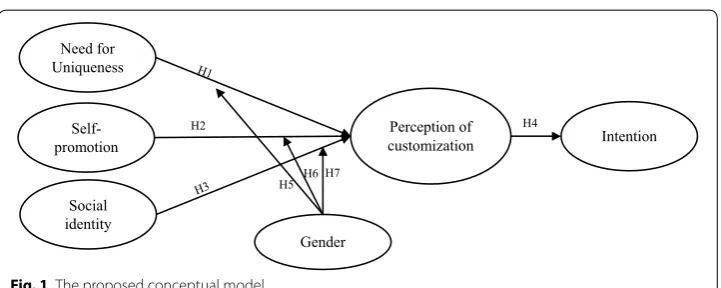
H1. Consumers with a high level of need for uniqueness tend to have a positive per-ception of customization.
Self-promotion embraces, “pointing with pride to one’s accomplishments, speaking directly about one’s strengths and talents, and making internal rather than external attributions for achievements” (Rudman 1998, p. 629). As a strategy of impression-management, self-promotion is a useful tactic to enhance favorable impressions to others, especially in an organizational context in order for achievements (Rudman
with high self-promotion tend to adopt fashion products to improve their self-image, the distinctiveness-focused apparel customization concept, which is deeply related to appearance and aesthetic features of the products, may be attractive to consumers with high self-promotion. Therefore, the following hypothesis is proposed:
H2. Consumers with a high level of self-promotion tend to have a positive percep-tion of customizapercep-tion.
Social identity refers to “the individual’s knowledge that he belongs to certain social groups together with some emotional and value significance to him of this group mem-bership” (Hogg and Terry 2017, p. 122). According to Social Identity Theory (SIT), indi-viduals classify themselves and other people into diverse social groups based on their personal attributes (i.e., gender, age, and religion) or thoughts when defining others and identifying themselves. The same group members share an emotional connection and experience of general concurrence on assessment of their affiliation (Tajifel and Turner
2004). Individuals constantly and instinctively strive to belong to certain organizations or communities. They assimilate to the group atmosphere and conform to norms whether or not they like, and they repress their counter-opinions or beliefs to avoid social sanc-tions (Kim and Park 2011). According to social comparison theory, in the comparison process, individuals solidify their values, behavior norms, and beliefs, which are associ-ated with group classification. Having a social identity also indicates pursuing similarity with group members both internally and externally (Kim and Hahn 2015).
H3. Consumers with a high degree of social identity tend to have a positive percep-tion of customizapercep-tion.
Perception and purchase intention
Perception refers to the process of choosing, organizing, and interpreting that trans-lates the raw stimuli (e.g., light, color, sound, odor, and texture) into assigned meaning, and the perception of brand includes “both its functional attributes (e.g., its features, its price, and so on) and its symbolic attributes (its image and what we think it says about us when we use it)” (Solomon 2017, p. 123). The perception of customization deline-ates how consumers perceive the process of creating customized products. Individuals perceive particular objects or phenomena through sensory reactions. When people have a positive perception of a given behavior, they tend to view the process of the behavior in a positive way and develop a positive attitude towards it (Icekson and Pines 2013). Typically, positive perceptions of a product due to its good quality and unique design conclusively result in consumers’ buying intention (Cronin et al. 2000). Perceptions are established by combined moments that take place during the browsing and purchasing process and they occur spontaneously (Kahn 2017). Having one-of-a-kind fashion prod-ucts designed by individual consumers may lead to consumers’ satisfaction and a special feeling toward the products (Park et al. 2013), engendering positive perceptions of cus-tom-made products. Therefore, the positive perception of customized apparel products is considered to fit consumers’ preferences for customization. Numerous studies have supported the positive relationship between perception and purchase intention across products and services (Cronin et al. 2000; Lee and Moon 2015), indicating when con-sumers have a positive perception toward certain products, they are more likely to pur-chase them. With this respect, the following hypothesis is developed:
H4. Positive perception of customization leads to the purchase intention of custom-ized apparel products.
Gender in the shopping setting
In terms of gender differences in consumer behavior in fashion, many researchers agree that typically females rather than males are more fashion conscious; they tend to buy more clothing and spend more resources (i.e., time, money and mental energy) on shopping (Gitimu 2013; Rahman et al. 2014; Cho and Workman 2011). In addi-tion, females process product information and advertisement in a more meticulous and exhaustive manner than males do. Similarly, Kruger and Byker (2009) found that female consumers are more likely to consider shopping as a recreational and an effec-tive way to socialize, and are more likely to inspect closely before purchasing prod-ucts. Females are more likely than males to have a higher level of brand commitment, putting higher values on product quality, and more involved in impulse buying, which is dominantly resulted from effects of sensory cues (Tifferet and Herstein 2012). On the other hand, male consumers tend to avoid shopping; however, if shopping is nec-essary, they tend to shop quickly, trying to reduce shopping time (Cho and Workman
2011).
However, when it comes to the influence of need for uniqueness for female and male consumers, there have been conflicting points of views among different researchers. Some scholars argue that consumers’ desire for uniqueness is positively associated with fashion leadership, and fashion leaders are predominantly young females who are more fashion-oriented than fashion followers (Gitimu 2013; Cho and Workman
2011). Thus, female fashion leaders seek uniqueness to be different from others (Rah-man et al. 2014). Conversely, others claim the salient desire for uniqueness among males. For example, Baumeister and Sommer (1997) argue that males are strongly driven to seek uniqueness to enhance their social appeal. Wood et al. (1997) assert that males’ need for uniqueness is used to reflect the basic attempt of being distinc-tive from others. According to Lynn and Harris (1997), males with a high level of need for uniqueness than their counterparts are more likely to adopt untraditional gifts for Valentine’s Day. In addition, to date, the traditional concept that fashion consump-tion has been greatly weighed toward female consumers is outmoded (Bakewell et al.
2006). Young male consumers have emerged as a significant market segment which has a great purchasing power, and their interest of clothing has been increasing due to the growing socialization activities through social media (Bakewell and Mitchell
2004; Bakewell et al. 2006). In a similar vein, Lambert and Desmond (2013) found that, currently, males enjoy receiving attention and care about their appearances, dis-playing themselves through various brand choices. They believe conspicuous prod-uct selections assure their social confirmation (Lambert and Desmond 2013). With this respect, due to uniqueness and distinction attributes, customization may be more appealing to males rather than females in modern society. Thus, the hypothesis was developed below:
This is because males are socialized to gain both monetary benefits and intimate attention from females, whereas females are socialized to be public-focused rather than self-focused. Females tend to be afraid of self-promoting because of the fear of being expressed as pushy and domineering (Rudman 1998), which violates tradi-tional feminine behavioral expectations (e.g., attractive, sensitive, emotradi-tional) (Guad-agno and Cialdini 2007; Moss-Racusin and Rudman 2010). However, even if females with high self-promotion are considered socially less agreeable, self-promotion is a critical requirement for their career advancement. Rudman and Glick (1999) support that individuals who apply for a higher position at work have to possess masculine-typed traits such as being agentic that presents competence (i.e., self-promotion), and females feel normative pressure to be agentic in organizations. Today, the highly edu-cated modern female consumers counteract gender-role stereotypical expectations where females should be feminine, engaging in self-promotion actively (Moss-Racu-sin and Rudman 2010). In addition, Abell and Brewer (2014) found that females who are cynical and try to manipulate others are more likely to engage in self-promotion activities than their counterparts. Considering that modern females have become more self-promoting than they used to be in order to improve self-image for their career, they are more likely to perceive customization favorably since custom-made products with scarcity and uniqueness attributes seem to be well applied as an effec-tive tool of self-promoting to enhance their impressions in public rather than stand-ardized products. This leads to that customization would be more engaging to females with high self-promotion rather than to males. Therefore, the following hypothesis is proposed:
H6. The relationship between self-promotion and the positive perception of custom-ization will be strengthened more for female than male consumers.
Gender is a significant element, not only for personal identity but also for social classification and social identity (Henderson-king and Stewart 1994). Gender is intensely related to power and social status and males are considered the dominant group, whereas females are considered the minor group in economic, political, and social settings. Brown (2000) stated that women tend to have discontented attitudes toward collective activities, such as the work environment. Henderson-king and Stewart (1994) also support that women are negatively engaged with building group consciousness, explaining that women’s levels of social identity are below than that of older people and that of minority racial groups (e.g., African-Americans). This implies that social identity is more likely to be noticeable among males than females. Furthermore, Baumeister and Sommer (1997) delineate that American males highly associate with uniqueness to be extraordinary in comparison to others (e.g., unique ability), and they are also motivated by the need to belong, trying to be a member of a group and socialize with others. Males strive to use their unique traits to make themselves indispensable to social groups or communities (Baumeister and Sommer
H7. The relationship between social identity and the positive perception of customi-zation will be strengthened for male rather than female consumers.
Based on the hypotheses developed above, the proposed conceptual model is illus-trated in Fig. 1.
Methods
Data collection and demographic information
The sample consists of college students enrolled at a Southeastern university in the US. A self-administered online survey was conducted and a total of 338 out of 371 returned responses were included in the final data analysis, with a completion rate of 91.1%. The purpose of the survey was explained in class and invitation emails were sent to the stu-dents with a link to the survey. Each respondent was given a brief description of the study, explaining the Institutional Review Board approval and the implications of his/her participation. Extra credit was offered to increase the participation rate. The majority of participants were females (69.2%) with a mean age of 22.6. In terms of ethnicity, White/ Caucasian accounts for over 70%, followed by African American (13.9%). In addition, about two-third of participants (38.2%) answered that their family annual income was above USD $100,000.
Instrument development
To assess independent variables, multi-item scales were adopted. Existing scales were borrowed and adapted to measure each variable utilizing a five-point Likert scale of 1 = “strongly disagree” to 5 = “strongly agree.” Three items chosen from Tian et al.
(2001) were used to measure need for uniqueness. These items were selected from the creative choice sub-dimension of need for uniqueness (as shown in Table 1) because those questions are in line with the purpose of the study for unique consumption behavior by specifically stating about seeking uniqueness and unusual experience when buying products. A number of customization research in the fashion context has administered the shorten version of consumer uniqueness scale developed by Tian et al. (2001) (c.f. Zaggl et al. 2018; de Bellis et al. 2016; Franke and Schreier 2008). Self-promotion was measured by four items adapted from Bolino and Turnley (1999). In addition, both social identity and the perception of customization were measured by three items borrowed from Cheek et al. (2002) and Goldsmith and Freiden (2004)
Gender
H4 H2
H7 H6 H5
Need for Uniqueness
Social identity
Perception of
customization Intention
Self-promotion
respectively. Lastly, a single-item indicator was used to measure purchase intention, which has been employed in many previous consumer studies (c.f., Chang and Wildt
1994; Wood and Scheer 1996; Summer et al. 2006). Participants were requested to indicate the level of willingness to purchase custom-made products by replying to the statement: “I am willing to buy customized apparel products in the next 12 month,” utilizing a 5-point Likert scale.
Results
The influences of psychological needs
Initially, an exploratory factor analysis (EFA) was conducted to assess the factorial structures of antecedent factors. Every factor loading of thirteen items appeared acceptable, ranging from 0.78 to 0.89 with KMO of 0.82. Cronbach’s alpha was per-formed to test the reliability of the constructs and the values are greater than 0.70, the widely acknowledged threshold criterion for basic research (Fornell and Larcker
1981). The result of mean, standard deviation, Cronbach’s alpha, and Pearson correla-tion analysis was provided in Table 2.
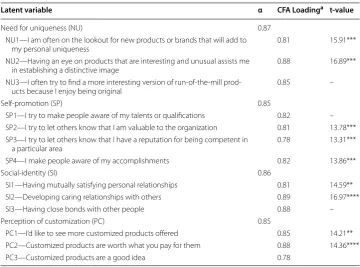
Then, confirmatory factor analysis (CFA) was conducted and the results showed that the indicators appropriately reflect corresponding constructs. The fit indices of CFA present an adequate fit (χ2= 90.816, df= 59, ρ = 0.01; AGFI = 0.94; GFI = 0.96;
NFI = 0.96; CFI = 0.98; SRMR = 0.04; RMSEA = 0.04). The overall CFA loadings were
Table 1 Results of the measurement model
χ2= 90.816 (df= 59), ρ = 0.01; AGFI = 0.94; GFI = 0.96; NFI = 0.96; CFI = 0.98; Standardized SRMR = 0.04; RMSEA = 0.04
*** p < 0.001
a Standardized estimate
Latent variable α CFA Loadinga t-value
Need for uniqueness (NU) 0.87 NU1—I am often on the lookout for new products or brands that will add to
my personal uniqueness 0.81 15.91*** NU2—Having an eye on products that are interesting and unusual assists me
in establishing a distinctive image 0.88 16.89*** NU3—I often try to find a more interesting version of run‑of‑the‑mill prod‑
ucts because I enjoy being original 0.85 –
Self‑promotion (SP) 0.85
SP1—I try to make people aware of my talents or qualifications 0.82 – SP2—I try to let others know that I am valuable to the organization 0.81 13.78*** SP3—I try to let others know that I have a reputation for being competent in
a particular area 0.78 13.31*** SP4—I make people aware of my accomplishments 0.82 13.86*** Social‑identity (SI) 0.86
SI1—Having mutually satisfying personal relationships 0.81 14.59** SI2—Developing caring relationships with others 0.89 16.97**** SI3—Having close bonds with other people 0.88 – Perception of customization (PC) 0.85
also acceptable, ranging from 0.78 to 0.89. Then, structural equation modeling (SEM) was used to test the hypothesized conceptual model. The model estimated the extent to which consumer psychogenic needs predict positive perception of customization, resulting in the purchase intention of custom-made apparel products based on theoreti-cal discussion explaining that individual psychologitheoreti-cal values significantly affect con-sumption behavior (c.f. Foxall et al. 1998; Park et al. 2013; Kalyanaraman and Sundar
2006). The SEM results indicated the excellent fit, supporting the reasonable fit of the model (χ2= 112.267, df= 71, ρ = 0.00; AGFI = 0.93; GFI = 0.96; NFI = 0.96; CFI = 0.98;
SRMR = 0.04; RMSEA = 0.04).
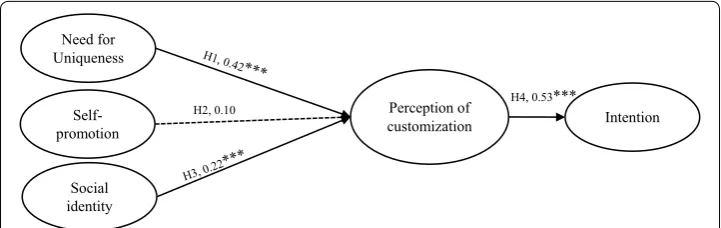
Regarding the basic model as shown in Fig. 2, the relationship between need for uniqueness and perception of customization was revealed to be significant (β = 0.42,
p < 0.001), as expected in H1. However, the effect of self-promotion on the positive per-ception of customization was found to be not significant (β = 0.10, p = 0.098) at a 0.05 significance level. Therefore, H2 was not supported. Moreover, social identity appeared to have a positive effect on customization perception (PC) (β = 0.22, p < 0.001); therefore, H3 was supported. Furthermore, the results indicated that the relationship between the positive perception of customization and the purchase intention was identified to be sta-tistically significant (β = 0.53, p < 0.001); thus, H4 was supported.
Moderating effects of gender
The structural multi-group model was conducted to test moderating effects of gen-der, showing satisfactory fit (χ2= 217.934, df= 142, ρ = 0.01; AGFI = 0.88; GFI = 0.97;
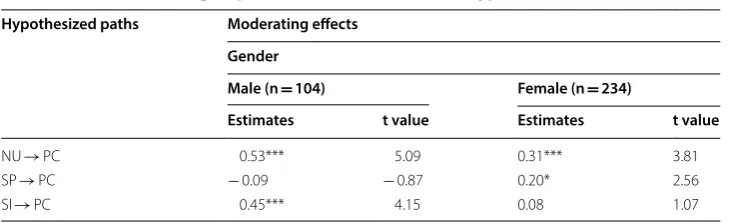
NFI = 0.91; CFI = 0.97; SRMR = 0.06; RMSEA = 0.04) and then path coefficient com-parisons were made by gender. Regarding the moderating effects of gender (as shown
Table 2 Descriptive statistic, correlation, and Cronbach’s alpha
NU need for uniqueness, SP self-promotion, SI social identity, PC perception of customization
a Correlation is significant at the 0.05 level (2-tailed)
Variables Mean SD. Cronbach’s NU SP SI PC
NU 3.64 0.98 0.87 1
SP 3.62 0.89 0.85 0.00 1
SI 4.25 0.74 0.86 − 0.06 0.26a 1
PC 3.92 0.79 0.85 0.00 0.00 0.17a 1
H2, 0.10 H4, 0.53***
Need for Uniqueness
Social identity
Perception of
customization Intention
Self-promotion
Fig. 2 SEM results of the research model. Numbers on the structural paths are standardized path coefficients; the dotted line indicates non‑significant relationship, χ2= 112.267, df= 71, ρ = 0.00; AGFI = 0.93; GFI = 0.96;
the Table 3), though for both male (β = 0.53, p < 0.001) and female consumers (β = 0.31,
p < 0.001), need for uniqueness had a significantly positive impact on the perception of customization, the difference of the relationship for males and females was found to be significant, indicating that the influence is more strengthened for males (χ2= 4.9,
p < 0.05), therefore, H5 was supported. Self-promotion was a determinant factor on posi-tive perception of customization for female consumers (β = 0.20, p < 0.05) while its effect
for male consumers was shown as weak (β =− 0.09, p = 0.38), indicating a significant dif-ference between gender groups (χ2= 4.1, p < 0.05). Thus, H6 is supported. Social
iden-tity is a stronger indicator of positive perception of customization for male consumers (β = 0.45, p < 0.001) than for female consumers (β = 0.08, p =0.29), and the gender
differ-ence was prominent (χ2= 12.4, p < 0.001), supporting H7.
Discussion and implications
Gender differences have been overlooked in consumer behavior literature. In addition, the study on apparel customization from consumers’ viewpoint is lacking. This study aims to determine how behavior-inducing psychogenic needs affect the perception of customization. Further, this perception of customization is examined to have posi-tive effects on the buying intention of tailored clothing. The study also intends to iden-tify whether gender plays a moderating role in the relationships between psychogenic needs and the perception of apparel customization. As the behavior-inducing psycho-genic needs, three psychological properties (i.e., need for uniqueness, self-promotion, and social identity) were adopted based on the theory of Murray’s psychogenic needs. The study demonstrates that need for uniqueness and social identity elicit the positive perception of customization; however, the impact of self-promotion is negligible. The favorable perception then leads to the purchase intention of customized apparel prod-ucts. The study also indicates that significant differences exist in perceiving customiza-tion between female and male consumers.
Specifically, the results of the study indicated that need for uniqueness instills a strong desire for consumers to perceive customization positively. Since custom-made products are designed based on consumer’s individual preferences, need for uniqueness may be fulfilled through customized products. This finding is consistent with the previous research, which argues that seeking distinctiveness is considered a main sociopsychological driver for leading to consumers’ buying decisions for rare
Table 3 Structural multi-group moderation test results for hypotheses
NU need for uniqueness; SP self-promotion; SI social identity; PC perception of customization *** p < 0.001, * p < 0.05
Hypothesized paths Moderating effects
Gender
Male (n = 104) Female (n = 234)
Estimates t value Estimates t value
products (Belk et al. 1989). Franke and Schreier (2008) explain that the adoption of highly unique labels would allow consumers to perceive the products more unique by promoting self-tailored products. Furthermore, providing a wide spectrum for options of custom-made products would be a potentially lucrative strategy, satisfying both retailers and consumers.
Unexpectedly, self-promotion was found to have no influence on the positive percep-tion of customizapercep-tion. The possible explanapercep-tion for this is that individuals strive to pro-mote themselves to be seen as competent to others by expressing their strong internal aspects (e.g., intelligence, talents, knowledge, experience, and skills) rather than external aspects (i.e., appearance) (Giacalone and Rosenfeld 1986; Moss-Racusin and Rudman
2010; Rudman, 1998); however, customized apparel products help to display exclusive individual characteristics in a more external manner (i.e., physical attractiveness and appearance) rather than internal ability aspects. That is, the impact of self-promotion on the positive perception of customization is negligible. However, self-promotion is still an important element for marketers since the level of self-promotion on customization perception between genders has revealed significantly different (see Table 3), indicating females with high self-promotion perceive custom apparel products more favorable than males. In this vein, the results of the study suggest that retailers who provide customized apparel products, especially business attires, may target more females rather than males.
Expectedly, social identity appears to be an influential indicator that elicits consum-ers’ positive perception toward customization. As illustrated in the previous study (Crane 2012; Feinberg et al. 1992), the results confirm that the apparel is efficient visual means of presenting social identity and customized apparel products aid indi-viduals to show their social identities in a more effective way by empowering consum-ers to tailor their clothing appropriately. Thus, custom-made clothing is attractive to consumers with a higher sense of social identity. As predicted, positive perception of customization has revealed to significantly bring about purchase intention of custom-ized apparel products. As described, except for self-promotion, need for uniqueness, and social identity was found to play crucial roles leading to positive perception, fur-thering buying intention of customized apparel products. In other words, in order to enhance buying intentions, retailers and fashion managers should take into account these factors when constructing marketing strategies.
friends, or family. This opportunity will lead consumers to create their one-of-a-kind products and elicit special memories and feelings toward products and brands.
As expected, self-promotion toward the positive perception of customization was not observed for males, while it is a significant driver for females. According to Gua-dagno and Cialdini (2007), self-promotion appeared to be proactive and masculine typed impression strategy (i.e., controlling, assertive, dominant) in order to express confidence in the competitive workplace. Females are required to be self-promoting in modern profession settings rather than be feminine. In addition, Howlett et al. (2015) state that females tend to be evaluated by appearance and they found that their appear-ance, namely dressing attires, can largely influence their professional impressions (e.g., intelligence and competence) at a workplace. Many researchers mention that as impres-sion management tactics, individuals also engaged in nonverbal and cooperative atti-tudes for building a firm relationship with others to be likable and visible in order to achieve what they want in the professional setting (Guadagno and Cialdini 2007; Singh and Vinnicombe 2001). The nonverbal impression tactics that contribute to self-image improvement include stylistic features such as wearing suitable attire. Specifically, indi-viduals consider dress choice carefully in order to look serious, display commitment, and be seen appropriately depending on different professional occasions (Singh and Vinnicombe 2001). Not surprisingly, females struggle with balancing professionalism (i.e., self-promoting behaviors) that is required at the workplace and feminism that is encouraged by social norms (Howlett et al. 2015; Wood et al. 1997). Taken together, even though self-promotion focuses on expressing confidence through achieving the goal, its impact on the favorable perception of customization is limited (as H2 is not supported). Females with high self-promotion, who feel heavy pressure to balance both values (pro-fessionalism and attractiveness), may also want to improve appearance more than males, considering customization as appealing. In order to hybrid attractiveness and profes-sionalism, adding a masculine style can result in the positive judgment of females’ mana-gerial competence. In this sense, customization retailers can consider adding mannish fashion in females’ clothing lines, such as various tailored pantsuits and blazers to mod-erate femininity by being business-appropriate to attract female professionals.
As predicted, social identity is a more determinant booster of positive perception of customization among males than females. Kim and Park (2011) mention that the way of dressing restrains individuals’ behaviors and manners; uniforms present a wearer’s social identity of religion and social classes, for example. Feinberg et al. (1992) state that people who share the same social background have similar dress codes. Custom-made products can be implanted in the particular community spirit for certain groups, enhancing group membership. Moreover, males are more associated with and attached to social activities rather than females (Henderson-king and Stewart 1994). In this regard, it is essential for retailers who specialize in men’s clothing lines to gather and accumulate male consum-ers’ social-activity information as well as demographic data in order to develop a prod-uct portfolio and constrprod-uct a target consumer segment.
embrace a sense of uniqueness and put more emphasis on social identity for males and on self-promotion for females.
Conclusions and limitations
As consumers’ demands have become diversified and complicated, customization is praised as a facilitator to fulfill consumers’ various needs, resulting in consumer satis-faction. However, studies on customization from the consumers’ perspective are few. The purpose of this study was to examine how consumers’ psychological antecedents influence the perception of customization, leading to the purchase intention of cus-tomized apparel products. Furthermore, the moderating effects of gender between antecedents and perception were also identified. This study contributes to the current literature on customization and a better understanding of consumers’ behavior. The different moderating effects of gender on need for uniqueness, self-promotion, and social identity toward the positive perception of customization provide useful impli-cations for fashion marketing managers to build marketing strategies based on gender segments.
A number of limitations exist in this research, which provides a direction for fur-ther studies. First of all, this study utilized a convenience sample of college students who are in their early 20 s and about 70% of participants were females, the results cannot be generalized across the entire generations. A random sampling of a more diverse population may be adopted to improve the research. Second, this study only considered a limited number of psychological antecedents toward customization per-ception. Including more antecedents is recommended (e.g., autonomy, defendance) in the future study. Another limitation is that only apparel products were considered in this study. Future research investigating different products, different brands, and different price range might induce different results. In addition, though past purchase experience may have influences on the relationship among the constructs, it was not considered in this study. Lastly, a single-item indicator of purchase intention was used, which may have decreased validity and reliability of measurement in compari-son to utilizing multiple items.
Authors’ contributions
SKS designed and conducted the research, collected and analyzed the data and drafted the manuscript. CML contrib‑ uted to the research design, supervised the research conduction, and contributed to the writing and improvement of the manuscript. Both authors read and approved the final manuscript.
Author details
1 PhD Candidate, Department of Consumer, Apparel, and Retail Studies, The Bryan School of Business and Economics, University of North Carolina at Greensboro, Greensboro, NC 27402, USA. 2 Assistant Professor, Department of Textiles, Apparel Design & Merchandising, Louisiana State University, 143 Human Ecology, Baton Rouge, LA 70803, USA.
Acknowledgements
Article Production Cost of publishing the paper in Fashion and Textiles was fully supported by the Korean Society of Clothing and Textiles (KSCT).
Competing interests
The authors declare that they have no competing interests.
Availability of data and materials
The datasets used in the current study are available from the corresponding author on a reasonable request.
Ethics approval and consent to participate
This research was approved by IRB at Louisiana State University.
Funding
No funding was provided in the design of the study and collection, analysis, and interpretation of data and in writing the manuscript.
Publisher’s Note
Springer Nature remains neutral with regard to jurisdictional claims in published maps and institutional affiliations.
Received: 25 October 2018 Accepted: 17 February 2019
References
Abell, L., & Brewer, G. (2014). Machiavellianism, self‑monitoring, self‑promotion and relational aggression on Facebook. Computers in Human Behavior,36, 258–262.
Armstrong, C. M., Niinimäki, K., Kujala, S., & Lang, C. (2015). Sustainable product‑service systems for clothing: exploring consumer perceptions of consumption alternatives in Finland. Journal of Cleaner Production, 97(15), 30–39. Bakewell, C., & Mitchell, V. W. (2004). Male consumer decision‑making styles. The International Review of Retail. Distribution
and Consumer Research.,14(2), 223–240.
Bakewell, C., Mitchell, V. W., & Rothwell, M. (2006). UK Generation Y male fashion consciousness. Journal of Fashion Market-ing and Management,10(2), 169–180.
Baumeister, R. F., & Sommer, K. L. (1997). What do men want? Gender differences and two spheres of belongingness: Comment on Cross and Madson (1997). Psychological Bulletin,122(1), 38–44.
Belk, R. W., Wallendorf, M., & Sherry, J. F., Jr. (1989). The sacred and the profane in consumer behavior: Theodicy on the odyssey. Journal of Consumer Research,16(1), 1–38.
Billstedt, E., Waern, M., Falk, H., Duberstein, P., Östling, S., Hällström, T., et al. (2017). Time trends in Murray’s psychogenic needs over three decades in Swedish 75‑year‑olds. Gerontology.,63(1), 45–54.
Bolino, M. C., & Turnley, W. H. (1999). Measuring impression management in organizations: A scale development based on the Jones and Pittman Taxonomy. Organizational Research Methods,2(2), 187–206.
Brown, R. (2000). Social identity theory: past achievements, current problems and future challenges. European Journal of Social Psychology,30(6), 745–778.
Chang, T.‑Z., & Wildt, A. R. (1994). Price, product information, and purchase intention: An empirical study. Journal of the Academy of Marketing Science,22(1), 16–27.
Cheek, J. M., Smith, S. & Tropp, L. R. (2002), Relational identity orientation: A fourth scale for the AIQ, In meeting of the Society for Personality and Social Psychology. Savannah, GA.
Cheema, A., & Kaikati, M. A. (2010). The effect of need for uniqueness on word of mouth. Journal of Marketing Research, 47(3), 553–563.
Cho, S., & Workman, J. (2011). Gender, fashion innovativeness and opinion leadership, and need for touch: Effects on multi‑channel choice and touch/non‑touch preference in clothing shopping. Journal of Fashion Marketing and Management,15(3), 363–382.
Corti, D., Taisch, M., Pourabdollahian, G., Bettoni, A., Pedrazzoli, P., & Canetta, L. (2011). Proposal of a reference framework to integrate sustainability and mass customization in a production paradigm. In 2011 World Conference on Mass Customization, Personalization and Co-Creation: Bridging Mass Customization & Open Innovation (MCPC2011). (pp. 1–10). San Francisco.
Costa, P. T., Jr., & McCrae, R. R. (1988). From catalog to classification: Murray’s needs and the five‑factor model. Journal of Personality and Social Psychology,55(2), 258–265.
Crane, D. (2012). Fashion and its social agendas: Class, gender, and identity in clothing. Chicago: University of Chicago Press. Cronin, J. J., Brady, M. K., & Hult, G. T. M. (2000). Assessing the effects of quality, value, and customer satisfaction on con‑
de Bellis, E., Sprott, D. E., Herrmann, A., Bierhoff, H. W., & Rohmann, E. (2016). The influence of trait and state narcissism on the uniqueness of mass‑customized products. Journal of Retailing,92(2), 162–172.
Dickson, M. A., & Pollack, A. (2000). Clothing and identity among female in‑line skaters. Clothing and Textiles Research Journal,18(2), 65–72.
Feinberg, R. A., Mataro, L., & Burroughs, W. J. (1992). Clothing and social identity. Clothing and Textiles Research Journal, 11(1), 18–23.
Fornell, C., & Larcker, D. F. (1981). Evaluating structural equation models with unobservable variables and measurement error. Journal of Marketing Research,18(1), 39–50.
Foxall, G., Ronald, G., & Stephan, B. (1998). Consumer psychology for marketing. Cengage Learning EMEA.
Franke, N., & Schreier, M. (2008). Product uniqueness as a driver of customer utility in mass customization. Marketing Let-ters,19(2), 93–107.
Giacalone, R. A., & Rosenfeld, P. (1986). Self‑presentation and self‑promotion in an organizational setting. Journal of Social Psychology,126(3), 321–326.
Gitimu, P. (2013). Garment quality evaluation: Influence of fashion leadership, fashion involvement, and gender. Interna-tional Journal of Fashion Design, Technology and Education,6(3), 173–180.
Godfrey, D. K., Jones, E. E., & Lord, C. G. (1986). Self‑Promotion is not ingratiating. Journal of Personality and Social Psychol-ogy,50(1), 106–115.
Goldsmith, R. E., & Freiden, J. B. (2004). Have it your way: Consumer attitudes toward personalized marketing. Marketing Intelligence & Planning,22(2), 228–239.
Guadagno, R. E., & Cialdini, R. B. (2007). Gender differences in impression management in organizations : A qualitative review. Sex Roles,56(7–8), 483–494.
Hankammer, S., & Steiner, F. (2015). Leveraging the sustainability potential of mass customization through product service systems in the consumer electronics industry. Procedia CIRP,30, 504–509.
Henderson‑king, D. H., & Stewart, A. J. (1994). Women or feminists? Assessing women’s group consciousness, Sex Roles, 31(9–10), 505–516.
Hogg, M. A., & Terry, D. J. (2017). Social identity and self‑categorization processes in organizational contexts. Academy of Management Review,25(1), 121–140.
Howlett, N., Pine, K. J., Cahill, N., Orakçıoğlu, İ., & Fletcher, B. (2015). Unbuttoned: The interaction between provocativeness of female work attire and occupational status. Sex Roles,72(3–4), 105–116.
Hu, S. J. (2013). Evolving paradigms of manufacturing: From mass production to mass customization and personalization. Procedia CIRP,7, 3–8.
Icekson, T., & Pines, A. M. (2013). Positive perception: A three dimensional model and a scale. Personality and Individual Differences,54, 180–186.
Ives, B., & Piccoli, G. (2003). Custom made apparel and individualized service at Lands’ End. Communications of the Associa-tion for InformaAssocia-tion Systems,11(1), 3.
Kahn, B. E. (2017). Using visual design to improve customer perceptions of online assortments. Journal of Retailing,93(1), 29–42.
Kalyanaraman, S., & Sundar, S. (2006). The psychological appeal of personalized content in web portals: Does customiza‑ tion affect attitudes and behavior? Journal of Communication,56(1), 110–132.
Kang, J. M., & Kim, E. (2012). e‑Mass customisation apparel shopping: Effects of desire for unique consumer products and perceived risk on purchase intentions. International Journal of Fashion Design, Technology and Education,5(2), 91–103.
Kang, J., & Park‑Poaps, H. (2010). Hedonic and utilitarian shopping motivations of fashion leadership. Journal of Fashion Marketing and Management: An International Journal, 14(2), 312–328.
Kelly, M. (2003). Projecting an image and expressing identity: T‑shirts in Hawaii. Fashion Theory,7(2), 191–211. Kim, J., & Hahn, K. H. Y. (2015). The effects of self‑monitoring tendency on young adult consumers’ mobile dependency.
Computers in Human Behavior,50, 169–176.
Kim, J., & Park, H. S. (2011). The effect of uniform virtual appearance on conformity intention: Social identity model of deindividuation effects and optimal distinctiveness theory. Computers in Human Behavior,27(3), 1223–1230. Knight, D. K., & Kim, E. (2007). Japanese consumers’ need for uniqueness: Effects on brand perceptions and purchase
intention. Journal of Fashion Marketing and Management: An International Journal,11(2), 270–280.
Kruger, D., & Byker, D. (2009). Evolved foraging psychology underlies sex differences in shopping experiences and behav‑ iors. Journal of Social, Evolutionary, and Cultural Psychology,3(4), 328–342.
Lambert, A., & Desmond, J. (2013). Loyal now, but not forever! A study of narcissism and male consumer‑brand relation‑ ships. Psychology & Marketing,30(8), 690–706.
Leary, M. R., & Kowalski, R. M. (1990). Impression management: A literature review and two‑component model. Psycho-logical Bulletin.,107(I), 34–47.
Lee, S. Y., Gregg, A. P., & Park, S. H. (2013). The person in the purchase: Narcissistic consumers prefer products that posi‑ tively distinguish them. Journal of Personality and Social Psychology,105(2), 335.
Lee, H. H., & Moon, H. (2015). Perceived risk of online apparel mass customization: Scale development and validation. Clothing and Textiles Research Journal,33(2), 115–128.
Lee, S., & Sundar, S. S. (2014). Cosmetic customization of mobile phones: Cultural antecedents, psychological correlates. Media Psychology,18(1), 1–23.
Lynn, M., & Harris, J. (1997). Individual differences in the pursuit of self‑uniqueness through consumption. Journal of Applied Social Psychology,27(21), 1861–1883.
Moon, J. H., Lee, E., Lee, J. A., Choi, T. R., & Sung, Y. (2016). The role of narcissism in self‑promotion on Instagram. Personality and Individual Differences, 101, 22–25. https ://doi.org/10.1016/j.paid.2016.05.042.
Moss‑Racusin, C. A., & Rudman, L. A. (2010). Disruptions in women’s self‑promotion: The backlash avoidance model. Psychology of Women Quarterly,34(2), 186–202.
Nysveen, H., Pedersen, P. E., & Thorbjørnsen, H. (2005). Explaining intention to use mobile chat services: Moderating effects of gender. Journal of Consumer Marketing,22(5), 247–256.
Park, J. K., Han, H. J., & Park, J. H. (2013). Psychological antecedents and risk on attitudes toward e‑customization. Journal of Business Research, 66(12), 2552–2559. https ://doi.org/10.1016/j.jbusr es.2013.05.048.
Rahman, S. U., Saleem, S., Akhtar, S., Ali, T., & Khan, M. A. (2014). Consumers’ adoption of apparel fashion: The role of inno‑ vativeness, involvement, and social values. International Journal of Marketing Studies,6(3), 49–64.
Rudman, L. A. (1998). Self‑Promotion as a risk factor for women: The costs and benefits of counter stereotypical impres‑ sion management. Journal of Personality and Social Psychology,74(3), 629–645.
Rudman, L. A., & Glick, P. (1999). Feminized management and backlash toward agentic women: The hidden costs to women of a kinder, gentler image of middle managers. Journal of Personality and Social Psychology,77(5), 1004–1010.
Senanayake, M. M., & Little, T. J. (2010). Mass customization: points and extent of apparel customization. Journal of Fashion Marketing and Management,14(2), 282–299.
Seock, Y.‑K. (2007). Mass customization: Points and extent of apparel customization. Journal of Fashion Marketing and Management,11(4), 571–586.
Shen, B. (2014). Sustainable fashion supply chain: Lessons from H&M. Sustainability,6(9), 6236–6249.
Singh, V., Kumra, S., & Vinnicombe, S. (2002). Gender and impression management: Playing the promotion game. Journal of Business Ethics,37(1), 77–89.
Singh, V. A. L., & Vinnicombe, S. (2001). Impression management, commitment and gender: Managing others’ good opinions. European Management Journalv,19(2), 183–194.
Solomon, (2017). Consumer behavior: Buying, having, and being. Boston: Pearson.
Song, W., & Sakao, T. (2017). A customization‑oriented framework for design of sustainable product‑service system. Jour-nal of Cleaner Production,140, 1672–1685.
Summer, T. A., Belleau, B. D., & Xu, Y. (2006). Predicting purchase intention of a controversial luxury apparel product. Jour-nal of Fashion Marketing and Management,10(4), 405–419.
Tajifel, H., & Turner, J. C. (2004). The Social Identity Theory of Intergroup Behavior. New York: Political psychology. Tian, K. T., Bearden, W. O., & Hunter, G. L. (2001). Consumers’ need for uniqueness: Scale development and validation.
Journal of Consumer Research,28(6), 50–66.
Tifferet, S., & Herstein, R. (2012). Gender differences in brand commitment, impulse buying, and hedonic consumption. Journal of Product & Brand Management,21(3), 176–182.
Turnley, W. H., & Bolino, M. C. (2001). Achieving desired images while avoiding undesired images: Exploring the role of self‑monitoring in impression management. Journal of Applied Psychology,86(2), 351–360.
van Doorn, J., & Hoekstra, J. C. (2013). Customization of online advertising: The role of intrusiveness. Marketing Letters, 24(4), 339–351.
Vlasceanu, S. (2013). Psychology of the consumer’s and the advertise in terms of factors that leads to consumer’s decision making. Romanian Journal of Experimental Applied Psychology,4(1), 23–29.
Willemsen, E. W. (1987). Sex‑role orientation, self‑esteem, and uniqueness: An exploration of the undifferentiated cat‑ egory. Psychological Reports, 60(3), 859–866.
Wood, W., Christensen, P. N., Hebl, M. R., & Rothgerber, H. (1997). Conformity to sex‑typed norms, affect, and the self‑ concept. Journal of Personality and Social Psychology,73(3), 523.
Wood, C. M., & Scheer, L. K. (1996). Incorporating perceived risk into models of consumer deal assessment and purchase intent. Advances in Consumer Research,23(1), 399–405.
Wu, W.‑Y., Lu, H.‑Y., Wu, Y.‑Y., & Fu, C.‑S. (2012). The effects of product scarcity and consumers’ need for uniqueness on purchase intention. International Journal of Consumer Studies,36(3), 263–274.
Yang, C., Hsu, Y.‑C., & Tan, S. (2010). Predicting the determinants of users’ intentions for using YouTube to share video: Moderating gender effects. Cyberpsychology, Behavior, and Social Networking,13(2), 141–152.
Yeung, H.‑T., Choi, T.‑M. & Chiu, C.‑H. (2010). Innovative mass customization in the fashion industry, In Innovative quick response programs in logistics and supply chain management (pp. 426–454). Berlin Heidelberg: Springer.