The Thirty-Third AAAI Conference on Artificial Intelligence (AAAI-19)
Adversarial Training for Community Question Answer Selection
Based on Multi-Scale Matching
Xiao Yang,
1∗Madian Khabsa,
2∗Miaosen Wang,
3∗Wei Wang
4Ahmed Hassan Awadallah,
4Daniel Kifer,
1, C. Lee Giles
11Pennsylvania State University,2Apple,3Google,4Microsoft
[email protected], [email protected], [email protected], [email protected] [email protected], [email protected], [email protected]
Abstract
Community-based question answering (CQA) websites rep-resent an important source of information. As a result, the problem of matching the most valuable answers to their corresponding questions has become an increasingly pop-ular research topic. We frame this task as a binary (rele-vant/irrelevant) classification problem, and present an adver-sarial training framework to alleviate label imbalance issue. We employ a generative model to iteratively sample a sub-set of challenging negative samples to fool our classification model. Both models are alternatively optimized using REIN-FORCE algorithm. The proposed method is completely dif-ferent from previous ones, where negative samples in training set are directly used or uniformly down-sampled. Further, we propose using Multi-scale Matching which explicitly inspects the correlation between words and ngrams of different levels of granularity. We evaluate the proposed method on SemEval 2016 and SemEval 2017 datasets and achieves state-of-the-art or similar performance.
1
Introduction
Community-based question answering (CQA) websites such as Yahoo Answer and Quora are important sources of knowl-edge. They allow users to submit questions and answers cov-ering a wide range of topics. These websites often organize such user-generated content in the form of a question fol-lowed by a list of candidate answers. Over time, a large amount of crowd-sourced question/answer pairs has been accumulated, which can be leveraged to automatically an-swer a newly submitted question.
To fully make use of the knowledge stored in CQA sys-tems, the CQA selection task has received much attention recently. CQA selection task aims at automatically retriev-ing archived answers that are relevant to a newly submitted question. Since many users tend to submit new questions rather than searching existing questions (Nakov, M`arquez, and Guzm´an 2016), a large number of questions reoccur and they may already be answered by previous content. Sev-eral challenges exist for this task, among whichlexical gap is a fundamental one that differentiate this task from other general-purpose information retrieval (IR) tasks. The term
∗
Work done at Microsoft.
Copyright c2019, Association for the Advancement of Artificial Intelligence (www.aaai.org). All rights reserved.
lexical gap describes the phenomenon that text in ques-tions may lead to causally related content in answers, rather than semantically related content such as synonymy. In other words, a sentence sharing many overlapping words with the question may not necessarily be a relevant answer.
To tackle the lexical gap problem, many methods explic-itly model the correlations between text fragments in ques-tions and answers, and frame this task as a binary classi-fication problem. Under this setting, each question/answer pair is labeled as either relevant or irrelevant. Consequently, the CQA selection task can be approached by first predict-ing the relevance/confidence score of a candidate answer to a question, then re-ranking these answers to find the most appropriate one.
When treating CQA selection as a binary classification task, a practical issue is label imbalance. First, the total num-ber of relevant answers is naturally smaller than that of ir-relevant ones. For example, in SemEval 2016 dataset, only 9.3% of the total answers are relevant. In SemEval 2017 dataset, the number is even smaller: 2.8%. Furthermore, in order to better utilize labeled data and provide more training question/answer pairs, many researches augment negative samples by randomly coupling a question with an answer from adifferentquestion thread. The underlying assumption is that answers from other questions are unlikely to be quali-fied as relevant to the current question. While such data aug-mentation can provide much more training samples, it also amplifies the problem of label imbalance. Inspired by Gen-erative Adversarial Nets (GANs) (Goodfellow et al. 2014), we present an adversarial training strategy, which employs a generative modelGto select a small subset ofchallenging negative samples. A fair amount of negative samples (espe-cially those generated by random coupling described above) can be easily classified (e.g. the topics of answers are com-pletely irrelevant to the questions), making little contribution to the gradients. On the contrary, samples selected by a gen-erative model are expected to be more challenging, therefore are more likely to fool the classification modelD, and conse-quently result in larger gradients. By alternately optimizing the generative model and the classification model, we can finally obtain a more robust and accurate classifier.
Wang, Hamza, and Florian 2017) is a representative work for CQA task. It first represents each word by embeddings, then exhaustively compares each word in questions to another word in answers. The comparison results are later aggregated by a feed-forward neural network to make final predictions. Various strategies have been proposed for aggregating comparisons, such as max-pooling method (Zhang et al. 2017b), attention method (Parikh et al. 2016), or a combination of various strategies (Wang, Hamza, and Florian 2017). It is shown that such “matching-aggregating” framework outperforms Long Short Term Memory (LSTM) (Hochreiter and Schmidhuber 1997) based methods (Wang and Jiang 2016; Zhang et al. 2017b). Our work also follows the “matching-aggregating” framework. However, in addition to word-to-word comparisons, we also explicitly consider comparisons between words and ngrams of different length. The rationale behind is that the semantic meaning of a text fragment is not the simple combination of the meanings of individual words (Stubbs 2001). By explicitly considering word-to-ngrams comparisons, our model is enforced to capture semantic information at different levels of granularity, and utilize it to assist classification. To obtain word-to-ngrams comparisons, we employ a deep convolutional neural net-work (CNN) to learn a hierarchical representation for each sentence. Neurons at higher levels compress information of larger context. Representations at different levels of one sentence are then compared with those from the other sentence.
Our contributions are summarized as follows:
• We present an adversarial training strategy which employs a generative model to produce challenging negative sam-ples. By alternately optimizing the generative model and the classification model, we are able to significantly im-prove performance on CQA task.
• We extend the current matching-aggregating framework for CQA selection task by also considering matchings from multiple levels of granularity. Experiments show that such multi-scale matching consistently improves per-formance.
• The proposed model ranks first on SemEval 2017 dataset and ranks second on SemEval 2016 dataset (first among methods that do not use external meta information such as answers position in a thread or author’s personal infor-mation).
2
Related Work
Community Question Answering
For an automatic community question answer selection sys-tem, two main tasks exist: (1) retrieving related questions to a newly submitted question (Jeon, Croft, and Lee 2005; Xue, Jeon, and Croft 2008; Cai et al. 2011; Zhou, Lyu, and King 2012); and (2) retrieving potentially relevant an-swers to a newly submitted question (Surdeanu, Ciaramita, and Zaragoza 2008; Lu and Li 2013; Shen et al. 2015; 2017; Wang, Hamza, and Florian 2017; Nakov, M`arquez,
and Guzm´an 2016; Zhang et al. 2017b). Successfully ac-complishing the first task can assist the second task. How-ever, it is not a must step. Techniques for CQA selection can be broadly categorized into three classes: (1) statistical translation models; (2) latent variable models; and (3) deep learning models.
Early work spent great efforts on statistical translation models, which take parallel corpora as input and learn cor-relations between words and phrase from one corpus and another. For example, (Jeon, Croft, and Lee 2005; Xue, Jeon, and Croft 2008) use IBM translation model 1 to learn translation probability between question and answer words. Later work has improved upon them by considering phrase-level correlations (Cai et al. 2011) and entity-phrase-level corre-lations (Singh 2012). The proposed Multi-scale Matching model shares similar idea by incorporating word-to-ngrams comparisons, however such comparisons are modeled by a neural network rather than translation probability matrix.
Another line of work explores using topic models for ad-dressing this task. Such approaches (Ji et al. 2012; Cai et al. 2011; Shen et al. 2015) usually learn the latent topics of questions and answers, under the assumption that a rele-vant answer should share a similar topic distribution to the question. Recently, these approaches have been combined with word embeddings (Shen et al. 2015; Zhou et al. 2015) and translation models (Deepak, Garg, and Shevade 2017), which have led to further improvements of performance.
With the recent success of deep learning models in mul-tiple natural language processing (NLP) tasks, researchers started to explore deep models for CQA. (Nakov, M`arquez, and Guzm´an 2016) proposed a feed-forward neural net-work to predict the pairwise ranking of two candidate an-swers. (Zhou et al. 2016) trained two auto-encoders for questions and answers respectively which share the inter-mediate semantic representation. Recently, a number of work has framed this task as a text classification prob-lem, and proposed several deep neural network based mod-els. For example, (Tan et al. 2015) first encode sentences into sentence embeddings using LSTM, then predict the relationship between questions and answers based on the learned embeddings. However, such approaches ignore di-rect interactions between words in sentences, therefore their performances are usually limited. Later, (Wang and Jiang 2016; Parikh et al. 2016; Zhang et al. 2017b) pro-posed a matching-aggregating framework which first ex-haustively compares words from one sentence to another, then aggregates the comparison results to make final predic-tions. Different aggregating strategies have been proposed, such as attentive method (Parikh et al. 2016), max-pooling method (Zhang et al. 2017b), or a combination of various strategies (Wang, Hamza, and Florian 2017). The proposed Multi-scale Matching model also follows such framework, however we explicitly examine comparisons at multiple lev-els of granularity.
Generative Adversarial Nets and NLP
modelGand a discriminative modelD.Gaims to fit the real data distribution and attempts to map a random noise (e.g. a random sample from a Gaussian distribution) to a real sam-ple (e.g. an image). In contrary,D attempts to differentiate real samples from fake ones generated byG. During train-ing,GandDare alternately optimized, forming a mini-max game. A number of extensions to GAN have been proposed to achieve stable training and better visualization results for image generation.
The idea of adversarial training can also be applied to NLP tasks. Although such tasks often involve discrete sam-pling process which is not differentiable, researchers have proposed several solutions such as policy gradient (Sutton et al. 2000; Yu et al. 2017; Li et al. 2016) and Gumbel Soft-max trick (Jang, Gu, and Poole 2016). (Yu et al. 2017) pro-posed SeqGAN to generate sequence of words from noises. (Li et al. 2016) adopted adversarial training to improve the robustness of a dialog generation system. A more relevant work to our method is IRGAN (Wang et al. 2017), which applied adversarial training to multiple information retrieval tasks. However, IRGAN models the relationship between two documents solely based on the cosine similarity be-tween two learned sentence embeddings, ignoring all direct interactions between words. In contrary, we explicitly ex-plore comparisons at multiple levels of granularity, and use the aggregated comparison results to measure the relevance.
3
Method
In this section, we first formally define the task of commu-nity question answer selection by framing it as a binary clas-sification problem, then present details about how to fit this problem in an adversarial training framework. Finally, we describe how to instantiate the generative model and classi-fication model using a Multi-scale Matching Model.
LetQ= (q1, q2,· · ·, qm)andA = (a1, a2,· · ·, an)be the input question and answer sequence of lengthmandn, respectively. Letfθ(Q, A)be a score function parameterized byθthat estimates the relevance betweenQandA. A higher
fθ(Q, A)value means that an answer is more relevant to the question. Given a questionQ, its corresponding candidate answer setA={Ai}can be ranked based on the predicted
relevance score. The top ranked answers will be selected as the correct answers. Therefore the answer selection task can be accomplished by solving a binary classification problem.
Adversarial Training for Answer Selection
Generative Adversarial NetsGenerative Adversarial Nets were first proposed by (Goodfellow et al. 2014). They con-sists of two “adversarial” models: a generative model (gen-eratorG) aiming at capturing real data distribution pdata(x), and a discriminative model (discriminatorD) that estimates the probability that a sample comes from the real training data rather than the generator. Both the generator and dis-criminator can be implemented by non-linear mapping func-tions, such as feed-forward neural networks.
The discriminator is optimized to maximize the probabil-ity of assigning the correct labels to either training samples or the generated ones. On the other hand, the generator is op-timized to maximize the probability ofDmaking a mistake,
or equivalently to minimize log(1−D(G(x)). Therefore, the overall objective can be summarized as:
J(G, D) = min
G maxD Ex∼pdata(x)[logD(x)]+
Ex0∼p
G(x0)[log(1−D(x
0))] (1)
where the generative modelGis written aspG(x0). During training, we alternately minimize and maximize the same objective function to learn the generatorGand the discrim-inatorD, respectively.
Adversarial Training for Answer Selection Here we propose an adversarial training framework which uses a Multi-scale Matching model (described in next section) to generate (sample) challenging negative samples and another Multi-scale Matching model to differentiate positive sam-ples from negative ones. In parallel to terminologies used in GANs literature, we will call these two models generatorG
and discriminatorDrespectively.
In the context of answer selection, the generator aims to capture real data distributionpdata(A|Q)and generate
(sam-ple) relevant answers conditioned on the question sentence
Q. In contrary, the discriminator attempts to distinguish be-tween relevant and irrelevant answers depending onQ. For-mally, objective function in Equation 1 can be rewritten as:
J(G, D) = min
G maxD EA∼pdata(A|Q)[logD(A|Q)]+
EA0∼p
G(A0|Q)[log(1−D(A
0|Q))] (2)
We now describe how to build our discriminator and generator using the proposed Multi-scale Matching model. Since our Multi-scale Matching model can be seen as a score function, which measures how relevant an answerAis to a questionQ, we can directly feed the relevance into a sig-moid function to build our discriminative model. The gen-erator attempts to fit the underlying real data distribution, and based on that, samples answers from the whole answer set in order to fool the discriminator. In order to model this process, we employ another Multi-scale Matching model as a score function and evaluate it oneverycandidate answer. Afterwards, answers with high relevance scores will be sam-pled with high probabilities. In other words, we would like to sample negative answers from the whole set which is more relevant toQ.
Formally, given a set of candidate answersA={Ai}of
a specific questionQ, the discriminative modelD(A|Q)and the generative modelpG(A|Q)is modeled by:
D(A|Q) =σ(fθ(Q, A)) (3)
pG(Ai|Q) =Pexp(fθ0(Q, Ai))
jexp(fθ0(Q, Aj))
(4)
withσbeing a sigmoid function.
Ideally, the score functionfθ0(Q, A)needs to be evaluated
answers. SetA˜ is constituted by answers from two sources: (1) labeled negative answers for questionQ; and (2) answers from other questionsQ˜ 6= Q. Since irrelevant answers are far more than relevant answers, the resulting set A˜ is un-likely to contain any false negatives.
The original GANs require that both the generator and the discriminator are fully differentiable, so that a gradient-based optimization algorithm can be applied. However, this is not true in our case due to the random sampling step involved in the generator. A number of approaches have been proposed to tackle this problem, such as policy gra-dient (Sutton et al. 2000; Yu et al. 2017; Li et al. 2016) and Gumbel Softmax trick (Jang, Gu, and Poole 2016). Here we adopt the policy gradient approach. As can be seen in Equa-tion 1, the objective funcEqua-tion for optimizingGis expressed as minimizing the expectation of a function evaluated on samples from a probability distribution. Therefore, using the REINFORCE (Sutton et al. 2000) algorithm, the gradient of
Jwith respect toG’s parametersθ0can be derived as:
∇θ0J(G, D) =∇θ0EA0∼p
G(A0|Q)[log(1−D(A 0|Q))]
= X
A0∈A
∇θ0pG(A0|Q) log(1−D(A0|Q))
=EA0∼p
G(A0|Q)[∇θ0logpG(A
0|Q) log(1−D(A0|Q))]
' 1
|A˜|
X
A0∈A˜
∇θ0logpG(A0|Q) log(1−D(A0|Q)) (5)
where in the last step the expectation is approximated by sampling. The termlog(1−D(A0|Q)can be seen as the
re-ceived reward when a policypGtakes an action of choosing answerA0. In practice we also use the averaged reward from last epoch as a reward baseline.
Multi-scale Matching Model
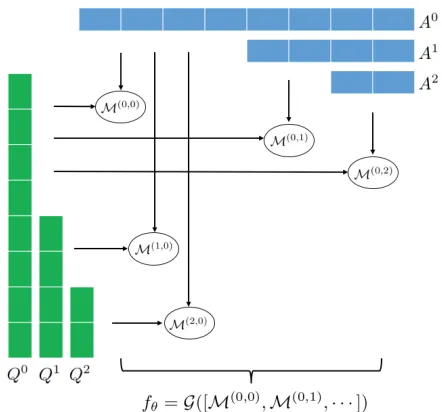
In this section we describe the details of our Multi-scale Matching model. The goal of the proposed Multi-scale Matching Model is to estimate a relevance score of a question/answer pair. Our model follows the “matching-aggregating” framework. Different from (Parikh et al. 2016) which only consider word-to-word matches and (Wang, Hamza, and Florian 2017) which implicitly consider word-to-ngrams matches using an attention model, we explicitly examine matches between words and ngrams of different lengths. In this way, the proposed model is enforced to lever-age context information at different levels of granularity. The architecture is illustrated in Figure 1.
Word and Ngram Embeddings For either a question or answer sentence, we represent each word with a d -dimensional real-valued vector. In this work, we use pre-trained word embeddings from GloVe (Pennington, Socher, and Manning 2014), which has shown its effectiveness in multiple natural language processing tasks. For each sen-tence, our model learns a hierarchy of representations us-ing a convolutional neural network. Formally, for a sentence
Q= (q1, q2,· · ·, qm)where each wordqiis represented by the corresponding word embeddings, a series of convolution blocks are applied:
Qk=conv blockk(Qk−1) Q0=Q (6)
Figure 1: Architecture of the proposed Multi-scale Matching model. The model first learns a hierarchy of representations for each sentence, then applies matching function M be-tween representations at multiple levels of granularity. The matching results are finally aggregated to predict the rele-vance scorefθ.
HereQkis the resulting feature maps after applying thek
-th convolution block. A convolution block consists of a con-volution layer, followed by a batch normalization (Ioffe and Szegedy 2015) layer, a rectified linear unit (Glorot, Bordes, and Bengio 2011) layer and a max pooling layer. The ker-nel size of the convolution layer is 3, the stride is 1 and the number of output channels is 128. At the end, a hierarchy of feature representations(Q0, Q1,· · · , QK)is learned, which
compresses the semantic information at different levels of granularities. For example,Q0i represents thei-th word em-bedding, whileQ1
i represents the context information from
a 5-gram centered ati, since the receptive field is 5. Similar process is applied to the answer sentence A = (a1, a2,· · ·, an), resulting in another hierarchy of feature representations(A0, A1,· · · , AK).
Multi-scale Matching and Aggregating For a specific pair of feature representationsQuandAv, we can define a
matching functionM(Qu, Av)to measure the relation
be-tween them. The final scorefθ(Q, A)can be calculated by aggregating{M(Qu, Av)}, abbreviated as{M(u,v)}.
Multiple ways exist on how to realize the matching func-tion M, for example the max-pooling matching (Zhang et al. 2017b) and attentive matching (Parikh et al. 2016). Here we adopt the max-pooling matching method due to its sim-plicity. First, we compare each time-step inQuandAvusing
a non-linear functionH:
h(i,j)=H([Qui, A v
j]) (7)
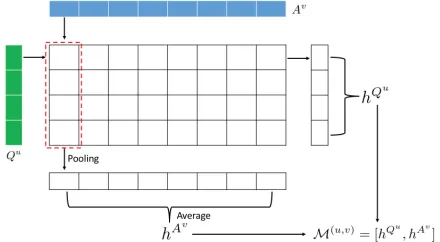
Figure 2: Illustration of the matching between two represen-tations.
element-wise max-pooling and obtain a single vectorh(i,·):
h(i,·)=Pooling(h(i,1), h(i,2),· · ·, h(i,n)) (8)
Figure 2 shows a diagram of such aggregation process. Similarly, for each time-stepjinAv, we can also
aggre-gate the comparison results and obtain:
h(·,j)=Pooling(h(1,j), h(2,j),· · · , h(m,j)) (9)
Now we have two sets of comparison vectors{h(i,·)}and
{h(·,j)}, we can aggregate over each set by averaging:
hQu = 1
m m X
i
h(i,·) hA
v
= 1
n n X
j
h(·,j) (10)
then formulate the matching functionMas the concatena-tion ofhQu andhAv:
M(u,v)= [hQu
, hAv] (11)
Based on the defined the matching functionMabove, the score functionfθ(Q, A)can be formulated as:
fθ(Q, A) =G([{M(u,v)}]) (12)
where [{M(u,v)}] denotes the concatenation of all possi-ble matching resultsM(u,v) foru= 0,1,· · ·, K andv =
0,1,· · · , K, andGis a real-value function implemented by a two-layer feed-forward neural network. Equation 12 in-dicates that all possible word-to-word, word-to-ngram and ngram-to-ngram matches are being considered. A simpler way is to formulate the score function as:
fθ(Q, A) =G([{M(0,v)},{M(u,0)}]) (13)
meaning that we only consider word and word-to-ngram matches, and ignore all word-to-ngram-to-word-to-ngram matches. It is also clear that the way in (Wang and Jiang 2016; Zhang et al. 2017b; Parikh et al. 2016) is equivalent to formulating the score function as:
fθ(Q, A) =G(M(0,0)) (14)
indicating that only word-to-word matching is considered. The time complexity of these three ways areO(K2),O(K)
and O(1) respectively if we consider each M(u,v) as an
O(1)operation.
In this work, we adopt the second way as described in Equation 13, since the first way (Equation 12) is computa-tionally expensive and the third way (Equation 14) may not fully utilize context information conveyed in ngrams. Re-sults in Section 4 shows that the second way leads to better performance compared with the third way.
4
Experiments
In this section, we evaluate the proposed method on two benchmark datasets: SemEval 2016 and SemEval 2017. Ab-lation experiments are conducted on both datasets to demon-strate the effectiveness of the proposed adversarial training strategy and Multi-scale Matching model.
Datasets and Evaluation
DatasetsSemEval 2016 (Nakov et al. 2016) and SemEval 2017 (Nakov et al. 2017) datasets are used for Task 3, Sub-task C (Question-External Comment Similarity) of SemEval 2016 and SemEval 2017 challenge, respectively. SemEval 2016 contains 387 original questions from Qatar Living website among which 70 questions are used as test set. Each question is associated with the top 10 related questions (re-trieved by a search engine) and their corresponding top 10 answers appearing in the thread. As a result, each question is associated with 100 candidate answers, and the ultimate goal is tore-rankthese 100 answers according to their relevance to the original question. SemEval 2017 is the most recent dataset where additional 80 questions are used as test set. This is a more challenging dataset compared with SemEval 2016, since it has a much more imbalanced label distribu-tion: only 2.8% candidate answers are labeled as relevant, whereas in SemEval 2016 the number is 9.3%.
Evaluation MetricsWe use the official evaluation mea-sure for the competition which is mean average precision (MAP) calculated over the top 10 ranked answers. We also report mean reciprocal rank (MRR), which is another widely-used information retrieval measure.
Training Hyper-parameters
The model weights are optimized using Adam (Kingma and Ba 2014) optimization method. The initial learning rate is
1e−4and is decayed by 5 for every 10 epochs. We use L2 regularization on model weights with a coefficient of1e−6
and a drop out rate of 0.2.
Results on SemEval 2017
Method MAP MRR
Baseline (IR) 9.18 10.11
Baseline (random) 5.77 7.69
(Tian et al. 2017) 10.64 11.09 (Zhang et al. 2017a) 13.23 14.27 (Xie et al. 2017) 13.48 16.04 (Filice, Da Martino, and Moschitti
2017)
14.35 16.07
(Koreeda et al. 2017) 14.71 16.48 (Nandi et al. 2017) 15.46 18.14 Contrs. (Koreeda et al. 2017) 16.57 17.04
Ours (single) 14.67 16.75
Ours (multi) 14.80 17.57
Ours (single+adversarial, D) 17.25 17.62 Ours (multi+adversarial, D) 17.91 18.64 Ours (single+adversarial, G) 13.31 15.07 Ours (multi+adversarial, G) 14.33 16.51
Table 1: Performance on SemEval 2017 dataset. “Contrs” denotes non-primary submission.
consistently improves the performance. With only a discrim-inative model, MAP is increased from 14.67 to 14.80. With adversarial training, MAP is increased from 17.25 to 17.91. With adversarial training, both our single-scale and multi-scale models are significantly improved and outperform pre-vious methods which are primarily based on feature engi-neering (Filice, Da Martino, and Moschitti 2017; Xie et al. 2017; Nandi et al. 2017) and neural networks (Tian et al. 2017; Zhang et al. 2017a; Koreeda et al. 2017). For single-scale model, the MAP is increased from 14.67 to 17.25, while for multi-scale model, the number is increased from 14.80 to 17.91. This demonstrates the effectiveness of uti-lizing a generative model to produce challenging negative samples. Since in SemEval 2017 dataset each question is as-sociated with 100 candidate answers and only 2.8% of them are labeled as relevant, the class labels are severely imbal-anced. By having a generative model, we are able to select more challenging adversarial samples as training proceeds, resulting in a more robust discriminator. Table 1 also shows the performance achieved by generators that are check-pointed at the same stage as the discriminators. The MAP is 13.31 and 14.33 for single-scale and multi-scale model respectively, significantly outperforming a random baseline and a information-retrieval (IR) based baseline. This shows that our generators also learned useful information. Conse-quently, the negative samples selected by the generators are much more challenging that those selected randomly or by a IR based approach.
Results on SemEval 2016
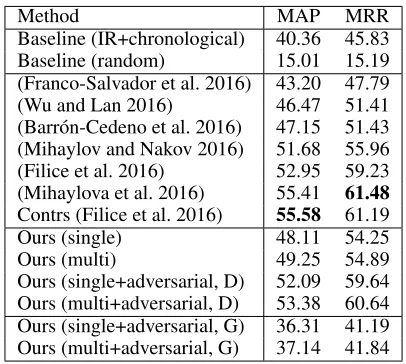
Table 2 summarizes our results on SemEval 2016 dataset (numbers are extracted from (Nakov et al. 2016)). Using Multi-scale Matching model boosts MAP for both direct and adversarial training, and the improvements are more signifi-cant than those on SemEval 2017. With adversarial training, our single-scale and multi-scale models are significantly im-proved, achieving a MAP of 52.09 and 53.38, respectively.
Method MAP MRR
Baseline (IR+chronological) 40.36 45.83 Baseline (random) 15.01 15.19 (Franco-Salvador et al. 2016) 43.20 47.79 (Wu and Lan 2016) 46.47 51.41 (Barr´on-Cedeno et al. 2016) 47.15 51.43 (Mihaylov and Nakov 2016) 51.68 55.96 (Filice et al. 2016) 52.95 59.23 (Mihaylova et al. 2016) 55.41 61.48 Contrs (Filice et al. 2016) 55.58 61.19 Ours (single) 48.11 54.25 Ours (multi) 49.25 54.89 Ours (single+adversarial, D) 52.09 59.64 Ours (multi+adversarial, D) 53.38 60.64 Ours (single+adversarial, G) 36.31 41.19 Ours (multi+adversarial, G) 37.14 41.84
Table 2: Performance on SemEval 2016 dataset. “Contrs” denotes non-primary submission. Note that both (Mihaylova et al. 2016) and (Filice et al. 2016) utilized meta informa-tion (e.g. answers’ posiinforma-tions in threads; whether an answer is written by the author of the question; whether the author of an answer is active in the thread) while our method only relies on textual information.
Again we list the performances achieved by the generators. It can be seen that the generators significantly outperform random baseline but is slightly worse than IR and chrono-logical ranking based baseline.
However, when comparing with other prior methods, our method ranks only second in terms of MAP among primary submissions. We hypothesize that this is because SemEval 2016 dataset is more balanced. In the test set of SemEval 2016, 9.3% of the candidate answers are labeled as relevant, which is roughly 3.3 times more balanced than that of Se-mEval 2017. This makes improvements made by adversarial training less significant. The motivation of adversarial train-ing is to let a generator down-sample negative examples in a smarter way, so that as training proceeds, more and more challenging negative examples can be used to train the dis-criminator. If labels are already balanced, then directly train-ing a discriminator is likely to yield good results. Note that our result is still an important achievement given that many other methods, including the best performing method, make use of meta information (e.g. answers’ positions in threads; whether an answer is written by the author of the question; whether the author of an answer is active in the thread), while our method only relies on textual information.
Examples
challeng-Question Results Question: Does anyone know
if there is a dog kennel/hotel in Qatar; where we can have someone to look after our dogs...
Correct: Ok; I have a cat. But we take him to Pampered Pets whenever we travel. They also board dogs...
Gen.1: Dogs as pets are not allowed in Islam but if there was a reason such for security; hunting is allowed...
Gen.2: ... Have you had dogs before? Where will it live? Have you thought about what you will do when you go on vacation? ...
Gen.3: ... and that the dog be taken out.’ This prohibition is limited to keeping dogs without need or benefit.
Question: We now feel ready to explore Qatar and was won-dering if anyone can suggest a sandy beach that’s suitable for young children?
Correct: Best places are Fuwarait beach - swim straight out and there are lots of corals; different fish...
Gen.1: Some hotels have beaches. Otherwise; like DaRuDe said; you gotta drive. Get a Marhaba book...
Gen.2: Mostly any beach in the Mediterranean Sea; some in Southeast Asia; South Amer-ica and Australia...
Gen.3: with a beautiful sandy beach; a breeze from the ocean; a peaceful and restful place to lay your head; a great pool...
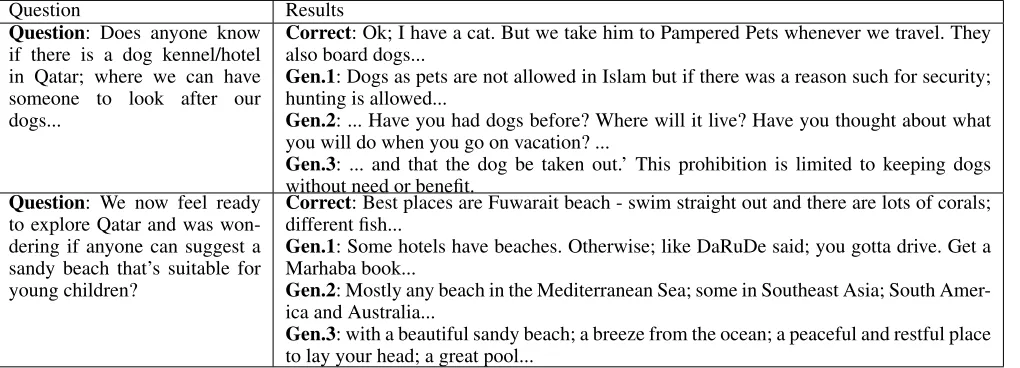
Table 3: Example results. For each question, we show the correctly predicted answer by our discriminator, and three top ranked negative examples (irrelevant answers) ranked by our generator.
ing negative examples, compared with random sampling. This process can be viewed as an active way of hard example mining, which boosts the performance of the discriminator.
5
Conclusions
We framed the community question answer selection task as a binary classification problem, and presented an adversarial training strategy to alleviate the label imbalance problem. A generative model is introduced to produce challenging neg-ative samples in order to improve the performance of a dis-criminator. Furthermore, we proposed a Multi-scale Match-ing model which is enforced to examine context information at different levels of granularities.The proposed method is evaluated on SemEval 2016 and 2017 datasets and achieved state-of-the-art or similar performance. Future work would investigate the stability of GAN training which remains an open research question, especially when discrete sampling is involved.
Acknowledgements: We gratefully acknowledge partial support from NSF grant CCF 1317560 and a hardware grant from NVIDIA. This work initiated during Xiao Yang’s in-ternship at Microsoft.
References
Barr´on-Cedeno, A.; Da San Martino, G.; Joty, S.; Moschitti, A.; Al-Obaidli, F.; Romeo, S.; Tymoshenko, K.; and Uva, A. 2016. Convkn at semeval-2016 task 3: Answer and question selection for question answering on arabic and english fora. InSemEval-2016.
Cai, L.; Zhou, G.; Liu, K.; and Zhao, J. 2011. Learning the latent topics for question retrieval in community qa. In IJCNLP.
Deepak, P.; Garg, D.; and Shevade, S. 2017. Latent space embedding for retrieval in question-answer archives. In EMNLP.
Filice, S.; Croce, D.; Moschitti, A.; and Basili, R. 2016. Kelp at semeval-2016 task 3: Learning semantic relations between questions and answers. In The 10th International Workshop on Semantic Evaluation (SemEval-2016). Filice, S.; Da Martino, G.; and Moschitti, A. 2017. Kelp at semeval-2017 task 3: Learning pairwise patterns in commu-nity question answering. InThe 11th International Work-shop on Semantic Evaluation (SemEval-2017).
Franco-Salvador, M.; Kar, S.; Solorio, T.; and Rosso, P. 2016. UH-PRHLT at semeval-2016 task 3: Combining lexi-cal and semantic-based features for community question an-swering. InThe 10th International Workshop on Semantic Evaluation (SemEval-2016).
Glorot, X.; Bordes, A.; and Bengio, Y. 2011. Deep sparse rectifier neural networks. InAISTATS.
Goodfellow, I.; Pouget-Abadie, J.; Mirza, M.; Xu, B.; Warde-Farley, D.; Ozair, S.; Courville, A.; and Bengio, Y. 2014. Generative adversarial nets. InNIPS.
Hochreiter, S., and Schmidhuber, J. 1997. Long short-term memory.Neural computation.
Ioffe, S., and Szegedy, C. 2015. Batch normalization: Accel-erating deep network training by reducing internal covariate shift. InICML.
Jang, E.; Gu, S.; and Poole, B. 2016. Categorical reparameterization with gumbel-softmax. arXiv preprint arXiv:1611.01144.
Jeon, J.; Croft, W. B.; and Lee, J. H. 2005. Finding similar questions in large question and answer archives. InCIKM. Ji, Z.; Xu, F.; Wang, B.; and He, B. 2012. Question-answer topic model for question retrieval in community question an-swering. InCIKM.
task 3: Combination of neural similarity features and com-ment plausibility features. InThe 11th International Work-shop on Semantic Evaluation (SemEval-2017).
Li, J.; Monroe, W.; Ritter, A.; Galley, M.; Gao, J.; and Ju-rafsky, D. 2016. Deep reinforcement learning for dialogue generation.arXiv preprint arXiv:1606.01541.
Lu, Z., and Li, H. 2013. A deep architecture for matching short texts. InNIPS.
Mihaylov, T., and Nakov, P. 2016. Semanticz at semeval-2016 task 3: Ranking relevant answers in community ques-tion answering using semantic similarity based on fine-tuned word embeddings. InThe 10th International Workshop on Semantic Evaluation (SemEval-2016).
Mihaylova, T.; Gencheva, P.; Boyanov, M.; Yovcheva, I.; Mihaylov, T.; Hardalov, M.; Kiprov, Y.; Balchev, D.; Koy-chev, I.; Nakov, P.; et al. 2016. Super team at semeval-2016 task 3: Building a feature-rich system for community ques-tion answering. InThe 10th International Workshop on Se-mantic Evaluation (SemEval-2016).
Nakov, P.; M`arquez, L.; Moschitti, A.; Magdy, W.; Mubarak, H.; Freihat, A. A.; Glass, J.; and Randeree, B. 2016. Semeval-2016 task 3: Community question answering. In The 11th International Workshop on Semantic Evaluation (SemEval-2017).
Nakov, P.; Hoogeveen, D.; M`arquez, L.; Moschitti, A.; Mubarak, H.; Baldwin, T.; and Verspoor, K. 2017. Semeval-2017 task 3: Community question answering. InThe 11th International Workshop on Semantic Evaluation (SemEval-2017).
Nakov, P.; M`arquez, L.; and Guzm´an, F. 2016. It takes three to tango: Triangulation approach to answer ranking in community question answering. InEMNLP.
Nandi, T.; Biemann, C.; Yimam, S. M.; Gupta, D.; Ko-hail, S.; Ekbal, A.; and Bhattacharyya, P. 2017. Iit-uhh at semeval-2017 task 3: Exploring multiple features for com-munity question answering and implicit dialogue identifica-tion. InThe 11th International Workshop on Semantic Eval-uation (SemEval-2017).
Parikh, A. P.; T¨ackstr¨om, O.; Das, D.; and Uszkoreit, J. 2016. A decomposable attention model for natural language inference. arXiv preprint arXiv:1606.01933.
Pennington, J.; Socher, R.; and Manning, C. 2014. Glove: Global vectors for word representation. InEMNLP.
Shen, Y.; Rong, W.; Sun, Z.; Ouyang, Y.; and Xiong, Z. 2015. Question/answer matching for cqa system via com-bining lexical and sequential information. InAAAI.
Shen, Y.; Rong, W.; Jiang, N.; Peng, B.; Tang, J.; and Xiong, Z. 2017. Word embedding based correlation model for ques-tion/answer matching. InAAAI.
Singh, A. 2012. Entity based q&a retrieval. InEMNLP. Stubbs, M. 2001. Words and phrases: Corpus studies of lexical semantics.
Surdeanu, M.; Ciaramita, M.; and Zaragoza, H. 2008. Learning to rank answers on large online qa collections. In ACL.
Sutton, R. S.; McAllester, D. A.; Singh, S. P.; and Mansour, Y. 2000. Policy gradient methods for reinforcement learning with function approximation. InNIPS.
Tan, M.; Santos, C. d.; Xiang, B.; and Zhou, B. 2015. Lstm-based deep learning models for non-factoid answer selec-tion. arXiv preprint arXiv:1511.04108.
Tian, J.; Zhou, Z.; Lan, M.; and Wu, Y. 2017. Ecnu at semeval-2017 task 1: Leverage kernel-based traditional nlp features and neural networks to build a universal model for multilingual and cross-lingual semantic textual similarity. In The 11th International Workshop on Semantic Evaluation (SemEval-2017).
Wang, S., and Jiang, J. 2016. A compare-aggregate model for matching text sequences. arXiv preprint arXiv:1611.01747.
Wang, J.; Yu, L.; Zhang, W.; Gong, Y.; Xu, Y.; Wang, B.; Zhang, P.; and Zhang, D. 2017. Irgan: A minimax game for unifying generative and discriminative information retrieval models.
Wang, Z.; Hamza, W.; and Florian, R. 2017. Bilateral multi-perspective matching for natural language sentences. arXiv preprint arXiv:1702.03814.
Wu, G., and Lan, M. 2016. Ecnu at semeval-2016 task 3: Exploring traditional method and deep learning method for question retrieval and answer ranking in community ques-tion answering. InThe 10th International Workshop on Se-mantic Evaluation (SemEval-2016).
Xie, Y.; Wang, M.; Ma, J.; Jiang, J.; and Lu, Z. 2017. Eica team at semeval-2017 task 3: Semantic and metadata-based features for community question answering. In The 11th International Workshop on Semantic Evaluation (SemEval-2017).
Xue, X.; Jeon, J.; and Croft, W. B. 2008. Retrieval models for question and answer archives. InSIGIR.
Yu, L.; Zhang, W.; Wang, J.; and Yu, Y. 2017. Seqgan: Sequence generative adversarial nets with policy gradient. InAAAI.
Zhang, S.; Cheng, J.; Wang, H.; Zhang, X.; Li, P.; and Ding, Z. 2017a. Furongwang at semeval-2017 task 3: Deep neu-ral networks for selecting relevant answers in community question answering. InThe 11th International Workshop on Semantic Evaluation (SemEval-2017).
Zhang, X.; Li, S.; Sha, L.; and Wang, H. 2017b. Attentive interactive neural networks for answer selection in commu-nity question answering. InAAAI.
Zhou, G.; He, T.; Zhao, J.; and Hu, P. 2015. Learning contin-uous word embedding with metadata for question retrieval in community question answering. InACL.