
RESEARCH
Determinants of smallholder farmers’
decision to adopt adaptation options to climate
change and variability in the Muger Sub basin
of the Upper Blue Nile basin of Ethiopia
Abayineh Amare
*and Belay Simane
Abstract
Smallholder farmers’ decisions to adopt adaptation options in response to climate change and variability are influ-enced by socioeconomic, institutional, and environmental factors, indicating that decision patterns can be very specific to a given locality. The prime objective of this research is to identify factors affecting smallholder farmers’ decisions to adopt adaptation options to climate change and variability in the Muger River sub-basin of the Blue Nile basin of Ethiopia. Both quantitative and qualitative data were collected using a semi-structured questionnaire, focused group discussions, and key informant interviews from 442 sampled households. Frequency, mean, Chi-square test, and one-way ANOVA were used for analysis. Furthermore, a multinomial logit model was employed to analyze the data. Results signified that small-scale irrigation, agronomic practices, livelihood diversification, and soil and water conservation measures are the dominant adaptation options that smallholder farmers used to limit the negative impact of climate change and variability in the study area. The results further revealed that adoption of small-scale irrigation as an adaptation to climate change and variability is significantly and positively influenced by access to credit, social capital, and the educational status of household heads. Greater distance to marketplace and size of farmland negatively affected the use of agronomic practices, whereas crop failure experience and access to early warning systems have a positive influence. The results also point out that adoption of soil and water conservation measures are positively affected by exposure to early warning systems, greater distance to the marketplace, and larger size of cultivated land. It is also noted that livelihood diversification is negatively influenced by socioeconomic factors such as education, the gender of the household head, and livestock ownership. Overall, the results suggested that improved policies aimed at increasing the adoption of adaptation options to offset the impact of climate change and variability should focus on: creating effective microfinance institutions and effective early warning systems, increasing farmer awareness, improving infrastructure, and encouraging farmers’ membership to many social groups. The results further suggested that agroecological and gender-based research should be promoted and increased for a more holistic understanding of farmer adaptation options.
Keywords: Adoption, Adaptation options, Determinant, Climate change
© The Author(s) 2017. This article is distributed under the terms of the Creative Commons Attribution 4.0 International License (http://creativecommons.org/licenses/by/4.0/), which permits unrestricted use, distribution, and reproduction in any medium, provided you give appropriate credit to the original author(s) and the source, provide a link to the Creative Commons license, and indicate if changes were made. The Creative Commons Public Domain Dedication waiver (http://creativecommons.org/ publicdomain/zero/1.0/) applies to the data made available in this article, unless otherwise stated.
Background
Climate change is expected to have significant adverse effects on agricultural production in Africa, in particular, due to the continent’s dependence on rain-fed agriculture
[1–4]. Empirical studies show that climate change and variability already place a heavy burden on smallholder farmers, and their livelihoods will be further threatened by ongoing climate change [5–7].
Like most African countries, Ethiopia is frequently identified as a country that is highly vulnerable to cli-mate variability and change [8–10]. The agriculture sec-tor has been playing a very significant role in providing
Open Access
*Correspondence: [email protected]
food, employment, and income to the majority of people in Ethiopia. It accounts for about 42.9% of gross domes-tic product (GDP), 80% of employment, and 88% of export earnings [11]. However, climate change remains the major challenge to the development of agriculture and food security [12]. Despite its high contribution to the overall economy, the sector is inherently sensitive to climate climate-related disasters like drought and flood and is among the most vulnerable sectors to the risks and impacts of global climate change [13]. Studies indicate that Ethiopian agriculture is characterized by a low use of external inputs and it is highly vulnerable to climate vari-ability and change [10, 14–17]. The impact on agriculture is manifested by increasing incidence of floods, droughts, and unpredictable rainfall [18, 19] and has resulted in food shortage and famine in the past [20–23], and they continue to pose a serious threat to Ethiopia’s develop-ment [12].
Because of the huge contribution of agriculture to Ethiopian’s economy and its high susceptibility to climate change and climate-related extreme events–droughts and floods, it is important to study adaptation strategies to overcome the anticipated adverse impacts. It has been recognized that adaptation to climate change and varia-bility is one of the policy agenda widely supported to help smallholder farmers to limit the negative effects of cli-mate change in this sector [24–26]. It has been noted that the existing support system determines differences in adaptation options to climate hazards among households to households and region to region. There is considera-ble evidence that climate change holds back the progress of Ethiopian agriculture [27–29]. However, results from these studies were inclusively focused on the impact of climate change on agricultural production and produc-tivity and suggested adaptation strategies, but failed to address the driving forces that determine household’s choices of adaptation options. This presents an important limitation since farmers’ responses to climate change or their choice of adaptation strategies have been dictated by a host of environmental and socioeconomic factors.
Furthermore, studies have been undertaken to analyze the impact of climate change and factors affecting the choice of adaptation methods in mono-crop and mixed crop production system in Africa at the regional level [25,
30, 31]. The aggregate nature of these studies, however, makes it very difficult to provide insights in identifying country-specific impacts and adaptation methods given the heterogeneity of countries included. Diversity in agroecological features, socioeconomic, institutional, and environmental issues was not addressed in these studies. This has limited the contribution of adaptation strategies, as the adoption of adaptation strategies to climate vari-ability and change is context specific.
So far, there is only a study specific to the Nile River Basin that investigates factors affecting the choice of adaptation methods [32]. Although the study by Deressa et al. [32] provides important information, it is limited to an analysis of crop production systems and does not take into account the dramatic spatial heterogeneity (i.e., in soil qualities, steepness of slopes, and access to infra-structure), socioeconomic, and environmental diversity. Thus, there is limited scientific evidence on which to base feasible development policy interventions, although these are urgently necessary to strengthen effective adap-tation measures that can be implemented by smallholder farmers and help them to reduce food insecurity. Thus, an understanding of the determinants of a household decision to adopt a particular adaptation strategy among the available choices is crucial to provide insights and identify target variables that enhance the use of adapta-tion strategies. In this context, the results of the study can potentially provide an informed basis on which pol-icy recommendations can be drawn from these insights to facilitate the adoption of adaptation strategies at the local level so that the adverse impact of climate change and variability on their livelihoods can be limited.
Hence, the objectives of this study are to explore adap-tation strategies used by smallholder farmers in response to the adverse effects of climate change and variability and to analyze factors that influence smallholder farm-ers’ decisions to adopt adaptation strategies in the Muger River sub-basin of the Blue Nile River Basin.
Description of the study area Biophysical setting
Muger sub-basin is part of the upper Blue Nile basin and covers a total area of 8188 km2. Muger River flows from the southeast of the basin into upper Blue Nile basin. The altitude in Muger sub-basin ranges between 953 and 3550 masl. The highlands in the eastern and southern part of the sub-basin are higher in altitude, greater than 2600 m up to 3550 m. The lowlands along the Muger River have lower altitude less than 1700 masl [33].
The sub-basin has an annual rainfall that varies between 833 and 1326 mm. Lower annual rainfall rang-ing from 833 mm up to 1000 mm is observed along the river and lowlands. Relatively high rainfall is recorded in the highlands of the sub-basin. The annual maximum and minimum temperature of the sub-basin varies between 16–31.5 and 3–16.5 °C, respectively. Temperature is higher along the river with a maximum of 28–31.5 °C and minimum of 13–16.5 °C. The sub-basin is characterized by tepid to cool moist highlands. The northwestern part of the lowlands is hot to warm moist lowlands [33].
most widely occurring soils within the sub-basin. The sec-ond dominant soil is Luvisols. Small patches of Cambisols, Nitosols, and Rigosols are also in some parts of the basin.
Socioeconomic setting
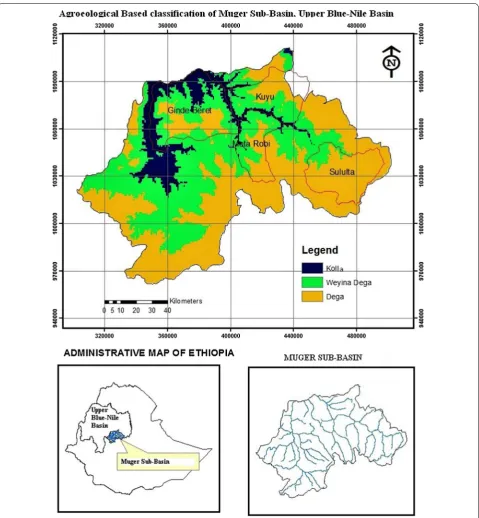
According to the current zonal structure, the sub-basin is shared between three zones: North shoa, West shoa, and Oromia Regional State Finfine Special Zone. Muger sub-basin covers 15 districts: Ejersa (Addis Alem), Walmara, Jeldu, Mulo, Sululta, Adda Berga, Meta Robi, Yaya Gule-lena Debre Libanos, WichaGule-lena Jido, Ginde Beret, Kuyu, Kutaya, Gerar Jarso, Degem, and Wara Jarso. The total population of the sub-basin is 2,442,247 people [33]. The Muger sub-basin is predominantly rural in character, and the farmers are engaged in small-scale and subsistence mixed agriculture. The dominant sources of livelihoods in the sub-basin are crop production and livestock rear-ing. Map of the study area is presented in Fig. 1.
Methods
Research design and methods of data collection
The research design was based on multistage sampling procedure. In the first stage, the whole sub-basin consti-tuting fifteen districts was grouped into three strata (Kolla, Woyina Dega, and Dega agroecological zones) based on their agroecological characteristics including the rain-fall, soil, and topography. Kolla refers to an area with an altitude ranging between 500 and 1500 m asl, with mean annual temperature between 20 and 28 °C and annual rainfall between 600 and 900 mm. Woyina Dega refers to an altitude ranging between 1500 and 2300 m asl, with mean annual temperature 16 and 20 °C and annual rain-fall above 900 mm; Dega refers to an altitude between 2300 and 3200 m asl, with mean annual temperature between 6 and 16 °C and mean annual rainfall above 900 mm [34]. Then, two districts were randomly selected from Kolla and Dega agroecological zones. Similarly, two dis-tricts were also selected from Woyina Dega agroecology using simple random sampling technique. Two districts from Woyina Dega were taken to maintain proportional-ity as the Woyina Dega agroecology covers larger area of the study site. In the second stage, only Peasant Associa-tions (PAs) found in the sub-basin in each sampled dis-tricts were listed in consultation with agricultural experts in the area. This is mainly to exclude PAs which are not part of the sub-basin in that particular district. Then, four PAs were randomly selected from each selected districts. Finally, 450 sample respondents were selected from 16 PAs using random sampling technique on the basis of prob-ability proportional to size (PPS). The sampling frame was the list of households which was obtained from the PAs administration. Households for Focussed Group Discus-sions (FGDs) were also drawn from each identified district,
and a member of the group was identified with the help of development agents working in the area.
Both quantitative and qualitative methods of data collection were used to obtain information from the selected respondents. Quantitative data were gathered using semi-structured questionnaire. Qualitative data were obtained from FGDs to complement the informa-tion obtained through a semi-structured quesinforma-tionnaire in order to have a better understanding of adaptation strategies used by these farmers and barriers to adopt-ing adaptation options. Besides data on lists of adapta-tion measures, this survey addressed perceived barriers to those adaptation options. Questions were also posed to investigate factors that constrain/facilitate adaptation measures to change in mean temperature and rainfall over the last two or three decades in the study area. Mean monthly temperature and precipitation from 1991 to 2016 were obtained from Ethiopian metrological station found in each sampled district.
Methods of data analysis
In order to analyze and present the data collected from sampled households, descriptive statistics (frequency, mean, maximum, minimum, and standard deviation), inferential tests (Chi-square test and one-way ANOVA test), and econometric model were used. Qualitative categorical types of data were analyzed using frequency and Chi-square test, while quantitative continuous types of variables were analyzed using one-way ANOVA, minimum, maximum, mean, and standard deviation. Qualitative information was organized and constructed coherently and analyzed based on theoretical and con-ceptual frameworks. After computing the descriptive statistics and inferential tests, a multinomial logistic regression model was used to identify determinants of household’s adoption of adaptation options where the dependent variable was found to be multioutcome. The data analysis was conducted using Statistical Package for Social Sciences (SPSS) version 20 and Stata 12.
Multinomial logit model specification
dependent variable is discrete, it is more appropriate to treat factors which are supposed to determine farmers’ decision on the use of adaptation options as a multiple choice decision. Based on this argument, the appropriate econometric model would be either multinomial logit or multinomial probit regression model. Regarding estima-tion, both of them estimate the effect of explanatory vari-ables on dependent variable involving multiple choices with unordered response categories [35]. However, mul-tinomial probit is rarely used in empirical studies due to estimation difficulty imposed by the need to solve multi-ple integrations related to multivariate normal distribu-tion [37]. Moreover, a multinomial logit model is selected not only because of the computational ease but also it exhibits a superior ability to predict livelihood diversifi-cation and picking up the differences between the live-lihood strategies of rural households [38]. In this study, therefore, a multinomial logit model was employed. This model makes it possible to analyze factors influencing households’ choices of adaptation strategies in the con-text of multiple choices.
The decision of whether to use any adaptation option or not could fall under the general framework of utility maximization [39]. Following Greene [35], suppose for the ith respondent faced with j choices, we specify the utility choice j as:
If the respondent makes choice j in particular, then we assume that Uij is the maximum among the j utilities. So
the statistical model is derived by the probability that choice j is made, which is:
where Uij is the utility to the ith respondent from
adapta-tion strategy j, Uik the utility to the ith respondent from
adaptation strategy k.
If the household maximizes its utility defined over income realizations, then the household’s choice is simply an optimal allocation of its asset endowment to choose adaptation strategy that maximizes its utility [40]. Thus, the ith household’s decision can, therefore, be modeled as maximizing the expected utility by choosing the jth adap-tation strategy among J discrete adapadap-tation strategies, i.e.,
In general, for an outcome variable with J categories, let the jth adaptation strategy that the ith household chooses to maximize its utility could take the value 1 if the ith household chooses jth adaptation strategy and 0 other-wise. The probability that a household with characteris-tics x chooses adaptation strategy j, Pij is modeled as:
(1)
Uij=Zijβ+εij
(2) Prob
Uij>Uik
for all otherK �=j
(3) max
j =E(Uij)=fj(xi)+εij; j=0. . .J
With the requirement that J
j=0Pij =1 for any i, where
Pij = probability representing the ith respondent’s chance of falling into category j; X = predictors of response probabilities
βj= Covariate effects specific to jth response category with the first category as the reference.
Appropriate normalization that removes an indeter-minacy in the model is to assume that β1=0 (this arise
because probabilities sum to 1, so only J parameter vec-tors are needed to determine the J + 1 probabilities) [41], so that exp(Xiβ1)=1, implying that generalized Eq. (4) above is equivalent to
where y = A polytomous outcome variable with catego-ries coded from 0… J.
Note The probability of Pi1 is derived from the
con-straint that the J probabilities sum to 1. That is,
pi1=1−pij..
The multinomial logistic models crucially depend on the independence of irrelevant alternatives (IIA) assump-tion in order to obtain unbiased and consistent param-eter estimates. This assumption requires the likely of the household’s using a certain adaptation options need to be independent of other alternative adaptation options used by the same household’s. Hausman test was used to test the validity of the IIA assumption.
The estimated cofficients of multinomial logit model provide only the direction of effect of independent vari-ables on dependent varivari-ables, but estimate neither rep-resent the actual magnitude of change nor probabilities [42]. Thus, the Stata version 12 was used to generate the parameter estimates (marginal effect). The marginal effects measure the expected change in the probability of a particular choice being made with respect to a unit change in an independent variable [35].
Definition of variables and hypothesis
The dependent variable in this study is the choice of an adaptation option that is listed in Fig. 2. The poten-tial explanatory variables, which were hypothesized to influence farmers’ use of adaptation options in response to climate variability and change and considered in the (4)
Pij=
exp(Xi′βj)
J
j=0exp(X′βj)
, J=0. . .3
Pr(yi=j/Xi)=Pij=
exp(Xiβj)
1+J
j=1exp(Xi′βj) ,
forj=0, 2. . .J and
(5) Pr(yi=1/Xi)=Pi1=
1
1+J
j=1exp(Xi′βj)
analysis, are often classified as personal, physical, socio-economic, institutional, and climate factors [43, 44]. These variables include age of the household head, gen-der of the household head, education status, and family size, membership in the social group, access to extension
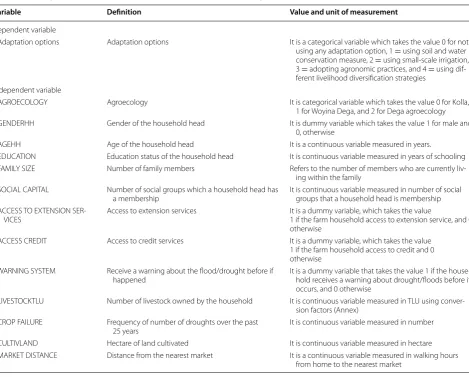
service, access to credit service, and climate warning sys-tem, agroecology, livestock ownership, the occurrence of drought and flood, and land cultivated. Table 1 presents the description, definition and unit of measurment for both dependent and independent variables.
Family size
The empirical adoption literature shows that household size has mixed impacts on farmers’ adoption of agricul-tural technologies. Larger family size positively influences farmers to take up labor-intensive adaptation measures like soil and water conservation (SWC) and irrigation that demand labor which is a critical problem in a peak period of production and livestock rearing [45, 46]. Alternatively, a large family might be forced to divert part of its labor force into non-farm activities to generate more income and reduce consumption demands [42]. We hypothesize that SWC and small-scale irrigation are more labor inten-sive and hence we expect family size to have a positive influence on the adoption of such adaptation measures. Similarly, this variable is expected to have a positive effect on the use of diversified livelihood options.
Age of the household head
The influence of age on adoption of SWC is unclear. Some studies found a positive relationship between age and conservation investment. This indicates that the likelihood of adoption of conservation practices is more among older farmers than among the younger ones, per-haps because older farmers could adopt SWC because they have more experience that helps them to perceive erosion problems [43, 47]. Conversely, older farmers could be less willing to bear the risk of investing in SWC due to their shorter planning horizons [45, 46]. In this study, we hypothesize that age of the household head has both positive and negative impacts on adaptation meas-ures. Empirical studies by Arega et al. [48] and Gebreye-sus [49] showed that age of the household head negatively related to farmers decision to diversify to non-farm and off-farm activities. Thus, age is hypothesized to influence the decision to diversify livelihood options.
Gender of the household head
It is a dummy variable that takes 1 if the household head is male, 0 otherwise. Many previous literature on adapta-tion, the influence of gender on adoption of adaptation measures are mixed. Female farmers have been found to be more likely to adopt natural resource management and conservation practices [45, 50]. However, some studies found that male household heads had a better opportu-nity to take an adaptation measure than female house-hold by involving on agronomic practices (such as crop diversification and use of drought-tolerant crop species) and by adopting SWC measures and irrigation to their farm [51, 52]. For instance, Asfaw and Admassie [51] noted that male-headed households are often considered to be more likely to get information about new technolo-gies and take risky businesses than female-headed house-holds. We hypothesize that female- and male-headed
households differ significantly in their ability to adapt to climate change because of major differences between them in terms of access to assets, education, and other critical services such as credit, technology, and input supply.
Farm size
It is a continuous variable defined as the years of school-ing attained by the household heads. In most of the adoption studies, it has been shown that education is an important factor that positively influences adoption decisions [42, 46, 53–55]. These studies have shown that better education and more farming experience increase farmers’ ability to get and use of information and improve awareness of potential benefits and willingness to participate in local natural resource management and conservation activities. Educated and experienced farm-ers are expected to have more knowledge and informa-tion about climate change and agronomic practices that they can use in response [56]. We expect that improved knowledge and farming experience will positively influ-ence farmers’ decisions to take up adaptation measures.
Farm size
Empirical adoption studies have found mixed effects of farm size on adoption of SWC. For example, a study on soil conservation measures and irrigation in Ethio-pia found that farmers with larger farms were found to have more land to allocate for constructing soil bunds, stone bunds, check dams, and improved cutoff drains and motivate to use irrigation [47, 53, 57, 58]. Similarly, Gbetibouo [59] revealed that farm size is positively cor-related with the probability of choosing irrigation as an adaptation measure. On the other hand, Nyangena [60] found that farmers with a small area of land were more likely to invest in soil conservation than those with a large area. It is also supported by the study conducted by [32]. According to their argument, the need for specific adapta-tion opadapta-tion (i.e., SWC measures) to climate variability and change is dictated by characteristics of the plot than the size of the farm. This means that it is not the size of the farm. Empirical studies have shown that the area of land owned by the household has a negative correlation with the likelihood of diversifying to non-farm and off-farm activities [48, 61]. Therefore, farm size to have a positive role in the decision to use irrigation is hypothesized. On the other hand, farm size was expected to negatively affect the use of different livelihood diversification options.
Access to agricultural extension services
an increased intensity of the use of specific SWC prac-tices and irrigation use because access to extension services and information help farmers to have better understanding of the land degradation problem and soil conservation practices and hence may perceive SWC practices to be profitable [42, 43, 46, 53]. Thus, extension service is hypothesized to be promoting decision to use SWC practices, agronomic practices, and irrigation use. This study postulates that the availability of better climate and agricultural information helps farmers make com-parative decisions among alternative crop management practices and hence choose the ones that enable them to cope better with changes in climate [62].
Access to credit
Several studies have shown that access to credit is an important determinant enhancing the adoption of vari-ous technologies [42, 52, 59, 62]. Deressa et al. [32] and Gbetibouo [59] reported that farmers with more financial and other resources at their disposal are able to make use of all their available information to invest on the use of irrigation, use of agricultural inputs, use of drought-tol-erant crop species, use of SWC, and take up livelihood diversification in response to changing climatic and other conditions. Credit provision has the advantage to solve financial constraints to meet their need to change their practices to suit the forecasted climate change. Thus, it is hypothesized that access to credit has a positive effect on the use of irrigation, use of SWC measures, use of drought-tolerant crop species, and use of non-farm and off-farm activities.
Market access
Distance to the nearest market is used to proxy for availa-bility of input and output markets. It is another important factor affecting adoption of agricultural technologies. The households located further away from markets are found to adopt lesser adaptation practices [30, 56, 63, 64]. Input markets allow farmers to acquire the inputs they need such as different seed varieties, fertilizers, and irrigation technologies. At the other end, access to output markets provides farmers with positive incentives to produce cash crops that can help improve their resource base and hence their ability to respond to changes in climate [30]. Maddison [56] observed that long distances to markets decreased the probability of farm adaptation in Africa and that markets provide an important platform for farmers to gather and share information. Lapar and Pan-dely [65] found that in the Philippines access to markets significantly affected farmers’ use of conservation tech-nologies. Piya et al. [66] showed that in Nepal distance to markets negatively and significantly affected the use of SWC technologies. It is expected that the households
located further away from the road are less likely to adopt livelihood diversification strategies, varietal selection, and the construction of tanks, but more likely to depend on traditional coping strategies.
Livestock ownership in TLU
Previous studies have shown mixed evidence about the relationship between livestock ownership and farmers’ decision in relation to SWC investment [42, 47, 55, 58]. Amsalu and De Graaff [47] showed that livestock own-ership has negative influence to adopt stone terrace. On the contrary, more specialization in livestock negatively influences the use of SWC by reducing the economic impact of soil erosion. Hence, the effect of the size of livestock holding on conservation decision is difficult to hypothesize a prior. Livestock holding negatively influ-ences household’s choice of non-farm and off-farm activ-ities that means the farmer with lower livestock holding would be obliged to diversify livelihoods into off- and non-farm in order to meet needs [67, 68]. Therefore, it is hypothesized to have a negative relationship with diversi-fying livelihood options.
Access to weather information
Smallholder farmers require different types of climate information during each stage of the agricultural produc-tion process in order to adapt to climate variability and change. Major climate change information includes early warning signals, weather forecasts, pest attacks, input management, cultivation practices, pest and disease man-agement, and prices [69–71]. Nhemachena and Hassan [72] reported that better access to weather information has a positive influence on the decision to invest in SWC measures, use of irrigation, use of drought-tolerant crop varieties, and diversify livelihood options in response to climate change problem. In the same way, Deressa et al. [52] found that access to information increases the likeli-hood of using SWC measures and different crop varieties to adapt climate change. The effect of access to weather information on the decision to use SWC measures, irri-gation, drought-tolerant crop varieties, and livelihood diversification is expected to be positive.
Membership in a social group
the probability of adapting climate variability and change using conservation agriculture, drought-tolerant varie-ties, and irrigation. Thus, membership in social groups positive effect on adoption of adaptation options in response to climate change impact is hypothesized.
Agroecological setting
In Ethiopia, Kolla agroecology (lowland) is characterized by relatively hotter and drier climate, whereas Weyina Dega (middle land) and Dega agroecology (highland) are wetter and cooler [32]. Evidence revealed that farmers living in different agroecological settings have their own choice of adaptation methods [32, 75, 76]. For instance, Deressa et al. [32] observed that farming in the Kolla
zone significantly increases the probability of SWC prac-tices, compared to farming in Weyina Dega. However, farming in Kolla significantly reduces the probability of using different crop varieties, planting trees, and irri-gation as compared to farming in weyna Dega. Hence, agroecology was hypothesized to have a positive or nega-tive effect on household’s adoption decision on climate change adaptation options.
Results and discussion
Adaptation strategies of smallholder farmers to climate change and variability
Based on data from a comprehensive survey of agricul-tural households across three agroecologies in Muger River sub-basin of the Blue Nile River Basin, this sec-tion briefly summarizes farmers’ adaptasec-tion strategies in response to climate variability and change. In this
survey, farmers were asked questions about what meas-ures and practices they have typically used in order to cope with the negative impact of climate variability and changes over the past 5 years. The results show that adaptation strategies farmers used include using stone bund; soil bund; check dam; terrace; small-scale irriga-tion; drought-tolerant and/or improved crop varieties; crop diversification; on-farm activity, non-farm activity, and off-farm activity. For the purpose of this analysis, the identified adaptation strategies are combined into five categories including the ‘no adaptation’ category for the convenience of model analysis. In this study because of their close relation, the above four adaptation strategies (namely stone bund, soil bund, check dam, and terrace) are grouped into one single component of SWC measure. Similarly, use of an on-farm activity, non-farm activity, and off-farm activity is merged together into livelihood diversification component. Moreover, use of drought-tol-erant crop varieties, crop diversification, and improved crop varieties has merged together and categorized as an agronomic practice.
Figure 2 shows that the use of SWC measures (28.7%) and small-scale irrigation (27.4%) are the two most widely used adaptation strategies in the study area. Most of the smallholder farmers use stone bund, soil bund, check dam, and terrace. The use of these strategies was found to reduce soil erosion associated with short but heavy rains which are usually common in the study areas. It is also disclosed that because of the unreliable and erratic pattern of rainfall and repeated drought, farmers started using small-scale irrigation schemes over their farm. We
also observed that diverted streams, pond construction, and use of water pump are found to be the major means for small-scale irrigation in the Muger River sub-basin. Farmers have also been using different livelihood strate-gies as a vitally important adaptation strategy in the face of the uncertainties due to the implications of climate variability and change (Table 1).
In response to the adverse effects caused by climate variability and change, smallholder farmers have been diversifying their sources of livelihood with an under-standing of more diversified livelihood strategies lead them both enhance incomes and spread the risk for smallholder farmers. About 14% of the survey respond-ents are engaged in diversifying their livelihood strate-gies using off-farm and/or non-farm activities in addition to their farming practice. The result shows that small-holder farmers in the study area diversified their liveli-hood strategies from depending on farming activities only to off-farm and/or non-farm income-generating
activities. Using agronomic practices (13.6%) is another strategy that is found to be used by smallholder farmers in adapting to the effects of variability and change as well as resultant changes in crop pest and disease pressures. To minimize the risk from the total loss of crop produc-tion and to increase crop productivity, farmers employed diversifying crops grown on the same plot of farm, drought-tolerant crop variety, and improved crop vari-ety. These strategies are important in managing current climate risks, particularly for subsistence agricultural communities of which majority are smallholder farmers. Nevertheless, the number of farmers who did not adjust their farming practices in response to climate variability and change (18.8%) is found to be large. However, this figure is relatively low compared to similar data collected from Ethiopia where 37% of farm households did not adapt [77].
Table 1 Descriptions, definition, and values of variables used in empirical model
Variable Definition Value and unit of measurement
Dependent variable
Adaptation options Adaptation options It is a categorical variable which takes the value 0 for not using any adaptation option, 1 = using soil and water conservation measure, 2 = using small-scale irrigation, 3 = adopting agronomic practices, and 4 = using dif-ferent livelihood diversification strategies
Independent variable
AGROECOLOGY Agroecology It is categorical variable which takes the value 0 for Kolla, 1 for Woyina Dega, and 2 for Dega agroecology GENDERHH Gender of the household head It is dummy variable which takes the value 1 for male and
0, otherwise
AGEHH Age of the household head It is a continuous variable measured in years.
EDUCATION Education status of the household head It is continuous variable measured in years of schooling FAMILY SIZE Number of family members Refers to the number of members who are currently
liv-ing within the family SOCIAL CAPITAL Number of social groups which a household head has
a membership It is continuous variable measured in number of social groups that a household head is membership ACCESS TO EXTENSION
SER-VICES Access to extension services It is a dummy variable, which takes the value1 if the farm household access to extension service, and 0 otherwise
ACCESS CREDIT Access to credit services It is a dummy variable, which takes the value 1 if the farm household access to credit and 0 otherwise
WARNING SYSTEM Receive a warning about the flood/drought before if
happened It is a dummy variable that takes the value 1 if the house-hold receives a warning about drought/floods before it occurs, and 0 otherwise
LIVESTOCKTLU Number of livestock owned by the household It is continuous variable measured in TLU using conver-sion factors (Annex)
CROP FAILURE Frequency of number of droughts over the past
25 years It is continuous variable measured in number CULTIVLAND Hectare of land cultivated It is continuous variable measured in hectare MARKET DISTANCE Distance from the nearest market It is a continuous variable measured in walking hours
Comparison of adopters and non‑adopters of adaptation options
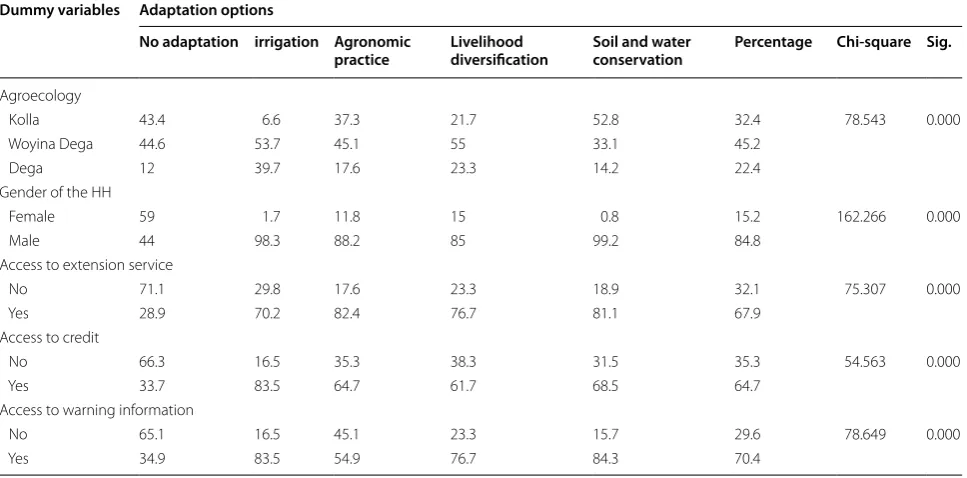
Tables 2 and 3 present the continuous and dummy explana-tory variables that are supposed to influence adoption of adaptation options that smallholder farmers pursue in response to the adverse effect of climate variability and change. These variables are grouped into demographic char-acteristics, farm charchar-acteristics, and institutional factors.
Household demographic characteristics
The sample population is made of 84.8% male and 15.2% women. This large number of men is due to the fact that
men are the heads of the households as custom demands are answerable to anyone who comes to the house. It is also reported that 99.2% of households that adopt SWC measures are found to be male-headed households, whereas 56% of non-adopters of any of the adaptation option are found to be female-headed households. The Chi-square test shows that differences of the gender of the household head are statistically significant (p < 0.000) among the adopters of any of the adaptation option and non-adopters of the adaptation options. Age of the household head influences overall adoption of adaptation options in response to climate variability and change.
Table 2 Differences of continuous explanatory variables between adopter and non-adopter households using one-way ANOVA
Continuous variables Adaptation options
No adaptation Irrigation Agronomic
practice Livelihood diversification Soil and water conservation Average mean Sig.
Mean age of HH 42.72 45.1 45.14 46.38 47.28 45.46 0.138 Mean of education of the HH 1.55 4.72 2.84 2.08 3.33 3.15 0.000 Mean of family size 5.08 5.90 6.43 5.93 6.20 5.9 0.000 Mean of number of social capital 0.89 4.26 2.51 2.3 2.51 2.74 0.000 Mean of distance to market in walking
hours 1.88 1.30 1.5 1.42 1.96 1.64 0.000
Mean of livestock in TLU 4.92 8.54 6.17 4.77 6.51 6.5 0.000 Mean of number of crop failed
experience 3.51 7.17 8.14 7.02 7.09 6.55 0.000 Mean of farm size in ha 0.98 1.84 1.15 1.21 1.89 1.47 0.000
Table 3 Differences of dummy explanatory variables for adopter and non-adopter households
Dummy variables Adaptation options
No adaptation irrigation Agronomic
practice Livelihood diversification Soil and water conservation Percentage Chi‑square Sig.
Agroecology
Kolla 43.4 6.6 37.3 21.7 52.8 32.4 78.543 0.000 Woyina Dega 44.6 53.7 45.1 55 33.1 45.2
Dega 12 39.7 17.6 23.3 14.2 22.4
Gender of the HH
Female 59 1.7 11.8 15 0.8 15.2 162.266 0.000
Male 44 98.3 88.2 85 99.2 84.8
Access to extension service
No 71.1 29.8 17.6 23.3 18.9 32.1 75.307 0.000 Yes 28.9 70.2 82.4 76.7 81.1 67.9
Access to credit
No 66.3 16.5 35.3 38.3 31.5 35.3 54.563 0.000 Yes 33.7 83.5 64.7 61.7 68.5 64.7
Access to warning information
Through experience, farmers perceive and understand the impact of climate variability and change on agricul-tural production, environment, and social issues. The mean age of sample household heads was 45.46 with a standard deviation of 12.67. The statistical analysis reveals that there is no significant difference in the mean age of sample household heads between adopters and non-adopters of adaptation option. The mean family size for the sample population is found to be 5.9 with a stand-ard deviation of 2.021. This mean family size is above the national average family size of 4.7 persons per household [78]. Furthermore, the mean family size for non-adop-ter households and adopnon-adop-ter of agronomic practices is found to be 5.08, and 6.43, respectively. The mean differ-ence of family size among the groups is statistically sig-nificant (p < 0.000). Average of highest grade attained is 3.15. The average years of formal education of adopter of small-scale irrigation and non-adopters of any adaptation option are estimated to be 4.72 and 1.5, respectively, and one-way ANOVA result shows that the mean difference between non-adopters and adopters of any adaptation option is statistically significant (p < 0.000).
Farm characteristics
The average cultivated landholding of the total sam-ple household heads is 1.47 ha with an average size of 0.98 and 1.89 ha for non-adopters and adopters of SWC measure households, respectively. The result further reveals that the mean difference between adopters and non-adopters of any of the adaptation option is found to be statistically significant at less than 1% significance level. Although landholding size is significantly differ-ent between adopters and non-adopters of adaptation options, it is noted that the mean land ownership of the sample households is larger than the national average of landholding of which less than 1 ha. Livestock is an important component of the farming system in the study area. A vast majority of the sample households included in this survey own animals of a different kind. The aver-age livestock holding for sample households in Tropical Livestock Unit is found to be 6.5. The average livestock holding for non-adopters and adopters of small-scale irrigation are found to be 4.92 and 8.54, respectively. One-way ANOVA result reveals that livestock owner-ship is statistically significant (at less than 1%) between adopter groups and non-adopter. This leads to the con-clusion that a household who own more livestock is more likely to adopt small-scale irrigation as compared to their counterparts.
Institutional factors
Institutional support like credit facilities, market acces-sibility, extension services, timely input supply, and
availability of agricultural technologies, irrigation scheme, and other rural infrastructure development is central to development. The survey result indicates that from the total sample household heads about 67.9% of households have access to extension services, while the remaining 32.1% of sample population do not have access to extension. The result further indicates that from the total adopters of agronomic practices, 82.4% of the households have access to extension services. On the other hand from the total of non-adopter households, only 28.9% have access to those extension services. The Chi-square analysis reveals that difference among adop-ters and non-adopadop-ters of different adaptation options is found to be significant at less than 1% significance level. Credit availability has also a paramount importance to improve the ability of the households at critical times of year to buy inputs. Availability of credit and modern inputs is integral parts of the extension system required to increase agricultural production through the use of modern agricultural technologies like fertilizer, improved seeds, and farm implements. As reported from the sur-vey result, about 64.7% of sample households get credit either in the form of cash or in kind from government, informal local institutions, and private money lenders and from friends and relatives, while 35.3% of sampled households do not have access to credit from any credit and saving institutions. It is noticed that from a total of small-scale irrigation adopters, 83.5% of households get credit. On the other hand, only 33.7% of households get access to credit from a total of non-adopters. It is also reported that access to credit is statistically different among adopter and non-adopter categories.
adverse impact of climate change and variability. The Chi-square result reveals that difference in access to early warning information is statistically significant between users and non-users of adaptation options. Although the information of early warning is broadcasted on the radio, such warning is limited to farmers who have a radio, and not available to remote areas of the study sites. Another important variable that has a strong association with the adoption of adaptation options is walking distance from the home of the household to the marketplace. A sig-nificant relationship is observed between distance to the market and adoption of adaptation options at less than 1% significance level.
Determinants of adoption of climate change adaptation measures
To estimate the multinomial logit model, we considered the first category (no adaptation) as a base category. Moreover, multicollinearity was checked using vari-ance inflation factor (VIF) and contingency coefficients (CC). The results from VIF values have shown that vari-ance inflation factors for all variables are less than 10, which indicate all the continuous explanatory variables have no serious multicollinearity problem. Similarly, val-ues of the CC have shown no multicollinearity problem among dummy variables. Based on the above test both the hypothesized continuous and dummy variables were retained in the model. Prior to running the multinomial logit model, we used Hausman test and the seemingly unrelated post-estimation procedure (SUEST) to test for the validity of the independence of the irrelevant alter-natives (IIA) assumptions. The results of the tests show that both tests failed to reject the null hypothesis of inde-pendence of the climate change adaptation options, sug-gesting that the multinomial logit (MNL) specification is appropriate to model climate change adaptation practices of smallholder farmers. The likelihood ratio statistics as indicated by Chi-square statistics are highly significant (p < 0.01), suggesting the model has a strong explanatory power. Table 4 presents the estimated coefficients of the MNL model, along with the levels of significance.
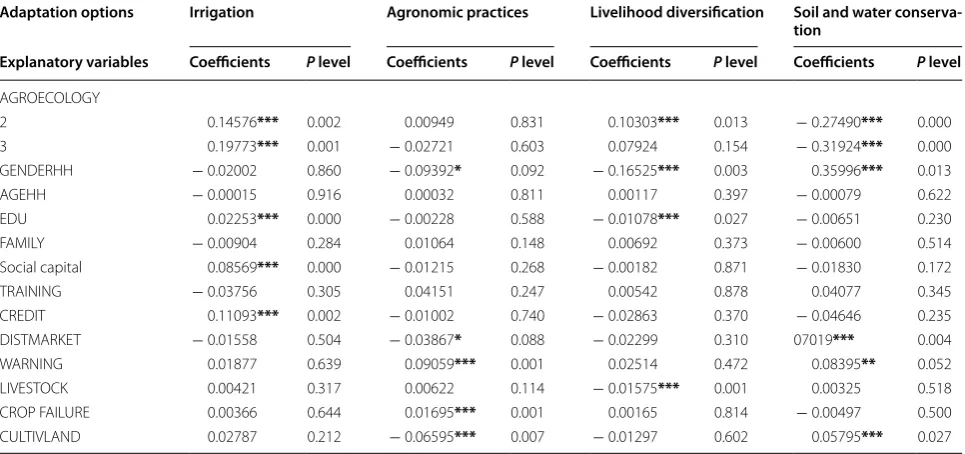
It is noted that the parameter estimates of the MNL model provide only the direction of the effect of the inde-pendent variables on the deinde-pendent (response) variable and lacks to represent the actual magnitude of change or probabilities. Thus, the marginal effects from the MNL, which measure the expected change in the probability of a particular choice being made with respect to a unit change in an independent variable, are reported and dis-cussed. As mentioned earlier, this analysis uses the esti-mated coefficients of no adaptation as the base category and evaluates the other choices as alternatives to this option. Table 5 presents the marginal effects along with
p values. Multinomial logistic regression model results show that most of the explanatory variables determined adoption of adaptation options are as expected.
Gender of the household head
Agronomic practice, livelihood diversification strate-gies, and SWC are significantly affected by gender of the household head. It is also observed that small-scale irrigation is not influenced by gender. The results have shown that gender was negatively and significantly related to the adoption of agronomic practices and liveli-hood diversification strategies at 10 and 1% significance level, respectively. The results indicate that being male-headed households more likely reduce practicing agro-nomic practices by 9.4%, and reduce to diversify their livelihood options by 16.5%. The negative effect of gender of the household heads on adoption of agronomic prac-tices and livelihood diversification strategies is probably due to the fact that women do much of non-agricultural works in the study area. These results are in conformity with the prior argument by Nhemachena and Hassan [72] which revealed that female-headed households are more likely to take up climate change adaptation meth-ods. However, it is in contrary to the previous argument by showing that male-headed households had better opportunity to take an adaptation measure than female household mainly due to cultural and social barriers in the area that limits women’s access to land and informa-tion using agronomic practices [51, 52].
Conversely, male-headed households adapt more read-ily to climate change using SWC. Male-headed house-holds were about 36% more likely to use SWC measures. This may be explained by the fact that constructing SWC measures needs substantial labor and female-headed households in Ethiopia are constrained with labor avail-ability than male-headed households. This study follows the prior argument that indicates male-headed house-holds are more likely to take up the SWC measures as SWC structures are labor intensive [51, 52]. The impor-tant policy implication is the call to target women farm-ers and to increase their uptake of adaptation measures.
Education status of the household head
Table 4 Parameter estimates of the multinomial logit climate change adaptation model
Base category no adaptation Number of obs. 442 LR χ2 (56) 642.74
Prob > χ2 0.0000
Log likelihood − 362.53853 Pseudo-R2 0.4699
***, ** Significant at 1, and 5 probability level, respectively
Explanatory variables Irrigation Agronomic practices Livelihood diversification Soil and water conser‑ vation
Coefficients P level Coefficients P level Coefficients P level Coefficients P level
AGROECOLOGY
2 0.04382 0.969 − 0.81489 0.429 − 0.00684 0.995 − 1.94269** 0.058 3 − 1.6309 0.260 − 3.09980*** 0.027 − 2.06575 0.135 − 4.11506*** 0.003 GENDERHH 4.5784*** 0.001 3.39037*** 0.002 2.92271*** 0.007 6.31437*** 0.000 AGEHH 0.02474 0.530 0.02838 0.465 0.03507 0.363 0.02153 0.571 EDUCATION 0.35660*** 0.002 0.15505 0.162 0.09720 0.389 0.16838 0.123 FAMILYSIZE 0.02708 0.897 0.20196 0.323 0.15449 0.444 0.06125 0.761 Social capital 3.5246*** 0.000 2.62318*** 0.000 2.77039*** 0.000 2.79201*** 0.000 TRAINING 2.2494*** 0.010 2.81760*** 0.001 2.46013*** 0.004 2.66200*** 0.002 CREDIT 2.3048*** 0.013 1.30769 0.148 1.21670 0.173 1.29698 0.148 DISTMARKET − 0.3730 0.545 − 0.66452 0.276 − 0.49368 0.418 0.06126 0.917 WARNING 2.2758*** 0.011 1.08831 0.203 2.17846*** 0.012 2.47294*** 0.004 LIVESTOCKTLU − 0.06469 0.600 − 0.03279 0.787 − 0.22183** 0.073 − 0.07275 0.547 CROP FAILURE 0.90076*** 0.000 1.00497*** 0.000 0.86159*** 0.000 0.84016*** 0.000 CULTIVLAND 0.75052 0.275 − 0.17688 0.797 0.35875 0.600 0.80477 0.231 _cons 21.7216*** 0.000 − 16.0392*** 0.000 − 15.528*** 0.000 − 18.4650*** 0.000
Table 5 Marginal effects from the multinomial logit of climate change adaptation model
***, **, * Significant at 1, 5, and 10% probability level, respectively
Adaptation options Irrigation Agronomic practices Livelihood diversification Soil and water conserva‑ tion
Explanatory variables Coefficients P level Coefficients P level Coefficients P level Coefficients P level
AGROECOLOGY
as an adaptation method. A unit increase in a number of years of schooling would result in a 22.5% increase in the probability of small-scale irrigation to adapt to cli-mate change. This might be education that helps farmers to search and use relevant information for their ing practices. On the same vein, education helps farm-ers to anticipate the consequences of climate change and understand the potential benefit of small-scale irrigation to minimize the possible impact of climate change. This is possible because educated farmers are more likely con-sulting different agencies that promote climate change adaptation options that would have a significant positive impact to reduce farmers’ vulnerability to climate change and variability. This result supports the view of numer-ous studies that show the positive impact of education on farmers’ decision to adopt small-scale irrigation [32, 42,
46, 53–55].
A study in rural Africa shows that education is an important determining factor to engage in non-farm and skilled employment businesses [80]. It is more cru-cial that better paid local jobs require formal schooling, usually the completion of secondary school or beyond. Contrary to our expectation, level of education negatively and significantly (p < 0.01) determines farmers’ decision to adopt livelihood diversification strategies such as off- and non-farm activities. A unit increase in a number of years of schooling would result in a 10.8% decrease in the probability of livelihood diversification strategies to adapt to climate change. This might be due to the fact that edu-cated households may have realized higher earnings from on-farm activity than off-farm and non-farm activities that have low return.
Social capital
It should be noted that self-help grouping and formation of cooperatives is a more reliable and pragmatic means of achieving social capital and ensuring dissemination and adoption of innovative technology [73, 74]. Member-ship to many social groups organized at the local level, as a proxy for social capital, is positively and significantly related to the likelihood of adoption small-scale irrigation at 1% significance level. A unit increase in membership to the social group would result in an 8.6% increase in the probability of adopting small-scale irrigation to adapt to climate change. The possible explanation of this result is social capital increase awareness and use of climate change adaptation options. It shows a quite promising picture in which social capital is also important resource for the community in evaluating risk and vulnerabil-ity imposed by climate variabilvulnerabil-ity and change in such a way that it serves both to disseminate information and to shape the way individuals process and understand infor-mation to promote small-scale irrigation to combat the
negative impact of the change on their farming. Another possible explanation is that social capital helps to under-stand the usefulness of small-scale irrigation to combat the risk posed by climate change.
The strong social networks can help the communities to have a strong supporting system which can enhance their adaptive capacity to respond to environmental shocks. As group discussants revealed, cooperation in the form of water user group, water shade management group, credit unions, agricultural producer organizations, livestock marketing group, and women credit association have positive effects on the income generating a capac-ity of their members and this may capacitate farmers’ financial status to invest in small-scale irrigation scheme. This result suggests that the role of individual member-ship to social groups in determining preference can be a useful point to consider since our result indicates that adoption of small-scale irrigation is high for those having a membership to many social groups. Although it is not significant, the sign of membership in organizations on adoption of agronomic practices, livelihood diversifica-tion, and SWC is not in the hypothesized direction. This is probably because households are receiving informa-tion only limited to irrigainforma-tion, but informainforma-tion related to different agronomic practices, different ways of creating livelihood options, and techniques of SWC are not circu-lated effectively by the social groups. The result suggests that while membership in the organization is important to receive information on adaptation strategies, sim-ply membership in the organization is not sufficient for adaptation strategies that need skills. This further sug-gests a need to supplement by training for capacity development.
Previous studies have shown that social capital, in its different forms, played a crucial role to adopt different adaptation options to reduce environmental shocks that came out from climate variability and change [32, 81, 82]. For instance, Mpogole [82] found that increased mem-bership to social groups would increase the probability of adopting conservation agriculture, drought-tolerant vari-eties, and irrigation. Similarly, Ortmun and King [81] and Mpogole [82] found that being a member of the social networks and organizations have substantially increased the likelihood to adopt improved and high yielding vari-eties. On the same vein, Deressa et al. [32] found that social networks increase awareness and use of climate change adaptation options.
Access to credit
livelihood diversification, and SWC measures, it has a significant influence on adoption of small-scale irriga-tion. As expected, the influence of access to credit service on farmer’s decision to invest in small-scale irrigation is significantly positive (p < 0.001). Having access to credit increases the probability of adoption of small-scale irri-gation by 11.1%. This may be explained by the fact that availability of credit minimizes liquidity constrains and thereby enhances adoption of small-scale irrigation. This clearly indicates that those farmers who neither have cash nor access to credit are priced out of using small-scale irrigation. To say it in another way, adopting small-scale irrigation is heavily affected by credit market imperfec-tions. This makes sense because the availability of credit eases the cash constraints and allows farmers to purchase irrigation facilities. This suggests the important role of increased financial institutional support in promoting the use of small-scale irrigation as adaptation option to reduce the negative impact of climate change. Similar results were reported in the previous literature [32, 42,
59, 62].
Climate warning system
As hypothesized, better access to early warning about drought and flood before it happened has a significant and positive impact on the likelihood of using agronomic practices and SWC measures on their farmland at 1 and 5% significance level, respectively. The results reveal that getting access to climate warning about drought and/or flood increases the likelihood of using agronomic prac-tices (9%), and SWC measures (8.4%). This implies that farmers who get early warning about drought and/or flood will try to construct SWC measures such as stone bunds, soil bunds, check dams, and hillside terrace either to preserve the moisture content of the soil not to loss of water associated with an increased evapotranspira-tion due to increased drought or to reduce soil erosion to be happened due to the flood. Moreover, early warn-ing mechanism helps farmers to use drought-tolerant varieties to cope with increased temperature. This result supports the findings of earlier researchers on technol-ogy adoption. Phillipo et al. [84] noted that information on climate warning empowered smallholder farmers to adapt to climate variability and change. Alike to this, a study conducted by Deressa et al. [52] in assessing cli-mate change adaptations of smallholder farmers in South Eastern Ethiopia revealed that better access to informa-tion on climate change has a significant and positive impact on the likelihood of using different crop varie-ties. Although it is noted that climate warning system helped increase the uptake of adaptation options, the effective early warning system remains an important concern voiced by survey respondents. This leads to the
conclusion that the benefits from adaptation options may be reduced or entirely forgone if the lack of effective early warning system constrains households from adopting adaptation options.
Livestock ownership
In line with prior expectation, livestock holding in TLU negatively influences household’s choice of livelihood diversification strategies at 1% probability level. This result reveals that a unit increase in a number of livestock in TLU would result in a 15.7% decrease the probability of creating another source of livelihoods like petty trad-ing and small business as an alternative means of income. This suggests that farmers with lower livestock holding would be obliged to diversify livelihoods into off- and non-farm in order to meet needs. This result is in con-trary to the notion that higher livestock ownership would help farmers more likely to have better financial source helping them to create another source of livelihood [85].
Crop loss experience (crop failure)
Multinomial logit result shows that a number of times a household’s crop failed due to the adverse impact of climate change over the last 20 years greatly influenced farmers’ decision to adapt to climate change using agro-nomic practices. The result indicates that a unit increase in the number of times a farmer’s crop failed as a result of climate change over the past 20 years could increase the likelihood of adopting agronomic practices by 16.9% at p < 0.001 to minimize the adverse effect. This evidence suggests that farmers experience crop loss because cli-mate-related hazards have developed their indigenous knowledge and innovations to respond to the risk. The result is in conformity with the finding of Teshager et al. [86] in their investigation of determinants of adapta-tion strategies to climate change in the Batti district of Amhara Regional State.
Agroecological setting
options in both Woyina Dega and Dega agroecology to cope with the risk imposed by climate change and vari-ability. This might be due to high irrigation potential of
Weyina Dega and Dega agroecology. Most of the per-manent and intermittent rivers which have a potential for small-scale irrigation are found in Woyina Dega and Dega agroecology. More importantly, these rivers are located in a suitable setting for using them for irrigation. Conversely, Kolla agroecology is endowed with a few number of rivers that will be used for irrigation. It is also noted that these rivers are flowing in a gorge which needs huge capital and advanced technology to make use of them for irrigation purpose as compared to rivers found in Woyina Dega and Dega agroecology.
Furthermore, the tendency that the household diversi-fies livelihoods into agriculture plus off-farm plus non-farm increases as we go from Kolla to Woyina Dega. This might be due to high infrastructure development in Woyina Dega as compared to Kolla. In a previous study, we have reported differences in access to major infra-structure across the three agroecologies [87]. This study found that households in Kolla agroecology had traveling an average of higher time to the main road, school, vet-erinary service, market, water point, and health center as compared to Woyina Dega and Dega households. The probable reason is that good infrastructure development increases the incentive of sample farmers to diversify their livelihoods that will help them reduce the negative impact of climate variability and change.
Farm size
The size of cultivated land is negatively and signifi-cantly related to the adoption of agronomic practices in response to climate variability and change in the study area. A unit increase in a hectare of cultivated land would decrease the likelihood of using different agronomic practices by 6.6%. This might be due to the fact that farm-ers with the large size of cultivated land have less fear to take the risk of climate change than their counterparts. Farmers with the large size of cultivated land have a high probability of having many farm plots with different soil physical and chemical characteristics that have been impacted by climate change differently. It may be this fact that gave farmers confidence not to worry about drought-tolerant varieties, crop rotation, and changing planting dates to reduce impact posed by climate change and vari-ability. This result affirms with a study done by Deressa et al. [88] in the Nile basin of Ethiopia to analyze farmers perception and adaptation to climate change, which sup-ports the notion that the negative relationship between farm size and adaptation could be due to the fact that adaptation is plot specific. According to their argument, the need for specific adaptation method in response to
climate variability and change is dictated by characteris-tics of the plot that the size of the farm.
The negative effects of farm size on adopting agro-nomic practices found here are inconsistent with other studies [59, 77, 84]. For instance, Phillipo et al. [84] sup-port the notion that households with small land hold-ing are more likely to choose traditional crop varieties because of the associated costs to the new crop varie-ties. They further explained the probable reason for why small land holders do not adopt improved crop varieties; they argued that poor farmers always farm for home con-sumption; therefore, they are likely to choose varieties that suit them rather than the market.
The model result of this study reveals that size of cul-tivated land significantly increases the likelihood of using soil conservation measures at 1% significance level. A unit increase in a hectare of cultivated land would increase the probability of using SWC by 5.6%. The prob-able reason is that constructing SWC measures will reduce their farm size. As a matter of fact, farmers with large farm size have less risk of reduction to farm size that came out from constructing SWC measures on their farm land. The result is in conformity with the earlier studies [47, 53, 57–59].
Distance to the main market
income-earning opportunities. This could be further explained distant households from the main market are constrained by the lack of information and lack of access to the market to dispose of their products, have less off-farm employment opportunities, and lead to rely more on traditional strategies. Unlike our result, many kinds of the literature indicated that improving market access for small-scale subsistence farmers would increase their abil-ity to adapt to climate change [2, 30, 63, 66].
Conclusion and policy recommendations
It has been noted that climate change and variability adversely affect agriculture, which is the major means of livelihoods of smallholder farmers in the study area. As agriculture remains a source of income for rural com-munities in the study areas, adaptation to climate change and variability is imperative. It is learned that adaptation to this change tends to reduce the negative impact of cli-mate change and variability. Different adaptation options are employed by smallholder farmers in response to climate variability and change in the study area. The main adaptation strategies can be broadly categorized to include small-scale irrigation, agronomic practices, livelihood diversification strategies, and SWC measures. It is learned that adoption of these adaptation options tends to reduce a high production risk imposed by cli-mate variability and change. This indicates that these adaptation options provide a venue to reduce sensitivity and increase the adaptive capacity of smallholder farm-ers that latter improve their livelihoods and ensure food security.
The study finds that better access to credit allows households to adopt small-scale irrigation. This implies that credit market imperfection can create a barrier for the capital-constrained farm households to participate in small-scale irrigation in the study area. Provision of microcredit facilities complemented with skill devel-opment training can help the households to invest in small-scale irrigation to avert the adverse impact of cli-mate change and variability. The study further reveals that household characteristics such as education status of the household heads which could be enhanced through policy intervention have a significant impact on adapta-tion to climate change using small-scale irrigaadapta-tion. Thus, investment in education systems which increases farmers awareness to invest in small-scale irrigation and that help farmers to specialize on farming in the rural areas can be underlined as a policy option in the reduction of the neg-ative impacts of climate change.
As often stated in climate literature, early warning sys-tem increases farmers’ preparedness to design and imple-ment adaptation options in response to the expected climate change. This improves adaptive capacity and
reduces the sensitivity of smallholder farmers to the neg-ative impact of climate variability and change. In prac-tice, although climate warning system helped increase the adaptive capacity and reduce the sensitivity of small-holder farmers, early warning system remains an impor-tant concern voiced by survey respondents. This leads to the conclusion that the benefits from adaptation options may be reduced or entirely forgone if concerns about early warning system constrain households from adopt-ing adaptation options or to limit adoption of adaptation options to few smallholder farmers who have the previ-ously higher adaptive capacity and less sensitive. This implies that additional efforts to increase effective early warning system may have the desired impact on the adoption of SWC measures and agronomic practices as adaptation options.
The results of the study also indicate the important role of social capital in adaptation to climate change. Policy interventions which encourage farmers’ membership to many social groups can promote group discussions and better information flows and enhance adaptation to cli-mate change. The result further reveals that farmers liv-ing in different agroecological settliv-ings used different adaptation options. Thus, the future policy has to aim at providing adaptation technologies through agroecology-based research.
Experience in crop failure is another important variable that affects adoption of agronomic practices positively. With increasing experiences in crop failure, farmers adopt agronomic practices such as using drought-tol-erant crop varieties, changing planting dates, and using crop rotation. Thus, future policy to develop and pro-mote drought-tolerant crop varieties can support farmers to better cope with climate change.
Authors’ contributions
Abayineh Amare and Belay Simane generated the idea and designed the study. Abayineh carried out the data collection, data analysis, and write-up. Belay provided statistical assistance and read and revised the manuscript. Both authors read and approved the final manuscript.
Acknowledgements
We wish to express our profound gratitude to Addis Ababa University; the German Academic Exchange Service (DAAD), Germany; African Climate Change Fellowship Program; and International Development Research Centre (IDRC) for their financial support in accomplishing this paper. We also want to thank Catharine Roynald for her rigorous comments and suggestions on the manuscript.
Competing interests
The authors declare that they have no competing interests.
Availability of data and materials
Data sharing is not applicable to this article as no datasets were generated or analyzed during the current study.

![Table 6 Conversion factors used to estimate TLU. Source: Stock et al. [89]](https://thumb-us.123doks.com/thumbv2/123dok_us/376468.2034797/18.595.57.291.230.323/table-conversion-factors-used-estimate-tlu-source-stock.webp)