ISSN 2324-805X E-ISSN 2324-8068 Published by Redfame Publishing URL: http://jets.redfame.com
Experiences and Future Expectations towards Online Courses
–An Empirical Study of the B2C-and B2B-Segments
Andreas Krämer1, Sandra Böhrs21BiTS-Business and Information Technology School GmbH, University of Applied Sciences, Iserlohn, Germany and
exeo Strategic Consulting AG, Bonn, Germany
2Simpleshow S.A., Luxembourg
Correspondence: Andreas Krämer, BiTS-Business and Information Technology School GmbH, Reiterweg 26b, 58636 Iserlohn, Germany
Received: August 28, 2015 Accepted: September 18, 2015 Online Published: September 24, 2015 doi:10.11114/jets.v4i1.1104 URL: http://dx.doi.org/10.11114/jets.v4i1.1104
Abstract
This article explores the future potential for the development of online courses. The findings are based on an empirical study with 3 sample groups: (1) B2C segment in Germany, (2) B2C segment in the United States, and (3) B2B segment (international). In the first step the status quo of the use of e-learning in general and online courses in particular is presented. Subsequently, the expectations of potential users concerning the design of online courses are determined. Respondents were segmented according to their basic needs, based on ten distinct attributes relevant for the decision-making process. Thirdly, an innovative concept for online courses is reviewed as part of a concept test. Since people increasingly watch (short) videos instead of reading documents, the authors emphasize that creators of online courses can take advantage of this development, provided they adapt their formats to the changed communication behavior of potential users.
Keywords: e-learning, online courses, customer satisfaction, willingness to pay, innovative formats 1. Introduction
According to Androulla Vassiliou - European Commissioner for Education, Culture, Multilingualism and Youth - “the online and open education world is changing how education is resourced, delivered and taken up. Over the next 10 years, e-learning is projected to grow fifteen-fold, accounting for 30% of all educational provision” (European Commission, 2014). Among the instruments of e-learning, online courses are regarded as a subsector with particularly strong growth. The dream of the “democratization of knowledge” might soon be fulfilled: as stated by Fozdar (2015), ODL (Open and Distance Learning) may be the solution for overcoming the gap between those who have had access to science and technology education and those who have not.
“Massive Open Online Courses” (MOOCs) represent an important step in this direction. These are online courses with scientific content and a large number of participants – in some cases tens of thousands. A typical online course includes digital lectures with interactive elements such as discussions in forums and multiple-choice questions. Enrollment to the course is usually free, or very cheap. By December 2014 the number of universities offering MOOCs has exceeded 400, and the cumulative number of courses offered has reached 2,400. Courses are often financed by venture capital firms, nonprofit organizations, profit oriented companies, and universities (Holdaway, 2015). Alsadhan, Alhomod & Shaf (2014) express themselves less euphoric about the future potential of online courses when stating that “there is a little doubt that e-learning courses are becoming more popular each day with thousands of students joining the new courses each day. A survey of online courses reveals that most of the courses are mostly text-based.” Also, growing interest in video format can be recognized with regard to the development of YouTube video hosting. The average upload of videos to YouTube per minute, boosted from 8 hours in 2007 to 300 hours in 2014 (Statista, 2014).
1.1 Broad Application of Online Courses
Journal of Education and Training Studies Vol. 4, No. 1; January 2016
a relatively low price or even for free. During the last 3 years “… MOOCs have largely moved from pedagogy to promotion and are now more used to advance institutional reputation than any serious drive to reinvent the institution” (Stewart, Khare & Schatz, 2015).
However, if online courses are also of interest for a wider range of segments (B2C or B2B) and offer a significant value proposition, they do not necessarily have to be free of charge. Consequently, platforms like Udemy offer both: free online courses and courses with prices of up to USD 500 (on average USD 75).1
1.2 Study Background and Objectives
The Simpleshow Company (hereinafter TSC) is a media company (founded in 2008), which is specialized in the production of explanatory videos (2 – 4 minutes length) in the business sector. With an accumulated production volume of approximately 5,000 videos, TSC has a leading position in the worldwide market. As explanatory videos strongly compress information and achieve high recall values due to their unique presentation style, there are opportunities to use these advantages as one of several key elements of an online course. Short videos (e.g. 10 minutes length), at discrete intervals during the week, presented to stimulate students, can be more effective than long one hour monologues (University of London, 2013). This corresponds with the finding that it is particularly common for students to complain about the workload on new courses (Mason and Weller, 2000), and that the length of the course plays a crucial role.
The general objective of the study is to explore the future prospects of online courses using a quantitative and representative survey and to measure the acceptance of innovative online courses (concept testing). Within the global market of e-learning, Western Europe (16 %) and North America (53%) are key markets (Docebo, 2014). Therefore Germany and the U.S. were selected as focus regions. In addition to the B2C perspective, the segment of B2B contacts of TSC has been included in the study. In particular it is assumed that the affinity to online courses and explanatory videos is above average in the B2B segment.
1.3 Research Questions
1. What are relevant customer segments for e-learning in general and online courses in particular? Which differences are prevalent across the sample groups?
2. How were online courses used in the past (customer groups, topics, formats) and evaluated in terms of customer satisfaction? Which areas offer opportunities for improvements?
3. What are the key requirements to using online courses in the future? Is there a willingness to pay for online courses?
4. How do potential users of online courses evaluate new formats of online courses (30 min, change of style, sequence of 3 min explanation/explanatory videos etc.)? How does the explanatory video style influence the overall evaluation of the online course concept?
5. How does product-category expertise influence the results of the concept test? Do the results differ between B2C and B2B respondents?
2. Method
2.1 Procedures and Methodology
In order to answer the research questions, an empirical study was developed and carried out. It allows getting insights to regional differences in the B2C sector as well as differences between the B2B and B2C segments.
To map the B2B segment, TSC´s contact data was provided by the company's CRM system and was used for the survey. As the study aims to ensure a representative description of the status quo for important target countries (B2C markets), the survey utilized contacts that have been made available through two online access panels. In addition to the economic benefits of an online research study this survey type also has further substantive advantages for concept testing. This is particularly true when different types of information such as videos and graphics will be presented during the interview. As the assessment of innovative formats of online courses is relevant for the study, online market research becomes particularly favorable.
The online survey - representing 3 different groups (n=1.176) - was conducted in July 2015 and was focused on B2C as well as B2B segments (see Table 1).
Table 1. Samp
Sampl # 1 B2 # 2 B2 # 3 B2 * Sample quota 2.2 Structure o
According to previous expe satisfaction, in with regard t expectations e innovative for The test was c short explanat TSC has deve interview, in t an innovative changing form use, the willin ensure the va invited to part expertise enh experimental segments (“ex
In addition to interview dem for weighting
2 Since the re average Inte available st
ple groups and
le group 2C, Germany 2C, U.S. 2B, International
a were set to n=50 of the Study
the purpose of erience in the ntention to use to the develo etc.). In the th rmat of online
carried out in tory video (3 eloped its own the subsequent online course ms of presentat ngness to pay alidity of the c ticipate in a co hances a respo design shown xperts”) on pro
Fig the core area mographic char
the raw data a
ecruitment of res ernet usage, and atistics and seco
d characteristic
Respo n=4 n=4 l n=1 00 cases. Respond
f the study, the field of onlin e online cours opment, design
hird part of th courses (see G a two-stage ap minutes), whi style (hands, t step the actu was presented tion; final test; for the TSC f concept test re oncept test sho ondent's abilit n by the resea oduct innovatio
gure 1. Concep s of the study, racteristics we and adjusting th
spondents relies d hence a potenti ondary informat s ondents 491* 489* 96
dents with unrealis
e designed sur ne courses (to ses in the futur n and creatio he interview a Giannakos et al pproach: in th ich presented scribbles, etc.) ual concept test d (explanatory ; total length o format, and th esults, Schoorm
ould possess a ty to evaluate archers. Hence on are examine
pt test: Explain , there is a scr ere recorded, w
hose to represe
s on online acces ial bias for the s ion.
Interview time 12.0 mi 13.0 mi 22.9 mi stic short interview
rveys are divid opics, number re etc.). The s n of online c a concept test l., 2014). e first stage, th
complicated c ). After displa t was carried o
video as an es of about 30 min
e willingness mans, Ortt, & a degree of pr e concepts in
e, the reaction ed in more det
ner video and n reening part at which later ser entative structu
ss panels, there study topic is giv
in Age, sex, re in Age, sex, re
in
--w time (< 2 minute
ded into three p r of online co second area re courses (topic t was carried
he TSC video content in ver aying an exemp
out. During th ssential input; nutes). With re
to recommend de Bont (199 oduct knowled a test of ma ns of B2C tar
ail.
new online cou t the beginning rved as descrip
ures.
is a particular ri ven. Therefore,
Weight egion, internet u egion, internet u
--es) were eliminate
parts: the first ourses attended elates to the cu cs of interest,
out with a sp
format was p ry condensed a
plary video in his concept test a speaker lead egard to the co d have been re 95) suggest th dge. The idea, ajor innovatio rget group (“n
urse concept g of the interv ptive variables
isk that interview Internet usage w
usage2 usage ed.
t section deals d, degree of c ustomer's requ , customer ne pecial focus o
presented. It in and compresse
this format du t the basic stru ding through th
oncept, the inte ecorded (Figur hat consumers , that product-ons, was supp no experts”) a
view. At the en s as well as pa
wees show an ab was weighted ba
with the customer irements eeds and
n a new
cluded a ed form. uring the ucture of he topics; ention to re 1). To who are category ported in
and B2B
nd of the rameters
Journal of Education and Training Studies Vol. 4, No. 1; January 2016
2.3 Data Analysis
To examine the significance within the three sample groups and to statistically evaluate background characteristics, the repeated measures ANOVA, given its ability to perform overall comparisons, as well Chi-Square distribution tests were used. Hierarchical clustering to determine the number of clusters and K-Means-Clustering were used for segmentation. All analytical work was done by SPSS version 22.
3. Results
3.1 Experiences with e-learning and Online Courses in the Past
As shown in Table 2, the level of involvement in e-learning reaches 45 % in the U.S., compared to 38 % in Germany. In contrast, 83 % of B2B respondents already experienced e-learning. Differences are significant, when performing Chi-Square Test (p=0.001). Overall, experience with e-learning is strongly correlated with age: all sample groups have shown lower level of involvement if respondents are seniors (60+ years).
Table 2. Experiences with e-learning according to sample group
Question (Germany)B2C (U.S.)B2C (International)B2B
Experience
with e-learning* YesNo 62 % (81 %)38 % (19 %) 55 % (60 %) 17 45 % (40 %) 83 % % (25 %)(75 %) * Question: Do you already have experience with e-learning in general, and have you also used digital learning applications? Values in ( ): 60+ years
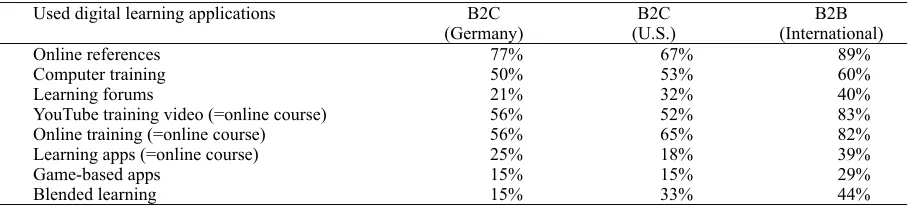
Respondents who confirmed e-learning experience were asked to indicate which digital learning applications were used. Here, the usage of online references (for example Wikipedia) ranks number 1 (see Table 3). While blended learning plays a minor role in Germany, its relevance increases in the U.S. B2C and the B2B segments. Since the term "online course" is not clearly defined, the following definition has been used in the study: users of YouTube training videos, online trainings or learning applications. Overall, 75 % of the B2B contacts completed at least one online course in the past, followed by the B2C segment in the U.S. (34%) and the B2C segment in Germany (29%). At the same time about one third of all users of online courses did not complete one or more online courses. When asked for the reasons (open question) it turned out that length (“course was too long”, 38 % of responses) as well as style and pedagogy (32 % of responses) were the main factors. Among all respondents students showed the highest drop-out rate.
Table 3. Digital learning applications according to sample group
Used digital learning applications B2C
(Germany) (U.S.)B2C (International)B2B
Online references 77% 67% 89%
Computer training 50% 53% 60%
Learning forums 21% 32% 40%
YouTube training video (=online course) 56% 52% 83%
Online training (=online course) 56% 65% 82%
Learning apps (=online course) 25% 18% 39%
Game-based apps 15% 15% 29%
Blended learning 15% 33% 44%
* Question: Which digital learning applications did you use? (Multiple responses).
Online courses cover a broad range of topics. Here, business and professional topics play a dominant role (especially in the B2B segment). The relevance of language courses strongly differs between the B2C segments in the U.S. (13 %) and Germany (45 %).3 Similarly, the length of the courses shows a wide range.4 B2B respondents prefer rather short
online courses (51 % up to 1 hour). Between 15 % (B2B contacts) and 22 % (B2C, Germany) of respondents paid for the last online course. The median price is approximately USD 90 in the B2C segments and is significantly higher in the B2B segment (median: USD 550).
The degree of customer satisfaction with online course reaches 48 % (top-2) in Germany and is significantly lower in the U.S. (29 %), while the highest level is recorded in the B2B segment (45 %, differences are significant, p<0.000).
3 Other sources confirm that there is a wide gap of speaking foreign languages in the U.S. compared to Europa. The National Journal reports that only 10% of native-born Americans can speak a second language, compared to 56% of European Union citizens (Czekalinski, 2012). The MLA's newest report, released this month, highlights a drastic fallout in foreign language studies: roughly 100,000 fewer students took language classes in 2013 than did in 2009, the last time the association surveyed students (Ferdman, 2015).
Therefore it can be assumed that there is considerable room for improvement in the market. Concerning potential drivers, the length of a course does not significantly influence customer satisfaction (p=0.055); neither do the number of courses booked (p=0.340), and the topic of the course (p=0.340). The customer satisfaction level is below average for business topics and is above average for languages and leisure topics. However, the satisfaction level significantly depends on age groups (p=0.001). Furthermore, there are indications that the style of the video and its format are relevant factors as well. Pictures, video sequences, and text pages appear significantly more frequently in those courses that were rated "satisfying" by their customers. In particular respondents in the age of up to 30 years are less euphoric about their last online course (top-2: 29 %, low-2: 30 %).
Since many possibilities for the distribution of online courses exist (Holdaway, 2015), further questions focused on the awareness and use of the most important marketing and distribution platforms. As it turned out the market for online courses is strongly fragmented: Khan academy reaches 24 % in terms of awareness (recognition). All other online platforms rank lower.
3.2 Consumer Expectations and Drivers of the Decision for Online Courses
Most respondents see online courses as a good option/opportunity to get further training in interesting subject areas. The evaluation of statements concerning online courses is especially positive within the B2B segment, as well as the group of respondents with usage of online courses in the past.
Overall, approximately one fourth of the respondents have used online courses in the past and have indicated usage in the future. Typically, those interviewees have a relatively high degree of customer satisfaction (49 % top-2) and intensively book online courses. More than 80 % of them are employed and 58 % are willing to pay for online courses. Concerning the B2B segment the share of this subgroup is 64 %.
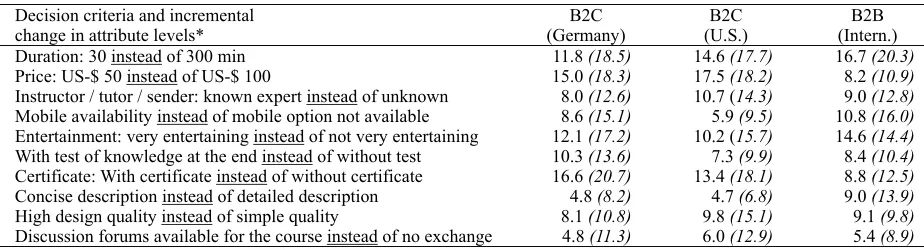
To identify the decision drivers when selecting online courses, a 3-steps-design was chosen. At the beginning the preferred type of course was defined (language, business topics etc.). Afterwards ten decision criteria were presented. These attributes were explained by incremental changes in the characteristics, which have been referred to as improvements. Respondents were asked to identify the most important feature from their point of view. Finally, they were asked to distribute a total of 100 points according to the importance of the individual attribute. This 3-steps-approach was developed to ensure a realistic decision-making including typical trade-offs (Netzer & Srinivasan, 2007). The authors have successfully implemented this approach in other research fields (see Kalt, Bongaerts & Krämer, 2013). The evaluation of the individual criteria seems to be balanced: on average weights were specified at 5.5 out of 10 possible criteria, a clear indicator that respondents more intensively have set itself apart with the attributes shown. This is confirmed by the measured answer time in the interview.
Table 4. Weight of different decision criteria (Mean and SD)
Decision criteria and incremental
change in attribute levels* (Germany)B2C (U.S.) B2C (Intern.)B2B
Duration: 30 instead of 300 min 11.8 (18.5) 14.6 (17.7) 16.7 (20.3)
Price: US-$ 50 instead of US-$ 100 15.0 (18.3) 17.5 (18.2) 8.2 (10.9)
Instructor / tutor / sender: known expert instead of unknown 8.0 (12.6) 10.7 (14.3) 9.0 (12.8) Mobile availability instead of mobile option not available 8.6 (15.1) 5.9 (9.5) 10.8 (16.0) Entertainment: very entertaining instead of not very entertaining 12.1 (17.2) 10.2 (15.7) 14.6 (14.4) With test of knowledge at the end instead of without test 10.3 (13.6) 7.3 (9.9) 8.4 (10.4) Certificate: With certificate instead of without certificate 16.6 (20.7) 13.4 (18.1) 8.8 (12.5) Concise description instead of detailed description 4.8 (8.2) 4.7 (6.8) 9.0 (13.9) High design quality instead of simple quality 8.1 (10.8) 9.8 (15.1) 9.1 (9.8) Discussion forums available for the course instead of no exchange 4.8 (11.3) 6.0 (12.9) 5.4 (8.9) * Question: Below we would like to ask you a few questions about the decision-making criteria for selecting online courses in the field of … (most
relevant topic for the interviewee is embedded) Various improvements are shown below. First, please tell us the most important improvement for selecting a course. Please allocate 100 points to the improvements according to their weight. ( ) Standard Deviation; Basis: Respondents, who generally consider to book online courses (n=680).
Journal of Ed customer bene identified with Focu weig Focu Indif Ther
Figure 2 rev
3.3 Evaluation
As presented i the interview. generally kno Approximatel expected corre the group of Chi-Square-te In a second ste 30 % of resp (respondents w significantly d good evaluati p<0.000). In addition th comparable to (Table 5). Typ willingness to high probabili segments are
5 To measure measuremen their WTP ( certain situa
ducation and T
efits. Therefor h homogeneou us on time: this ght). Also, the p us on certificate fferent: in this
e is no clear fo
veals that the d online co
n of Innovative
in Figure 1 a c TSC´s video own in the B2 ly 50 % of all esponding resu f respondents ests differences
ep the structur ondents in the with intention driven by the ion of the vid
he interviewee o the style as
pically, TSC c o pay for the o
ity to use and lower and rea
e the retention pr nt. Recent resea (Lowe, Lowe an ation, but also a
Training Studies
re, a clustering us customer ex s segment attac
price plays an e: the custome segment, the ocus on few cu
Figure
distribution of s ourses in the fu
e Online Cours
concept test co format plays 2C segments. l respondents ults for the B2 with the ge s across group re of an innova e U.S. show a to book onlin assessment of deo indicated
es were also r presented.5 B
contacts (B2B online course c a willingness ach 20 % in th
rice a direct que arch suggests mo nd Lynch, 2013)
robust one (Krä
s
g of respondent xpectations:
ches special im above-average er in this segme relevance of ustomer benefi
e 2. Customer
segments acco uture (p=0.189
se Formats
oncerning an in a crucial role Therefore a v
in Germany a 2B segment we eneral intentio s are indicated ative online co a high probabi ne courses in th f the TSC vid
67 % probab
requested to i Based on thes B) show a hig concept. Almo s to pay 10 US
he U.S. and 1
estion was used i ood and environ ). Therefore it is ämer, 2015).
ts was carried
mportance to a e role (29 % w ent values a ce different attri its.
segmentation b
ording to a sam 9) are relatively
nnovative onlin in this this co video example and the U.S. r ere more favor on to book o d to be signific urse format wa ility to book a he future: 50 % deo format, wh bility to use th
indicate wheth se responses in gher level of i ost 45 % of the
SD or more pe 3 % in Germ
instead of a rath nment can delive not only decisiv
out in a furthe
reduction of t weight).
ertificate for on ibutes is distri
based on need
mple group (p= y equal across
ne course form oncept and it
was shown i rate the TSC rable (82 % top online courses
ant (p<0.000) as described. 2 an online cour %). The evalua hich was show he online cou
her they are w nterviewees w interest, a high e respondents er course. The many (Table 5)
her complex and er major benefit ve to use a valid
Vol. 4
er step. As a re
the length of th
nline courses. ibuted relative
ds
=0.055) as well all three samp
mat was conduc was assumed in the first ste video as inter p-2). This shar s in the futur for both splits 25 % of respon
rse as present ation of the on wn before. Res urse (low inte
willing to pay were allocated
her probability within the B2 e correspondin . Overall, diff
d time-consumin s in encouraging d instrument to m
4, No. 1; Janu
esult, 3 segme
he online cour
(47 % weight) ely equally dis
l as intention to ples.
cted in the fina that this form ep of the conc resting (% top re increases to re. When per s.
ndents in Germ ted in the con nline course co
spondents wit erest: 7 % pro
y for an onlin to 3 differen y to use and 2B segment ind
ng figures for ferences across
ng methods like g consumers to i measure the WT
uary 2016
nts were
se (36 %
). stributed.
o book
al part of mat is not cept test. p-2) – as 67 % in rforming
groups as well as groups with different intention to book online courses in the future show a strong significance (p<0.00).
Table 5. Intention to use and willingness to pay for 30 min online course (concept test)
Used digital learning applications* B2C
(Germany) (U.S.)B2C (International)B2B
Low-medium intention to use** 75.1 % 69.7 % 34.6 %
High intention to use and willingness to pay
< USD 10 per course 12.0 % 10.1 % 20.1 %
High intention to use and willingness to pay
USD 10+ per course 12.9 % 20.2 % 44.9 %
* Question: Now imagine an online course consisting of several three-minute chapters. Each chapter can follow different formats such as the TSC
video you have just seen, but also traditional elements. Would you book such an online course? (Scale from 0=not at all to 10=very probable,
How much would you pay to participate in this online course (30 min.)?
** Scale points 0–7 (on the 0-10 scale) used to define low probability to book an online course as presented. 4. Discussion
The study results show that the use of online courses has become popular among the population and is not only a subject for academic training. Free of charge offers do not necessarily have a high quality. This also applies to online courses. On the one hand the number of users of online courses increases. On the other hand a relatively low degree of customer satisfaction suggests that there is a considerable room for improvement. Correspondingly, dropout rates are high. For 2014 Stanford University reported a completion rate of just 5 – 10 % (Walsh, 2015). This is consistent with the results of our study, showing an above-average proportion of not completed courses in the group of students. For other target groups, this is also true. Studies with focus on the business environment underline also that employees only weakly participate in online courses (IBIS Capital, 2013). A lack of incentives, failure to understand the content material, having no one to turn to for help, and having other priorities to fulfill, are the main reason for drop out, as Hew and Cheung (2014) point out. The authors conclude, “quality of MOOC education and MOOC business model are some unresolved issues”. Other studies show that course completers tend to be more interested in the course content, whereas non-completers tend to be more interested in MOOCs as a type of learning experience (Wang & Baker, 2015).
As described by Shah (2014), most popular subjects of online courses are IT/software-use (Java coding, Excel, Adobe), business (entrepreneurship, project management, investing and others), and science (Biology, Physics, Medicine). This does not contradict the empirical results presented in our study. However, a special feature is the importance of languages as a topic for online courses in Germany. In this case, significant differences between the study regions arise. With regard to the requirements of the potential benefits to the design of online courses, it becomes evident that a special sub-segment, in particular, expects a strong reduction in the length of online courses. This may be explained by two factors. On the one hand, shorter courses provide more options to fit the course in the time schedule. On the other hand, such courses are compressed in terms of content and detail. Here, videos can play a crucial role. Since video content is easy to understand and learners often retain more by watching a video than by reading a document (Abeer & Miri, 2014), the video format is one option to compress content in order to reduce the length of an online course. Further examining the possibilities of use and the learning efficiency of explanatory videos help identifying a rule of thumb: shorter videos are more engaging than longer videos. It should be strived to make the content as concise as possible to achieve the highest engagement. The longer the video is, the higher the dropout rates (Hornung, 2014). However, this relationship is not linear. Usually higher dropout rates arise when thresholds are exceeded: 2-3 min, and 10 min, respectively (Ruedlinger, 2012).
Journal of Education and Training Studies Vol. 4, No. 1; January 2016
also take advantage of this development provided they are able to adapt formats to the changed requirements of potential users. In addition to the concept test in September 2015 a market test will start, wherein a fully developed online course (according to the design featured in interview) is offered on a well-known online platform.
Acknowledgments
The authors are grateful to Rogator AG, Nurnberg, for the provision of survey software, the programming of the questionnaire and the complete data management. Many thanks also to Susanne Schmidt (Simpleshow), Dr. Gerd Wilger and Dr. Robert Bongaerts (exeo) for substantive input to the study.
References
Abeer, W., & Miri, B. (2014). Students’ Preferences and Views about Learning in a MOOC. Procedia-Social and Behavioral Sciences, (152), 318–323, http://dx.doi.org/10.1016/j.sbspro.2014.09.203
Alsadhan, A. O., Alhomod, S., & Shaf, M. M. (2014). Multimedia Based E-learning: Design and Integration of Multimedia Content in E-learning. IJET, 3(9), 26-30, http://dx.doi.org/10.3991/ijet.v9i3.3308
Bowley, J. (2015). Two Minds Are Better Than One. Chief Learning Officer. http://www.clomedia.com/articles/6396-two-minds- are-better-than-one.
Czekalinski, S. (2012). Uplifting Languages.
http://www.nationaljournal.com/thenextamerica/uplifting-languages-20120723.
Docebo (2014). E-Learning Market: Trends & Forecast 2014–2016. www.docebo.com/landing/contactform/elearning-market-trends-and-forecast-2014-2016-docebo-report.pdf
European Commission (2014). Modernization of Higher Education - New modes of learning and teaching in higher education. Report to the European Commission on “New modes of learning and teaching in higher education”. http://ec.europa.eu/education/library/reports/modernisation-universities_en.pdf
Ferdman, A. (2015). Americans are beginning to lose their love for foreign languages. http://www.washingtonpost.com/news/wonkblog/wp/2015/02/19/americans-are-beginning-to-lose-their-love-for-fo reign-languages/
Fozdar, B. I. (2015). Open and Distance Learning (ODL): A Strategy of Development through its Potential Role in Improving Science & Technology Knowledge. IJET, 2(10), 9-16. http://dx.doi.org/10.3991/ijet.v10i2.4176
Giannakos, M. et al. (2014). Video-Based Learning and Open Online Courses. IJET, 9(1), 4-7.
http://dx.doi.org/10.3991/ijet.v9i1.3354
Hew, K. F., & Cheung W. S. (2014). Students’ and instructors’ use of massive open online courses (MOOCs): Motivations and challenges. Educational Research Review, (12) June, 45–58. http://dx.doi.org/10.1016/j.edurev.2014.05.001
Holdaway, X. (2015). Major Players in the MOOC Universe. Retrieved from http://chronicle.com/article/The-Major-Players-in-the-MOOC/138817/
Hornung, Y. (2014). The optimal length for video marketing content? As short as possible. Retrieved from http://thenextweb.com/socialmedia/2014/05/02/optimal-length-video-marketing-content-short-possible
IBIS Capital (2013). Global E-Learning Investment Review. Retrieved from http://www.smarthighered.com/wp-content/uploads/2013/02/IBIS-Capital-E-Learning-Lessons-for-the-Future.pdf Kalt, M., Bongaerts, R., & Krämer, A. (2013). Value-to-Value-Segmentierung im praktischen Einsatz. Planung und
Analyse, 6(40), 21-24.
Krämer, A. (2015). Pricing in a VUCA World - How to Optimize Prices, if the Economic, Social and Legal Framework Changes Rapidly. In: Mack et al. (ed.), Managing in a VUCA World. Springer, New York, 115–128. http://dx.doi.org/10.1007/978-3-319-16889-0
Lister, M. (2014). Trends in the Design of E-Learning and Online Learning. MERLOT Journal of Online Learning and Teaching, 4(10), 671–680.
Lowe, B., Lowe, J., & Lynch, D. (2013). Behavioral Aspects of Pricing. In: Hinterhuber, A., Liozu, S. (eds.), Innovation in Pricing, Abingdon, 357-375.
Mason, R., & Weller, M. (2000). Factors affecting students’ satisfaction on a web course. Australian Journal of Educational Technology, 16(2), 173-200. http://www.ascilite.org.au/ajet/ajet16/mason.html
Reasearc Ruedlinger, B
video-2k Schoormans, J
of Produc Shah, D.
https://ww Statista (2015
http://de. reihe/ Stewart, B., K
Mack http://dx. Sun, P. C., Ts investiga http://dx. University
http://ww Walsh, L. (
http://issu Wang, Y., & B Learning
This work is l
ch, 1(48), 140-B. (2012). Do k12-edition
J., Ortt, R., & ct Innovation M
(2014). ww.edsurge.co ). YouTube-St statista.com/st
Khare, A., & Sc et al. (e .doi.org/10.100 sai, R. J., Fing ation of the cr .doi.org/10.10
of Londo ww.londoninter
2015). Bring uu.com/human Baker, R. (201 g and Teaching
icensed under
156, http://dx. oes Length M
de Bont, C. ( Management, MOOCs in om/news/2014 tatista-Dossier, tatistik/daten/s
chatz, R. (2015 ds.): Manag 07/978-3-319-ger, G., Chen, Y
ritical factors i 16/j.compedu.
n (2013). rnational.ac.uk ging MOOCs
ncapitalmedia/ 15). Content or g, 1(11), 17-30.
a Creative Co
doi.org/10.150 Matter? Retriev
1995). Enhanc
2(12), 153–16 n 2014: 4-12-26-moocs
, Hamburg. Re studie/207321/
5). Volatility, U ging in a -16889-0_16
Y. Y., & Yeh, influencing le 2006.11.007
Massive k/sites/default/
Back to L /docs/co0215_ r platform: W .
ommons Attrib
09/jmkr.48.1.1 ved from http
cing Concept T 62. http://dx.do
Breaking s-in-2014-break etrieved from /umfrage/uploa
Uncertainty, Co a VUCA
D. (2008). W earner satisfact
Open On /files/documen Life. Chief L _r1_digital Why do students
ution 3.0 Licen 40
p://wistia.com/
Test Validity b oi.org/10.1111/
Down the king-down-the
ad-von-videom
omplexity and World. Spr
What drives a su tion. Compute
nline Cour nts/mooc_repor
Learning Offi
s complete MO
nse.
/blog/does-len
by Using Expe /1540-5885.12 Numbers. e-numbers
material-bei-yo
d Ambiguity in ringer, New
uccessful E-L ers & Educatio
se (MOOC rt-2013.pdf ficer. February
OOCs? MERL
ngth-matter-it-d
ert Consumers 220153
Retrieved
outube-pro-min
n Higher Educa w York, 2
earning? An e on, 4(50), 118
C) Report
y 2015, pp.
LOT Journal o
does-for-
. Journal
from
nute-zeit
ation. In: 241–250.
empirical 83–1202.
2013.
26–29.