ISSN 2392-8042 (online) © Faculty of Management (SNSPA)
An Analysis of the Effectiveness of Understudy Programs:
The Case of the Roads Authority Namibia
Chalwa Gladys KASIKA MANCOSA Graduate School of Business
16 Samora Machel St., Durban Central, Durban, 4001, RSA [email protected]
Fanuel DANGAREMBIZI MANCOSA Graduate School of Business
16 Samora Machel St., Durban Central, Durban, 4001, RSA [email protected]
Abstract. There is a lack of effective, comprehensive understudy training programs in the Roads Authority (RA) of Namibia, compounded by a lack of monitoring and evaluation mechanisms of such programs. Minimal research has been done on the topic of understudy programs and knowledge transfer in Namibia. The objectives of this study were to investigate the implementation of the RA’s understudy programs and their management and determine the extent to which expatriates comply with the understudy policies. This study adopted a mixed research approach. Data for the study were obtained through face-to-face interviews and self-administered questionnaires. The motive behind this choice was the need to communicate only with those with experience as mentors or who have been appointed as understudies in the Roads Authority (RA). The overall findings established that the effectiveness of the understudy program was hampered by a lack of commitment, awareness and communication, and a lack of personal growth and development opportunities. In addition, the study revealed conflicting roles in work situations due to incompatible work programs, and scheduling of the program. It is recommended that RA devise formal training programs for understudies appointed to understudy expatriates and ensure that those are strictly enforced. The program should include tacit on-the-job knowledge transfer which is monitored by management on a regular basis. The program should be tailored to suit the employees’ training needs. In addition, regular information sessions should be conducted in order to sensitize all parties involved concerning the understudy policy and Affirmative Action Act, No.28 of 1998.
Keywords: knowledge transfer; mentoring; training programs; understudy programs.
Introduction
This study intends to analyze the effectiveness of understudy programs in the caseof the Roads Authority, Namibia.
a person who learns another’s role in order to be able to act in that particular position
at short notice in their absence (Sam-Okere & Agbeniga, 2014). In other words, it is about knowledge or skills transfer from non-Namibians (expatriates) to local persons appointed as understudies with the ultimate goal of filling capacity gaps occupied by foreign nationals if and when necessary. In addition, Musasizi, Aarakit, and Mwesigwa (2016) argue that for meaningful training and skills transfer to take place it is required of each relevant employer to develop a well-structured training program for every individual understudy. Musasizi et al. (2016) further emphasized that expatriates must transfer suitable up to date knowledge and skills to those appointed to understudy them.
Understudy programs in the RA are important due to their role in ensuring that skills transfer takes place with the view of enhancing capacity building in creating a pool of a skilled workforce that has the minimum educational requirements and the potential to be developed for higher level responsibilities within the organization in positions occupied by expatriates (Ravu & Parker, 2015).
Empirical studies on the implementation of understudy development programs in state-owned companies and their role in knowledge transfer are practically non-existent. However, in order to deal with skills gaps, some reputable companies in Namibia, such
as Olthaver & List Group, introduced a ‘Talent on the Move’ programme aimed at
addressing succession management for strategic positions in order to fast-track the development of employees who display potential in their specific lines of work and who are willing to avail themselves for development. In line with the Affirmative Action (Employment) Act 29 of 1998, the Group ensures that there is mentoring and development for every non-Namibian employed with a Namibian as an understudy. The
understudy employees are also incorporated in the ‘Talent on the Move’ program.
Ohorongo Cement (Pty) Ltd, which is a Namibian cement producer, successfully implemented programs for its highly specialized professionals that are critical for business success. The company identifies possible contingency understudies and long-term successors within the company and develops skills-development plans for them.
Ravu and Parker (2015) stressed that the goal of understudy programs is to replace expatriates with citizens who are qualified and skilled to take over after a stipulated period. This view coincides with the RA understudy programs whereby civil engineering expatriates and retirees are involved in training new graduates from universities and colleges. Despite putting measures in place such as understudy programs, developing a National Human Resources Plan and other government policies, expatriates still
continue to be appointed by the RA. Therefore, this study’s purpose was to scrutinize
the success of the programs within the RA to ascertain whether knowledge that is transferred to understudies is properly managed. Furthermore, the study determined the shortcomings of the programs and made recommendations to management to ensure obstacles, if any, are minimized.
Problem statement
The RA is a state-owned entity that was established in terms of an act of parliament (Act no. 17 of 1999). The mandate of the organization is to manage Namibia’s national road
to executing its mandate of managing and maintaining the national road network. In addition, there is an existing imbalance between senior engineers and engineers-in-training, which poses serious challenges in knowledge transfer and capacity building for the RA. Consequently, the RA continues to experience challenges in filling senior supervisory positions locally, hence the need to recruit expatriates (non-Namibians) with the intention of transferring knowledge to the local engineers through understudy programs. The intervention was necessary after several complaints were received from employees ranging from inadequacy and ineffective training thus the need to investigate the effectiveness of understudy programs in knowledge transfer within the RA.
Research questions
The research questions are in line with the objectives and are as follows:
What implementation process of knowledge transfer is in place and how is the knowledge transferred to understudies being managed?
To what extent are expatriates complying with understudy policy? How effective are understudy programs in knowledge transfer?
What recommendations can be made to the RA regarding effective implementation and management of its understudy programs?
Significance of the study
This study is significant due to its contribution towards the body of knowledge on capacity building using understudy programs as vehicles to ensure an effective knowledge transfer in the RA. It is envisaged that the outcomes/findings of this study will be used by the leadership of the RA and its Human Resources (HR) sub-division in reviewing its policy pertaining to understudy programs with the ultimate goal of refining and implementing a comprehensive training and development structure for understudies.
Literature review
Three hypothetical viewpoints provide a background for studying the strategic
methodology linked with the continuous improvement of a company’s human capital.
These viewpoints are the human capital theory, the resource-based view, and the social capital theory.
According to the human capital theory, investment in the organization’s key assets,
namely its employees, leads to increased productivity and sustained competitive advantage (Grobler, Bothma, Brewster, Carey, Holland, & Wärnich, 2012). By investing in capacity building the company provides opportunities for its key employees with skills improvement and future career advancement.
The next theoretical viewpoint deals with the resource-based view (RBV), which is consistent with the first theoretical view. The emphasis of RBV is discussed by Grobler et al. (2012), who maintain that: organizations retain and develop these human resources through investment such as HR development strategies. These strategies will ensure that these assets become appreciated, exceptional and not easily replicated,
HR can function as a foundation for the competitive advantage of a company. Grobler et al. (2012) suggest that HR structures can offer a continued competitive advantage by assisting the improvement of capabilities that are relevant to the company. However, it is further argued that developing capabilities that are short term in nature can have adverse effects on the competitive advantage that the company enjoys.
Another theory by Fossum (1991) states that social learning theory suggests that learning can take place in the absence of actual behavior. A practical example of social learning takes the form of on-the-job training whereby an apprentice observes an experienced coach/mentor /instructor /teacher carry out specific tasks in a real work environment. Subsequently, the apprentice would eventually be able, through observation, to acquire the knowledge and skills needed to perform alike in the work environment.
Most of the studies on knowledge transfer (KT) use theories that focus more on an organizational level, namely the resource-based view, the dynamic capability perspective, and social capital theory, whereas less emphasis is placed on individual level theories namely, identity theory, social exchange theory and motivational/ expectancy theory. Therefore, this study will focus on a combination of these theories from both levels as this is imperative in the comprehension of KT.
This study is based on social capital theory. Hsu (2012) defines social capital as the summation of the definite and possible resources established through and resulting from the system of connections influenced by an individual or social unit. In addition, the theory is more concerned with the importance of relationships as a basis for collective action. Since KT denotes how one is affected by the experience of the other, it is a theory centered on relationships or networks and how they influence social behavior.
Understudy programs
For the purpose of this study, the definition of the term understudy is limited to the definition provided by Sam-Okere and Agbeniga (2014), who states that an understudy is described as somebody who is training to take responsibility for the position presently occupied by the person he or she is understudying. An understudy is given the responsibility to carry out duties and sometimes has to deal with the everyday difficulties and /or challenges which his/her supervisor experiences in carrying out their duties. When the understudy demonstrates potential ability, he/she can be appointed as a replacement or substitute when the supervisor is moved to a higher position (promotion) or reassigned to another division /branch/department and/or relocated (transfer), or out of service (retirement).
Skills, and Attitude (KSAs) to empower employees to execute complex and advanced tasks (Lin & Shariff, 2008).
Understudy programs equate to succession planning and Boselie (2014) defines it as: Succession planning is referring to practices with regard to detecting, attracting, developing and socializing future leaders of an organization. In other words, succession planning is defined as any effort intended to ensure the organization in its entirety continues to perform effectively by providing for the development, replacement and planned application of key persons over a period of time.
An understudy program planning process should include consultations with the understudy concerned and it should be an integral part of the three-year affirmative action plan. Understudy programs should include but are not limited to the following: formal training, on-the-job development, and mentorship.
Guidelines outline what must be followed during training and form an important part of any training program. In the Namibian context, training guidelines aim to ensure that relevant employers develop training programs for understudies; this means employers not only develop training programs for understudies but also attend to the implementation, monitoring, and evaluation. These guidelines must include the following:
Scope, which covers non-Namibians employees and Namibian understudies;
Procedure for identification and appointment of understudies (who qualify to be appointed as an understudy);
The development of the training program. The understudy training program itself should include the following: training objectives, action plan, duration, monitoring, evaluation, reporting, and
The responsibility of management, the non-Namibian and the understudies.
The implementation stage occurs when understudy programs are in place, with training objectives and milestones achieved. Then the execution begins. During this stage, resources flow between the recipient (understudy) and the source (non-Namibian). To comprehend the knowledge implementation process, it is paramount to consider various definitions of knowledge transfer. In a similar study, Hsu (2012, p.11) refers to “KT as the process of a systematically organized exchange of information and skills between entities”.
Therefore, it can be concluded that knowledge transfer (KT) is a learning process through which precise forms of information are replicated from one person to another.
Even though there may be several forms of KT, such as employees’ movement, staff
Once knowledge is transferred it is expected that mechanisms are put in place by an organization to manage it effectively. This process requires management support from the onset. The researcher focused on what knowledge management (KM) is about. Santosh and Muthiah (2012, p.10) define KM as a “structured activity that improves an organization’s capacity to acquire, share, and use knowledge in ways that improve its survival and success. It is further revealed that knowledge can play a significant role if it is transferred and managed effectively in an organization”.
In the context of this study, understudy training programs are intended to develop knowledge, skills, and attitudes which prepare the trainee to be more effective in his/her current job or prepare him/her for future job responsibilities (Singh & Yadav, 2014).
Top management’s attitudes are considered to play an important role in program
effectiveness. The behavior, skills, and knowledge of the trainees can be used as determinants to measure learning success. In support of the abovementioned statement, Lin and Shariff (2008) indicate that an effective training program should be based on learning objectives and learning outcomes. Therefore, it is noteworthy to understand that understudy training effectiveness is influenced by the organizational atmosphere and culture that is predominant in the organization. Hence, a supportive work environment is encouraged.
Sam-Okere and Agbeniga (2014) point out that capacity development in every organization begins with the identification of training needs and ends with improved performance. Failure to do proper identification would lead to a waste of time and resources, as training might be given to people who already possess the knowledge. It also depends on the level of training being offered, whether basic or advanced, as well as the knowledge and skills of the trainees, as all these contribute to identifying whether the training program is effective or not.
Understudy programs as tools for knowledge transfer have their advantages and disadvantages. Firstly, the advantages include that the understudy is confident in taking over greater responsibilities because they have observed their mentors/trainers and are knowledgeable of the history, current state and future direction of the company. Secondly, having undergone the process of understudying their mentors/trainers, the understudy gains remarkable on-the-job training experience and develops leadership skills and improves productivity. The disadvantage of this method of training is that it requires that the mentor/trainer dedicate additional time to transfer knowledge to the understudy, which can take time away from daily responsibilities and tasks (Sam-Okere & Agbeniga, 2014). In other words, this method of development is time-consuming because it is done in addition to the job responsibilities one is appointed for in a specific position.
A recent study by Singh and Yadav (2014) revealed that training indeed improves the
trainee’s self-confidence and communication ability, plus the ability to identify
Succession planning and understudy programs give emphasis to the importance of developing talent from within the organization to solve present or upcoming talent needs by preparing the trainees for their current job responsibilities as well as making them ready to fill key positions in future (Singh & Yadav, 2010). It is worth noting that both succession planning and understudy programs should not be limited to managerial positions only but rather to address the need for back-up of core job categories, including key professional and technical positions. The focus is on addressing the future needs of the organization to ensure continuity with the operations should key persons leave the organization.
Effectiveness of understudy programs
The effectiveness of the program hinges on the quality of the relationship between the expatriate and the understudy. Hsu, (2012) states that the effectiveness of understudy programs normally begins with the theory of change, coupled with team cohesion including problem-solving and ultimately the ability of an institution to manage the acquired knowledge. In doing so it is expected that the source (mentor) should possess superior skills for KT.
Change management
Change management is vital at the initial stage of an understudy program as it illustrates why and how the desired change is expected to happen. A person appointed
as an understudy shall have additional duties to the understudy’s responsibilities. The
initiative is a change management issue as it involves a transition from the current state of affairs to a future desired state, and failure to embrace or adopt these changes can result in the failure of the program itself. In a recent study by Sam-Okere and Agbeniga (2014), change management is described as a means to manage change by involving the employees in the change process to obtain a better understanding of the change process, and also offer the skills and abilities required to adapt to different circumstances.
Team cohesion
A team that is united remains focused on achieving the ultimate goal. It is imperative that the mentor and the understudy strike a balance between social and work life, value each other's roles, and communicate and know each other.
Long-term benefits of effective understudy program
competitive not only nationally, but also regionally and internationally (Office of the President Windhoek, 2004).
Understudy programs are among such interventions that government put in place to develop and step up training in the professional and technical skill, in order to speed up the replacement of hired non-Namibian employees with Namibian trained employees (National Planning Commission of Namibia, 2012).
Problem-solving skills
Parties should display problem-solving skills in the implementation process of an understudy program as challenges will be encountered in the process, hence the need to handle these challenges in a professional manner in order to foster a good working relationship.
Training processes
An organization’s culture plays a crucial role in the training process, i.e. whether it is
supportive of its employees who undergo training or not. In a study by Luo and Lee (2014) they demonstrated that in an organization that has a trusting and cooperation-emphasized-culture, the workforce will be keen to share knowledge. Therefore, as employees become more knowledgeable and gain more experience through the mastering of the organization and job knowledge, the organization’s performance is
also improved.
This element entails the proper identification of skills and knowledge of the trainee in order to design and develop an effective training program. Equally, Sam-Okere and Agbeniga (2014) point out that capacity development in every organization begins with the identification of training needs, and ends with improved performance. Failure to do proper identification would lead to a waste of time and resources as training might be given to people who already possess the knowledge.
This element consists of a number of established ways and means to assess training delivery effectiveness. It is worth noting that KT is most effective when multiple methods are used in the transfer process. Zarinpoush, von Sychowski, and Sperling (2007) found that interactive delivery methods allow collaboration among groups who interact frequently to share knowledge. The above view supports exactly how the understudy program is packaged and presented, which impacts how the knowledge gained through the program will be utilized or applied on the job.
Training monitoring & evaluation
The last component after an intervention has been carried out is to assess the effectiveness of the program through an evaluation process. The element aids in weighing the magnitude of the T&D intervention towards improved employee performance and results. Evaluation is central in the management of a proper training program which encompasses the monitoring aspect as well. Monitoring is totally crucial to the successful implementation of any program.
Firstly, training effectiveness is heavily dependent on instructors or coaches. If at the end of the training program the trainees do not show any improvement in their behavior or work performance, then the trainer is held responsible. Secondly, training effectiveness is determined by the kind of atmosphere and culture prevailing in the organization.
Masilo (2015) proposes two models to assess training program effectiveness. The first is the expectations-achievements model involving a comparison of expectations for before and after training accomplishments for both the supervisor, the trainee herself/himself, and co-workers. The second is the experimental-control group model in which individuals who have attended training are matched in relation to those who have not in terms of their performance. The information gathered through these models can be compared to make conclusions on whether training has been effective or not.
Knowledge transfer
Knowledge transfer (KT), according toNorling and Retz (2013), involves two parties, a transmitter (the source) and a receiver (the recipient). It is also further claimed that successful knowledge transfer is reliant on the connection between the transmitter and the recipient (Norling & Retz, 2013).
In 1996, Szulanski (cited in Hsu, 2012, p.11) defines knowledge transfer (KT) “as a process of a dynamic interchange of information between the transmitter and the recipient”. In a similar study, Hsu (2012, p.11) refers to “KT as the process of a systematically organized exchange of information and skills between entities”. In addition, several studies (Kalling, 2003; Saka-Helmhout, 2009) came to define KT as a process through which employees in an organization learn from one another.
Kunche et al. (2011) suggest that using different methods of transferring skills can yield better results and lead to improved performance. These methods consist of on-the-job training, mentoring, job rotation, and counterpart training/secondment. Most organizations adopt on-the-job training as a method of skills transfer because its advantages outweigh its disadvantages. On-the-job-training is a method of learning skills while at work whereby the worker acquires the knowledge and skills (K&S) needed to perform their job through an orderly training program. Kunche et al. (2011) point out that workers attain about 80 percent of their job-related K&S on the job itself.
Mentors are experienced employees or managers to whom trainees can turn when they have questions or need assistance. Mentors also offer guidance on how to carry out particular responsibilities, such as how to get ahead in the organization, and understanding how the organization’s culture and politics work.
Job rotation occurs when employees are able to execute multiple tasks at work for different divisions in the company. In this way, employees can develop a full understanding of the operations of an organization and appreciate how each division/business unit operates within the organization. In some companies, job rotation is considered a very valuable exercise ensuring continuing exposure of employees to different tasks and responsibilities. A study by Peng, Dey, and Lahiri (2014) found that an organization can take steps to develop employees’ absorptive
capacity through job rotation resulting in improved absorption capacity.
In line with the RA Understudy policy, it is expected that an appointed expatriate develops an understudy development program that includes formal training, on-the-job development, and mentorship as a means of imparting knowledge to an understudy. As such, an expatriate and the understudy are obliged to submit progress reports every six months to the HR office. The reports are indicative of milestones achieved as well as challenges in executing the understudy development program and provide suggestions on how these challenges will be mitigated.
It should be understood that understudy training programs and reports are statutory requirements, to which compliance is required of each relevant employer. Therefore, the program and progress reports form part of the Affirmative Action Further Report which is submitted annually to the Employment Equity Commission, in terms of the Affirmative Action Act, 29 of 1998.
Knowledge management
Some training programs fail to realize their objectives due to failure by management to develop strategies to manage the knowledge acquired by trainees. Therefore, it is of paramount importance to adopt good practices that encourage knowledge retention and enhancement to ensure that existing capacity gaps within an organization are mitigated. In every organization two types of knowledge are usually defined: a) tacit and b) explicit knowledge. Norling and Retz (2013) point out that tacit knowledge as information is more challenging to impart to another person than explicit knowledge. This kind of information is acquired through practice and is not arranged in a systematic manner. Tacit knowledge is vested in the human mind, is hard to formalize, and is best transferred via social interactions.
Therefore, it can be concluded that KT is a learning process through which precise forms of information are replicated from one person to another. Even though there
may be several forms of KT, such as employees’ movements, staff development,
counterpart training, and collaboration, the outcome, in principle, is that knowledge is transferred from the transmitter to the recipient who is also the beneficiary.
incorporate both tacit and explicit forms of knowledge. Ravu and Parker (2015) found that knowledge transferred from expatriates to locals was explicit in nature. However, Pérez and Brewster (2001) as cited in Ravu and Parker (2015), observed that tacit knowledge was easily and effectively transferred by some expatriate supervisors at a Spanish financial institution.
Namibian context
According to the National Human Resources Plan (National Planning Commission of Namibia, 2012), Namibia has a skewed distribution of wealth, a huge skills deficit, and a highly segmented labor market as a result of its colonial past and apartheid policies. Findings from a survey conducted on companies across various sectors regarding their perceptions and experiences on skills shortage established that 96 percent agreed that Namibia is experiencing a skills shortage, with 51 percent indicating such shortage as
severe (Namibian Employers’ Federation, 2010). Such shortages are noticeable when
companies have a need for specialized or professional skills. Although the country has succeeded in retaining a middling position on the Global Competitiveness Index (GCI) of the World Economic Forum (WEF), the report shows that it is ranked very low in terms of innovation and the availability of specialized skills (WEF, 2016). Namibia recognizes the importance of skills enhancement, and the government made a commitment to intensify skills transfer from expatriates employed in the country to Namibians, in order to build capacity in the country. Namibian national legislation requires companies to give preference to Namibians in hiring and allows the recruitment of foreigners only if the positions advertised cannot be filled nationally.
In support of the above view, the Training Policy for the Public Service of Namibia (Directorate Human Resources Development, 1999, p.18) states “expatriate personnel has to ensure the transfer of skills to local personnel by including a deliberate program designed to facilitate this transfer”. Therefore, the onus lies with the company that recruits expatriates to ensure that they are willing and capable of transferring skills to Namibians.
By law, it is required to train a Namibian citizen as an understudy for every non-Namibian citizen employed by any relevant employer, as set out in subsections 19(3) and (4) of the Affirmative Action (Employment) Act. In fact, it is a requirement according to the Namibian legislations for an expatriate to obtain a work permit; the law recommends the training of a Namibian understudy, to work alongside the expatriate with the intention of bridging the skills gap in the long run.
Another requirement by law is that all relevant employers are obliged to submit an affirmative action report as per section 27(1) of the Affirmative Action (Employment) Act, and amongst the contents of the report shall be a list of the names of every non-Namibian citizen employed by such relevant employer and non-Namibian citizen trained as required by section 19(3) of the Affirmative Action (Employment) Act. Unfortunately, studies by the National Human Resources Plan (National Planning Commission of Namibia, 2012) have shown that sustainable understudy and skills transfer programs are not yet completely operationalized.
implementation of the understudy program at the RA as no individual is responsible or held accountable at the moment and that there is no commitment or buy-in support from management to monitor the development of the understudies.
Despite the non-operational understudy and skills transfer programs in place in Namibia, a company such as Amecor is one company that appoints understudies for their key job positions to ensure continuity. Knowledgeable and suitably trained employees add fundamentally to the competitive advantage of the group. The ongoing success of the group is dependent on the attraction and development of a skills pipeline. According to Amecor (2015), understudies at Amecor are selected to shadow key members of staff, with the possibility of being promoted into core roles within the company.
Research design and methodology
The study used a mixed research design because of the objectives of this study. It is deemed necessary to use both qualitative and quantitative research approaches to ensure that the findings are consistent and validate what the study intended to achieve. Questionnaires and semi-structured interviews were used in order to analyze the responses from the investigation in considering the effectiveness of understudy programs in the RA as observed by participants and to suggest measures to improve the effectiveness of understudy programs within the RA.
For this study’s purpose, the target population was 58 members of staff drawn from
the population. This study targeted staff members from four engineering divisions within the RA based at the Head Office and others based at the RA offices in the regions. The population comprised five expatriates, 30 engineers-in-training, and 23 staff in
managerial occupations and supervisors’ resultant of figures obtained from the HR
sub-division. A sample comprised of 10 participants who took part in the study. A judgment/ purposive sampling technique was used to choose the research participants. Cooper and Schindler (2014) argue that when a researcher selects respondents that conform to some set criteria the process is referred to as judgment sampling. The motive behind this choice was because the researcher wished to focus only on employees who have experience as mentors or were appointed as understudies through the understudy program.
Limitations of the study
The research study was restricted to the engineering divisions within the RA, Namibia. Even though the target of this study was to collect data from those employees who have mentors, included are mentors themselves, management and supervisors and employees from HR who are involved in the administration of the understudy program. The majority of the employees were out of the office on official duties attending a congress on Sustainable Transport Practices Tools for Modern Connectivity at the time of data collection and others, more especially the engineers-in-training, were also out of office on-site training.
Ethical considerations
Ensuring the participants have given informed consent: The researcher provided information to the participants explaining the purpose of the study and informed them that they were part of the sample selected for the study. This discussion at the onset ensured that participants gave consent and participated out of their free will.
Ensuring that no harm comes to the participants: Secondly, the participants were informed that they could terminate their participation if it was going to harm them in any way. The participants in this study were assured that no harm would be sustained by any of the participants as a result of their participation or non-participation in the study.
Ensuring anonymity and confidentiality: Thirdly, the researcher ensured that the identities of the participants were not publicized and the data collected remained confidential. The identities of the participants were protected by not asking for such information in the questionnaire.
Ensuring that permission is obtained: A copy of the approved and signed the letter by the Senior Manager: HR, through the Chief Executive Officer, for the study to be conducted in the RA was provided prior to the completion of the questionnaire or interview.
Results
The analysis of data covers the outcomes from the research questions, semi-structured interviews and self-administered questionnaires with engineering staff members of the RA. The main objective of this research was to analyze the effectiveness of the
implementation and management of the RA’s understudy programs. The focus of the
study was to examine the factors that contribute to effective understudy programs with specific reference to the RA. The data collected were analyzed through thematic analysis and frequency distribution using Microsoft Excel.
Fundamental to this discussion is an analysis, among others, of the effectiveness of understudy programs in the RA; whether there is alignment of the understudy programs to the Affirmative Action (Employment) Act; whether expatriates are complying with the understudy policy; and lastly, to establish the challenges experienced during the implementation of the understudy programs and suggest means to improve the identified challenges.
Sample
Fifteen respondents participated in the study through self-administered questionnaires and semi-structured interviews. The sample included expatriates, engineers-in-training, managers and supervisors who were involved in the RA’s
More than 60% of the respondents were males and only 5% were females. At the same time, the finding shows that engineering is still predominantly a male profession. However, both males and females had an equal chance of representation in the study.
The majority of these respondents have a technical background and hold either an
undergraduate (67%) or a master’s (27%) degree qualification in the field of
engineering. Only 7% have other qualifications. More than half of the sample were qualified engineers suggesting that the RA is not facing a skills shortage but rather a skills gap in terms of experienced versus inexperienced engineers. Findings from the study point out that the majority of respondents in the study are still relatively young, suggesting that they are fairly new in their jobs and have not yet gained the necessary experience. The sample was comprised of managers, expatriates, engineers-in-training, and supervisors, while others, such as the HR employees, were picked due to their experience in the administration and management of the understudy program in the RA. Therefore, the sample was selected using both quotas as well as purposive sampling techniques using the different job categories that were targeted for the study.
The majority of respondents 73% were employed on a permanent basis whereas 27% of the respondents were employed on a contract basis. The contract employees were also non-Namibians. 33% of the sample had between 1-5 years of experience which means that they are fairly new to the RA. This is in relation to 47% of employees who have between 6-10 years’ experience and expertise in the engineering arena, while
20% have 10 years and more of experience. The majority of the respondents were expatriates and (Namibian) engineers-in-training with each category of respondents showing 27% representation. This is in comparison to managers and others that have 20% representation with supervisors showing 7%.
Discussion of findings from close-ended questions
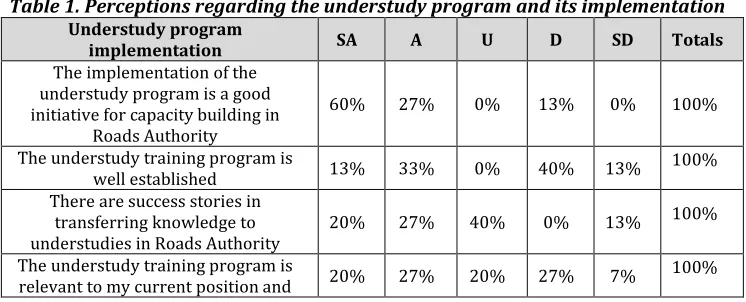
Face-to-face interviews and self-administered questionnaires were conducted to gauge the opinions of the expatriates, management, and engineers-in-training, whether understudy programs were effective in transferring knowledge from expatriates to understudies and to ascertain its implementation and whether there is compliance
with the policy. In the table below are the respondents’ perceptions regarding the
implementation of the RA’s understudy programs.
Table 1. Perceptions regarding the understudy program and its implementation Understudy program
implementation SA A U D SD Totals
The implementation of the understudy program is a good initiative for capacity building in
Roads Authority
60% 27% 0% 13% 0% 100%
The understudy training program is
well established 13% 33% 0% 40% 13% 100%
There are success stories in transferring knowledge to
understudies in Roads Authority 20% 27% 40% 0% 13%
100%
The understudy training program is
the acquired knowledge is effectively utilized
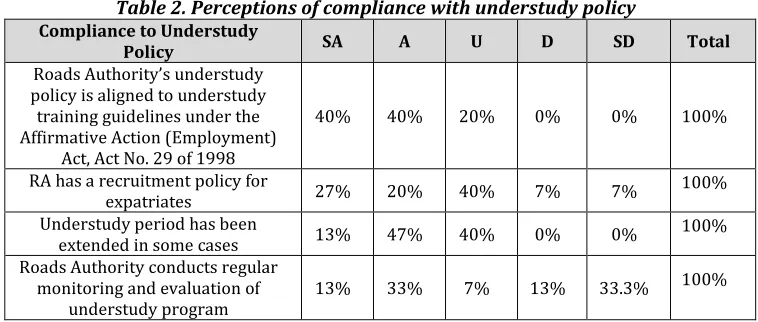
Table 2 below indicates respondents’ perceptions of understudy policy.
Table 2. Perceptions of compliance with understudy policy Compliance to Understudy
Policy SA A U D SD Total
Roads Authority’s understudy policy is aligned to understudy training guidelines under the Affirmative Action (Employment)
Act, Act No. 29 of 1998
40% 40% 20% 0% 0% 100%
RA has a recruitment policy for
expatriates 27% 20% 40% 7% 7% 100%
Understudy period has been
extended in some cases 13% 47% 40% 0% 0% 100%
Roads Authority conducts regular monitoring and evaluation of
understudy program 13% 33% 7% 13% 33.3%
100%
More than half of the respondents were either not sure about the existence of the policy or they were certain the policy did not exist. This seems to suggest a high level of ignorance and disengaged employees. Table 4.3 below presents the respondents’
perception of the effectiveness of understudy programs.
Table 3. Perceptions of the effectiveness of the understudy program Effectiveness of Understudy
Programs SA A U D SD Total
The understudy program encourages interaction between
parties in the process of knowledge transfer
40% 27% 7% 13% 13% 100%
Knowledge transferred to understudies is managed in an
orderly manner 7% 13% 20% 27% 33%
100%
The content, design, and presentation of the understudy program are crucial to what the understudy is expected to learn
40% 33% 7% 20% 0% 100%
Expatriates are knowledgeable about the subject/areas included
in the understudy program 27% 20% 33% 20% 0%
100%
This specific finding gives the impression that expatriates are not conversant with their areas of expertise and as such, are not able to transfer knowledge to understudies. It also implies a lack of confidence by the trainees in the abilities of the expatriates’
Semi-structured questions
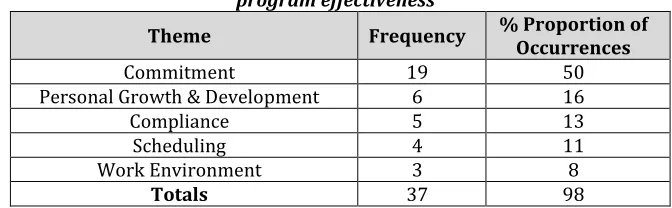
Next, are some of the answers to the question What factors determine understudy program effectiveness? Table 4.4 below presents frequencies of factors that contribute
to the understudy program’s effectiveness.
Table 4. Frequencies of factors that contribute to the understudy program effectiveness
Theme Frequency % Proportion of Occurrences
Commitment 19 50
Personal Growth & Development 6 16
Compliance 5 13
Scheduling 4 11
Work Environment 3 8
Totals 37 98
Eleven percent of the respondents strongly felt that the effectiveness of the program depended on a well-planned program with clear goals and objectives to be achieved over a specific period. Furthermore, the results show that the program should include action plans that should be monitored and evaluated and progress reported. Next are the responses of the second interview question concerning the alignment of the RA understudy policy to the understudy training guidelines under the AA (Employment) Act, No.29 of 1998?
Findings from the study indicate that some respondents felt positively that there was alignment between the RA understudy policy and understudy training guidelines by citing the following responses: Respondent 1 said: I believe the RA understudy policy is in line with Act. Respondent 3 stated: Both the understudy policy and the training guidelines emphasize the need for the exchange of knowledge between mentor and understudy. Respondents 6 and 7 felt negatively about the alignment issue. They indicated that there was no alignment and that they were not familiar with the understudy training guidelines.
Below are the responses from some of the respondents:
Respondent 6 said: Am not familiar with the understudy training guidelines under the Affirmative Action Employment Act, No. 29 of 1998. It was not made available.
Respondent 7 stated: I am not very well versed with the training guidelines of the AA employment Act, but whatever policy is being used the results are not showing yet. It is imperative that we start seeing our trainees gain the necessary experience through training.
The above responses imply that there is no alignment between the understudy policy and the training guidelines and whatever is happening to the understudy program in RA is not adding value to the initiative.
Below are the responses to the aspect of compliance with the understudy policy.
Do you think expatriates are complying with the understudy policies?
The majority of the respondents representing 53% indicated that expatriates were not complying with the understudy policy. The following responses were cited in support
of the respondent’s views:
Respondent 4 said: No they have too much other work responsibilities in addition to attending to understudies.
Respondent 8 stated: No, there is no control on whether the expatriates are complying with their duties. This implies that there are no effective control measures in place to ensure knowledge transfer is actually taking place. One of the respondents felt that there was compliance to a certain extent, as indicated by respondent 15, who said:
Some of them try to comply. I gave importance to it and one of my engineers-in-training registered with the Engineering Council of Namibia (ECN) while I was her mentor.
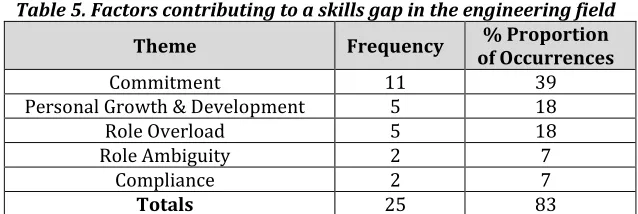
Table 5 below shows the factors identified as contributing to the skills gap in the engineering field.
Table 5. Factors contributing to a skills gap in the engineering field Theme Frequency of Occurrences % Proportion
Commitment 11 39
Personal Growth & Development 5 18
Role Overload 5 18
Role Ambiguity 2 7
Compliance 2 7
Totals 25 83
Question: What do you think are the factors contributing to the skills gap in the engineering field?
Below are some of the responses from the respondents:
Respondent 4 said: With a technical organization, there is a need to build, coach and mentor the younger generation and currently the RA does not have that skills level. This implies that there is no proper mentoring taking place.
Respondent 8 stated: Mentors are usually not available to transfer the knowledge.
Respondent 11 stated: Salaries for registered engineers were very low compared to other professions, in all sectors that employ engineers which results quite often in the resignations of experienced engineers. In addition, there is a lack of opportunities for upcoming engineers to practice and gain experience.
Few of the respondents also indicated that role overload which is a sub-theme under the roles in a work situation is another contributing factor to the skills gap in the engineering divisions. Respondent 14 indicated: There is no time to share knowledge and skills or learn because the engineers are overloaded with projects that they must oversee while they are without the relevant experience.
In the table below the challenges experienced transferring knowledge to understudies are indicated.
Table 6. Challenges experienced in transferring knowledge to understudies Theme Frequency % Proportion of Occurrences
Commitment 12 43
Role Conflict 4 14
Role Overload 3 11
Work Environment 3 11
Compliance 2 7
Scheduling 2 7
Totals 26 93
Recommendations
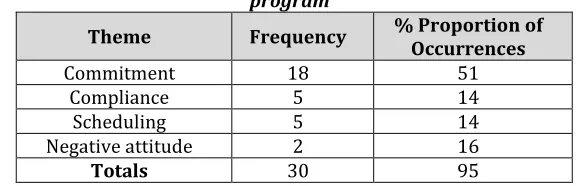
Next, are the suggested recommendations for improvement of understudy programs in the RA. Table 7 below presents suggestions/recommendations for improving understudy programs in the RA.
Table 7. Suggestions/Recommendation for improvement of the understudy program
Theme Frequency % Proportion of Occurrences
Commitment 18 51
Compliance 5 14
Scheduling 5 14
Negative attitude 2 16
Totals 30 95
Respondents suggested a number of recommendations with a view to improving understudy programs in the RA. The recommendations were grouped and resulted in the following themes:
Respondent 2 stated: There should be effective engagement by senior management and buy-in. Respondent 3 indicated: The introduction of a job rotation program for engineers-in-training will enable them to acquire skills from all areas of engineering. Similarly, Singh and Yadwa (2014) state that job rotation is a technique of job enrichment which involves exposing the employee to a variety of responsibilities and therefore broadening their understanding bases.
Respondent 5 stated: All understudies are required to do job attachment at a consultancy involved with construction activities and thereafter they can take up the RA roles.
Respondent 8 indicated: Proper identification of all expatriates and understudy candidates required to participate in understudy programs should be adopted. HR should have regular engagements and consultative sessions with the mentors and understudies.
Compliance: The results from the study shows that respondent 3 felt that there should be a better realignment of the RA work program & Engineering Council of Namibia (ECN) program to fast-track the registration process for engineers-in-training. The RA must enforce regular and continuous monitoring, reporting and evaluation procedures.
Respondent 1 said: The understudy program should not only be limited to expatriates but it must be implemented on all senior employees including the locals.
Conclusions and recommendations
In response to the question that dealt with the implementation of the understudy programs and their management in the RA, respondents felt strongly that the understudy program was a good initiative for capacity building in the RA. Some respondents believed that understudy programs are well established. However, there are those respondents who also expressed their dissatisfaction with the way the program is being managed.
The second research question was about whether expatriates were complying with the understudy policy. Respondents expressed mixed opinions regarding expatriates complying with the understudy policy. Some respondents felt that to some extent there was compliance as indicated by respondent 10 who said: Measures still need to be put in place to enforce the compliance.
On the question that dealt with understudy program effectiveness, 67% of the respondents strongly agreed that the understudy program truly encourages interaction between the parties (mentor and the trainee) involved in the process of knowledge transfer. The effectiveness of the training program depends on, among others, a clearly set out curriculum that has to be covered in a specified amount of time, and determination by the mentor, supervisor and the understudy, of how much and what knowledge and skills the understudy should know at the end of the program.
nature. Tacit knowledge, on the other hand, is more difficult to transmit, and it is more complex because it resides in the person, not in books or manuals.
On the question of whether the content, design, and presentation of the understudy program were effectively implemented, the majority of the respondents (about 63%) strongly expressed that the program was developed by taking into consideration the
understudy’s training needs, thereby addressing the specific skills and knowledge gaps.
However, 27% of the respondents disagreed that the content, design, and presentation of the understudy programs were effectively implemented.
Asked whether the expatriates were knowledgeable about the subject or areas of expertise included in understudy programs, the findings showed that less than half of the respondents (47%) expressed satisfaction, while 33% of the respondents were undecided. 20% of the respondents strongly disagreed, implying that there is
uncertainty about the expatriates’ expertise in some areas.
Recommendations
Based on the findings of the study it is recommended that the following needs attention.
The RA must come up with formal training programs for understudies appointed to understudy expatriates which are strictly enforced; understudy programs should include tacit on-the-job knowledge transfer which is monitored by management on a
regular basis. The program should be tailored to suit the employees’ training needs.
Furthermore, regular sessions to sensitize the mentor (expatriate) and the trainee (understudy) about the understudy policy are also important for all involved.
Understudies should be evaluated to assess and confirm whether knowledge transfer is really happening. This recommendation is supported by Noe (2013) who maintains that evaluation is a powerful tool in increasing training effectiveness.
There should be a better alignment of the understudy program with the graduate development program that allows engineers-in-training to register as professional engineers. At the moment engineers-in-training who are appointed as understudies lose interest in the process due to their own priorities, one of which is to register with the Engineering Council of Namibia. Professional registration is a legal requirement for all professional engineers in the field of engineering, just as it is with other professions.
Conclusions
Most of the literature reviewed indicated that understudy programs are most common in the banking sector. Companies are more concerned with business continuity, once those occupying key positions leave or retire. As a result, interventions are put in place to prepare potential individuals who can take over when the time comes.
expatriates work with understudies to accomplish assigned tasks they build capacity for the organization. And since they are fully engaged in the activities, knowledge, and skills are imparted from the experienced expatriates to the understudies. Therefore, this study concludes that successful knowledge transfer involves interaction between people (mentor and understudy). A study noted that social capital theory found that the achievement of knowledge transfer is determined by the ease of communication and by the general relationship between the two parties (mentor and the understudy) involved in the transfer process (Hsu, 2012).
It was revealed through the study that the majority of the respondents agreed that there is a lack of monitoring and evaluation of understudy programs. This is in spite of the fact that the RA have instruments in place, such as training programs and training progress report templates for effective reporting and monitoring. The presence of these tools does not, however, translate into strict enforcement.
The study also concluded that the challenges for the continued skills gap in the engineering field included a lack of commitment from the mentors and expatriates involved in the knowledge transfer process, through roles in work situations such as role overload and role conflict, compliance, and scheduling.
The results of the study indicate that knowledge transfer in the RA is limited. A policy is in place, understudies are appointed for every non-Namibian employed and everything is good on paper but the implementation is lacking. Both senior and line management are uninvolved in the process.
The study was aimed at analyzing the effectiveness and management of the RA’s
understudy programs as instruments of knowledge transfer in the Republic of Namibia.
Findings from the study revealed that the RA has an understudy policy, which is aligned to understudy training guidelines of the Affirmative Action Act, Act No. 29 of 1998. On an annual basis, the company receives a compliance certificate issued by the office of the Employment Equity Commission on the proviso that the RA employs expatriates; and an understudy is appointed for every non-Namibian on board, and that progress reports are submitted for every understudy. However, the implementation and management of understudy programs in the RA are not very effective.
It was observed that senior management is not fully involved in driving and managing understudy programs. The process is left to be managed by HR with little support from the top, hence the recommendation that formal training programs must be enforced by management and monitoring measures tightened.
References
Amecor (2015). Integrated Annual Report. Retrieved August 14, 2017, from http://www.amecor.com/2015iar/pdf/amecor-iar201.
Boselie, P. (2014). Strategic human resource management: A balanced approach. New York, NY: McGraw Hill Education.
Cooper, D.R., & Schindler, P.S. (2014). Business research methods. New York, NY: McGraw Hill.
Directorate Human Resources Development (1999). Training Policy for the Public Service of Namibia. Office of the Prime Minister. Retrieved March 31, 2017, from http://www.npc.gov.na/downloads/policies%20by%20year/1999/Training%2 0Policy%20for%20the%20Public%20Service%20of%20Namibia.pdf.
Fossum, J.A. (1991). Issues in the design and delivery of corporate training programs. In Burton, J.F. Jr. (Ed.), Proceedings of the 1991 Spring Meeting (pp.575-581). Madison, Wisconsin: Industrial Relations Research Association.
Grobler, P., Bothma, R., Brewster, C., Carey, L., Holland, P., & Wärnich, S. (2012).
Contemporary issues in human resource management. Cape Town: Oxford University Press.
Hsu, Y. (2012). Knowledge transfer between expatriates and host country nationals: A social capital perspective. Retrieved August 14, 2017, from
https://dc.uwm.edu/cgi/viewcontent.cgi?article=1036&context=etd.
JEMS Strategists (2014). Senior management development programme: An investigation into the implementation of Roads Authority’s objective C2: Attract, develop,
empower and retain competent staff to assess the impact it has on the operations of the organisation. Windhoek, Namibia: Roads Authority.
Kalling, T. (2003). Organization-internal transfer of knowledge and the role of
motivation: A qualitative case study. Knowledge and Process Management, 10(2), 115-126. doi: 10.1002/kpm.170.
Kunche, A., Puli, R.K., Guniganti, S., & Puli, D. (2011). Analysis and evaluation of training effectiveness, Human Resource Management Research, 1(1), 1-7. doi:
10.5923/j.hrmr.20110101.01.
Lin, A., & Shariff, M.Y. (2008). Factors affecting training effectiveness: A study of
semiconductor wafer fabrication industry in Malaysia. Retrieved August 12, 2017, from http://repo.uum.edu.my/2663/.
Luo, S., & Lee, G. (2015). Exploring the key factors to successful knowledge transfer.
Total Quality Management & Business Excellence, 26(3-4), 445-464. doi: 10.1080/14783363.2013.856548.
Masilo, S. (2015). An assessment of the training and development strategy at Inland Revenue Department (IRD) in Namibia. Durban: Mancosa.
Ministry of Labor (1998). Affirmative Action (Employment) ACT. Retrieved August 12, 2017, from
https://mol.gov.nadocuments/432260/1685800/AFFIRMATIVE%2bACTION%2 bACT%2b29%2bOF%2b1998.pdf/7fe6e92d-eb75-4eec-b910-aa3f2055e869. Musasizi, Y., Aarakit, S., & Mwesigwa, R. (2016). Expatriate capabilities, knowledge
transfer and competitive advantage of the foreign direct investments in Uganda’s
service sector. International Journal of Economics, Commerce and Management, 4(2), 130-143.
Namibian Employers’ Federation (2010). About NEF. Retrieved August 31, 2017, from
National Planning Commission of Namibia (2012). The Fourth National Development Plan. Retrieved August 14, 2017, from https://www.npc.gov.na/?page_id=202. National Planning Commission of Namibia (2017). Namibia’s 5th National Development
Plan (NDP5). Retrieved March 31, 2017, from
https://www.gov.na/documents/10181/14226/NDP+5/5a0620ab-4f8f-4606-a449-ea0c810898cc?ve.
Noe, R.A. (2013). Employee training and development. New York, NY: McGraw-Hill. Norling, N.R., & Retz, J. (2013). Knowledge transfer from expatriate to headquarters:
What obstacles are limiting and why?. Retrieved August 14, 2017, from https://gupea.ub.gu.se/bitstream/2077/33474/1/gupea_2077_33474_1.pdf. Office of the President Windhoek (2004). Namibia Vision 2030 Policy Framework for
Long-Term National Development. Retrieved August 12, 2017, from
https://www.namfisa.com.na/wp-content/uploads/2017/10/Vision-2030.pdf. Peng, G., Dey, D., & Lahiri, A. (2014). Healthcare IT Adoption: An Analysis of knowledge
in socioeconomic networks. Journal of Management Information, 31(3), 7-34. doi: 10.1080/07421222.2014.994672.
Pérez, J.B., & Brewster, C. (2001). Knowledge transfer and the management of expatriation. Thunderbird International Business Review, 43, 145-168. doi: 10.1002/1520-6874(200101/02)43:13.0.CO;2-7.
Ravu, S.Y., & Parker, K.M. (2015). Expatriates and knowledge transfer: A case study of a power plant constructed in Africa. International Business and Economics Research Journal, 4(2), 327-342.
Saka-Helmhout, A. (2009). Agency-based view of learning within the multinational corporation. Management Learning, 40(3), 259-274. doi:
10.1177/1350507609104339.
Sam-Okere, J., & Agbeniga, F.I. (2014). Training as capacity development for
effectiveness and productivity of lower cadre employees of local governments.
Journal of Research and Development, 2(3), 1-10.
Santosh, B.R., & Muthiah, K. (2012). Knowledge transfer from repatriated employees: The Indian experience. The IUP Journal of Knowledge Management, 10(1), 7-25. Singh, S., & Yadav, D. (2014). Impact of training & development in public sector
enterprises (a case study of BHEL & HMT). Journal of Commerce and Trade, 9(1), 38-45.
Szulanski, G. (1996). Exploring internal stickiness: Impediments to the transfer of best practices within the firm. Strategic Management Journal, 17(2), 27-43. doi: 10.1002/smj.4250171105.
WEF (2016). The Global Competitiveness Report 2016-2017. Geneva, Switzerland: World Economic Forum.
Zarinpoush, F., von Sychowski, S., & Sperling, J. (2007). Effective knowledge transfer and exchange for nonprofit organizations: A framework. Toronto, Canada: Imagine Canada.