Identity, Patience and War
A Dynamic Theory of Secessionist vs Centrist Conflict
⇤
Joan Esteban
†Sabine Flamand
‡Massimo Morelli
§Dominic Rohner
¶April 15, 2020
Abstract
This paper proposes an integrated dynamic theory of bargaining and conflict be-tween ethnic groups, delivering novel predictions on secessionist versus centrist conflict. Ethnic identities, inequality and intertemporal preferences are predicted to impact the risk of secessionist conflict and the risk of centrist conflict in di↵erent directions. Be-side obtaining a full characterization of equilibrium for every set of conditions, we also show empirical evidence that cultural similarity reduces the scope for secessionist conflict (compared to centrist conflict); that small ethnic groups stick more often to peaceful union; that higher patience and higher group inequality fuels secessionism.
Keywords: Secessions, Conflict, Surplus Sharing, Patience.
JEL codes: C7, D74
⇤We are grateful to Marco Battaglini, James Fearon, Kerim Can Kavakli, Michael Gibilisco, David Laitin,
Marina Petrova, Robert Powell, Debraj Ray, Shlomo Weber, as well as seminar and conference participants at the ThReD conference, Cornell Political Economy Workshop, SAE meeting, Priorat conference, ASSET meeting, NYU-LSE meeting, Bologna, Bocconi, NYU, Rovira i Virgili University, University of Michigan, NYUAD, New Economic School Moscow, Universitat de Barcelona. Joan Esteban gratefully acknowledges financial support from the Severo Ochoa Programme SEV-2015-0563 and grant ECO2015 66883 P, from the Generalitat de Catalunya grant 2017SGR1359, and from NSF grant SES-1629370. Sabine Flamand thanks the Ministry of Economy and Competitiveness for Grant ECO2016-75410-P. Massimo Morelli wishes to thank the ERC, grant 694583. Dominic Rohner wishes to thank ERC Grant 677595. The usual disclaimer applies.
†Institut d’An`alisi Econ`omica, CSIC and BGSE; [email protected] ‡Universitat Rovira i Virgili and CREIP; [email protected]
1
Introduction
The literature on the size of nations has mostly focused on efficiency considerations, assessing under what conditions secessions would be efficient or, on the opposite side of the same medal, when would integration make sense. However, in reality we see a lot of conflicts involving secessionist movements, so that even cases where eventually secession is obtained experienced a series of inefficient destructions of surplus. What explains conflicts followed by secessions? What characterizes such outcomes as equilibrium phenomena in spite of their dynamic inefficiency? Are there clear distinctions between situations leading to centrist conflicts (i.e., conflict path where no one secedes) vs secessionist conflicts? This paper sheds light on these questions, providing in particular some important di↵erential conditions in terms of ethnic identity, group size, group level productivity, discounting of future and costs of conflict vs economies of scale.
Historically, the collapses of the Soviet empire and Yugoslavia were accompanied by a series of bloody conflicts, with disagreements over whether to split or stay together. In both cases the sizes of the composing regions varied greatly, and while the richest and most productive regions were eager to secede (i.e., Russia, the Baltic states, resp. Slovenia and Croatia) other regions opposed secession.
We assume that the group in power can make a proposal (union or secession), which the group in opposition can either accept –in which case the proposal is implemented– or reject –inducing costly conflict. If there is a conflict, the game continues with the winning group acquiring full control of power, choosing between seceding or taking the surplus and becoming the new ruling group in the union. In the latter case, another period of the game starts, identical to the previous one, with the new (or reconfirmed) group in power having to make a new surplus sharing o↵er for that period. It is an infinite horizon game, with secession being an absorbing state (after secession no more strategic decisions are made).1
In our complete information sequential game there is a unique Subgame Perfect Equilib-rium outcome for every set of parameters. Depending on the parameters, the equilibEquilib-rium can be: union, peaceful secession, conflict followed by secession, or centrist conflict. When no importance is ascribed to the future (equivalent to a static game) and the ideological di↵erences are small, the equilibrium is union or peaceful secession for all pairs of popula-tion and relative productivity, with union always prevailing for a sufficiently small size of the opposition group. When the ideological di↵erences increase, the set of parameter values yielding an equilibrium with peaceful secession becomes larger and that of peaceful union becomes smaller, consistent with intuition and the simple comparison of efficient outcomes. However, with ideological or identity preferences a zone emerges where a relatively numerous opposition triggers conflict. Importantly, in the static setting conflict is never followed by secession, whereas we will show that conflict followed by an eventual secession can be an equilibrium path when dynamic considerations are added. The main reason for the greater scope for secession as the time discount factor increases, is that secession is an end state. With a high time discount factor the short-run costs of secession weigh less than the stream of future payo↵s from independence. High inequality and high intensity of ideological pref-erences also increase the risk of secessionist conflict, whereas under some conditions they decrease the risk of centrist conflict.
The focal point of many papers is whether there are inter-group [inter-regional] transfers that would deter a group from secession and independence. The various contributions di↵er in the specification of the preference heterogeneity within and across groups and in the nature of the benefits of country size. Our paper has a di↵erent point of departure: remaining united implies that the public decisions will have to be negotiated every period by groups with di↵erent preferences and priorities, while secession entails a cost today but no need to bargain with the other group ever again. This inter-temporal argument, in our view, is an essential factor in the reasoning for or against secession and it generates a radically di↵erent
1Of course, in reality the subgame starting after a secession is not necessarily peaceful (see Tir, 2005),
equilibrium characterization from the static game. Conflict of any kind can occur on the equilibrium path because the di↵erent ideological preferences create a sort of indivisibility problem.2 In our dynamic model we show that the two types of conflict are however impacted
di↵erently by such identity preferences.
In order to bring to the data our novel predictions of the di↵erential role of patience, identity preferences and inequality on the two types of conflict, we draw on fine-grained panel data at the ethnic group and year level, with a unit of observation being one of 892 ethnic groups in a given year between 1946 and 2017. First, building a new measure of linguistic similarity between the government and opposition groups, we are able to test the model’s prediction that preference similarity deters secessionist conflict with respect to centrist conflict, finding indeed strong empirical support. Second, we confront to the data the model’s result that small groups are more likely to stick to peaceful union, finding support for this prediction. Third, we also provide evidence in line with our setting’s implication that higher levels of patience are associated to more frequent secessionist conflict. For further implications of the model for which already detailed evidence exists, we review in some detail the existing literature. This is the case for the prediction of our framework that inequality in relative economic productivity favors secessionist conflict. Finally, we will formulate a series of policy recommendations suggested by our model’s predictions.
The remainder of the paper is organized as follows: Section 2 reviews the literature. Section 3 sets up the model. Section 4 characterizes the equilibrium outcomes. Section 5 contains our empirical analysis. Section 6 concludes.
2
Related literature
Excellent reviews of the literature on secessionism are provided in Bolton et al. (1996), Alesina and Spolaore (2003), and Spolaore (2014). One key point made by this strand of economic literature is that the size of countries results from the trade-o↵ between economies of scale and the costs of di↵erences in the preferences over public goods and government policies.3 The literature distinguishes various potential determinants of the incentive for
secession: region size (Goyal and Staal, 2004), international openness (Alesina, Spolaore and Wacziarg, 2000, 2005; Gancia, Ponzetto and Ventura, 2017); democratization (Alesina and Spolaore, 1997; Arzaghi and Henderson, 2005; Panizza, 1999); the optimal level of public spending (Le Breton and Weber, 2003; Le Breton et al., 2011); the presence of mobile
2If the group in power imposes a religion or culturally driven rules that are disliked by the opposition
group, and that would indeed be changed in case of victory of the opposition, bargaining cannot fully eliminate the risk of conflict, even if there is complete information. See e.g., Fearon (1995).
ethnic groups (Olofsgard, 2003); the presence of natural resources in potentially secessionist regions (Gehring and Schneider, 2017; Hunziker and Cederman, 2017); or external threats (Alesina and Spolaore, 2005, 2006; Wittman, 2000). Bolton and Roland (1996, 1997) focus on di↵ering preferences for income tax policies owing to inter-regional di↵erences in income distribution.
The literature on secessionism has also studied whether there exist mechanisms of inter-regional compensation such that potentially seceding regions are better o↵ staying in the union. Haimanko et al. (2005) show that in an efficient union whose citizens’ preferences are strongly polarized, the threat of secession cannot be eliminated without interregional transfers. Le Breton and Weber (2003) establish the principle of partial equalization: the gap between advantaged and disadvantaged regions must be narrowed, but should not be completely eliminated.4 Alesina and Spolaore (2003) point out the problems for compen-sation transfers, such as feasibility issues and administrative costs, political credibility, or incompatibility with other social goals.5 The recent paper by Gibilisco (2017) analyzes the potential e↵ects of decentralization in a repeated game in which the periphery, when it is not repressed by the center, may initiate a secessionist mobilization whose probability of success depends on the amount of accumulated resentment.6
As far as the conflict consequences of secession incentives, there is a small literature: Fearon (2004) has a dynamic model of separatist conflict and secession in which the reason that transfers may not be adequate to prevent inefficient conflict (and secession) is a commit-ment problem created by shocks to the relative military capability of center versus regional rebels (commitment problem rather than indivisibility), and has secession as an absorbing state like us. Spolaore (2008) analyzes the choice of regional conflict when a peripheral (minority) region wishes to secede, focusing on the trade-o↵between economies of scale and heterogeneity of preferences where transfers are barred. Our setup is dynamic, it includes the option of compensating transfers and allows for the groups having di↵erent productivities per capita.7 Anesi and De Donder (2013) construct a static model of secessionist conflict with
an exogenous winning probability; they find the existence of a majority voting equilibrium with a government type biased in favor of the minority. Our contribution is complementary to theirs, in that our dynamic setting features general transfers conditioned by the credible
4See also Flamand (2015).
5Related to this, Bordignon and Brusco (2001) analyze whether constitutions should include provisions
for agreed potential secessions.
6Our paper also speaks to the debate in political science on whether secessionism stems mostly from
economic grievances or ethnic identity (see Laitin, 2007, and Toft, 2012), as we provide a simple model in which economic conditions and ethnic identity both enter the characterization results, with ethnic identity entering directly in the utility function (see Akerlof and Kranton, 2000).
7Flamand (2019) complements Spolaore’s model by analyzing the e↵ect of inequality on the conflict
thread of future conflict and no commitment assumption is possible for the future.
In the conflict literature only a handful of papers have explicitly modelled the incentives for secession. Morelli and Rohner (2015) allow both nationwide and secessionist conflict in a model where concentration of resources and geographical group concentration matter, showing (theoretically and empirically) that the situations where most oil revenues accrue in minority regions are the ones with highest conflict risk. Our dynamic model of bargaining generates novel predictions on secessionist vs centrist conflict that could not be obtained in that setup, taking into account all endogenously feasible compensating transfers.
Further important implications of our theory concern the role of patience. There exists only a very small literature so far linking conflict to patience and the shadow of the future (see Powell, 2006 and McBride and Skaperdas, 2014). In contrast with existing work, our framework generates the novel prediction of opposite e↵ects of patience on di↵erent types of conflict, which we are able to investigate empirically as well, drawing on the new data from Dohmen et al. (2015).
3
The model
Consider a country with two ethnic groups,iandj, with population sizeNiandNj,Ni+Nj =
N.
There is a total divisible surplus denoted by S >0, and each group considers its contri-bution to the total surplus Sh, h =i, j, as an important indicator of what it would have in
case of secession, Si +Sj = S.8 The total surplus S may be obtained from production as
well as from non-produced rents. We denote by A >0 the cost of running the State, so that the divisible surplus in a given period is S A.
Assume WLOG that groupj is in power at the beginning of the game. Taking equal per capita division of the surplus as a benchmark, we say that j makes the strategic choice of treating iwith i fairness if the share of surplus received by group iis in, where n⌘Ni/N
denotes the population share of the opposition group. In addition to the divisible surplus, citizens’ utility also reflects ideological or identity preferences. If group h is in power they obtain a utility equal to their share of the divisible surplus plus a positive ideological or
8In reality, in a country in which the two groups are geographically segregated in separate regions
the assumption is realistic, but if they are much more integrated and production has various kinds of complementarities, a group’s expected total output after secession could be lower, in the aftermath, say, of a collapse of domestic trade (see Suesse, 2018). For simplicity we ignore this complication (but we capture costs of secession through the parameterA, described below). Note also that adding the role of segregation or intermingled groups would be possible, by adding to the model a scalar↵2[0,1] such that when groupi
splits it obtains↵Si, with↵going to 1 in the case of perfect segregation. Hence, the e↵ect of segregation is
identity based utility level Ph > 0. If grouph is not in power this additional component is
absent, i.e., we normalize to zero the utility for group hrelated to non transferable and non divisible goods that is obtained when the other group is in power. In other words, Ph is a
parameter of utility di↵erential between being in power and not being in power that relates for example to language, culture, legislation, government-favored religion, but the idea could extend more generally to policies and their di↵erent utility implications for people with di↵ering ideologies.
In the case of an ethnic secession, with groups i and j forming new states, each group would have to incur the cost of setting up or maintaining the state institutions and re-organizing production. For simplicity, we assume that the cost of running each new State is
A, without di↵erentiating between the cost of the original State and that of each new State. Therefore there are returns to scale in a union since the fixed cost A is divided up among a larger population.
The player in power j has two possible moves: (i) propose a distribution of surplus in the union, with fairness o↵er i; and (ii) propose peaceful secession.
If a surplus sharing proposal or a peaceful secession proposal by the group in power is rejected by the opposition group, then a costly conflict begins. The probability of success for group i is given by q. With the victory, the e↵ective resistance of the other group gets temporarily nullified until next period in which, established as the opposition to power, they can again challenge proposals. At the moment of victory, the winner can aim either to conquer power in the union and capture the entire surplus leaving nothing for the loser in that period,9 or to secede and take away its own surplus forever, making the loser bear the
cost of conflict D. We assume thatD <min{Si, Sj} and A <min{Si, Sj}.10
We use the following normalized notation: n = Ni
N, s= Si
S, a= A S, d=
D S, =
S N.
Notice that min{Si, Sj} > A implies that S > A+ min{Si, Sj} > A+D. The latter
inequality, or its equivalent 1 a d >0, will appear at di↵erent stages of our analysis. It is immediate that in a one-shot game, in case of conflict, the winner always opts to maintain the union: since min{Si, Sj} D >0, there is more surplus to be obtained. Hence a violent
conflict leading to secession can be an equilibrium solution only if the game has more than one period.
The per-period payo↵s to the two players in the three possible scenarios are as follows:
9We could have left the distribution of the surplus to be determined by the winner. Yet, since the
allocation in this period has no bearing on future strategic decisions, it is clear that the optimal distributional choice by the winner is to grab the entire surplus.
10The assumption A < min{S
i, Sj} is made for making the problem interesting. If it did not hold,
• Equilibrium union
UiU( i)⌘ in
S A
Ni
and (1)
UjU( i)⌘(1 in)
S A
Nj
+Pj; (2)
• Secession
UiS ⌘
Si A
Ni
+Pi and
UjS ⌘ Sj A
Nj
+Pj; (3)
• Conflict
UiC ⌘q
S A D
Ni
+Pi and
UjC ⌘(1 q)
S A D
Nj
+Pj , (4)
(when the winner takes the entire surplus of that period minus the conflict costs).
The timeline is as follows:
1. Production: Each period starts with a group in power, sayj; output is produced, and
surplus S is obtained.
2. Proposal: The group in power makes one of two possible proposals: [i] union, proposing
a distribution of the surplus with i fairness; [ii] peaceful secession.
3. Peace or conflict: The opposition can either accept or challenge the proposal. If it is
accepted, it is carried out; if it is challenged, conflict follows.
4. Exercise of power. If there is peace, and hence j remains in power, the policies
an-nounced are carried out, these being either (i) the anan-nounced distribution of the surplus or (ii) secession. In case of conflict the winner has temporarily eliminated all resistance and can unrestrictedly choose between secession and union. In the first case, it splits the country and takes its own produced surplus (while placing the full cost of conflict,
D, on the loser); in the second case it appropriates the entire remaining surplus leav-ing nothleav-ing for the losers and begins the next period in power. The loser begins next period as the organized opposition that can challenge unacceptable proposals.
The expected payo↵of future periods is discounted by the usual discount factor 2[0,1]. The only state variable is which group is in power. Note that decisions are sequential, and hence this is a complete information infinite horizon sequential game.
4
Equilibrium characterization
Given stationarity, any Subgame Perfect Equilibrium path ending with a peaceful agreement on distribution consists of an initial proposal by group j that is immediately accepted by group i. Accordingly, any equilibrium path that starts with a rejection ends either with permanent conflict or conflict with eventual secession.
The opposition can influence the initial o↵er by implicitly threatening conflict. But this threat is credible only if such a one-step deviation has a continuation that is itself subgame perfect.
The only way for conflict to last indefinitely is if the equilibrium consists of a strategy profile where each player rejects the other’s proposal when in opposition and makes an unacceptably unfair proposal when in power (say, allocating zero surplus to the opposition). The following lemma characterizes the set A of parameters such that, conditional on an initial rejection by the opposition group, the centrist conflict path is a SPE continuation path. The proof is obtained by simply comparing the incentive compatibility constraints with the corresponding recursive computations.
Lemma 1 Let the opposition player start by triggering conflict. Then the necessary and
sufficient condition for the sequence of centrist conflicts to be a SPE is that
s (1 d) (1 q)
✓
1 a d+nPi ◆
(5)
and
s d+ q
1 a d+ (1 n)Pj . (6)
Therefore, the necessary and sufficient condition for the set A to be non-empty is
< 1 2d
(1 q)⇥1 a d+nPi⇤+q⇥1 a d+ (1 n)Pj⇤ >0. (7)
Proof: see Appendix A.
vector of values of the other parameters. The higher isPi orPj, i.e., the identity public good
component of the utility of being in power, the stricter is the restriction on necessary to make centrist conflict a continuation equilibrium.
A second type of continuation equilibrium after an initial rejection by group i could be one in which groupj after a victory would continue to hold on power (hence fighting in order to maintain power in the whole country) whereas groupi would want to secede at their first victory time. The characterization of the set of parametersBi under which this continuation
equilibrium exists is given in the following lemma:
Lemma 2 Let the opposition player start by triggering conflict. Then the continuation path
with j playing conflict at every iteration and i seceding after the first victory is a SPE i↵:
s > d(1 + q) (8)
and (5) is violated.
The set Bi is always non-empty.
Proof: see Appendix A.
Symmetrically:
Lemma 3 Let the opposition player start by triggering conflict. Then the continuation path
with i playing conflict at every iteration and j seceding after the first victory is a SPE i↵
s <1 d (1 q)d (9)
and (6) is violated.
The set Bj is always non-empty.
Proof: omitted, since it is analogous to that of Lemma 2.
The three potential equilibrium paths characterized in the above three lemmas are an exhaustive list under the realistic assumption thatd <1/3, which we will maintain through-out.11 Then, given that it is easy to inspect that A\B=;, B⌘B
i[Bj, it follows that in
the set A of parameters, centrist conflict is the unique equilibrium continuation path after an initial conflict.
11For the sufficiency of the restrictiond <1/3 for the claim that the three possibilities highlighted in the
On the other hand, Bi \Bj may be non empty. However, it is easy to show that if j
wins the conflict and we are inBi\Bj,j strictly prefers to e↵ectively select the continuation
equilibrium without seceding (knowing that i will secede at the first victory). Hence the continuation path where j is the one seceding at first victory is the relevant one if and only if the parameter values are in B\Bi.
Summing up, and using standard recursive methods, the continuation utility of going to conflict in the first period for groupi, which we can denote byVi(war) can take the following
three values:
Vi(war) = ViBi ⌘
q[ (s a)+nPi]
(1 )n[1 (1 q)] if Bi;
VBj
i ⌘ (1 1q)n
h
q[(1 a) +nPi] + (1 q)(s a1) +nPi d
i
if B\Bi
VA
i ⌘ (1q )n 1 a d+n
Pi if A.
(10)
The corresponding continuation equilibrium utility for groupj if it makes a proposal that is rejected by i is
Vj(war) = VjBi ⌘ (1 n)[1 (1 q) ]
q1 s a1+(1 n)Pj + (1 q)h1 a+ (1 n)Pji
d if Bi;
VBj
j ⌘
(1 q) h1 s a+(1 n)Pji
(1 n)(1 )(1 q ) if B\Bi;
VA
j ⌘
(1 q)
(1 )(1 n)
h
1 a d+ (1 n)Pji if A.
(11) In the next two subsections we characterize the set of parameters under which centrist conflict or secessionist conflict can emerge as SPE for the whole game, using the above characterization of the continuation paths in case of a rejection of the first o↵er. Let us start with centrist conflict, the most inefficient SPE.
4.1
Centrist conflict
For centrist conflict to be a SPE three conditions have to be met: [i] the threat of centrist conflict has to be credible and hence the parameter values have to belong to the set A
characterized above; [ii] the group in power prefers centrist conflict over the most favorable peaceful union agreement acceptable to the opposition; and [iii] at least one of the two players prefers centrist conflict to peaceful secession, the alternative potential proposal.
We have already dealt with [i]. We now obtain the restrictions deriving from [ii]. Given that a share i yields for i (if accepted) a present discounted value equal to i1 (1 a),
the indi↵erence condition between this and VA
A) yields
A i =
(1 )VA i
(1 a) =
q 1 a d+nPi
n(1 a) (12)
Thus, it follows that condition [ii] for centrist conflict to be the SPE of the whole game is that j does not like to have to concede A
i :
VjU = (1
A
i n)(1 a) + (1 n)Pj
(1 )(1 n) < V
A
j (13)
If (13) holds and in addition VS
h < VhA for at least one h = i, j (condition [iii]), then
conflict is unavoidable in equilibrium. In other words, centrist conflict is the unique SPE if the parameter values are in A and the two above conditions hold, as established in the proposition below.
Proposition 1 Endless centrist conflict is the unique SPE of the game if the following conditions hold:
• The country parameters are in the set A (see Lemma 1);
• The group in power j prefers centrist conflict to a union with fairness level A
i :
n > d+q
Pj
q⇣Pi + Pj⌘ (14)
• At least one of the two groups prefers centrist conflict to peaceful secession:
either
s <1 d (1 q)
✓
1 a d+nPi ◆
(15)
or
s > d+q
1 a d+ (1 n)Pj (16)
Proof: See Appendix A.
From the conditions above we can obtain the role of the di↵erent parameters for whether centrist conflict is a SPE. The potentially testable implications of the model on centrist conflict are the following:
2. An increase in Pj shrinks the set A and makes j more likely to deviate from centrist
conflict to peaceful secession. Therefore, a higher ideological value attached to being in power by the ruling group Pj reduces the likelihood that centrist conflict is a SPE.
3. An increase inPi also shrinks the setAand makes groupimore likely to prefer peaceful
secession to centrist conflict, both reducing the likelihood of the latter. However, an increase in Pi makes it harder for the ruler to compensate the opposition for staying
in the union, making centrist conflict more likely.
4. In order for centrist conflict to be the SPE, s cannot be too high nor too low, so that centrist conflict is a credible threat (we are in the set A). Yet, within this set, s has to be either low enough, so that the opposition prefers conflict to peaceful secession, or high enough, so that the group in power prefers conflict to peaceful secession. All in all, because of the first e↵ect, centrist conflict occurs for intermediate values of s.
5. An increase in the opposition’s population size n makes it more likely that the group in power prefers centrist conflict to the union (since it is more expensive to compensate the opposition).
Observation 1 Summing up, we should observe a greater incidence of centrist conflict in
countries with: [i] a low level of patience; [ii] a not too high intensity of identity preferences
by either group; [iii] intermediate inequality in economic power s;12 and [iv] an opposition
with large population size.
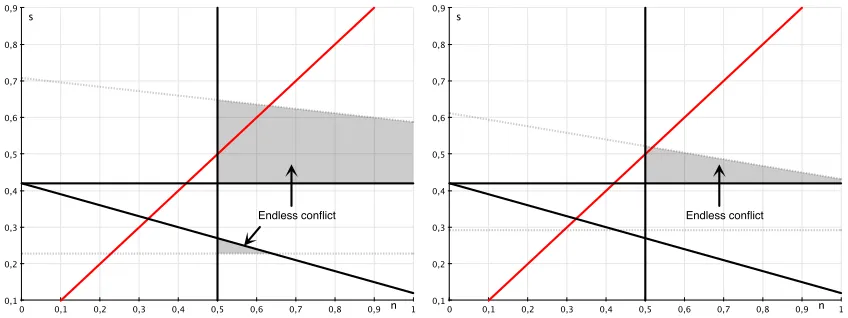
Figure 1 illustrates the areas in which centrist conflict is a SPE in the (n, s) space, for two di↵erent levels of patience. We set the parameters to d = a = 0.1, q = 0.4, Pi = 0.5,
Pj = 0, = 0.4 (Panel a) and = 0.6 (Panel b). Centrist conflict occurs when the size of
the opposition group is sufficiently high, and for intermediate values of s. Indeed, a lower size of the opposition group would make the union sustainable, while more extreme values of s would imply that secession is more profitable for the richest group. Further, as can be seen by comparing the two panels, a higher degree of patience shrinks the set of parameter values for which centrist conflict is a SPE.
These corollary predictions will contrast somewhat with those derived below about seces-sionist conflict, and such distinct implications for the two types of conflict will be the main focus of the empirical section of the paper.
12The term inequality hereafter refers to the share of income of the group, independently of its size (i.e.,
1
0 0,1 0,2 0,3 0,4 0,5 0,6 0,7 0,8 0,9
0,9 0,1 0,2 0,3 0,4 0,5 0,6 0,7 0,8 n s Endless conflict 1 0 0,1 0,2 0,3 0,4 0,5 0,6 0,7 0,8 0,9 0,9 0,1 0,2 0,3 0,4 0,5 0,6 0,7 0,8 n s Endless conflict
Figure 1: Centrist conflict with = 0.4 (Panel a) and = 0.6 (Panel b)
4.2
Conflict followed by secession
For the unique SPE to be one with conflict followed by secession the economy must be inB. Beside this necessary condition, the characterization requires the consideration of incentive compatibility conditions for the group in power. Recall that the conflict pathBi is such that
isecedes in case of victory, whilej prefers to keep playing conflict. Given that a sharing o↵er
i yields for i a present discounted value equal to i1 (1 a), the indi↵erence condition
between this and VBi
i (the relevant expression for the Vi(war) in Bi) yields
Bi
i =
q s a+nPi
n(1 a) [1 (1 q)] (17)
It must then be the case that j is unwilling to o↵er such an appeasing share:
VjU = (1
Bi
i n)(1 a) + (1 n) Pj
(1 )(1 n) < V
Bi
j (18)
Finally, we know that in Bi i would accept a peaceful secession proposal. Therefore, for
conflict followed by secession (byi) to be an equilibrium, it must hold that j is unwilling to make such a proposal:
VjS = (1 a s) + (1 n)
Pj
(1 )(1 n) < V
Bi
j (19)
The other situation to consider is the one where the economy is in B\Bi and j prefers
secession eventually to o↵ering the corresponding necessary appeasing share:
Bj
i =
(1 q) 1 a+nPi (1 q)(1 s) (1 )d
It must then be the case that j is unwilling to o↵er such an appeasing share, which holds if VU
j < V Bj
j .
Finally, we know that in B\Bi, j prefers a peaceful secession to conflict. Therefore, in
order for conflict followed by secession (by j) to be an equilibrium, it must hold that i is unwilling to accept a peaceful secession proposal:
VS i =
nPi+ (s a)
n(1 ) < V
Bj
i (21)
Proposition 2 The unique equilibrium displays conflict followed by eventual secession if one of the two following situations hold:
1. There is conflict followed by secession by the opposition i whenever:
• The country parameters are in the setBi (see Lemma 2):
• The group in powerj prefers conflict of type Bi to a union with fairness level Bii:
n > d(1 ) +aq
qPi (22)
• The group in power j prefers conflict of type Bi to peaceful secession:
s > d
1 q (23)
2. There is conflict followed by secession by the group in power j whenever:
• The country parameters are in the setB\Bi.
• The group in powerj prefers conflict of typeBj to a union with fairness level
Bj
i :
n > (1 q)a+ (1 )d+ (1 )q
Pj
(1 )qPj
+ (1 q)Pi (24)
• The opposition i prefers conflict of type Bj to peaceful secession:
s <1 d
q (25)
Proof: See Appendix A.
1. Higher patience expands the set B, making either type of secessionist conflict more likely. Further, higher patience unequivocally increases the likelihood of secessionist conflict when the parameter values belong to the set Bi, that is, when the opposition
wants to eventually secede, since it makes it harder for the ruler to compensate the opposition for keeping in the union.
2. Higher intensity of ideological group preferences (higher Pi and/orPj) expand the set
B, making either type of secessionist conflict more likely. An increase inPiin particular
increases the likelihood of either type of secessionist conflict by making it harder for the group in power to compensate the opposition. An increase in Pj increases the
likelihood of secessionist conflict (where j secedes) when the population size of the opposition group n is large and/or the time discount factor is large.
3. Inequality in relative economic productivity favors secessionist conflict (and the rich group is the one seeking secession).
4. As for the case of centrist conflict, an increase in the population size of the opposition
n makes either type of secessionist conflict more likely, since it makes it harder for the ruler to compensate the opposition for keeping in the union.
Observation 2 Summing up, we should observe a greater incidence of secessionist conflict
in countries with: [i] a high level of patience; [ii] a high intensity of identity preferences by
either group, or both; [iii] high inequality in economic power s; and [iv] an opposition with
large population size.
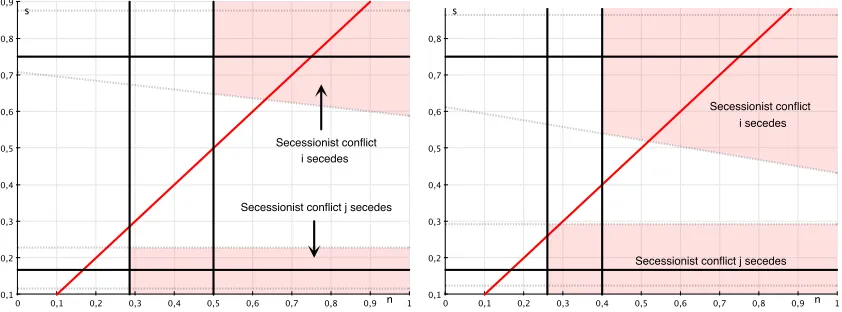
Figure 2 illustrates the areas in which secessionist conflict is a SPE in the (n, s) space, for two di↵erent levels of patience. The parameter values are the same as in Figure 1. As in the case of centrist conflict, secessionist conflict is a SPE when the size of the opposition group is sufficiently high, so that union is not sustainable. However, secessionist conflict occurs for extreme values ofs, as the richest group has a clear incentive to secede in case of victory. Further, as can be seen by comparing the two panels, a higher degree of patience enlarges the set of parameter values for which secessionist conflict is a SPE. Indeed, more patience means lower conflict cost relative to the stream of future benefits from secession, exacerbated by higher intensity of identity preferences.
Let us now examine the case for agreed secession
4.3
Agreed secession
1 0 0,1 0,2 0,3 0,4 0,5 0,6 0,7 0,8 0,9 0,9 0,1 0,2 0,3 0,4 0,5 0,6 0,7 0,8 n s Secessionist conflict
Secessionist conflict j secedes i secedes
1 0 0,1 0,2 0,3 0,4 0,5 0,6 0,7 0,8 0,9 0,9 0,1 0,2 0,3 0,4 0,5 0,6 0,7 0,8 n s Secessionist conflict
Secessionist conflict j secedes i secedes
Figure 2: Secessionist conflict with = 0.4 (Panel a) and = 0.6 (Panel b)
in power j must prefer peaceful secession to conflict; [iii] the group in power j must prefer peaceful secession to a union with the lowest incentive compatible fairness level. Observe that peaceful secession may occur under any of the conflict pathsA,Bi orBj. Accordingly,
we have to examine the above three conditions for each path separately.
Suppose we are in the set of parameters such that conflict path X =A, Bi, Bj is SP. In
such case, the opposition i would accept a peaceful secession proposal whenever VS
i > ViX
(observe that the latter condition is always satisfied when the country parameters are in the set Bi). Then, the group in power j prefers peaceful secession to the underlying conflict if
and only if VS
j > VjX (observe that the latter condition is always satisfied when the country
parameters are in the setB\Bi). Finally, the group in powerj prefers peaceful secession to
a union with fairness level i whenever VjS > VjU( Xi ). The following proposition provides
the precise conditions for each case:
Proposition 3 The unique equilibrium displays agreed secession if one of the three following situations hold:
1. The country parameters are in the set A (see Lemma 1) and
• The opposition i prefers peaceful secession to conflict of type A:
s >(1 q)
✓
a nPi
◆
+q(1 d) (26)
• The group in power j prefers peaceful secession to conflict of type A:
s < d+q
• The group in power j prefers peaceful secession to a union with fairness level A i :
s < q ✓
1 a d+ nPi
◆
(28)
2. The country parameters are in the set Bi (see Lemma 2) and
• The group in power j prefers peaceful secession to conflict of type Bi:
s < d
1 q (29)
• The group in power j prefers peaceful secession to a union with Bi
i :
s < q n
Pi a
(1 )(1 q) (30)
3. The country parameters are in the set B\Bi (see Lemma 3) and
• The opposition i prefers peaceful secession to conflict of type Bj:
s >1 d
q (31)
• The group in power j prefers peaceful secession to a union with Bj
i :
s <1 + (1 q)
nPi a + d
(1 )q (32)
Proof: See Appendix A.
From Proposition 3 we obtain the following implications for the role of the di↵erent parameters on the likelihood of agreed secession: Agreed secession requires a low degree of inequality in the share of surplus controlled by either group. All the bounds that we have obtained impose that the share s be neither too large nor too small. An increase in the opposition group size or the time discount factor have ambiguous e↵ects on the likelihood of an agreed secession. Higher nationalism by either group (higher Pi and/or Pj) makes
peaceful secession more likely.
Observation 3 Summing up, we should observe peaceful secession with: [i] low inequality
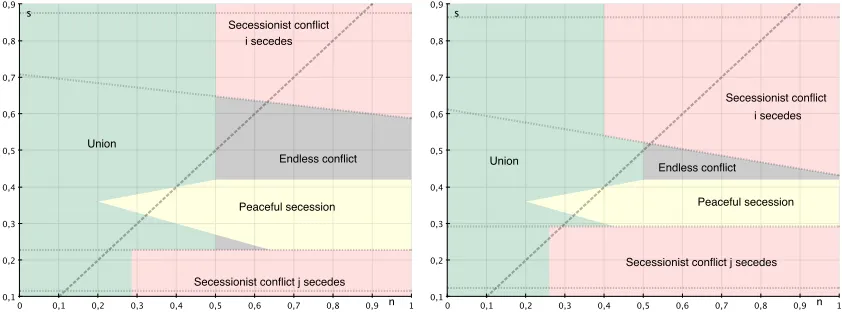
Obviously the space of parameters where the unique equilibrium is peaceful union is the residual of all the characterized areas above, as it can be seen in the following summary picture (Figure 3), for the same parameters as in Figure 1 and 2.
1
0 0,1 0,2 0,3 0,4 0,5 0,6 0,7 0,8 0,9
0,9 0,1 0,2 0,3 0,4 0,5 0,6 0,7 0,8 n s Secessionist conflict
Secessionist conflict j secedes i secedes
Endless conflict
Peaceful secession Union
1
0 0,1 0,2 0,3 0,4 0,5 0,6 0,7 0,8 0,9
0,9 0,1 0,2 0,3 0,4 0,5 0,6 0,7 0,8 n s Secessionist conflict
Secessionist conflict j secedes i secedes
Endless conflict
Peaceful secession Union
Figure 3: Equilibria with = 0.4 (Panel a) and = 0.6 (Panel b)
4.4
A discussion on the role of relative strength
One of the motivations for focusing for each type of equilibrium on the predictions in terms of the role of parameters n, s, , Pi, Pj is because on these parameters we can produce some
evidence in the next section. On the contrary, any prediction that could be obtained on the role of q, the relative strength of the opposition group, would be hard to test, because there does not exist (yet) a reliable measure of the probability of winning for ethnic groups.13
Moreover, the relative strength is highly endogenous, since an ethnic group that secretly decides to challenge the status quo in the near future certainly has an incentive to strategic militarization.
The conditions in the propositions above do however give us some indications about the role of relative strength for the two types of conflict. Given that we do not do any empirical testing below on this matter, we now report the most important e↵ects, leaving for future work a more serious analysis, which will involve data collection for groups never involved in conflict and endogenous militarization.14
An increase in the opposition’s win probability q makes secessionist conflict more likely when the opposition is sufficiently wealthys. When the opposition is poor, a higherqmakes
13Measures of relative availability of arms and/or mobilization exist only for groups that actually
partic-ipated to some conflict, but very little is available about groups that never particpartic-ipated, and this selection problem is difficult to bypass.
14See e.g., Meirowitz et al (2020) for a model of conflict onset that takes into account endogenous
secession conflict more likely if their population size n is sufficiently large. The richer group fears that their surplus could be more easily captured by the poor group and hence they seek for secession.
As far as centrist conflict is concerned, when the win probability of the opposition q
goes up, the bounds on s for belonging to A and for conditions (15) and (16) shift in the same direction. We can therefore assume that this change will not significantly modify the size of the set of parameter values satisfying these conditions. If anything, an increase in q
makes centrist conflict more likely when the opposition is ”rich” (since both thresholds shift upwards). Also, an increase in q makes the group in power prefer centrist conflict to union for a larger set of parameter values. Hence, an increase in conflict strengthq makes centrist conflict more likely to be a SPE.
So for both types of conflict a group becoming stronger (ceteris paribus) seems harder to appease (intuitively) and the interaction with s seems to be relevant. Even from these preliminary observations it is evident that the e↵ects of q are roughly going in the same direction for the two types of conflict; and hence, even if we could solve the methodological and data problems mentioned above, it is unlikely that a more detailed analysis of the e↵ects ofq could give us further substantive insights on the di↵erentiation between secessionist and centrist conflicts, which is the main goal of the paper. The interaction e↵ects with s are the most likely to diverge between the two types of conflict.
5
Empirics
In this section we confront the major predictions of the model to existing and novel empir-ical evidence. In particular, we shall focus on the following four results of our theoretempir-ical framework:
1. Cultural preference similarity (i.e., low Pi) decreases the risk of secessionist conflict
and raises the risk of centrist conflict (with respect to peaceful union);
2. Low size of the opposition n reduces the likelihood of conflict with respect to union;
3. Patience deters centrist conflict with respect to secessionist conflict and other outcomes;
4. Inequality in relative economic productivity favors secessionist conflict relatively more (and the rich group, be in power or in opposition, is the one seeking secession).
5.1
Preference similarity decreasing the risk of secessionist
con-flict
Most if not all independentist movements present the need to save their own national identity as their key goal and motivation. However, the fact that often the secessionist regions are the wealthiest has fueled the argument that the independentists simply seek for material benefits and the issues of preferences and identity are instrumental: a mere framing of very earthy true motives. Hence the need to know empirically if preferences and identity are indeed straw men, or if – as predicted by our model – preference similarity decreases the risk of secessionist conflict.
To the best of our knowledge, there is no existing empirical paper that provides large-scale global evidence exactly on the question at hand, and it is a novel prediction of our framework that large cultural goods di↵erential utility between being in power and being in the opposition, captured by high Pi, is a cause of secessionist conflict rather than centrist
conflict, while preference similarity (lowPi) is associated with a lower likelihood of
secession-ist conflict compared to centrsecession-ist conflict. To address this gap in the literature, we present our own novel evidence on the matter. A variety of factors may a↵ect cultural goods di↵erential utility, some of which endogenous (e.g., an ethnic group fighting against other groups may endogenously develop a more distinct and stronger ethnic identity – see Rohner, Thoenig and Zilibotti, 2013b). In order to exploit historical potential cultural di↵erences between groups, we will focus on how similar the languages of the ethnic groups are (as discussed in much more detail below).15
After a more general ”tour d’horizon”, in much of the analysis we will restrict the sam-ple to conflicts, and focus on the predicted di↵erential e↵ect of a lower Pi on secessionist
versus centrist conflict, because this outcome is very specific to our setting, and as a sample containing only conflicts may be somewhat less heterogenous than a sample also containing peace observations (i.e., comparing two countries at war, say, Yemen with Sudan, may su↵er to a lower extent from unobserved heterogeneity than comparing Yemen with, say, peaceful Canada). While we filter out a series of confounding factors through demanding batteries of fixed e↵ects, it is still important to keep in mind that we do not have a source of exogenous variation in language diversity. Hence the results can only be interpreted as associations, as
15Our approach follows the strategy of employing the linguistic distance between two groups as an
our data does not allow us to draw causal statements.
In what follows, we shall give a brief overview of the data used (a much more detailed discussion of all data sources is contained in the Empirical Appendix). We focus on panel data at the ethnic group level, drawing on data from GrowUP (Girardin et al., 2019). We start by defining the most powerful group in a given country in a given year, labelled l. The GrowUP data contains information on the power ”status” of a given group and we naturally define as most powerful group the one with the highest power status. In the rare event of more than one ethnic group having the highest power status (e.g., with two ”senior partner” groups), we define as most powerful the one with the largest size.16
Given that our theory contains predictions on the likelihood of the opposition group ito trigger secessionist conflict, we focus on all ethnic groups outside the most powerful one in a given country-year. Hence, our dataset consists of a panel at the ethnic group year level, with a unit of observation being one of 892 ethnic groups in a given year between 1946 and 2017.
The dependent variable is taken from GrowUP and is a dummy of incidence of seces-sionist conflict, varying for di↵erent ethnic groups over time.17 The explanatory variable of interest is constructed using information on the main language spoken for each ethnic group (from GrowUP), combined with language trees from the Ethnologue (Lewis et al., 2019). In particular, we posit that language diversity proxies diversity in ethnic identity preferences more broadly. We first construct a variable on whether a given opposition group
g speaks the same language as the main government group l. If for example this leading group speaks English then a given opposition group speaking English as well may have more similar preferences and may be less likely to want to split than some other opposition group speaking another language. Then, in a second step, we construct a more specific measure of preference similarity: We compute the number of joint nodes of the language tree. If two groups are in the same branch of the language tree but there is a slight bifurcation at the end, the number of di↵erent nodes is very small (e.g., German versus Swiss-German), while if two languages belong to completely di↵erent language families, then their distance in nodes is larger. The measure of joint number of language nodes ranges from 0 to 15, with 15 being identical languages while 0 referring to completely di↵erent ones. We posit that greater similarity in language may reflect more similar social norms and in term more similar preferences for public goods, as captured by a lower Pi when i is in the opposition.
16Groups with the highest power status but being of smaller size than their government partner –and
hence not defined as the most powerful groupl– amount to 7 percent of the sample.
17In particular, we use as measure of secessionist conflict the incidence of territorial conflict (”incidence
Armed with these variables, we estimate the following equation:
SecessionistConf lictgit =↵+ 1⇥LanguageSimilaritygit+F Eit+✏git,
where the variable SecessionistConf lictgit is a dummy that takes a value of 1 if a given ethnic groupg of a countryi in a given yeart is involved in ”Secessionist conflict”, and zero otherwise. Language similarity is measured as described above, and F Eit is a battery of
fixed e↵ects at the country-year level.
This specification allows to filter out all time-invariant country characteristics (i.e., rugged-ness of terrain, latitude, elevation etc) as well as all shocks taking place in a given country-year (e.g., an election, or the government being involved in fighting outside or inside).The identifying variation amounts to comparing di↵erent opposition groups within the same coun-try year. Given that in most countries there is relatively little time-variation in language diversity for a given ethnic group g, we focus on between group comparisons in a given country and year, but we shall show additional results when filtering out also time-invariant ethnic group characteristics.18
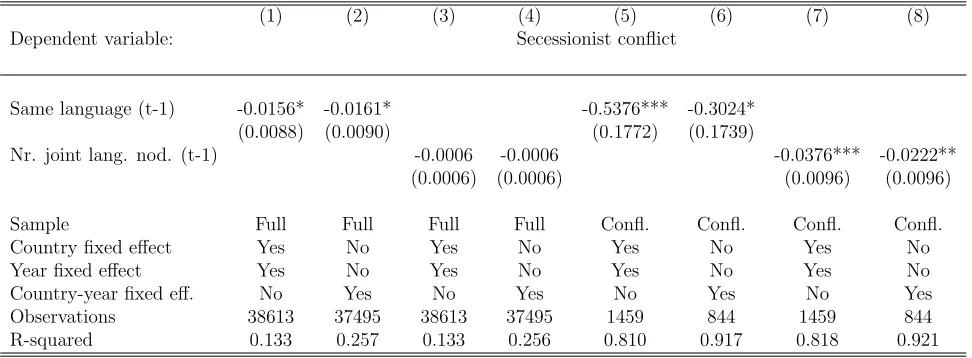
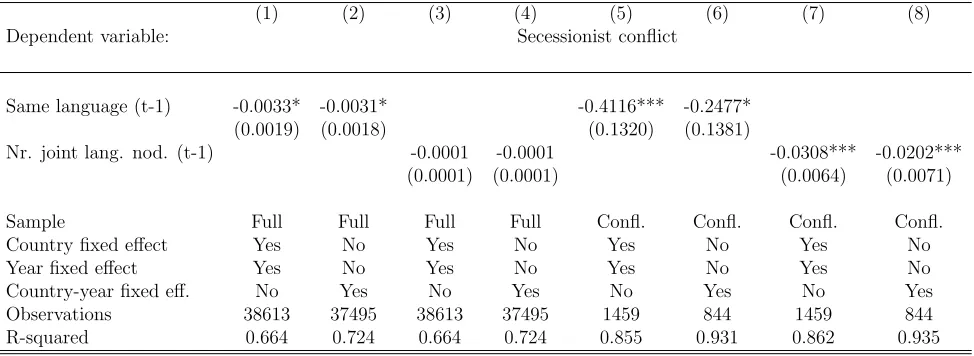
Table 1 presents the baseline estimates linking preference similarity to secessionist con-flict. In column 1 we start with the full sample, with the dummy for group g having the same language as leading groupland the simplest fixed e↵ects structure (i.e., at the country level and at the year level). We find, as predicted, that having the same language –which means that Pi is small– reduces the risk of triggering secessionist conflict. The coefficient
of -0.016 is sizeable compared to the baseline conflict risk of 0.02. In column 2 we adopt a more demanding fixed e↵ects structure, focusing on country-year fixed e↵ects. The results are very similar.
In columns 3 and 4 we run the analogous regressions but using the finer measure of language similarity. As this variable ranges no more from 0 to 1, but now from 0 to 15, we expect a coefficient that is an order of magnitude smaller, which is what we find. While this language similarity measure has the expected sign, it is imprecisely estimated and no longer statistically significant. Columns 5-8 replicate columns 1-4 but restricting the sample to conflicts only (i.e. including only observations with conflicts, secessionist and non-secessionist ones), which leads to a big drop in sample size. We find that in all of columns 5-8 language
18We have carried out a whole battery of further sensitivity checks, controlling for major potential
similarity significantly reduces the risk of secessionist conflict. In the empirical Appendix B we provide further results, controlling for the lagged dependent variable and including group fixed e↵ects.19
Table 1: Preference similarity and secessionist conflict
(1) (2) (3) (4) (5) (6) (7) (8)
Dependent variable: Secessionist conflict
Same language (t-1) -0.0156* -0.0161* -0.5376*** -0.3024* (0.0088) (0.0090) (0.1772) (0.1739)
Nr. joint lang. nod. (t-1) -0.0006 -0.0006 -0.0376*** -0.0222** (0.0006) (0.0006) (0.0096) (0.0096)
Sample Full Full Full Full Confl. Confl. Confl. Confl. Country fixed e↵ect Yes No Yes No Yes No Yes No Year fixed e↵ect Yes No Yes No Yes No Yes No Country-year fixed e↵. No Yes No Yes No Yes No Yes Observations 38613 37495 38613 37495 1459 844 1459 844 R-squared 0.133 0.257 0.133 0.256 0.810 0.917 0.818 0.921
Note: Panel with an observation being the ethnic-group year, covering 892 ethnic groups and the years 1946-2017. All explanatory variables lagged by one year. OLS estimations in all columns. Robust standard errors clustered at the country level. t-stat in parenthesis. *=significant at the 10% level, **=significant at the 5% level, ***=significant at the 1% level.
5.2
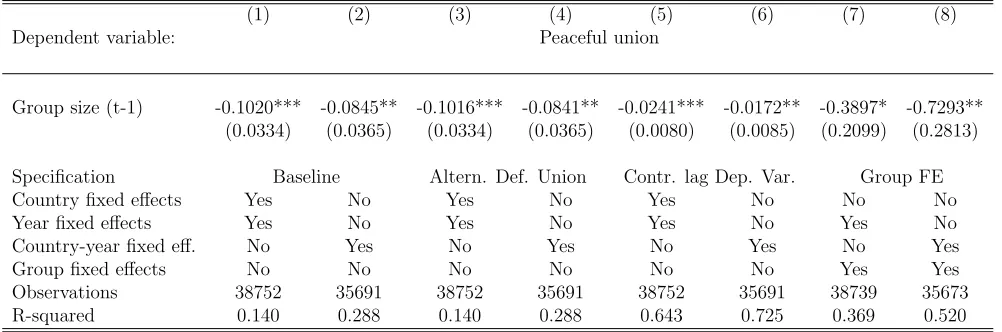
Peaceful union and group size
A second major prediction of our theory is that peaceful union tends to prevail when minority groups are small. To the best of our knowledge also this implication has not yet been tested empirically for a global sample, with the exception perhaps of Cederman et al (2009), and challenges a core inference made by Fearon and Laitin (2003) namely that the number of people needed to keep an insurgency alive is very low and doesnt really need mass support to survive as an insurgency.20 So far only quite few related empirical results exist. In particular,
many enduring states are characterised either by ethnic homogeneity or by extreme ethnic fractionalisation (which does not correlate much with civil conflict, as shown in Laitin, 2007);
19In our baseline specification we prefer to focus on conflict incidence, relegating specifications with a
lagged dependent variable to the appendix. Our two underlying reasons for this are that i) the interpretation of this augmented specification is somewhat di↵erent (capturing onsets /endings instead of incidence) and ii) that having the lagged dependent variable in a panel regression can lead to Nickell-bias (Nickell, 1981). Still, it turns out that our explanatory variable of interest also remains of the expected sign and statistically significant when including as control the lagged dependent variable (see results in the empirical Appendix B).
20Cederman et al (2009) have results similar to ours on this matter. One main di↵erence is that –contrary
but ethnic polarization matters (Montalvo and Reynal-Querol, 2005; Esteban, Mayoral and Ray, 2012). As our model predicts, when potential separatist groups are absent (in the case of ethnic homogeneity) or very small in size (in the case of high ethnic fractionalization), forming a separate state would be very costly, so peaceful union is more easily sustained. In addition, anopposition of small size does not require a large part of the surplus to be transferred to appease them. Suesse (2017) also shows that during the collapse of the Soviet Union smaller regions were on average less likely to seek independence and more likely to favor maintaining the union.
While this existing evidence is suggestive, it does not provide large-scale evidence for a global sample and does not focus directly on our prediction. As in the previous subsection, we again focus on a global sample of all ethnic groups (excluding leading groupl in the country), and the unit of observation is again the group-year. We define the outcome variable ”peaceful union” as the absence of (any type of) conflict and the absence of accepted secession.21 The information of ethnic group size is taken from GrowUP. We run the following specification:
U niongit =↵+ 1⇥GroupSizegit+F Eit+✏git,
where the variableU niongitis a dummy that takes a value of 1 if a given ethnic groupg of
a countryiin a given year tselects remaining in ”Union”, and zero otherwise. GroupSizegit
is the share of a country’s population belonging to group g, and F Eit is a battery of fixed
e↵ects at the country-year.
This specification –as above– filters out time-invariant country characteristics or current shocks hitting a country. As in the previous subsection, we do not have an exogenous source of variation in the explanatory variable of interest, which means that the results should be interpreted as associations and not as causal estimates.
Table 2 presents the results. In column 1 we start with the simplest structure of fixed e↵ects, at the country level as well as at the year level. We find, as expected, that larger groups have a lower likelihood to remain in Union. Quantitatively, moving from a population share of 0 percent to 50 percent (0.5) would reduce the likelihood of Union by 5 percentage points (with the baseline likelihood of Union being at 97 percent of ethnic groups and years). We find virtually the same result when adopting the more demanding battery of fixed ef-fects at the country-year level (column 2) and when replicating the findings of these first two columns for an alternative, more encompassing definition of union (columns 3-4).22 In
21Conflict data is as previously taken from GrowUP, and we code as accepted secession the few least
controversial splits not involving violence (i.e., the split of Czechs and Slovaks; the independence of Mace-donians).
columns 5-6 we run the same specifications, but controlling for the lagged dependent variable, while in columns 7-8 we include ethnic group fixed e↵ects. While in the first four columns the coefficient magnitude is very stable, in columns 5-8 it moves around considerably. This is not very surprising, as the identifying variation is very di↵erent (i.e., moving from total union incidence to onset /ending, and moving from comparing ethnic groups within the same country-year to restricting identifying variation to be within-ethnic group). In all columns we find the expected negative coefficient for group size.
Table 2: Group size and peaceful union
(1) (2) (3) (4) (5) (6) (7) (8)
Dependent variable: Peaceful union
Group size (t-1) -0.1020*** -0.0845** -0.1016*** -0.0841** -0.0241*** -0.0172** -0.3897* -0.7293** (0.0334) (0.0365) (0.0334) (0.0365) (0.0080) (0.0085) (0.2099) (0.2813)
Specification Baseline Altern. Def. Union Contr. lag Dep. Var. Group FE Country fixed e↵ects Yes No Yes No Yes No No No Year fixed e↵ects Yes No Yes No Yes No Yes No Country-year fixed e↵. No Yes No Yes No Yes No Yes
Group fixed e↵ects No No No No No No Yes Yes
Observations 38752 35691 38752 35691 38752 35691 38739 35673 R-squared 0.140 0.288 0.140 0.288 0.643 0.725 0.369 0.520
Note: Panel with an observation being the ethnic-group year, covering 892 ethnic groups and the years 1946-2017. All explanatory variables lagged by one year. OLS estimations in all columns. Robust standard errors clustered at the country level. t-stat in parenthesis. *=significant at the 10% level, **=significant at the 5% level, ***=significant at the 1% level.
5.3
Patience deters centrist conflict and fosters secessionism
A novel prediction of the model is that in the case of low patience conflict not followed by secession is predicted, while other outcomes such as secessionist conflict are associated to higher patience levels. To the best of our knowledge, there does not exist yet a statistical investigation linking patience to the set of outcomes of our model. Some anecdotal evidence suggests that there may be a link though. Recently, The Economist has asked “Why Latin America has no serious separatist movement?” (23 November 2017). This is telling, given that Latin American patience levels are remarkably low (according to data of Dohmen et al., 2015). There is one exception: the secessionist movement in the Santa Cruz region in Bolivia. Conspicuously, Bolivia is the only Latin American country with above average patience
scores, highlighting again the positive correlation between patience and secessionism. A similar pattern emerges beyond Latin America: According to the Dohmen et al. (2015) patience data, indeed the two countries with lowest patience are Nicaragua and Rwanda, both of which have experienced decades-long fighting without a secessionist component. In contrast, many secessionist movements occur in places with relatively high patience, such as for example in Quebec (Canada), Scotland (UK), Catalunya / Basque Country (Spain), Tibet / Taiwan (China), or Corsica (France), and also the formerly united Czech Republic and Slovakia are characterized by high patience levels (see again the recently collected data by Dohmen et al., 2015).
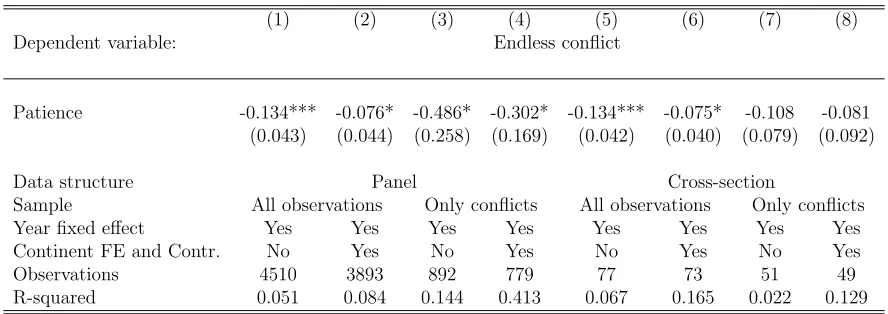
While these examples are very useful, in what follows, we shall perform a systematic regression analysis linking the Dohmen et al. (2015) patience data to the data on peace and conflict outcomes from GrowUP that we described above. The patience data is time-invariant and only available for a cross-section of countries; it cannot be linked to our ethnic group identifiers. Hence, the structure of the following regressions will be rather di↵erent from the ones above, with our unit of observation becoming the country-year level. Note that –as before– we do not have any exogenous variation in patience, and hence all the following results should be interpreted as associations and not as causal estimates. We run the following specification:
EndlessConf lictit=↵+ 1⇥P atiencei+F Et+F Ec+Controlsit+✏git,
where the variable EndlessConf lictit is a dummy that takes value 1 if a given country
i in a given yeart experiences a centrist conflict, and zero otherwise. P atiencei is the
time-invariant patience score at the country level, F Et is a battery of annual time e↵ects, and
F Ec refers to continent fixed e↵ects.
Table 3 displays the baseline results. We have a panel of 77 countries over the 1946-2017 period and regress endless conflict as dependent variable on the patience score as main explanatory variable. The endless conflict variable is defined as above (i.e., drawing on ”incidence gov flag” from GrowUP). We focus on centrist conflict, as our predictions are particularly stark with respect to the complete drop in incentives for centrist conflict in the presence of high patience (while the strength of the e↵ect of patience on the relative comparison between union, peaceful secession and secessionist conflict depends very much on several parameters in the model). Importantly, we first compare centrist conflict with respect to all other outcomes, before restricting the sample to conflicts only, which amounts to comparing only secessionist versus centrist conflict (and which again has the advantage of a less heterogenous sample).
battery of annual time e↵ects. We find that higher patience significantly reduces the scope for centrist conflict. Quantitatively, the coefficient of -0.13 means that one standard deviation in patience (0.37) results in a roughly 5 percentage point decline in the risk of centrist conflict, which corresponds to about half of the 10 percentage point baseline risk. The result is similar although of a somewhat smaller magnitude in column 2 when we include a battery of continent fixed e↵ects and two major controls, i.e. population size (from Feenstra, Inklaar and Timmer, 2015) and ethnic fractionalization (from Alesina et al., 2003).23 We continue
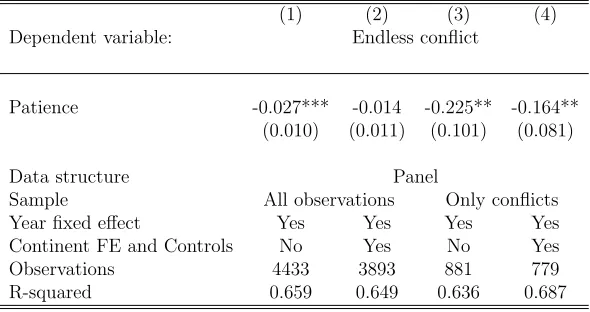
to find a significant negative e↵ect of patience when restricting the sample to conflicts only (columns 3-4). Note that this very di↵erent sample results in a substantially di↵erent (i.e., larger) coefficient. Given that the patience data is time invariant, we also display in columns 5-8 the analogous analysis as in columns 1-4, but for the collapsed cross-section. The results are qualitatively similar, but less precisely estimated in the last 2 columns where we only have around 50 observations. The Empirical Appendix contains further results, showing that our findings go through when controlling for the lagged dependent variable, which amounts to focusing on conflict onsets and endings.
Table 3: Patience and peaceful union
(1) (2) (3) (4) (5) (6) (7) (8) Dependent variable: Endless conflict
Patience -0.134*** -0.076* -0.486* -0.302* -0.134*** -0.075* -0.108 -0.081 (0.043) (0.044) (0.258) (0.169) (0.042) (0.040) (0.079) (0.092)
Data structure Panel Cross-section
Sample All observations Only conflicts All observations Only conflicts Year fixed e↵ect Yes Yes Yes Yes Yes Yes Yes Yes Continent FE and Contr. No Yes No Yes No Yes No Yes Observations 4510 3893 892 779 77 73 51 49 R-squared 0.051 0.084 0.144 0.413 0.067 0.165 0.022 0.129
Note: Panel with an observation being the country year, covering 77 countries and the years 1946-2017. Control variables include lagged population and ethnic fractionalization. OLS estimations in all columns. Robust standard errors clustered at the country level. t-stat in parenthesis. *=significant at the 10% level, **=significant at the 5% level, ***=significant at the 1% level.
5.4
High Inequality in productivity favors secessionist conflict
A further prediction of our model is that situations characterized by inequality in relative economic productivity or potential, fuel secessionist conflict. There is a substantial and
23We restrict ourselves to a parsimonious set of controls, as (1) we want to avoid adding endogenous
convincing body of existing work on this (and hence no need for us to perform our own estimations). In particular, in the literature to date several studies have presented systematic evidence that natural resource-rich ethnic minorities have a relatively high propensity to engage in separatist conflict (see e.g., Sorens, 2012; Morelli and Rohner, 2015; Paine, 2019). In fact, there are many examples of conflicts in which (resource-)rich ethnic minority groups aim at secession.24 Examples include the armed separatist movement in now independent
Timor-Leste, the civil war in Nigeria’s Biafra region and the recent fighting in the Niger Delta regions of Nigeria, Katanga’s attempt to secede from the Congo in 1960-1963, the Basque country’s armed struggle for independence from Spain, the rebellion of the Aceh Freedom Movement in Indonesia starting in 1976, and the Sudan People’s Liberation Army struggle beginning in 1983. Other ethnically divided countries with separatism linked to a wealth of local natural resources include Angola, Myanmar, Democratic Republic of Congo, Morocco and Papua New Guinea.
These cases just mentioned have often involved actual political violence, but the impact of resource spoils is also perceptible in less violent calls for secession. Gehring and Schneider (2017) find that the Scottish bid for independence has been systematically fuelled by the value of prospective oil fields, while Suesse (2017) shows that at the moment of the collapse of the Soviet Union popular support for the creation of new sovereign states was stronger in the oil rich republics.25
6
Policy implications
Welfare statements are generally hard to make and involve various measurement problems (e.g., Pi may be hard to measure). This being said, given that conflict is costly, a robust
welfare statement to make is that in terms of aggregate welfare peaceful union dominates permanent conflict, and agreed peaceful secession dominates secession after conflict. Hence, in the discussion of potential policy implications below we shall focus on institutions or measures that reduce the likelihood of the two conflict outcomes. This way we do not make any judgment on whether union or peaceful secession is more desirable – which may very
24This draws on the more detailed accounts of Ross (2004), Collier and Hoe✏er (2006) and Morelli and
Rohner (2015).
25Although in these examples the prosperity of separatist regions is linked to natural resources, this is
much depend on the particular context.
One obvious policy dimension that is natural to consider is federalism versus centralisa-tion. What makes it difficult to assess the relative virtues of federalism is the fact that it bundles together a variety of characteristics – some of which may favor peaceful outcomes while others may favor conflict.26 Hence, we shall below attempt to ”unbundle” what is
commonly understood under the term of federalism, and distinguish particular components.
6.1
Pluralism of local culture (lowering
P
iand
P
j)
One policy typically associated with federalism is the permission for the local state to select its own language of instruction in school, religious ceremonies and cultural events. In terms of our model, this corresponds to a decrease inPi andPj, which increases the scope for union
and reduces the likelihood of secessionist conflict. Intuitively, if within the same country local regions can select their own preferred policies over a wide range of matters they can up to some extent ”have their cake and eat it” – they can benefit from the scale economies for the things that are centralized and where preference heterogeneity does not play a big role (e.g., national defense) while they can still select their own policies for a wide range of matters where preference heterogeneity is large (e.g., education, health, culture, social state).
There are three caveats. First, a lower Pi makes it also ”cheaper” to keep the (now less
unhappy) opposition group in the union, which leads to a lower level of monetary ”fairness”, i.e., a lower i. Catalonia may illustrate this: While it has obtained the right to have Catalan
as official language, it has been found that the level of net fiscal transfers to the central government is so high that in terms of public service provision Catalonia obtains less than several regions that were poorer before taxation.27 Second, depending on the policy at stake, Pi and Pj may be more or less related or independent. There may be dimensions for which
the government can reducePi at no cost (e.g., allowing the opposition group to perform their
traditional folk songs may not a↵ect Pj). We would typically expect that in most cases such
uncontroversial policies would be enacted (the opposition would typically not oppose more autonomy, and the government could buy o↵ the now less unhappy opposition more cheaply – with a lower i). In contrast, in other policy dimensions there may be a trade-o↵, where
increasing autonomy for the opposition could impose a cost on the incumbent group, e.g., allowing certain religious practices could lowerPi but may also reduce Pj. Endogenizing this
26See Cederman et al. (2015) on the potentially ambivalent e↵ect of devolution. Gibilisco (2017) analyzes
how the repression of regional values may delay conflict but increases resentment and hence the probability of conflict in future. See also Flamand (2019) for a theoretical analysis of the possibility of using partial decentralisation as a secessionist conflict mitigating strategy.
27L´opez-Casasnovas and Rossell´o-Villalonga (2014) conclude that in terms of tax collection per capita
trade-o↵ could be an interesting extension to our setting which we plan to study in future work. Third, engineeringPi and Pj levels may involve commitment problems (as a powerful
group may want to alter them again in the future).
6.2
Melting pot leading to converging tastes (lowering
P
iand
P
j)
Another policy that may reduce Pi and Pj is to encourage fostered interaction between
groups. Members of di↵erent groups meeting more often may naturally lead to having more in common and tastes converging. Think of the United States with new arrivers starting to believe in the ”American Dream” and traditional American culture starting to integrate elements of the new comers (e.g., food habits, like French Fries or Tex-Mex). While the centrally imposed banning of some cultural traits (say, some language) may lead to resentment and large Pi, the bottom-up convergence of tastes through free interaction
may well reduce over timePi andPj, which imp