ISSN 2324-805X E-ISSN 2324-8068 Published by Redfame Publishing URL: http://jets.redfame.com
Differences in Perceptions of the Importance of Subject Matter Knowledge
and How These Shaped Supervision and Assessment of Student Teachers
on Teaching Practice
Young Mudavanhu
Correspondence: Department of Education, Bindura University of Science Education, Zimbabwe
Received: November 24, 2014 Accepted: December 9, 2014 Online Published: December 22, 2014 doi:10.11114/jets.v3i1.589 URL: http://dx.doi.org/10.11114/jets.v3i1.589
Abstract
The purpose of the study was to establish lecturers and student teachers’ perceptions of the importance of subject matter knowledge and how these views affected supervision and assessment of pre-service and in-service science teachers at University of Mashonaland (pseudonym) in Zimbabwe. The study was largely qualitative and used group discussions, interviews and document analysis to collect data. Lecturers that offered professional courses had varied backgrounds with the majority claiming a background in science education at university level and a large number did not study science beyond Ordinary Level. There were mixed feelings about quality of supervision and assessment received from lecturers who did not have sound science knowledge. Student teachers thought they did not benefit much from supervision by non-science educators and their view was supported by science educators. On the other hand lecturers with no science background insisted they were competent to assess documents and live lessons conducted by the student teachers. Further research was recommended to determine qualitative and quantitative differences in supervision and assessment by lecturers with different backgrounds in science education.
Key words: assessment, in-service, pre-service, subject matter knowledge, supervision, teaching practice
1. The Context of the Study
Three key components of teacher education evident in various models and structures are subject matter and pedagogical knowledge, theoretical foundations of education and school experience (teaching practice). Research suggests that subject matter, knowledge and understanding of school subjects, as the content of classroom instruction is associated with effective teaching (Fajet et al., 2005; Darling-Hammond, 2000; Goldhaber & Brewer, 2000; Pring, 2000; Bucat, 1998; Grossman, 1994; Monk, 1994; Guyton & Farokhi, 1987). As exemplified by Pring (2000, “a teacher cannot be teaching chemistry when he does not understand the basic concepts” of the subject. Pedagogical knowledge, commonly referred to as ‘methods courses’ include teaching methods and ways of assessing learning. To help student teachers develop an understanding and know-how of teaching, equally demands a sound understanding of the subject matter being taught (Exley, 2011; Monk, 1994; Ferguson & Womack, 1993). Teaching practice involves working under supervision, initial periods of classroom observation, practice micro teaching with peers, and follow up discussions of school experience. As cited above research seem to suggest that effective supervision of pre-service and in-service teachers who were teaching science disciplines like chemistry requires a deep understanding of the subject content, for example, Pring (2000) and Bucat (1998). The place and value of each of the three components of teacher education is not contested (Darling-Hammond, 2000). Ideally lecturers must have a deep understanding of the three key components of teacher in order to help student teachers develop into effective practitioners. Often this is not possible for several reasons like the high demand of mathematicians and scientists in better paying professions. In poor nations and failing states lecturers found in initial teacher education institutions often had strength in only one area and there was no agreement on who was best suited to conduct supervision and assessment of teaching practice; teacher educator of subject content, or subject pedagogy or theoretical foundations of education.
basis for learning from practice and doing it more creatively (Carroll, 2007; Bolton, 2001; Moon, 1999). In models where the university supervisor is considered officially more powerful than the student teacher the notion of supervision is adjudicatory, that is, “a supervisor goes into schools to observe student teachers and makes suggestions about their teaching practice” (Stones, 1984, p. viii) and implies telling students about teaching. Stones (1984) suggests a re-conceptualization, where supervision plays a cooperative role, in order to help student teachers take a leading role in their own learning of how to teach. Supervision, on one hand, can be viewed as directing or watching over so as to maintain order and, on the other hand, supervision means counselling or guiding. These two meanings of supervision would seem to suggest that adopting supervision as counselling forces you to behave differently form the conventional conception of supervision (Stones, 1984).
Many teacher educators implement methods of supervision that have been characterised adjudicatory (Stones, 1984) and not those that promote development of reflective practice. There are several reasons that could be propounded to explain why this was the case. Teacher educators hardly receive exposure to the theory and practice of supervision (Stones, 1984). Supervision is seen as relatively unproblematic and hardly features in recruitment and training policies and practices. Staff is recruited on the strength of subject matter not familiarity with pedagogy (Stones, 1984). To complicate matters, the subject matter considered when lecturers are recruited could be theoretical foundations of education, and not the school subject student teachers were learning to teach. Further, new recruits in teacher education find themselves in the field supervising student teachers as soon as they take up the posts without any form of induction. This lack of discussion of the actual process of supervision in terms of aims/objectives, links between practical teaching and what students do in their theoretical studies (Stones, 1984) meant that university supervisors concentrate on cosmetic activities, e.g. voice production, chalkboard presentation, teacher’s position in the classroom, and syllabus covering.
2. The Assessment of Teaching
Teaching practice is important in teacher education because student teachers are afforded opportunity to work as teachers. It provides opportunity for teacher educators to develop and evaluate student teachers’ competence in a school setting. According to Santiago & Benavides (2009) meaningful evaluation involves an accurate appraisal of the effectiveness of teaching, its strengths and areas for development, followed by feedback, coaching and support for professional development. Evaluation of student teachers doing teaching practice may involve assessment, often characterised by lack of rater agreement. Reaching agreement is not the ultimate goal, instead what is important is demonstrating that the ratings are valid (Stones, 1984) and the later requires consensual criterion. When there is “no real identifiable consensual criterion of teaching competence then supervision becomes problematic” (Stones, 1984, p. 16). Besides disagreements among raters from teacher training institutions, there were differences in ratings between teacher educators and mentors (or cooperating teachers). University lecturers who acted as supervisors considered their own assessment to be more valid than the mentors’ and were often hesitant to take mentors’ views into account.
Further, failure rate in final teaching practice assessment is often very low. This is despite glaring evidence of disagreements among raters calling to question whether it is worth the time, effort and resources required to perform “the rituals of final teaching practice assessment” (Stones, 1984, p. 17). It should not come as a surprise when pre-service and in-service teachers hold the view that teaching practice supervision was a waste of time.
Another source of conflict is the dual role of supervision and assessment. By its very nature assessment cannot be part of supervision. Supervision is concerned with guidance whereas assessment implies possibility to decide that the student has passed or failed teaching practice. However administrators in education were likely to have a different opinion. To them assessment is essential in achieving teacher improvement, a role consistent with “supervision of practising teachers” and less so with student teachers (Stones, 1984, p.19). Those who argue for removal of assessment from supervision are convinced that supervision must remain non-threatening in order for the student teachers to accept the feedback. Another way to look at the conflicting roles is in terms of summative and formative evaluation. Assessment of student teachers leans heavily toward summative supervision (Stones, 1984, p.19) when supervision should be emphasizing growth and development.
Lecturers follow student teachers on school experience to supervise and assess them. These school visits are most useful if the university supervisor can assist student teachers in the improvement of instruction and the development of teaching competencies (Henry & Beasley, 1982). The student teachers have expressed different feelings about the supervision and assessment they received from different lecturers. Lecturers have also expressed mixed feelings about the quality of classroom teaching observed. The current study was a response to the conflicting feelings about teaching practice.
3. Research Questions
teachers?
2. Who do pre-service and in-service science teachers prefer to carry out supervision and assessment of their teaching practice?
3. What were the challenges faced by lecturers in supervision and assessment of teaching practice?
4. Conceptual and Theoretical Framework
Student teachers doing teaching practice were expected to critically reflect theories of education against practice as well as to explore current issues in science education. Different terms have been used to describe teaching practice of student teachers for example applied science education, practicum and school attachment. Teaching practice in teacher education refers to the practical component of learning to teach during which lecturers visited schools to carry out supervision and assessment of teaching practice. Supervision and assessment instrument was a form used to observe, supervise and assess a student teacher on teaching practice. The user of the instrument wrote comments about the quality of work observed; stated strengths and weaknesses of the student teacher and at the same time awarded a mark. Student teachers expressed discontent when they were awarded low marks and questioned competencies of their supervisors.
The assumption that university teachers were better supervisors of teaching and learning at secondary school than school teachers needs to be interrogated. Teaching at university was substantially different from teaching in primary and secondary education classrooms (Berge, 1998). There was limited transferability of experience because there were different skills required of higher education students and because of the different learning outcomes the students were expected to achieve. Ramsden (2003) listed conceptions of teaching in higher education, for example, that learning at university was ultimately the students' responsibility, and that good teaching in higher education was an elusive, many-sided, idiosyncratic and ultimately indefinable quality. Teaching was not important at all because greater part of learning in higher education took place apart from lectures and other formal classes.
Sometimes science education lecturers claimed to be scientists when they were merely science teachers. Scientists were people who exhibited a curiosity about nature, hence were described as natural philosophers. They carried out research using the scientific method, and were either theoreticians for developing models or experimentalists who tested models. In this study the term science teacher was taken to refer to someone who taught science at secondary school and beyond. Examples of science subjects taught at secondary were biology, chemistry, computer science, general science, geography, mathematics, and physics. For effective teaching, science teachers must have knowledge about the science curriculum, science instructional strategies, science assessment, and science understanding (Fajet et al., 2005; Darling-Hammond, 2000; Goldhaber & Brewer, 2000; Pring, 2000; Bucat, 1998; Magnusson & Krajcik, 1998; Grossman, 1994; Monk, 1994; Guyton & Farokhi, 1987). Science education lecturers were individuals concerned with the pre-service education, induction, and professional development of science teachers. They must have knowledge possessed by science teacher plus knowledge about student understanding of science teaching and learning. The science education lecturers understand the areas of difficulty that prospective teachers encounter when learning about science teaching and know strategies for helping students of science teaching to confront these areas of difficulty (Bucat, 1998). They must be qualified teachers in their own right and specialised to teach one or more of the knowledge bases and skills of the teaching job. Those who teach theoretical foundations of education and those who teach both general and subject-specific pedagogy were teacher educators. Lecturers in subject-specific departments, who might be scientists, were also teacher educators as far as they taught subject matter knowledge to pre-service and in-service teachers. Teaching practice supervision had two functions. The first function was to evaluate the quality of science teaching with the aim of enhancing professionalism. The second function was developmental, that is, to "support the renegotiation of prior conceptions and build stronger links between theory and practice" (Gosling, 2002), and stimulate reflective practice. The latter is a developmental means of enhancing the quality of teaching. In this study supervision and assessment of teaching practice was interrogated to find out if it achieved both functions. Supervision and assessment of teaching practice should provide a non-intimidating environment for the participants and feedback must be supportive. Quite often what constitutes 'good teaching' has been derived from a non-disciplinary view of the teaching session, although subject knowledge or subject application were two facets of the implied subject expertise that was rewarded in the supervision and assessment instrument. The question how a lecturer assesses a Chemistry student teacher’s expertise in subject matter when him/her self’s background was not science remains to be answered.
knowledge and pre-existing sound student knowledge, and might try to create situations that the students need to grapple with challenging ideas (Bucat, 1998). The need to question effectiveness of supervision and assessment in promoting constructivist teaching and learning is imperative; even more demanding is need to find out who pre-service and in-service science teachers believe can help them to become effective science teachers. Supervisors required must possess the ability to elicit prior science teaching beliefs and provide scaffolding required by student teachers to confront such beliefs and seek alternatives.
5. Research Methodology
One of University of Mashonaland (UOM)’s mission is to produce quality science educators and the education department provides professional courses, among them theoretical foundations of education and pedagogy. The department is also responsible for 'applied science education' (ASE) referred to as teaching practice (TP) in this paper. While acknowledging that there were general pedagogy techniques, to produce quality science teachers it is imperative for the department to equip the student teachers with science specific pedagogy techniques. Subject specific departments focus on teaching subject matter knowledge beyond the secondary school curriculum, but do not supervise students on teaching practice. It would appear that supervision of teaching practice at UOM contradicts the value placed on subject matter knowledge in teacher education.
Teaching practice was divided into four parts for pre-service teachers and only one part for in-service teachers. Parts I, II and III were similar in that the student teacher visited a school of his or her choice in any part of the country and spend a period of not less than 4 weeks observing teaching and learning. First student teachers observed teaching and learning at a pre-school and primary school, then Forms I-IV at a secondary school, and Forms V and VI at a high school. The focus of the study was final teaching practice done as Part IV course by pre-service teachers and Part II for in-service teachers. As final year student teachers the two groups go on school attachment where they scheme, plan, teach and keep records of work done. This was a case study of supervision and assessment of teaching practice at University of Mashonaland (not real name of the university studied). The case study was qualitative and used focus group discussions, interviews and document analysis to collect data. Two cohorts of student teachers who had recently returned from final school attachment devoted one lecture each, two hours long, to discussing teaching practice experiences. The students initiated the discussion and chose to write down their concerns and forwarded these to the researcher, who in turn promised to discuss the concerns with rest of staff in the department. Three weeks later a one-day workshop was conducted and 16 participants were drawn from pre-service and in-service teachers, mentors and lecturers using convenience sampling. The pre-service teachers who were invited to attend were selected on the basis that they had participated in the researcher’s previous work in mentoring. Two in-service teachers volunteered to attend the workshop. An invitation to all lecturers, stating objectives for the workshop, was send to all departments in the faculty of education. It stated clearly that participation was voluntary, and participants had freedom to opt out any time. The purpose of the workshop was explained to all participants, and they were assured freedom to decide to participate or not. During the workshop participants had opportunity to describe their expectations, watch and discuss pre-service teachers' recorded micro-teaching of peers, examine in-service teachers concerns about secondary school experience and report what they learnt from the workshop.
6. Findings and Discussion
6.1 Biodata of the Participants
The distribution of workshop participants by job description were two pre-service and two in-service student teachers, one secondary school teacher, three university teaching assistants and 12 university lecturers. The student teachers were in their final year of BScEd Honours prgramme. The secondary school teacher had a first degree in a science subject and was completing an MScEd degree in science education at another university. All teaching assistants were registered as postgraduate students in science education. All the lecturers had masters’ degree as highest qualification and the areas of specialisation were chemistry (1), curriculum studies (4), science education (2), philosophy (1), psychology (1), sociology (2) and teacher education (1).
Teacher educators responsible for teaching professional courses were divided into groups; science educators (8) and non-science educators (4). Science educators taught pedagogy and all had a first degree in a science subject and majority had or were working toward MSc degree in science education. These were assumed to have a strong background in teaching science at secondary school. Non-science educators were responsible for teaching theoretical foundations of education: philosophy, psychology, sociology and communication skills. They had strong background in the theoretical foundations of education; one of them had studied a science subject up to first degree level. They all had an experience in teaching at secondary school before joining university as lecturers.
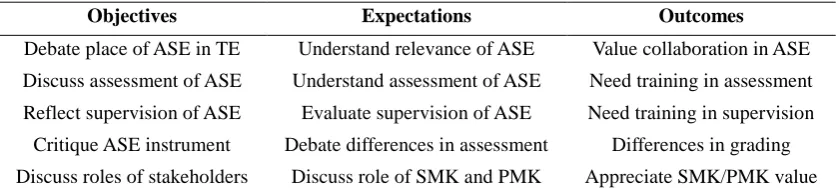
In order to find out the needs of pre-service and in-service teachers, mentors, and teacher educators objectives of the ASE workshop were compared with expectations of the participants and the reported outcomes.
Table 1. Participants' objectives, expectations and outcomes of ASE workshop
Objectives Expectations Outcomes
Debate place of ASE in TE Understand relevance of ASE Value collaboration in ASE Discuss assessment of ASE Understand assessment of ASE Need training in assessment Reflect supervision of ASE Evaluate supervision of ASE Need training in supervision
Critique ASE instrument Debate differences in assessment Differences in grading Discuss roles of stakeholders Discuss role of SMK and PMK Appreciate SMK/PMK value
The objectives were based on the assumption that participants had valuable contributions to make in discussions of teaching practice. Participants' expectations implied a need for training in supervision and assessment of teaching practice. The outcomes indicate that participants appreciated the need to strengthen collaboration among schools and university as well as different departments in the faculty. Regrettably there was no clear-cut outcome stating strategies to use supervision and assessment to develop subject matter knowledge and pedagogical content knowledge of student teachers during teaching practice.
6.2 ASE Conceptual Framework
6.2.1 What is Supervision and Assessment?
One lecturer from the education department was asked to lead a discussion of supervision and assessment in applied science education. In the discussion participants were agreed that supervision denotes giving direction and inspecting so as to give further directions. They agreed that assessment meant estimating the worthiness and quality of performance. They agreed that supervision and assessment of applied science education was characterised by different valuing systems held by assessors with different backgrounds and experiences, and that it was also difficult to be objective without being subjective and vice versa. Other issues raised were the questions of desirability, usefulness and importance of supervision and assessment. In this part of the workshop the following grey areas were highlighted: subjectivity shown by different assessors who gave widely varying marks for the same student teacher's performance, contradictions evident in comments that focused at student learning or teacher learning or teacher learning through student learning, participants questioned reliability and validity of the supervision and assessment instrument plus too much emphasis on quantifying performance, participants doubted common understanding of supervision and assessment, and issue of minimum standards required to award a pass grade.
6.2.2 Concerns Raised by Student Teachers Who Had Been on School Attachment between January and March 2006 Pre-service and in-service student teachers had discussed school attachment experiences in one lecture prior to the workshop. They listed concerns among them: timing and duration of ASE, timing of lecturers' visits, computing marks, reliability and validity, and what documents to keep.
supervision and assessment to promote professional development of student teachers. In response lecturers also faced problems of logistics, where transport resources were controlled by a different department in the university that required vehicles to be booked out after 8am, had long distances to travel from one school to the next, and could not predict changes in activities at schools.
The study found that different university supervisors were giving student teachers contradictory guidelines, for example, in-service teachers felt that different lecturers expected different documents to be kept in the teaching practice file. They wanted specific guidelines that could be referred to by either student teachers or lecturers to resolve any misunderstandings. They were not happy that the supervision and assessment instrument for pre-service teachers was used to assess in-service teachers. They wanted the two groups of student teachers to be assessed using different instruments. Student teachers have discovered that the ticks on the Likert scale did not tally with lecturers' aggregate scores on several occasions. There were 25 items on the supervision and assessment instrument. The lecturer must add up 25 figures to compute score and such a high number of items to add increased chances of making mistakes be it manual or computerised addition. Validity of supervision and assessment was questioned by in-service teachers. They were concerned that being supervised by one lecturer instead of other meant a difference between getting a high mark and just a pass mark. Lecturers had opportunities to respond to some of the concerns in the workshop. They agreed that some of them overlooked to consult the student ASE handbook and the varying and often contradictory comments made were a reflection of different conceptions of pedagogical knowledge, for example, how to state objectives and describe teaching and learning activities. They also agreed that they found it difficult to use the supervision and assessment instrument to discriminate outstanding students from just good performers, and in such cases they ignored the ticks and gave impressionist marks. As an example any student who scores 3 in all areas attains a distinction mark of 75 when the lecturer thinks the teacher’s standard is above 50% but less than 75%.
The study found out that there were differences between university and school supervisors in grading same performance of student teachers. The pre-service and in-service teachers reported that school-based supervisors awarded in-service teachers higher marks than university lecturers. According to participants, mentor teachers who supervised student teachers found them to be hard working in school environment were there was general laxity. Further student teachers introduced variety in classroom activities and this increased participation of learners. Student teachers were of the opinion that mentors' marks must contribute to the final grade awarded in teaching practice. They believed that mentors gave them marks that closely matched their performance unlike lecturers who appeared to be strict. Pre-service and in-service teachers felt that they were often marked down for lack of using a variety of media when the blame should be on schools that did not have resources. They wanted the lecturers to be ‘considerate’ and understand that schools did not have adequate equipment and materials for learner-centred activities. Student teachers might be experiencing evaluation anxiety (Kyriacou & Stephens, 1997; Nyaumwe, 2006) and were coping with the anxiety by shifting blame from their inability to teach effectively onto the lecturer and supervision and assessment process. An element of escapism cannot be ruled out; where teachers who do not want to change or to learn new things complain of external demands, reduction in resources and shortages of time (Haggarty & Postlethwaite, 2003) resulted in need for retrenchment, a falling back on the familiar ways of teaching in order to complete the course on time and to ‘survive’ (Haggarty & Postlethwaite, 2003, p. 433).
This study found out that university lecturers were neither training nor supporting teachers to be effective mentors. Pre-service and in-service teachers thought mentors hardly helped student teachers the way the university expected because the mentors did not have guidelines and knew that their assessment did not affect the final grade of student teachers. Besides schools used assessment instruments different from what university employed, and when asked to do so school-based supervisors were not eager to use unfamiliar university supervision instruments. Role of mentors should be well documented and communicated to address the concerns in a mentor’s handbook that supports student’s ASE handbook. In-service teachers were worried that there were no discussions between school-based supervisors and lecturers. Mentors who spent long time with student teachers in schools were better placed to provide detailed and accurate information about student teacher's competencies, and by not consulting mentors, lecturers missed informative feedback. The participants in the workshop agreed that it was important to find time to talk to the mentor about the pre-service and in-service teachers’ progress, not only as courtesy to the host, but to negotiate how best the student teachers could be helped to develop their subject matter knowledge, pedagogy and professionally.
within the wider evaluation of the mathematics”. However in the absence of specific details about the differences in quality of supervision and assessment by lecturers with different qualifications it is difficult to put blame on the supervision process or on the one being supervised or on the supervisor. There seemed to be different expectations among schools and the university, mentors and student teachers, science educators and non-science educators.
6.2.3 Scheming and Planning
One lecturer of pedagogy led a discussion of supervision and assessment of documents kept by student teachers, and participants were given opportunities to look at the structure of schemes, lesson plans, and records kept by student teachers. In the discussion two competing views were noted. First there were participants who argued that genuine supervision and assessment of student teachers' scheming, planning and documents required an understanding of the subject content and pedagogical knowledge. According to this view only lecturers with strong science background were competent to supervise student teachers’ documents for teaching practice. This position is supported by literature as cited earlier. A second view was that teachers teach students and not the subject and therefore lecturers with experience and knowledge of secondary school students were equally competent to supervise and assess scheming and planning of science subjects.
The participants were agreed that schemes and plans represented espoused theory, what student teacher thought could be the best way to learn the content. They were agreed that schemes and plans were theoretical guides hoped to be used in live lessons. While participants acknowledged that live lessons differed from the espoused theory they believed that student teachers who do not stick to schemes and plans warranted to be marked down. What the student teacher did in the live lesson represented practised theory. Lecturers needed to “reassure student teachers when they consult planning documentation that they were not always expected to rigidly follow their written plans”, Kyriacou & Stephens (1997, p. 27). In fact one important skill of an effective teacher is the ability to adapt and modify one’s plans during the course of the lesson in response to the context and needs of students.
6.2.4 Assessment Instrument
A second lecturer in pedagogy led discussion of the supervision and assessment instrument. In the discussion participants looked at the historical development of the instrument and debated the use of the current instrument. He stated that the university had developed a supervision and assessment instrument for live lessons guided by constructivist instructional philosophy. Supervisors using the old instrument looked at four areas of competence: documents (30%), student learning (20%), professionalism (10%) and lesson presentation (40%). Emphasis on scheming, planning and record keeping was evident in 30% awarded to the section. Despite belief in constructivism, student learning had a weighting of 20% against 40% for lesson presentation. In theory the science educators believed in constructivism and in practice they gave double credit to transmission. The report did not use a Likert scale; assessors were given space to describe weaknesses and strengths displayed in the observed lesson. Subject educators were expected to observe students teaching subject(s) they were competent to assess and this worked well until the university hired staff who did not have a strong background in science. Wide differences were reported among different assessors, prompting development of a new instrument to address subjectivity in the old instrument.
At the time the study was conducted all lecturers of professional courses were assessors: science educators and non-science educators. In order to reduce individual differences the supervision and assessment instrument used a Likert scale. Supervisors using the new instrument examined eight areas; introduction of lesson (8%), lesson development (8%), feedback mechanism (12%), content (16%), media (12%), classroom management (12%), student learning (16%), and documents (16%). Student learning credit had been reduced to 16%. The instrument had 25 items of equal weighting. On each item the student teacher performance was rated exemplary (maximum of 4) and not displayed (minimum of 1). The new supervision and assessment instrument demonstrated a shift from subjective assessment to largely quantitative assessment. In principle the instrument promised to narrow differences among different assessors by being objective yet in practice the differences remained unabated. When assessors found that tallying ticks (marks) resulted in a high grade they tended to ignore the ticks and awarded an impressionist mark, and this explained why pre-service and in-service teachers raised the concern that ticks awarded did not tally with the recorded score.
Poor staffing and transport costs have recently trimmed supervision and assessment to summative assessment only. In the past each student teacher had three visits and conducted three live lessons making it easy to monitor and record professional growth. Now each student teacher was visited once and given a summative assessment only, and university regulations were still to be changed to echo the situation on the ground. One way to overcome this problem was to use lecturer-peer collaborative assessment (Nyaumwe, 2006). The current study did not look at the feasibility of peer supervision.
Micro-teaching video recordings were used to collect data about supervision and assessment differences among lecturers. The videos were recorded as a requirement for a course called ‘pedagogics in a science subject’. Pre-service teachers who registered for the course prepared lesson plans, used the lesson plans to teach peers who acted as A-level students, the plan and lesson presentation were supervised and assessed by the peer and three lecturers. In the post-lesson discussion each supervisor gave feedback to the student teacher and this guided subsequent discussion. During the workshop the video clips were played and participants used focus group discussion to determine differences among different supervisors.
The participants were divided into two groups. The first group looked at a Mathematics lesson and the second group studied a Physics lesson. The group that looked at a Mathematics lesson was made up of participants who had a strong background in Mathematics. There were three assessors in the video clip and each focused on different aspect of the student teacher: subject matter knowledge, pedagogical techniques and professionalism. The group felt that the most accurate assessment and informative feedback came from the science educator because of his sound understanding of the subject matter knowledge, and this finding supported the view that understanding subject matter knowledge is important in the professional development of the prospective teacher and teacher educator. Literature exists to support the view that assessor's subject matter knowledge was required to help the student teacher to identify misconceptions, and select strategies to help learners confront these (Gosling, 2002; Bucat, 1998). The group felt that a student teacher who displayed misconceptions or limited subject matter knowledge needed someone to help him/her identify areas of weakness and to take steps to learn the content, and this could only be managed by an assessor with an understanding of the taught subject matter knowledge. The assessor's pedagogical knowledge was required to judge whether the observed teacher used appropriate teaching methods, activities and media. The group agreed that it was only someone with sound grasp of the taught subject matter knowledge and pedagogy used who ensured that supervision and assessment was worthwhile in the renegotiation of prior conceptions (Gosling, 2002). The group agreed that assessor's professional expertise was required to guide the student teacher towards expected behaviours and treatment of students; professional ethics. The views held by this group of participants would seem to suggest that lecturers in subject specific disciplines were the best qualified lecturers to supervise and assess pre-service and in-service student teachers during teaching practice, but they did not make any such suggestions.
The second group looked at a Physics lesson and was made up of participants who did not have a strong background in Physics. They reported that the different assessors put emphasis on different teaching competencies but gave equally informative feedback. The group believed that while the assessor's subject matter knowledge was important, someone with university education and a strong understanding of teaching practice can judge the quality of student teacher's performance. Besides, it was argued, all lecturers had postgraduate qualifications, and were capable of sitting in effective science lessons and learn the science in the same way the secondary students were learning, contrary to literature e.g. Pring (2000)’s strong support for knowledge of subject matter. The third point raised was that assessors must put emphasis on student teacher's abilities to create a learning environment where learners are actively engaged and dominate the lesson. The assessor's professional expertise was required to guide the student teacher towards expected behaviours and treatment of students. They thought the assessor must be honest to give constructive criticism and at the same time allow the student teacher to make reasonable progress without fear of being assessed against the image of the teaching expertise of experienced teachers (Kyriacou & Stephens, 1999).
7. Discussion
The concept of applied science education appears to be a misnomer because the participants used the term teaching practice more frequently than applied science education. Use of the term teaching practice, to refer to any course or component that required student teachers to visit schools, is appropriate because the focus was practical teaching as opposed to application of science. This study therefore recommends that the department should use the term teaching practice.
courses were not important in teacher education. Science education lecturers need professional development so that they become competent and confident to teach both pedagogy and theoretical foundations of education.
Teaching practice was guided by constructivism in theory yet in practice student teachers were encouraged to use the transmission model, a position echoed by Bucat (1998). There was no evidence in documents, lessons recorded, discussions and supervision to suggest that lecturers helped student teachers to use constructivist teaching and learning strategies. Student teachers' prior knowledge was not sought. Lecturers neither highlighted strategies to challenge prior knowledge nor ways of recording knowledge constructed as a result of classroom experiences. In turn pre-service and in-service teachers were neither able to elucidate their students' conceptions of mathematics and science nor employ strategies to help learners confront the misconceptions. Beginning teachers need to know how to teach electricity, how to teach fractions, how to teach stoichiometry, how to teach chemical equilibrium, and how to teach stereochemistry (Bucat, 1998). Chemistry teachers must know the subject matter (Excley, 2011; Monk, 1994; Guyton & Farokhi, 1987), not only for itself, but also in terms of its teachability and learnability; transformation of subject matter knowledge into forms accessible to students (Shulman, 1986). The position taken here is that lecturers with a sound understanding of say chemistry education were needed to guide pre-service and in-service teachers to use constructivist teaching and learning strategies.
Student teachers' concerns were supported by lecturers with a strong background in science education. The two groups of stakeholders were convinced that teaching at secondary school required a deep understanding of subject matter to be taught. This finding was consistent with literature (Fajet et al., 2005; Darling-Hammond, 2000; Goldhaber & Brewer, 2000; Pring, 2000; Bucat, 1998; Grossman, 1994). However, it would appear these sentiments portray the picture that you teach the subject and not the students. If this was to be the case then the traditional transmission mode of teaching influences actions of student teachers and science education lecturers. Lecturers without a strong background in science education believed that they were competent in carrying out supervision and assessment of pre-service and in-service teachers. After all student learning was the object of teaching practice and the non-science educators argued that they had academic background to understand teaching and learning at secondary school level.
8. Conclusion
Some lecturers at the university studied had strong background in science education while others did not, and the latter group was those lecturers whose secondary teaching subjects were not sciences. The non-science educators believed that they were competent to supervise and assess pre-service and in-service science teachers because teaching was more than subject matter knowledge. These lecturers faced the challenges of helping pre-service and in-service teachers to develop their subject matter knowledge and subject specific pedagogical matter knowledge during teaching practice. Pre-service and in-service teachers would prefer to be supervised and assessed by lecturers whom they knew were knowledgeable about the subject matter they were teaching, as if the job of teaching is all about subject matter knowledge. The study concludes that the concerns raised, that having a strong science background was a required condition for effective supervision and assessment, and the contrary view that anyone experienced in secondary teaching could do the same required further research to determine qualitative and quantitative differences in supervision and assessment among different lecturers.
References
Bell, M. (2001). Supported reflective practice: a programme of peer observation and feedback for academic teaching development. In The International Journal of Academic Development, 6(1), 29-39.
http://dx.doi.org/10.1080/13601440110033643
Berge, Z. L. (1998). Barriers to online Teaching in Post-secondary Institutions: Can Policy Changes Fix It? Journal of Distance Learning Administration,1(2). http://www.westga.edu/~distance/Berge12.html
Bolton, G. (2001). Reflective practice. London: Paul Chapman.
Bucat, R. (1998). Pedagogical content knowledge: applied chemical education research-bridging the gap between 'pure' education research and teaching practice. www.chem.uwa.edu.au
Carroll, M. (2007). One more time: what is supervision? Psychotherapy in Australia, 13(3), 34-37. http://www.bps.org.uk/system/files/documents/one_more_time_0.pdf
Darling-Hammond, L. (2000). How Teacher Education Matters. Journal of Teacher Education, 51(3), 166-173. http://dx.doi.org/10.1080/13601440110033643
Fajet, W., Bello, M., Leftwich, S. A., Mesler, J. L., & Shaver, A. N. (2005). Pre-service teachers’ perceptions in beginning education classes. Teaching and Teacher Education, 21, 717–727.
Ferguson, P., & Womack, S. T. (1993). The impact of subject matter and education coursework on teaching performance.
Journal of Teacher Education, 44(1), 55-63.
Goldhaber, D. D., & Brewer, D. J. (2000). Does teacher certification matter? High school teacher certification status and student achievement. Educational Evaluation and Policy Analysis, 2, 129-145.
http://dx.doi.org/ 10.3102/0162373702202129
Gosling, D. (2002). Three models of Peer Observation of Teaching.
www.heacademy.ac.uk/resources.asp?process=full_record§ion=generic&id=200
Grossman, P. (1994). Teachers’ Knowledge. In T. Husen & T. Postlethwaite (eds.) The International Encyclopaedia of Education, (2nd ed.). Oxford: Pergamon.
Haggerty, L., & Postlethwaite, P. (2003). Action research: A strategy for teacher change and school development? In
Oxford Review of Education,29(4), 423-448.
Henry, M. A., & Beasley, W. W. (1982). Supervising student teachers the professional way: a guide for cooperating teachers. Terre Haute: Sycamore Press.
Kyriacou, C., & Stephens, P. (1999). Student teachers’ concerns during teaching practice”. Evaluation and Research in Education, 13(1), 18-31.
Magnusson, S., & Krajcik, J. S. (1998). Teacher knowledge and representation of content in instruction about heat
energy and temperature. Paper presented at the Annual meeting of the National Association for Research in Science Teaching, Atlanta.
Monk, D. H. (1994). Subject Matter preparation of secondary mathematics and science teachers and student achievement. Economics of Education Review,13(2), 125-145.
Moon, J. (1999). Reflection in learning and professional development. London: Kogan Page.
Nyaumwe, L. J. (2006). Detecting Reflection-on-Action of Secondary School Pre-service Mathematics Teachers on teaching Practice in SAJEST,1(1), 9-16.
Pring, S. (2000). Philosophy of Educational Research. London: Continuum.
Santiago, P., & Benavides, F. (2009). Teacher evaluation: a conceptual framework and example of country practices. The OECD Mexico Workshop Towards a Teacher Evaluation Framework, Mexico City, 1-2, December 2009. Shulman, L. S. (1986).Those Who Understand Knowledge Growth inTeaching. Educational Researcher,15(2), 4-14. Ramsden, P. (2003). Learning to teach in Higher Education. London: Routledge.