Journal of Applied Linguistics and Language Research Volume 2, Issue 8, 2015, pp. 28-40
Available online at www.jallr.ir ISSN: 2376-760X
* Correspondence: Nooshin Nasery, Email: [email protected] © 2015 Journal of Applied Linguistics and Language Research
A Case Study of Translation of Taboo Words Based on
Anthony Pym's Model
Nooshin Nasery *
MA Student of English language Translation, Islamic Azad University, Bandar Abbas Branch, I.R. Iran
Kian Pishkar
Faculty member of Islamic Azad University, Jieroft Branch and PhD Candidate of ELT, University of Isfahan, I.R. Iran
Abstract
This study shows that literary writings have their own features and these features distinguish them from other writings. Translation of especial features of literary text needs familiarity with cultural, linguistic and semantic features. Simin Daneshvar's Suvashun as a postmodern Iranian novel and as an outstanding literary masterpiece is full of literary terms and one of them is the taboo that has been used so many times in it. Translation of taboo words needs great cultural familiarity with L1 and L2 by the translator and this paper tries to consider Translation of taboo words in Ganoonparvar’s requires a great attention and this thesis tries to analyze the correctness, possibility and acceptability of these kinds which needs transferring of correct cultural elements that translation of Simin Daneshvar's Suvashun as a postmodern Iranian novel is full of them and their translation for transferring these special correct cultural elements in target language is a very difficult task.
Keywords: Suvashun, translation, taboo words, Pym's model
INTRODUCTION
Translation of taboo words is one of the most difficult tasks for the translators because they should be familiar with culture of source and target languages. This paper tries to analyze the taboo words in Simin Daneshvar’s Suvashun and M. R. Ghanoonparvar’s translation with the help of four dictionaries, Amid, Dehkhoda, and Moien and online translator of Google translation.
The main problem with the term "internationalization" is that nations have little to do with the processes referred to (hence, after all, the quite valid concept of “locales”). The term is also misleading on ideological grounds suggesting that the one "international" text will do for all locales, somehow placing our technology prior to the Tower of Babel. As for "globalization", it fares even worse on both counts, intimating that none of the planet is excluded (as if there were no digital divide) and that cultural and linguistic universals reign supreme. There are so many taboo words in the Persian language which may be they are so meaningless or without any negative meanings and concepts in the target language, according to Pym they should be translated somehow that we have same effect in target language.
The aim of this paper is to analyze different taboo words in Simin Daneshvar’s novel. In order to achieve that objective, the method designed by Anthony Pym is used in a different corpus and includes two languages (Persian and English).
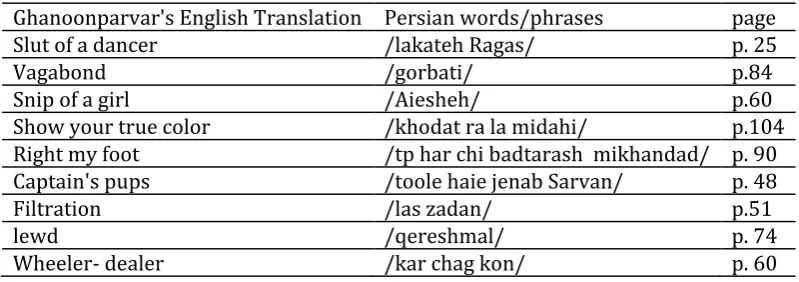
There are so many taboo words in Simin Daneshvar’s novel which has been considered one of the best novels of postmodern literature in Iran and in Persian language. The following examples are some for introducing of the style and kind of the taboo words which have been used by Simin Daneshvaran Iranian female novel writer and have been translated by one of the greatest contemporary translators, M. R. Ghanoonparvar.
Table 1. Ghanoonparvar's Translation
Ghanoonparvar's English Translation Persian words/phrases page
Slut of a dancer /lakateh Ragas/ p. 25
Vagabond /gorbati/ p.84
Snip of a girl /Aiesheh/ p.60
Show your true color /khodat ra la midahi/ p.104
Right my foot /tp har chi badtarash mikhandad/ p. 90
Captain's pups /toole haie jenab Sarvan/ p. 48
Filtration /las zadan/ p.51
lewd /qereshmal/ p. 74
Wheeler- dealer /kar chag kon/ p. 60
The findings of this study will be useful for the study of language translation in the first language and target language (Persian–English). This study also provides some positive contributions in translation of the taboo words in literary works such as:
/barge chogondar/ /khole khoda/ /goor be goor/
Which have been translated respectively "chopped liver", "crazy fool"," you not rest in your grave"(kicked the bucket is better equivalence), "ingrate", "whoring", "thief of peoples wives", "slut"[prostitute], "hefty"[so large], and "filthy ".
differences among countries (here, English and Persian language) and their own specific features of languages, is a crucial task for translators. So the present study is theoretically and practically helpful for translation scholars, practitioners, teachers and students majoring in translation. Moreover, the findings of this study could be applied in the syllabus design and materials and it may be beneficial for translation tutors and translation students as well as professional literary translators and it can be beneficial to improve their proficiency in translation of the taboo word.
Translation in cultural studies
implications for translation. According to Nida, a ‘‘gloss translation’’ mostly typifies formal equivalence where form and content are reproduced as faithfully as possible and the TL reader is able to ‘‘understand as much as he can of the customs, manner of thought, and means of expression’’ of the SL context (Nida, 1964). Contrasting with this idea, dynamic equivalence ‘‘tries to relate the receptor to modes of behavior relevant within the context of his own culture’’ without insisting that he ‘‘understand the cultural patterns of the source-language context’’ (idem).
Pym was one of the first to move the study of translation away from texts and towards translators as people. He has also conceptualized translating as a form of risk management, rather than a striving for equivalence. He has hypothesized that translators can be members of professional intercultures, operating in the overlaps of cultures, and that their highest ethical goal is the promotion of long-term cross-cultural co-operation. In recent years he has been attracted to the concept of inculturation, through which he sees translation as one of the ways in which minority cultures are absorbed into wider cultural systems and can then modify those wider systems. Pym's ideas have been contrasted with those of the American translation theorist Lawrence Venuti by the Finnish translation scholar KaisaKoskinen, and his critique of Venuti has been commented on by Jeremy Munday and Mary Snell-Hornby.
The following is a series of propositions designed to connect a few ideas about translation as a mode of cross-cultural communication. The ideas are drawn from a multiplicity of existing theories; the aim is not particularly to be original. The propositions are instead intended to link up three endeavors: an abstract conception of cross-cultural communication, a description of the specificities of translation, and an attempt to envisage the future of such communication in a globalizing age. The various points at which the propositions draw on or diverge from previous theories are indicated in a series of notes.
sense. At one limit of the concept we would place all the ways in which local specificities are removed or standardized so as to facilitate distribution, thus including many forms of pretranslation. At the other extreme, the notion might even be extended to the adoption of a lingua franca for production purposes (international English would thus be one possible mode of internationalization). Between those limits, here are a few of the practices we would regard as internationalization:– An extension of category super ordinates is the compiling of multilingual terminology databases, where terms in different languages are made to have the same function because they are authoritatively aligned next to each other, in the same field box. Here the moment of internationalization becomes the compiling of the database itself.
A further extension is the use of controlled input language. Texts are written with a reduced lexis and limited syntactic resources precisely so that ambiguities are avoided when being localized. Various degrees of controlled (automatic or semi-automatic) translation then become possible.
Literary Translation
Literary translation, at least in the English-speaking world, faces a difficulty that texts originally written in English do not: resistance by the public to reading literature in translation. One of the most difficult concepts about literary translation to convey to those who have never seriously attempted it - including practitioners in areas such as technical and commercial translation - is that how one says something can be as important, sometimes more important, than what one says.
Daneshvar's stories reflect reality rather than fantasy. They contain themes such as child theft, adultery, marriage, childbirth, sickness, death, treason, profiteering, illiteracy, ignorance, poverty and loneliness. The issues she deals with are the social problems of the 1960s and 1970s, which have immediacy and credibility for the reader. Her inspiration is drawn from the people around her. In her own words: "Simple people have much to offer. They must be able to give freely and with peace of mind. We, too, in return, must give to them to the best of our abilities. We must, with all our heart, try to help them acquire what they truly deserve."
language is full of the taboo words, Booth (1974).The taboo word is rooted in the culture and context and it is one of the frequently used stylistic devices in different types of text. As a matter of fact, literal translation cannot transfer the exact meaning of the intention of the SL; consequently, it does not result in a similar response from TL reader.
Translation of taboo word needs to be dominant in source and target language and since the taboo words are cultural their translation need something more than checking dictionary and knowing the denotations of the words. The problem is that we have very few studies about the translation of taboo words from Persian to English language and because of these our translators, students and sometimes the professors overlook the importance of translation of these words. Ever since man began to translate one language into another, he has always encountered many problems, such as the cultural differences between SL and TL. Translating literary elements such as taboo words depends on these cultural differences is a crucial task.
Moreover, there have been great debates on rendering the taboo words between translation scholars whether it is translatable or untranslatable into TL and the definition of the taboo word is strongly debated in the literature. The problem is that the reader will have the concept of the term based on his own culture and will apply that accordingly. Additionally the taboo word is part of the context of intercultural communication and is a culture specific element that is subcategories of taboo words and depends on specific cultures and attitudes, so it’s transferring between different countries with different languages and cultures is also related to understanding of these features. Simin Daneshvar's novel if full of feminist tone. This tone is not a young lady's tone. Since this is an old lady's tone she has used so many idioms which contain so many taboo words. Furthermore, the duality and vagueness of the nature of taboo words intensifies the problem of translation from culturally different SL and TL. In addition, according to the type of the taboo word they may be culture- specific or language-specific; from simpler to the more problematic category, so the translators may face many problems. Furthermore, some taboo words may belong to more than one category. So any misunderstanding and misinterpreting of any of these words by the translator may result in a translation that lacks moral sense. As a result, many aspects of taboo words remain understudied and their meaning may remain ambiguous unless the translator has a deep knowledge of the religious, social, and ethnological beliefs and traditions of the related communities.
THIS STUDY
Furthermore, this study aims at finding out which type of Persian taboo has been substituted their English counterparts in the process of translating of Simin Daneshvar's Suvashun And Ghanoonparvar’s Translation and also keeps its cultural, literary, feminist and comic sense in TT. And then identify the tendencies in the transfer of irony with respect to the target language and different types of translation. Finally, this study tends to concentrate on these elements and discuss their effects on readers.
Objective of this study is to critically evaluate Anthony Pym's model on the process of translating of Simin Daneshvar's Suvashun and Ghanoonparvar’s Translation, with special reference to the strategies which are used to deal with culture-specific items. To be specific, the study aim is to contribute to the existing literature on Anthony Pym's model of translations in relation to translation strategy by providing new insights through applying it in practical translation analysis on both a theoretical and practical level. As far as the theoretical landscape is concerned, the study intends to have a better understanding of Anthony Pym's model, that is, how to conceptualize and examine a translator’s orientation in handling cultural differences. The practical landscape, on the other hand, consists in the exemplification of how translators domesticates or foreigners, in different cultural domains, by different means, to different extents, with different degrees of consistency in translation of Simin Daneshvar's Suvashun into English by Ghanoonparvar.
Based on the objectives of this study, the following questions will be specifically investigated:
1. How is it possible that the reader of the translation of Simin Daneshvar's Suvashun in target language get the same impact as an Iranian reader get?
2. Why it is necessary to know and understand cross - cultural effects of the translation (Pym, 2004) of the taboo words of Simin Daneshvar's Suvashun the in target language?
3. Which strategies are used by the translator to transfer the taboo words and are they successful in transferring of cultural and literary elements?
DESIGN
The research and study will be qualitative and is based on library study method and will be based on comparative study of Simin Daneshvar’s Suvashun and Ghanoonparvar’s Translation. According to the research questions mentioned above, the following procedure will be applied:
1. Taboo words and taboo expressions in the source book and its translation will be gathered.
2. It will be studied which translation techniques in terms of pragmatics and Pym's cross cultural theory are frequently used by the translator.
The type of this research is descriptive and deals with comparing Simin Daneshvar’s Suvashun and its translation. It will investigate the translation strategies in terms of Pym's cross cultural theory. The present study contains one independent and one dependent variable. The independent variable is translation techniques based on the dependent variable is the strategies used in the translation of the taboo words.
The type of this research is descriptive and deals with comparing the book and its translated version. The present study contains one independent and one dependent variable. The independent variable is translation techniques based on Pragmatic Model and the dependent variable is the strategies used in the translation of taboo words. This study a comparative descriptive and analytical analysis on the basis of the original text of Simin Daneshvar’s Suvashun has been carried out. This analysis employed the classification taboo words by Anne researcher based on Anthony Pym's Model in order to have an instrument to describe what Ganoonparvar has done for maintaining the use of the taboo words. The 12 micro-strategies are as follows:
1- Direct transfer; 2-Calque; 3-Direct Translation; 4-Oblique Translation; 5-Explicitation; 6-Paraphrase; 7-Condensation; 8-Adaptation; 9-Addition; 10-Substitution; 11-Deletion and 12-Permutation.
Procedures
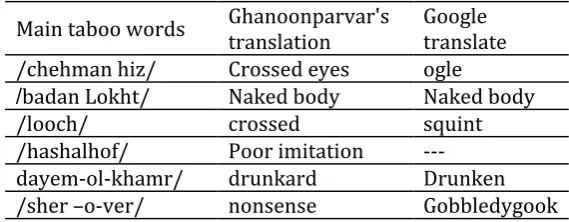
The data is an excerpt of the dialogue from the original text of Simin Daneshvar’s Suvashun and Ganoonparvar’s translation based on Anthony Pym's cross cultural model. The data has been chosen because it includes a substantial number of slang words and expressions, making it suitable for an analysis of the size required in a study such as this.
Table 2. Main taboo words Google translate Ghanoonparvar's
translation Main taboo words
ogle Crossed eyes
/chehman hiz/
Naked body Naked body
/badan Lokht/
squint crossed
/looch/
--- Poor imitation
/hashalhof/
Drunken drunkard
dayem-ol-khamr/
Gobbledygook nonsense
/sher –o-ver/
RESULTS
Modern Persian novels are good sources of taboo expressions which somehow are fantastic and attractive to the readers. These taboo words will be gathered and compared to Ganoonparvar’s translation. So a Modern Persian novel among many bestsellers was chosen and analyzed based on Anthony Pym's cultural model.
of the taboo words in target language and similarity of influence that Pym believes should have on target language reader. Then the result will be reported according to analyzing data. The translation strategy and Pym's cross cultural theory are employed and discussed for data analysis.
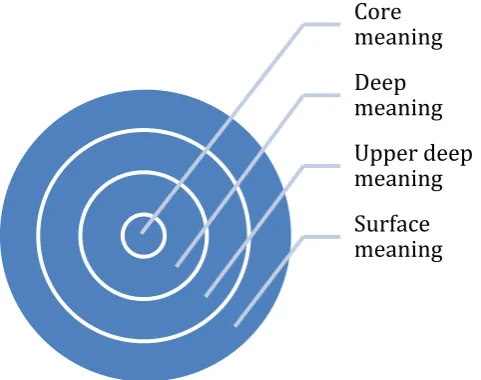
Figure 1. Translator's secondary task: text rendering procedure, reaching core meaning This study reveals that if the translator does not consider the importance cross-cultural model and concept in his/her translation he/she cannot be successful in his/her translation. The importance of translation of the taboo words which are present in every language in the world is not deniable. Since this kind of study about the taboo words and their translation from Persian to English language is very few, this study showed that we need this kind of investigation about the culture based concepts for better translations. A brief review of the results on taboo words demonstrates that the taboo words play an important role in the context of intercultural communication. One of the means for exporting the taboo words that pose a real challenge for translators across cultures is the taboo word; subcategory of the taboo words which rooted in a specific cultural and linguistic context. Therefore, during the taboo words translating process, dozens of factors need to be taken into account.
Besides having to decide whether the target language reader understands the taboo words, translators also have to render the taboo words-inducing effect of the ST. They have to make source the taboo words function as the taboo words in the target culture. Translators’ ability to make creative decisions is often tested by culturally bound items and language-specific devices. Consequently, the translator makes a decision of moving towards the target-culture end of the continuum and chooses a target-language oriented solution, to some extent allows more freedom to manipulate the target version. The translator used various strategies in order to bring the translation closer to target culture norms, expectations and preferences. Consequently this leads to a free translation. Briefly speaking, due to the TT culturally different traits, norm and expectations, the humorous sense of the taboo words ST underwent a change to a TT non-humorous sense or somewhat humorous.
This research tried to study the translation of taboo words in Simin Daneshvar's Suvashun which have been done by M. Ghanoonparvar. Since the novel writer (Simin Daneshvar) has a feminist tone in her novel, and she is an old lady, she has great social and literary experience, she uses so many idioms, and slangs which is considered as taboo words nowadays. The translation of this literary masterpiece has been done more than 30 years ago and the researcher asked from Mr. Ghanoonparvar (via email) would you translate this book as same as this if you want to translate again or you will change the style and lexicography of the translation, he answered that because in that period there was not such theories and methods about translation I just translated and not more but now it should be considered from cultural, literary and social perspective. Although there are some words and literary terms that may not be considered as taboo words in the first glance, when they are used about one person in a special setting (time and place), that time it can be considered as he taboo words such as:
/dalal/
/padoo/
/dilmaj/
May be these words were not taboo words by themselves, but in the special text and context the writer use these words as taboo words for someone who has تنایخto his country by the social and political helping to English agencies in Iran. There are other words and phrases such as “(go) the girl in trouble” which its translation by Ghanoonparvar is not a correct translation and it is a kind of euphemism in translation and can convey its connotation and cultural meaning in target language. The word of
/khanoom Raies/ is for a lady who is the head and boss of a brothel which has been
translated as "madam director", and also the phrase of /khayer khaneh/ which in Persian language means brothel has been translated as a "charity house". The researchers believes that according to Anthony Pym's cross-cultural model, the real meaning of these words and phrases have not been conveyed by the translator and he has used a kind of euphemism in his translation and it can cause a kind of confusion in target language readers for understanding real meanings of these words.
Another words that researcher wants to analyze here is the word of /Ayeisheh/. It is an Arabic and Persian proper name which means "happy lady" with different connotations in Persian and Arabic languages. It is used in Persian as an expression for rude and shameless girls (prostitutes), but Ghanoonparvar translated it as "snip of a girl" which is not proper translation for it and could be …; the next word is "mother fucker" which in Persian text has been written as /modar gahbeh/" which could be … as a proper translation.
As the researcher mentioned, since Simin Daneshvar has mixed the Persian language with Shirazian dialect and accent in her Suvashun, translation of these phrases "he pays for his disloyalty, the ingrate", "hard fart", "old woman" which are the examples of the translator's style of translation of the taboo words that some of these translations are not correct and they show that cross-cultural elements of translation is vital elements in these translations if the translators want to convey same connotations as we have in the source language and the readers in the target language enjoy with the translation.
CONCLUSION
The study starts from a pair of hypotheses, it ends in them. They are as follows:
1. Culture according to Anthony Pym's cross-cultural model has a great affect the translation of taboo words in target language.
2. The original sense of taboo words have been changed in the translation process. Meaning Exploring in taboo words is up to the ST readers. It depends on reader's background knowledge or their world knowledge and their cultures. The original author leaves the reader alone to interpret the meaning and the translator conveys the implicit meaning of the original while elucidating meaning in terms of TT culture (i.e. some ironic utterances may have equivalents in TT or their equivalents may be absent in the TT). In other words, ST readers have the responsibility of filling the gaps and every interstices among their world knowledge, their expectations, norms and the hidden meaning due to their cultures (i. e. reading between the lines in terms of their culture or language borders); but in TT, it is the translator's task to fill the gaps between Source and Target cultures and move toward the TT readers background knowledge and expectations. In a nutshell, culture affects the translation of taboo words in TT; consequently the comic and humorous sense of the original undergoes some changes in translation process.
REFERENCES
Bergner, G. (2005). Taboo Subjects Race, Sex, and Psychoanalysis. University of Minnesota Press Minneapolis, London.
Bloom, H.(2010).The Taboo InfoBase Publishing.
Brown, K. (2010). Concise Encyclopedia Of Philosophy Of Language and Linguistic Coordinating University of Cambridge, Cambridge, UK Elsevier Ltd.
Delgado, P., Guerrero, G., Goggin, J. P, & Ellis, B. B. (1999).Self-assessment of linguistic skills by bilingual Hispanics. Hispanic Journal of Behavioral Sciences, 21, 31-46. Dewaele, J. M. (2004a). Blistering barnacles! What language do multilinguals swear in?!
Estudios de Sociolinguistica, 5, 83-105.
Dewaele, J. M. (2004b). The emotional force of swearwords and taboo words in the speech of multilinguals. Journal of Multilingual and Multicultural Development, 25, 204-222.
Dewaele, J. M. (2006). Expressing anger in multiple languages. In A. Pavlenko (Ed.),
Bilingual minds: Emotional experience, expression, and representation (pp.
118-151). Clevedon: Multilingual Matters.
Eilola, T. M., Havelka, J., & Sharma, D. (2007).Emotional activation in the first and second language.Cognition & Emotion, 21, 1064 – 1076.
Feldman Barrett, L., Robin, L., Pietromonaco, P. R., & Eyssell, K. M. (1998). Are women the “more emotional” sex? Evidence from emotional experiences in social context.
Cognition and Emotion, 12, 555-578.
Fine, M. G., & Johnson, F. L. (1984).Female and male motives for using obscenity. Journal
of Language and Social Psychology, 3, 59-74.
Foote, R. & Woodward, J. (1973).A preliminary investigation of obscene language.
Journal of Psychology, 83, 263-275.
Freud,S.(2001).Totem and Taboo Routledge London.
Grosser, G. S., & Walsh, A. A. (1966).Sex differences in the differential recall of taboo and neutral words. Journal of Psychology: Interdisciplinary and Applied, 63, 219-227. Hakuta, K., Bialystok, E. & Wiley, E. (2003). Critical evidence: A test of the critical period
hypothesis for second language acquisition. Psychological Science, 14, 31-38.
Harris, C. L. (2004). Bilingual speakers in the Lab: Psychophysiological measures of emotional reactivity. Journal of Multilingual and Multicultural Development, 2, 223-247.
Mabry, E. (1974). Dimensions of profanity. Psychological Reports, 35, 387–391. McEnery, T. (2006). Swearing in English. New York: Routledge.
Mehl, M., &Pennebaker, J. (2003). The sounds of social life: A psychometric analysis of student‟s daily social environments and natural conversations. Journal of
Personality and Social Psychology, 84, 857–870.
Nerbonne, G. P., & Hipskind, N. M. (1972).The use of profanity in conversational speech.
Journal of Communication Disorders, 5, 47-50.
Pym, A. (1998). Method in Translation History. Manchester: St. Jerome.
Pym, A. (2004). Propositions on cross-cultural communication and translation. Target,
16(1), 1-28.
Pym, A. (1992). Translation and text transfer: An essay on the principles of intercultural
communication (Vol. 16). Lang, Peter, Gmbh, Internationaler Verlag Der
Wissenschaften.
Pym, A. (1996). Multilingual Intertextuality and Translation. In The intertextual
dimension of discourse: pragmalinguistic-cognitive-hermeneutic approaches (pp.
207-218). Universidad de Zaragoza.
Robinson, D. (1996). Translation & Taboo. DeKalb: Northern Illinois UP.
Selnow, G. W. (1985). Sex differences in uses and perceptions of profanity. Sex Roles,
12(3-4), 303-312.
Shipley, W. C. (1940). A self-administering scale for measuring intellectual impairment and deterioration. Journal of Psychology, 9, 371-377.
Shipley, W. C. & Burlingame, C. C. (1941). A Convenient self-administering scale for measuring intellectual impairment in psychotics. American Journal of Psychiatry,
97, 1313-1325.
Simkins, L., &Rinck, C. (1982). Male and female sexual vocabulary in different interpersonal contexts. The Journal of Sex Research, 18, 160-172.
The American Heritage Dictionary of the English Language (2000). New York: Houghton
Mifflin Company.
Simões Elsa, (2008). Taboo in Advertising. Pessoa University, John Benjamins Publishing Company: Amsterdam, Philadelphia.
Simpson M. Y., (1994). Encyclopedia of Language and Linguistics (ELL1), J. Elsevier Social Sciences.
Sperber, D. & Deirdre W. (1988) Relevance. Communication and Cognition. Cambridge MA: Harvard University Press.