THE LATIN MUSIC DATABASE
Carlos N. Silla Jr.
University of Kent
Computing Laboratory
[email protected]
Alessandro L. Koerich
Pontifical Catholic
University of Paran´a
[email protected]
Celso A. A. Kaestner
Federal University
of Technology of Paran´a
[email protected]
ABSTRACT
In this paper we present the Latin Music Database, a novel database of Latin musical recordings which has been de-veloped for automatic music genre classification, but can also be used in other music information retrieval tasks. The method for assigning genres to the musical recordings is based on human expert perception and therefore capture their tacit knowledge in the genre labeling process. We also present the ethnomusicology of the genres available in the database as it might provide important information for the analysis of the results of any experiment that employs the database.
1 INTRODUCTION
The maturation of the music information retrieval (MIR) field has required that researchers move beyond work in-volving simplistic musical databases to more expansive stud-ies that require much larger, more varied and carefully an-notated collections [19]. McKay et al. [19] have suggested a list of desired features for the development of new music databases in order to have music databases that can be em-ployed in different types of research instead of only a few experiments. The suggested list of desired features in new databases can be divided into three major groups: related to the musical recordings, related to the underlying framework to efficiently use the musical recordings and considering the accessibility and distribution of the database.
The desired features related to the musical recordings are: (1) The database should contain many different types of music; (2) The database should include many thousands of recordings; (3) The database should include a significant amount of commercial music; (4) Each recording should be annotated with as diverse a range of metadata fields as possi-ble, in order to make the database usable as ground truth for as wide a range of research as possible; (5) Entire record-ings should be accessible, at least indirectly, not just short excerpts; (6) Given that different compression methods can influence extracted feature values, the audio format(s) most commonly used by the public should be adopted in order to reflect realistic conditions.
The desired features related to the underlaying frame-work are: (7) It should ideally be possible to label segments
of recordings as well as recordings as a whole; (8) Anno-tations of subjective fields such as genre or mood should include a wide range of candidate categories; allowing ten or so coarse categories is unrealistic; (9) It should be pos-sible to assign multiple independent values to a single field so that, for example, a recording could be classified as both swing and blues; (10) The ability to construct ontological structures between fields could be useful; (11) Metadata should be made available to users in formats that are easy to both manually browse and automatically parse; (12) Automatic tools should be available to validate metadata and generate profiles of the database; (13) It should be easy to add new recordings and their metadata.
The last desired feature is concerned with the accessi-bility and distribution of the database: (14) Data should be freely and legally distributable to researchers.
Another question that often arises is how to assign a mu-sic genre in order to create a mumu-sical genre database. In the work of McKay and Fujinaga [18] this issue has been ex-tensively covered. We consider the following definition of a musical genre: “a kind of music, as it is acknowledged by a community for any reason or purpose or criteria” [9].
description of the musical genres used in the database. This paper is organized as follows: Section 2 presents the related work; Section 3 presents the development process of the LMD; The concluding remarks and a brief discus-sion about future work are presented in the last section; Ap-pendix A presents the ethnomusicology of the genres used in the LMD.
2 RELATED WORK
The work of Tzanetakis and Cook [22] have strongly moti-vated the research in automatic music genre classification. The contributions from this work were three fold: First, it showed the task of an automatic music genre classification as a pattern recognition problem; Second, it not only pro-posed a feature set for the task but also developed an open source software for feature extraction know as Marsyas; and Third, the database used in the experiments is available. This database contains 1.000 music pieces from 10 musi-cal genres (Blues, Classic, Country, Disco, Hiphop, Jazz,
Metal,Pop,ReggaeandRock). In the remainder of this work this database will be as referred the GTZAN database. From this work onwards, different methods were developed based on extracting features from the audio signal [12].
Current work in the field is trying to break through the possible glass ceiling that content-based audio classifica-tion using timbral features has reached [2]. In [3] the au-thors proposed a method for considering context attributes in order to improve classification accuracy. The experiments were performed with database containing 4.936 songs with 801 boolean attributes grouped in 18 categories, some of which being correlated with some acoustic aspect of the sound (“Main Instrument”, “Dynamics”), while others seem to result from a more cultural aspect of the sound (“Genre”, “Mood”). This method achieved an improvement of 5% ac-curacy in average when compared to using only features extracted from the music signal. In [16] a framework for augmenting genre classification accuracy using an ensemble that considers two different views of the same audio signal. The first view is based on the audio signal content, while the second is based on a symbolic form that is obtained us-ing a transcription system. The experiments were performed on three databases: GTZAN, ISMIR Rhythm and ISMIR Genre. The achieved results shown improvements over the previous results on the same databases.
Another important aspect that concerns current research is how the evaluation of music genre classification have been performed. In [10] is verified that performing classification without artist filters (i.e. using music pieces from the same artist in both training and test sets) not only lower the clas-sification accuracy but may also erode the differences in ac-curacies between different techniques. In [7] is presented a discussion on how to define ground-truth for the task of music genre classification. In this work they define
ground-truth as an artefact of an individual response to music, not an artefact of the audio itself; to establish any ground-truth is therefore a cultural study. An approach that comply with this definition is presented by Gouyon et al. [12]. In this work they used the instantly ability that dancers have to rec-ognize different ballroom musical genres (Jive,Quickstep,
Tango, Waltz, Viennese Waltz, Cha Cha Cha, Sambaand
Rumba) to label their database. These approaches are sim-ilar to the one used to define ground-truth for the LMD, as we will see in section 3.1.
Despite the efforts on the development on new techniques for the task of automatic music genre classification, rela-tively less work have been done concerning the development of music databases that can be used as ground-truth. Besides the GTZAN database, other known databases are: the RWC database [11], the CODAICH database [19], the magnatune database which was used in the MIREX 2004 [8] genre con-test, and the database developed by Homburg et al. [14].
3 THE DEVELOPMENT OF THE DATABASE
We start the development of the LMD1 aiming to collect at least 3.000 musical recordings from ten Latin musical gen-res. However, there are many issues involved in the devel-opment of a new audio database, as we will see in the fol-lowing.
3.1 The Process of Assigning Musical Genres
In the development of the LMD we used an approach mo-tivated by the human perception of how to assign musical genres to the musical recordings. The genre is defined ac-cording to how human listeners dance the musical record-ings. The musical recordings were labeled by professional teachers with over ten years of experience in teaching ball-room and Brazilian cultural dances. In the first stage of the process these professionals made a selection of the mu-sical recordings that they judged representative of a spe-cific genre, according to how that musical recording is dan-ced. In the second stage of the process the first author of this work verified each one of the selected songs in order to avoid mistakes that were expected to happen due to the stress produced by manually listening and labeling each one of the songs. About 300 musical recordings were classified by month, and the total duration of the development of the LMD took a year.
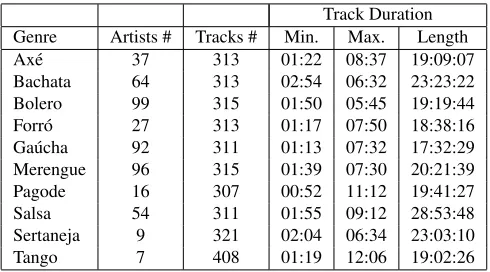
As a result of this attempt, we developed the Latin Mu-sic Database which currently has 3.227 muMu-sical recordings from ten Latin music genres in MP3 format. Table 1 presents information concerning the informetrics of the LMD. The original source of the recordings are CD’s (which were en-coded using 256 kbps and 44 kHz) and from different web-sites.
Track Duration
Genre Artists # Tracks # Min. Max. Length
Ax´e 37 313 01:22 08:37 19:09:07
Bachata 64 313 02:54 06:32 23:23:22
Bolero 99 315 01:50 05:45 19:19:44
Forr´o 27 313 01:17 07:50 18:38:16
Ga´ucha 92 311 01:13 07:32 17:32:29
Merengue 96 315 01:39 07:30 20:21:39
Pagode 16 307 00:52 11:12 19:41:27
Salsa 54 311 01:55 09:12 28:53:48
Sertaneja 9 321 02:04 06:34 23:03:10
Tango 7 408 01:19 12:06 19:02:26
Table 1. Latin Music Database Informetrics
The employed protocol of human inspection based on the perception about how that musical recordings are danced contrasts with the suggestion given by Aucouturier and Pa-chet [1]. They suggest to use complete CDs from collections of a given genre or theme. We justify the approach because the latter proposal, in the case of Latin music, is highly inef-ficient for labeling. For example in the case of the four CD collectionLos 100 Mayores Exitos De La Musica Salsaonly half (50 out of 100) of the songs can be classified asSalsa, the remaining of the collection belongs to other music gen-res likeMerengue,Lambadaand evenSamba.
Another approach that could be used for automatically labeling the music is the classification of albums based on the artist profile, a common practice in the area. However this approach does not seems to be adequate again. For ex-ample, if we want to add songs by Carlos Gardel (the fa-mous Tango Composer), all his songs would be labeled as
Tango. Although he has over 500 compositions, only about 400 of them are actuallyTangos, so the straightforward la-beling introduces unnecessary noise from a machine learn-ing perspective. Even with other artists from a specific genre hardly ever all the tracks from an album are from the same genre. One interesting fact that was perceived during the database creation is that about one of three songs in each album are not from the main style of the Artist profile.
3.2 Storage and Retrieval of the Musical Recordings
Besides the acquisition and genre labeling of the music pieces, much effort was employed in order to develop a database with the following characteristics: (1) it must be easily used in other MIR tasks; (2) it must allow the reproducibility of the performed experiments; (3) it must avoids duplicity in the stored musical recordings; and (4) it must be easily ex-tended, with the storage of new music pieces, new music genres or any other kind of desired metadata (i.e. mood). Taking this issues in consideration a prototype system for storing, labeling and handling the musical recordings was developed. The proposed system is in accordance with the list of desirable features proposed by McKay et al. [19].
The process of adding a new music recording to the frame-work is as follows. First, a musical genre is assigned to the recording following the procedure explained at Section 3.1. Next, the ID3v2 tag (which contains meta-information) of the musical recording is manually inspected to verify if the fields have been correctly fulfilled. Sometimes we need to correct / adapt them according to a standardization proce-dure, such as in the case of names that contain the special character &, indicating more than one artist in the same song. This procedure could be replaced by an automated process like the one suggested by McKay et al. [19] as it mainly involves converting the music titles and artists to a pre-defined standard. To add a new music to the database the mandatory fields in the ID3v2 tag are the artist and the song title. The reason is simple: even if only one person is working on adding new songs to the database, eventually albums from the same artist can contain musical recordings that also appear in other albums, e.g. in the case of albums with greatest hits of a particular artist. The contribution of this simple procedure is two-fold: first, it avoids having du-plicate songs in the database; second, it enforces that all mu-sic added to the database have the valuable metadata of song artist and title.
Finally, the musical recording is stored in the database. In this step the framework obtains the metadata from the ID3v2 tag of the musical recording and verify if the song is not already present in the database, to avoid duplicity. If there is no duplicity the framework assigns the song an identifier code, associate this song to the defined genre and creates an internal copy of the song. The information concerning the music genre is stored into a relational database, because the Genre field of ID3v2 tag is not reliable. Another reason for this approach is flexibility, as it makes the assignment of multiple genres per musical recording as simple as adding another entry into the relational database.
The process of retrieval in the framework is straightfor-ward: it is started by the user, who specifies how many recordings from each musical genre should be retrieved. The framework also implements other modules that execute spe-cific tasks, such as the integration of the database with fea-ture extraction frameworks – like Marsyas [22] – or to allow the user to retrieve the feature set in a specific data format – such as in the arff format for using the WEKA machine learning tool [24].
Database No. Songs No. Genres Commercial Music Meta Data Full Recordings
CODAICH 20.849 53 Yes Yes Yes
Homburg et al. 1.886 9 No Yes No
GTZAN 1.000 10 Yes No No
LMD 3.227 10 Yes Yes Yes
Magnatune 2.181 6 No Yes Yes
RWC 100 10 No Yes Yes
Table 2. Comparison of the existing databases for musical genre classification
(2) Using only the system assigned ID we cannot obtain a re-liable information, because if for some reason (i.e. backup) the musical recordings need to be restored in the system, they will probably not be added in the same order they were originally; (3) It might be easier to understand and interpret the achieved results if one knows which songs / artists were used in the experiment.
3.3 Analysis of the Database
In this section we present an explanation on how the LMD deals with the list of desired features in new databases indi-cated in [19]. As discussed in Section 1, the list of desired features can be divided into three major groups: related to the musical recordings, related to the underlying framework to efficiently use the musical recordings and considering the accessibility and distribution of the database.
Concerning the features related to the musical record-ings, the LMD satisfy all the desired criteria because: (1) it has 10 Latin music genres; (2) 3.227 music pieces; (3) every musical recording in the LMD is commercial; (4) the fields from artist, tile, and musical genre have all been care-fully annotated; (5) only full recordings are available; (6) every recoding is in the MP3 format.
Concerning the features related to the underlying frame-work, some of them are not fully implemented yet. How-ever, they are less critical than the features related to the mu-sical recordings, because doing implementation improve-ments is easier than doing carefully and correct annotation. In the current framework the issues that can be handled are as follows: features (7) and (9) can be handled by creating a table in the relational database of the framework to con-sider the segments of the music recordings, or to allow more than one genre per musical recording; (8) Although only 10 Latin music genres are presented in the database, it is im-portant to stress that the classification was done by human experts and not using website listings in order to achieve ground-truth. Therefore, we would like to encourage more approaches as the one presented in this paper, even if few genres are presented as the classification by human experts is a really time-consuming task; (10) is beyond the scope of the designed framework; (11) and (12) the framework outputs information in arff and SAL formats, and could be easily modified to deal with other formats as needed; (13) as
seen in section 3.2 it is a straightforward process.
The last desired feature is concerned with the accessi-bility and distribution of the database. Due to copyright reasons, the LMD cannot be made freely available to the research community; however there are on-going efforts in two directions to disseminate the use of the database. The first direction is making the LMD available through the OmeN tool [17]. The second direction is contributing the LMD to the MIREX (Music Information Retrieval Evaluation eX-change) community [8].
A summary of the different databases according to the list of desired features related to the musical recordings as seen in Section 1 is presented in Table 2. An analysis of this table shows that besides CODAICH, only the LMD has all the desired features related to the musical recordings, due to its large number of entire commercial songs associated to metadata.
4 CONCLUDING REMARKS
In this work we present a novel and carefully developed database for the task of automatic music genre classification, namely the Latin Music Database (LMD). An analysis of the database shows that the LMD has all the desired features listed in the work of McKay et al. [19], with one exception: the legal questions related to music recording distribution. However two efforts are being made in order to make the LMD available to the research community: (a) contributing the database to the MIREX community; and (b) using it in the OMEN framework. The method for assigning musical genres although similar in concept to the one used in [12] differs from it for the following reasons: (1) the LMD has a greater number of musical recordings; (2) the genre labeling process is based on two human experts instead of assuming that the classification given by a website is the ground-truth; and (3) most of the genres used are different.
context information may be explored in novel ways. One interesting aspect of future research is training a classifier based on the lyrics of the musical recordings, in order to pro-vide further information about the context of specific genres or sub-genres. Another goal for future research is to expand the LMD and further classify the existing songs into their sub-genres categories.
5 REFERENCES
[1] Aucouturier, J. J.; Pachet, F. “Representing Musical Genre: A State of the Art”,Journal of New Music Research, vol.32, no.1, pp.1-12, 2003.
[2] Aucouturier, J. J.; Pachet, F. “Improving timbre similarity: How high is the sky?”,Journal of Negative Results in Speech and Audio Sciences, vol. 1, no. 1, 2004.
[3] Aucouturier, J. J.; Pachet, F.; Roy, P.; Beuriv´e, A. “Signal + Context = Better Classification”,Proc. 8th Intl Conf. on Music Information Retrieval, pp.425–430, 2007.
[4] Austerlitz, P.; Merengue: Dominican Music and Dominican Identity. Temple University Press, 1997.
[5] Clark, W. A.;From Tejano to Tango: Latin American Popular Music. Routledge, 2002.
[6] Collier, S.; Cooper, A.; Azzi, M. S.; Martin, R.; ¡Tango!. Thames and Hudson, 1997.
[7] Craft, A. J. D.; Geraint A.Wiggins, G. A.; Crawford, T. “How Many Beans Make Five? The Consensus Problem in Music-Genre Classification and a New Evaluation Method for Single-Genre Categorization Systems”,Proc 8th Intl Conf. on Music Information Retrieval, 2007.
[8] Downie, J. Stephen. “The Music Information Retrieval Eval-uation eXchange (MIREX)”,D-Lib Magazine, vol.12, no.12, 2006.
[9] Fabbri, A. “Browsing Music Spaces: Categories and the Mu-sical Mind”,Proc. of the IASPM Conference, 1999.
[10] Flexer, A. “A Closer Look on Artist Filters for Musical Genre Classification”,Proc. 8th Intl Conf. on Music Information Re-trieval, 2007.
[11] Goto, M.; Hashiguchi, Hashiguchi, H.; Nishimura, T.; Oka, R. “RWC Music Database: Music Genre Database and Musical Instrument Sound Database”.
[12] Gouyon, F.; Dixon, S.; Pampalk, E.; Widmer, G. “Evaluating rhythmic descriptors for musical genre classification”, Proc. AES 25th Int. Conf., pp. 196-204, 2004.
[13] Hernandez, D. P.;Bachata: A Social History of a Dominican Popular Music. Temple University Press, 1995.
[14] Homburg, H.; Mierswa, I.; M¨oller, B.; Katharina, M.; Wurst, M. “A Benchmark Dataset for Audion Classification and Clus-tering”,Proc. 6th Intl Conf. on Music Information Retrieval, pp. 528–531, 2005.
[15] Koskoff, E.;Music Cultures in the United States: An Introduc-tion. Routledge, 2005.
[16] Lidy, T.; Rauber, A.; Pertusa, A.; I˜nesta; “Improving Genre Classification by Combination of Audio and Symbolic De-scriptors Using a Transcription System”,Proc. 8th Intl Conf. on Music Information Retrieval, 2007.
[17] McEnnis, D.; McKay, K.; Fujinaga, I. “Overview of
On-demand Metadata Extraction Network (OMEN)”, Proc. 7th
Intl Conf. on Music Information Retrieval, 2006.
[18] McKay, K.; Fujinaga, I. “Musical Genre Classification: Is it worth pursuing and how can it be”, Proc. 7th Intl Conf. on Music Information Retrieval, 2006.
[19] McKay, K.; McEnnis, D.; Fujinaga, I. “A Large Publicly Ac-cessible Database of Annotated Audio for Music Research”,
Proc. 7th Intl Conf. on Music Information Retrieval, 2006.
[20] McGowan, C.; Pessanha, R. The Brazilian Sound: Samba,
Bossa Nova, and the Popular Music of Brazil. Temple Uni-versity Press, 1998.
[21] Steward, S.; ¡Musica!: Salsa, Rumba, Merengue, and More. Chronicle Books, 1999.
[22] Tzanetakis, G.; Cook, P. “Musical genre classification of audio signals”.IEEE Trans. on Speech and Audio Processing, vol.10, no.5, pp.293-302, 2002.
[23] Waxer, L.Situating Salsa: Global Markets and Local Mean-ings in Latin Popular Music. Routledge, 2002.
[24] Witten, I. H.; Frank, E.Data Mining: Practical machine learn-ing tools and techniques. Morgan Kaufmann, 2005.
A ETHNOMUSICOLOGY OF THE DATABASE
One important aspect of the research on music genre classi-fication that is often forgot is how it can contribute to music-related fields like musicology. This might be due to the fact that most approaches still use only content based informa-tion extracted from the audio signal [12, 22]. However, as any other application in data mining, in order to better un-derstand the results achieved by the state of art algorithms, prior knowledge about the data itself is needed. For the task of music genre classification, this can be achieved from the field of Ethnomusicology, which considers not only the origin of the music genres but also the social and cultural context in which it exists. In this section, we present a brief analysis of the music genres used in the database in the hope of: (a) a better understanding of any results using the database; (b) a briefly description of what some of the unknown genres are; (c) act as starting reference points to books that discuss the social and cultural aspects of the mu-sical genres used in the LMD.
which typically feature simple melodies and harmonies. It is energetic, good-time party music, designed for dancing and Carnival. The lyrics usually focus on romance, sex, and Carnival [20].
Bachata: Closely associated with poor rural migrants residing in urban shantytowns in the Dominican Republic, was considered too crude, too vulgar, and too musically rus-tic to be allowed entrance into the mainstream musical land-scape, since its emergence in the early 1960‘s. In 1991, Juan Luis Guerra and his group were responsible for transforming the genre into a success with the songBachata Rosa. In his album only 4 of the 10 musics were considered as bachata because of the standard instrumentation (guitar, maracas and bongos) although the arrangements were enhanced by syn-thesizers and Guerra sang the romantic lyrics with the height-ened emotion typical of bachata singers. Since 1990 the most significant change is bachata is the instrumentation, while still guitar led, bachata is increasingly being played with hollow-body electric guitars rather than acoustic gui-tars, which has dramatically changed its timbre[13].
Bolero: It has the same Afro-Cuban roots as the Rumba and is thought to have originated from Cuban or Spanish folk dances such as the Danzon and Beguine. However the Bolero is strongly associated with Mexico, because of its appropriation by the MexicanTrios Romanticos. Bolero po-ems often deal with themes of bittersweet, unrequited, be-trayed or eternal love. The music is frequently arranged with Spanish vocals and a subtle percussion effect, usually imple-mented with guitar, conga or bongos [5].
Forr´o: Originated in 1946 when Luiz Gonzaga recorded the evolutionary song namedbai˜ao, whose title become the name of a new genre. Thebai˜aoderived from an old north-eastern circle dance of African origin. It has a steady beat from beginning to end, making it easier to dance to. The ba-sic instruments are the accordion, a triangle and a zabumba bass drum which are used to create a syncopated 2/4 rhythm. Around 1950, Luiz Gonzaga popularized others musical gen-res such asXaxadoandXote. Nowadays much of his music is referred to asForr´o, a word that originally meant a party or place to play music, however the etymology of the word is subject to much speculation [20].
Ga ´ucha: Is related to the southern states in Brazil and is related to its cultural identity. As with the Forr´o, this label is used to refer to different music genres such as theVaneira,
Vaneir˜ao,Buggio,Xote Ga´ucho, among others. The lyrics usually refer to a specific set of values like respect for the women, the love for the countryside, the culture and the an-imals.
Merengue: Is a century-old music has been used to tell news and gossip an to spread political propaganda since the birth and is also the national dance of the Dominican Re-public. There is no mistaking its crisp.,zippy beat, hissed and scratched out on a metal grater quira in jaunty 2/4 time, or the bubbling triple beat roll of tambora rhythms and sharp
twitter of interlocked saxophone vamps[21]. The mainstream Merengue is also called merengue cibae˜no. There are other types of Merengue like the merengue palo eacho (or pri-pr`ı) of the south and east. While few regional merengues are played today, a vital pri-pr´ı culture persists. This music class for one singer, the single-headed basie drum, the guira, and the one-row accordion and its 12/8 rhythm is markedly different from the 4/4 of meregue cibae˜no[4].
Pagode: It is a style of Brazilian samba, that surged in the mid-1970’s, when a group of musicians associated with the Carnival BlockCacique de Ramosstarted getting together for apagode, a party where people played samba. In these informal get-togethers they introduced the tan-tan, a type of atabaque, which replaced the larger and heavier surdo. This was more practical for informal samba get-togethers, as the tan-tan could be more easily carried on buses, the mode of transportation for Rio de Janeiros‘ Working class. Almir Guineto added a banjo, which was louder than a cavaquinho and better for open-air gatherings. Ubirany started playing a hand-held repique, calledrepique de m˜aoand dispensed with the usual use of drum sticks. And Bira played the pan-deiro in unusual ways. The sound was intimate and earth with new percussive textures. Their lyrics were unpreten-tious, focusing on situations from their daily life [20].
Salsa: The term salsa did not come into common usage until the early 1970s, when it appeared in Latin New York magazine and was adopted as a category for the 1975 Latin New York Music Awards [15]. There are different theories around the origins of Salsa, one of them is that it surged in Cuba and later went to Puerto Rico. However, studies from the lyrics show that Puerto Rican musical identity and salsa are inseparable, because Puerto Ricans in New York made salsa a political movement in the 1970‘s. The most important aspect of the instrumentation in Salsa is the Clave as every musician in the band must understand it [23].
Sertaneja: A type of Brazilian country music, surged in national popularity and was the single biggest category in term of record sales. It is a pop-music version of m´usica caipira, the rural folk music from Brazil‘s South, Southeast and central regions. MostSertanejaartists areduplas(duos) who strum guitars and ten-strings violas, harmonizing plain-tively as they croon about romance and rural life [20].
Tango: The etymology of the word tango cannot be traced completely, but it seems high probable that it reached the Western hemisphere with the slave-ships and on the lips of slaves. Regardless of the origin, in many parts of the Spanish-American empire, the wordTangoacquired the stan-dard meaning of a place where African Slaves assembled for the purpose of dancing. The dance as we know today come from a parodistic way of dancing the African-Argentinetango