JIEM, 2015 – 8(1): 184-202 – Online ISSN: 2013-0953 – Print ISSN: 2013-8423 http://dx.doi.org/10.3926/jiem.1357
Object Unified Identifier Method in Logistics Resource Integration
Huiqi Zhu, Hanping Hou
Beijing Jiaotong University (China)
zhuhuiqi0505
@ 126 .com, houhanping @ 126.com
Received: December 2014
Accepted: February 2015
Abstract:
Purpose:
The status which many programs for the object identifier are not incompatible with
each other has become a bottleneck for integrating logistics resources. Scholars have done
some relevant studies in terms of coding and conversion mechanisms, but the problem still
has not got a better solution. The purpose of this study is to research how to make the object
identifier programs compatible.
Design/methodology/approach:
Author proposed an object unified identifier (OUID)
method based on OID and introduced the standard identification code in it, according to the
problems of th e object identifier in logistics resource integration. And the paper further
designed the acquisition process of the resource basic information and location information,
and analyzed the application environment of object unified identifier based on OID.
Findings:
OUID made up for the lack of location information in conversion mechanism, and
avoided to promote new unified identifier standards at the same time. The supplement of the
application environment provided an important support to solve the problems of poor
communication caused by non-unified object identifier in the process of logistics resource
integration.
Originality/value:
Using this method, each identification system not only can keep its own
territory, but also can compatible with other object identifiers.
1. Introduction
In recent years, Internet of things (IoT) and other IT technologies enable logistics resources to connect with the Internet through information devices, which let the logistics resources have the connectivity, visibility and virtuality and give the resources ideas. It is helpful to realize intelligent identification and management and provides a new way of thinking for the logistics resource integration. But the inconsistent resource identifier, the equipment that access information relied on belonging to different organizations, greatly reduced the effectiveness and accuracy of the logistics resource search (Yu &Yu, 2013), and restricted the improvement of logistics resource integration. Especially the heterogeneity and high dispersion of data sources under the Internet of things (Hribernik, Kramer, Hans & Thoben, 2010), made uniquely identifying and positioning logistics resource more difficult. When enterprises intended to complete cross-domain integration of logistics resources, they felt that it was difficult to manage and operate information in a unified way in network. Such as manufacturing enterprises used the bar-code to identify the products or pallets, but when the products or pallets got into the logistics field, logistics enterprises didn’t use the identifier continuously, and adopt their own identifiers and the rules. This phenomenon led to the same resource having different identifiers in different logistics information systems, caused the inconsistency of object identifiers, and made resource information scattered and logistics resources operating uncoordinated. Thus, an object unified identifier (OUID) becomes the key issue in integrating logistics resources.
Tian, Kong, Li & Yan, 2014) or conversion mechanism (Kong, 2008; Pang, 2012; Jung, Choi, Lee & Kim, 2012) in order to find the existing information in network. Some scholars discussed
the problem from the perspective of computer languages. For example, Martinez-Julia and Skarmeta (2013) believed that the future Internet was a mobile, host-free node model with the possibility of multiple attachment points to the network, and needed flexible naming and integrated discovery mechanisms. They tried to decouple the identification and location (Spleiß
& Kunzmann, 2011) to adapt to the trend of dynamic networks. But scholars inthe field of USN thought IP addresses were too long to fit on small embedded devices. These studies provided the new perspective for the unified object identifier, but it was difficult to be realized because of lower operability. Therefore, according to the standardized method, firstly, this study applied conversion thought to research how to make the existing object identifier unified using the OID standard, and at the same time ensured that no new coding standard was generated. Secondly, relying on the Internet discovery mechanism, compatible and operable network architecture was proposed which can achieve the unifying of the object identifier.
2. Object Identifier Basic Philosophy in Logistics Resource Integration
The identifier mentioned in this article referred to the sign or symbol that showed the properties of an object in the form of a physical or electronic data. If the resources have the identifiers, logistics bodies can identify them, and then unique find the related information in network. This was also the main task of the object identifiers undertook in the process of logistics resource integration. Logistics resources mainly referred to the infrastructure and ancillary equipment that scattered in various functional resources for completing the logistics missions, for instance, shelves, trays, transport vehicles, positioning equipment, goods, etc.
2.1.Object Identifier Operation Conceptual Model
The operating process of the object identifier was described by a conceptual model in this section, as shown in Figure 1. It contained four parts, such as coding, labeling, identifying, and decoding.
When the logistics resource information needed to be collected automatically, first of all, it should be coded and then formed codes that could be identified by a computer. Encoding process of the codes needed to follow certain standards, and requiring the code could indicate only one object. After generating the code, it must be combined with the resource, otherwise, it was a meaningless symbol. The purpose of the labeling was to link the resources with the codes that had been written, and formed the resources unified identifiers. When logistics resources participated in the social and economic activities, people could only clear the state of the logistics resources by identifying the identifiers in order to provide assistance for controlling, managing and making integrated decision. To improve the utilization rate of resources, enterprises needed to timely understand itself and resources state in society. For this reason, they required identified the resources. There were lots of technologies to identify the identifiers, and all of them were to obtain the loaded codes in the identifiers to receive the resource information. Decoding was the process of restoring the resource information that included the encapsulation, unpacking, resolving, etc., which was mainly completed by computers. It should be noted that decoding might not be completed in the network because of the non-unified object identifier of the logistics resources. This was also the core problem that was solved in this study.
2.2. Problems of the Object Identifier
From the object identifier operation conceptual model, you can see that the main role of the object identifier is to let the logistics resources be connected with network so that logistics bodies can control and manage the resources through the internet. But the status of the numerous objects identification technologies led that identifier could only be identified within the scope of its corresponding system. This made realizing the above function having difficulties, and some problems had been reflected as follows,
1. There was large difference of coding standards, so the expression of the same information faced the problem of choosing different standards. For example, Ucode and mRFID Code both have a 128-bit long code, but they have different structures. EPC has various classes of codes, such as EPC-64, EPC-256, and so on. And each category can be further subdivided. Therefore, coding standards difference caused the coding inconsistent phenomenon in the expression of resource information.
3. The same resource information obtained through different collection means, and stored in databases of different bodies. Some information could be traced and inquired in local area by technologies such as EPC, but most information was also still in the vertical closed-loop applications system and couldn’t communicate with each other. Lead to resource information was scattered and not manageable.
2.3. The Demand for OUID
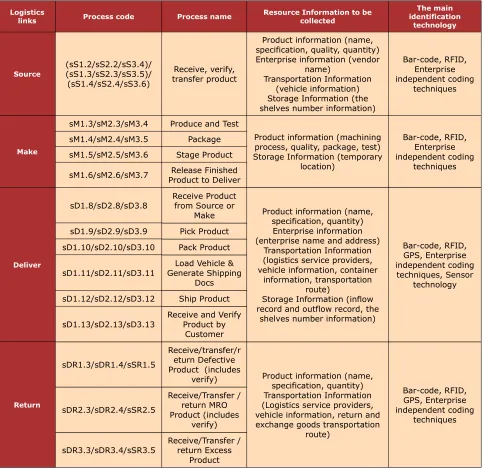
The problems existing in the object identifier mentioned above was manifested mainly in field of logistics. Especially, when the enterprise needed a lot of accurate and timely cross-domain resource information (including resources basic information and location information) to integrate the logistics resources, low search success rate and accuracy problems of logistics resources became more prominent brought with non-unified object identifier. Logistics section of supply chain operation reference model (SCOR) reflected the application status of the objects identification technology in the logistics resources. Analyzing the SCOR 10.0 can also get the logistics resource information that need collected in the logistics process (as shown in Table 1). This information was the basis of integrating logistics resources.
Logistics
links Process code Process name Resource Information to becollected
The main identification
technology
Source (sS1.2/sS2.2/sS3.4)/(sS1.3/sS2.3/sS3.5)/ (sS1.4/sS2.4/sS3.6)
Receive, verify, transfer product
Product information (name, specification, quality, quantity) Enterprise information (vendor
name)
Transportation Information (vehicle information) Storage Information (the shelves number information)
Bar-code, RFID, Enterprise independent coding
techniques
Make
sM1.3/sM2.3/sM3.4 Produce and Test
Product information (machining process, quality, package, test) Storage Information (temporary
location) Bar-code, RFID, Enterprise independent coding techniques sM1.4/sM2.4/sM3.5 Package
sM1.5/sM2.5/sM3.6 Stage Product
sM1.6/sM2.6/sM3.7 Product to DeliverRelease Finished
Deliver
sD1.8/sD2.8/sD3.8 Receive Productfrom Source or
Make Product information (name, specification, quantity) Enterprise information (enterprise name and address)
Transportation Information (logistics service providers, vehicle information, container
information, transportation route)
Storage Information (inflow record and outflow record, the
shelves number information)
Bar-code, RFID, GPS, Enterprise independent coding
techniques, Sensor technology sD1.9/sD2.9/sD3.9 Pick Product
sD1.10/sD2.10/sD3.10 Pack Product
sD1.11/sD2.11/sD3.11 Generate ShippingLoad Vehicle & Docs sD1.12/sD2.12/sD3.12 Ship Product
sD1.13/sD2.13/sD3.13 Receive and VerifyProduct by Customer
Return
sDR1.3/sDR1.4/sSR1.5
Receive/transfer/r eturn Defective Product (includes
verify) Product information (name, specification, quantity) Transportation Information (Logistics service providers, vehicle information, return and exchange goods transportation
route) Bar-code, RFID, GPS, Enterprise independent coding techniques sDR2.3/sDR2.4/sSR2.5 Receive/Transfer / return MRO Product (includes verify)
sDR3.3/sDR3.4/sSR3.5 Receive/Transfer /return Excess Product
Table 1. Sub-processes of Using Identification Technology in SCOR10.0 Model
(1) Unique. The object identifier must be unique in the world, and it can be the temporary identifier of resource (Spleiß & Kunzmann, 2011).
(2) Compatibility. Under the premise of unchanging existed identifier standard, it can achieve finding and transforming among the various object identifier information.
(3) Scalability. When new requirements or new coding scheme emerged, object identifier can add fields to express meaning accordingly.
3. Method of Logistics Resource Integration OUID
Almost all standardization organization declared its standardization structure can be compatible with other standards, but different standard compatible problems remain existed. Analyzing the reasons that the heterogeneity problems of object identifier weren’t solved nicely, we can find the following arguments. Firstly, a large number of heterogeneous and valuable historical data existed in network and enterprise database with the development of identification technologies. Secondly, internet information addressing mechanism did not adapt to the development of the IoT. Lastly, organizational interests hindered the unified of identifier. So promoting and applying the unified identifier standards was unrealistic, we needed to discuss the OUID method on the basis of unchanging the existed standards.
3.1. Problem Description
Logistics resource integration can achieve intelligent identification of resource, and knowing the location of logistics resources through the object identification technology under the IoT environment. But the current logistics system was designed based on internet host information discovery mechanism, so logistics resource unified identifier shouldn’t be separated from internet application condition. Therefore, Logistics resources OUID should meet the requirements of the internet, and at the same time adapt to the rapid development of IoT. Then there would be considered the internet reality condition and physical location information. The following assumptions have been proposed.
(1) OUID mainly used the existing severs, and relied on internet information discovery mechanism.
(2) Logistics resources integration required the identification information included the resource basic information and location information. Resource basic information referred to the information that could reflect the nature of resources mostly and had the characteristics of shared demands across business systems. Location information referred to the physical location of logistics resources.
(3) Have designed specialized hardware devices which could input the entity encoding information into tags and computers.
(4) Logistics bodies generally accepted and applied the scheme of unified identifier.
3.2. The Selection of the OUID Method
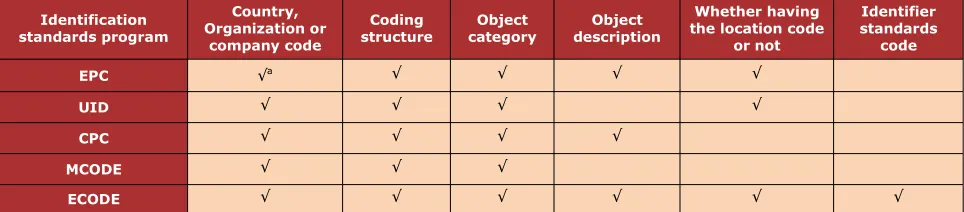
Compared coding structures of EPC, UID, MCODE, and CPC, which have been widely applied (as shown in Table 2), we can find that existing standard coding structure generally was consisted of organization or enterprise code information, coding structure information, and object categories information. Although some of the resource information has already been contained in object identifier, more detailed information which will be available by further addressing, such as product quality, logistics service providers, inflow and outflow record, the shelves number information, still stored in the relevant enterprises databases or organizations databases. In terms of location information, the physical location information of resources was commonly out of the coding structure scope. Although location codes can be accomplished by the EPC and UID (as shown in Table 2), these location codes cannot be directly associated with encoded resources. Analysis also found that almost all of the identifier codes had the hierarchical structure, but it could not be directly identified from the codes. When the different identifier codes appeared, people had no way to know the expressed information of the codes, and that which identification standard system the codes belonged to. Therefore, EPC, UID, MCODE, CPC were all not suitable as a unified method.
Compared with the above four kinds of coding structure, Ecode achieved compatibility among the codes mainly by the way of distributing header on the basis of keeping the original coding structure. It was much more to provide compatible coding solutions. This study did not choose Ecode as the method of unified identifiers, because it was developed by our own country and its universality in the international arena was lower, furthermore, its coding structure was fixed that was not conducive to extend the resource information.
Identification standards program Country, Organization or company code Coding
structure categoryObject descriptionObject
Whether having the location code
or not
Identifier standards
code
EPC a
UID
CPC
MCODE
ECODE
a
represents the information contained
Table 2. Comparison Table of Objects Code and Structure
difficulty of using OID to convert identifiers was very low, it was easy to maintain and guarantee good expansibility. OID coding structure was a hierarchical authorization, so there was conducive to the interconnection of countries. In addition, OID supported people read and machine read, and could be converted into binary and be stored in RFID, sensor, two dimensional bar-code and other carriers. In this paper, the unified method of object identifiers will be mainly use identifier code based on OID to complete the compatibility and query between the identifier information.
In order to confirm logistics resource type, quantity, function, capability and feasible mode of transportation among the various facilities in a certain space (Shan, Zhang, Wang & Chen, 2011), resource location information was needed except for the basic information. It was explained by analyzing OUID application environment that utilized the existing network topology.
3.3. OUID Method Based on OID
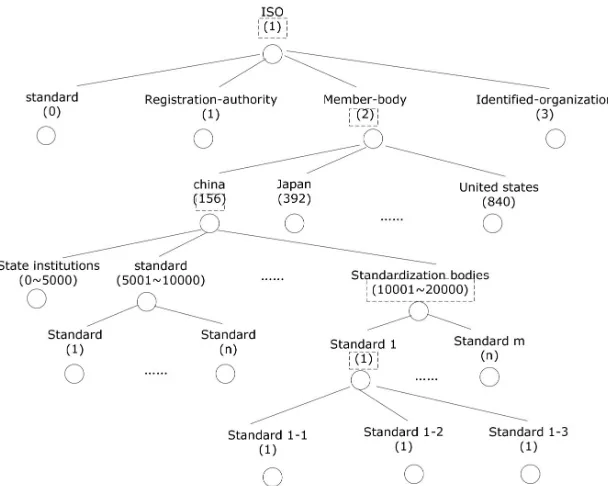
Structure of the OUID was standard identification code + resource code. The standard identification code was used to uniquely express coding standard code that object identifier code belongs to, and its allocation rules followed OID standard (GB/T 26231-2010, 2010). The allocation management of the standard identification code was shown in Figure 1. Allocating standard identification code based on the OID standard can transform different coding structures into the unified grading ones.
For instance, An Ecode–64 logistics resources code can get standard identification code just like 1.2.156.x.x.x (x indicated a set of indefinite length code). Resource code can be allocated according to the standard of different identification system. GS1 applied for 2.51 as identifiers prefix which was used to manage resource objects in the logistics field. If a logistics resource object’s bar code was 6937512503343, its standard identification code can be 2.51.x.x. After being unified, logistics resource object identifier will become 2.51.x.x.6937512503343. Object identifier coding standard with the unique standard identification code can help complete decoding the object identifier code. As can be seen from the sample, allocation right of standard identification code belonged to identifier standards management department. Distributed management helped to realize countries and standard organizations manage coding standard, code type dispersedly and independently, and avoided interest conflict that caused by centralized management of identifier standard (Jung, et al., 2012).
Figure 2. Application Example of Standard Identification Code Allocation
4. Application of Logistics Resource Integration OUID
4.1. Application Environment
To make OUID based on OID give full play to the role in the network, there needed to resolve the identifier so as to complete acquisition of resource detailed information. However, the network cannot do the job. To solve the problem, we introduced the identifier resolution layer (IRL), shown in Figure 3.
IRL firstly resolved OUID, and then decided whether through the DNS to obtain complete information according to the resolution results. So IRL was the network structure composed by many servers, included DNS resolution servers, OID servers and other standard organization servers, etc. (as shown in Figure 4).
Figure 3. Network Topology of IRL
In order to explain the effect of IRL and how to realize the compatible among different object identifiers, acquisition of logistics resource basic information and location information will be analyzed specifically.
4.2. Realization of Information Flow
(1) Acquisition process of logistics resource basic information
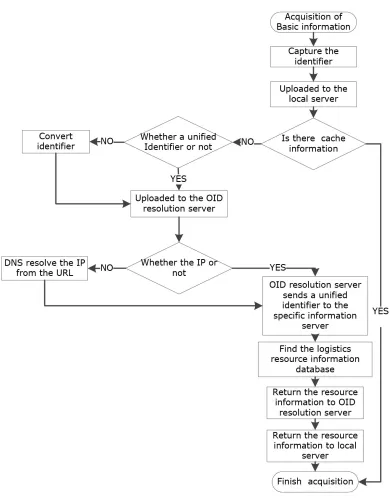
The realization of logistics resources basic information acquisition process was shown in Figure 5.
1. Read identifier from label and upload it to the local server. When the local server has stored the identifier’s corresponding resource basic information, the local server returned basic information directly, otherwise the local server sent the object identifier to the OID resolution server.
2. Two situations may arise when the reader read resource information. (A) It read an OUID contained a standard identification code. (B) It read a resource code. For the case A, the local server sent OUID to OID resolution server, otherwise the resource code needed to be converted into OID encoding format in wrapper, and then be sent to the OID resolution server.
3. OID resolution server can get two results according to OUID based on OID. (A) Organization’s URL of the resource basic information. (B) Organization’s IP of the resource basic information. When the resolution result was URL, it needed to be resolved by DNS. When the result was IP, OID resolution server directly accessed to the resource basic information in specific server.
4. Specific server provided access path of logistics resource information database, and returned the resource basic information to OID resolution server.
5. OID resolution server returned logistics resource basic information to local server and stored in it. Local server returned information to client. Acquisition of logistics resource basic information has been finished.
The above was acquisition process of logistics resource basic information used OUID, and the process of logistics resource location information still relied on OUID.
(2) Acquisition process of logistics resource location information
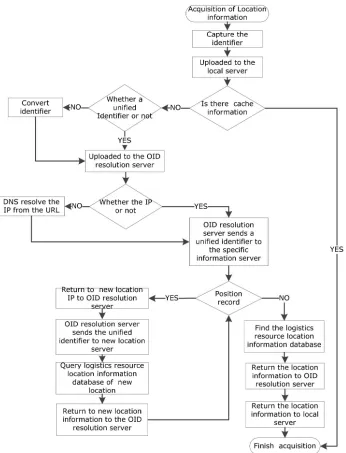
The realization of logistics resource location information acquisition process was shown in Figure 6.
Figure 6. Flow Chart of Accessing to Logistics Resource Location Information
2. Acquisition of dynamic location information. The resolving process of OUID based on OID remained the same as the process of resource basic information, and then OID resolution server sent OUID to the specific information server. When specific information server had the resource position record, it returned IP of new location to OID resolution server. OID resolution server sent OUID to new location server, and then got new location information. OID resolution sever didn’t send OUID to new location servers until there were not position record that hasn’t been accessed. Finally, the OID resolution server returned logistics resource location information to the local server, and completed the task of location information query.
From query process of the resource basic information and location information, OUID and IRL can realize the compatible query of logistics resource information on the base of without changing the existing object identifier rules.
4.3. Application Scenarios
(1) The application of two-dimensional bar-code
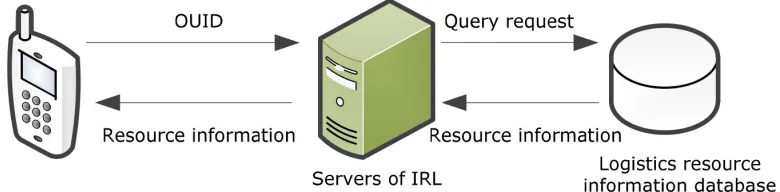
When company needed to know the delivery information, it can scan the two dimensional bar-code to get goods order information, vendor information, product information, etc. However, because of many different kinds of two dimensional bar-code, when mobile phone read two-dimensional bar-code, some two-two-dimensional bar-code information can be obtained only through installing enterprise designated APP on mobile phone. Otherwise, the phone just gets a string of unrecognizable characters. OUID application environment based on OID can be a good solution to this problem.
Figure 7. Process of Two Dimensional Bar-code Information Query Using Mobile Phone
information flow mentioned above. At last, using the result of resolution found corresponding logistics resource information database to get the logistics resource information required.
(2) The application of RFID
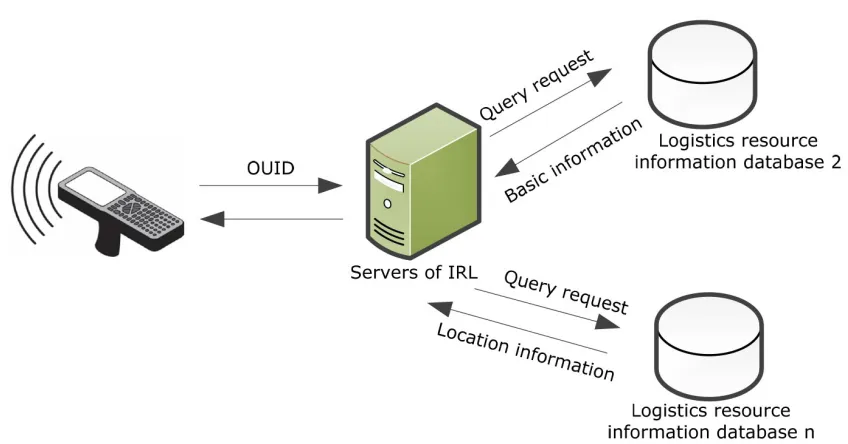
Figure 8. Process of RFID Information Query
When an enterprise wanted to collect the information about the pallets, such as location information of the pallet, vendor information, storage information, etc., it can use the RFID tags on pallets.
Firstly, RFID read-write devices collected OUID within the target scope. Then, they sent OUID to IRL. Because of the strong liquidity of pallets, many servers may have their location information records. So IRL got pallet location information from many specific information servers, besides the pallet basic information. After IRL servers returned the whole pallet information to query terminal, the query task was completed.
5. Conclusion
To ease the influence of non-unified object identifier on logistics resource integration, this study designed the OUID method, and analyzed the OUID application environment by using the computer technologies and standardized method. Specific measures were as follows. (1) Introduce the standard identification code. In order not to change the existing identifier standards, the standard identification code was introduced in object identifier with the help of OID standard. Let object identifier have the OUID structure based on OID. The structure can guarantee object identifier unique in the world, realize compatible query and transformation among multiple object identifiers, and both adapt to the current technology development environment and meet the needs of the logistics resources integration. (2) Construct identifier resolution layer (IRL). The current network structure can't resolve the OUID based on OID, so IRL formed by DNS, OID resolution servers and other servers of standards organizations used to finish resolving OID so as to help address information. This network structure allowed administrators to control data administrator, to realize the traceability of logistics information, classifying information, monitoring and management information, dynamic routing forwarding, etc. On the basis of OUID and IRL, object identifier can confirm logistics resource type, quantity, function, capability and feasible mode of transportation among the various facilities in a certain space through resource static and dynamic location information, except for resource
basic information. Moreover, application scenarios of two dimensional bar-code and RFID were list to illustrate the application of OUID method, in order to guide the promotion of OUID.
Overall, OUID proposed both reflected the conversion thought and considered the reality of the Internet information discovery mechanisms. It made up for the lack of location information in conversion mechanism, and avoided to promote new unified identifier standards at the same time. The supplement of the application environment provided an important support to solve the problems of poor communication caused by non-unified object identifier in the process of logistics resource integration. In addition, this paper also had some shortage. For instance, the demand for logistics resource integration OUID was still insufficient in the aspect of data. Therefore, the future research will focus on the above aspect, in order to improve this study.
Acknowledgements
References
CASAGRS. (2010). RFID and the inclusive model for the internet of things. Available at:
http://www.grifs-project.eu/data/File/CASAGRAS%20FinalReport%20(2).pdf
CERP-IoT. (2009). Internet of things strategic research roadmap. Available at:
http://www.grifs-project.eu/data/File/CERP-IoT%20SRA_IoT_v11.pdf
GB/T 26231-2010. (2010). Information technology-Open systems interconnection-National numbering system and registration procedures for Object identifier (OID).
Hribernik, K.A., Kramer, C., Hans, C., & Thoben, K.D. (2010). A Semantic Mediator for Data Integration in Autonomous Logistics Processes. In: K. Popplewell, J. Harding, R. Poler & R. Chalmeta (Eds.). Enterprise Interoperability IV, 157-167. Springer-Verlag London.
Ilie-Zudor, E., Kemény, Z., van Blommestein, F., Monostori, L., & van der Meulen, A. (2011). A survey of applications and requirements of unique identification systems and RFID techniques. Computers in Industry, 62(3), 227-252. http://dx.doi.org/10.1016/j.compind.2010.10.004
Jung, E., Choi, Y., Lee, J.S., & Kim, H.J. (2012). An OID-based identifier framework supporting the interoperability of heterogeneous identifiers. In Advanced Communication Technology
(ICACT), 2012 14th International Conference on (304-308). IEEE.
Karakostas, B. (2013). A DNS Architecture for the Internet of Things: A Case Study in Transport Logistics. Procedia Computer Science, 19, 594-601.
http://dx.doi.org/10.1016/j.procs.2013.06.079
Kong, N. (2008). Research on key technology of the resource addressing in the internet of things. PhD. Thesis. Beijing: Graduate University of Chinese Academy of Sciences.
Liu, P., Yan, Z., Tian, Y., Kong, N., Li, X., & Yan, B. (2014). A Discovery Service for RFID Network Based on Hybrid Architecture. In: J. J. Park, Y. Pan, C. Kim & Y. Yang (Eds.), Future Information Technology, 849-856. Springer Berlin Heidelberg.
Martinez-Julia, P., & Skarmeta, A.F. (2013). Beyond the separation of identifier and locator: Building an identity-based overlay network architecture for the Future Internet. Computer Networks, 57, 2280-2300. http://dx.doi.org/10.1016/j.comnet.2012.11.020
Pålsson, H., & Johansson, O. (2009). Supply chain integration obtained through uniquely labelled goods: a survey of Swedish manufacturing industries. International Journal of Physical Distribution & Logistics Management, 39(1), 28-46.
Pang, X.T. (2012). Research on the Resource Addressing Features in the Internet of Things.
Information System Engineering, 1, 64-65.
Prajogo, D., & Olhager, J. (2012). Supply chain integration and performance: The effects of long-term relationships, information technology and sharing, and logistics integration.
International Journal of Production Economics, 135(1), 514-522.
http://dx.doi.org/10.1016/j.ijpe.2011.09.001
Romano, P. (2003). Co-ordination and integration mechanisms to manage logistics processes across supply networks. Journal of Purchasing and Supply Management, 9(3), 119-134.
http://dx.doi.org/10.1016/S1478-4092(03)00008-6
Shan, L.H., Zhang, Z.Y., Wang X.F., & Chen, Z.W. (2011). Analysis of Logistics Network and Resources Integration Based on System Theory. Journal of Beijing Jiaotong University (Social Sciences Edition), 10(2), 47-53.
Spleiß, C., & Kunzmann, G. (2011). A Naming Scheme for Identifiers in a Locator/Identifier-Split Internet Architecture. In ICN 2011, The Tenth International Conference on Networks
(57-62).
Sun, H., Zhang, J.H., Qin, S.W., Tu, Q.W., Wang, X.W., & Wu, Q.Z. (2013).Research on unified coding system of Internet of things. Application Research of Computer, 30(9), 2707-2710.
Yang, H.R. (2013). Address-based Items Identification and Query Scheme for Internet of Things. Thesis. Guangzhou: South China University of Technology.
Yu, H., & Yu, X. (2013). A Multi-path Concurrency Object Universal Search (MCOUS) Algorithms based on Code in Internet of Things. Intelligent Computer and Applications, 3(2), 25-31.
Zhang, D. (2012). Internet of things and Object identification system. Internet of things technologies, 2(3), 1-4.
Journal of Industrial Engineering and Management, 2015 (www.jiem.org)
Article's contents are provided on a Attribution-Non Commercial 3.0 Creative commons license. Readers are allowed to copy, distribute and communicate article's contents, provided the author's and Journal of Industrial Engineering and Management's names are included.