COMMUNICATIVE ASPECTS OF MULTILINGUAL CODE SWITCHING IN
COMPUTER-MEDIATED COMMUNICATION
Pilar Caparas
1Leah Gustilo
2Western Mindanao State University, Zamboanga City1 De la Salle University, Manila2
[email protected]; [email protected]2
First received: 11 March 2017 Final proof received: 25 September 2017
Abstract
The quintessential role of language has been punctiliously studied relative to intercultural communication, cultural heritage, social development, education, identity construction and many more domains. One forum wherein language is investigated is the Computer-mediated Communication (CMC), which provides a fertile ground for linguistic and sociolinguistic analyses. The present study aims at investigating the preferred codes used in code switching (CS), functions of CS, and the motives of users for employing CS in CMC. The present study was based on the investigation of 200 status updates and 100 wall posts of 50 Facebook accounts of students who are enrolled in a leading state university in Mindanao and professionals who graduated from the same university. Besides English and Filipino, these Facebook users speak various regional languages such as Chavacano, Cebuano, and Tausug. Their posts were analyzed employing eclectic approaches in analyzing inter-sentential and intra-sentential code switching. The findings reveal that the preferred code in their online communication is Taglish. It implies that Taglish is an equalizer, non-privileging, non-discriminating, and more unifying. The primary reason for CS is because of real lexical need. Besides the given categories, the study determined four other reasons for CS, namely: to express ideas spontaneously, to retain native terminology, to express disappointment, and to promote relationship. The findings vouch for the viability of regional languages to co-exist with English and other languages in the gamut of human interactions in the internet.
Keywords: computer-mediated discourse; internet code switching; internet language
Language plays an important role in intercultural communication, preservation of cultural heritage, social development, achievement of quality education, identity construction, and so on (Van Deusen-Scholl, N., 2003). Hence, being gifted with the ability to speak other than one’s mother tongue holds several benefits. Being a multilingual speaker proffers advantages, which include cognitive, learning, communication, cultural, personal, and employment benefits (Fritz, 2016).
Language users in multilingual/bilingual communities can communicate in two or more languages. Because of language contact and language policy, code switching from one language to another is inevitable. Code switching, which also appears as ‘codeswitching’, and ‘code-switching’ in the literature, broadly refers to the systematic use of two or more languages or varieties of the same language during oral or written discourse (Skiba, 1997). Code switching has been perceived by some as a less ideal language behavior, a characteristic of an incompetent, imperfect bilingual (Boztepe, 2003). However, research has documented that it is no longer viewed as a deviation from the ‘normal’ linguistic practices (Thomson, 2003); it is an important part of the linguistic repertoire in
multilingual speech communities (Smedley, 2006; De Fina, 2007; Gonzalez, 2004; Go & Gustilo, 2013).
journalistic writing (Hua, 2012; Leung, 2006; Onysko, 2007; Tajolosa, 2013).
The scarcity in the literature of online code switching especially in the local setting and the significance of findings that could increase our understanding of language contact in the internet, therefore, justifies the need for the present study. This qualitative study aims to investigate the participants’ preferred code in online communication, the patterns, and functions of their code switching, and the reasons why they code switch. The linguistic investigation on code switching has been approached by scholars in either structural or sociolinguistic perspective: the structural approach focuses on the grammar aspects of CS, while the sociolinguistic approach focuses on the functions it serves (Boztepe, 2003). The present study situates itself within the sociocultural linguistics approach (Nilep, 2010). It seeks to describe the syntactic configurations of code-switching while identifying the reasons it serves.
How and why do people code switch?
First, bilingual speakers mixed the languages available to them for various communicative purposes, such as marking social class identity, education, and modernization. Kamwangamalu (1989) demonstrated these functions in his study which addressed (1) whether or not there were structural constraints on code mixing, (2) whether there were language-universal as opposed to language-specific constraints on code mixing, (3) the kind of underlying grammars or linguistic systems that allowed the bilingual to engage in code mixing, and (4) why bilingual speakers tended to engage in code mixing.
Second, speakers rely on CS in order to express group identity. Wahdani (2010) analyzed code switching and code mixing in the characters of the novel Macarin Anjing by Christian Simamora. Her findings revealed that the characters employed code switching and code mixing to express group identity. The characters who belong to the same speech community utilized both English and Bahasa Indonesia in their dialogues. The findings indicated that code switching and code mixing were only used within their speech community.
Code switching facilitates learning. Many studies on code switching also provided reasons why teachers (and also students) used code switching in the classroom. Notable and more recent studies which conformed to this function include: Then and Ting (2011), Ahmad and Jusoff, (2009), Then and Ting (2009), and Chowdhury (2012). The participants of these studies were mostly teachers and students in English and Science classes. Primarily, in Then and Ting (2011) study of secondary school teachers and students in Malaysia, the findings suggested that code switching facilitates
learning. This finding supported their previous finding in 2009, which revealed that CS was a useful resource for teachers to achieve teaching goals in content-based lessons involving students who lacked proficiency in the instructional language. In addition, in response to the declining proficiency level among English language learners in Malaysia, Ahmad and Jusoff‘s study in 2009 addressed (1) learners’ perception of teachers’ code switching, (2) the relationship between teachers’ code switching and learners’ affective support, (3) the relationship between teachers’ code switching and learners’ learning success and the (4) future use of code switching in students’ learning. The study involved 257 students with low English proficiency and found that low-proficient English learners perceived code switching as a positive strategy due to the various functions it has.
Code switching is used as a communicative strategy. Chung (2006) posited that CS functions as a communicative strategy for facilitating family communication by lowering language barriers. Lee (2010) claimed that children employed CS as a communicative strategy to organize and structure their discourse, such as turn-taking, repairs and side-sequences. Metila (2009) revealed that the communicative function of CS allowed the students to express themselves in the class. Gocheco (2013) who examined the functions of CS in television-mediated political campaign advertisements (TPCA) in the Philippines showed that code switching was used by choice to integrate sense from more than one language and maximize communication strategies.
Recent studies involving discourse analysis in computer-mediated communication showed that individuals code switch for several reasons. Choy (2011) investigated the functions and reasons of code switching on Facebook among Mandarin Chinese-English students of Universiti Tunku Abdul Rahman (UTART). Their findings suggested that CS occurs in online communication mainly to serve referential, expressive and metalinguistic functions. Shafie and Nayan (2013) examined the language used on Facebook wall posts and comments, code switching practices and functional orientations of CS among multilingual university students. Their findings indicated that while the majority of these functions were categorized under friendship maintenance orientation, situational CS between English and Bahasa was heavily utilized.
language choices by preceding contributions or to challenge other participants’ language choices, (6) contextualizing a shift of topic , (7) marking jokes or serious discourse and mollifying face threatening acts, and (8) indicating agreement, disagreement, conflict, distancing.
This study hopes to contribute novel findings in the already vast research on CS. It aimed to determine the patterns and functions of code switching and the motives for code switching in Computer-Mediated Communication among Filipino college students and professionals.
Specifically, the present study sought to answer the following research questions:
1. What are the preferred codes in the inter-sentential and intra-sentential switching used by Filipino students and professionals in their Facebook wall posts and status updates?
2. What are the functions of CS manifested in the posts?
3. What are the motives of FB users in employing CS in the posts?
Communicative Competence
For the purpose of studying the communicative aspects of code switching in computer-mediated communication, the study adapted the first comprehensive model of communicative competence which is that of Canale and Swain (1980) to account for the “underlying systems of knowledge and skills required for communication” (p. 16) described as follows. (1) Grammatical
competence refers to the knowledge of the language
code (grammatical rules, vocabulary, pronunciation, spelling, etc). In code switching, this competence can be displayed in the development of meta-linguistic and meta-cognitive competence. Students (and other individuals) are supposed to bring them (languages) together in other places for rhetorical purposes (Canagarajah, 2003). (2)
Sociolinguistic competence refers to the mastery of
the socio-cultural code of language use (appropriate application of vocabulary, register, politeness, and style in given situation). This may also refer to the “probabilistic rules of occurrence concerning whether something is ‘sayable’ in a given context” (Street & Leung, 2010, p.293). (3) Discourse
competence which refers to the ability to combine
language structures into different types of cohesive texts (e.g. political speech, poetry). In the studies of code switching for example, discourse competence can be manifested when “the speaker develops a competence to alternate between the two available languages to convey subtle pragmatic message while in the company of other bilinguals” (Halmari, 2004, p.115). (4) Strategic Competence, which refers to the knowledge of verbal and non-verbal communication and, where necessary, enables the learner to overcome difficulties when
communication breakdown occurs. Hymes’ ideas on communicative competence were taken up by applied linguists from one field to another. This study will also be anchored on this model.
Code switching defined
CS is the alternation of the syntactic elements of two languages within one utterance (McClure, 1977). The numerous definitions used to define CS imply different ways in describing it. Some scholars distinguished CS from code mixing, while others used CS to cover both. The present study treats all instances of code alternation as code switching, following the definitions of scholars in the succeeding discussion.
Hymes (1974) defines CS as “a common term for alternative use of two or more languages, varieties of a language or even speech styles” (p.91). Gumperz’ (1982) seminal definition of CS indicated that it is the “juxtaposition within the same speech exchange of passages of speech belonging to two different grammatical systems or subsystems” (p.59), while Gardner-Chloros (1991) emphasized that switching can occur not only between languages but also between dialects of the same language. In addition, Milroy and Muysken (1995) define CS as “an alternative use by bilinguals of two or more languages in the same conversation” (p.7). These varied definitions were used in the various studies of CS. There are two general types of CS: intra-sentential and inter-sentential CS.
Intra-sentential code switching
The term intra-sentential is used to refer to switching within the sentence (Koban, 2013). In an analysis of this kind, it is important to establish the matrix and embedded languages used in CS. The matrix language (ML) is the ‘principal’ language, while the ‘embedded’ language (EL) is the second language (Coulmas, 1998). Further, the matrix language “is the main language of code-switched utterances unlike the embedded language which is the less dominant language and plays a lesser role” (Kebeya, 2013, p. 229). Myers-Scotton (1993b in Kebeya, 2013, p. 230) identifies two principles, which guide the analysis in determining the matrix language and embedded language, namely: (1) the ML provides the largest proportion of lexical items in the CS text, while the EL provides fewer items; (2) it is the ML that sets the morpho-syntactic frame of the sentences in code-switched material. The present study concurs with these principles.
Inter-sentential code switching
language, and sometimes it is followed by another totally different language.
Functions of code switching
The present study is anchored on the analytical framework of Hoffmann (1991) and Saville–Troike (1986) to categorize the functions of code switching on Facebook. Examples were drawn from FB posts to exemplify the categories. All code switching instances involving Philippine languages are translated into English and italicised in the excerpts presented in this present paper.
Talking about a particular topic.People sometimes
prefer to talk about a particular topic in one language rather than in another. Sometimes a speaker feels free and more comfortable in expressing his/her feelings in a language that is not his/her everyday language. The Visayan speaker in example (1) uses English and Tagalog, which are not her every day and regional language.
FB Post Translation
(1) I’ve seen the truth and it was all clear to me. Alam ko na. Hindi naman pala lahat ng expect mo is totoo. Sometimes kailangan nating magsacrifice to know the truth.
Now I know. Not all that you expect is true. Sometimes we need to sacrifice to know the truth…
Quoting somebody else’s statements. A speaker
switches code to quote a famous expression, proverb, or saying of some well-known figures as in example (2).
FB Post Translation
(2) Sabi nga ni Ed Sheeran,
“The worst things in life come free to us.”
Ed Sheeran said,…
Being emphatic about something. When speakers
want to be emphatic about something, they either intentionally or unintentionally switch from their second language to their first language or vice versa like in example (3).
FB Post Translation
(3) Mag-aaply ka na lang ng trabaho, sinama mo pa nanay mo. IS THIS ENROLMENT?
You’re going to apply for work, you brought your mother with you…
Interjection (inserting sentence fillers or sentence
connectors). Interjections are words or expressions
which are inserted into a sentence to convey surprise, strong emotion, or to gain attention. Interjections are short exclamatory words or expressions such as darn, hey, well and the like. In (4), the interjection is Kewl (cool).
FB Post Translation
(4) siomai plus puso! Kewl!
siomai plus rice wrapped in coconut leaves! Cool!
Repetition used for clarification. A message in one
code is repeated in the other code to clarify or amplify the message. In example (5), SUPLADA, in English, ‘snobbish,’ was repeated in English to clarify and amplify the meaning of SUPLADA in Tagalog.
FB Post Translation
(5) May mga nagtetext sakin sinasabihan ko na DELETE MY NUMBER, ang reply nila sa akin: “SUPLADA”. Oo, I’m SNOBBISH because you do not know me.
Those who texted me to whom I replied “DELETE MY NUMBER,” they replied to me: SNOBBISH. Yes, I am SNOBBISH because you do not know me.
Clarification of the speech content. Speakers code
switch to clarify the content of the message. The code switched information in (6) explains what was meant by the speaker in the previous sentence.
FB Post Translation
(6) BIG TURN OFF? Those guys who post as singles, yung nagagalit pag nagpost ang GF nila sa wall nila.
… they get mad when their girlfriends post something on their wall.
Expressing group identity. Speakers use terms that
are used within their speech community to express group identity. The example in (7) is a post in Tausug. Mga bagay was used to address the speakers of Tausug.
FB Post Translation
(7) Mag hinang na kita niyu ASSIGNMENT mga bagay.
Let’s do our
ASSIGNMENT friends.
Saville–Troike (1986:69) also gives some reasons as to why speakers mix their languages. These are the following:
To soften or strengthen a request or command.
Code switching can strengthen or soften a command since the speaker can feel more powerful than the listener can because he can use a particular language. The Visayan speaker in (8) used Tagalog intra-sentential CS to soften a threatening admonition.
FB Post Translation
(8) Miss… wag na malandi.. may syota na eh... hanap ka na lang sa iyo… yung single. Wag na yung mahal ng iba.
Because of real lexical need. Speakers code switch due to the lack of equivalent lexicon in their language as in (9). Schedule is a borrowed word that is not present in Chavacano.
FB Post Translation
(9) bien bale gad
SCHEDULE na 2-J! with my papabols.
Very good SCHEDULE of 2-J! with my handsome boyfriends.
To limit the intended audience. Sometimes
speakers use the language that not everyone knows to communicate within their group like in example (10).
FB Post Translation
(10) KARI NA KAMU MGA BUDDY! AHUN TV DIIH RAH SAAN HAH WMSU!
COME NOW BUDDY! THERE’S THIS TV ONLY FOUND IN WMSU!
These categories were used to analyze the reasons for code switching that are evident in the wall posts and status updates of Filipino Facebook users in the present study.
METHOD
Data gathering techniques
This study utilized texts as data from Facebook wall posts and status updates of college students and professionals who are the researchers’ FB friends. Purposeful sampling is used. To investigate the motives of the participants in employing CS on their Facebook, the researchers conducted unstructured interview to 20 participants via mobile phones and recorded the conversations using the same mobile phones used by the researchers.
Participants
The present study recruited 26 students from a university in Western Mindanao and 24 alumni of the same university who are working professionals in different industries all over Mindanao. The professionals (10 Male & 14 Female), their ages ranging from 20-25 years, speak English and Tagalog, but their regional languages differ. Sixteen are Chabacano, 6 are Visayan, 1 Tausug and 1 Tagalog. Most of them (20) are natives of Zamboanga city, 2 from Basilan, 1 from Zamboanga del Norte and 1 from Jolo.
The undergraduates (15 Male & 11 Female), their ages ranging from 17-22 years, are all currently enrolled at the university. They speak English and Tagalog. Ten of them are Chavacano, eight are Cebuano, five are Tausug and three are Tagalog. Most of them (19) are residents of Zamboanga city since birth, four from Zamboanga del Norte, two from Basilan and one from Jolo. They have been exposed to the multilingual setting in and out of the classroom. Practically all of them have been exposed to these regional languages in Zamboanga
city. A few of Visayan from Zamboanga del Norte and Muslim from Jolo have difficulty in speaking Chavacano, but they understand the Chavacano language.
Data collection procedure
Facebook timelines of possible participants were browsed to see instances of CS before selecting them. They were invited to participate in the study through a letter posted in their Private Messages Inbox. Those who consented were asked to give some information, which the study used to describe the participants. There were 200 statuses and 100 wall posts collected from the 50 Facebook users. The length of each post varies from short phrases to sentences. In other words, most have short messages while others have longer ones. Each post was copied and pasted in the Microsoft Word. The code-switched lines from English to regional languages were translated into English.
One-third of the corpus was subjected to inter-coding. The inter-coder is a native Chavacano who also speaks and understands Tagalog, Visayan and Tausug languages and a graduating Ph.D. student. Initially, she verified all the translations done by the researchers and then categorized the posts into the subcategories under inter-sentential and intra-sentential switching following the principles of Myers-Scotton (1993). Finally, she identified the functions of CS using the taxonomies of Hoffman (1991) and Saville–Troike (1986).
The researchers and the inter-coder achieved 100% agreement in classifying intra-sentential switching, while they achieved 90% in classifying the inter-sentential. However, 100% agreement was achieved after the parameters indicated in the analytical framework of the study were reviewed and applied.
In coding the reasons for CS, a painstaking analysis was made by reviewing the posts several times. The researchers’ and inter-coder’s knowledge and exposure to these speakers in Zamboanga City have helped them in coding the messages and decisions made.
Lastly, additional data were gathered to determine the motives of the participants in employing CS when communicating on Facebook. An unstructured interview was conducted to 20 participants to determine their motives. The interview was done via telephone using a mobile phone and recorded by the same phone. Interview data were transcribed. The process of reducing the data, which enabled the researchers to verify and draw out conclusions, was done following the procedures described by Miles and Huberman (1994).
Data analysis
and intra-sentential CS. Further categorizations were made for inter-sentential CS wherein the patterns of switches were identified as (1) Taglish (Tagalog to English), (2) Engalog (English to Tagalog), (3) Tagalog to Other Regional Languages (ORL), (4) English to Other Regional Languages, (5) Other Regional Languages to Tagalog, (6) Other Regional Languages to English. Frequency counting determines the preponderance of these categories. Also, further categorizations were made for intra-sentential switching wherein the researchers identified the Main Language (ML) and the Embedded Language (EL) following the same patterns of switches with that of the inter-sentential switching.
To answer question number two, What are the functions of code switching manifested in the posts,
the same data used in research question number one were categorized according to the taxonomies of Hoffmann (1991) and Saville-Troike (1986). Lastly, to answerresearch question number three, What are their motives in employing code switching on their wall posts and status updates, each interview transcript was transcribed, coded and analyzed following the same categories in research question number two.
RESULTS AND DISCUSSION Preferred code in CS
Table 1 summarizes the preferred languages used in CS. As can be seen, of the 348 CS instances identified, 272 are intra-sentential and only 76 are inter-sentential switching. Noteworthy is the finding
that close to one-third of the total intra-sentential switching show that Tagalog is the ML and English is the EL; hence, the pattern is Taglish. This result indicates that in multilingual environment such as Zamboanga city, Taglish is widely used. Taglish or Tagalog-English code switching or Tagalog-English mix-mix, the alternation of Tagalog and English in the same discourse or conversation (Gumperz, 1982) is said to be “the language of informality among middle class, college-educated, urbanized Filipinos” (Bautista, 2004, p.1). Recently, Bautista (2004) has stated that “Taglish has been viewed as a mode of discourse and linguistic resource in the bilingual’s repertoire” (p.1). The finding of this research affirms Bautista’s claim that “it is now the lingua franca in the Philippine cities” (p.1). It is worth noticing that almost 30% of the intra-sentential switching shows that English is the matrix language (ML) and Tagalog is the embedded language (EL); hence, the pattern is Engalog. In addition, one-fourth of the intra-sentential switchings used ORL as the matrix language and English is the embedded language; hence the pattern is ORL-Eng or the use of Other Regional Languages to English.
Equally interesting are the results on the coded subcategories in the inter-sentential switching. Significantly, almost 40% of the total occurrences of inter-sentential switching is from English to Tagalog. Hence, the pattern is Engalog. Tagalog to English (Taglish) and English to ORL (Eng-ORL) showed the same number of occurrences being the second most preponderant codes in the inter-sentential switching.
Table 1. Preferred codes used in the CS of FB users
Codes Intra-sentential Inter-sentential Frequency Percentage Frequency Percentage
Taglish 93 34.19 17 22.37
Engalog 77 28.30 30 39.47
ORL-Eng 71 26.10 9 11.84
Eng-ORL 15 5.51 17 22.37
Tag-ORL 11 4.04 1 1.31
ORL-Tag 5 1.84 2 2.63
Total 272 100.00 76 100.00
Intra-sentential CS with Tagalog as ML and English as EL
In examples (11-12), the participants used English words that do not have equivalent lexicon in Tagalog.
FB Post Translation
(11) Buti naalala ko pa username at password nitong account na to.
(12) Wow blackout na naman sa Zamboanga.
Good thing I still remember my username and password in this account.
Wow, it is blackout again in Zamboanga.
There are also inserted English words that have equivalent words in Tagalog such as in (13) in which blessing was used instead of the Tagalog word pagpapala.
FB Post Translation
(13) Wala nang ikakasaya pa kapag nag-increase blessing mo.
There is nothing more fulfilling than having more blessings.
Intra-sentential switching with English as the ML and Tagalog as the EL
FB Post Translation
(14) Show me your evidence na nasolve nyo.
(15) If someone says PANGET KA,
just smile and say, every creature is beautiful.
If someone says YOU ARE UGLY, just smile and say, every creature is beautiful.
Inter-sentential CS showing English to Tagalog pattern
While the intra-sentential switching predominantly showed a Taglish pattern, the inter-sentential code switching is predominantly Engalog in pattern, as exemplified by examples (16-17).
FB Post Translation
(16) I know about you, but I’m feeling twenty-two.
Kinanta ko nalang mahal.
(17) How are you? Ingat ka lagi.
I just sing it my love.
You take care always.
It is always assumed that when one posted a message, he or she wanted it to be read and understood by readers. This is one of the reasons why a Facebook user who can express well in the English language switches to Tagalog.
Functions of code switching
Real lexical need. This is the most widely used
reason or function of CS in the corpus. It constitutes almost 20% of the total coded functions of CS. Montes-Alcala (2005) described this type as the most ill-defined of all categories since the issue of a real need is a very relative one. According to her, “each and every lexical switch fulfills a need, although under no circumstances should this be interpreted as lack of language proficiency, but rather as lack of an exact equivalent in the other languages” (Montes-Alcala, 2005, p.105). It was also noted in the definition of code mixing by McClure (1981) who argues that code mixing occurs when a person temporarily does not have access to a word for a particular concept or in need of terms to express the concept he wishes to convey. An example of this function was exemplified in sentence (9) in the previous discussion.
Clarification of speech content. This is the second
most widely used function of CS identified in the data as it has 62 instances or almost 15% of the total coded functions. If a Facebook user feels that the language he used in writing his post may not be sufficiently specific, he or she may attempt to clarify his or her meaning by switching to another language as exemplified earlier in example (6) and in example (18) below:
FB Post Translation
(18) Hindi nila kasi alam
yung totoong
nararamdaman ko na sometimes I feel like an outcast.
They do not really know my real feelings that ...
In (18), the Facebook user expressed her feeling initially in Tagalog but expressed it further in English. She switched to English because the word ‘outcast’ was more specific, and it carried the exact meaning of what she felt.
Being emphatic about something. Emphasis may
go either way–Taglish, Engalog, or other regional languages to English in asking for a request or command, expressing thoughts and feelings, stressing a topic one wanted to address to someone, or expressing solidarity. CS for emphasis was used 49 times in the corpus and is exemplified in examples (3) and (19).
FB Post Translation
(19) May mga nagtetext sa akin na unknown numbers tapos sinasabihan ko na DELETE
MY NUMBER.
I tell those who are texting me using unknown numbers to …
The writer emphasized her points by switching from Tagalog to English “DELETE MY NUMBER”. The emphasis was indicated also by the upper case writing.
The analysis of the present study reveals that emphasis was shown in code-switched utterances on the following situations: 1) the writer chose specific and stronger words to emphasize something and to indicate the tone of the message; 2) the writer capitalized the words being emphasized; and 3) the writer used several exclamation points or question marks in punctuating the sentences.
Directing the post to an in-group. Facebook users
code switch if they intend to direct their messages to an in-group or a closed group which can be their classmates, colleagues, friends, or family members. Facebook users used this function 35 times in the corpus. They exclude the people outside their group by using a language that the out-group does not know but a code that is close to the heart of the Facebook user’s in-group. In such situations, the other language functioned as a “secret code” as in (20) wherein the post was intended for those who have knowledge of the language used in the post.
FB Post Translation
(20) “Numa yatu yura, last ya man se, gradua yatu. Selos lang sila kuntigo.” Chene point el di miyo nobyo. Padayun lang mga HATERS.
“Do not cry anymore, that will be the last, you’re going to graduate… they just envy you.” My boyfriend has a point. Just go on HATERS.
ideas spontaneously, (2) retaining native terminology, (3) expressing disappointment, and (4) promoting relationship.
Expressing ideas spontaneously. This function
accounts for seven percent (7%) of the total coded code switching. This function shows that the writers switch to another language using common expressions and formulaic language such as fixed expressions (e.g., good night, I swear) to spontaneously express their ideas as in example (21-22).
FB Post Translation
(21) First time makatouch screen phone. Paxenxia na.. goodnight!!!
(22) Ang sarap grumadweyt. I swear!
First time to have a touch-screen-phone. Sorry…
It’s great to graduate…
Other common expressions and formulaic language found in the data include: you don’t do
that to me, see you, turn-on, killjoy,good afternoon,
good morning, goodeve, get lost, happy monthsary,
atik ra ‘jokeonly’, drive through, thanks for adding andaccepting me, thank you, masha Allah ‘religious
expression’, felices pascua a todos ‘merry
Christmas to all’, and day off.
Retaining native terminology. FB users switch to
the native terms in their language to maintain the use of the concepts they want to express (e.g., Misa de Gallo, Aswang) as shown in (23) and (24).
FB Post Translation
(23) 8th day of Misa de Gallo with sir Joe.
8th day of Night Mass with sir Joe
(24) So, ASWANG ya tamen si Mang Pepe.
So, Mang Pepe plays as the evil spirit.
Expressing disappointment. FB users switch to
another language, usually regional language, to express disappointment subtlety and with indirectness by sounding funny as in (25) in which the writer switches to Chavacano to express her thought against her fake friends.
FB Post Translation
(25) Nagsimula na ang PLASTIC BAN… Naku paano ang mga plastic kong kaibigan? Bueno kaninyo bende por kilo para tiene tamen kita ginansya! LOL
PLASTIC BAN has started. What will happen to my fake friends? It is good to sell them in kilos to gain profit. LOL
Promoting relationship. Fb users switch code to
boost and maintain relationship with friends, family, co-workers, and students as in (26) in which a mother showed affection by switching in her greeting from English to regional language to call her child langgah meaning ‘dearest.’
FB Post Translation
(26) To our unico iho and forever baby boy, happy birthday langgah.
To our only son and forever baby boy, happy birthday,
dearest.
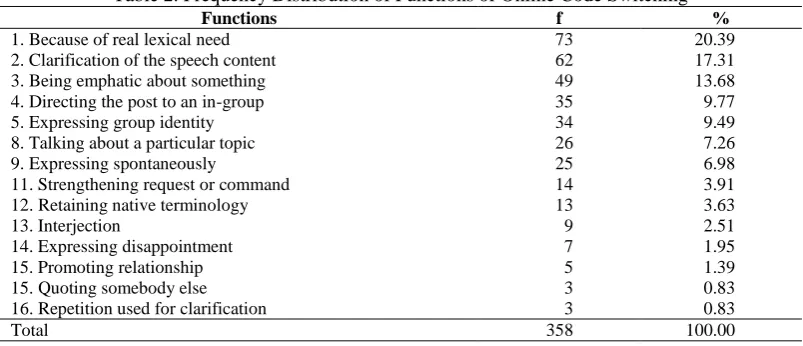
The other reasons together with the functions previously discussed and their frequency of occurrences are summarized in Table 2.
Table 2. Frequency Distribution of Functions of Online Code Switching
Functions f %
1. Because of real lexical need 2. Clarification of the speech content 3. Being emphatic about something 4. Directing the post to an in-group 5. Expressing group identity
8. Talking about a particular topic 9. Expressing spontaneously
11. Strengthening request or command 12. Retaining native terminology 13. Interjection
14. Expressing disappointment 15. Promoting relationship 15. Quoting somebody else 16. Repetition used for clarification
73 62 49 35 34 26 25 14 13 9 7 5 3 3
20.39 17.31 13.68 9.77 9.49 7.26 6.98 3.91 3.63 2.51 1.95 1.39 0.83 0.83
Total 358 100.00
Motives for Code Switching
The replies of the participants regarding their motives for CS were coded following the categories of Hoffman (1991) and Saville-Troike (1986). Three-fourths of the interviewed participants pointed out that they switched codes in order to fill lexical gap not only because they could not find the
These findings further indicate that they employed CS to make their messages clear and comprehensible for Facebook readers so that they can draw comments and be ‘liked’ and achieve an effective and dynamic interaction in CMC.
CONCLUSION
The findings of the present study reveal that CS is being practiced by Filipino college students and professionals when communicating through their Facebook wall posts and status updates. Most of the time, they used it because of lexical need, because they want to clarify the content of their speech, and because they want to be emphatic about something. The findings suggest that online communication is a quintessential place for code switching.
Looking closely at the types of switching they used, the findings show that intra-sentential switching with Tagalog as the main language, and English as the embedded language (Taglish) is the most preponderant switching Facebook users employed on Facebook.
Taglish Intra-sentential switching is utilized five times more than the use of inter-sentential switching. This finding supports Bautista’s (2004) claim that Taglish is the lingua franca in the Philippine cities and Go and Gustilo’s (2013) statement that Taglish has gained acceptance among majority of Filipinos as a communicative strategy. These findings can create ripples of implication. First, it implies that Taglish is an equalizer. It breaks social gaps. It bridges the gap between people speaking different languages in the Philippines. Second, it is non-privileging and non-discriminating as other speakers from different regions who did not come from Tagalog-speaking regions also used Taglish in their computer-mediated communication. Third, Taglish is less divisive and it is more unifying. People from all walks of life in the Philippines can speak it.
Equally significant is the finding that the dominant pattern of inter-sentential switching is from English to Tagalog (Engalog). This finding strongly suggests that we cannot undermine the role of the English language as the dominant global language of communication.
In addition, it seems to imply that code switching can be accommodated in line with the language of profession and academic discussion, which is viable in internet communication. As Filipinos appropriated the resources of the English language, it also enriched English communication by code switching. Filipinos find it beneficial to be competent in English and other languages in the Philippines to be effective communicators in different situations including online communication. Moreover, the findings have pedagogical implications. If CS has made online communication dynamic, it would prove beneficial also in the
classroom. Allowing CS in class can promote greater interactivity because it widens comfort zone for students to participate more, aiding their second language learning. The findings also reveal that next to Taglish and Engalog, Other Regional Languages to English is the third most dominant intra-sentential switching pattern. This is highly indicative of the Filipinos’ pride as Chavacano, Visayan and Tausug speakers. This finding vouches for the viability of regional languages to co-exist with English and other languages in the gamut of human interactions in the internet.
ACKOWLEDGMENT
Western Mindanao State University and De la Salle University are gratefully acknowledged for supporting the research.
REFERENCES
Ahmad, B., & Jusoff, K. (2009). Teachers’ code-switching in classroom instructions for low English proficient learners. English Language Teaching, 2(2), 49-55. Retrieved from
http://www.ccsenet.org/journal/index.php/elt/a rticle/view/2363.
Androutsopoulos, J. (2013). Code switching in
computer-mediated communication. Retrieved
from
http://jannisandroutsopoulos.files.wordpress.co m/
2009/12/2010-code-switching-in-cmc-2nd-draf t.pdf.
Bautista, M. L. (2004). Tagalog-English code switching as a mode of discourse. AsiaPacific Education Review, 5(2), 226-233. Retrieved from
http://Springer.com/Article/10.007%2F13F030 24960#page1.
Boztepe, E. (2003). Issues in code-switching: Competing theories and models. Working Papers in Applied Linguistics and Tesol,3(2), 1-27. Retrieved from
http://journals.tclibrary.org/index.php/tesol/arti cle/view/32/37.
Canagarajah, S. (2003). Forward. In G. Smitherman and V. Villanueva (Eds.), Language diversity in the classroom: From intention to practice.
The Conference on College Composition and Communication of the National Council of Teachers of English, Carbondale, IL; Southern Illinois Press, ix-xiv.
Canale, M., & Swain, M. (1980). Theoretical bases of communicative approaches to second language teaching and testing. Applied Linguistics, 1, 1-47.
A Bangladeshi perspective. Stamford Journal of English, 7, 40-61.
Choy, W. F. (2011). Functions and Reasons for Code-Switching on Facebook by UTAR English-Mandarin Chinese Bilingual Undergraduates (Undergraduate thesis). UTAR, Malaysia. Retrieved from
http://eprints.utar.edu.my/263/1/EL-2011-0803 813-1.pdf%20
Chung, H. H. (2006). Code switching as a communicative strategy: A case study of Korean–English bilinguals. Bilingual Research Journal, 30(2), 293-307.
Coulmas, F. (1998). The handbook of
sociolinguistics, volume 4. Hoboken, New Jersey: Wiley-Blackwell.
De Fina, A. (2007). Code-switching and the construction of ethnic identity in a community of practice. Language in Society,36, 371-392. Dino, C., & Gustilo, L. (2015). Digitalk: An
exploration of the linguistic features of CMC.
International Journal of Languages, Literature, and Linguistics, 1(1), 51-55. Ellison, N. B., Steinfield, C., & Lampe, C. (2011).
Connection strategies: Social capital implications of Facebook-enabled communication practices. New Media and Society, 13(6), 873–892.
Fritz, G. K. (2016). The benefits of being bilingual.
The Brown University Child and Adolescent Behavior Letter, 32(5), 8-8.
Gardner-Chloros, P. (1991). Language Selection
and Switching in Strasbourg. Oxford: Oxford
University Press.
Georgakopoulou, A. (1997). Self-presentation and interactional alignments in e-mail discourse: The style and code switches of Greek messages. International Journal of Applied Linguistics7(2), 141–164.
Go, M., & Gustilo, L. E. (2013). Tagalog or Taglish: The lingua franca of Filipino urban factory workers. Philippine ESL Journal,10, 57-87.
Gocheco, P. M. (2013). Code –switching in television-mediated political campaign ads in the Philippines. Philippine ESL Journal, 10,
30-56. Retrieved from http://www.philippine-esl journal.com/V10-A2.pdf.
Gonzalez, M. (2004). Code switching occurrences of an adult with autism (Master’s Thesis). De La Salle University, Manila, Philippine. Gumperz, J. (1982). Discourse strategies. New
York: Cambridge University Press. Gustilo, L. E. (2007). Language and
self-presentation: A linguistic analysis of filipino personal home pages. Philippine Journal of Linguistics,38(1-2), 39-63.
Gustilo, L. E., & Dino, C. M. (2017a). Old speak or young speak: An analysis of netspeak features.
Advanced Science Letters, 23(2),1099-1103. Gustilo, L.E., & Dino, C.M. (2017b). Digitalk: An
analysis of linguistic features and their functions in CMC. Advanced Science Letters, 23(2), 1055-1059.
Halmari, H. (2004). Codeswitching patterns and developing discourse competence in L2. In D. Boxer and A. Cohen (Eds.), Studying Speaking
to Inform Second Language Learning (p.115).
Retrieved from
http://books.google.com.ph./books? Isbn=0521479126.
Hoffmann, C. (1991). An introduction to
bilingualism. New York: Longman.
Hua, W. (2012). The study of codeswitching in advertisements. Intelligent Computing Technology Lecture Notes in Computer Science, 7389, 579-585.
Hymes, D. (1974). Foundations in sociolinguistics:
An ethnographic approach. London: Longman.
Hayati, I., & Abdul, R. G. (2012). Construction of Knowledge on Facebook. 3L: Language Linguistics Literature, Southeast Asian Journal of English Language Studies. 18(3), 61 – 72. Kamwangamalu, N. (1989). Code-mixing across
languages: structure, functions, and
constraints (Doctoral Dissertation). University of Illinois). Retrieved from
http://kanagawa.lti.cs.cmu.edu/11719/sites/def ault/files/Chapter_1_Dissertation.pdf.
Kebeya, H. (2013). Inter- and intra-sentential switching: Are they really comparable?
International Journal of Humanities and Social Science, 3(5), 225-233.
Koban, D. (2013). Intra-sentential and inter-sentential code-switching in
Turkish-English bilinguals in New York City, US. Procedia-Social and Behavioral Sciences,
70, 1174-1179.
Lee, W. (2010). Code switching as a communicative strategy in a Korean-Heritage language classroom (Master’s thesis). San Diego State University, San Diego, USA. Retrieved from http://sdsu-dspace.calstate.edu/bitstream/handl e/10211.10/526/Lee_Wona.pdf?sequence=1. Leung, C. (2006). Codeswitching in print
advertisements in Hong Kong and Sweden.
(Master’s Thesis). Lund University, Lund, Sweden. Retrieved from
http://lup.lub.lu.se/luur/download?func=downl oadFile&recordOId=1325529&fileOId=13255 30.
McClure, E. F. (1977). Aspects of code-switching in the discourse of bilingual Mexican-American children. Center for the Study of Reading
Technical Report; no. 044. Retrieved from
pt.pdf?sequence=1http://journals.upd.edu.ph/in dex.php/edq/article/download/2018/1913. McClure, E. (1981). Formal and functional aspects
of the code-switched discourse of bilingual children. In R. Duran (Ed.), LatinoLanguage
andCommunicative Behavior, 69-94.
Metila, R. (2009). Decoding the switch: The functions of codeswitching in the classroom.
Education Quarterly 67(1), 44-61. Miles, M. B., & Huberman, A. M. (1994).
Qualitative data analysis: An expanded
sourcebook. Thousand Oaks: Sage
Publications.
Milroy, L., & Muysken, P. (1995). Introduction: Code-switching and bilingualism research. In L. Milroy & P. Muysken (Eds.), One speaker two languages: Cross-disciplinary
perspectives on code-switching (pp. 1-14). Montes-Alcala, C. (2005). “Dear Amigo”:
Exploring code-switching in personal letters. In L. Sayahi, & M. Westmoreland, Selected proceedings of the second workshop on Spanish Sociolinguistics, Somerville, USA.
Retrieved from
http://www.lingref.com/cpp/wss/2/paper1144.pdf. Myers-Scotton, C. (1993). Duelling Languages.
Oxford: Oxford University Press.
Nilep, C. (2010). Code switching and language alternation. Retrieved from: Society for Linguistic Anthropology:
http://linguisticanthropology.org/blog/2010/02/ 04/code-switching-and-language-alternation/ Onysko, A. (2007). Anglicisms in German:
Borrowing, lexical productivity, and written codeswitching. Berlin: Walter de Gruyter. Paolillo, J. C. (1996). Language choice on soc.
culture. punjab. Electronic Journalof Communication, 6(3), n3.
Palacio, M., & Gustilo, L. (2016). A Pragmatic Analysis of Discourse Particles in Filipino Computer-Meditated Communication. Gema Online Journal of Language Studies, 16(3), 1-19.
Saville-Troike, M. (1986). The ethnography of communication: An introduction. Oxford: Basil Blackwell.
Shafie, L. A., & Nayan, S. (2013). Languages, code-switching practice and primary functions of Facebook among university students. Study in English languageTeaching 1(1), 187-199. Skiba, R. (1997). Code switching as a countenance of
language interference. The Internet TESL Journal, 3(10), 1-6.
Smedley, F. (2006). Code-switching and identity on the blogs: An analysis of Taglish in computer mediated communication (Master’s Thesis). Auckland University of Technology, Auckland, New Zealand.
Street, B., & Leung, C. (2010). Sociolinguistics, language teaching and new literacy studies. In N. H. Hornberger and S. L. McKay (Eds.),
Sociolinguistics and language education,
290-316.
Tajolosa, T. D. (2013). Motivation for code switching in advertising and the construction of consumers’ multiple identities: the case of Philippine TV commercials. Philippine ESL Journal, 11, 48-84.
Then, D., & Ting, S. H. (2009). Researching code-switching in teacher classroom discourse: Questioning the sufficiency of informant reports. The International Journal – Language Society and Culture, 33, 8-18. Retrieved from https://www.academia.edu/2749310/Researchi ng_codeswitching_in_teacher_classroom_disc ourse_Question-ing_the_sufficiency_of_infor mant_reports.
Then, D., & Ting, S.H. (2011). Code-switching in English and science classrooms: More than translation. International Journalof Multilingualism, 8(2), 187-204. Thomson, R. M. (2003). Filipino English and
Taglish: Language switching from multiple
perspectives. Amsterdam: John Benjamins.
Wahdani, N. S. (2010). Analysis of code switching and code mixing in the novel Macarin Anjing by Christian Simamora. Retrieved from http:// www.syafiqajja.blogspot.com/2010/01artikel-s kripsi-code-switching-and-code.html.