Issues
ISSN: 2146-4138
available at http: www.econjournals.com
International Journal of Economics and Financial Issues, 2015, 5(Special Issue) 281-285.
2nd AFAP INTERNATIONAL CONFERENCE ON ENTREPRENEURSHIP AND BUSINESS MANAGEMENT (AICEBM 2015), 10-11 January 2015, Universiti Teknologi Malaysia, Kuala Lumpur, Malaysia.
Exploring Reduce, Recycle and Reuse (3Rs) Awareness,
Practice among Oil and Gas Workers and its Influence on Their
Productivity
Mas Anom Abd Rashid
1*, Mohd Noor Azman Othman
2, Saidatul Shahida Rashid
3, Mohamad Bilal Ali
41Department of Corporate Communication, Faculty of Communication and Media Studies, Kolej Poly-Tech MARA , Malaysia, 2Department of IT, Faculty of Computing and Technological Sciences, Malaysia, 3Department of Applied Management, Faculty of Business Management, Universiti Teknologi MARA, Malaysia, 4Department of Applied Management, Faculty of Business Management, Universiti Teknologi MARA, Malaysia. *Email: [email protected]
ABSTRACT
One of the approaches to reduce waste generated is reduce, recycle and reuse (3R) method. The reduction in waste generated or increase in recycling rates reflects the success of both the government and voluntary public participation. Nowadays, developed and developing countries are trying to find out new ways for climate change mitigation and adaptation options. Developing countries like Malaysia must also look for options to lessen the climate change effect and at the same time increase office productivity particularly on the ways the employees managed their supplies, resources and generated waste. This study is conducted on the office employees at Petronas Berhad with regards to how the manage the generated waste. It is aimed to determine the level of employees’ awareness and attitude towards 3R and determine its influence on their productivity. It was found that the employees have a high level of awareness on 3R, yet their practices are at the low to moderate levels. The authors believed that this could due to the management’s support towards the 3R is not as high as expected by the office employees.
Keywords: Recycle, Reuse, Awareness, Waste Generated, Productivity
JEL Classifications: Q4, Q5
1. BACKGROUND OF STUDY
According to Olson (2008), adopting the green culture in people needs the appropriate tools and training. The awareness of the green environment among employees should be measured on a consistent basis. The concept of green environment in an organization is not widely propagated to the point the employees
are not aware of the influence of the environmental awareness
toward the productivity.
Moreover, the consequences of the environmental awareness can bring positive impacts towards the employees. Armitage et al. (2011) believed that 100% of Australian employers and employees alike thought that the green building was better than expected with all things considered. They considered that
green buildings have much positive impact rather than the non-green buildings. Besides, the productivity of employees is likely to increase as the absenteeism can be reduced due to the conductivity of the work environment.
According to Cole and Fieselman (2013), the benefits from the
green environment culture can result in cost, resource and time savings which inevitable create a green office environment.
Through the study, the green environment is able to help employees to improve their productivity level.
used are posters, pamphlets, bulletins and electronic medium such as television, radio, websites, school buses, light rail transit, billboards, exhibition, carnivals and seminar. According to Agamuthu et al. (2011), based on a survey by the Ministry of Housing and Local Government, there is 100% awareness among the public but only 80% are actually practicing the 3R.
One important reason for this is the insufficiency of facilities,
including collection centres coupled with the inappropriateness in the location of recycling facilities and the schedule of collection. At present, facilities developed include recycling bins, recycling centers, mobile collection unit (van) and recycling lorry.
The 3Rs principle was established to improve waste management system towards a more sustainable approach and to reduce human ecological footprint. The authors believe that the implementation of 3Rs can boost economic activities, reduce environmental impacts from waste disposal, prevent the loss of resources and lengthen
landfills operating life. Though the implementation of 3Rs has been
successful in many developed countries, the accomplishment among the developing nation is yet to be seen. Many factors are contributing towards the failure of 3Rs implementation in most developing
countries including Malaysia. Among others is the lack of efficient
institutional mechanisms in waste management and lack of policy
to promote 3Rs. Malaysia launched the first official 3Rs strategies
in the late 1980s where the campaigns are focused mainly on the recycling activities. It has initiated the participation of various non-governmental organizations. However, the recycling rate was too low that it did not improve the existing waste management practice.
1.1. Statement of the Problem
The authors observed that implementation of green office environment in an organization in Malaysia has not been fully successful due to the employees’ lack of awareness on 3R practices, i.e. some of them are reluctant to follow the policies and procedures. As mentioned earlier, organizations in Malaysia and the government have proposed green environment awareness, i.e. 3R to help the society and people to have a “cleaner” life. In this era of globalization and rapidly changing environment, organizations are clearly facing increase in competition and face regulatory and business pressures. Obviously, the government bodies in Malaysia are providing adequate information regarding green environment issues so as to increase the awareness of and sensitivity towards green environmental issues in organizations. This foregoing discussion leads to the research question regarding
3R awareness, attitude and influence on the productivity among
the employees at Petronas Berhad in Petronas Twin Towers, Kuala Lumpur. Petronas Berhad is the biggest Malaysian conglomerate with global businesses and thus is worthy to be researched accordingly.
1.2. Research Questions
The main aim of this research is to answer the following research questions:
1. What are the levels of Green Office Environment awareness
and attitude among employees at Petronas Twin Towers, Kuala Lumpur City Centre?
2. What is the relationship between Green Office Environment
awareness with employees’ productivity?
3. What is the relationship between Green Office Environment
attitudes with employees’ productivity?
2. AWARENESS OF GREEN OFFICE
ENVIRONMENT
According to Harju-Autti et al. (1999), an environmental awareness is a combination of motivation, knowledge and skills.
The employees should have the knowledge of green office before
they are able to implement the any 3R principle in their work
environment. Within the green office, employees are able to
experience the environment that comforts them and be productive. Zsolnai (2002) stated that a green business is a business that has adopted the concept of environmentalism across the various functions of the business.
2.1. Attitude
Steve and Noah (2012) indicate attitudes as a reflection of a
person’s likes and dislikes towards other persons, objects, events and activities in their environment. According to Deal (2011), people at higher level in an organization have higher organizational commitment than employees at the lower level. The attitude of employee mirrors his outcomes which is the productivity level at work. Saari and Judge (2004) stated that employees have different attitudes or viewpoints about many aspects of their jobs, their careers, and their organizations. This explains why employees react differently and could change. With regards to awareness
towards the green office, at first the employees might not really
care. Then, when they are knowledgeable on the importance of environmental sustainability, they are willing to accept the green
office practices. Velnampy (2007) defined that attitudes are the
feelings and beliefs that largely determine how employees will perceive their environment, commit themselves to intended actions, and ultimately behave. It is based on the working environment
which looks up on what the office has implemented as practice. The practice of green office creates changes in the employee’s
attitude where it can be either positive or negative. Thus attitudes such as involvement and satisfaction contribute to increase the performance of the employees which as evident by studies by Vroom (1964); Lawler and Porter (1967) and Velnampy (2006). According to Akinyele (2007), a conducive work environment ensures the well-being of employees which will enable them to exert themselves to their roles vigorously that may result in higher
productivity. As such, a green office environment can be stated as an office that promotes good environment that will benefit to all
parties concerned especially the employees.
2.2. Productivity
According to Kemppila and Lonnqvist (2003), productivity is an important success factor for all organizations. This study stretches on how the employees’ awareness can affect their productivities in their working environment. The Royal Institution of Chartered
Surveyors (2005) stated that the most significant green building
benefits is related to increased occupant productivity and
satisfaction, exceeding even the projected environmental benefits.
their productivity. Dole and Schroeder (2001) believed that
employees who are more satisfied with the physical environment
are more likely to produce better work outcomes in the workplace. Mohr (1996), stated that the physical environment is a tool that can be leveraged both to improve business results and employee well-being. According to Lasalle (2011), staff participation in sustainable office practices is a powerful tool in driving engagement, reducing cost and enhancing employee productivity.
As such, the green office environment has the possibility to either
increase or decrease the employees’ productivities.
3. CONCEPTUAL FRAMEWORK
The conceptual framework for this study is shown in Figure 1.
3.1. Research Hypotheses
Based on the aforementioned framework, there are two hypotheses in this study:
H1: There is a significant relationship between 3R awareness and employee productivity.
H2: There is a significant relationship between 3R attitude and employee productivity.
3.2. Research Methodology
This is a correlation study looking into the relationship between attitude and awareness of 3R to productivity of the employees at the Petronas Berhad. A sample size of 100 was taken from Human
Resource Office. The unit of analysis for this research consists of all
employees, i.e. the support staff, junior executive, senior executive, manager and senior manager at the company. The sample was extracted using a simple random sampling technique based on the name list provided by the Human Resource Department.
3.3. Instrument
A set of questionnaire modified from instruments developed by
Aminrad et al. (2013) and Gluch et al. (2007) which consists of four sections were used in this study. The Section 1 is about the background information which consists of 6 items which includes the respondent’s demographic profile such as gender, age,
education level, status, working experience, and position held. The Section 2 includes the implementation of 3R at the organization. It seeks to measure the respondent’s awareness of 3R practice at
the organization, which consists of 5 items. Section 3 indicates the level of respondents attitudes towards 3R consisting of 10 items. The last part consists of 5 items related to productivity level after the implementation of 3R.
4. DATA FINDINGS
4.1. Demographic Analysis
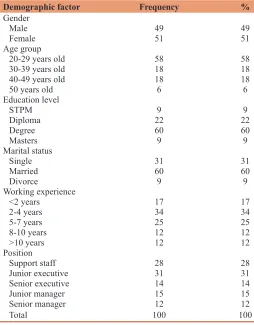
Table 1 shows the descriptive analysis of the demographic factors of the study.
Table 1 shows that there were 49% male and 51% female who have participated in the survey. About 58% of the respondents are from the age group of 20-29 years old. There were 18% of 30-39 years old and 40-49 years old groups. Finally, 6% of the respondents are more than 50 years old.
Table 1 also indicates that the majority of the respondents are holding post as junior executive (31%). In contrast, the senior managerial position consists of 12% while the rest of the
Table 1: Profile of the respondents
Demographic factor Frequency %
Gender
Male 49 49
Female 51 51
Age group
20-29 years old 58 58
30-39 years old 18 18
40-49 years old 18 18
50 years old 6 6
Education level
STPM 9 9
Diploma 22 22
Degree 60 60
Masters 9 9
Marital status
Single 31 31
Married 60 60
Divorce 9 9
Working experience
<2 years 17 17
2-4 years 34 34
5-7 years 25 25
8-10 years 12 12
>10 years 12 12
Position
Support staff 28 28
Junior executive 31 31
Senior executive 14 14
Junior manager 15 15
Senior manager 12 12
Total 100 100
STPM: Sijil Tinggi Persekolahan Malaysia (English: Malaysian Higher School Certificate)
Table 2: Reliability analysis
Variables Cronbach’s alpha No. of items
3R awareness 0.756 5
Employee attitude 0.965 10
Employee productivity 0.919 5
3R: Reduce, recycle and reuse
INDEPENDENT VARIABLE IV
DEPENDENT VARIABLE DV R A
P
A
Figure 1: 3R awareness and attitude influence on Petronas employees’
respondents comprise of support staff (28%), senior executive (14%) and junior manager (15%).
4.2. Reliability Analysis
Table 2 presents the reliability analysis of each construct in the questionnaire. All of the calculated values indicated high statistical
reliability due to the Cronbach’s alpha coefficient of greater than
0.7 (Nunnaly, 1978).
RQ1: What is the level of 3R awareness and attitude among employees at Petronas Kuala Lumpur?
Table 3 presents the finding to answer RQ1 that is the levels of 3R
awareness and attitude among employees at Petronas.
It is evident that the employees at Petronas Kuala Lumpur have a moderately high level of awareness (mean = 3.794) of the 3R practice. They are aware of the 3R programs and have exposures
on the issue related to green environment and its benefits. Based on the finding shown on Table 3, the mean for attitude is 3.147 indicating that the Petronas employees’ attitude towards 3R is at the moderately low level. This is evident by the fact that the majority of the employees used recycle paper for taking notes with a mean of 3.72 and the mean for employee preferred to send e-mails instead of written memos and letters on hardcopy/paper is 3.69.
RQ 2-3: What are the relationships of 3R awareness and attitude towards employee productivity?
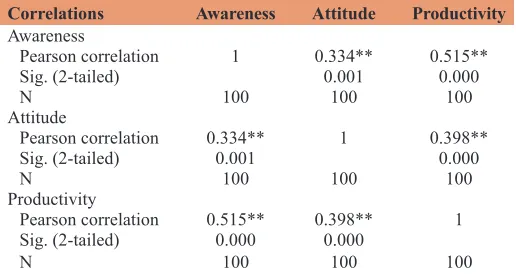
Table 4 shows the answer to research question 3 which is whether there is a relationship between Petronas employee 3R and productivity.
Based on the results of the correlational analyses, it is evident that
there is a moderately high but positive significant relationship
between 3R awareness and employees productivity at Petronas Kuala Lumpur, where the Pearson Correlation value is 0.515 (p = 0.001). Thus HO1 isrejected. However, 3R attitude has at a moderately low but significant relationship to employees’ productivity, i.e. the Pearson Correlation value is at 0.398 (p = 0.001). HO2 isrejected. These findings indicate that the
employees at Petronas Kuala Lumpur are aware of 3R and accept 3R, however, their attitude towards 3R has a weaker relationship with productivity.
5. CONCLUSION AND RECOMMENDATION
The authors conclude that the employees have a moderate level of awareness on 3R, yet their productivity stood between low to moderate. This could be due to the management support towards the 3R is not as high as expected as 3R movement and practices need to have strong support from the top management. Bouten and Sophie (2013) claimed that top management commitment and the presence of an environmental champion are important considerations for improved productivity. Management should also have high awareness of 3R to fully support the movement and to ensure that it 3R will be one of the standard practice in the organization.
One possible recommendation that can be put forward is the management involvement in the green movement. This is supported by a study by Fok et al. (2009) that indicated employees who believe that their organizations are aligned with the green movement are more likely to also see better outcomes in terms of overall performance. Management has to understand that such movement needs to be made a policy so that the 3R spirit among the worker can be part of the organizational culture instead of the
flavor of the month approach as practiced by most problematic
companies.
REFERENCES
Agamuthu, P., Chenayah, S., Fauziah, S.H., Victor, D. (2011), 3R Related Policies For Sustainable Waste Management In Malaysia in Conference Proceedings of ‘Innovation and Sustainability Transitions in Asia’, Kuala Lumpur, Malaysia, Paper 135.
Akinyele, S.T. (2007), A critical assessment of environmental impact on workers productivity in Nigeria. Research Journal on Business Management, 1(1), 50-61.
Aminrad, Z., Zakaria S.Z.S., Hadi, S., Sakari, M. (2013), Relationship between awareness, knowledge and attitudes towards environmental education among secondary school students in Malaysia. World Applied Sciences Journal, 22(9):1326-1333.
Armitage, L., Murugan, A., Kato, H. (2011), Green offices in Australia: A user perception survey. Journal of Corporate Real Estate, 13(3), 169-180.
Bouten, L. Sophie, H. (2013), On the interplay between environmental reporting and management accounting change. Management Accounting Research, 24(4), 333-348.
Cole, E.J., Fieselman, L. (2013), A community-based social marketing campaign at pacific University Oregon: Recycling, paper reduction, and environmentally preferable purchasing. International Journal of Sustainability in Higher Education, 14(2), 176-195.
Deal, J.D. (2011), Workplace Attitudes: Positive Managers, Positive
Table 3: 3R awareness and attitude levels Descriptive statistics
Factors No Minimum Maximum Mean Std. deviation
3R awareness 100 2.20 4.80 3.794 0.50006
Attitude 100 1.30 4.50 3.1470 0.83611
Valid N (listwise) 100 3R: Reduce, recycle and reuse
Table 4: Corelational analyses between 3R awareness,
attitude and productivity
Correlations Awareness Attitude Productivity
Awareness
Pearson correlation 1 0.334** 0.515**
Sig. (2-tailed) 0.001 0.000
N 100 100 100
Attitude
Pearson correlation 0.334** 1 0.398**
Sig. (2-tailed) 0.001 0.000
N 100 100 100
Productivity
Pearson correlation 0.515** 0.398** 1
Sig. (2-tailed) 0.000 0.000
N 100 100 100
Organizations. Center for Creative Leadership. January, 2011. Dole, C., Schroeder, R.G. (2001), The impact of various factors on the
personality, job satisfaction and turnover intentions of professional accountants. Managerial Auditing Journal, 16(4), 234-245. Fok, L.Y., Zee, M.L., Hartman, S.J. (2009), Employee perceptions
of organizational commitment to the green movement, quality management maturity and outcomes. The Coastal Business Journal Spring, 8(1), 1-17.
Gluch, P., Brunklaus, B., Johansson, K., Lundberg, O., Stenberg, A., Thuvander, L. (2007), What makes it slow? A questionnaire survey of environmental attitudes, management and performance. Available from: http://www.epubl.ltu.se/1402-1528/2007/18/LTU-FR-0718-SE.pdf#page=214.
Harju-Autti, P., Kreft-Burman, K., Partanen-Hertell, M., Pemperton, D. (1999), Raising Environmental Awareness in the Baltic Sea Area. Helsinki: Finnish Environment Institute.
Hughes, J. (2007), Office design in pivotal to employee productivity. Sandiego: The Daily Transcript.
Kemppila, S., Lo¨nnqvist, A. (2003), Subjective productivity measurement. Journal of theAmerican Academy of Business, 2(2), 531-537.
Lasalle, J.L. (2011), Green Buildings Driving Employee Productivity. Advance, 2011 (September), 1-6.
Lawler, E., Porter, L.W. (1967), The effect of performance on job satisfaction. Industrial relations: A Journal of Economy and Society,
7, 20-28. doi: 10.1111/j.1468-232X.1967.tb01060.x.
Mohr, R. (1996), Office space is a revenue enhancer, not an expense. National Real Estate Investor, 38(7), 46-47.
Nunnally, J.C. (1978), Psychometric Theory, 2nd ed. New York:
McGraw-Hill.
Olson, E.G. (2008), Creating an enterprise-level “green” strategy. Journal of Business Strategy, 29(2), 22-30.
Royal Institution of Chartered Surveyors. (2005), Green Value: Green Buildings, Growing Asset. Available from: http://www.rics.org/ greenvalue.
Saari, L.M., Judge, T.M. (2004), Employee attitudes and job satisfaction. Human Resource Management, 43(4), 395-407.
Steve, M., Noah, Y. (2012), Work environment and job attitude among employeesin a Nigerian work organization. Journal of Sustainable Society, 1(2), 36-43.
Velnampy, T. (2006), Satisfaction and organizational commitment on the impact of performance, 10th Annual International Symposium;
Growth and Challenges for 21st Century. p338.
Velnampy, T. (2006), Satisfaction and Organizational Commitment on the Impact of Performance, 10th Annual International Symposium;
Growth and Challenges for 21st century. p338.
Vroom, V.H. (1964), Work and Motivation. San Francisco, CA: Jossey-Bass