Volume 3, Issue 1, 2016, pp. 217-231 Available online at www.jallr.com ISSN: 2376-760X
* Correspondence: Masoumeh Dousti, Email: [email protected] © 2016 Journal of Applied Linguistics and Language Research
ELT Students’ Gender Differences in the Use of Hedges in
Interpersonal Interactions: A Mixed Method Approach Applied
Masoumeh Dousti *
Ph.D. Candidate in TEFL, Department of Foreign Languages, University of Isfahan, Isfahan, Iran
Abbass Eslami Rasekh
Associate professor, Department of Foreign Languages, University of Isfahan, Isfahan, Iran
Abstract
This study was an attempt to examine the presence of possible differences in the linguistic behavior of male and female ELT major students with respect to the utilization of hedging devices in their interpersonal interactions. To do so, three discussion sessions in a single-gendered context were separately recorded for male and female participants. Frequency counts and chi-square were used to analyze the obtained data. The findings of the study showed females’ more tendency to employ hedging devices. Moreover, a focus group interview was held. The identified themes revealed different functions of hedging devices for female participants including their desire to welcome others’ opinions, to be friendly, and to build good rapport with their interlocutors. However, the participants firmly rejected their lower social status as the reason for their more use of hedges. The findings of this study may pave the way to better understand the world of communication.
Keywords: hedges, gender differences, interpersonal interaction, linguistic behavior, academic context
INTRODUCTION
back to 1975 when Lakoff’s acknowledged book entitled “Language and Woman's Place” was first published. Although the distinction between males and females’ conversational styles is absolutely observable (O’Loughlin, 2000), empirical research about gender-associated language has attracted the attention of a good number of sociolinguists (Vassileva, 2001; Eckert & McConnell-Ginet, 2003; Holmes & Meyerhoff, 2003; Vold, 2006; Jalilifar, 2007; Letsoela, 2013; Samaie, Khosravian, & Boghayeri, 2014).
In line with such empirical studies, a number of theories are proposed to shed light on the noticed distinction in the linguistic behavior of males and females. Four approaches to gendered speech being identified by Coates (1986) are presented in the literature, which are deficit, dominance, difference, and dynamic approaches.
Deficit approach ascribed to Jespersen (1922) identifies males’ language to be standard and that of females inherently deficient. Hence, females’ language is evaluated on the basis of males’ language which is treated as the benchmark.
Dominance approach attributed to Zimmerman and West (1983) addresses females’ subordination and males’ supremacy in social interactions. This approach considers male-centered language to be more conspicuous. The deficit and dominance theories relate women’s linguistic inadequacies to the existing unequal political and cultural status of men and women. These theories highlight the secondary role of women in society which directly leads to the overt use of mitigations and redundant qualifiers by female speakers.
In order to highlight the difference between the selected linguistic devices by different genders, the phrase “women’s language” was offered by Lakoff (1975). One of the features that Lakoff (1975) has mentioned to be prominent in women’s language is the utilization of lexical hedges as a class of devices employed to soften and add uncertainty to the utterances. According to Hyland’s (2004) models of metadiscourse, hedges are interactional metadiscourse devices which reveal the speakers’ orientation toward propositional statements and release the speaker from commitment to the accuracy of propositions in the academic settings. To put it in other words, hedges can reveal the speakers’ attitudes toward the listener along with his degree of certainty about the veracity of the statements.
The ability to effectively use hedges arms the speaker with a kind of communicative ability that in the case of use increases or reduces the illocutionary force of the utterance (Hyland, 1998). Hedges contribute to employ appropriate communicative tone and acceptable epistemic as well as affective meanings.
REVIEW OF LITERATURE
Fraser (2010) considers hedging as a rhetorical strategy employed by the speaker which signals the reduction of commitment to the force of the conveyed speech acts. Taking into account the significant role of hedges in negotiation of ideas in general and academic claims in particular, a good number of studies have addressed the utilization of hedges in academic discourse across different languages, cultures, and disciplines (Samaie, et al., 2014; Millan, 2008; Martı´n-Martı´n, 2008; Jalilifar, 2007; Vold, 2006; Kong, 2006; Hyland, 2005; Dahl, 2004; Hyland & Tse, 2004; Martı´n-Martı´n & Burgess, 2004; Vassileva, 2001). In order to examine the disciplinary influences in the use of hedges as one category of the interpersonal metadiscourse markers, Abdi (2002) found significant differences with respect to the utilization of these devices in the published articles of natural and social sciences. The results revealed that articles of social sciences were heavily hedged in comparison to those of natural sciences. In contrast to the findings of the previous study, in another research conducted by Jalilifar (2007), no significant difference was observed between articles of humanities and natural sciences with respect to the utilization of hedges. In that study, the context and frequency of hedges were focused on in forty research articles in humanities and natural sciences written by Iranian and English authors. In spite of no significant differences, the writers of these papers aimed at being objective in reporting their results and providing implications rather than making sharp claims.
use in undergraduates’ research reports, the findings revealed that hedges as members of interactional metadiscourse category are of highest degree of frequency.
To examine the possible role of culture in use of hedging devices by authors with different languages, the frequency of hedges were calculated in the published papers. For example, Vassileva (2001) meticulously investigated the utilization of hedges in the introduction, discussion, and conclusion sections of articles in linguistics in English, Bulgarian, and Bulgarian English. The observed variations were considered as signs of maintaining cultural identity while using English as the dominant language in academic communication. Similarly, Samaie et al. (2014) investigated the type and frequency of hedges used in the introduction section of articles. Specifically, they gathered a random sample of forty articles in the field of literature written by Persian and English native speakers. The obtained results of the analysis revealed that Persian writers are less tentative in presenting their claims while English native speakers took advantage of more hedges in rejecting or accepting the ideas of other authors.
Besides all these areas of investigation about the utilization of hedges, addressing the presence of gender differences with regard to the use of hedges is worth of scrutinizing as Gorjian (2008) believes that identification of the gender differences in language use will lead to a more pleasant world of communication. To highlight the importance of gender-specific language use, Saffarian and Gorjian (2012) considered the research on the presence of differences in men and women’s language use to be an appropriate response to one of the most popular questions. The highly influential work of Lakoff (1975) as the pioneer in introducing gender differences in language use attracted many adherents of socio-cultural approach in language studies to examine her claims. One of the ten linguistic features characterizing females’ speech is various kinds of hedges which are claimed to be outstanding in females’ conversation (Lakoff, 1973). However, Lakoff’s claim is just based on her introspection which is demonstrative of a methodological weakness; hence with the notification of this weakness, a good number of empirical studies have focused on this issue.
SIGNIFICANCE OF THE STUDY
There are a number of reasons behind the logic for conducting the research about the differences in the types and frequency of hedges in males and females’ oral communicative interactions in the academic setting of Iran.
First, Lakoff (1975) has hypothesized that women’s language is immature, hyper-formal, hyper-polite, and non-assertive. However, if the dynamic nature of gender’s speech is taken into account as stated by Michaelson and Margil (2001), it is worth investigating lakoff’s claim after a few decades. In line with other studies, the present study considered Lakoff’s (1975) work as the starting point to examine its validity in a less touched upon context, i.e. Iranian academic context, with respect to lakoff’s claim after about four decades.
Second, lakoff’s claims are based on the use of introspective method and lacks empirical evidence; hence gathering real data to test her proposed hypothesis seems necessary. Third, in order to examine the proposed claim of a number of researchers (Rakow, 1986; Thorne, Kramerae, & Henley, 1983; Uchida, 1992) who attribute gender differences in using linguistic devices in communications to the political inequalities that are present between genders, the present study aims at focusing on hedging in academic communication. In other words, the discussion about the effect of political status and lack of authority on the application of a number of linguistic devices to reflect uncertainty in communications requires new array of investigation and needs to be confirmed in the new century with the undeniable presence of women in the academic and political settings.
Fourth, as the literature review presented in the previous section demonstrates, there seems to be lack of studies focusing on hedges in spoken discourse in the academic setting. The majority of the studies conducted on hedges examined the written discourse; hence, further research seems to be required in this area.
Fifth, Lakoff (1973) has emphasized that in order to effectively address the utilization of hedges, the context must be focused on. Furthermore, according to Varttala (2001), in academic settings, it is of high priority to attend to the expectations of that academic community as taking part in a conversation requires attending to the social norms of that particular language community. So, addressing the use of hedges in Iranian context may reveal interesting findings.
Sixth, according to Pickering and Garrod (2004) whatever methodologies that focus on single speakers’ language use are non-normative as they neglect providing conditions for interaction. The importance of this interaction stems from the fact that the inherent aspect of language use relates to the social and interactive features. Hence, the interactions occurring in Iranian academic context are worth examining.
1. What are the types and frequency of hedges employed by male ELT university students in their interpersonal interactions within the academic setting?
2. What are the types and frequency of hedges employed by female ELT university students in their interpersonal interactions within the academic setting?
3. Are there any significant differences between different genders in terms of the types and frequency of the employed hedges in the interpersonal interactions within the academic setting?
METHOD
Participants
To accomplish the objectives of this study, 35 (17 male and 18 female) BA university students majoring in ELT recruited for speaking/listening 2 course credit as part of their ELT program requirements were chosen. They were all native speakers of Turkish and Kurdish and their age ranged from 18 to 21. The selection of these participants was based on a non-probability convenience sampling procedure. To address their homogeneity, it must be mentioned that all these students had successfully passed BA university entrance exam which is a competitive one in Iran. Moreover, they all had passed their speaking/listening 1 course in the previous semester. Hence, it can be concluded that these participants enjoyed the same level of proficiency.
Data collection procedure
Discussion groups
The discussions were held in a single-gendered context. Males’ group consisted of 17 members while females’ group consisted of 18 participants.
Discussion topics
Some researchers believe that males and females’ language may be affected by the selected topics (Brown, Dovido, & Ellyson, 1990). To tackle with the mentioned issue, 15 topics were given to another student sample doing their fifth semester of their BA to rank the topics on the basis of the degree to which they can be considered as gender-biased topics. Then the six topics which were judged to be less biased were chosen for the discussion sessions. The discussions around the following topics were used as data: technology and social networking, youth and old age, and money and shopping. The reasons for analyzing just three discussion sessions from among the six available recorded discussions is presented in the following section.
Discussion sessions
the researcher and the effect of researcher’s presence on the performance of the participants was reduced to the minimum, only the obtained data of the last three discussion sessions were selected for the analysis. Each discussion was lasted 30 minutes and the overall amount of recorded discussions for the three sessions was one and half an hour for each group.
Unit of analysis
To decide about the unit of analysis, a number of criteria were taken into account. Since the study examined the communicative oral interaction taking place among the participants in the discussion sessions, sentence could not be a good candidate for being the analysis unit. This issue becomes more tangible if the nature of oral discussions is attended to as this kind of interaction is full of incomplete sentences. Moreover, making decisions about where a sentence finishes and a new one begins is difficult due to the presence of lots of pauses in spontaneous speech. Hence, Nemati and Bayer’s (2007) unit of analysis, i.e. utterance, appeared to be more suitable for this study. On the basis of their definition, “the whole linguistic production of each person, in a conversation, in each turn, be it a single sound, a word, phrase, sentence, or even a series of sentences can be considered as one utterance” (p.192).
Taxonomy of hedges
The taxonomy of hedges provided by Salager-Meyer (1997) was employed for the analysis of the transcriptions. His taxonomy consists of seven main categories which are: 1. Modal auxiliary verbs: e.g., may, can, would, should, etc.
2. Modal lexical verbs: These are speech act verbs mostly employed to reveal one’s doubt and evaluation: e.g., to indicate, to believe, to appear, to suggest, to assume, to seem, etc. 3. Adjectival, adverbial, and nominal modal phrases: a) probability adjectives: e.g., probable, possible, b) nouns: e.g., assumption, possibility, claim, c) adverbs: e.g., presumably, perhaps, probably, likely, possibly.
4. Approximators of degree, quantity, frequency, and time: e.g., about, approximately, usually, roughly, generally, often.
5. Introductory phrases: e.g., it is our view that, to our knowledge, I believe, we feel that. 6. If clauses: e.g., If true, if anything
7. Compound hedges: Salager-Meyer (1997) distinguishes double hedges (it may suggest), treble hedges (it seems reasonable to assume that) and quadruple hedges (it would seem somewhat unlikely that).
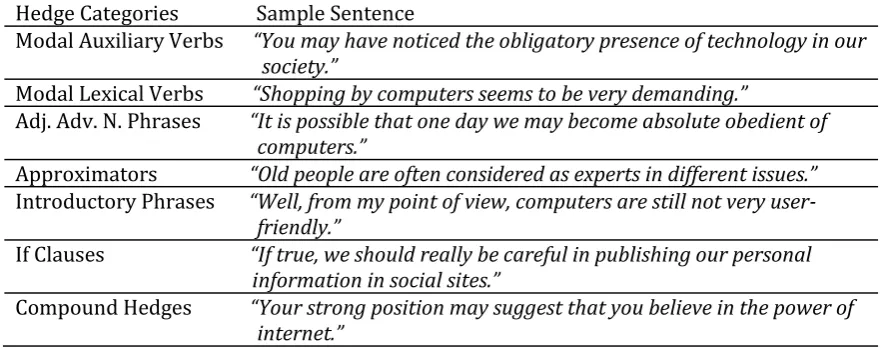
Table 1. Examples of hedge uses drawn from data Hedge Categories Sample Sentence
Modal Auxiliary Verbs “You may have noticed the obligatory presence of technology in our c society.”
Modal Lexical Verbs “Shopping by computers seems to be very demanding.”
Adj. Adv. N. Phrases “It is possible that one day we may become absolute obedient of computers.”
Approximators “Old people are often considered as experts in different issues.” Introductory Phrases “Well, from my point of view, computers are still not very user- friendly.”
If Clauses “If true, we should really be careful in publishing our personal information in social sites.”
Compound Hedges “Your strong position may suggest that you believe in the power of internet.”
Semi-structured interviews
After the analysis of data, a semi-structured interview was used to explore female participants’ opinions about their more use of hedging devices. As recommended by Fielding and Thomas (2001), a focus group interview which requires the participants to negotiate their ideas was conducted. All female participants were asked to take part in the interview session; however, just 10 participants were present to express their opinions in the interview session.
Data analysis
To address the first and the second research questions examining the frequency of the hedges in male and female ELT university students’ interpersonal interaction, frequency counts were used. To answer the third question with respect to the presence of any significant differences between different genders in terms of the frequency of the employed hedges in interpersonal interaction, Chi-square test was applied.
RESULTS
To analyze the data, first of all the number of utterances produced by male and female participants was calculated. As Table 2 shows female participants produced more utterances (n=640) in comparison to male participants (n=573) within an equal amount of time, i.e. one and half an hour. The overall number of produced utterances was 1213 as shown in the following table.
Table 2. Males and females’ produced utterances Produced
Utterances
Males Females Total
573 640 1213
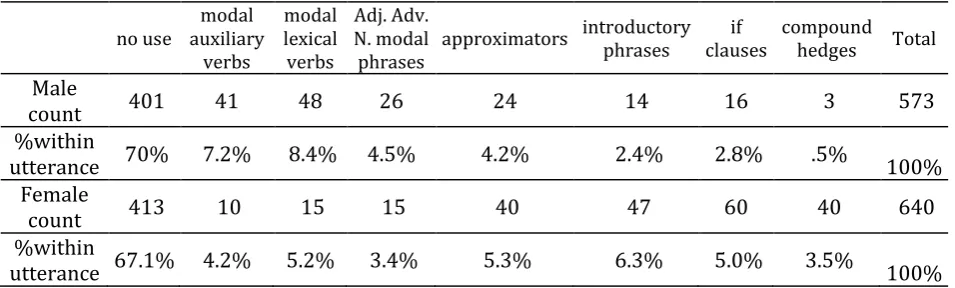
types used by male speakers were related to modal lexical verbs with 8.4% of the produced utterances. However, introductory phrases with 6.3 % of the produced utterances forms the chief part of females’ applied hedges.
Table 3. Utterances and hedge types
no use auxiliary modal verbs
modal lexical verbs
Adj. Adv. N. modal
phrases approximators
introductory
phrases clauses if compound hedges Total Male
count 401 41 48 26 24 14 16 3 573
%within
utterance 70% 7.2% 8.4% 4.5% 4.2% 2.4% 2.8% .5% 100% Female
count 413 10 15 15 40 47 60 40 640
%within
utterance 67.1% 4.2% 5.2% 3.4% 5.3% 6.3% 5.0% 3.5% 100%
To answer the third research question addressing the presence of any differences between genders in terms of the employed hedges in interpersonal interaction within the academic setting, Chi-square test was used. Table 4 is indicative of the results of this test. The Chi-square test for independence indicated a significant association between gender and hedge use, X2 (7, n = 1213) = 1.15, p = 0.0, phi = .30.
Table 4. Chi-square tests
Value Df Asymp. Sig. (2-sided) Pearson Chi-Square 1.15E2a 7 .00
Likelihood Ratio 125.72 7 .00
Linear-by-Linear Association 48.14 1 .00 N of Valid Cases 1213
a. 0 cells (.0%) have expected count less than 5. The minimum expected count is 19.37.
Although the obtained results revealed the presence of significant difference between genders’ hedge use, the value of Cramer’s V is 0.3 which is reported to be a medium effect size (See Table 5).
Table 5. Symmetric Measures
Value Approx. Sig. Nominal by Nominal Cramer's V Phi .30 .30 .00 .00
N of Valid Cases 1213
DISCUSSION
(Akhmaliah, 2009; Zaini et al., 2012; Ansarin & Bathaie, 2011); however, the results of the study conducted by Samaie et al. are in contrast with the findings of the present study. In order to provide more plausible reasons for the frequent occurrence of hedges in women’s discourse in their interpersonal interactions, an interview session was held in which the interviewees were asked to talk about the underlying reasons for their different linguistic behavior with respect to their more use of hedges. In order to facilitate their explanations, samples of their produced utterances as the stimulus were given to them.
The interview results revealed the application of hedges with different functions for female speakers. The main identified themes showed that female speakers employed hedges to welcome and facilitate others’ participation in the discussions to achieve general consensus, to mitigate their utterances to show their concern and respect for interlocutors’ opinions and their possible disagreements, and finally as a device to be friendly. Moreover, rejecting political inequalities and specifying the crucial role of context in which the interaction was taking place were the other noticed themes.
A good number of interviewees acknowledged the use of hedges to keep the communication move forward to achieve consensus. One of the participants referred to the mentioned issue in this way:
“We used hedges to show our disagreement with others but not in an offensive way. We wanted the discussion to be continued and sometimes we used hedges to politely criticize others’ perspectives.”
One sample of the participants’ use of hedges with the above-mentioned function can be identified in the following sentence produced by one of the participants in the discussion session:
“Although I agree with you that we should welcome the technological tools, from my point of view overuse of such tools may hinder the development of our creativity, do you think so?”
This identified theme can be supported by Holmes’ (1990) study about hedges in everyday conversations which specified a variety of functions for hedges among which affective function received greater attention. This function of hedges is indicative of the speakers’ tendency to establish and sustain interpersonal relations.
With respect to the second identified theme, the participants acknowledged that in the case of being wrong, the extensive utilization of hedges allowed them to leave the room open for expression of opposing opinions. Hence, the use of hedges as devices showing their doubt about the soundness of utterances helped female participants to hold neutral positions. One of the participants expressed it in this way:
is willing to hear others’ opinions. In achieving this goal, hedges are the appropriate devices for me to attend to the potential audience disagreement.”
One selected sentence from the sample showing this function is provided below:
“I think that not all the expensive products have necessarily good qualities as well. What is your idea? It has happened to me that I had spent a lot to buy something with a special brand which was found not to be good as it was expected.”
The other theme that was continually referred to was the participants’ attitude that strongly expressing themselves was not nice or ladylike. Females stated that they avoid that sort of language that evokes the idea of being hostile and unfriendly. Females, moreover, insisted on employing those language devices that empowered them to build good rapport with their interlocutors. They articulated the purpose of the discussions in their speaking/listening course to be primarily experiencing good interaction with their classmates without the presence of the sense of competitiveness.
Some of the participants called the attentions to the issue of Iran’s peculiar culture, one of them stated that:
“I think the use of what you call hedges helps us to seem more liked and polite; however, being direct leads others to judge about the woman speaker to be strident and blunt which are not appreciated traits for women in our culture. I think the attitudes towards acceptable roles for different genders shape how different genders communicate.”
This statement reveals that participants exploited hedges to construct acceptable interactions with their interlocutors while taking into account their country’s cultural norms.
Although female speakers used more hedging devices, relating this finding to the political inequalities was considered to be wrong from their point of view. One of the participants asserted that:
“The fast improvements in the social status that women achieve in Iranian context and their outstanding presence in the academic and political settings are themselves evidences of females’ strong position in our country. Hence, I think that if we use more hedges, it does not relate to our subordinate position in our society.”
Although Holtgraves (2002) refers to the variation in language style in relation to speakers’ status and power and in the two preceding decades, some findings attributed the vast application of hedges by women to their less powerful status (Crawford, 1995; Krauss & Chiu, 1998; Mulac, 1998), the perspective of this study’s females reject those findings and the above-mentioned theme directs a critique towards lakoff’s hypotheses that attributes females’ more tendency to use hedges to their less powerful status.
line with the purpose of interaction. Female participants also mentioned their desire to group the conversational participation and insisted that more utilization of hedges did not reflect their deficiency of knowledge. Female participants specified the priority of being attentive to others’ opinions as their main objective in interactional discourse rather than competing with others to dictate their personal ideas. Moreover, they reminded that in interpersonal interaction they are concerned about establishing and maintaining good relationships with their classmates and being liked and respected by their peers, while in transactional interaction they are more concerned about achieving others’ consensus in specialized conversations. Moreover, they stated that they had great aspiration to prove their high academic status to their peers in specialized classes.
Hence, it can be concluded that different social goals are pursued by men and women. This hypothesis specifies the existence of different sub-cultures for males and females. It further points to male and females’ different behaviors in similar social contexts which are rooted in adaptation of varying cultural ends and norms, all of which are presented in the employed language by males and females.
CONCLUSION
In this concluding section, first a number of implications are presented and then new areas of research to be addressed with the centrality of hedging devices are offered. With regard to implications, the extent to which university students majoring in English put emphasis on the truth value of their claims with the employment of hedging devices can pave the way for their better performance in their future career. As most of these students will become English teachers and as the consequence they will express themselves in the class environments, the way they make claims may be considered as a guide for their students or will influence the acceptance of their ideas by the students. Furthermore, some of these EFL university students will present their personal ideologies or the findings of their action research in academic conferences or even within the teacher education programs, hence these future teachers and lecturer should notice the significance of hedging as an interactional metadiscourse device that can be employed in the speech to evade providing any overt evaluation about the accuracy of particular ideas. Examining these ELT students’ ability in using hedging devices in producing coherent speech in the academic discourse may be illuminative; that in the case of deficiency, providing more exposure to hedge uses in the university courses can be an appropriate solution.
Furthermore, investigating the linguistic behavior of males and females while involved in the transactional discourse may reveal contradictory findings compared with the outcome of the present study. Female participants of this study highlighted the importance of building good rapport with their classmates in the interactional discussions. It is possible to notice less use of hedges by them in the transactional discussions in which the idea of competition is more conspicuous. However, this is just a hypothesis which demands further array of studies to be proposed as a reliable finding. Additionally, more research is required to shed light on the frequency, type, and reasons behind using different hedging devices in other cultural contexts as the present study has merely focused on Iranian context. Furthermore, even within a single cultural context, different situational factors may cause a change in the application of hedging devices. One more area of investigation can examine the mixed-gender conversations which will be more illuminative.
REFERENCE
Abdi, R. (2002). Interpersonal metadiscourse: An indicator of interaction and identity. Discourse Studies, 4, 139–145.
Akhmaliah. R. (2009). An analysis of language features in blogs of female undergraduates. Unpublished B.A. project paper. Universiti KebangsaanMalaysia.
Ansarin, A.A., & Bathaie, M. (2011). Hedging as an index of gender realization in research articles in Applied Linguistics. Iranian Journal of Applied Language, 3 (2), 85-108. Brown, C.E., Dovido, J.F., & Ellyson, S.L. (1990). Reducing sex differences in visual displays
of dominance: Knowledge is power. Personality and Social Psychology Bulletin, 16, 358-368.
Brown, G. & G. Yule. (1983). Discourse Analysis. Cambridge: Cambridge University Press. Coates, J. (1986). Women, men and language. London: Longman Group.
Crawford, M. (1995). Talking difference: On gender and language. London: Sage.
Dahl, T. (2004). Textual metadiscourse in research articles: A marker of national culture or of academic discipline? Journal of Pragmatics, 36, 1807-1825.
Eckert, P., & McConnell-Ginet, S. (2003). Language and gender. Cambridge, U.K.: Cambridge University Press.
Fielding, N., & Thomas, H. (2001). Qualitative interviewing. In N. Gilber (Ed.), Researching social life. London: Sage Publications.
Fraser, B. (2010). Pragmatic competence: The case of hedging. In G. Kaltenboeck, (Ed.), New Approaches to Hedging. Bingley: Emerald Publishing, 15-34.
Gorjian, B. (2008). Developing linguistic and cultural perspectives of English as a foreign language through email discussion. The JALT CALL Journal, 4(3), 3-14.
Holmes, J. (1990). Hedges and boosters in women’s and men’s speech. Language and Communication, 10, 185-205.
Holmes, J., & Meyerhoff, M. (2003). Different voices, different views: An introduction to current research in language and gender. In J. Holmes & M. Meyerhoff (Eds.), The handbook of language and gender (pp. 1-18). Oxford: Blackwell.
Holtgraves, T.M. (2002). Language as social action: Social psychology and language use. Mahwah, NJ: Erlbaum.
Hyland, K. (1998). Boosting, hedging and the negotiation of academic knowledge. Text, 18, 349-382.
Hyland, K. (2004). Disciplinary interactions: Metadiscourse in L2 Postgraduate writing. Journal of Second Language Writing, 13, 133-151.
Hyland, K., & Tse, P.M. (2004). Metadiscourse in academic writing: A reappraisal. Applied Linguistics, 25(2), 156-177.
Hyland, K. (2005). Meta-discourse: Exploring interaction in writing. London, UK: Continuum.
Jalilifar, A. (2007). Hedging as a pragmatic strategy: Variations across disciplines and cultures. TELL, 1(3), 43-69.
Jespersen, O. (1922). Language: Its nature, development and origin. London: George Allen & Unwin.
Kong, C.C.K. (2006). Linguistic resources as evaluators in English and Chinese research articles. Multilingua 25, 183–216.
Krauss, R.M., & Chiu, C. (1998). Language and social behavior. In D.T. Gilbert, S.T. Fiske, & G. Lindzey (Eds.), The handbookof social psychology (4th ed.; pp. 41–88). New York: McGraw-Hill.
Lakoff, G. (1973). Hedges: A study in meaning criteria and the logic of fuzzy concepts. Journal of Philosophical Logic, 2 (4), 458 - 508.
Lakoff, T.R. (1975). Languages and Woman’s Place. New York: Harper & Row.
Letsoela, P.M. (2013). Interacting with readers: Metadiscourse features in National University of Lesothos undergraduate student’s academic writing. International Journal of Linguistics, 5(6), 138-153. http://dx.doi.org/10.5296/ijl.v5i6.4012
Martı´n-Martı´n, P., & Burgess, S. (2004). The rhetorical management of academic criticism in research article abstracts. Text, 24, 171–195.
Michaelson, G., & Margil, P. (2001). Virtual gender: Gender in e-mail based cooperative problem solving. London, UK: Routledge.
Millan, E.L. (2008). Epistemic and approximative meaning revisited: The use of hedges, boosters, and approximators when writing research in different disciplines. In S. Burgess, P. Martı´n-Martı´n. (Eds.), English as an Additional Language in Research Publication and Communication. Peter Lang, Bern, Germany, pp. 65–82.
Nemati, A., & Bayer, J.M. (2007). Gender differences in the use of linguistic forms in the speech of men and women: A comparative study of Persian and English. Language in India, 7, 185-201.
O’Loughlin, K. (2000). The impact of gender in the IELTS oral interview. IELTS Annual Report, pp.128.
Pickering, M.J., & Garrod, S. (2004). Toward a mechanistic psychology of dialogue. Behavioral and Brain Sciences, 27, 169–226.
Rakow, L.F. (1986). Rethinking gender research in communication. Journal of Communication, 36, 11-26.
Saffarian, R., & Gorjian, B. (2012). Effect of computer-based video games for vocabulary acquisition among young children: An experimental study. Journal of Comparative Literature and Culture (JCLC), 1(3), 44-48.
Salager-Meyer, F. (1994). Hedges and textual communicative function in medical English written discourse. English for Specific Purposes, 13, 149-170.
Salager-Meyer, F. (1997). I Think That Perhaps You Should: A Study of Hedges in Written Scientific Discourse. In T. Miller (Ed.), Functional approaches to written text: Classroom applications. Washington, D.C.: English Language Programs-United States Information Agency, 105-118.
Samaie, M., Khosravian, F., & Boghayeri, M. (2014). The Frequency and Types of Hedges in Research Article Introductions by Persian and English Native Authors. Science Direct, 98, 1678 – 1685. doi: 10.1016/j.sbspro.2014.03.593
Šeškauskien, I. (2008). Hedging in ESL: A case study of Lithuanian learners. Studies about languages, 13, 71-76.
Tannen, D. (1990). You just don’t understand: Women and men in conversation. NewYork: Ballantine.
Uchida, A. (1992). When 'difference' is 'dominance': A critique of the 'anti power-based' cultural approach to sex differences. Language in Society, 21, 547-568.
Varttala, T. (2001). Hedging in scientifically oriented discourses: Exploring variation according to discipline and intended audience (Electronic Doctoral Dissertation. Acta Electronica Universitatis Tamperensis 138). Retrieved from http://acta.uta.fi/ pdf/951-44-5195-3.pdf._
Vassileva, I. (2001). Commitment and detachment in English and Bulgarian academic writing. English for Specific Purposes, 20, 83-102.
Vold, T.E. (2006). Epistemic modality markers in research articles: A crosslinguistic and cross-disciplinary study. International Journal of Applied Linguistics, 16 (1), 61-87. West, C., & Zimmerman, D.H. (1983). Small insults: A study of interruptions in cross-sex
conversations between unacquainted persons. In B. Thorne, C. Karmarae, & N. Henley (Eds.), Language, gender, and society (pp. 102–117). Rowley, MA: Newbury House.