Volume 3, Issue 4, 2016, pp. 71-78 Available online at www.jallr.com ISSN: 2376-760X
* Correspondence: Maryam Karimpour, Email: [email protected] © 2016 Journal of Applied Linguistics and Language Research
The Effect of Extensive Reading on Iranian EFL Learners’
Vocabulary Learning
Maryam Karimpour *
Department of ELT, College of Humanities, Bostan Abad Branch, Islamic Azad University, Bostan Abad, Iran
Nader Assadi Aidinlou
Department of ELT, College of Humanities, Ahar Branch, Islamic Azad University, Ahar, Iran
Abstract
Vocabulary knowledge has indispensable function in learning and using a language. The number of words one knows is really important in how effectively s/he makes use of a particular language. Thus, the current study aimed at investigating the effect of reading on vocabulary learning of the Iranian EFL learners. Sixty female elementary level learners took part in this quasi-experimental study which lasted for one academic semester. The results of the study provided strong support for the effectiveness of reading in vocabulary acquisition. The effectiveness of reading might be due to “a richer grasp of the contextual meaning and use”, “the concurrency of the two activities of reading and vocabulary learning” and having “a more learner-centered learning atmosphere”.
Keywords: extensive reading, Iranian EFL learners, vocabulary learning
INTRODUCTION
REVIEW OF THE LITERATURE
Vocabulary
Pikulski and Templetion (2004) state that words are vital part of life; they affected the knowledge of the world and will keep on doing so. Vocabulary is an essential constituent of language use. The significant effect of vocabulary knowledge in second or foreign language learning has been highlighted recently. In early 1930s, it was reported that there is close association between English word knowledge and achievement in life. There was high correlation between success in earning and management and vocabulary scores. When the vocabulary knowledge is not at adequate level people have difficulty in communicating their thoughts and ideas and this typically leads to physical aggressiveness. It can be claimed that low vocabulary is a type of imperfection (Shoari & Farrokhi, 2014). For understanding what one hears and reads and also with the intention of communicating effectively with other people vocabulary size is so crucial (Shoebottom, 2013).
On the importance of vocabulary knowledge in communication Wilkins (1972) states “"without grammar very little can be conveyed, without vocabulary nothing can be conveyed" (as cited in Schmitt, 2010, p.3). As said by Schmitt a large vocabulary is required for anyone to use language in the most wanted way. Since people make use of language for communicating, handing over thoughts and sharing beliefs. Thus there is an essential point here;” the size of vocabulary “that might be appropriate for a language user to utilize language productively and without breakdowns, is of great importance. In English vocabulary size yields in putting limitation on the types of texts someone is able to read, put it another way there is close relationship between number of words one knows, and how well s/he is in diverse language skills (Nation & Meara, 2002, p. 46). On the significance of vocabulary, Krashen (1989) insisted that "a large vocabulary is of course, essential for mastery language"(as cited in Schmitt 2010, p.4). Rubin and Thompson (1994) on the role of vocabulary in communication have discussed: “One cannot speak, read or write a foreign language without knowing a lot of words. Vocabulary is at the heart of mastering a foreign language”.
Incidental vocabulary learning
researchers propose that extensive reading is chiefly for the purpose of reinforcing partially known words in order that they may elevate to known words, rather than center on constructing new vocabulary (Nation & Wang, 1999).
Extensive reading
There are several studies on the effectiveness of the extensive reading on vocabulary development. Extensive reading is derived from the fixed idea that we learn to read by reading. This is right for learning to read our first language over and above foreign languages. In teaching foreign language reading, an extensive reading assists students to read again and again. The research influentially demonstrates that extensive reading raises vocabulary knowledge. It might not be unexpected that it aids students get better readers. Research in both L1 and L2 explains that we” learn to read by reading”. The more language users read the better reader they will be. An essential part of this is learning new words. One of the main ways wherein vocabulary is learned is by means of reading. Learners come across the same words over and over in context, which give rise to vocabulary learning (Gatbonton & Segalowitz, 2005). While Read (2000) gives emphasis to the role of large vocabulary knowledge in reading comprehension and its relationship with fluency, Richards and Renandya (2002) persist powerfully for including extensive reading in the second or foreign language core curriculum. There is currently forceful evidence that extensive reading can have significant impact on learners' second or foreign language development. According to Loucky (2003) wider extensive reading is supportive for lengthening exposure to the target language meanings and forms, while intensive reading serves to extend cognitive processing through learning and practicing specific lexical and reading comprehension.
RESEARCH QUESTION AND HYPOTHESIS
The current study aims at finding answer to the following questions:
Research question: Does extensive reading enhance Iranian EFL learners’ vocabulary learning?
Null hypothesis: There are no significant differences in the effect of extensive reading on Iranian EFL learners’ vocabulary learning.
Alternative hypothesis: Iranian EFL Learners’ vocabulary learning will be improved through extensive reading.
METHODOLOGY
Participants
Context of Study
The participants were selected from Irandoostan institute. In this institute a course consists of 15 sessions which meet three times a week. “New Parade” series by Mario Herrera and Theresa Zanatta are the main source books there.
Design of the study
The design of the study is quasi-experimental, that is without random assignment. Typical experimental study includes a control group for the case of comparing the results of treatment. The independent variable of the research is extensive reading and the dependent variable is vocabulary learning.
Instruments
For collecting quantifiable data, the researcher made use of the following instruments. One language proficiency test (PET) was run for assuring the proficiency level of the contributors. The other instrument was pre-test of vocabulary that was carried out for proving that there were not meaningful preexisting differences on the word knowledge of the participants. At the end of the study one post-test was performed on the pupils’ vocabulary knowledge.
Procedure
RESULTS AND DISCUSSION
Table 1. Paired Samples Statistics-Experimental Group
Mean N Std.
Deviation
Std. Error Mean
Pair 1 Posttest 16.7344 30 .73966 .13507
Pretest 12.1655 30 1.17686 .21485
As indicated in the Table1, the experimental group of the study had a mean score of 12.16 (SD=1.17) in the Vocabulary pretest. The group, however, scored higher (M=16.73, SD=0.73) in the Vocabulary posttest. It is safe to argue that there was a statistically significant increase in the Vocabulary scores from Pretest to Posttest following the treatment sessions.
Table 2. Paired Samples Test-Experimental Group
Paired Differences
t df Sig.
(2-tailed) Mean Deviation Std.
Std. Error Mean
95% Confidence Interval of the
Difference
Lower Upper
Pair 1
Posttest -
Pretest 4.56661 1.00639 .18375 4.19092 4.94242 24.855 29 .000
Table 2 depicts that the mean increase in Vocabulary scores was 4.56 with a 95% confidence interval ranging from 4.19 to 4.94. It is also indicated that the mean increase in the vocabulary posttest was statistically significant (t= (29) = 24.85, P= .000). Therefore, the Null Hypothesis is rejected and the Alternative hypothesis is supported.
Table 3. Paired Samples Statistics-Control Group
Mean N Std.
Deviation
Std. Error Mean
Pair 2 Posttest 12.8311 30 .91288 .16669
Pretest 12.0322 30 1.06622 .19469
Table3 shows the descriptive statistics for the control group. By a brief look, it can be noticed that there was a statistically significant increase in the Vocabulary scores from Pretest (M= 12.03, SD= 1.06) to Posttest (M= 12.83, SD=0.91).
Table 4. Paired Samples Test-Control Group
Paired Differences
t df Sig.
(2-tailed) Mean Deviation Std. Std. Error Mean
95% Confidence Interval of the
Difference
Lower Upper
Pair 1
Posttest
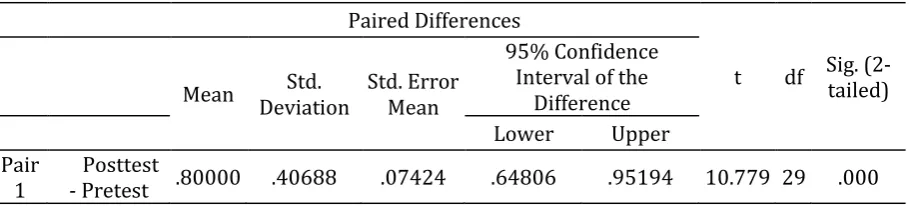
- Pretest .80000 .40688 .07424 .64806 .95194 10.779 29 .000
posttest was statistically significant (t= (29) = 10.77, P= .000). In respect of the experimental group, the control group demonstrated much poor performance in the Vocabulary posttest though.
Table 5. Descriptive Statistics-Pretest
Groups N Mean Std. Deviation Std. Error Mean
Pretest Experimental 30 12.1655 1.17686 .21485
Control 30 12.0333 1.06620 .19466
Table 5 depicts the descriptive statistics for the Vocabulary pretest. The experimental and control groups of the study had a mean score of 12.16 (SD=1.17) and 12.03 (SD=1.06) respectively. That is to say, the two groups did not perform differently in the pretest and they were harmonized in terms of their vocabulary performance.
Table 6. Independent Samples Test-Pretest
Levene's Test for Equality of
Variances
t-test for Equality of Means
F Sig. t df Sig.
(2-tailed)
Mean Difference
Std. Error Difference
95% Confidence Interval of the
Difference
Lower Upper
Equal variances
assumed
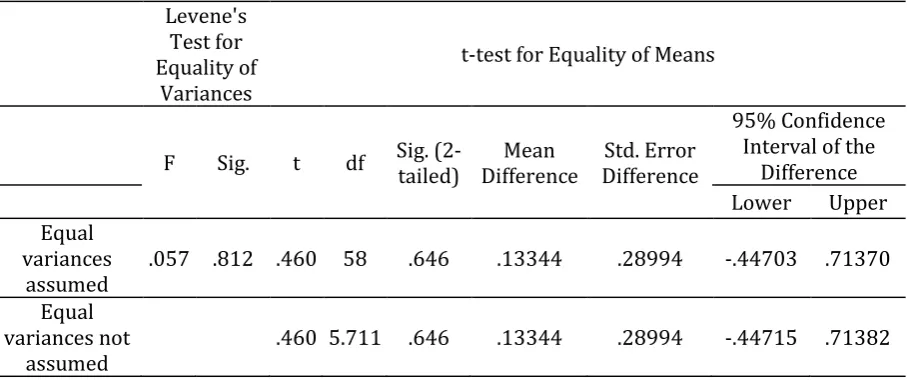
.057 .812 .460 58 .646 .13344 .28994 -.44703 .71370
Equal variances not
assumed
.460 5.711 .646 .13344 .28994 -.44715 .71382
An independent-samples t-test was conducted to compare the statistics scores of experimental and control groups in the Vocabulary pretest. The mean difference in statistics scores was 0.13 with a 95% confidence interval ranging from -.44 to .71. The results revealed no significant difference between the mean scores of experimental and control groups in the Vocabulary pretest t (58) = .460, p = .647. Therefore, the two groups performed homogeneously in the Vocabulary pretest.
Table 7. Descriptive Statistics-Posttest
Groups N Mean Std. Deviation Std. Error Mean
Posttest Experimental 30 16.7344 .73966 .13507
Control 30 12.8311 .91288 .16669
Table 8. Independent Samples Test-Posttest
Levene's Test for Equality of
Variances
t-test for Equality of Means
F Sig. t df Sig. (2-tailed) Difference Mean Difference Std. Error
95% Confidence Interval of the
Difference
Lower Upper
Equal variances
assumed
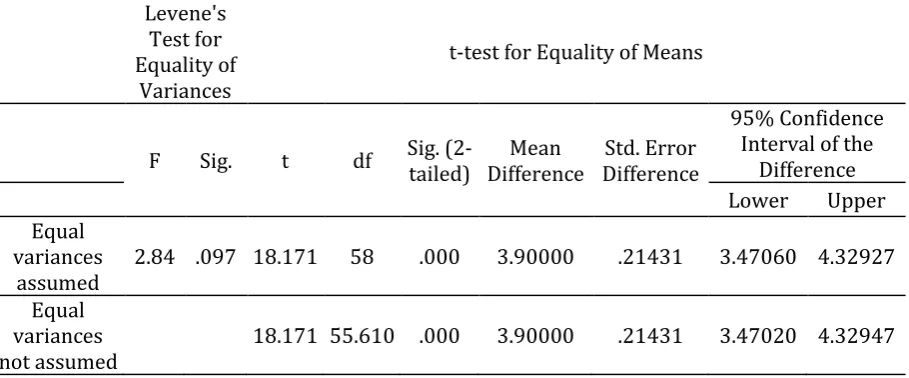
2.84 .097 18.171 58 .000 3.90000 .21431 3.47060 4.32927
Equal variances not assumed
18.171 55.610 .000 3.90000 .21431 3.47020 4.32947
Another independent-samples t-test was conducted to compare the statistics scores of the two groups in the Vocabulary posttest. The mean difference in statistics scores was 3.90 with a 95% confidence interval ranging from 3.47 to 4.32. The results revealed significant difference between the mean scores of experimental and control groups in the Vocabulary pretest t (58) = 18.171, p = .000. Therefore, the Null hypothesis is rejected and the Alternative hypothesis is supported. The results of the study provide strong support for the effectiveness of the extensive reading in vocabulary learning. CONCLUSION
This small-scale research examined whether extensive reading has an important effect on vocabulary development of elementary level of the Iranian EFL learners. There might be interaction between vocabulary development and reading. The current study reported that extensive reading affects positively EFL learners’ vocabulary development and it guarantees supplementary word learning albeit the participants were reluctant to learn English. The findings of the study indicate that extensive reading significantly improved the results. These findings are in agreement with that of Hafiz and Tudor (1989) and Raemer (1996).
The claims of Davis (1995) also are supported here, he discusses that extensive reading might be supplementary class library scheme put together to an English course wherein learners are given the” time, encouragement and materials “to read enjoyably at their own level. Nevertheless, there were some limitations. It more often than not reading causes noise and thus students were sometimes experience difficulty focusing on the works. Anyhow there were also other limitations like the gender of the participants and their proficiency level, which put limitation on the generalizability of the findings. Time on tasks was also another issue; it means more time was needed for reading the texts in desired manner.
ability to read is seen as the steadiest and durable for the second or foreign language skills (Rivers, 1981). Through learning through reading in effect we kill two birds with one stone: learning vocabulary and improving reading skill together. Reading is important by itself because; it is of crucial role to function in the societies; it develops the minds, and discovers new things. Thus, through applying reading as a tool for vocabulary learning, not only learners obtain words which are building blocks of language learning and use but also they get successful readers, and consequently effective language learners and users.
REFERENCE
Davis, C . (1995). ER: An Expensive Extravagance? ELT Journal, 49(4), 329-336.
Hafiz, F. & Tudor, I. (1989). Extensive reading and the development of language skills,
ELT Journal, 43 (1), 4-13.
Krashen, S. (1994). The pleasure hypothesis. In J. Alatis (Ed.), Georgetown University
round table on languages and linguistics, Washington, DC: Georgetown University
Press, (pp. 299–322).
Loucky, J. P. (2003). Enhancing students' English reading and vocabulary skills using CALL innovations. Seinan Women's University, Tandai Kiyo, 49.
Nation, P., & Wang, M. (1999). Graded readers and vocabulary. Reading in a Foreign
Language, 12, 355–380.
Nation, P., Meara, P. (2002). Vocabulary. In Schmitt. N (Ed) and introduction to applied linguistics, Oxford University Press.
Pikulski, J. J., Templeton, S. (2004). Teaching and Developing Vocabulary: Key long – term Reading Success, Houghton Mifflin Reading.
Raemer, A. (1996). Literature review: extensive reading in EFL classroom. English
Teachers' Journal, 49, 29-31
Read, J. (2000). Assessing vocabulary, Cambridge University Press, Cambridge.
Richards, J. C. & Renandya, W. A. (2002). Methodology in language teaching: An anthology of current practice, Cambridge University Press, Cambridge.
Rivers, W. M. (1981). Teaching Foreign Language Skills. University of Chicago Press,
Chicago.
Rubin, J., & Thompson, I. (1982). How to become a more successful language learner?
Boston, MA: Heinle & Heinle.
Schmitt, N. (2010). Researching Vocabulary: A Vocabulary Research Manual, University
of Nottingham, UK, pp1-386.
Shoari, E. & Farrokhi, F. (2014). The Effect of Graphic Organizer Strategy on Improving Iranian EFL learners’, Vocabulary Learning. Iranian Journal of research in ELT, 1, 71-83.
Shoebottom, P. (2013). The importance of vocabulary,http://esl.fis.edu/parents/advice/
vocab.htm
Widdowson, H. (1979). Explorations in applied linguistics, Oxford, England: Oxford
University Press.