Dynamics of Investment, Debt, and Default
∗
Grey Gordon
†Pablo A. Guerron-Quintana
‡February 25, 2016
Abstract
How does capital affect default in small open economies? We answer this question by constructing a model of investment, sovereign debt, and equilibrium default. With long-term debt, the model generates default episodes that closely resemble those in the data. Negative productivity shocks make international borrowing expensive and, with long-term debt, induce the sovereign to cut investment. If the shocks continue, default occurs. This generates a decline in investment, consumption, and output prior to default, as in the data. Else equal, we find that additional capital reduces the incen-tive to default at large debt levels and increases it at small debt levels. Despite this, increased capital almost always reduces risk premia because default occurs at large debt levels in equilibrium. Through the endogenous relationship of risk premia and productivity, the model also captures properties of small open economy business cycles such as countercyclical spreads and net exports.
Keywords: Investment, Debt, Default, Long-Term Debt
JEL classification numbers: F34, F41, F44
1
Introduction
Defaults are a pervasive feature of emerging economies. Among countries who have defaulted
at least once, the annual default rate from 1980 to 2012 was 3.8% (Tomz and Wright, 2013,
∗We thank Roc Armenter, Yan Bai, Satyajit Chatterjee, Burcu Eyigungor, Joao Gomes, Juan Carlos
Hatchondo, Urban Jermann, Leo Martinez, Makoto Nakajima, Jim Nason, and seminar participants at the Federal Reserve Bank of Philadelphia, Wharton, and the NYU/FRBA International Conference for their valuable comments. Joy Zhu provided superb research assistance. This research was supported in part by Lilly Endowment, Inc., through its support for the Indiana University Pervasive Technology Institute, and in part by the Indiana METACyt Initiative. The Indiana METACyt Initiative at IU is also supported in part by Lilly Endowment, Inc. The views expressed here are those of the authors and do not necessarily reflect those of the Federal Reserve Bank of Philadelphia or the Federal Reserve System. This paper is available free of charge athttps://www.philadelphiafed.org/research-and-data/publications/working-papers.
†Indiana University,[email protected].
p. 257). Moreover, defaults are becoming more prevalent over time: The number of defaults
and reschedules in Latin America and Asia was nearly three times larger in 1975-2006 than in
1950-1974 (Reinhart and Rogoff,2008, p. 27). Hence, to properly understand business cycles
in emerging economies, one must account for the joint dynamics of output, consumption,
investment, net exports, and interest rates in and around sovereign defaults.
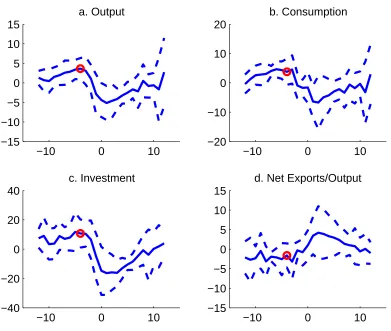
In this paper, we first document empirical features of sovereign default episodes. We find
that sovereign defaults are characterized by pronounced declines in output, consumption, and
investment that persist for several quarters following default. On average, output contracts by
5%, consumption by roughly the same amount, and investment by almost 20%. Additionally,
we find that the growth in output, consumption, and investment is above trend until a year before default. This growth then gives way to a gradual decline that culminates in a collapse
when default occurs.
We capture these features of sovereign default episodes by constructing a model of
endoge-nous investment, long-term debt, and default. In our model, a negative productivity shock
increases the sovereign’s default risk and makes issuing debt more costly. In response, the
sovereign mitigates the impact on consumption by paying off the fraction of debt that comes
due, issuing a small amount of debt, and reducing investment. This reduction in investment
reduces future output, making debt grow relative to output. If the negative shocks continue,
the sovereign defaults. This mechanism naturally generates a gradual decline leading up to default. The model also generates persistent declines after default as productivity—and the
rest of the economy—gradually mean-reverts.
Interestingly, the model also captures the increase in output, consumption, and
invest-ment that peaks several quarters before default. Typically, default occurs when debt is high
and productivity is low. The sovereign reaches such a point by first going through a
pe-riod in which productivity is high and, hence, borrowing is cheap. Under these conditions,
the sovereign finds it optimal to borrow internationally in order to invest domestically. If
these positive productivity shocks give way to negative ones, the sovereign finds itself with
large levels of debt and low output, which makes default more likely. The run-up in pro-ductivity leading to such a point generates above-trend growth in output, consumption, and
investment that peaks several quarters before default.
We use the model to analyze the role capital investment plays in default decisions, debt
pricing, and consumption smoothing. How capital affects these is a tale of two counteracting
forces. First, capital provides a means of saving and borrowing that is not sensitive to
default risk, unlike international credit markets. This alone delays default in the face of
negative productivity shocks because capital can be liquidated to meet outlays. Additionally,
advantage of periods of high productivity and favorable borrowing conditions. We refer to
the roles capital plays along these dimensions as the smoothing channel: Sovereign economies
can use capital to both take advantage of and insure themselves against fluctuations in
productivity and foreign lending. The counteracting force is that as a country’s capital stock
increases, so does the value of default: In modern history, physical assets within a sovereign
country’s borders have not been seized upon default. Hence, additional capital makes default
more attractive else equal. We refer to this alternate role of capital as the autarky channel.
Quantitatively, we find that the smoothing channel dominates. That is, additional capital,
for a given level of debt, decreases the likelihood of default and hence interest rates on
sovereign debt. We also find that with long-term debt, interest rates are decreasing in capital even when the sovereign repays with certainty next period: Additional capital reduces default
rates (and hence risk premium) well into the future. Relatedly, we show that while additional
capital improves credit, this effect is typically diminishing. Additional capital has the most
effect on bond prices when one-period ahead default rates respond strongly. This is the case
at low levels of capital. If the sovereign has sufficient capital to default next period with low
probability, additional capital primarily reduces default rates several periods into the future.
This has only a second-order effect on debt prices.
While incorporating capital into a model of sovereign default would appear to be
straight-forward, we find complex dynamics between investment, debt, and default that make it a considerable undertaking. For instance, in a reasonably calibrated model, interest rates on
sovereign debt must be quite volatile. If capital can be converted one for one into consumption
goods, then its return structure is similar to that of bonds, which results in something close
to a no-arbitrage condition. Hence, capital must fluctuate wildly to generate large volatility
in returns to capital. For this reason, we find it necessary to weaken this relationship by
including capital adjustment costs.
Like Chatterjee and Eyigungor(2012), we also find that long-term debt is necessary for
matching debt and spread statistics simultaneously for conventional parameter values. While
a short-term debt version of our model can match most of the calibration targets, it can only do so using an extremely low discount factor. This generates counterfactual behavior in terms
of default episodes—where short-term debt has no gradual decline leading to default—and
in a number of business cycle moments such as the correlation between output and interest
rates. With both long-term debt and capital adjustment costs, our model is consistent with
default episodes and business cycle regularities of small open economies. Including
long-term debt and capital accumulation complicates the computation of our model beyond the
difficulties discussed in Chatterjee and Eyigungor(2012). We extend their solution method
By constructing a model of capital matching behavior in default episodes and business
cycle regularities, we build on three broad strands of the literature. First, by endogenizing
the relationship between bond spreads and future productivity that is crucial in Neumeyer
and Perri (2005), we micro-found a key assumption in the standard small open economy
literature. Second, by incorporating capital in a sovereign default model, we extend Aguiar
and Gopinath (2006); Arellano (2008); Hatchondo and Martinez (2009); Mendoza and Yue
(2012); Chatterjee and Eyigungor (2012); and others to allow for new predictions along the
investment dimension while preserving key predictions along existing dimensions. Third, we
build on Mendoza (2010) and Bianchi, Hatchondo, and Martinez (2014) by showing that
an extension of our benchmark model can incorporate sudden stops (modeled as stochastic periods in which debt issuance is impossible) without impairing the model’s business cycle
predictions.
One of the key papers in this literature is Bai and Zhang (2012b).1 They propose a
multi-country model with short-term debt and capital to study financial integration and risk
sharing. The model is similar to Bai and Zhang (2010) (which focuses on the cross-country
correlation between savings and investment), but it allows for default to occur in equilibrium.
The authors show quantitatively that capital helps sustain debt. Yet there are a number of
important differences between our study and theirs. Foremost is that they do not examine
the business cycle properties or behavior in default episodes. Consequently, it is unclear whether their model is consistent with the properties of the data that we establish. Since we
show long-term debt is essential for capturing both behavior in default episodes and business
cycles, we suspect that it is not. Second, we provide a much broader and in-depth analysis of
the role of capital. E.g., we show how capital sustains debt at all prices, not just at the two
prices (risk-free and zero) that they show. Additionally, we show that the impact of capital
on debt prices displays diminishing returns and has a positive effect even when one-period
ahead repayment rates are one, results that rely on long-term debt.
Hamann(2004) is another important paper that examines the role of capital in a model of
equilibrium default.2 He also identifies the smoothing and autarky roles of capital. Relative to his work, ours relaxes several restrictive assumptions. First, we do not assume financial
autarky is permanent, which allows us to study default and investment without conditioning
on an arbitrary initial state. Second, we let the sovereign internalize the impact of debt
issuance on interest rates, an obvious consideration for policymakers. Third, we allow for
1We also build on Kehoe and Perri (2002) and Kehoe and Perri (2004). Like Bai and Zhang (2012b),
these focus on cross-country patterns and abstract from endogenous labor choice. However, they also have no default in equilibrium and hence cannot discuss, for instance, how capital affects spreads and behavior in default episodes.
long-term debt and elastic labor supply. Additionally,Hamann(2004) focuses on the welfare
costs of default, whereas our work is positive in nature.
Park (2015) and Roldan-Pena (2012) provide models of endogenous capital, short-term
debt, and equilibrium default. Park (2015) focuses on economic default in times of
above-trend growth and shows how the incentive to default (i.e., the spread between the value of
default and the value of repayment) is U-shaped in the stock of capital. In fact, we show that
the shape of these incentives depends on the level of debt in two ways. First, for large levels
of debt, incentives to default are decreasing in capital while for small levels of debt they
are increasing. Second, these incentives are convex at large debt levels and concave at small
debt levels.3 Consistent with our findings, the short-term debt assumption in Park (2015)
and Roldan-Pena (2012) prevents them from matching many moments in the data and the
gradual declines leading to default.4 In fact, Roldan-Pena (2012) concludes that “adding
mechanisms that reduce the degree of substitutability between borrowing and savings might
potentially contribute to improve upon our results” (p. 22). We show that long-term debt
with capital adjustment costs provides this missing mechanism.
2
Investment and Default
Figure 1 displays a typical default episode in our sample of emerging economies 12
quar-ters before and after a default (Appendix A.1 describes the data and countries included).
The values are reported as deviations from an HP-filtered trend (the standard smoothing
parameter value of 1600 is used). Dotted lines correspond to plus- and minus-one-standard
deviations around the mean. Relative to previous studies, the novel element in this figure is
the dynamics of investment.5
Investment follows a path qualitatively similar to that of output. For example, investment
gradually declines leading up to default, collapses in default, and remains depressed for
around 10 quarters. However, investment is far more responsive than output and consumption
3The first result is due to the marginal utility of consumption in repayment states being large at large
debt levels and small at small debt levels. Similarly, the second result is due to the elasticity of consumption with respect to capital in repayment states being large at large debt levels and small at small ones. These results are discussed extensively in Section5.4.
4Both papers fail to report the correlations of consumption and investment with output.Park(2015) does
not report the debt-output ratio, but misses low on the mean spread (2.8% vs. the data’s 8.2%), the spread standard deviation (1.6% vs. 4.4%), the standard deviation of the net exports-output ratio (0.4% vs. 2.3%), and the excess consumption volatility (0.95 vs. 1.23). Roldan-Pena (2012) fails along these dimensions as well while also not reporting the mean spread and having a default rate of only 0.07%.
5Mendoza(2010) documents the decline of investment during sudden stops in several countries. His data
at the onset of the crises. Whereas consumption declines by 5% in the quarter of default, the
collapse of investment is nearly 20%. In fact, at the country level, the decline can be as large
as 44%, like it was in the 2001 Argentinean crisis. On average, investment contracts by a
whopping 27% from peak to trough (compare this with the milder decline in output of 8%).
Clearly, investment does move substantially during default episodes. More importantly, this
movement suggests that countries use investment to ameliorate the negative consequences
of a default, i.e., to smooth out consumption.
−10 0 10
−15 −10 −5 0 5 10 15
a. Output
−10 0 10
−20 −10 0 10 20
b. Consumption
−10 0 10
−40 −20 0 20 40
c. Investment
−10 0 10
−15 −10 −5 0 5 10 15
d. Net Exports/Output
Figure 1: Average Default Episode in Data
Also evident is that emerging economies are typically growing above trend until four
quarters before the default crisis. Indeed, investment as well as output and consumption
peaks about four quarters (as indicated by the red circles) prior to reneging on debt. At face
value, the slow-moving transition to default suggests that a sequence of moderately adverse
shocks is what brings the sovereign to stop meeting its foreign obligations. Interestingly, the
default dynamics hint that, to some degree, default episodes are forecastable. That is, if one
As we will show, the model ingredients we propose—long-term debt with capital investment—
are able to capture these features of the data. We will also show that neglecting either of
these ingredients results in default episodes where the economy is growing steadily until a
large negative shock triggers default.
3
Model
In the long tradition of sovereign default models (Eaton and Gersovitz, 1981; Arellano,
2008; Mendoza and Yue,2012), we study the default decision of a sovereign that borrows in international markets to maximize the welfare of citizens living at home. The key assumption
is that the sovereign has access to a production technology in which labor and capital are
endogenous inputs.
Domestic residents have consumption c, supply labor l, and rank consumption/labor
bundles according to
E0 ∞
X
t=0
βtu(ct, lt).
For the computation, we useGreenwood, Hercowitz, and Huffman (1988) preferences of the
formu(c, l) = (c−ηlωω)1−σ/(1−σ). The benevolent sovereign has access to a technology that uses capitalkand laborlto produce outputyusing the Cobb-Douglas functiony=Akαl1−α. We assume that productivity follows logA0 = (1−ρA) logµA+ρAlogA+ε0A where εA ∼
N(0, σ2
A). In addition to endogenous output, the sovereign has an iid endowment m drawn
from a bounded normal with standard deviation σm and support [m,m¯]. As Chatterjee and
Eyigungor(2012) show, incorporating even a small iid shock greatly facilitates computation,
which is its role here. Our computational algorithm is given in Appendix A.5.
The sovereign government has access to long-term debt contracts in which outstanding
debt matures with probability λ.6 If debt does not mature, it delivers a coupon paymentz.
As shown by Chatterjee and Eyigungor (2012) (and Hatchondo and Martinez, 2009, with
z = 0), this memoryless debt structure can capture average debt maturities in the data without making computation overly onerous. Following the convention in the literature,
we treat debt as negative bond holdings. Current bond holdings are denoted b, which we
restrict to be negative.7 The contract structure implies that new debt issuance is given by
6Arellano and Ramanarayanan (2012) and Sanchez, Sapriza, and Yurdagul (2014) endogenize debt
ma-turity, but doing so here would be computationally infeasible.
7In the computation, bonds, capital, and productivity lie in finite sets.Chatterjee and Eyigungor(2012)
−b0+ (1−λ)b (if negative, then existing debt has been repurchased). Bonds are discounted by the price q.
A default has four consequences for the sovereign. First, its debt goes away. Second, it is
excluded from credit markets (i.e., goes to autarky) upon default. Third, it is readmitted to
credit markets with probabilityφ. Last, for the duration of autarky, a fractionκof output is
lost. This last assumption captures in part what is endogenized inMendoza and Yue(2012),
namely, that default impairs a country’s ability to produce by limiting its access to imports.
Since capital refers to assets physically located within the borders of an economy, we further
assume that capital cannot be expropriated in default and cannot be pledged as collateral.
When the sovereign has access to financial markets, it decides whether to repay debt and, if so, how much new debt to issue subject to households’ preferences, technology, and the
economy’s resource constraint.8 In particular, the sovereign solves
V (b, k, m, A) = max
d∈{0,1}(1−d)V
nd(b, k, m, A) +dVd(k, A) (1)
wheredis the default choice,Vnd is the value of repaying debt (i.e., not defaulting) andVdis
the value of entering or being in autarky. Consistent with our assumption of no expropriation,
capital remains a state variable after default. The value of repaying debt is
Vnd(b, k, m, A) = max
c,l,k0≥0,b0≤0u(c, l) +βEm0,A0|AV (b
0, k0, m0, A0)
s.t. c+i+q(b0, k0, A)(b0 −(1−λ)b) =Akαl1−α+m−Θ 2 (k
0−
k)2+ (λ+ (1−λ)z)b
k0 =i+ (1−δ)k,
(2)
wherei is investment and Θ controls the cost of adjusting capital. The term (λ+ (1−λ)z)b
captures payments from the fractionλof debt that matures and the coupon from the fraction (1−λ) that remains outstanding. The termq(b0, k0, A)(b0−(1−λ)b) reflects any income from
new bond issuance or repurchases.
As already argued, a key contribution of this paper is the inclusion of capital accumulation
in a way that captures the dynamics of investment found in the data. To this end, we found
it necessary to include a variable adjustment cost paid any time the capital stock deviates
from its previous value. This is because—without adjustment costs—negative productivity
shocks result in two effects that make investment fluctuate drastically. First, a negative
binding in our calibration).
8We allow the sovereign to default provided they currently have access to credit markets. When they do
shock makes the sovereign want to smooth consumption by borrowing against future higher
productivity. Second, such a shock also increases the sovereign’s default probability and so
causes interest rates on debt to rise. Without adjustment costs, the cheapest way for the
sovereign to “borrow” is by sharply reducing investment rather than borrowing on the world
market. Consequently, investment ends up being too volatile relative to the series in the data.
Adjustment costs make borrowing using capital more costly and so tame the fluctuations in
investment.9
The value of defaulting or being in autarky is
Vd(k, A) = max
c,l,k0≥0u(c, l) +βEm0,A0|A
(1−φ)Vd(k0, A0) +φV(0, k0, m0, A0)
s.t.c+i= (1−κ(A))Akαl1−α−Θ 2(k
0 −
k)2
k0 =i+ (1−δ)k.
(3)
Note that when the economy regains access to credit markets (which happens with
proba-bility φ), the sovereign has no debt. In the quantitative work, we assume that κ(A) is given
by
κ(A) = min (max (κ0+κ1A,0),1),
which captures the asymmetric losses used in Arellano (2008), Chatterjee and Eyigungor
(2012), and others. The assumption that the cost depends on the state of technology (rather than output) allows for a straightforward computation of the labor choice.
For a bond levelband capital stockk, it is optimal to default for total factor productivity
(TFP) values and iid shock values in
D(b, k) =
A, m :Vnd(b, k, m, A)< Vd(k, A) . (4)
In the absence of capital, it is well understood that the default set shrinks withb, i.e., lower
debt increases the likelihood of repayment (Arellano,2008;Chatterjee and Eyigungor,2012;
Mendoza and Yue, 2012). Because Vnd is increasing in b, the same result obtains here: D is
monotonically decreasing in b.10
Unfortunately, characterizing how the default set varies in capital is much more difficult.
9We suspect that the presence of an adjustment cost rather than its specific structure (ours follows Mendoza,1991) is necessary for capturing the dynamics of investment. In this sense, alternative formulations like those inBaxter and Crucini(1993);Christiano, Eichenbaum, and Evans(2005); andNason and Rogers
(2006) should work equally well. For the model’s behavior without adjustment costs, see the working paper
Gordon and Guerron-Quintana(2013).
The first and obvious obstacle is that the value functionsVnd and Vdmay not be monotonic
in capital due to capital adjustment costs. Second, even with monotonicity for each value
function, a change in the capital stock can have uneven effects on the two value functions and
cause the spreadVnd−Vdto vary in non-trivial ways. In fact, we will show quantitatively that
this spread does vary unevenly (see Figure 6). Hence, the inequality in (4) might fluctuate,
which prevents a simple characterization of the default set with respect to capital.
A major difference in our model relative to previous ones is that the default decision,
and consequently the price of debt, depends on capital and productivity rather than an
exogenous output level. In particular, the equilibrium debt prices implied by risk-neutral
foreign lenders making zero profits loan-by-loan are given by
q(b0, k0, A) =Em0,A0|A(1−d(b0, k0, m0, A0))
λ+ (1−λ) [z+q(b00, k00, A0)]
1 +r∗ (5)
whereb00=b0(b0, k0, m0, A0),k00 =k0(b0, k0, m0, A0), andr∗ is the risk-free international rate on
a one-period bond. If the sovereign repays next period, creditors receive back theλfraction of
the debt that comes due plus the couponz and market valueq(b00, k00, A) for the 1−λfraction
of debt that does not mature. If the sovereign defaults, they receive nothing. Since the model
is already challenging to solve, we follow Arellano(2008);Chatterjee and Eyigungor(2012);
and Mendoza and Yue(2012) and abstract from the important issue of debt renegotiation.
Yue (2010) and Bai and Zhang (2012a) provide an excellent discussion of default and debt renegotiation.
Before turning to the quantitative aspects of our model, it is worth discussing an
im-portant assumption in our model. Namely, we assume that the central planner chooses
al-locations on behalf of households. In Appendix A.2, we show that a combination of
state-contingent capital taxesτk, labor taxesτl, and lump sum taxesT are sufficient to implement
the planner’s allocations in a market-based economy where all investment is done by
homo-geneous, infinitely-lived households. The taxes are given by
τl = 1
w
ul(c, l)
uc(c, l)
+ 1
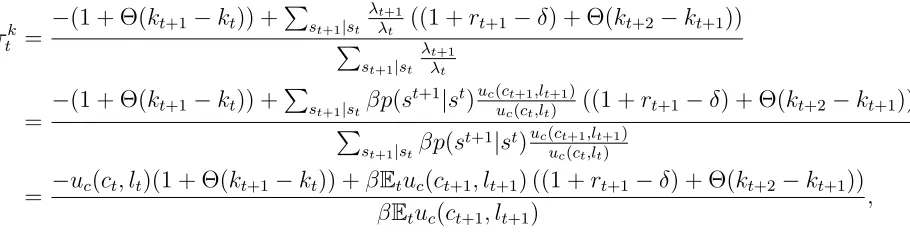
τk = −uc(c, l)(1 + Θ(k
0 −k)) +β
Em0,A0|Auc(c0, l0) ((1 +r0 −δ) + Θ(k00−k0)) βEm0,A0|Auc(c0, l0)
T =q(b0, k0, A)(b0−(1−λ)b)−(λ+ (1−λ)z)b−τlwl−τ−k1k,
wherewand r are the equilibrium wage and rental rate of capital, respectively. Rearranging
the first two equations gives the intratemporal labor-leisure choice condition and the
alongside any net income from sovereign debt.
4
Calibration
Our calibration approach follows the default literature closely. Taking a period to be a
quarter, the benchmark adopts the long-term debt structure in Chatterjee and Eyigungor
(2012) where the coupon payment is 3% (z =.03) and debt matures with a 5% probability
(λ=.05). These nearly match the Argentinean data’s 20 quarter median maturity of average
bonds and 11% value-weighted average coupon rate (Chatterjee and Eyigungor, 2012, p. 2685).11Our short-term debt calibration hasλ = 1 (with the coupon irrelevant). The support
of the continuous shock m is the same as in Chatterjee and Eyigungor (2012). Following
Aguiar and Gopinath (2006),φ is set to .1 which generates an average stay in autarky of 2.5
years.
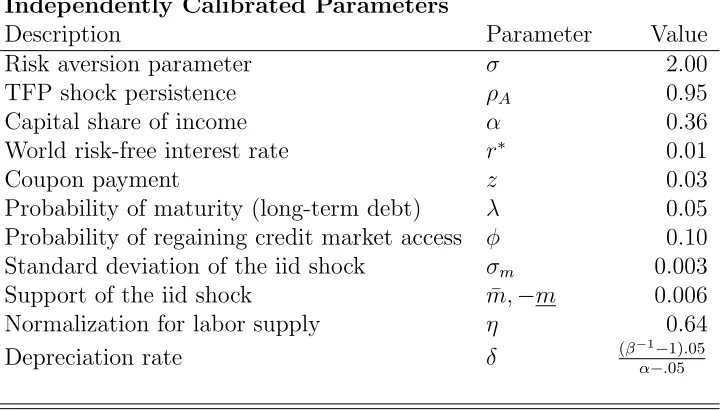
The rest of the independently determined parameters are reported in Table 1, and some
of these are worth mentioning. Given the lack of reliable labor data, we followNeumeyer and
Perri (2005) and set the persistence of TFP to be .95 (which is in line with the values used
in the emerging-economy business-cycle literature such as Fernandez-Villaverde,
Guerron-Quintana, Rubio-Ramirez, and Uribe, 2011 and Mendoza and Yue, 2012). Conditional on
the other parameters, we choose mean productivityµA and the labor disutility parameter η
so that, in the steady state without foreign lending, output and labor both equal 1. Likewise,
the depreciation rateδ is set to deliver an investment-GDP ratio of 0.05 (which is the value
for Argentina) in the steady state without foreign lending. The utility function curvature σ
is set to a standard value of 2.
The second group of parameters is chosen to match empirical moments. There are six
parameters in this group: the discount factor β, the default cost parameters κ0 and κ1,
the cost of adjusting capital Θ, the volatility of productivity σA, and the labor elasticity
parameter ω. These were chosen to match six empirical moments: the debt-output ratio −Eb/y, the average spread Er, the spread volatility σr, the volatility of investment σi, the
volatility of output σy, and the ratio of the volatilities of consumption and output σc/σy.
As in Chatterjee and Eyigungor (2012), we measure the spread as the difference between
an annualized “internal rate of return”—an ˜r satisfying q = (λ+ (1−λ)z)/(λ+ ˜r)—and
the annualized risk-free rate. The resulting parameter values, target moments, and model
11As Chatterjee and Eyigungor (2012) discuss, an additional advantage of this structure is that the 4%
Independently Calibrated Parameters
Description Parameter Value
Risk aversion parameter σ 2.00
TFP shock persistence ρA 0.95
Capital share of income α 0.36
World risk-free interest rate r∗ 0.01
Coupon payment z 0.03
Probability of maturity (long-term debt) λ 0.05
Probability of regaining credit market access φ 0.10
Standard deviation of the iid shock σm 0.003
Support of the iid shock m,¯ −m 0.006
Normalization for labor supply η 0.64
Depreciation rate δ (β−α1−−.1)05.05
Table 1: Parameter Values Calibrated Independently
moments are listed in Table 2, but we defer the discussion of the calibration results to the
next section.
5
Results
We begin this section by analyzing the model’s behavior in default episodes. As will be
seen, the benchmark model outperforms the short-term debt model substantially. We then
examine why the short-term debt model fails before turning attention to other properties of
the benchmark. The section concludes with an in-depth examination of the role of capital in the decision to default.
5.1
Default Episodes
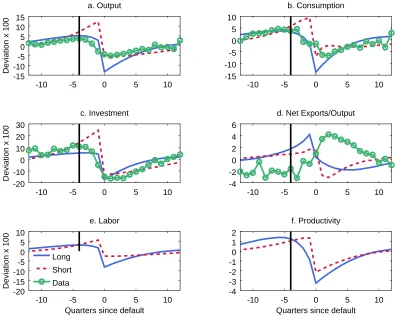
Figure 2 displays the dynamics of a typical default episode in the data, our benchmark
calibration, and the short-term debt calibration. Relative to short-term debt, the benchmark
does a superior job of matching the data’s slow transition to default. Also consistent with the
data, the benchmark predicts that the economy peaks a few quarters before repayments are
stopped (the black vertical line marks one year prior to default). In the benchmark, it takes
investment, consumption, and output roughly 10 quarters to return to trend post-default,
which is very similar to the data. In contrast, short-term debt, despite a shallower decline
Jointly Calibrated Parameters
Description Value Short Long
Discount factor β 0.449 0.946
Fixed default cost κ0 -0.07 -0.26
Proportional default cost κ1 0.10 0.66
Adjustment cost Θ 7.91 21.16
TFP innovation size σA 0.016 0.017
Labor supply elasticity 1/(ω−1) 0.85 1.57
Targeted Statistics
Target Value Short Long
Debt-output ratio∗ (−Eb/y) 0.70 0.66 0.70
Average spread∗ (Er) 8.15 5.23 8.20
Standard deviation of spread∗ (σr) 4.43 4.06 4.41
Standard deviation of investment∗∗ (σi) 12.8 12.7 12.8
Standard deviation of output∗∗ (σy) 4.82 6.35 4.87
Excess consumption volatility∗∗ (σc/σy) 1.23 1.36 1.22
∗
Sample excludes 20 periods after default (as in Chatterjee and Eyigungor,2012).
-10 -5 0 5 10 -15 -10 -5 0 5 10 15
Deviation x 100
-10 -5 0 5 10
-15 -10 -5 0 5 10
-10 -5 0 5 10
-20 -10 0 10 20 30
Deviation x 100
-10 -5 0 5 10
-4 -2 0 2 4 6
-10 -5 0 5 10
-20 -15 -10 -5 0 5 10
Quarters since default
Deviation x 100
Long
Short
Data
-10 -5 0 5 10
-4 -3 -2 -1 0 1 2
Quarters since default
a. Output b. Consumption
c. Investment d. Net Exports/Output
e. Labor f. Productivity
Figure 2: Default Episode in Model
economy closely resemble default episodes in the data.
The proximal reason for why the short- and long-term debt calibrations differ is tied to the sequence of productivity shocks leading to default. For the benchmark, productivity peaks
about a year before default and is followed by a gradual decline. In contrast, the short-term
specification has productivity steadily increasing until default. For both calibrations, output,
consumption, and investment comove with productivity. For the benchmark, this results in
gradual increases and decreases leading up to default. For the short-term calibration, it
results in a counterfactual boom-bust cycle.
Both calibrations wrongly predict a trade surplus prior to default and a trade deficit
after default. To understand the latter failure, note that net exports in the economy can be
written asN X =q(b0−(1−λ)b)−(λ+(1−λ)z)b. When a sovereign defaults,bis set to 0 and, for as long as the sovereign remains in autarky, both b0 and N X are 0. When the economy
is readmitted to financial markets, their new bond position is restricted to be negative and
so N X must be less than 0. Hence, the economy must run a trade deficit after default.12
12This is a feature common to most sovereign default models. An exception is that ofMendoza and Yue
To see why the benchmark runs a trade surplus prior to default, consider that the change
in net exports is given by ∆N X = −x∆q−q−1∆x+ (λ+ (1−λ)z)∆(−b) where x is new
debt issuance,−b0+ (1−λ)b.13 Until six quarters before default, productivity and capital are
both increasing. As we will show, both of these cause ∆q >0 else equal. The sovereign, then
being impatient relative to lenders, takes advantage of this to borrow on world markets. In
fact, from 12 quarters to 6 quarters before default, the level of debt increases 6% on average,
which makes x, ∆x, and ∆(−b) all positive. The change in net exports is ambiguous in
this case. However, when productivity starts declining around 6 quarters before default, this
causes a decline in q that is reinforced by a decline in investment. In response to ∆q < 0,
the sovereign typically just rolls over its debt: From 6 quarters to the period of default, debt increases by only 0.7%. Hence, typically one has ∆q < 0, x > 0, and ∆x and ∆(−b)
both nearly 0. This unambiguously drives up net exports. While the model’s prediction of
a trade surplus pre-default differs from the average in the data, it is in fact consistent with
the default episodes of Indonesia (1998.Q3), Peru (1983.Q2), and South Africa (1998.Q1).
5.2
Short-Term Debt
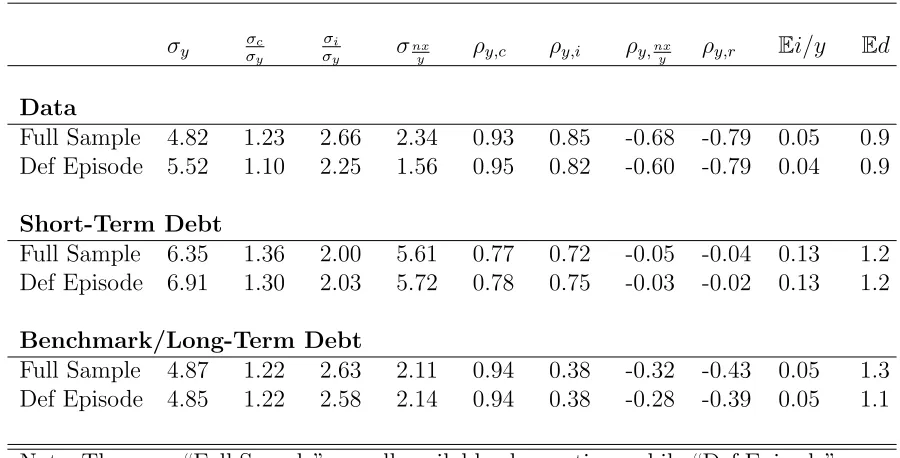
As can be seen in column “Short” of Table 2, the short-term debt calibration comes fairly
close to reproducing the targeted moments. This matching, however, comes at the price of
a very low discount factor, β = 0.45, and even then fails to deliver large enough spreads
and small enough consumption volatility. The high impatience of the planner is a common
feature of default models, but the value here is well below the values in, for example,Aguiar and Gopinath (2006) and Mendoza and Yue (2012).
To see why the short-term debt model fails to match the targeted moments for
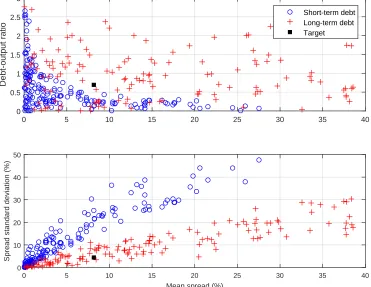
con-ventional parameters, consider the results of a prior predictive exercise in which the model
is solved hundreds of times for randomly chosen parameter values. As we explain more
thoroughly in Appendix A.3, we draw each of the parameters β, κ0, κ1,Θ, σA, and ω from
distributions whose bounds cover standard values used in the literature.14 For example, β is
drawn from a uniform distribution with support [0.9,0.99].
Figure3displays the implied spread mean, spread standard deviation, and average
debt-output ratio for each of these draws. Evidently, the model with short-term debt cannot simultaneously match the debt and interest rate moments. E.g., the model generates high
access, albeit limited, to intermediate imported goods. This means that if imports of these goods drop sufficiently (as they do in their paper), the economy can experience a trade surplus following default.
13To see this, write net exports in a given period as N X = −qx+ (λ+ (1−λ)z)(−b). Then ∆N X = −qx+ (q−1x−q−1x) +q−1x−1+ (λ+ (1−λ)z)∆(−b). Combining terms gives the expression.
14For parameters like κ
0, κ1 for which the literature offers little guidance, we tried to draw from a wide
0 5 10 15 20 25 30 35 40
Debt-output ratio
0 0.5 1 1.5 2 2.5 3
Short-term debt Long-term debt Target
Mean spread (%)
0 5 10 15 20 25 30 35 40
Spread standard deviation (%)
0 10 20 30 40 50
average spreads at the expense of an overly small debt-to-output ratio and overly large
spread volatility. Alternatively, data-consistent levels of debt and volatilities of spreads lead
inexorably to low average spreads. In contrast, long-term debt allows the model to easily
match the targeted moments along these dimensions.
The short-term debt model’s struggle to match the targeted moments for conventional
parameters pushes it away from non-targeted moments. Table 3 contains select moments
from the Argentinean data and short-term debt model (a σ denotes a standard deviation,
a ρ denotes a correlation, and an E denotes an average). For instance, the model fails to
produce a countercyclical trade-balance (ρy,nx
y is −.05 in the model but −.68 in the data)
and countercyclical spreads (ρy,r is −.04 in the model but −.79 in the data). Likewise,
consumption is procyclical, but not as procyclical as in the data (ρy,cis.77 in the model and
.93 in the data). These failures can be traced back to the low discount factor. Because the
discount factor is so low, the limiting factor on sovereign debt issuance is not the supply of
debt but the demand for it, q(·,·, A). Hence, when productivity increases, so does q, and so
does sovereign borrowing. This ties consumption, interest rates, and net exports more closely
to productivity than output, the latter depending on slow-moving capital.
The short-term debt model nearly matches the data’s investment volatility and
procycli-cality but deviates substantially from the investment-output ratio. Recall that depreciation
is set to give a 5% investment-output ratio in the steady state without foreign lending. In fact, the short-term debt model is very far away from this steady state: Average output in
the ergodic distribution of the model is 2.8 times larger than in the steady state. The reason
clearly is not due to the patience of the sovereign. Rather, it is because debt is cheaper at
higher levels of capital (as will be discussed). The incentive to save using k0 is a consequence
of the desire to consume today by borrowing from foreign markets.15
The row labeled Def Episode in Table 3 shows the model’s moments prior to a default
crisis. To this end, we do a long simulation of the model, locate the default events, and
then compute the moments using the 74 observations leading up to (but excluding) the
default period (the approach ofArellano,2008). The table reports the average across all the events. Conditioning on these episodes does not substantially change the predictions of the
short-term debt calibration.
All told, the model with short-term debt can capture some of the features of the data
if one assumes that emerging economies are extremely impatient. However, this tremendous
impatience results in other distortions, including the failure to match output, consumption,
and investment dynamics around default. We now show that long-term debt goes a long
15Presumably, the investment-output ratio could be matched by lowering the depreciation rate. However,
σy σσcy σσyi σnx
y ρy,c ρy,i ρy, nx
y ρy,r Ei/y Ed
Data
Full Sample 4.82 1.23 2.66 2.34 0.93 0.85 -0.68 -0.79 0.05 0.9
Def Episode 5.52 1.10 2.25 1.56 0.95 0.82 -0.60 -0.79 0.04 0.9
Short-Term Debt
Full Sample 6.35 1.36 2.00 5.61 0.77 0.72 -0.05 -0.04 0.13 1.2
Def Episode 6.91 1.30 2.03 5.72 0.78 0.75 -0.03 -0.02 0.13 1.2
Benchmark/Long-Term Debt
Full Sample 4.87 1.22 2.63 2.11 0.94 0.38 -0.32 -0.43 0.05 1.3
Def Episode 4.85 1.22 2.58 2.14 0.94 0.38 -0.28 -0.39 0.05 1.1
Note: The rows “Full Sample” use all available observations while “Def Episode” rows use 74 observations before a default. Data for σ and ρ are logged and HP-filtered except for r and nx/y. The data measure for Ed is the 3.8% annual rate reported in
Tomz and Wright (2013). Argentina’s full sample is 1993.Q1 - 2011.Q3 and default
episode is 1993.Q1 - 2002.Q1.
Table 3: Moments in Data and Model
way toward bringing the model closer to the data while using more conventional parameter
values.
5.3
Long-Term Debt
The column “Long” in Table2shows that our baseline model matches the targeted moments
and that it does so with a more realistic discount factor and a labor elasticity closer to the
values commonly used in the literature (specifically, those in Mendoza and Yue, 2012 and
Neumeyer and Perri, 2005). In fact, the prior predictive exercise in Figure 3 reveals that
the long-term debt model could match the targeted interest rate with a debt-output ratio
nearly three times as large as the data’s while still using conventional parameter values. The
model also does a superior job matching Argentina’s business cycles, as can be seen from the “Benchmark” panel in Table3. For example, it captures simultaneously the volatility of
output and of net exports. Although the model correctly predicts the countercyclicality of
the trade account, it falls short of delivering its magnitude (this is also the case inArellano,
2008; Chatterjee and Eyigungor, 2012; and Mendoza and Yue, 2012). The quarterly default
rate is 1.3%, which is slightly larger than the data’s 0.9%.
with a correlation of .38, qualitatively correct but falling short of the .85 in the data.16 While
the model misses the magnitude of this correlation, it produces the correct comovement in
default episodes (as can be seen in Figure 2). The investment-output ratio is .05, the same
as in the data. This moment is important because, in the spirit of incomplete market models
(e.g., Aiyagari, 1994), the sovereign can use capital to hedge against bad outcomes. That is,
having more capital ameliorates the cost of defaulting because capital can be transformed
into consumption goods.
The benchmark model predicts a significant negative correlation between output and
spreads. Neumeyer and Perri (2005) argue that this negative correlation is a crucial feature
of emerging small open economies that the standard RBC model without working capital fails to generate. In our long-term debt model, there are two forces shaping the correlation
between output and spreads. One force is the endogenous pricing of default risk: As
pro-ductivity declines, spreads increase and output contracts. The other force is the standard
RBC implication of higher productivity causing more output and a larger marginal product.
Because capital and sovereign debt have similar return structures, the two are closely
con-nected by something approaching a no-arbitrage condition. As a consequence, the resulting
correlation between output and interest rates lies somewhere between the pure default and
pure RBC realms. Our calibration implies that default is the dominant force, which delivers
the correct sign for the correlation.
We now turn to the implications of capital accumulation on the price of debt. The upper
panel in Figure 4 shows the bond price schedule along the capital and bond dimensions
conditional on a typical level of productivity (in our figures, debt is expressed as a fraction
of output in steady state, which is normalized to 1). For a given capital value, we obtain
the standard result that lower levels of debt are associated with higher bond prices. More
importantly, the figure reveals one key result of this paper: Additional capital helps sustain
higher levels of debt. This beneficial impact of capital on debt is also seen in the “iso-price”
graph in the lower panel of Figure 4. Specifically, this graph plots (b0, k0) pairs delivering a
particular price q (i.e., {(b0, k0)|q(b0, k0, A) =q} for differing values of q). For q close to the risk-free price, capital typically helps sustain more debt. For small and moderate values of
q, this is always the case.
To shed more light on how capital affects debt prices, the upper panel of Figure 5
dis-16We target the excess volatility of consumption seen in the data, but that includes both durable and
Capital k’
Bond b’ 0
0.2 0.4 0.6
Price q(b’,k’,A)
0.8 1 1.2 1.4
0 -0.5 -1
-1.5 -2
12
-2.5 10
8 6
4
2 -3
-1.2 -1 -0.8 -0.6 -0.4 -0.2 0 4
6 8 10
Bond b’
Capital k’
0.05 0.05
0.25 0.25
0.5 0.5
0.75 0.75
1
1
1.15
1.15
plays the price schedule for three different levels of capital (the smallest, median, and largest
values on our grid) conditional on two levels of productivity (corresponding to ±2 standard
deviations from the mean). The lower panel does similarly, but for the one-period-ahead
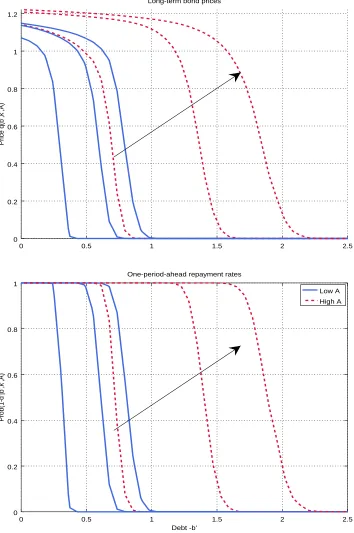
re-payment rateEm0,A0|A(1−d(b0, k0, m0, A0)). For clarity, the horizontal axis corresponds to debt (−b0) and the arrow indicates the direction in which capital increases. At the lowest capital and productivity levels, debt (as a fraction of steady-state output) starts being demanded
(i.e., q > 0) at around −b0 = 0.4. As capital moves to the largest value, debt starts being
valued at around b =−1, a value roughly 2.5 times larger. Similar dynamics occur at high
productivity levels. One can see that more capital raises the price of debt for virtually any
debt level.
Figure 5also reveals that capital reduces the odds of default not just in the next period
but well into the future. At low levels of capital, each additional unit increases the
one-period-ahead repayment rates (as can be seen in the bottom panel). This results in lenders
being willing to lend at low spreads, which increases debt prices. But more capital also
increases bond prices even when the probability of repayment next period is 1. E.g., for any
debt amount less than .2, the sovereign repays next period with probability 1 for each level
of capital. But, additional capital increases the debt price anyway because debt is long-term
and additional capital tomorrow results in additional ability to pay well into the future.
These results are consistent with the empirical observation that developed countries, i.e., countries with large capital stocks, seem less likely to default.
Relatedly, we find that—for regions of debt having positive prices for all capital levels—
the price schedule typically displays decreasing returns to capital. For instance, when debt
is 0.5 and productivity is high, the price of debt jumps from 1 to around 1.18 when capital
increases from the lowest level in the grid to the median (an 18% increase). In contrast,
when the stock of capital moves from the median to the highest capital stock, the price
moves from 1.18 to 1.20 (only a 2% increase). Since the capital grid is linearly spaced, this
implies decreasing returns.
This finding is explained by the effects of increased repayment rates at different horizons. When capital causes the one-period-ahead repayment rate to increase, this has a first-order
effect on the price schedule in (5) by increasing principal and coupon repayments as well
as the market value of remaining debt. In contrast, the effect of a capital increase when
repayment rates are 1 (or very high) is second-order: It only increases the current price
by increasing the future price of debt that does not come due. This naturally generates
0 0.5 1 1.5 2 2.5 0
0.2 0.4 0.6 0.8 1 1.2
Price q(b’,k’,A)
Long-term bond prices
0 0.5 1 1.5 2 2.5 0
0.2 0.4 0.6 0.8 1
Debt -b’
Prob(1-d’|b’,k’,A)
Low A High A One-period-ahead repayment rates
5.4
Dissecting the Role of Capital
As discussed in the introduction, capital causes a tension. More capital gives the planner a
savings tool to weather bad times and either avoid or postpone default. But, it also increases
the benefit of defaulting since the value of autarky rises with capital. To illustrate these
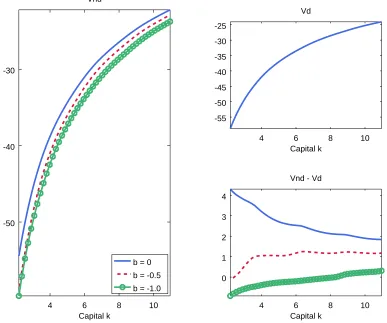
forces, we plot in Figure 6 the value functions of repayment (Vnd, left panel), default (Vd,
right upper panel), and their difference (Vnd−Vd, right bottom panel) as a function of capital for three levels of debt. All figures are conditional on median productivity andm = 0.
4 6 8 10
-50 -40 -30
Capital k
b = 0
b = -0.5
b = -1.0
4 6 8 10
-55 -50 -45 -40 -35 -30 -25
Capital k
4 6 8 10
0 1 2 3 4
Capital k Vnd
Vd
Vnd - Vd
Figure 6: Value Functions of Repayment (Vnd) and Default (Vd)
The interplay between debt and capital is nontrivial. For instance, when the country is
deeply indebted (which corresponds to the green circled line), additional capital improves
the sovereign’s ability to repay faster than it improves the value of autarky. This is reflected in the spread Vnd−Vd being increasing in k. That is, the smoothing channel of increased
capitalVnd
k dominates the autarky channel Vkd at large levels of debt. In contrast, when the
that the autarky channel dominates the smoothing channel.
To have some intuition about this result, consider what the envelope conditions for Vnd
andVd would be if leisure were not valued, there were no adjustment costs, and the problem
were smooth:
Vknd =u0(cnd)(1 +Aαkα−1−δ) and Vkd=u0(cd)(1 + (1−κ)Aαkα−1−δ). (6)
For sufficiently large debt levels, repaying or rolling over debt is costly, causing cnd cd.
Hence, Vnd
k −Vkd>0 and the spread is increasing in capital. In contrast, for small amounts
of debt, repaying debt is trivial but default costs are not. This causes cnd to typically be
greater thancd, and so the spread is decreasing in capital (Vnd
k −Vkd <0).
Another feature evident in Figure 6 is that the concavity or convexity of the spread also
hinges on the level of debt: For large levels of debt, the spread is concave; for low levels, the
spread is convex. To see cleanly why this is, consider differentiating the envelope condition
in (6) again while eliminating the impact of capital on its marginal product by settingα = 1.
Then,
Vkknd =cndk u00(cnd)(1 +A−δ) and Vkkd =cdku00(cnd)(1 + (1−κ)A−δ). (7)
For constant relative risk aversion of σ, the definition of relative risk aversion givesu00(c) = −σu0(c)/c. Using this to replace u00 in (7) and simplifying gives
Vkknd =−σndVknd and Vkkd =−σdVkd,
wherend and d, defined asdlogcnd/dk anddlogcd/dk, are elasticities of consumption with respect to capital. Putting these together, one has
Vkknd−Vkkd =−σd
nd
d V
nd k −V
d k
.
For large levels of debt, repaying or rolling over debt is costly since debt pricesqare low. Given
extra capital, the sovereign can choose a combination of (b0, k0) that results in an improved
priceq, which improves consumption beyond just the direct effect of additional capital. This
makesndlarge relative todfor large levels of debt. As a consequence, the term in parentheses is positive and the spread is concave. For smaller levels of debt, nd is smaller because now
the sovereign does not need to service debt at high-interest. In contrast, a sovereign in
default would generally like to borrow against the future when the default penaltyκ is gone
and hence output is higher. Given an additional unit of capital, the sovereign then finds it
in parentheses negative and results in a convex spread.
An economic interpretation of these results is as follows. When significantly indebted,
a sovereign that chooses to repay benefits greatly from extra capital because of the direct
effect of additional output and the indirect effect of lower debt service costs. Relative to a
sovereign in default who only has the direct effect, additional capital improves the sovereign’s
situation quickly. Once the indirect effect is gone (in the high debt case with lots of capital)
or if it is not present (as in the low debt case), it is the sovereign in default who benefits the
most: Consumption smoothing dictates that they consume more in the present, and extra
capital enables them to do so.
Since the spreadVnd−Vdis decreasing in capital for low levels of debt, a one-period debt framework would suggest that the price of small levels of debt decrease as capital increases.
Why, then, does the opposite result obtain? It is because debt is long term. High capital
today results in higher average levels of capital several periods in the future when, typically,
the country will be more indebted. It is there where additional capital, resulting in reduced
future default probabilities, comes to bear and results in a higher current price.
An alternative way to examine the role of capital is by studying an economy in which
investment follows a policy rule outside of the planner’s control. Under this assumption,
investment loses its role in the smoothing channel and retains only its role in the autarky
channel. To do this, we proceed in two steps. First, using the benchmark parameter values, we obtain an exogenous investment policy by solving an RBC version of our model in which
the sovereign chooses anyk0 but cannot borrow, i.e.,b0 = 0. For technical reasons, we assume
that this k0 applies to the entire interval [m, m] and that the sovereign chooses it assuming
m = m.17 In the second step, we use this exogenous investment policy function, together
with the autarky value function and autarky capital policy from the benchmark, but allow
the sovereign to optimally choose b0 and for prices to respond. Once again, we assume that
the b0 applies to the entire interval and that it is chosen assuming m=m.18
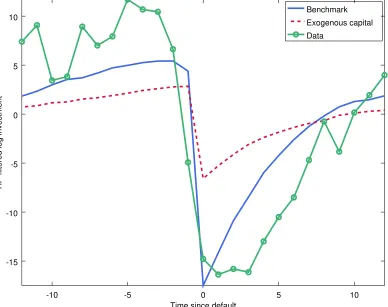
Figure 7 displays the dynamics of investment during default for both the benchmark
model (solid blue line) and when capital is exogenously determined (red dashed line). In the benchmark, the planner reduces investment in the periods prior to default to prop up
consumption at a time when the economy is being buffeted by negative productivity shocks
(the productivity decline can be seen in Figure 2). In contrast, when investment is not a
choice variable, the central planner defaults when the stock of capital is at its highest level.
The reason is two-fold. First, the planner internalizes the benefit that capital has on the
17When the sovereign is forced to use an exogenous capital policy that varies across them interval, then
the value function is no longer guaranteed to be increasing inm, which our computational algorithm assumes.
18These assumptions result in the value function iteration not converging. Since these cases are just for
-10 -5 0 5 10 -15
-10 -5 0 5 10
Time since default
HP-filtered log investment
Benchmark Exogenous capital Data
value of autarky. Second, the planner wants to liquidate some capital in order to smooth
consumption and avoid default, but he cannot as investment is outside of his control: The
smoothing channel is absent.
The crucial smoothing role of investment prior to default is further exposed in Table 4.
There we compare the dynamic properties of the model with exogenous capital accumulation
(the row labeled “Exogenous Capital”) and those of the benchmark. The exogenous capital
case induces excess consumption volatility of 1.36 compared to the benchmark’s 1.22: The
sovereign cannot use investment to avoid default or mitigate the effects of fluctuations in
foreign lending.
6
Alternative Models
In this section, we compare our model and small variations on it against a few existing models
that have explained important features of small open economies. We group the models into
three categories: RBC models with exogenous interest rates (Neumeyer and Perri, 2005),
models with sudden stops (Mendoza, 2010), and sovereign default models with exogenous
output (Aguiar and Gopinath, 2006;Arellano, 2008; Chatterjee and Eyigungor, 2012).
6.1
RBC with Exogenous Interest Rates
Neumeyer and Perri (2005) construct a small open economy model with exogenous interest
rates that successfully captures many important features of business cycles in emerging
economies. We allow for a small open economy RBC version with exogenous interest rates
in our model through two modifications. First, we replace the budget constraint with
c+q(b0−(1−λ)b) +i=Akαl1−α−Θ
2 (k
0−
k)2− Φ
2(b
0−¯
b)2+ (λ+ (1−λ)z)b.
Here, Φ is a small constant allowing for the model to be solved by linearization, and ¯b is a
target stock of debt. Second, we assume that q follows the stochastic process given by
q= (λ+ (1−λ)z)/(λ+r∗+s)
s0 = (1−ρs)¯s+ρss+σs0s.
The persistence ρs of the spread shocks is taken from Neumeyer and Perri (2005). The
target debt level ¯b and the average spread ¯s are set to match the debt-output ratio and the
annualized average spread in the data (0.70 and 8.15, respectively). As in the benchmark
The calibration strategy for the remaining parameters is nearly as before. The TFP shock
sizeσAis used to match the volatility of output in the data. The capital adjustment cost Θ is
set to matchσi/σy. The interest rate volatilityσs is set to match the data’s spread volatility.
The discount factor β is set to match the mean of the interest rate in the data. Finally, the
labor elasticity parameter ω and the cost of adjusting debt Φ are set to match the volatility
of consumption while ensuring the existence of a unique solution of the linearized model.19
Additional details may be found in Appendix A.4.
σy σσyc σσyi σnxy ρy,c ρy,i ρy,nxy ρy,r Ei/y Ed
Data
Full Sample 4.82 1.23 2.66 2.34 0.93 0.85 -0.68 -0.79 0.05 0.9
Benchmark
Full Sample 4.87 1.22 2.63 2.11 0.94 0.38 -0.32 -0.43 0.05 1.3
Other Variants
Exogenous Interest Rates
Naive SOE RBC 4.84 1.22 2.66 4.22 0.78 0.29 0.06 -0.01 0.05
Neumeyer and Perri (2005) 4.22 1.54 2.95 1.95 0.97 0.90 -0.80 -0.54
Sudden Stops
Benchmark sudden stops 4.81 1.25 2.71 2.52 0.91 0.37 -0.25 -0.37 0.05 1.2
Short-term debt sudden stops 11.69 1.07 2.24 7.07 0.88 0.75 0.05 -0.05 0.09 3.3
Mendoza (2010) 3.85 0.96 3.50 2.58 0.93 0.64 -0.18 -0.64 0.17
Exogenous Capital and Output
Exogenous Capital 4.58 1.36 1.34 2.65 0.91 0.18 -0.34 -0.45 0.05 1.0
Chatterjee and Eyigungor (2012) 4.22 1.11 0.88 0.99 -0.44 -0.65 1.7
Arellano (2008) 5.81 1.10 1.50 0.97 -0.25 -0.29 0.7
Aguiar and Gopinath (2006) 4.43 1.06 1.10 0.97 -0.12 -0.02 0.9
Note: Moments for Neumeyer and Perri(2005) are from row e, Table 3. Moments for Men-doza (2010) are from panel C, Table 3. Moments for Chatterjee and Eyigungor (2012) are from Table 4. Moments for Arellano (2008) are from Table 4. Moments for Aguiar and Gopinath (2006) are from column Model II with bailouts (3C), Table 3. Statistics for the data and benchmark are the same as in Table 3.
Table 4: Moments in Data and Model
19We found indeterminacy problems when we used the labor elasticity parameter alone to match the
The moments from this model are reported in the row labeled “Naive SOE RBC” in
Table 4. Clearly, the small open economy RBC model underperforms our benchmark. The
model’s most telling failure is the predicted correlation between output and interest rates,
-.01. The magnitude is small, in part, because the interest rate shocks are uncorrelated with
economic fundamentals: In both good and bad times, a positive interest rate shock is just
as likely as a negative interest rate shock. Note that in our benchmark, this could not be
further from the truth. Specifically, credit tightens whenever expected future output declines
and loosens whenever expected output increases. This is essentially a near perfect correlation
between interest rate “shocks” and future productivity.
As shown by Neumeyer and Perri (2005), one can improve on the naive small open economy model by introducing working capital and interest rates that depend on future
productivity. The resulting moments are in the row labeled “Neumeyer and Perri (2005)”
(empty spaces indicate that the corresponding moments are not available or not reported).
The most striking improvements are with respect to the correlations. E.g., now the correlation
between output and interest rates is−.54, exceeding the benchmark’s−.43 and approaching
the data’s−.79. In this regard, we view our benchmark model as providing microfoundations
to the model proposed by Neumeyer and Perri (2005). Not only does our model introduce
the dependence between the price of debt and future productivity that is crucial for the
performance of their model, it also simultaneously accounts for many features of sovereign defaults.
6.2
RBC with Sudden Stops
A defining feature of small open economies is that lending can rapidly dry up, as in the
Mexican sudden stop episode of 1995. To some extent, our benchmark model can capture
this endogenously: A negative productivity shock can trigger a fall in demand for sovereign
debt. Yet, our benchmark model has all foreign lending done by risk-neutral lenders who are
willing to substitute intertemporally at the constant rate 1+r∗. A number of papers,Mendoza
(2010) among them, have shown the importance of changes in external borrowing conditions
on economic activity in small open economies. As can be seen in the row labeled “Mendoza
(2010)” of Table4,Mendoza(2010) (which is calibrated to Mexican data) generates business cycle properties very similar to those in Argentina.
Following Bianchi et al.(2014), we allow for sudden stops in our model by stochastically
forbidding the issuance of new debt (in contrast with their work, our output loss during
sudden stops arises endogenously in response to a decrease in investment). Specifically, we
the economy is in a sudden stop. The sudden stops follow a two-state Markov chain process
identical to the one in Bianchi et al. (2014), which implies sudden stops last for an average
of 4 quarters. The row labeled “Benchmark sudden stops” in Table 4reports the results.
Surprisingly, allowing for sudden stops does not significantly change the performance of
the benchmark model. In a sudden stop, the sovereign must pay creditors at leastλ+(1−λ)z
fraction of the outstanding debt stock to avoid default. With long-term debt, this is less than
8%, which can be financed via relatively small reductions in consumption and investment.
On the other hand, when debt is short-term, the sovereign must pay 100%. Hence sudden
stops greatly change the short-term debt model (as can be seen in the row “Short-term debt
sudden stops”) but have little effect on the benchmark.
6.3
Sovereign Default with Exogenous Output
For completeness, we also present available business cycle statistics for select sovereign
de-fault models (Arellano, 2008; Aguiar and Gopinath, 2006; Chatterjee and Eyigungor, 2012)
featuring exogenous output. While the results are not fully comparable because Arellano
(2008) andChatterjee and Eyigungor (2012) linearly detrend their variables before
comput-ing moments, our benchmark model performs very similarly with the key distinction that it
also matches investment moments.
7
Conclusion
In this paper, we propose a model with endogenous sovereign default, long-term debt, and
capital accumulation. The model is parsimonious but captures the behavior of output,
con-sumption, and investment in default episodes as well as key business cycle regularities. We
find that additional capital increases debt prices and that this effect is diminishing. We show that current indebtedness determines whether the smoothing channel or autarky channel
dominates. The model builds on existing insights from several strands of the literature and
offers a more complete understanding of small open economies.
References
M. Aguiar and G. Gopinath. Defaultable debt, interest rates and the current account.Journal
of International Economics, 69(1):64–83, 2006.
S. R. Aiyagari. Uninsured idiosyncratic risk and aggregate saving. Quarterly Journal of
C. Arellano. Default risk and income fluctuations in emerging economies. American
Eco-nomic Review, 98(3):690–712, 2008.
C. Arellano and A. Ramanarayanan. Default and the maturity structure in sovereign bonds.
Journal of Political Economy, 120(2):187–232, 2012.
Y. Bai and J. Zhang. Solving the Feldstein-Horioka puzzle with financial frictions.
Econo-metrica, 78(2):603–632, 2010.
Y. Bai and J. Zhang. Duration of sovereign debt renegotiation. Journal of International
Economics, 86(2):252–268, 2012a.
Y. Bai and J. Zhang. Financial integration and international risk sharing. Journal of
Inter-national Economics, 86(1):17–32, 2012b.
M. Baxter and M. Crucini. Explaining saving-investment correlations. American Economic
Review, 83(3):416–436, 1993.
J. Bianchi, J. Hatchondo, and L. Martinez. International reserves and rollover risk. Mimeo,
2014.
S. Chatterjee and B. Eyigungor. Maturity, indebtedness, and default risk. American Eco-nomic Review, 102(6):2674–2699, 2012.
L. Christiano, M. Eichenbaum, and C. Evans. Nominal rigidities and the dynamic effects of
a shock to monetary policy. Journal of Political Economy, 113(1):1–45, 2005.
J. Eaton and M. Gersovitz. Debt with potential repudiation: Theoretical and empirical
analysis. The Review of Economic Studies, 48(2):289–309, 1981.
J. Fernandez-Villaverde, P. Guerron-Quintana, J. Rubio-Ramirez, and M. Uribe. Risk
mat-ters: The real effects of volatility shocks. American Economic Review, 101(6):2530–2561,
2011.
G. Gordon and P. Guerron-Quintana. Dynamics of investment, debt, and default. Working
Paper 13-18, Federal Reserve Bank of Philadelphia, 2013.
J. Greenwood, Z. Hercowitz, and G. W. Huffman. Investment, capacity utilization, and the
real business cycle. American Economic Review, 78(3):402–417, 1988.
J. C. Hatchondo and L. Martinez. Long-duration bonds and sovereign defaults. Journal of
International Economics, 79(1):117–125, 2009.
J. C. Hatchondo, L. Martinez, and H. Sapriza. Quantitative properties of sovereign default
models: Solution methods matter. Review of Economic Dynamics, 13(4):919–933, 2010.
P. Kehoe and F. Perri. International business cycles with endogenous incomplete markets.
Econometrica, 70(3):907–928, 2002.
P. Kehoe and F. Perri. Competitive equilibria with limited enforcement.Journal of Economic
Theory, 119(1):184–206, 2004.
E. Mendoza. Capital controls and the gains from trade in a business cycle model of a small
open economy. Staff Papers 38, IMF, 1991.
E. Mendoza. Sudden stops, financial crises, and leverage. American Economic Review, 100
(5):1941–1966, 2010.
E. Mendoza and V. Yue. A general equilibrium model of sovereign default and business
cycles. Quarterly Journal of Economics, 127(2):889–946, 2012.
J. Nason and J. Rogers. The present-value model of the current account has been rejected: Round up the usual suspects. Journal of International Economics, 68(1):159–187, 2006.
A. Neumeyer and F. Perri. Business cycles in emerging economies: The role of interest rates.
Journal of Monetary Economics, 52(2):345–380, 2005.
J. Park. Sovereign default risk and business cycles of emerging economies: Boom-bust cycles.
Mimeo, 2015.
C. Reinhart and K. Rogoff. This time is different: A panoramic view of eight centuries of
financial crises. Working Paper 13882, NBER, 2008.
J. Roldan-Pena. Default risk and economic activity: A small open economy model with
sovereign debt and default. Working Paper 2012-16, Banco Central de Mexico, 2012.
J. M. Sanchez, H. Sapriza, and E. Yurdagul. Sovereign default and the choice of maturity.
Working Paper 2014-031B, Federal Reserve Bank of Saint Louis, 2014.
M. Tomz and M. L. Wright. Empirical research on sovereign debt and default. Annual