20
Making the Most of Out-of-School Visits:
How does the Teacher Prepare?
Part II: Implementation & Evaluation of
the Learner Integrated Field Trip
Inventory (LIFTI)
Sandhya Colla, Richard Collb and David Treagustc Corresponding author: Sandya Coll ([email protected])
aWorld Health Organisation, Downtown Boulevard, Fiji National Provident Fund Building, Plaza 1 Level 4, Module 3, Suva, Fiji
bThe Deputy Vice Chancellors Office, Teaching, Learning and Student Services, The University of the South Pacific, Laucala Campus, Suva , Fiji
cCurtin University of Technology, Science & Mathematics Education Centre, Bentley Campus, Perth, WA 6001, Australia
Keywords: informal science institute (ISI), learner integrated field trip inventory (LIFTI), social constructivism, collaborative learning
International Journal of Innovation in Science and Mathematics Education, 26(4), 20–29, 2018.
Abstract
In another work (Coll et al., 2018), the development of the Learner Integrated Field Trip Inventory (LIFTI) was described. In this paper, Part II which was the implementation and evaluation of the LIFTI during two out-of-school visits to Informal Science Institutes (ISIs), is discussed. The study involved 10 secondary school teachers, and 100 students (15 years old) from one secondary school. The LIFTI focused on three major components of out-of-school visits: cognitive, procedural, and social, and was used by teachers for planning pre-visit, during-visit, and post-visit activities. After the classroom instruction and out-of-school visits, a written end of topic assessment was administered to evaluate students’ learning achievement. Data comprised of students end of topic test which showed a statistically significant difference between students who had exposure to using LIFTI and those who did not. The findings suggest that pre- and post-visit planning by teachers using LIFTI is more likely to engage learners in collaborative learning. Although the results are limited to this cohort, they provide evidence of improvement in methodological knowledge of teachers regarding out-of-school visits.
Introduction and background
21
There are many ways to educate a child. Out-of-school visits are one effective educational activity for students that helps facilitate fast and efficient learning. Schools in many countries are taking the initiative to organise out-of-school visits for their students. The New Zealand curriculum (the context for this study), places strong emphasis on learning experiences outside of school (LEOS) particularly in science. Instead of just reading and writing in the classroom, teachers are taking the effort to offer creative learning to students through educational field trips. School field trips provide every student with real-world experiences. Whether the trip is to a show home, hospital, a mangrove ecosystem, a planetarium or a museum, with each experience students are able to create a connection between what is happening at school and in the ‘real-world’. School field trips in practice are often more about enjoyment, excitement and fun, without the pressure of being called to answer a question or be given a surprise quiz. This helps address perceptions of boredom of classroom lectures, even if it is just for a day. Moreover, it awakens student’s interest to learn and get new information, no matter how boring the subject is in theory.A good example - described in Part I - was learning about the thermal co-efficient or ‘R value’, which was not only difficult for students to understand, but difficult to relate to.School field trips allow children to open their eyes to new environments and new cultures. Such trips positively shape their perspective on a global level, and trigger ideas and solutions that may not stem from their everyday classroom learning. Moreover, students who go on LEOS become more empathetic, tolerant and respectful towards different cultures and the society as a whole (Nadelson & Jordan, 2012). However, arguably the most valuable outcome of LEOS is to improve learning outcomes. Through real-life connections and hands on experience of the lessons they are learning in school, students are more likely to understand the subject better. The relevance of what they are learning helps them to perform better in school exams, test and projects.
Given the apparent benefits it is interesting to consider why more teachers do not take students on field trips.It seems that whilst many teachers agree that field trips are a great way to enhance learning and expose students to unique experiences, many do not take the time to plan one and/or do not want to be in charge of planning for LEOS, for a wide range of reasons (see below). Learning during out-of-school visits can be limited as a result of missed opportunities if the objectives are ill-defined and if the visit lacks preparedness, and uses poor pedagogy (Rennie, 2007). Further support for the above view comes from reports in the science education literature, which suggest that outdoor learning is strongly connected to pedagogies that promote active learning, self-control, real-world experiences, group work and inquiry learning (Ash & Wells, 2006; Dori & Tal, 2000). A critical reason why LEOS is not perceived by most teachers and students as an activity which could be fun but where students also enjoy learning, is mainly due to a lack of teacher planning, pre-, during and post-visit to an ISI. So, while there are several reasons why teachers find planning for LEOS difficult, we have developed the LIFTI which could be used by teacher pre- during and post-visit planning (Coll et al., 2018).
22
induce cognitive conflict, which encourages students to develop new knowledge. That is, the learner experiences teaching and learning situations and gives personal meaning to those experiences through their own reflection, and through social interactions with other students, teachers and ISI staff. LEOS provide great opportunities for such learning experiences. The LIFTI is essentially a checklist which incorporates three educational components (cognitive, procedural & social) and a number of descriptors which should be considered by teachers when developing a successful informal learning experience (see Part I).
In this work, we provide evidence that the implementation of the LIFTI can improve the learning of science. This study explores an off-site visit to the Show Home (a pseudonym for an ISI) and the Cottage (a pseudonym for an old school house) to develop student understanding of heating and insulation, a learning area from an achievement standard of the New Zealand science curriculum. The findings reported here are on student achievement with and without the use of LIFTI.
Aim
The overarching aim of this study is to improve student learning outcomes in science using the LIFTI. The motivation for this research came from literature reports, which claimed that teachers on the whole were not overly concerned with their students’ expectations, and do not much consider students’ ideas for visits as an important aspect of field trip planning (Morag & Tal, 2009; Tal, 2012). Also, students are often observed sharing their prior knowledge and experiences with others during visits; behaviors that could support learning if used constructively in field trip design (Ballantyne & Packer, 2002).
Research question
This study was guided by the following research question: How does student achievement compare with and without the use of LIFTI?
Method
23
Later that year, an out-of- school visit was conducted to an ISI called Cottage (a pseudonym), to study Implication of Heat to Everyday Life. This was an old teachers quarters located within the school compound. The trip included 10 teachers and 100 Year 11 (15 years old) students, 58 male and 42 female students. This visit did not use the LIFTI model or the checklist derived from this model when planning for LEOS. Students and teachers took turns to visit this ISI, where teachers showed different building materials used. Students wandered round, and only occasionally interacted with teachers to discuss the topic being studied. A few students remembered to bring their worksheets, while others constantly talked about the camp trip they had returned from a day before. Teachers were mostly concerned about student behaviour and consistently reminded students on the amount of time they had left before they went back to their classroom. A week later, students sat for a written test for two hours under examination conditions.
In early 2014, these same 10 teachers were introduced to the LIFTI model (see Part I, Figure 1), and a purpose-designed checklist for planning out-of-school visits, based on the LIFTI (see Part 1, Figure 2). A visit was made to the Show Home (a pseudonym), which included 10 teachers, but a different cohort of Year 11 (15 years old) students. There were 52 male and 48 female students, who studied the same topic as the cohort from 2013, and undertook the same end of topic assessment. Before the visit, teachers used the LIFTI to prepare worksheets, which included students’ ideas. The teachers also informed ISI staff on the objectives of the visit. These ISI staff consisted of an architect and a civil engineer, who had designed this new home. Students were asked to form groups they wished to work with to develop a worksheet, which had key questions on the assessment, but also allowed them to make inquiries which were not assessed. Examination of the teacher’s planning diaries showed diversity in planning, and the post-visit classroom session allowed students to draw upon findings which they made using worksheets while teachers discussed how these related to their end of topic assessment. As in the 2013 trip, these students sat for a two hour assessment under examination conditions. Test scores between the groups in 2013 and 2014 were compared using a Mann Whitney-U test.
Results and analysis
The research findings suggest that students who had been exposed to LIFTI for out-of-school visits did better than those who did not, with the difference found to be statistically significant. The results in Table 1 suggest that taking students on out-of-school visits helps them to construct knowledge by participating in activities where they interact with others and with artifacts (e.g., interactive exhibits, signage, etc.). This construction of knowledge is influenced by the learner’s context, prior knowledge and social interactions with teachers, ISI staff and other students. The LIFTI allows students some free choice learning, which provides autonomy to explore topics of personal interest. LEOS helps in conceptual learning, enrichment, social and emotional engagement, improving attitude to science, and reinforcement of certain content. This learner-centered approach is thought to translate into deeper learning for students, which is supported by the data provided in Table 1. There is evidence to suggest that changes made to the way teachers planned for LEOS, pre-, during and post-visit using LIFTI, have resulted in improving student learning outcomes.
Data Analysis
24
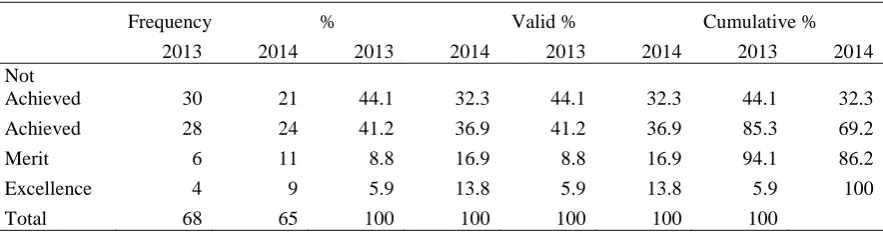
Mann-Whitney-U test, shows a statistically significant difference between groups. Table 2 shows assessment results from 2013 and 2014.
Table 1. Assessment results for AS90943: The Design Game, Keeping Your Home Warm between 2013 & 2014
Year Not Achieved Achieved Achieved at Merit
Achieved at Excellence
2014 19 35 25 21
2013 44 41 9 6
These results indicate that very little preparation, if any, was conducted for out-of-school visits at this school in 2013. After being introduced to using the LIFTI model and the checklist, teachers were asked to reconsider their preparations for visiting a second ISI, the Show Home, which included both students and professional assistance provided by ISI staff. The LIFTI, which included cognitive, procedural and social components of fieldtrip design, was used to ensure a more learner-centred approach intended to make learning more fun, enjoyable, and productive.
Table 2: Summary of assessment results for AS90943: The Design Game, Keeping Your Home Warm for 2013 and 2014
Frequency % Valid % Cumulative %
2013 2014 2013 2014 2013 2014 2013 2014
Not
Achieved 30 21 44.1 32.3 44.1 32.3 44.1 32.3
Achieved 28 24 41.2 36.9 41.2 36.9 85.3 69.2
Merit 6 11 8.8 16.9 8.8 16.9 94.1 86.2
Excellence 4 9 5.9 13.8 5.9 13.8 5.9 100
Total 68 65 100 100 100 100 100
The National Certificate of Educational Achievement (NCEA), is the current national secondary school qualifications in New Zealand, and consists of a standard-based assessment, which uses criterion-based marking. Assessment for achievement standards uses a four-grade system, the lowest being a failing grade (Ministry of Education [MoE], 2007). Achievement with ‘excellence’ indicates that the candidate has demonstrated comprehensive understanding of the material tested, while achievement with ‘merit’ is when the candidate has met the criteria of the standard, which demonstrates in-depth understanding of the material tested. Straight ‘achievement’ would represent candidate who have met the criteria of the standard to a level which demonstrates understanding of the material tested, and ‘not achieved’ is awarded when the candidate has not met the criteria required of the standard in order to pass.
25
the two years for achievement with merit and at excellence levels, both increased, by 16% and 15% respectively. A quantitative analysis using Mann Whitney-U Test showed that there is statistically significant difference between the test scores of the two groups. Students in Year 2014 generally performed better than those in Year 2013 students (p/sig.<0.05).
Student academic abilities at the beginning of 2013 and 2014 were relatively similar, as recorded in the school test register. Caution is needed in interpreting the findings from this case study, because the data presented here are for different cohorts of students at the same year level, and doing the same assessment tasks in different years. As such, the groups are not equivalent. However, the school teachers confirmed the results at the beginning for the year 2013 and 2014 are typical of Year 11 student’s performance, and the teaching approaches used in 2013 are unchanged from previous years, where similar performances were noted. In particular, under the New Zealand competency-based assessment regime, achieving ‘excellence’ is very difficult indeed, and the proportion of students that achieved this level of performance is dramatically different. Hence, although not directly causal, it does appear that 2014 cohort performed better than their earlier counterparts typically did.
Discussion
Learning at ISIs is influenced by a number of factors, namely teacher preparation, choice of ISI and the nature of ISI staff, as well as inclusion of free choice learning. Researchers note that the visits to ISIs such as zoos and museums, if not planned properly by teachers, that is, employing proper teaching pedagogies and setting specific learning outcomes, results in missed opportunities for learning (Kisiel, 2003; De Witt, 2007; Tofield, Coll, Vyle, & Bolstad, 2003; Tunnicliffe, Lucas & Osborne, 1997). Findings from this study which relate to visiting the ISI without using LIFTI indicated that lack of planning by teachers resulted in limited learning outcomes from LEOS. The assessment results indicated that students lacked knowledge, especially understanding a difficult concept such as thermal co-efficient and how it related to building material and designing homes in temperate countries. This was mostly because the subject teachers did not properly plan the visit, lacked inclusion of students ideas and support from ISI staff. These findings are similar to work reported by Kisiel (2003) and De Witt and Osborne (2007), who observe that not all interactions at the ISI result in better learning outcomes unless teachers adequately prepare for such visits. The literature states that LEOS result in limited learning outcomes, when teachers are more concerned about student behaviour, want them to only learn tasks which they have planned, keep to rigid timelines, and insist students simply complete worksheets (Griffin, 2004; Griffin & Symington, 1997; Kisiel, 2003). This parallels findings from the present study, which indicated that teachers were concerned about student behaviour and keeping to rigid timelines, so the students could board the buses at a specified time at the end of the day.There was little evidence for student learning at the ISI, and/or completing worksheets to record their discussions, which is reflected in student results.
26
teachers. In 2014, students were guided by enthusiastic ISI staff, who displayed active engagement which was reflected in their end of topic assessment.
There are numerous studies in the literature which report that while LEOS helps give meaning to abstract science ideas learnt in the classroom (Aubusson, Griffin, & Kearney, 2012; Gardner, 1991; Orion & Hofstein, 1994), there is a need for proper planning if we are to maximise learning opportunities. That is, preparing a learning environment where informal learning can be self-paced and self-directed (Griffin & Symington, 1997). As noted by Falk and Dierking (2000), LEOS planned properly with some degree of choice helps improve learning outcomes. This is consistent with findings of Rennie and McClafferty (1995, 1996) on inclusion of some freedom of choice in learning. Informal learning at an ISI should then include free choice learning, which acts as a mediation tool and helps scaffold students learning (Jarvis & Pell, 2005). This helps students to collaborate in groups, and ask personalised questions which are not formally assessed. According to Bamberger and Tal (2007) and, Jarvis and Pell (2005), this enables growth of individual identities (see also Griffin, 2007). However, Tofield et al. (2003), argue that the constituents of the environment are free choice in nature, activities that remain highly teacher-centred, reduce student choices about their learning, thus affecting the learning outcomes. This study revealed that planning without using LIFTI lacked inclusion of free choice learning, which resulted in students’ disengagement from the task. This was evident from the end of topic test results. However, teacher planning using LIFTI revealed a significant improvement in student performance for the same assessment. In summary, findings from this this study support literature recommendations that pre-, during and post-visit preparation by teachers helps improve the learning outcomes during LEOS. Using LIFTI to do field trip preparation resulted in a significant improvement in student academic performance.
Conclusion and implications
The LIFTI developed in this study provides a checklist, which teachers can use when preparing for a cognitively-successful field trip. Teachers may want to use the LIFTI model and the derived checklist as a teaching tool in assuring that their field trip designs cognitively engage students. The cognitive, procedural, and social components must be integrated to build a comprehensive field trip design. If one of the field trip characteristics is removed, the framework collapses, and cognitive engagement may not occur. If teachers do not take into account the cognitive, procedural, and social components of a good field trip design, then a positive learning experience may not take place. For example, students need to have problem- solving interactions before, during, and after the field trip in order to maximize their cognitive experiences. This would require the teachers to work with the ISI staff to plan the visit, and to include opportunities for students to interact with the ISI staff. Moreover, allowing students’ input to the development of the field trip experience is an important element of cognitive development. Teachers need to consider how students are grouped, and allow students some say in who they wish to work with, what they want to see and learn. Taken together, the various components of this study and other studies on field trip design suggest the promotion of field trip design, which is learner inclusive and should be used by all teachers in both primary and secondary schools.
Implications for teaching and learning
27
deeper understanding. The opportunity for free-choice learning encourages students to take some ownership of their learning.
Teachers may not be equipped with the knowledge of how to prepare for lessons when taking students on out-of-school visits, and may unknowingly adopt practices, which do not impact of students’ learning achievement. Alternatively, there are teachers who may not even consider taking learning outside the classroom, as they may not be aware of its impact on cognitive and affective domains.
An important outcome of this research is the extent to which a complex science topic, thermal insulation and conductivity, has been understood by the students. Out-of-school visits were originally seen by both students and teachers at this school as a reward, only to be conducted at the end of the school year. However, teachers used these findings to develop their teaching and learning strategies for out-of-school visits using the LIFTI.
Sometimes teachers are not aware that taking learning outside the classroom could influence students’ achievement in learning. This may be because the general assessment methods may be aligned with what is formally taught in the classroom. Curriculum planners and writers of Teacher Guide Books should take the initiative to provide teachers with more than just the formal ways of teaching science. The curriculum should also encourage, non-formal and informal learning. Science Teacher Guide Books should also include guidelines such as the one derived from the LIFTI model for planning out-of-school visits, especially for complex topics, which require inquiry-based learning. As a result of this research a book on the application of the LIFTI, for all four strands/topics of science namely Planet Earth & Beyond (Astronomy), Material World (Chemistry), Living World (Biology), and Physical World (Physics) will be published (Coll et al., 2018). This will provide specific lessons plans for teachers on selected topics, which are generally considered difficult to teach using formal learning methods only.
Limitations of the study
Like any work, this study has some limitations. First, this case study was completed at two ISIs only, the Cottage and Show Home by secondary school teachers and Year 11 (15 years old) students, and the findings are not then generalizable to other places of informal learning, other grade levels, and practicing classroom teachers. Additionally, only one internal assessment was used to evaluate learning outcomes. The data collection is limited to end of topic tests.
Also, this study was conducted in a decile 101 school in New Zealand, and so the findings are not generalizable in other types and decile rating schools. Future investigations concerning out-of-school visit should include a larger data pool to enhance statistical power and include students of different year groups. Additionally, the LIFTI was not used to establish the quality of the field trip designs. Therefore, further studies should use the LIFTI to investigate the quality of the field trip designs.
1
A decile is a 10% grouping, there are 10 deciles and around 10% of schools are in each decile. A school’s decile rating indicates the extent to which it draws its students from low socio-economic communities. Decile 1 schools are the 10% of schools with the highest proportion of students from low socio-economic communities, whereas decile 10 schools are the 10% of schools with the lowest proportion of these students. The lower a school’s decile rating, the more funding it gets. The increased funding given to lower decile schools is to provide additional resources to support their students’ learning needs. A decile does not indicate the overall socio-economic mix of the students attending a school or measure the standard of education delivered at a school. See
28
References
Ash, D., & Wells, G. (2006). Dialogic inquiry in classrooms and museums. In Z. Bekerman, N. C. Burbles & D. Silberman-Keller (Eds.), Learning in places: The informal education reader (pp. 35–54). New York, NY: Peter Lang.
Aubusson, P., Griffin, J., & Kearney, M. (2012). Learning beyond the classroom: Implications for school science. In B. J. Fraser, K. G. Tobin & C. J. McRobbie (Eds.), Second international handbook of science education
(vol. 2, pp. 1123–1134). Dordrecht, The Netherlands: Springer.
Ballantyne, R., & Packer, J. (2002). Nature-based excursions: School students' perceptions of learning in natural environments. International Research in Geographical and Environmental Education, 11, 218–236. Bamberger, Y., & Tal, T. (2007). Learning in a personal-context: Levels of choice in a free-choice learning
environment in science and natural history museums. Science Education, 91,75–95.
Clements, D. H., & Battista, M. T. (1990). Constructivist learning and teaching. Arithmetic Teacher, 38(1), 34– 45.
Coll, S., Coll, R., & Treagust, D. (2018). Best practices when preparing for out-of-school visits, Part I: Development of the Learner Integrated Field Trip Inventory (LIFTI). International Journal of Innovation in Science and Mathematics Education, 26(4), 1–19.
De Witt, J. (2007). Supporting teachers on science-focussed school trips: Towards an integrated framework of theory and practice. International Journal of Science Education, 29, 685–710.
DeWitt, J., & Osborne, J. F. (2007) Supporting teachers on science-focused school trips: Towards an integrated framework of theory and practice. International Journal of Science Education, 29(6), 685–710.
Dori, Y. J., & Tal, R. T. (2000). Formal and informal collaborative projects: Engaging in industry with environmental awareness. Science Education, 84, 95–113.
Falk, J. H., & Dierking, L. D. (2000). Learning from museums: Visitor experiences and the making of meaning.
Walnut Creek, CA: AltaMira Press.
Gardner, H. (1991). The unschooled mind: How children think and how schools should teach. New York, NY: Basic Books.
Griffin, J. M. (2007). Students, teachers and museums: Towards an intertwined learning circle. In J. H. Falk, L. D. Dierking & S. Foutz (Eds.), In principle, in practice: Museums as learning institutions (pp. 31–42). Lanham, MD: AltaMira.
Griffin, J. (2004). Research on students and museums: Looking more closely at the students in school groups.
Science Education, 88(Supplement 1), S59–S70.
Griffin, J., & Symington, D. (1997). Moving from task-oriented to learning-oriented strategies on school excursions to museums. Science Education, 81, 763-779.
Jarvis, T., & Pell, A. (2005). Factors influencing elementary school children’s attitudes towards science before, during, and after a visit to the UK National Space Centre. Journal of Research in Science Teaching, 42, 53–83.
Kisiel, J. F. (2003). Teachers, museums and worksheets: A closer look at a learning experience. Journal of Science Teacher Education, 14(1), 3–21.
Lincoln, Y. S., & Guba, E. G. (1985). Naturalistic inquiry. Newbury Park, CA: Sage. Merriam, S. B. (1988). Case study research in education. San Francisco, CA: Jossey-Bass.
Ministry of Education. (1997). The New Zealand curriculum framework. Wellington, New Zealand: Government Printer.
Morag, O., & Tal, T. (2009, April). Multiple perspectives of out-of-school learning in various institutions. Paper presented at the annual meeting of the National Association for Research in Science Teaching. Garden Grove, CA.
Nadelson, L., & Jordan, R. (2012). Student attitudes toward and recall of outside day: An Environmental science field trip. The Journal of Educational Research, 105(3), 220–231.
Nussbaum, J., & Novick, S. (1982). Alternative frameworks, conceptual conflict and accommodation. Instructional Science,22, 183–208.
Orion, N., & Hofstein, A. (1994). Factors that influence learning during a scientific field trip in a natural environment. Journal of Research in Science Teaching, 31, 1097–1119.
Patrick, P., Mathews, C., & Tunnicliffe, S. D. (2013). Using a field trip inventory to determine if listening to elementary school students conversations, while on a zoo field trip, enhances preservice teachers abilities to plan zoo field trips. International Journal of Science Education, 35(15), 2645–2669.
29
Rennie, L. J. (2007). Learning science outside of school. In S. K. Abell & N. G. Lederman, (Eds.), Handbook of research in science education (pp. 125–167). Mahwah, NJ: Lawrence Erlbaum.
Rennie, L. J., & McClafferty, T. P. (1996). Science centres and science learning. Studies in Science Education,
27, 53–98.
Rowell, J. A., & Dawson, C. J. (1984). Equilibration, conflict and instruction: A new class-oriented perspective.
European Journal of Science Education, 7, 331–334.
Tal, R. T. (2012). Out-of-school: Learning experiences, teaching and students' learning. In B. J. Fraser, K. G. Tobin & C. J. McRobbie (Eds.), Second international handbook of science education (vol. 2, pp. 1109– 1122). Dordrecht, The Netherlands: Springer.
Tofield, S., Coll, R., Vyle, B., & Bolstad, R. (2003). Zoos as a source of free choice learning. Research in Science and Technological Education, 21(1), 67–99.
Tunnicliffe, S. D., Lucas, A. M., & Osborne, J. (1997). School visits to zoos and museums: A missed educational opportunity? International Journal of Science Education, 19, 1039–1056.