Comparative Performance, Approximate Biochemical Composition and
Consumer Preference of Albino and Normally Pigmented Varieties of
Rainbow Trout (Oncorhynchus mykiss)
øbrahim Okumuú1,*, Ali De÷irmenci2
, Nadir Baúçınar1, M. Salih Çelikkale 3 1
Karadeniz Technical University, Faculty of Marine Sciences, Dept. Fisheries, 61530 Çamburnu, Trabzon, Turkey
2
Under Secretariat for Maritime Affairs, Directorate of Province of Trabzon, Trabzon, Turkey
3
University of Istanbul, Faculty of Fisheries, Ordu Cad. No: 200, 34480 Laleli, østanbul, Turkey
* Corresponding Author: Tel.: + 90. 462. 752 28 05; Fax: + 90. 462. 752 21 58; E-mail: [email protected]
Received 23 March 2001 Accepted 11 June 2001
Abstract
Growth rates, daily feed consumption (FC), feed conversion rates (FCR), condition factor (CF), tissue compositions and consumer preference of albino (A), and normally pigmented (N) varieties of rainbow trout (Oncorhynchus mykiss) were examined by rearing them in all albino, all normal and mixed or duo-culture groups. The fish were held at ambient water temperatures (8-18ºC) under natural autumn – winter photoperiod (41ºN) and fed manually for 7 days a week, and twice a day to apparent satiation.
At the end of the 122 day trial period the mean weights of the groups reached 317.5
r
66.03 g (normal), 366.4r
74.27 g (duo normal), 315.3r
44.63 g (duo albino) and 319.9r
50.26 g (albino). Statistical analysis of the final weight values showed that only the normally pigmented fish in duo-culture exhibited significantly higher growth. There were no significant variations in other variables examined. However, the feed conversion ratio in the duo-culture seemed to be slightly better than the others. Consumer preferences were in favour of the normal pigmented fish. It has been concluded that the colour genes controlling the albino phenotype may have pleiotropic effects on growth only in duo- or mixed culture of two varieties.Key Words: albino rainbow trout, Oncorhynchus mykiss, duo-culture, growth performance, feed conversion, biochemical
composition.
Introduction
Albinism is the lack of body and eye pigmentation due to absence of melanin in chromatophores, and has been observed in many species (Bridges and Von Limbach, 1972; Kirpichnikov, 1981; Bondari, 1984; Rothbard and Wohlfarth, 1993; Tave, 1993; Dobosz et al., 1999). It seems to be normally inherited as a simple autosomal recessive character (Bridges and von Limbach, 1972; Bondari, 1984; Rothbard and Wohlfarth, 1993; Tave, 1993). The distinctive appearance of albinos has made them of interest for commercial aquaculture (Bondari, 1984), aquarium breeding, and genetic studies as well (Thorgaardet al., 1995).
There seems to be a disagreement among the scientist on the pleiotropic effect of the colour genes controlling the albino phenotype. According to some authors (e.g. Bridges and von Limbach, 1972; Bondari, 1984) albinism in commercial aquaculture species does not appear to have a significant pleiotropic effect on the mutant gene. However, there seems to be the possibility of some kind of pleiotropic effects.
Tave (1993) cites that Wohlfarth and Moav (1970) found that blue and gold common carp, which are similar in the inheritance to albino trout, have lowered growth rates as a pleiotropic effect. Bondari (1984) reported normally pigmented catfish are superior to albino fish in growth when they were reared in tanks, ponds, and cages. In rainbow trout,
Bridges and von Limbach (1972) suggested that the albinos seem somewhat more lethargic, but were not substantially different from normally pigmented cousins in qualities such as fecundity, survival, or growth rate. However, they did not submit detailed data on the comparison of these qualities. Recently, Dobosz et al. (1999) found that the genes controlling the palomino and albino phenotype in the spring spawning rainbow trout strain have strong detrimental pleiotropic effects on growth and vitality.
In this study, the growth rates, daily feed consumption and conversion rates, condition factor, tissue biochemical compositions and consumer preference of the albino along with normally pigmented rainbow trout which were cultured in tanks as all normal, all albino, and mixed or duo-culture groups were compared.
Materials and Methods
The trial was conducted at Aquaculture Research and Training Facility of Karadeniz Technical University, Faculty of Marine Sciences, in North-eastern Turkey. Over six month old rainbow trout (Oncorhynchus mykiss) juveniles reared in this unit were used. The trial was designed as all normally pigmented (all-N), all albino (all-A) and mixed or duoculture (N+A) with two replicates for each. Three hundreds fish (150 albino and 150 normally pigmented) were divided randomly after grading and bulk weighing amongst six centrally drained circular
fibreglass tanks with a water volume of 0.3 m3. The initial stocking density was around 14.5 kg/m3. Prior to the start of the trial the fish were kept in tanks for three days for acclimatisation to the experimental conditions. The trial was performed under ambient conditions (short day-lengths and variable water temperatures) and lasted until the fish reached portion size or for 4 months from the end of September 1997 to the end of January 1998.
All tanks were supplied with unfiltered flow-through stream water during the first period and 50:50% mixture of stream and brackishwater of the Black Sea during the rest of the study. Water input ranged from 5 l/min to 10 l/min depending on fish size, stocking density, and water temperature. When the dissolved oxygen levels of the effluent started to decline below critical levels (around 6.5-7.0 mg/l), the water inflow was increased. Water exchange rates were similar for all tanks and there were only minimal differences in dissolved oxygen contents.
Water temperature and feed supply were recorded daily, while the dissolved O2 content in the water outlet was measured weekly to ensure the minimum concentration mentioned above. The minimum concentration. The growth rates (live weight gain) were then followed by bulk-weighing the fish in each tank to the nearest 2 g at 30, 61, 91 and 122 days, each time after a day of feed deprivation. Sampling days are hereafter termed P0 (initial), P1, P2, P3 and P4. In addition, individual weights (±0.01 g) and total lengths (±1 mm) of 20 fish from each group were taken for calculating condition factors. All the fish were weighed individually at the end of the experiment. Those fish handled individually (weighed and measured) were anaesthetized (50 ppm MS-222) before handling.
Fish were fed with a commercial steam pelleted feed with approximate (crude) biochemical composition of 40% protein, 12% lipid, 15% ash and 5% cellulose. Pellet size was increased according to the manufacture’s recommendations as the fish grew. Feeding was conducted manually 7 days a week (9 a.m. and 4 p.m), two times a day to near the satiation by observation of the feeding activity. This regime was similar to the practical feeding performed in commercial farms. The amount of feed given to the fish in each tank at each meal was noted. Around one hour after the last daily meal, the drainpipes were brushed out to remove accumulated faeces and feed wastes from the tanks. In order to estimate daily feed consumption rates, the feed that was given to the fish was recorded daily and uneaten pellets in each tanks were collected twice weekly (once after morning and once after the afternoon feeding).
The performances of the fish were evaluated by calculating the following parameters from the data collected: i) Daily Growth (W, g) = (WT-Wt)/(T-t); ii) Specific Growth Rates (SGR, %/day) = [(lnWT -lnWt)/(T-t)] x100; iii) Condition Factor (CF) = (W / L3) x 100; iv) Coefficient of Variation (CV) = (SD /
W) x100; v) Feed Consumption Rate (FC, % w/day) = [feed consumed/ (WT-Wt) x 100 / 2]; vi) Feed Conversion Ratio (FCR) = FC/ (WT-Wt); where WT and Wt are live weights (g) of the fish at day t and T, respectively. T-t is the number of days between weighing, and L is the total length of the fish (cm).
Tissue samples of three fish from each variety were analysed in triplicate for dry matter, crude protein, crude lipid, and ash at the beginning and end of the study. Crude protein (N x 6.25) was determined after acid digestion (Kjeldahl, total nitrogen x 6.25), lipid after extraction with petroleum ether in a Soxhlet apparatus, dry matter after drying at 100-105ºC for 24 h, and ash after combustion at 550ºC for 4-5 h. Consumer preferences were investigated by presenting the fish for sale in a fish monger in Trabzon.
The mean and standard deviation (±SD) were calculated for all parameters in each group, and the differences on growth performance were examined by comparison of mean weights of fish. One-way analysis of variance (ANOVA) was used to test for differences among groups, and where significant differences (P<0.05) were found a multiple comparison test (Tukey) was used to determine the different group(s). Percentage data were subjected arcsine transformation prior to statistical comparison. All data analysis and statistical testing were carried out using the Minitab (8.1) statistical programme.
Results
The trial was conducted under quite stable ambient condition with the exception of water temperature, which fluctuated from 8 to 18 ˚C (Figure 1). The dissolved oxygen content of water in the tanks ranged between 8.1 mg/l to 9.8 mg/l. As it has been mentioned, stream water and seawater (brackish water of the Black Sea with an average salinity of 16‰) were mixed during the major duration of the study, thus salinity of rearing water was around 6.5-8.7‰.
All fish were in good condition throughout the study and no disease, parasite or undesired problems occurred. There was not any mortality. The growth parameters, namely increments in mean weights, daily specific growth rates (SGR) and condition factor (CF) are presented in Figures 2-4 and are also summarized in Table 1.
. Okumu et al. / Turk. J. Fish. Aquat. Sci. 1 23-28 (2001) 25
5 10 15 20
P1 P2 P3 P4
Periods
T (ºC)
Figure 1. Mean values (with monthly ranges) of water temperature of rearing water during the study periods.
Table 1. Growth, condition factor, stocking densities, feed consumption rates, conversion ratios and tissue composition of albino and normally pigmented rainbow trout (mean ± s.d.).
Groups
Duo-culture Parameters
All-A All-N
Duo-A Duo-N
Wi 75.2±0.1 75.4±0.1 75.1±0.1 75.1±0.1
Live weight (g)
Wf 319.9±5.1a 317.5±1.1a 315.3±11.3a 366.4±13.6b
CVi 0.133 0.133 0.131 0.131
Coefficient of variation
(CV, %) CVf 1.594
b
0.346a 3.584c 3.712c
ǻCV (CVf/CVi) 11.985b 2.601a 27.359c 28.336c
(g/day) 2.00 a 1.98 a 1.97 a 2.39 b
Weight gain
(%/day) 2.67a 2.63 a 2.62 a 3.18 b
SGR (%/day) 1.21±0.02 a 1.20±0.01 a 1.20±0.03 a 1.32±0.03 b
Initial 1.27±0.025 1.24±0.024 1.29±0.045 1.29±0.023
Condition factor
Final 1.51±0.034 1.45±0.051 1.47±0.082 1.56±0.010
Initial 12.53 12.56 12.52
Stocking density (kg/m3)
Final 53.31a 52.91a 56.82b
FC (%/W) 1.50±0.08 1.47±0.03 1.50±0.01
FCR 1.31±0.03 1.29±0.04 1.20±0.03
Tissue approximate analysis (% of wet sample): Dry matter
Crude protein Crude lipid Ash
25.69 18.55 4.85 1.34
25.49 18.21 5.32 1.37
Note: Values in a row with different superscript letters are significantly different at least at a level of p<0.05.
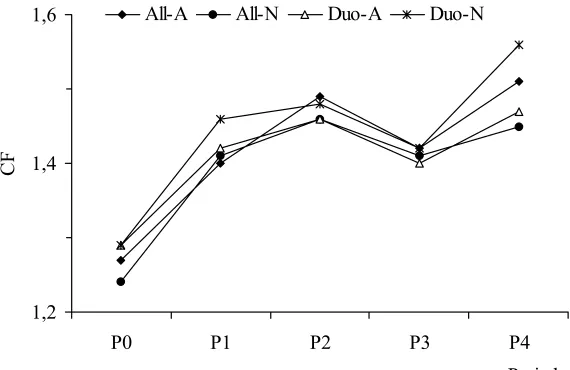
Growth was similar in all groups up to end of the first period, but growth of the fish in duo-culture differed significantly during the later periods (P<0.05) (Table 1). Growth variations, in favour of normally pigmented individuals, between the varieties were also significant in this group and this was apparent as early as during the first period (Figure 2 and 3). Growth rates (SGR) were highest in all groups with mean values of around 1.8-2.0%/day during the first period. They declined gradually during the following periods and almost levelled off around 0.8%/day in the last period (Figure 2). With exception of Duo-N, the overall mean SGR values were around 1.20%/day (Table 1). CF values increased from around 1.3 to 1.5
exhibiting similar and slight fluctuations in all groups (Figure 4).
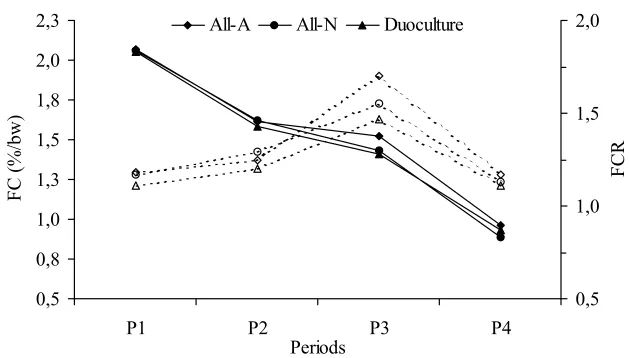
Daily feed consumption rates (FC) were just over 2.0% of bw during the first period and decreased gradually to around 0.9% through end of the trial in all groups (Figure 5). Values were very similar in all groups throughout the study (Table 1). Feed conversion ratios (FCR) exhibited very similar trends in all groups during the study (Figure 5). Values in duo-culture seemed to be slightly better than those of All-A and All-N, but not significantly.
50 100 150 200 250 300 350 400
P0 P1 P2 P3 P4
Periods
W(g)
All-A All-N Duo-A Duo-N
Figure 2. Increments in mean weights of the albino (A) and normally (N) pigmented rainbow trout reared as separate (All-A and All-N) and mixed or duo-culture (Duo-A and Duo-N) groups.
0,5 1,0 1,5 2,0 2,5
P1 P2 P3 P4
Periods
SGR (%/d)
All-A All-N Duo-A Duo-N
Figure 3. Variations in specific growth rates of albino and normally pigmented rainbow trout.
1,2 1,4 1,6
P0 P1 P2 P3 P4
Periods
CF
All-A All-N Duo-A Duo-N
. Okumu et al. / Turk. J. Fish. Aquat. Sci. 1 23-28 (2001) 27
0,5 0,8 1,0 1,3 1,5 1,8 2,0 2,3
P1 P2 P3 P4
Periods
FC (%/bw)
0,5 1,0 1,5 2,0
FCR
All-A All-N Duoculture
Figure 5. Mean FC (continuos lines) and FCR (dotted lines) values in trial periods.
(Table 1). According to the consumer preference trials, rainbow trout with a rate of 15.3% was the second most widely preferred species after the whiting. The other available species were frozen mackerel, grey mullet, and anchovy. As expected, the majority (>60%) of consumers buying rainbow trout preferred normally pigmented trout and albinos seemed to be bought just for trial.
Discussion
The study was performed to determine if there was difference in growth performance between albino and normally pigmented rainbow trout varieties. Growth rates, daily feed consumption, feed conversion rates, condition factors, tissue compositions and consumer preferences of albino, and normally pigmented varieties of rainbow trout were compared at ambient temperatures ranging from 8.0 to 18.0ºC over a full rearing period.
Fish grew from around 75 g to 315-366 g mean weight during the trial period of four months. Growth rate variations between the varieties differentiated significantly (P<0.05), but only in the duo-culture group. The normally pigmented specimen in duo-culture exhibited a higher growth rate than albinos in this group, which also from all albino and all normal groups. There were no significant growth variation between all albino and all normally pigmented groups.
Size variations (CV) within the groups and mean weights of the replicates and groups were very similar at the beginning. Environmental factors were within the acceptable limits for on-growing rainbow trout fingerlings and almost identical in all groups. In addition, there was not any notable problem related to the well fare of the fish throughout the study and daily feed consumption rates indicated that the feed was not restricted. Thus, differences in growth performance of
albino and normally pigmented specimen can be attributable to pigmentation and its possible pleiotropic effect.
The growth rates (SGR) of the experimental fish for the entire trial were around 1.2%/day. Rapid growth, 240-290 g increments in mean weight in 4 months, of experimental fish also demonstrates the suitability of the experimental conditions. Size variation increased in all groups during the course of the trial. At least some part of this can be accounted for competition for food (Jobling et al., 1995; Johansen and Jobling, 1998) and space, as the stocking density was quite high. Increments in size variation were very high within the duo-culture.
As reported by Jobling (1985) an increase in CV during the trial has been used as an indicator of such establishment of the dominance hierarchies. This may suggest that increase in size variation was associated with competition for food. In spite of slight fluctuations, CF increased considerably in all groups during the trial and there were slight differences in final values. These final values of around 1.5 indicate that feeding was not so restricted (Johansson et al., 1995). However, a slight difference in the final condition factor of varieties in duo-culture might also be an indication of somewhat feed limitation leading a competition among individuals and domination of those normally pigmented. Thus, growth performance variations in albino and normally pigmented specimen can be attributed to some kind of feed restriction, competition between individuals, and hierarchical domination of the normally pigmented individuals.
Cho, C.Y. 1992. Feeding systems for rainbow trout and other salmonids with reference to current estimates of energy and protein requirements. Aquaculture, 100: 17-123.
Dobosz, S., Kohlmann, K., Goryczko, K. and Kuzminski, H. 1999. Growth and vitality in yellow forms of rainbow trout. Journal of Applied Ichthyology, 16 (3): 117-120
Holm, J.C., Refstie, T. and Bø, S. 1990. The effect of fish density and feeding regimes on individual growth rate and mortality in rainbow trout (Oncorhynchus
mykiss).Aquaculture, 89: 225-232.
Holtby, L.B., Swain, D.P. and Allan, G.M. 1993. Mirror-elicited agonistic behaviour and body morphology as predictors of dominance status in juvenile coho salmon (Oncorhynchus kisutch). Canadian Journal of Fisheries and Aquatic Sciences, 50: 676-684.
Jobling, M. 1985. Physiological and social constraints on growth of fish with special reference to Arctic charr,
Salvelinus alpinus L. Aquaculture, 44: 83-90.
Jobling, M. 1995. Feeding of charr in relation to aquaculture. Nordic J. Freshw. Res., 71: 102-112. Jobling, M., Arnesen, A.M., Baardvik, B.M., Christiansen,
J.S. and Jørgensen, E.H. 1995. Monitoring feeding behaviour and food intake: Methods and applications. Aquaculture Nutrition, 1: 131-143.
Johansen, S.J.S. and Jobling, M. 1998. The influence of feeding regime on growth and slaughter traits of cage-reared Atlantic salmon. Aquaculture International, 6: 1-17.
Johansson, L., Kiessling, A., Åsgård, T. and Berglund, L. 1995. Effects of ration level in rainbow trout,
Oncorhynchus mykiss (Walbaum), on sensory
characteristics, lipid content and fatty acid composition. Aquaculture Nutrition, 1: 59-66. Jørgensen, E.H., Christiansen, J.S. and Jobling, M. 1993.
Effects of stocking density on food intake, growth performance and oxygen consumption in Arctic charr
(Salvelinus alpinus). Aquaculture, 10: 191-204.
Keenleyside, M.H.A. and Yamamoto, F. T. 1962. Territorial behaviour of juvenile Atlantic salmon (Salmo salar
L.). Behaviour, 19: 139-169.
Kirpichnikov, V.S. 1981. Genetic Base of Fish Selection. Springer, Berlin, 410 pp.
O’Keefe, R.A. and Benfey, T.J. 1997. The feeding response of diploid and triploid Atlantic salmon and brook trout. Journal of Fish Biology, 51: 989-997.
Okumuú,ø., Çelikkale, M.S., Kurtoglu, ø.Z. and Baúçınar, N. 1999. Saf ve karıúık olarak yetiútirilen gökkuúa÷ı
(Oncorhynchus mykiss) ve kaynak (Salvelinus
fontinalis) alabalıklarının büyüme performansları,
yem tüketimi ve yem de÷erlendirme oranları. Turkish Journal of Veterinary and Animal Sciences, 23: 123-130.
Rothbard, S. and Wohlfarth, G.W. 1993. Inheritance of albinism in the grass carp, Ctenopharyngodon idella. Aquaculture, 115: 13-17.
Storebakken, T., Hung, S.S.O., Calvert, C.C. and Plisetskaya, E.M. 1991. Nutrient partitioning in rainbow trout at different feeding rates. Aquaculture, 96: 191-203.
Tave, D. 1993. Genetics for Fish Hatchery Managers. 2nd edition, Van Nostrand Reinhold, New York, 415+ix pp.
Thorgaard, G.H., Spruell, P., Wheeler, P.A., Scheerer, P.A., Peek, A.S., Valentine, J.J. and Hilton, B. 1995. Inicidence of albinos as monitor for induced triploidy in rainbow trout. Aquaculture, 137: 121-130.
and ate the most food, while subordinate fish wait their satiation of far ends of the food delivery points or areas.
When the specimen reared in the same unit belongs to the same species, mainly individuals with larger initial body size or condition factors will be dominant (Holtby et al., 1993; Jobling, 1995). However, there is no doubt that genotypes of the individuals will also play an important role. If there were apparent differences, such as diploid-triploid (O’Keefe and Benfey, 1997) or pigmentation with some kind of pleiotropic effect (Wohlfarth and Moav, 1970 cited in Tave, 1993; Bridges and von Limback, 1972; Bondari, 1984; Dobosz et al., 1999) between the individuals, those fish with recessive characters or subjected some kind of genetic manipulations will be subordinate.
Bridges and von Limback (1972) reported that the albino rainbow trout seemed somewhat more lethargic, but are not substantially different from normally pigmented rainbows in qualities such as fecundity, survival or growth rate. However, the present study demonstrated that the pleiotropic effect in growth rate seemed to be highly significant.
There were no significant differences between the groups concerning the feed consumption. Estimated feed consumption rates (0.9-2.1%/bw) at 8-18ºC seemed to be higher than feeding rates recommended by some authors (e.g. Cho, 1992). The FCR values obtained ranged between 1.1 and 1.6 during the entire trial and seems to be within range of the values (1.0-1.5) reported for rainbow trout that were fed standard steam pelleted diets (Storebakkenet al., 1991; Alanärä, 1992). Only the duo-culture group had a slightly better feed conversion ratio, which shows that due to competition feed utilisation was better.
Approximate tissue composition, namely water, crude protein, lipid and ash did not show any variations between the varieties. Since the skin pigmentation of albinos is completely different from normally pigmented rainbow trout, consumers did not seem to be keen buying these fish.
In conclusion, the study demonstrated that the genes determining the albinism in rainbow trout may have some kind of pleiotropic effects on growth rate, but this is only apparent when albino and the normally pigmented specimen reared in the same culture unit. Further detailed studies are needed for resolving the exact cause(s) of this practical result.
References
Alanärä, A. 1992. Demand feeding as a self-regulating feeding system for rainbow trout (Oncorhynchus
mykiss) in net-pens. Aquaculture, 108: 347-356.
Bondari, K. 1984. Comparative of albino and normal pigmented channel catfish in tanks, cages and ponds. Aquaculture, 37: 293-301.