A Simple and Efficient Signature-Based Consensus Protocol in the
Asynchronous Distributed System
Chien-Fu Cheng
1, 2, *, Kuo-Tang Tsai
2, Hsien-Chun Liao
11 Department of Computer Science and Information Engineering,
2 Graduate Institute of Networking and Communication,
Tamkang University
No.151, Yingzhuan Rd., Tamsui Dist., New Taipei City 251, Taiwan (R.O.C.) e-mail: [email protected]
http://dx.doi.org/10.5755/j01.itc.41.2.931
Abstract. The consensus problem in distributed systems is mainly solved by message exchange. Most of previous
consensus algorithms rely on exchange of oral messages to achieve consensus among processors. As oral messages are susceptible to influences from malicious attackers, this type of consensus protocols usually requires a large number of rounds of message exchange, and the complexity of message exchange is also excessively high. In light of this drawback of oral message-based consensus algorithms, some scholars proposed signed message-based consensus algorithm to reduce the number of rounds of message exchange required. However, some signed message-based consensus algorithms still have certain drawbacks which make them ineffective in some conditions. To address this issue, we propose a new signed message-based consensus algorithm in this paper. We integrate the concept of grouping into the proposed algorithm and find the best number of groups through mathematical analysis to further reduce the rounds of message exchange required. In other words, the proposed algorithm makes use of digital signature and the concept of grouping to solve the consensus problem. This algorithm can not only increase the fault-tolerance of distributed systems but also significantly reduce the rounds of message exchange required to achieve consensus.
Keywords: distributed consensus problem; oral message; signed message; dormant fault; malicious fault and
grouping.
*Corresponding author
1. Introduction
With high scalability, distributed systems are less likely to have single point of failure (SPOF) problems. This advantage has considerably increased the importance and applications of distributed systems. Because a distributed system consists of a number of processors that work together in a network to provide computing power, how to maintain normal operation of the system in the presence of faulty components is an important issue. This issue is also called the fault-tolerance problem in distributed systems. The consensus problem is a well-known type of fault-tolerance problems [7][19]. By solving the consensus problem, we can enhance the reliability and fault-tolerance of distributed systems. An introduction of the consensus problem is provided as follows.
1.1. The Consensus problem
In any distributed system, some processors may operate abnormally due to damage of an internal component, external disturbance or malicious attacks. The abnormal operation of these processors may affect
the computing results of the entire system. Helping distributed systems keep away disturbance of faulty components and accurately perform assigned tasks is the primary goal of consensus algorithms. The consensus problem is usually solved by designating one or multiple commanders to broadcast the intended initial value and performing message exchange among processors to make all processors ultimately agree upon the consensus value.
There are two types of the consensus problem: (1) The consensus problem with a single commander: In a
distributed system consisting of n processors, one
processor is assigned to be the commander with an initial value. This problem is also called The
Byzantine Agreement Problem [3][16][17] . (2) The
consensus problem with n commanders: In a
distributed system consisting of n processors, all processors are commanders respectively having an initial value [4][5][21]. Although these two types of the consensus problems differ in the number of commanders, the second type of the problem can be solved using the consensus protocol for the first type
commanders can be solved by running n copies of the protocol for the problem with a single commander in
parallel. Through n runs of the protocol, each
processor in the problem with multiple commanders will get n agreement values. Later, we can select the majority value to achieve the consensus. Protocols designed to deal with the consensus problem with a single commander should satisfy the following conditions:
(Termination): All non-faulty processors agree on the same value;
(Validitysv): If the commander is non-faulty, then all non-faulty processors agree on the initial value that the commander sends.
Protocols designed to deal with the consensus problem with n commanders should satisfy the following conditions:
(Termination): All non-faulty processors agree on the same value;
(Validitymv): If the initial value of each non-faulty processor is vi, then all non-faulty
processors agree on vi.
We know that solution to the consensus problem relies on message exchange. Past research has classified messages exchanged by use of the digital signature technology into oral messages and signed messages [17]. The algorithms that achieve consensus by exchanging oral messages are called Oral Message-based Consensus Protocol (OMC protocol), and those that achieve consensus by exchanging signed messages are called Signed Message-based Consensus Protocol (SMC protocol). The use of digital signature is a key factor affecting the fault-tolerance of a consensus protocol. Given n processors in a distributed computing network, OMC protocols can tolerate (n-1)/3 faulty processors [17]. In the same
setting, SMC protocols can tolerate more than
(n-1)/3 faulty processors due to the use of digital
signature. For example, the SM algorithm proposed by Lamport et al. [17] and Quick Consensus algorithm proposed by Dalui et al. [8] can tolerate n-2 faulty processors. We will give a brief introduction of the above protocols in Section 1.2.
1.2. An Overview
OM algorithm is the first OMC protocol. It was introduced in a paper co-authored by Lamport, Shostak, and Pease in 1982 [17]. In this paper, the authors also developed an SMC protocol called SM algorithm [17]. OM algorithm can tolerate (n-1)/3
faulty processors whereas SM can tolerate n-2 faulty
processors. Both algorithms require (n-1)/3+1
rounds of message exchange, and each round of message involves three steps as follows (1) sends messages to other processors, (2) receives messages from other processors, and (3) local processing
[3][12][17]. Due to high complexity of message exchange, many later researchers have proposed solutions to reduce the complexity.
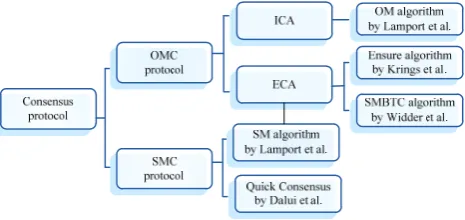
For OMC protocols, some researchers proposed to determine termination of message exchange based on sufficiency of messages collected. This kind of algorithm is called the Eventual Consensus Algorithm (ECA). Another algorithm which requires a fixed number of rounds of message exchange ((n-1)/3+1) is called the Immediate Consensus Algorithm (ICA). The Ensure Algorithm developed by Krings et al. [16] and the SMBTC (Synchronous Mortal Byzantine Tolerant Consensus) algorithm by Widder et al. [22] all belong to ECA. For SMC protocols, some researchers attempted to reduce the number of rounds of message exchange by employing the digital signature technology or improving the algorithm. For instance, Dalui et al. [8] introduced the Quick Consensus algorithm. A classification of consensus protocols is shown in Figure 1.
In the following sections, we will introduce the algorithms proposed to mainly reduce the rounds of message exchange required. These algorithms include the SMBTC algorithm [22], the Quick Consensus algorithm [8], and the Ensure Algorithm [16].
Figure 1. A classification of consensus protocols
1.2.1. The ensure algorithm by Krings et al.
The Ensure algorithm was proposed by Krings and Feyer [16]. During execution of the Ensure algorithm,
each processor pi (piN, where N is the set of
processors in the network, n=|N| and i1~n) will check if it has collected sufficient messages after each round of message exchange. If the processor has collected sufficient messages for reaching the consensus, it will terminate the message exchange operation immediately and compute the consensus value. Through this mechanism, the Ensure algorithm can avoid unnecessary message exchange operations and reach the consensus earlier. The maximum number of faulty processors it can tolerate is (n -1)/3.
That is, the number of rounds of message exchange required by the Ensure algorithm depends on the influences, i.e. the number of actual faulty processors f, not on the total number of processors n
rounds of message exchange [16]. When applied to systems with less than (n-1)/3 faulty processors, this algorithm can effectively reduce the rounds of message exchange required. Although the Ensure algorithm can determine the number of required rounds of message exchange based on actual number of faulty processors, it still requires a large number of rounds of message exchange (min{f+2, (n-1)/3+1}).
1.2.2. The SMBTC algorithm by Widder et al.
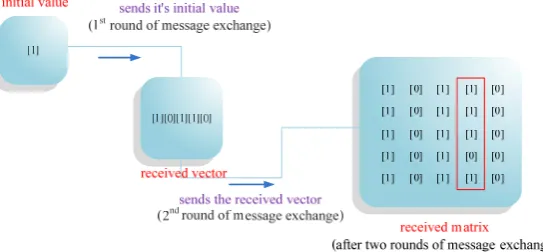
The Synchronous Mortal Byzantine Tolerant Consensus (SMBTC) algorithm was proposed by Widder, Gridling, Weiss and Blanquart [22]. During execution of the SMBTC algorithm, each processor will broadcast its initial value to all the processors and receive the initial values from other processors in the first round of message exchange. In the second round, each processor will send the initial values (a vector) obtained from other processors in the previous round to all processors in the network and receive the vector from other processors. Later, it will compare the messages sent with the messages received. If it detects any inconsistency between them, it will re-execute the algorithm. This operation continues until no inconsistency is detected. The maximum number of faulty processors this algorithm can tolerate is n/2.
The following is an example of “inconsistency”. Suppose that five processors are given in a network, namely p1, p2, p3, p4, and p5. The initial values of these processors are 1, 0, 1, 1, and 0, respectively. Assume that p4 is a faulty processor. Thus, p4 may send inconsistent messages to other processors in the
network. From the perspective of p1, this processor
will send its initial value [1] to p2, p3, p4, and p5 and receive the initial values from them in the first round of message exchange. Assume that the initial values it receives from other processors are [0], [1], [1], and
[0], respectively. In the second round, p1 will
broadcast the vector consisting of initial values it has obtained in the previous round ([1][0][1][1][0]) and receive the vectors from p2, p3, p4, and p5 (as shown in Figure 2). Through comparison of the vectors, p1 will detect inconsistency in the 4-th column of the matrix (as shown in Figure 2) and re-execute the SMBTC algorithm until it finds no inconsistency in any column. Therefore, the SMBTC algorithm requires 2*(1 + rounds of re-executing the algorithm) rounds of message exchange, which is variable, not fixed.
However, endless re-execution of this algorithm may occur if there is always inconsistency in the matrix. To avoid this problem, Widder et al. [22] introduced the following constraint: processors with Byzantine fault will finally crash. It should be noted that this assumption does not meet the definition of the Byzantine fault. The definition of Byzantine fault is as follows: In a Byzantine fault, the behavior of a faulty component is "unpredictable" and "arbitrary". A faulty processor with Byzantine fault may lie, lose or tamper messages so it causes the most damaging type of fault and is the worst problem [1][6][23].
In this paper, we will remove the above unreasonable assumption (processors with Byzantine fault will finally crash) and revisit the consensus problem to propose a new solution.
Figure 2. An example of execution of the SMBTC algorithm
1.2.3. The Quick Consensus algorithm by Dalui et al. The Quick Consensus algorithm was proposed by Dalui et al. [8]. It is based on the SMBTC algorithm but uses digital signature to reduce the rounds of message exchange required. Hence, the Quick Consensus algorithm is also a kind of SMC protocol. In addition, this algorithm integrates the concept of grouping. It finds the optimal number of groups through mathematical analysis to reduce the rounds of message exchange required. The maximum number of
faulty processors it can tolerate is n-2 and the number of rounds of message exchange is 2.
During execution of this algorithm, each processor
Each processor pi will immediately check presence of any inconsistent value in the matrix and remove the values immediately. For instance, if the message from
pj is inconsistent with the messages from other
processors, pi will remove all messages related to pj, namely [v1]p1pj[v2]p2pj…[vn]pnpj and [vj]pjp1[vj]pjp2… … [vj]pjpn (i.e. all values in the j-th row and the j-th column). Finally, the algorithm selects the majority value to be the consensus value.
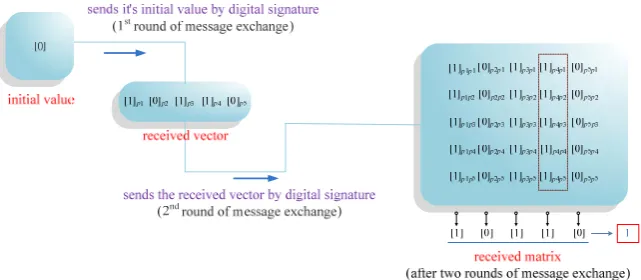
The Quick Consensus algorithm has the "chance" to reach the consensus in merely two rounds. We quote the word "chance" because this algorithm has some drawbacks, which may make the consensus impossible to reach. Below is an example of problems which this algorithm cannot solve. A network consists of five processors p1, p2, p3, p4,and p5, and p4 is a faulty processor. We will explain the operation of the algorithm from the perspectives of p1 and p2. From the perspective of p1, given the initial value of 1, p1 will send [1]p1 and receive the initial values from p2, p3, p4,and p5 ([0]p2, [1]p3, [1]p4, and [0]p5) in the first
round. In the second round, p1 will broadcast the
vector [1]p1p1[0]p2p1[1]p3p1[1]p4p1[0]p5p1 and receive the
vectors from p2, p3, p4, and p5 to form a vector as shown in Figure 3(a). The values in the 4-th column of the matrix are not entirely consistent, meaning that the initial value sent from p4 in the first round is not the same as the values from other processors. Meanwhile,
the Quick Consensus algorithm will ignore all messages related to p4 (including values in the 4-th row and the 4-th column) and find the majority value from the remaining values. In this case, the consensus value is the default value .
From the perspective of p2, the message denoted
by [0]p4p4 has been signed by p4 two times. If p4 alters
this value, its tampering will not be detected by other processors (for example, p4 sends [0] p4p4 to p1 but [1]
p4p4 to p2). For p2, it has a matrix consisting of
consistent values in each column (as shown in Figure 3(b)). As no message will be ignored by the algorithm, p2 will obtain 1 as the consensus value. In this example, the Quick Consensus algorithm is unable to make all processors reach a consensus,
because non-faulty processors p1 and p2 have
different consensus values.
1.3. Motivation
As afore-mentioned, the Ensure Algorithm uses oral messages and thus requires a large number of rounds of message exchange to achieve consensus. The main drawback of the SMBTC algorithm is that the number of rounds of message exchange it requires is not fixed. Besides, its assumption that all Byzantine faults will finally become crash faults is unreasonable
(a). An example of execution of Quick Consensus algorithm by processor p1
(b). An example of execution of Quick Consensus algorithm by processor p2
and does not conform to the definition of Byzantine fault. The Quick Consensus algorithm requires only two rounds of message exchange but cannot achieve consensus in some conditions, as demonstrated in the preceding subsection. Therefore, we will revisit the consensus problem to improve the drawbacks of these algorithms. In order to reduce the complexity of
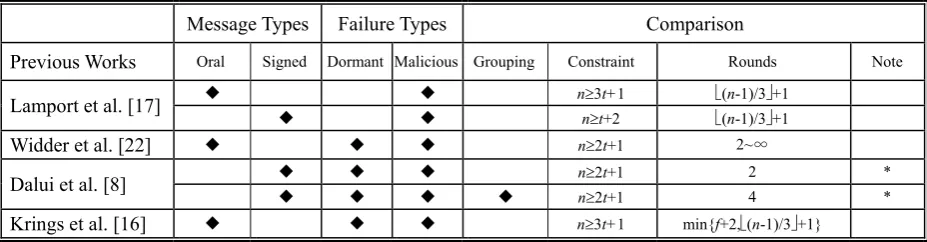
message exchange, we will also employ the concept of grouping as Dalui et al. [8] did for their Quick Consensus algorithm, to find the optimal number of groups through mathematical analysis. Table 1 shows the results of previous works on the consensus problem.
Table 1. The results of previous works on the consensus problem
n is the number of processors, t is the maximum number of faulty processors allowed and f is the number of actual faulty processors in the network.
*: The Quick Consensus algorithm may not reach a common consensus value.
1.4. Roadmap
This paper consists of six sections, and the remainder is organized as follows. Section 2 introduces the concept and approach. Section 3 presents the proposed protocols. Section 4 gives an example of executing the proposed protocols. Section 5 provides an analysis of the optimal number of groups. Finally, the conclusion is presented in Section 6.
2. The concept and approach
In this section, we will introduce the characteristics of the digital signature technology and the behavior of faulty processors and then explain the system model.
2.1. A brief introduction of digital signature
The increasing application of the digital signature technology to document processing and e-commerce in recent years can be attributed to five characteristics of this technology, including (1) Confidentiality: protecting confidential data from being stolen, illegally acquired or leaked; (2) Authentication: validating data sender; (3) Integrity: ensuring that data will not be tampered, resent or lost; (4) Non-repudiation: ensuring that a sender/receiver cannot deny that it has sent/received a message earlier; (5) Access control: avoiding unauthorized data access. The common encryption techniques used for signing are RSA [18] and ElGamal [10]. RSA requires that all the same messages must correspond to a specific signature. This signing method is called fixed signature. In contrast, ElGamal may encrypt a single plaintext into many possible ciphertexts. This signing
technique is called probabilistic signature. The digital signature operation involves two main processes, including signing process and verification process.
Digital signature can effectively protect data from being tampered and facilitate detection of data tampering. We will integrate the digital signature technology into the proposed consensus protocol to reduce the rounds of message exchange. Thus, the proposed consensus protocol can also be classified as a SMC protocol.
2.2. The behavior of faulty processors
The behavior of a faulty processor can be classified by damaging level into two categories: dormant fault and malicious fault [4]. Dormant faults include crashes and omission. A crash fault occurs when a processor stops executing prematurely [15]. An omission fault occurs when a processor fails to send or receive a message on time or at all [20]. The malicious fault is the most damaging failure type because the behavior of a malicious processor is unpredictable and arbitrary [1][6][23]. Malicious processors may work with other faulty processors to disrupt normal operation of the system. So, this type of fault is viewed as a fault with intelligence.
2.3. System model
The main features of completely asynchronous distributed systems are: (1) no assumption on communication delays and relative speed of processors; and (2) no access to real-time clocks [11]. According to Fischer et al. [13], it is impossible to solve consensus deterministically in a completely asynchronous system. As a consequently, many researchers have proposed various ways to circumvent this limitation, including employing a partially
Message Types Failure Types Comparison
Previous Works Oral Signed Dormant Malicious Grouping Constraint Rounds Note
Lamport et al. [17] ◆ ◆ ◆◆ nn3tt++21 ((nn-1)/3-1)/3+1 +1
Widder et al. [22] ◆ ◆ ◆ n2t+1 2~∞
Dalui et al. [8] ◆◆ ◆◆ ◆◆ ◆ nn22tt+1+1 4 * 2 *
synchronous assumption [9], using randomization protocol [14], failure detectors [2][14] or stubborn channels with a finite average response time [11]. For the above reasons, the system model of this study is built with considerations of an asynchronous network with the partially synchronous assumption.
To ensure proper operation of the system, we must set a reasonable limit on the number of faulty processors in the network. The number of faulty processors that can be tolerated in the network depends on use of digital signature. Tampering of unsigned messages is hard to detect. Thus, networks not using the digital signature technology certainly tolerate a much smaller amount of faulty processors than those using the technology. The network
environment considered in this paper consists of n
processors, and each of which has its initial value and always signs messages before delivering them. By using signed messages, all the processors can detect tampering of messages during message exchange. Through the time-out mechanism or encryption techniques, they can also detect loss of data packets and resend lost data immediately. Because of the characteristics of digital signature, the maximum number of faulty processors that can be tolerated in
the network can be increased to n-2 [8][17]. More
specifically, the number of processors in the network
(n) must be greater or equal to the number of
malicious processors tm plus the number of dormant
processors td and 2. (n ≥ t+2 where t = tm+td), The assumptions we have made for the asynchronous network are as follows:
The underlying network is asynchronous with a
partially synchronous assumption.
N is the set of processors in the network, where
n=|N|.
Each processor has its own initial value and can be identified uniquely in the network.
The failure types of the fallible processors are malicious fault and dormant fault.
The maximum number of faulty processors
allowed is n-2 (n≥t+2, where t=tm+td, tm is the
number of malicious processors and td is the
number of dormant processors).
A processor does not know the fault status of
other processors.
All messages are signed; processors cannot
falsify a message signed by other processors.
3. The proposed protocol GCPsm
In this section, we will introduce the proposed protocol, Grouping Consensus Protocol with signed message (GCPsm). GCPsm is used to solve the consensus problem with malicious and dormant processors in the asynchronous network. The basic operation of GCPsm is as follows: Each group will first
decide its "local" consensus value through message exchange and then elect the chief of its group. Later, all the chiefs will exchange their local consensus values with each other to obtain the "global" consensus value. After obtaining the global consensus value, they will broadcast this value among the members of their group to make all non-faulty processors reach the consensus. The proposed protocol involves three tasks, including Group_Cons Task, Gmsg_Collect Task, and Re_Elect Task. The Group_Cons Task is mainly about computation of the global consensus value. The Gmsg_Collect Task is performed to collect the messages from other groups. The Re_Elect Task is performed to re-elect the chief of the group. Upon launch, GCPsm will perform these three tasks concurrently. In order to effectively reduce the rounds of message exchange, we refer to the concept of grouping to group processors before executing GCPsm. Details on how to determine the optimal number of groups will be presented in Section 5.
Because GCPsm derives the "global" consensus value from "local" consensus values exchanged among groups, we must obtain the "local" consensus value of each group first. We develop the SignConsensus function to meet this need. A detailed introduction of the SignConsensus function is provided in the following sections.
3.1. The SignConsensus function
The SignConsensus function consists of two tasks, including Task Cons_Compute and Task Msg_Collect. These two tasks will be run concurrently when the SignConsensus function is called. Task Msg_Collect is dealing with receiving messages from other processors in the group, and Task Cons_Compute is responsible for computing the "local" consensus value. The notations of the SignConsensus function are shown as follows:
pi-Vector(pj) denotes the initial value from
processor pj to processor pi.
pi-Vector denotes the received vector of processor
pi, where piGc, Gc={pc1, p c2,…, pcn} and pi-Vector=[pi-Vector(pc1) …, pi-Vector(pcn)].
pi-Matrix denotes the received matrix of processor
pi, where pi-Matrix =
Vector p Vector p Vector p cn c c ... 2 1 .
pi-Matrix(pj, ) denotes the pj row of pi-Matrix, where pi-Matrix(pj, )=(pi-Matrix(pj, pc1), pi-Matrix(pj, pc2), …, pi-Matrix(pj, pcn))= pj-Vector. pi-Matrix(, pj) denotes the pj column of pi-Matrix,
where pi-Matrix(, pj)=(pi-Matrix(pc1, pj), pi-Matrix(pc2, pj), …, pi-Matrix(pcn, pj)).
pi _Cons denotes the local consensus value of processor pi.
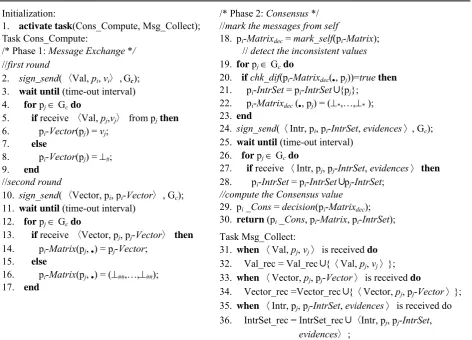
The SignConsensus function can be presented with the following primitives and the formal description of SignConsensus function is shown in Figure 4.
activate task(T1, T2): start the tasks T1 and T2
concurrently.
sign_send(〈msg〉, rcvr): send a message
〈msg〉 using the digital signature technology to receiver rcvr.
o sign_send(〈Val, pj, vj〉, Gc): send a Val
message with the value vj proposed by
processor pj to processors in group Gc.
o sign_send(〈Vector, pj, pj-Vector〉, Gc):
send a Vector message with the vector
pj-Vector proposed by processor pj to
processors in group Gc.
o sign_send(〈Intr, pi, pi-IntrSet, evidences
〉, Gc): send a Intr message with the set
pi-IntrSet and evidences proposed by
processor pi to processors in group Gc.
mark_self(pi-Matrix): mark each diagonal entities
in pi-Matrix to avoid the influence from self, if j =
k then pi-Matrix(pj, pk)=*.
chk_dif(pi-Matrix(, pj): ignore the -value, if the
values in pjcolumnare not the same, then return
"true"; else return "false".
decision(pi-Matrix): compute the majority value
according to pi-Matrix.
Function: SignConsensus(vi, Gc) //for each processor pi, where piGc and vi is the initial value of pi Initialization:
1. activate task(Cons_Compute, Msg_Collect); Task Cons_Compute:
/* Phase 1: Message Exchange */
//first round
2. sign_send(〈Val, pi, vi〉,Gc); 3. wait until (time-out interval) 4. for pj Gc do
5. if receive 〈Val, pj,vj〉 from pj then 6. pi-Vector(pj) = vj;
7. else
8. pi-Vector(pj) = #;
9. end //second round
10. sign_send(〈Vector, pi, pi-Vector〉, Gc); 11. wait until (time-out interval)
12. for pj Gc do
13. if receive 〈Vector, pj, pj-Vector〉then 14. pi-Matrix(pj, ) = pj-Vector;
15. else
16. pi-Matrix(pj, ) = (##,…,##);
17. end
/* Phase 2: Consensus */ //mark the messages from self
18. pi-Matrixdec= mark_self(pi-Matrix); // detect the inconsistent values
19. for pj Gc do
20. ifchk_dif(pi-Matrixdec(, pj))=truethen 21. pi-IntrSet = pi-IntrSet∪{pj};
22. pi-Matrixdec(, pj) = (*,…,* );
23. end
24. sign_send(〈Intr, pi, pi-IntrSet, evidences〉, Gc); 25. wait until (time-out interval)
26. for pj Gc do
27. if receive 〈Intr, pj, pj-IntrSet, evidences〉 then 28. pi-IntrSet = pi-IntrSet∪pj-IntrSet;
//compute the Consensus value
29. pi _Cons = decision(pi-Matrixdec); 30. return (pi _Cons, pi-Matrix, pi-IntrSet); Task Msg_Collect:
31. when 〈Val, pj, vj〉 is received do 32. Val_rec = Val_rec∪{〈Val, pj, vj〉}; 33. when 〈Vector, pj, pj-Vector〉 is received do
34. Vector_rec =Vector_rec∪{〈Vector, pj, pj-Vector〉}; 35. when 〈Intr, pj, pj-IntrSet, evidences〉 is received do 36. IntrSet_rec = IntrSet_rec∪〈Intr, pj, pj-IntrSet,
evidences〉;
Figure 4. SignConsensus Function
3.1.1. The Task Cons_Compute of SignConsensus function
Task Cons_Compute has two phases, namely The
Message Exchange Phase and The Consensus Phase.
In the beginning, each processor in the group has an
initial value. In The Message Exchange Phase, they
will perform two rounds of message exchange and
collect messages from other processors in the group
through Task Msg_Collect. In the Consensus Phase,
3.1.1.1. Phase1: The Message ExchangePhase of Task Cons_Compute
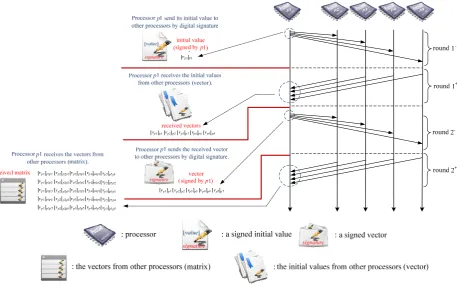
In the first round of The Message Exchange Phase, each processor pi (piN) will first sign its initial value and send it to other processors pj (j≠ i) in the group. Meanwhile, other processors pj will also send their signed initial values to pi. Processor pi will place the
signed values from other processors pj in the
pi-Vector(pj). If any processor (denoted by pk) fails to send its initial value to pi or has a dormant fault, we use # to represent the missing value from pk. In pi-Vector(pk), # denotes no value from pk or pk has a dormant fault. After the first round of message
exchange, each processor pi has a vector of values
pi-Vector=[pi-Vector(pc1) …, pi-Vector(pcn)] (lines 2-9
in SignConsensus function).
In the second round, each processor pi will sign the values (a vector) obtained in the previous round and
send them to other processors pj(j ≠ i) in the group. Concurrently, other processors will also send the message (a signed vector) they have obtained to pi. After receiving the vectors from other processors, pi will store all the vectors, including the vector it has sent to others, in pi-Matrix, which is in a matrix data structure. We use pi-Matrix(pj,) to denote the j-th row of pi-Matrix. The values in the j-th row come from the vector that pi has received from pj, In this round, if any processor (denoted by pk) fails to send its vector to pi or has a dormant fault, we use ##,…,## to represent
the missing vector from pk in pi-Matrix(pk,). After this round of message exchange, each processor in each group will have a matrix of values (lines 10-17 in SignConsensus function). Figure 5 shows the flow chart of The Message Exchange Phase of Task Cons_Compute in the SignConsensus Function.
Figure 5. The flow chart of The Message Exchange Phase of Task Cons_Compute in SignConsensus function
3.1.1.2. Phase2: The Consensus Phase of Task Cons_Compute
In each matrix derived through two rounds of message exchange, some messages are signed by a single processor two times (i.e. not signed by two different processors). If the processor that signs a message twice is a malicious processor, the message may have been altered, and other processors have no way to detect it (because the malicious processor owns the encryption key). To avoid this circumstance, the proposed protocol will mark diagonal entities in the matrix (i.e. replace all diagonal entities with *)
before computing the consensus value (line 18 in SignConsensus function).
In the next step, each processor pi will check
consistency of values in each column. Assume that
there is an inconsistent value in the j-th column.
Because this value is sent by processor pj, pi will view
pj as a malicious processor and replace all the values in this column with *,…,* . Further, it will put pj into pi-IntrSet, which is a logbook of faulty processors
it has detected (lines 19-23 in SignConsensus
the local consensus value of the group using the
decision function (lines 29-30 in SignConsensus
function). The decision function is explained as
follows:
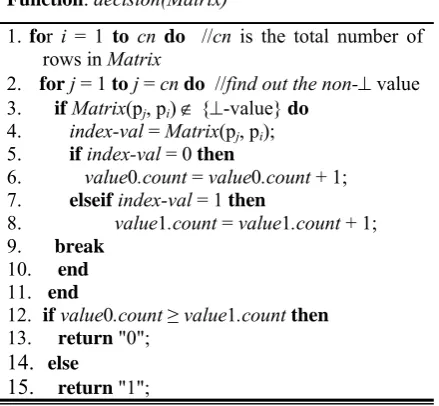
The process of the decision function
The decision function is intended to compute the
majority value in each matrix of values. The formal description of decision function is shown in Figure 6. It excludes the influences from malicious processors and dormant processors before computing the majority
value. First of all, it will remove -value in each
column and find the index value of the column. If this value is 0, the weight (count) of 0 increases by 1 (lines 5-6 in decision function); if this value is 1, the weight
(count) of 1 increases by 1 (lines 7-8 in decision
function). Through this process, it can determine the
majority value based on the weight (counts) of 0s and 1s. In the case that 0 and 1 have an equivalent weight (count), it uses default value as the consensus value. Here, we assume default value = 0 (lines 12-15 in
decision function).
Function: decision(Matrix)
1. for i = 1 to cn do //cn is the total number of rows in Matrix
2. forj = 1 toj = cndo //find out the non- value 3. ifMatrix(pj, pi) {-value} do
4. index-val = Matrix(pj, pi); 5. ifindex-val = 0 then
6. value0.count = value0.count + 1; 7. elseifindex-val = 1 then
8. value1.count = value1.count + 1; 9. break
10. end 11. end
12. ifvalue0.count ≥value1.countthen 13. return "0";
14. else
15. return "1";
Figure 6. Decision function
3.1.2. The Task Msg_collect of SignConsensus Function
The Task Msg_collect is performed to collect messages from other processors in the group. Three types of messages will be collected: (1) the initial value that each processor sends in the first round (lines 31-32 in SignConsensus); (2) the vector that each processor sends in the second round (lines 33-34 in SignConsensus); and (3) the list and evidence of faulty processors that each processor has detected (lines 35-36 in SignConsensus). The pseudo code of Task Msg_collected is shown in lines 31-36 of Figure 4.
3.2. The three tasks of GCPsm
After the SignConsensus Function, we will introduce the proposed GCPsm protocol. GCPsm performs three tasks concurrently (namely Grouping_Consensus Task, Gmsg_Collect Task, and Re_Elect Task) to compute the consensus value in the network (i.e. global consensus value). The Group_Consensus Task deals with most of the computation work, the Gmsg_Collect Task is intended to collect matrices sent by group chiefs, and the Re_Elect Task is performed to re-elect a new chief. Operational details of these three tasks are provided in Section 3.2.1, 3.2.2, and 3.2.3, respectively.
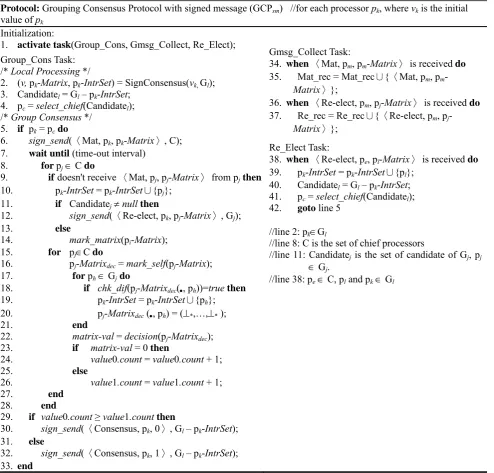
The GCPsm protocol can be presented with the following primitives and the formal description of GCPsm protocol is shown in Figure 7.
sign_send(〈msg〉, rcvr): send a message 〈msg
〉 using the digital signature technology to
receiver rcvr.
o sign_send(〈Mat, pm, pm-Matrix〉, C): send a
Mat message with the matrix pm-Matrix
proposed by processor pm to C, where C is the
set of chief processors.
o sign_send(〈Re-elect, pm, pj-Matrix〉, Gj):
send a Re-elect message with the evidence pj-Matrix proposed by processor pm to Gj, 〈
Re-elect, pm, pj-Matrix〉 is used to request
the processors in Gj to re-elect the new
chief, where Gj is the group of pj.
o sign_send(〈Consensus, pk, ũ〉, Gl): send
the Consensus message with the value ũ
proposed by processor pk to processors in
group Gl.
select_chief (Candidatel): elect the processor who
has the minimum ID as chief in the set of Candidatel.
3.2.1. The Group_Consensus Task of GCPsm
In the beginning of the Grouping_Consensus Task, each processor pk can use the SignConsensus function to obtain the local consensus value (pk_Con), list of faulty processors in the group (pk-IntrSet), and the matrix formed after two rounds of message exchange
(pk-Matrix) (line 2 in GCPsm). Later, one processor
with each other, and the matrix of their messages can be obtained using the SignConsensus function. In the message exchange process, each chief collects messages from other chiefs through the Gmsg_Collect Task. Details on the Gmsg_Collect Task are provided in Section 3.2.2.
In this paragraph, we will explain how GCPsm computes the global consensus value based on messages exchanged between chiefs. Assume that processors in group Gl select pk to be the chief (line 5 in GCPsm). Processor pk will send the matrix derived using the SignConsensus function to other chiefs pj,
where pj C and C is the set of chief processors.
Likewise, the chiefs of other groups will also send their matrices to pk at the same time (line 6 in GCPsm). If the chief of group Gj (denoted by pj) does not send
its matrix (Mat, pj, pj-Matrix) to pk, Processor pk will put pj on its list of faulty processors and send a re-elect message to all the other processors in group Gj, requesting them to elect a new chief (lines 7-12 in GCPsm). After receiving the Re-elect message,
processors in group Gj (excluding pj) will run the
Re_Elect Task to select a new chief among themselves. The detail description of Re_Elect Task is shown in Section 3.2.3. If all the processors in this group are faulty processors, no processor can be the chief candidate (i.e. Candidate= null). In this case, pk will use the mark_matrix function to mark the matrix delivered by this group so that all the messages from this group will be ignored (line 14 in GCPsm). After the message exchange operation, each chief has its own matrix and matrices from other group chiefs. The
Protocol: Grouping Consensus Protocol with signed message (GCPsm) //for each processor pk, where vk is the initial value of pk
Initialization:
1. activate task(Group_Cons, Gmsg_Collect, Re_Elect); Group_Cons Task:
/* Local Processing */
2. (v, pk-Matrix, pk-IntrSet) = SignConsensus(vk, Gl);
3. Candidatel = Gl – pk-IntrSet; 4. pc = select_chief(Candidatel); /* Group Consensus */
5. if pk = pc do
6. sign_send(〈Mat, pk, pk-Matrix〉, C);
7. wait until (time-out interval)
8. for pj C do
9. if doesn't receive 〈Mat, pj, pj-Matrix〉 from pj then
10. pk-IntrSet = pk-IntrSet∪{pj};
11. if Candidatej nullthen
12. sign_send(〈Re-elect, pk, pj-Matrix〉, Gj);
13. else
14. mark_matrix(pi-Matrix);
15. for pjC do
16. pj-Matrixdec= mark_self(pj-Matrix);
17. for ph Gj do
18. if chk_dif(pj-Matrixdec(, ph))=truethen
19. pk-IntrSet = pk-IntrSet∪{ph};
20. pj-Matrixdec(, ph) = (*,…,* );
21. end
22. matrix-val = decision(pj-Matrixdec);
23. if matrix-val = 0 then
24. value0.count = value0.count + 1;
25. else
26. value1.count = value1.count + 1;
27. end
28. end
29. if value0.count ≥value1.countthen
30. sign_send(〈Consensus, pk, 0〉, Gl – pk-IntrSet);
31. else
32. sign_send(〈Consensus, pk, 1〉, Gl – pk-IntrSet);
33. end
Gmsg_Collect Task:
34. when 〈Mat, pm, pm-Matrix〉 is received do
35. Mat_rec = Mat_rec∪{〈Mat, pm,
pm-Matrix〉};
36. when 〈Re-elect, pm, pj-Matrix〉 is received do
37. Re_rec = Re_rec∪{〈Re-elect, pm,
pj-Matrix〉};
Re_Elect Task:
38. when 〈Re-elect, pe, pl-Matrix〉 is received do 39. pk-IntrSet = pk-IntrSet∪{pl};
40. Candidatel = Gl – pk-IntrSet; 41. pc = select_chief(Candidatel);
42. goto line 5
//line 2: pkGl
//line 8: C is the set of chief processors
//line 11: Candidatej is the set of candidate of Gj, pj
Gj.
//line 38: pe C, pl and pk Gl
proposed algorithm will mark the diagonal entities in each matrix and check consistency of entities in each column. Inconsistent entities will be marked, and the faulty processors will be put into pk-IntrSet to preclude influences from faulty processors (lines 15-21 in GCPsm). Later, the proposed algorithm will use the
decision function to compute the index value of each
matrix (line 22 in GCPsm) and find the majority value. The majority value is then the global consensus value. Finally, it relies on all the chiefs to broadcast this global consensus value among non-faulty processors within their groups to achieve consensus in the network (lines 23-32 in GCPsm).
3.2.2. The Gmsg_Collect Task of GCPsm
The Gmsg_Collect Task is performed to collect messages from other group chiefs. Two types of messages can be collected, including (1) Mat message from other chiefs (lines 34-35 in GCPsm) and (2) Re-elect message that requests for re-Re-election of a new chief (lines 36-37 in GCPsm).
3.2.3. The Re_Elect Task of GCPsm
The Re_Elect Task is performed to elect a new chief among non-faulty processors in the group. When any processor detects that a group chief is a faulty processor, it will send a Re-elect message to all the other processors of the group, requesting them to elect a new chief. The steps are as follows: When the Re-elect message is received, pk will immediately put the faulty processor pl into pk-IntrSet and remove it from the chief candidate set. Later, it will select a new processor from the candidate set to be the chief and return to the Group_Cons Task (lines 38-42 in GCPsm).
4. An example of executing GCPsm
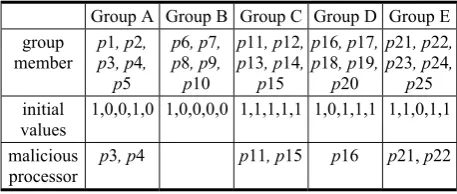
In this section, we use an example to explain the operation of the proposed protocol. The setting of this example is as follows: A network consists of 25 processors, and each processor has an initial value. These processors are divided into five equal-sized groups, as shown in Table 2. For instance, group A comprises processors p1, p2, p3, p4,and p5, and their initial values are 1, 0, 0, 1, and 0, respectively. Among these processors, p3 and p4 are malicious processors. We will explain the operation of the proposed protocol from the perspective of p1.
Table 2. The parameters of the scenario
Group A Group B Group C Group D Group E group
member
p1, p2, p3, p4, p5
p6, p7, p8, p9, p10
p11, p12, p13, p14,
p15
p16, p17, p18, p19, p20
p21, p22, p23, p24, p25 initial
values 1,0,0,1,0 1,0,0,0,0 1,1,1,1,1 1,0,1,1,1 1,1,0,1,1 malicious
processor
p3, p4 p11, p15 p16 p21, p22
4.1. Local processing
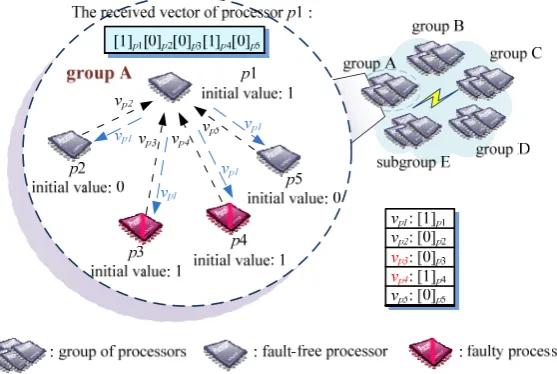
In the beginning, p1 uses the SignConsensus function to obtain the local consensus value of the group (group A). This operation requires two rounds of message exchange. In the first round,
p1 will sign its initial value [1]p1 and send it to
other processors within the group. At the same time, it will also receive signed initial values from p2, p3, p4, and p5. These signed values are, respectively, denoted by [0]p2, [0]p3, [1]p4, and
[0]p5. Hence, p1 can obtain a vector consisting of
[1]p1[0]p2[0]p3[1]p4[0]p5. It will store these values
into p1-Vector=[p1-Vector(p1) …, p1-Vector(p5)],
as shown in Figure 8(a). In the second round, p1 will sign the vector it has obtained in the previous round and send it to other processors. At the same time, it will also receive signed vectors from other processors. After two rounds of message exchange, each processor can obtain a matrix of messages. As shown in Figure 8(b), p1 can obtain a matrix consisting of the vector [1p1p2
0p2p2 1p3p2 1p4p2 0p5p2] from p2, the vector [1p1p3
0p2p3 1p3p3 0p4p3 0p5p3] from p3, the vector [1p1p4
0p2p40p3p40p4p40p5p4] from p4, and the vector [1p1p5
0p2p5#p5#p50p5p5] from p5.
In the next step, p1 will mark all the diagonal
entities in the matrix with * and check consistency of
entities in each column. In this example, it will detect the inconsistency in the 3rd and 4th columns. Take the inconsistency in the third column as an example. The entity in row 1 and column 3 is 0, the entity in row 2 and column 3 is 1, and the entity in row 4 and column
3 is 0. It can detect that p3 and p4 are faulty
processors. Hence, p1 will put p3 and p4 in p1-IntrSet
and use *,…,* to take the place of values in the third
and fourth column. Besides, it will also deliver the updated p1-IntrSet to other processors in the group to
tell them that p3 and p4 are faulty processors. Later, it
will use the decision function to compute the local
consensus value. The computation process is as follows: First, it finds the index value of each column. The valid index values are 0 and 1. The index value of column 1 is 1, the index value of column 2 is 0, and the index value of column 5 is 0. As shown in Figure 8(c), because 0 is the majority value among 1, 0, and 0, the local consensus value of group A is 0.
group B. As p6 is the non-faulty processor with the minimum ID, p6 is selected to be the chief of group B.
Subgroup C has two faulty processors, namely p11
and p15, so p12 is selected to be the chief. Subgroup D has one faulty processor, p16, so p17 is selected. Subgroup E has two faulty processors, p21 and p22.
p23 will be selected be the chief of this group.
4.2. Group Consensus
In the Group Consensus phase, all the group chiefs will exchange messages to derive the global consensus value. Chiefs p1, p6, p12, p17, and p23 will exchange their Mat messages. Figure 9(a) shows the exchange
of Mat messages between p1 and other chiefs. After
exchanging Mat messages, p1 will have five matrices, including p6, p12, p17, p23, and itself, as shown on the top of Figure 9(b). It will mark the diagonal
entities in all these matrices and check consistency of values in each column. As shown in the center of Figure 9(b), inconsistent values will be marked. Later,
p1 will use the decision function to compute the index value of each matrix.
In this example, the index values of the five matrices are 0, 0, 1, 1, and 1, respectively. Based on
the majority rule, p1 will find 1 as the global
consensus value, as shown in the bottom of Figure 9(b). Finally, p1 will send this global consensus value to other non-faulty processors in the group. While p1 is broadcasting the global consensus value, other chiefs are also broadcasting the global consensus values they obtain among their peer non-faulty processors. Therefore, all non-faulty processors in the network will end up having a consensus value.
Figure 8 (a). The 1st round of Message Exchange phase of p1in group A (SignConsensus function)
Figure 8 (b). The 2nd round of Message Exchange phase of p1in group A (SignConsensus function)
Figure 9(a). The message exchange of Mat message between the chiefs.
5. The Analysis of the Number of Groups In this section, we will perform mathematical analysis to find the optimal number of groups for GCPsm. GCPsm involves the local processing phase and
the global processing phase. The number of rounds of
message exchange that each phase requires is as follows:
Local processing: (n/g)((n/g)-1)g+(n/g)((n/g)-
-1)g+(n/g)((n/g)-1)g (1)
Global processing: g(g-1)+(g-1)(n/g)(n/g)(g)-
-2(n/g)(g)+(n-g-(n-2)) (2)
Given n processors in a network, we divide these n
processors into g equal-sized groups. In other words, each group has n/g processors. In the local processing
phase, each processor needs to perform two rounds of
message exchange. In the first round of message exchange, each processor (n/g in total) in each group will send their signed initial values to other processors in the group ((n/g)-1 in total) and also receive signed values from them. Therefore, a total of (n/g)((n/g)-1) times of message exchange will be performed in the first round. In the second round, each processor will send the vector it has obtained in the previous round to (n/g)-1 other processors in the group and also receive the vectors from them. A total of (n/g)((n/g)-1) times of message exchange will be needed. Later, each processor will check consistency of obtained values to find faulty processors and send the detection result to other processors in the group. A total of (n/g)((n/g)-1) times of message exchange will also be required. In sum, because each processor in each group has to perform two rounds of message exchange and send fault detection results, the entire network needs to perform
(n/g)((n/g)-1)g+(n/g)((n/g)-1)g+(n/g)((n/g)-1)g times of message exchange in the local processing phase.
In the global processing phase, because each of the
g group chiefs will exchange messages with g-1
chiefs, g(g-1) times of message exchange are needed. If any chief is found to be a faulty processor, a Re-elect message will be sent to all the processors in its group, requesting them to select a new chief. In other words, if any chief is a faulty processor, g-1 chiefs
will send a total of n/g Re-elect messages to
processors in its group. If all the n/gprocessors in this group become faulty while being the chief of their group, the above operation will be executed n/g times.
As there are g groups and at most n-2 faulty
processors in the network, GCPsm has to send the Re-elect message (g-1)(n/g)(n/g)(g)-2(n/g)(g) times in the worst case. After the global consensus value is obtained, all the chief processors have to broadcast this value to other non-faulty processors in their groups. In the worst case, this value has to be sent (n-g-(n-2)) times. Therefore, the entire network needs to perform g(g-1)+(g-1)(n/g)(n/g)(g)-2(n/g)(g)+(n-g-
-(n-2)) times of message exchange in the global
processing phase.
The total number of rounds of message exchange that GCPsm requires is as shown in Equation (3) (the sum of Equation (1) and Equation (2)). We conduct the following mathematical analysis to find the best number of groups.
f = g2+2n2/g-2g+n2-5n+2 (3)
2 2
2 22
g n g g f
(4)
0 2 4
3 2
2 2
g n g
f
Figure 9(b). An example of computing the global consensus value (from the perspective of p1)
Equation (5) is the result of quadratic partial differentiation. Both n and g are greater than zero, so Equation (5) must be greater than zero. We can infer that when Equation (4) (ordinary differentiation) is zero, the obtained g can result in a minimum f. In other words, the best number of groups for a network
consisting of n processors is 319 2
3 1
n
g . This
6. Conclusions
As mentioned earlier, OMC protocols exchange oral messages to achieve consensus and therefore require a large number of rounds of message exchange. The OM algorithm, the Ensure algorithm, and the SMBTC algorithm are all OMC protocols. SMC protocols exchange signed messages to achieve consensus. Due to the characteristics of digital signature, they require a significantly smaller number of rounds of message exchange. The SM algorithm and the Quick Consensus algorithm belong to SMC protocols. However, the existing signed message-based consensus algorithms still have some drawbacks which make them ineffective in some specific conditions. Therefore, we revisited the consensus problem in distributed systems in this paper. We proposed a signed message-based consensus algorithm that makes use of digital signature to effectively reduce the complexity of message exchange. In addition, we integrated the concept of grouping into the algorithm and obtained the optimal number of groups by mathematical analysis. That is, the proposed algorithm can not only facilitate achievement of consensus by removing influences from malicious and dormant processors but also reduce the complexity of message exchange.
References
[1] A.N. Bessani, M. Correia, J. da Silva Fraga, L.C. Lung. An Efficient Byzantine-Resilient Tuple Space.
In: IEEE Transactions on Computers, Vol. 58, No. 8, pp. 1080-1094, 2009. http://dx.doi.org/10.1109/ TC.2009.71.
[2] T.D. Chandra, S. Toueg. Unreliable Failure Detectors
for Reliable Distributed Systems. In: Journal of the ACM, vol.43, no.2, pp.225-267, 1996. http://dx. doi.org/10.1145/226643.226647.
[3] C.F. Cheng, S.C. Wang, T. Liang. Byzantine
Agreement Protocol & Fault Diagnosis Agreement for Mobile Ad-Hoc Network. In: Fundamenta Informaticae, vol. 89, no. 2, pp.161-187, 2008.
[4] C.F. Cheng, S.C. Wang and T. Liang. Investigation
of Consensus Problem over Combined Wired/Wireless Network. In: Journal of Information Science and Engineering, vol. 25, no. 4, pp.1267-1281, 2009.
[5] C.F. Cheng, S.C. Wang, T. Liang. File Consistency Problem of File-Sharing in Peer-to-Peer Environment. In: International Journal of Innovative Computing, Information and Control, vol. 6, no. 2, pp.601-613, 2010.
[6] M. Correia, N. F. Neves, L. C. Lung, P. Verissimo.
Worm-IT – A Wormhole-based Intrusion-tolerant Group Communication System. In: Journal of Systems and Software, vol. 80, no. 2, pp.178–197, 2007. http://dx.doi.org/10.1016/j.jss.2006.03.034.
[7] M. Correia, N. F. Neves, P. Verissimo. From
Consensus to Atomic Broadcast: Time-Free Byzantine-Resistant Protocols without Signatures. In: The Computer Journal, vol.49, no.1, pp.82-96, 2006. http://dx.doi.org/10.1093/comjnl/bxh145.
[8] M. Dalui, B. Chakraborty, B.K. Sikdar. Quick Consensus Through Early Disposal of Faulty Processes. In: Proceedings of the 22nd IEEE International Conference on Systems, Man and Cybernetics. pp. 1989-1994, 2009.
[9] C. Dwork, N. Lynch, L. Stockmeyer. Consensus in
the Presence of Partial Synchrony. In: Journal of the ACM, vol. 35, no. 2, pp.288-323, 1988. http://dx.doi.org/10.1145/42282.42283.
[10] T. Elgamal. A Public-Key Cryptosystem and a
Signature Scheme Based on Discrete Logarithms. In: IEEE Transactions on Information Theory, vol. 31, no. 4, pp.469-472, 1985. http://dx.doi.org/10.1109/TIT .1985.1057074.
[11] C. Fetzer, U. Schmid, M. Susskraut. On the
Possibility of Consensus in Asynchronous Systems with Finite Average Response Times. In: Proceedings of the 25th IEEE International Conference on Distributed Computing Systems, 2005.
[12] M.J. Fischer, N. A. Lynch. A Lower Bound for the Time to Assure Interactive Consistency. In: Information Processing Letters, vol.14, no.3, pp.183-186, 1982. http://dx.doi.org/10.1016/0020-0190(82)90 033-3.
[13] M.J. Fischer, N.A. Lynch, M.S. Paterson.
Impossibility of Distributed Consensus with One Faulty Process. In: Journal of the ACM, vol. 32, no. 2, pp.374-382, 1985. http://dx.doi.org/10.1145/3149.2141 21.
[14] R. Friedman, A. Mostefaoui, M. Raynal. Simple and
Efficient Oracle-Based Consensus Protocols for Asynchronous Byzantine Systems. In: IEEE Transactions on Dependable and Secure Computing, vol. 2, no. 1, pp.46-56, 2005. http://dx.doi.org/10.1109/ TDSC.2005.13.
[15] S. Jafar, A. Krings, T. Gautier. Flexible Rollback
Recovery in Dynamic Heterogeneous Grid Computing. In: IEEE Transactions on Dependable and Secure Computing, Vol. 6, No. 1, pp. 32-44, 2009.
[16] A. W. Krings, T. Feyer. The Byzantine Agreement Problem: Optimal Early Stopping. In: Proceedings of the 32nd Annual Hawaii International Conference on System Sciences, LNCS 520, Springer-Verlag, Berlin, 1999.
[17] L. Lamport, R. Shostak, M. Pease. The Byzantine Generals Problem. In: ACM Transaction on Programming Language Systems, Vol.4, No. 3, pp.382-401, 1982. http://dx.doi.org/10.1145/357172.35 7176.
[18] R.L. Rivest, A. Shamir, L. Adleman. A Method for
Obtaining Digital Signatures and Public-Key Cryptosystems. In: Communications of the ACM, vol. 21, no. 2, pp.120–126, 1978. http://dx.doi.org/10.1145/ 359340.359342.
[19] A. Silberschatz, P. B. Galvin, G. Gagne. In:
Operating System Concepts, 8th Edition, John Wiley & Sons Inc, 2008.
[20] H.Y. Tzeng, K.Y. Siu. On the Message and Time
Complexity of Protocols for Reliable Broadcasts/Multicasts in Networks with Omission Failures. In: IEEE Journal on Selected Areas in Communications, Vol. 13, No. 7, pp. 1296-1308, 1995. http://dx.doi.org/10.1109/49.414647.
Review, vol. 37, no. 3, pp. 43-54, July 2003, http://dx.doi.org/10.1145/881783.881789.
[22] J. Widder, G. Gridling, B. Weiss, J.P. Blanquart.
Synchronous Consensus with Mortal Byzantines. In: Proceedings of the 37th Annual IEEE/IFIP International Conference on Dependable systems and Networks, pp.102-112, 2007.
[23] W. Zhao. Design and Implementation of a Byzantine Fault Tolerance Framework for Web Services. In: Journal of Systems and Software, vol. 82, no. 6, pp.1004–1015, 2009. http://dx.doi.org/10.1016/ j.jss.2008.12.037.