The Journal of Threatened Taxa (JoTT) is dedicated to building evidence for conservation globally by publishing peer-reviewed articles online every month at a reasonably rapid rate at www.threatenedtaxa.org. All articles published in JoTT are registered under Creative Commons Attribution 4.0 International License unless otherwise mentioned. JoTT allows unrestricted use, reproduction, and distribution of articles in any medium by providing adequate credit to the author(s) and the source of publication.
www.threatenedtaxa.org
ISSN 0974-7907 (Online) | ISSN 0974-7893 (Print) Building evidence for conservation globally
Journal of Threatened Taxa
For Focus, Scope, Aims, Policies, and Guidelines visit https://threatenedtaxa.org/index.php/JoTT/about/editorialPolicies#custom-0 For Article Submission Guidelines, visit https://threatenedtaxa.org/index.php/JoTT/about/submissions#onlineSubmissions For Policies against Scientific Misconduct, visit https://threatenedtaxa.org/index.php/JoTT/about/editorialPolicies#custom-2 For reprints, contact <[email protected]>
Note
Re-collection of the Luminous Lantern Flower
Ceropegia lucida Wall. (Apocynaceae) from Assam, India
Debolina Dey, Manash Baruah, Nilakshee Devi & Jitendra Nath Borah
26 January 2020 | Vol. 12 | No. 1 | Pages: 15212–15215 DOI: 10.11609/jott.5053.12.1.15212-15215
Partner
Member
Threatened Taxa
Publisher & Host
PLATINUMOPEN ACCESS
Editor: K. Haridasan, Palakkad District, Kerala, India. Date of publication: 26 January 2020 (online & print)
Citation: Dey, D., M. Baruah, N. Devi & J.N. Borah (2020). Re-collection of the Luminous Lantern Flower Ceropegia lucida Wall. (Apocynaceae) from Assam, India. Journal of Threatened Taxa 12(1): 15212–15215. https://doi.org/10.11609/jott.5053.12.1.15212-15215
Copyright: © Dey et al. 2020. Creative Commons Attribution 4.0 International License. JoTT allows unrestricted use, reproduction, and distribution of this article in any medium by providing adequate credit to the author(s) and the source of publication.
Funding: None.
Competing interests: The authors declare no competing interests.
Acknowledgements: The authors would like to acknowledge the head, Kew Herbarium Catalogue, Kew; the director, Botanical Survey of India, Howrah (CAL); the
curator, Gauhati University Botanical Herbarium and Mr. Brahmananda Patiri, Assam Forest Department for his valuable support in conducting the research work.
Re-collection of the Luminous Lantern Flower Ceropegia lucida Wall.
(Apocynaceae) from Assam, India
Debolina Dey 1 , Manash Baruah 2 , Nilakshee Devi 3 & Jitendra Nath Borah 4
1,2,3 Department of Botany, Gauhati University, Jalukbari, Guwahati, Kamrup (Metro), Assam781014, India.
4 All Sanchi Growers Association of Assam (ASGAA), Alengi Chariali, Titabor, Jorhat, Assam 785632, India.
1 [email protected] (corresponding author), 2 [email protected], 3 [email protected],
o t e
#5053 | Received 09 May 2019 | Final received 31 December 2019 | Finally accepted 05 January 2020
Ceropegia lucida Wall. was first described by Wallich from Terrya Ghat, Sylhet, Bangladesh in the year 1831. Following that, the plant was also reported from the Khasia Hills, Meghalaya by Hooker & Thomson and by Wallich from Prome, Burma. It was also reported from China, Malaysia and Thailand (Siam). King collected this species from Sikkim in 1874 which was considered as the last collection of the century making it endangered or possibly extinct in India as stated by Nayar & Sashtry until its rediscovery and new distribution record from the Namdapha National Park, Arunachal Pradesh in 2017. Nautiyal’s record from Sikkim in 2009 is considered as a misidentification of Ceropegia longifolia (Khandal et al.
2017).
During a recent floristic survey to the Golaghat District, Assam during the period from August to October, 2018, the authors came across many interesting plant specimens. On consultation with the existing literature (Wallich 1831; Hooker 1883; Kanjilal et al. 1939; Ansari 1984; Kambale 2015) and herbarium specimens deposited at KEW and CAL, this specimen was confirmed
as Ceropegia lucida Wall.
Ceropegia lucida Wall.
Pl. Asiat. Rar. 2:33, t.139. 1831; Hook.f., Fl. Brit. India 4: 73. 1883; P.C. Kanjilal et al., Fl. Assam 3: 309. 1939; H. Huber, Mem. Soc. Brot; 12, 1-203. 1957; Ansari, Fasc. Fl. India 16: 22. 1984; M.P. Nayar & Sastry (eds.), Red Data Book Indian Pl. 2: 44. 1988; A.P. Jagtap & N.P. Singh, Fasc. Fl. India 24: 229. 1999.
According to the protologues and the existing
Re-collection of Ceropegia lucida from Assam Dey et al.
Journal of Threatened Taxa | www.threatenedtaxa.org | 26 January 2020 | 12(1): 15212–15215 15213
J
TT
lobes on the outside and five erect linear to clavate lobes
on the inside.
Flowering: September to November; fruits not seen. Specimen examined: Bangladesh, Sylhet, N. Wallich (K001129042, image!); INDIA. Cachar, Assam, June 1874, R. L. Keenan s.n. (K001325174, image!); Sikkim 1874, G. King s.n. (CAL0000031920, image!); Kakodanga, Golaghat, Assam, 25.xi.2018, D. Dey & M. Baruah, DDM01 (GUBH).
Image 1. Habit of Ceropegia lucida Wall. Image 2. Inflorescence with leaves of Ceropegia lucida Wall.
© Debolina Dey © Debolina Dey
Distribution: India (Arunachal Pradesh (Namdapha National Park), Assam (Cachar, Golaghat), Meghalaya (Khasia Hills), Sikkim), Bangladesh (Sylhet), Myanmar (Prome), Thailand, Malaysia, China.
Table 1. A comparative analysis of Ceropegia lucida Wall. with other closely related species of northeastern India.
Attributes Ceropegia macrantha Wight (Kambale & Yadav 2019). Ceropegia longifolia Wall. (Kambale & Yadav 2019). Ceropegia lucida 2019; present study).Wall. (Kambale & Yadav
Leaves Ovate to lanceolate, 4.5–14 x 2–7 cm. Lanceolate to linear, 5.7–20.3 x 0.4–3.8 cm. Elliptic to oblong, 5–11 x 2.3–4.9 cm.
Petiole 1.2–2.4 cm long. 0.5–0.8 cm long. 1.4–1.6 cm long.
Inflorescence 4–5 flowered, subumbellate cymes, peduncle 1.2–2.7 cm long, hairy in rows. 5–12 flowered, umbellate cymes, peduncle 1.8–4 cm long. 2–6 flowered, umbellate cymes, peduncle c. 2cm long, fleshy.
Pedicel c. 0.8cm long, glabrous. 0.5–1.2 cm long, puberulous. 1–1.5 cm long, glabrous
Corolla 2.5–7.6 cm long with pink spots throughout, tube cylindrical, 1.8–3.2 cm long. 1.6–3.8 cm with dark purple spots restricted to the funnel shaped throat only, tube curved, 0.5–2.5 cm long.
1.8–2.7 cm long with purple spots throughout, tube cylindrical, 1.2–2.5 cm long.
Lobes 2.4–2.8 cm long, yellow at lower and dull green at upper half, linear to lanceolate. 0.5–1 cm long, yellowish-green with dark purple spots, elliptic to ovate. 0.7–2.5 cm long, greenish white with purple spots, broadly or elliptic oblong.
Corona Outer of 5 deeply bifid, pink coloured densely haired lobes, inner of 5 linear lobes. Outer of 5 deeply bifid deltoid lobes, ciliate along and within margins, inner of 5 linear sub-spathulate lobes.
Outer of 5 shortly bifid- deltoid lobes, ciliate along margins, inner of linear-clavate lobes.
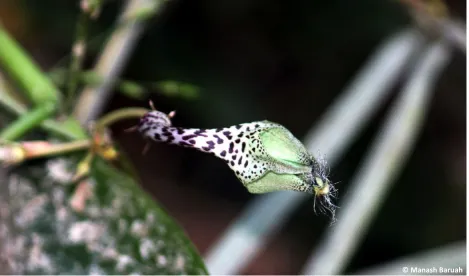
Image 3. A single flower of Ceropegia lucida Wall.
© Manash Baruah
number of individuals were observed growing in a single population, only a single plant with a single matured flower was collected for preservation and herbarium making. The voucher specimen has been deposited at the GUBH, Gauhati University, Guwahati (DDM01).
Discussion: According to the Flora of British India, Vol. IV. 73pp. and herbarium specimen (K001325174, image!); R.L. Keenan had collected this plant from the Cachar District of Assam in June, 1874 after which it was neither collected nor reported from anywhere within the state. Barbhuiya in 2013 categorized it as
Re-collection of Ceropegia lucida from Assam Dey et al.
Journal of Threatened Taxa | www.threatenedtaxa.org | 26 January 2020 | 12(1): 15212–15215 15215
J
TT
Image 4. Herbarium of Ceropegia lucida Wall. Photographed by Manash Baruah.
References
Ansari, M.Y. (ed.) (1984). Flora of India: Fascicle, 16, Asclepiadaceae: Genus - Ceropegia. Botanical Survey of India, Kolkata, 22pp. Barbhuiya, H.A. (2013). Study and assessment of threatened
and endemic vascular plant of southern Assam. Ph.D. Thesis. Department of Ecology & Environmental Science, Assam University, Silchar, 172pp.
Hooker, J.D. (1883). Flora of British India. Vol. 4. L. Reeve & Co., London, 73pp.
Huber, H. (1957). Revision der Gattung Ceropegia. Memorias Da Sociedade Broteriana 12: 1–203.
Jagtap, A.P. & N.P. Singh (1999). Flora of India: Fascicles, 24, Asclepiadaceae and Periplocaceae. Botanical Survey of India, Kolkata, 229pp.
Kambale, S.S. (2015). Taxonomic revision of Genus Ceropegia L. in India. Ph. D Thesis. Department of Botany, Shivaji University, 95pp. Kambale, S.S. & S.R. Yadav (2019). Taxonomic revision of Ceropegia
(Apocynaceae : Ceropegieae) in India. Rheedea 29(1): 1–115. Kanjilal, P.C., A. Das & R.N. De (1939). Flora of Assam. Vol.3.
Government of Assam, Shillong, India, 309pp.
Khandal, D., S. More, G. Kataria & S. Kambale (2017).Ceropegia lucida–rediscovery and new distribution record for Arunachal
Pradesh, India. Current Science 113(11): 2077.
Nautiyal, D.C., S.K. Sharma & M.K. Pandit (2009). Notes on the
taxonomic history, rediscovery and conservation status of two endangered species of Ceropegia (Asclepiadaceae) from Sikkim, Himalaya. Journal of Botanical Research Institute of Texas 3(2):
815–822.
Nayar, M.P. & A. R.K. Sastry (1988). Red Data Book of Indian Plants,
Vol. 2, pp. 44–45.Botanical Survey of India, Kolkata.
Wallich, N. (1831). Plantae Asiaticae Raroires. Vol. 2. Richard Taylor for
Treuttel and Wurtz, London, 33pp.
https://specimens.kew.org/herbarium/K001129042. https://specimens.kew.org/herbarium/K001325174.
ISSN 0974-7907 (Online) | ISSN 0974-7893 (Print)
January 2020 | Vol. 12 | No. 1 | Pages: 15091–15218 Date of Publication: 26 January 2020 (Online & Print)
DOI: 10.11609/jott.2020.12.1.15091-15218
www.threatenedtaxa.org
in any medium by providing adequate credit to the author(s) and the source of publication.
Article
A citizen science approach to monitoring of the Lion
Panthera leo (Carnivora: Felidae) population in Niokolo-Koba
National Park, Senegal
– Dimitri Dagorne, Abdoulaye Kanté & John B. Rose, Pp. 15091–
15105
Communications
Status, distribution, threats, and conservation of the Ganges River Dolphin Platanista gangetica (Mammalia: Artiodactyla: Cetacea) in Nepal
– Deep Narayan Shah, Amit Poudyal, Gopal Sharma, Sarah Levine, Naresh Subedi & Maheshwar Dhakal, Pp. 15106–15113
Bat (Mammalia: Chiroptera) diversity, dominance, and richness in the southwestern region of Bhutan with three new records for the
country
– Sangay Tshering, Dhan Bahadur Gurung, Karma Sherub, Sumit
Dookia, Kuenzang Dorji & Pema Choephyel, Pp. 15114–15128
The pattern of waterbird diversityof the trans-Himalayan
wetlands in Changthang Wildlife Sanctuary, Ladakh, India
– Pushpinder Singh Jamwal, Shivam Shrotriya & Jigmet Takpa,
Pp. 15129–15139
Composition, diversity and foraging guilds of avifauna in agricultural landscapes In Panipat, Haryana, India
– Parmesh Kumar & Sharmila Sahu, Pp. 15140–15153
An overview of fishes of the Sundarbans, Bangladesh and their present conservation status
– Kazi Ahsan Habib, Amit Kumer Neogi, Najmun Nahar, Jina Oh,
Youn-Ho Lee & Choong-Gon Kim, Pp. 15154–15172
Digital image post processing techniques for taxonomic publications with reference to insects
– Nikhil Joshi, Hemant Ghate & Sameer Padhye, Pp. 15173–15180
Short Communications
Description of a new species of the genus Lampropsephus Fleutiaux, 1928 (Coleoptera: Elateridae: Elaterinae: Dicrepidiini) from Konkan, Maharashtra, India
– Amol Patwardhan & Rahul Khot, Pp. 15181–15185
Spiders (Arachnida: Araneae) from the vicinity of Araabath Lake, Chennai, India
– John T.D. Caleb, Pp. 15186–15193
Two new records of gilled mushrooms of the genus Amanita (Agaricales: Amanitaceae) from India
– R.K. Verma, V. Pandro & G.R. Rao, Pp. 15194–15200
Notes
A first record of oviposition of Common Onyx Horaga onyx Moore, 1857 (Insecta: Lepidoptera: Lycaenidae) in Sri Lanka and its importance in conserving a highly threatened butterfly
– Chathura Udayanga Herath, Pavan Bopitiya Gamage, Iroshan Rupasinghe & Moditha Hiranya Kodikara Arachchi, Pp. 15201– 15204
Additions to known larval host plants of butterflies of the Western Ghats, India
– Deepak Naik & Mohammed S. Mustak, Pp. 15205–15207
Rhynchotechum parviflorum Blume (Gesneriaceae): a new
record to mainland India
– Momang Taram, Puranjoy Mipun & Dipankar Borah, Pp. 15208–15211
Re-collection of the Luminous Lantern Flower Ceropegia lucida Wall. (Apocynaceae) from Assam, India
– Debolina Dey, Manash Baruah, Nilakshee Devi & Jitendra Nath Borah, Pp. 15212–15215
Tetrasporidium javanicum Möbius (Chlorophyta), a rare species
recorded from Arpa River in Bilaspur, Chhattisgarh, India
– Rakesh Kumar Dwivedi, Pp. 15216–15218