ADAPTIVE CONTROL OF TEMPERATURE FOR MINIMIZATION
OPERATING COSTS OF INDUSTRIAL METHANE TANK PROCESS
Donatas Levišauskas, K
ę
stutis Jonelis, K
ę
stutis Brazauskas
Process Control Department, Kaunas University of TechnologyStudentų St. 50, LT−51368 Kaunas, Lithuania e-mail: [email protected]
Abstract. An algorithm for adaptive control of temperature in methane tank is developed in order to minimize operating costs under variation of the methane tank process conditions. The adaptation is based on process model and on-line minimization of objective function that relates operating costs to the process variables. Mathematical model for prediction of biogas production and simulation of the temperature control process is identified using experimental data from the waste water treatment plant. The temperature adaptive control system is investigated via computer simulation of the control system performance under operating conditions of real methane tank process during one year period. The process operating costs by optimal control of temperature are compared to those of temperature control at constant set-point. The model identification and the control system simulation results are presented and discussed.
Keywords: adaptive control; temperature; methane tank.
1. Introduction
Large-scale methane tanks operating in municipal sewage plants produce biogas through anaerobic digestion of sewage. Conversion of municipal sewage to biogas provides added value to sewage as an energy resource and reduces environmental problems associa-ted with municipal wastewater. To improve perfor-mance and economy of methane-tank, an accurate control of biogas process is required [1].
In the anaerobic digestion process, a community of microbial species breaks down both complex and simple organic materials, ultimately producing me-thane and carbon dioxide. Anaerobic digestion can occur over a wide range of environmental conditions, although narrower ranges are needed for optimum operation. The factors that affect the rate of digestion and biogas production in methane-tanks include tem-perature, retention time, mixing of the digesting ma-terial, pH (self-regulating in most cases), water/solids ratio, etc. Among the above factors, the most impor-tant is temperature. By controlling temperature at narrow ranges, the desirable digestion process (meso-philic or thermo(meso-philic) can be realized. However, heating of industrial methane-tanks during colder pe-riods is related to significant expenses of energy. The trade-off in maintaining optimum methane tank tem-perature to maximize biogas production while mini-mizing expenses is somewhat complex as the optimal level of temperature that provides minimum conver-sion cost can vary with changing external and internal conditions.
In this work, the temperature adaptive control sys-tem for minimization operating costs of the methane tank process is developed and investigated via com-puter simulation. The process model has been deve-loped using experimental data from Kaunas waste-water treatment plant [2]. The simulation experiments of the control system performance are carried out using one-year observation data of the real process disturbances.
2. Methane tank process
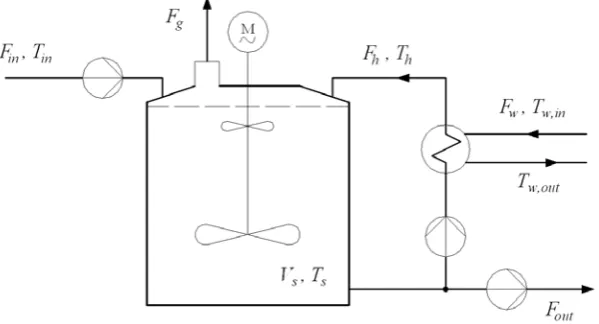
The process of biogas production through anae-robic digestion takes place in an enclosed methane tank with attached heating and mixing systems (Figure 1). The continuous-type industrial methane tank has capacity of about 10000 m3 and is fed by sludge stream at flow rate Fin and temperature Tin. Flow rate
of an unloading effluent is (at steady state operating conditions Fout = Fin) and the biogas is produced at a
rate Fg. The sludge circulating through the heat
exchanger system at flow rate Fh (manipulated
variable) maintains the methane tank process at operating temperature Ts. The energy for heating is
supplied by water circulating through the heat exchanger at flow rate Fw and the inlet and outlet
temperatures Tw, in and Tw, out , respectively.
methane-tank wall. Due to variation of the above
external parameters, the heating energy requirement can vary in a wide range during a cycle of the seasons.
Figure 1. Methane tank system
3. Development of the control algorithm
The goal of the methane tank process control is to break down the major part of organic materials of the sludge at minimum cost price.
The methane-tank process can be controlled by manipulating the temperature and the retention time of sludge in methane tank. The retention time depends on the sludge flow-rate through methane tank and the volume of sludge:
s ret
in
V t
F
= , (1)
where tret is retention time of the sludge in methane
tank; Fin is volumetric flow rate of inlet sludge; Vs is
volume of sludge in methane tank.
However, control of the flow rate or the volume is often not available in practice, as the volume of container for the inflowing sludge storage is usually small to accumulate large amounts of sludge, and the working volume of sludge in methane tank can vary in a narrow range. Therefore, the retention time usually is not controlled and depends on the load of methane tank (volumetric flow rate of inlet sludge). Thus, the industrial methane tank process is usually controlled by manipulating only the temperature of sludge.
Our strategy of temperature control of the anae-robic digestion process is to pursue simultaneously the two objectives: breaking down the desired percentage of organic materials of sludge and minimizing of the cost price of methane tank process under varying technological conditions. Therefore, an algorithm for calculation of the temperature set-point consists of two steps. At the 1st step, meeting of the demand to decompose the organic materials to desired percentage is estimated. At the 2nd step, the temperature set-point is calculated in order to minimize the cost price of the digestion process while breaking down the desired percentage of organic materials.
Realization of the temperature adaptation algo-rithm is based on prediction of the digestion process under various operating conditions.
Prediction of the digestion process
For prediction an intensity of the digestion process at various flow rates of inlet sludge and temperatures in methane tank, the functional relationship is required that relates the biogas production with the above para-meters. The functional relationship can be identified using experimental data of batch digestion process experiments, at which the samples of sludge are tested.
The identification procedure consists of the fol-lowing steps:
1. Carrying out of the digestion process experi-ments at various levels of temperature θs i, (i = 1, ...,
n, n is the number of temperature levels) from the range, at which the mesophilic bacteria’s growth and activity occurs (32-40 oC).
During the experiments, the biogas production rate
i g
F
,θ in the sludge volume unit at time points tj (j = 1,..., m, m is the number of points) is measured. The processes are carried out until production of biogas terminates.
2. Approximation of the experimental points by a relevant functional relationship.
In this work, functional relationship of the follow-ing structure was applied that suits well for approxi-mation of the experimental curves:
(
)
( )
0
, p k
g s k s
k
F θ t a θ t
=
=
∑
, (2)digestion process; ak
( )
θs are parameters identified as functions of the process temperature:( )
0n i
k s ki s
i
a θ α θ
=
=
∑
), (3)where αki are parameters.
The parameters akand αki are identified using the least squares method [3] and experimental data ob-tained at the 1st step.
The total amount of biogas produced in batch pro-cesses in the volume unit is estimated by integrating the equation (2):
(
)
(
)
( )
10 0
, ,
1
t p k
g s g s k s
k
t
Q t F t dt a
k θ θ θ + = = = +
∑
∫
. (4)3. Calculation a paired set of ultimate values of the interrelated variables θ and t, at which the desired percentage of organic materials is broken down (the desired part of the maximum amount of biogas available from the investigated sludge is obtained).
The above isoline is calculated using the equation (4), in which the produced biogas is fixed at the desired value:
( )
1 ,max0 1
k p
u
g k su
k t Q a k η θ + = = +
∑
, (5)where Qg,max is the maximum amount of biogas available from a volume unit of the investigated sludge, estimated at the 1st step;
η
is a desired percentage of the maximum amount of biogas;su
θ and tu are interrelated ultimate values of
tem-perature and process duration, respectively, at which the desired percentage of maximum amount of biogas is produced.
The equation (5) is further applied for prediction of the continuous methane tank process by replacing the batch process time t with the retention time of sludge in methane tank tret (1).
4. Evaluation of the continuous digestion process in methane tank.
The ultimate rate of biogas production at the retention time tret given by (1) is estimated using the
equation
,max
,max
g
gu s g in
ret
Q
F V Q F
t η
η
= = . (6)
Calculation of the temperature set-point
The temperature set-point variation is based on comparison of the estimated ultimate rate Fgu with the
measured rate Fgm of biogas production:
1. If Fgm≤Fgu, the biogas production rate is to be increased by raising the process temperature up to the upper permissible level.
The required increment of temperature can be predicted by estimating the ultimate value of temperature corresponding to the current retention time (equations (1) and (4)).
2. If Fgm≥Fgu, the demand to decompose the or-ganic materials to desired percentage is satisfied and the temperature set-point is calculated to minimize the cost price of the methane tank process.
The main expenses of the biotechnological process realization in methane tank are related with the cost of energy for stirring and keeping up the temperature of sludge. The cost price of the energy is partially compensated by a profit from the sold biogas.
For solving the optimization problem of the me-thane tank process, the following objective function (performance index) is applied:
stir temp gas
J=C +C −C →min, (7)
where Cstir is the cost per time unit of energy for the stirring; Ctemp is the cost per time unit of energy for keeping up the temperature of sludge; Cgas is the cost of biogas produced in methane tank per time unit.
The terms in formula (7) are related to the controll-able technological parameters according to the follo-wing functional relationships:
stir e m
C =p P , (8)
where pe is the cost of electric power;
P
m is the power of the stirrer motor.(
)
(
)
m s o in s s s in
temp h
he
A h F c
C p θ θ ρ θ θ
η
− + −
= , (9)
where
p
h is the cost of energy for heating; θs is the temperature of sludge in methane tank; θo is the outdoor temperature; θin is the temperature of inflowing sludge; Fin is the volumetric flow rate of inflowing sludge; Am is the methane-tank surface area;h is the heat transfer coefficient through the methane tank wall; ρs is density of sludge; cs is the specific heat capacity of sludge; ηhe is efficiency of the heat exchanger.
(
,)
gas g s gc s ret
C = p V F θ t , (10)
where pg is the cost of biogas per volume unit;
(
,)
gc s ret
F θ t is the biogas production rate in the conti-nuous methane tank process in the volume unit of sludge. Prediction of the biogas production rate refers to the equation (4), in which the process time corres-ponds to the retention time of sludge in the continuous operating mode methane tank:
(
)
(
)
( )
0 , , 1 k pg s ret ret
gc s ret k s
k ret
Q t t
F t a
t k θ θ θ = = = +
At each time discretization point of the process optimization, the optimal temperature set-point value is determined, at which the minimum value of the objective function (7) is gained. When the above set-point control action is applied, a real alteration of the objective function is to be estimated using the
measured values of process parameter at the new steady state operating point, and the control correction is to be applied if necessary.
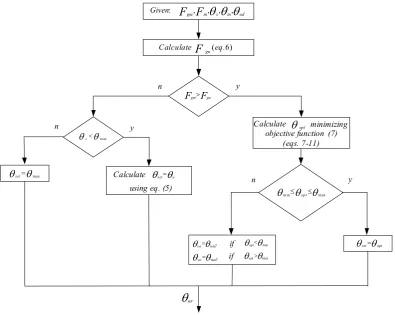
Block-scheme of the temperature set-point optimal control algorithm is presented in Figure 2.
θ
set) 6 . (eq Calculate
F
guθ θ θm in≤ opt≤ max
θ θs< max
F Fgm> gu
θ
θset= max
θ θset= opt Calculate
θ
opt minimizingobjective function (7) (eqs. 7-11)
using eq. (5) θ θset= u Calculate
, min
θ
θset= θopt<θmin
θ θopt> max if
,
max
θ θset= if
n y
y y
n n
θ
θ
θ
s in od ingm
F
F
Given: , , , ,
Figure 2. Block-scheme of the temperature set-point control algorithm
Methane tank Process (eqs. 12-15) Process disturbances
θset
θs
Fgm
θ
θin od
in
F , ,
+
Temperature set -point calculation algorithm
(Figure 2)
PI controller
-Figure 3. Block-scheme of the temperature optimal control system
4. Simulation of the control systems performance
Performance of the temperature control system was investigated via computer simulation implemen-ted in the Matlab/Simulink environment.
The block-scheme of the simulated system is presented in Figure 3.
Mathematical model of the methane tank process
(
)
(
)
(
)
h in m m
s h s s in s od
s s s s s
F F A h
V V V c
θ θ θ θ θ θ θ
ρ
•
= − − − − − , (12)
(
,)
(
)
h h h
h w out h h s
hs s s hs
A h F
V c V
θ θ θ θ θ
ρ •
= − − − , (13)
(
)
(
)
, , , , , ww out w in w out w
L W h h
w out h
w w w w w w
F V
E A h
V c V c
θ θ θ θ θ ρ ρ • = − − − − − , (14)
(
)
(
)
1 ,s gc s ret
F V F t F
T θ
•
= − , (15)
(
)
( )
0 , 1 k p retgc s ret k s
k
t
F t a
k θ θ = = +
∑
,ret s in
t =V F ,
where θs is temperature in the methane-tank, θh is temperature of heated sludge in the outlet of heat exchanger, θw out, , θw in, are outlet and inlet
tem-peratures of heating water, θin is temperature of inlet sludge, θod is outdoor temperature, F is biogas pro-duction rate, Fgc is biogas production rate in the
volume unit of sludge at steady state operating condi-tions, Fh is sludge volumetric flow rate through heat
exchanger, Fin is volumetric flow rate of inlet sludge,
Fw is volumetric flow rate of water through heat
exchanger, T is time constant, Vs is volume of sludge
in methane-tank, Vhs, Vw are volumes of sludge and
water in heat exchanger, Am is methane-tank surface
area, Ah is heat transfer area of heat exchanger, hm is
heat transfer coefficient over methane-tank surface,hh
is heat transfer coefficient through heat exchanger wall, cs, cw are specific heat capacities of sludge and
water, ρs,ρw are densities of sludge and water, and
EL,W is heat loss over heat exchange surface.
The other factors of energy balance in methane-tank, the heat of biochemical reactions and stirring energy are neglected because they are small compared with the other terms of the balance equations.
The heat transfer ratesA hh h, A hm m and the heat loss QL W, were estimated using observation data of
the industrial methane tank at steady state operating conditions. The time constant T is estimated using observation data at transient conditions.
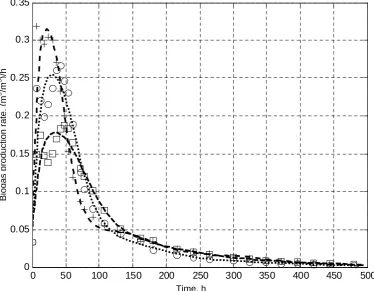
Parameters of equations (2), (3), (15) have been identified using experimental data of 3 batch digestion process experiments, realized at different temperatures (32 oC, 37 oC, 40 oC). In Figure 4, the experimental data and their approximation by the identified 8th order (k=8) functional relationships (2) are presented.
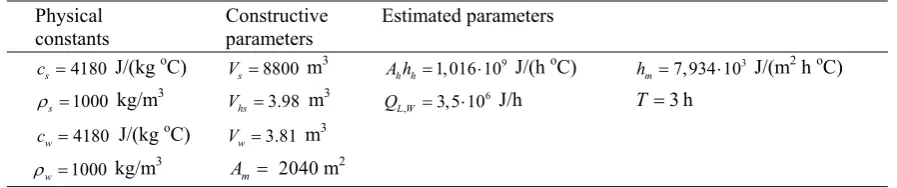
Parameters of the model equations (12)-(15) are given in Table 1.
0 50 100 150 200 250 300 350 400 450 500 0 0.05 0.1 0.15 0.2 0.25 0.3 0.35
Figure 4. Experimental data (points) and the model-based approximation (lines) of biogas production at various temperatures (□ – θ=32 0C, ○ – θ=37 0C, + – θ=40 0C)
Table 1. Values of the model (12)-(15) parameters
Physical Constructive Estimated parameters constants parameters
4180 s
c = J/(kg oC) 8800 s
V = m3 1,016 109
h h
A h = ⋅ J/(h oC) 7,934 103
m
h = ⋅ J/(m2 h oC) 1000
s
ρ = kg/m3 3.98 hs
V = m3 6
, 3,5 10
L W
Q = ⋅ J/h T =3h 4180
w
c = J/(kg oC) 3.81 w
V = m3
ρw=1000 kg/m
3 2040
m
A = m2
Parameters of the equations (5)-(10) in simulation experiments are as follow: Pm=16 kW, η=0.60,
0.7
he
η = , pe=0.18 Lt/kWh, ph =0.188 Lt/kwh, 0.63
g
p = Lt/m3. The retention time is estimated using mean value of the volumetric flow rate of inlet sludge from the moving window of 14 days length.
Feed-back controller
Transient responses of the process temperature to step changes of control variable (volumetric flow rate of sludge through heat exchanger) show that the resultant time delay is significantly smaller then the time constant, therefore, the PI control law is adequate for the feedback control. The velocity form of the discrete PI control algorithm is
( )
( )
1( )
PI k PI k PI k
u t =u t − + Δu t , (16)
( )
( )
1( )
1PI k C k k
I
t
u t K e t e t
T −
⎛ ⎛ Δ ⎞ ⎞
Δ = ⎜⎜ ⎜ + ⎟− ⎟⎟
⎝ ⎠
⎝ ⎠, (17)
in which uPI
( )
tk is control action of the PI controller,( )
PI k
u t
Δ is an increment of the control action, e t
( )
k is deviation of the controlled temperature from theset-point value (e t
( )
k =θs( )
tk −θset( )
tk ), Δt is time discretization step of control actions, KC and TI are controller parameters.The internal model control tuning rules [4] that demonstrate high performance of controller by tracking set-point changes are used for tuning the controller parameters:
2 pr pr
C pr f T K K T τ +
= , Tf =0.25Tpr, (18)
2
I pr pr
T =T +τ , (19)
where Kpr, Tpr, τpr are the process gain, resultant time constant and resultant time delay, respectively. The above parameters are estimated using simulation experiment of the controlled temperature response to the step change of sludge volumetric flow rate through heat exchanger (Fh) at nominal operating conditions (Fin =17m3/h, 17.6
in
θ = 0C,
od
θ =6.2 0C).
The estimated process dynamic parameters and the controller tuning parameters are given in Table 2.
Table 2.
Process dynamic parameters PI controller tuning parameters
pr
K = 0.89 0
3/
C
m h, Tpr =8 h, τpr =2 h; KC =10.1, TI =9 ,
Δ =
t
2
h .For more accurate tracking of time-varying temperature set-point, the adaptive PI controller can be applied [5].
Simulation results
In the simulation experiments, the process disturbances (the volumetric flow rate of inlet sludge (Fin), the temperature of inlet sludge (θin), and the outdoor temperature (θod)) were simulated using re-gistered data of real disturbances of methane tank operating in Kaunas sewage plant. Variations of the above variables during one year time period are given in Figures 5a-c.
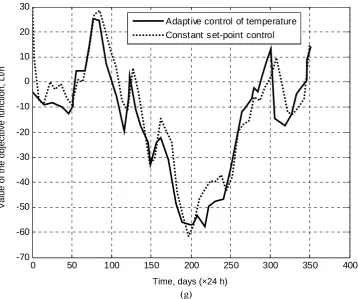
The performance of the proposed temperature control system minimizing the objective function (7) under the simulated disturbances is illustrated in Figure 5d. The presented variation of temperature
de-monstrates adaptation of temperature to the time-varying process variables. The dotted line in Figure 5d shows the temperature set-point (θ =34.4 oC), at which the temperature is controlled by ordinary control system according to technological schedule.
In Figure 5e, the simulated biogas production rate time trajectories by applying the adaptive control sys-tem and by controlling the process sys-temperature at constant level are shown. The predicted percentages of organic material degradation by applying the adaptive control system and by controlling the process at predetermined constant temperature set-point are presented in Figure 5f.
0 50 100 150 200 250 300 350 400 8
10 12 14 16 18 20 22 24 26
(a)
0 50 100 150 200 250 300 350 400
12 14 16 18 20 22 24 26
(b)
F
low
rate
of
inlet
s
ludge,
m
3 /h
Time, days
T
e
mperature
o
f
inlet
sludge,
O C
0 50 100 150 200 250 300 350 400 -5
0 5 10 15 20
(c)
0 50 100 150 200 250 300 350 400 32
32.5 33 33.5 34 34.5 35 35.5 36 36.5 37
A daptive control of temperature P redetermined temperature set-point
(d)
Yearly
average
outdoor
temperature,
O C
Time, days
T
e
mperature
in
m
ethan
tank,
O C
0 50 100 150 200 250 300 350 400 120
140 160 180 200 220 240 260 280 300 320
Adaptive control of temperature Constant set-point control
(e)
(f)
Biogas
production
rate,
m
3 /h
0 50 100 150 200 250 300 350 400 -70
-60 -50 -40 -30 -20 -10 0 10 20 30
Adaptive control of temperature Constant set-point control
(g)
Figure 5. Simulation results of the control system performance
As it follows from the simulation results, the in-vestigated control system copes with the main objec-tives of control: the biogas production rate is main-tained to meet the requirement of the organic material degradation and the operating costs of the controlled process are reduced compared to that by keeping up the process temperature at constant set-point.
The estimated mean percentage of the organic ma-terial degradation by applying the adaptive control system totals 60.8 % (the lowermost desired percen-tage is 60 %). The estimated mean percenpercen-tage at con-stant set-point control of temperature totals 56 %. It is by 7.9 % less compared to this by applying the adaptive control system.
In the simulation experiment, the yearly operating costs due to adaptive control of process temperature decrease for about 30 000 Lt.
5. Conclusions
In this paper, an adaptive control system of tempe-rature is developed for minimization the operation costs of industrial methane tank process. The tempera-ture adaptation is based on the on-line minimization of objective function that relates operation costs of digestion process with the process parameters: the out-door temperature, the temperature of inlet sludge, the volumetric flow rate of inlet sludge and the biogas production rate. The biogas production rate is pre-dicted using the identified functional relationship that
relates biogas production with the process temperature and the retention time of sludge in methane tank.
Efficiency of the proposed control system is inves-tigated via computer simulation of the control system performance under time-varying operating conditions of real methane tank process during one year period. The simulation results show noticeable decrease of operating costs while keeping the biogas production rate above the ultimate values. In the simulation ex-periment, the operating costs due to adaptive control of temperature are reduced by 30 000 Lt compared to those by controlling the temperature at constant level.
Acknowledgement
This research is supported by Agency for International Science and Technology Development Programmes in Lithuania (Eureka project E!3692).
References
[1] A.J. Garnajeva, L.G. Sedyx, M.Z. Kristapsons, A.P. Grinberg, V.E.Davids. Biological treatment of effluent water and agricultural waste. Dynamical mo-dels and optimal control. Zinatne: Riga, 1991 (in Russian).
[2] K. Brazauskas, D. Levišauskas. Experimental inves-tigation of temperature impact to anaerobic digestion process. ECT - 2008: Proceedings of the 3rd Interna-tional Conference on Electrical and Control logies. Book Series: Electrical and Control Techno-logies, ISSN 1822 5934, Kaunas, 2008, 136-139.
Value of the objecttive function, Lt/h
[3] D.C. Montgomery. Design and Analysis of Experi-ments. John Wiley & Sons, Inc., 2001.
[4] D.E. Rivera, S. Skogestad, M. Morari. Internal model control 4: PID controller design. Industrial & Engineering Chemistry Process Design and Develop-ment, 1986, Vol.25(1), 252-265.
[5] K.Brazauskas, D. Levišauskas. Adaptive transfer function-based control of nonlinear process. Case study: Control of temperature in industrial methane-tank. International Journal of Adaptive Control and Signal Processing, 2007, Vol.21, 871-884.