
637
Information Technology and Control 2019/4/48
Research on Intention
Recognition Method Based on
Radial Basis Function Neural
Network
ITC 4/48 Information Technology and Control
Vol. 48 / No. 4 / 2019 pp. 637-647
DOI 10.5755/j01.itc.48.4.23031
Research on Intention Recognition Method Based on Radial Basis Function Neural Network
Received 2019/03/27 Accepted after revision 2019/10/16
http://dx.doi.org/10.5755/j01.itc.48.4.23031
Corresponding author: [email protected]
Han Yan, Han Ming, Ruoxi Yang
College of Mechanical Engineering, Hebei University of Technology, Tianjin 300132, China;
e-mails: [email protected], [email protected], [email protected]
Tiejun Li
College of Mechanical Engineering, Hebei University of Technology, Tianjin 300132, China; e-mail: [email protected]
A robot should be endowed with certain collaboration experience to recognize human’s behavioral intention. This paper provides a method based on machine learning to recognize the collaborator’s intention. A radial basis function neural network model was built for offline practice of a robot to recognize intention. Some col-laboration skills can be obtained by the robot by building a map between the collaborator’s intention and the system state, deducing human’s intention based on the dynamic characteristics of collaborator and robot and taking the collaborator’s intention as the feedforward information for controlling the robot so as to estimate the human’s intention online based on collaborator’s force and robot’s motion characteristics during collaboration. The proposed method can overcome the difficulties in building the human-robot collaboration model by tra-ditional method, especially the complicated human motion model, and difficulties in estimation of impedance parameters of human body. An experiment was conducted on a motion platform with single degree of freedom. The results prove that the collaborator’s force is reduced while synchronization of human-robot collaboration is improved, so that the compliance of collaborated motion is also improved.
Information Technology and Control 2019/4/48 638
1. Introduction
The collaborative robot enjoys a history of more than 20 years. At present, it has a very wide space for appli-cation in military, aerospace, rehabilitation, nursing, industry, living, etc. The robot should be capable of sensing the force, judging the intention and making the decision of motion during the collaboration with human for handling, assembling, limb rehabilitation exercising, robot assisted walking and other work to ensure its safety, compliance and high efficiency. For a long time, the human-robot collaboration sys-tem had an obvious defect, i.e. a robot calculates the position information based on the acquired infor-mation, then transmits the position information to its controller, and finally realizes the follow motion, resulting in the time delay [6]. In order to solve this problem, Maeda et al. [12], on the basis of human-hu-man collaboration, put forward that if a robot is en-dowed with the prejudging ability like human, can recognize the collaborator’s intention in real time and build the relationship between its expected trajecto-ry and the collaborator’s intention based on certain rule, many problems can be solved, i.e. the robot and the collaborator are not synchronous, and the collab-orator’s force is too high. Finally, the robot can make more natural and more flexible motion. Therefore, the expected trajectory of a robot should be designed as a random variable related to the collaborator’s in-tention. The recognition of collaborator’s intention becomes an important task. At present, the research-es on methods of collaborator’s intention recognition mainly focus on the methods based on model and machine learning. Human intentions come from the brain. The research should start from the root of gen-erating the intention. If the human’s intention signal can be abstracted from brain, the human’s intention can be clear and can be transmitted to the effector by external signal. For example, a neurologist, prof. Gregoire Courtine [4] from Swiss Federal Institute of Technology took an experiment on a monkey whose nervus centralis of leg is injured. The brain signal was abstracted from monkey’s brain and transmitted to the effector (monkey’s leg) by external transmission mode. The paralyzed monkey regained the ability to walk. At present, the brain signal is mainly abstracted by wearing the wearable devices. However, the head wearable device cannot abstract the brain signal well
and the interference may not be eliminated. In addi-tion, the correspondence relationship between brain phonetics and action is fuzzy. Thus, the research has not made significant progress.
Many researchers simplify the control model of hu-man’s upper limbs as the impedance control model, even directly simplify as the mass-spring-damper sys-tem and represent the human’s intention as a virtual variable [14, 20, 5] of expectation. The method has an obvious defect, i.e. the method is based on a hypothe-sis that the mass, damper and rigidity of a collaborator are not change during the human-robot collaboration. However, collaborator’s intention always changes with the change of current scenes, goals and tasks, i.e. the human’s intention changes at any time. Therefore, the method of recognition of collaborator’s intention based on model is not applicable to human-robot col-laboration system with strong randomness. Thus, the prediction model built by machine learning meth-od without consideration of human bmeth-ody mmeth-odel can make the robot recognize the collaborator’s intention more visually and effectively [3].
639
Information Technology and Control 2019/4/48
to recognize the collaborator’s intention. Kelley et al. [8] adopted a novel HMM to recognize the collabo-rator’s intention, while this method was analyzed by M Awais et al. [2] by Finite State Machines method based on probability.
Among above methods, most of them are based on gestures or actions and deduce the collaborator’s in-tention on the basis of human’s action without con-sideration of necessity of using mutual information and state information of the collaboration system in human-robot collaboration. Thus, these methods cannot meet the demand of human-robot collabora-tion. Therefore, this paper provides a method based on machine learning to recognize the collaborator’s intention on the basis of the human-robot interac-tion informainterac-tion. A radial basis funcinterac-tion neural net-work (RBFNN) model was built for offline practice of a robot to recognize intention. Some collaboration skills can be obtained by the robot by building a map between the collaborator’s intention and the system state, deducing human’s intention based on the dy-namic characteristics of collaborator and robot and taking the collaborator’s intention as the feedforward information for controlling the robot so as to estimate the human’s intention on line based on collaborator’s force and robot’s motion characteristics during col-laboration.
2. The Principle of Intention
Recognition Based on Radial Basis
Function Neural Network
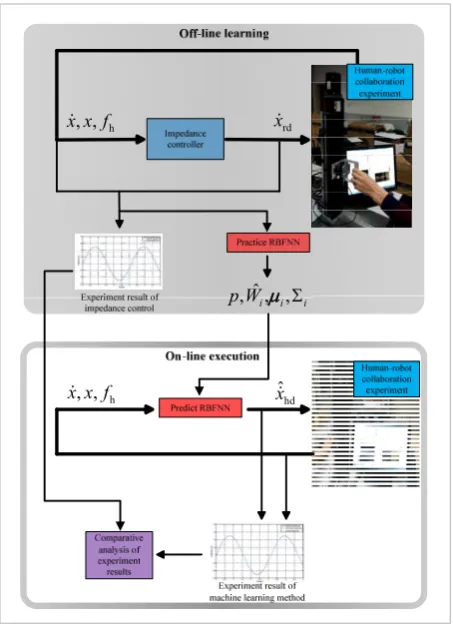
The human’s intention is embodied by dynamic per-formance of system and can be estimated on the ground of external performance of the system. Based on this idea, the intention recognition method based on radial basis function neural network is put forward. Its principle is shown in Fig. 1. The intention identi-fication process includes offline learning and online real-time estimation. The human’s intention is sim-plified as the speed of interaction point between the collaborator and the robot { }xhd . Ge et al. [6] proved the rationality of this hypothesis. In order to prevent “resilience” of the robot, the expected rigidity of robot is set as 0, i.e. Kd=0. If there is no requirements for ex-pected inertia of robot, only the exex-pected speed of
ro-bot { }xrd affects the interaction in impedance control. Therefore, the human’s intention is defined as the speed of collaborator’s palm, and the expected speed of robot { }xrd verges on the human’s intention speed
hd
{ }x in an optimal mode to realize the synchronous motion of human-robot collaboration and play the role of reducing the interaction force.
In this paper, robot perceives human’s intention by the force from human, and follows human’s inten-tion to move. In this process, RBFNN is used to pre-dict human behavior. RBFNN has strong input and output mapping ability and it can avoid falling into local minimum when training. Poggio et al. [15] have proven that the RBFNN is superior in approximating continuous functions. The essence of RBFNN used here is to build human intent model based on human historical behavior data including the speed, position and the corresponding interaction force of the robot.
predict the collaborator’s intention { }xˆhd . Therefore, the output layer of radial basis function neural network is one
layer and is expressed as:
2 2 1
1
exp , 1,2,
2
p
i i
i
y w x c i p
, (1)where, y is the output of neural network, p is the size of hidden layer, Wi is the weight from hidden layer to output layer, is the extension constant of radial basis function, x
is the input of neural network and ciis the center of neural network basis function.
Figure 1
A schematic diagram of intention recognition based on radial basis function neural network
rd x h
, , x x f
ˆ , , ,i i i
p W
h , ,
x x f xˆhd
In order to ensure the effective and real-time intention recognition, only the end-speed, position and interaction force are selected as the intention estimation information. The network parameters are defined by combining the variable of human-robot collaboration system. Name and description of parameters are as follows:
hdi, , ,i i i
, 1D x x x f () () () () i n
, (2)
where, x( )hdi is the vector of human’s intention in the ith group of observation data; x()i is the vector of robot’s end-speed in the ith group of observation data; x()i is the vector of robot’s end-position in the ith group of observation data;
i
f() is the vector of interaction force between the robot and
the collaborator in theith group of observation data and the vector of force in motion direction which triggers the sensor.
3.
Basis Function Center Design Method
Based on K-means
The prerequisite of estimation of collaborator’s intention based on radial basis function neural network is building a proper neural network model. The key points of design lie in the method of selecting hidden layer node based on data and the design method of weight from hidden layer to output layer. Due to the number of hidden nodes in radial basis function neural network, i.e. p in formula 1, greatly influences the generalization ability of the whole network, it is very important to find a rational method to confirm the number of hidden nodes. There are many methods to confirm the hidden nodes, such as clustering method, gradient training method and resource allocation network. However, in practice, the dynamic clustering algorithm is often adopted for data center selection by self-organization. During learning, the position of data center should be dynamically adjusted.
K-means clustering method, as a common and effective clustering method, can confirm the extension constant of hidden nodes on the basis of the distance among various clustering centers. The main idea of this method is that the K value and K initial class cluster centers should be set firstly, then each center point should be allocated in the class cluster where there is the class cluster center which is closest to the center. After this, the mean of class clusters should be recalculated according to the data in each class cluster. It is a process of allocating center points and updating the class cluster centers by iteration method. The algorithm will not stop until the change of class cluster center is very small (convergence) or the specified iteration number are achieved. Rational determination of K value and K initial class cluster centers greatly influences of the clustering effect. Therefore, K value and K initial class cluster centers shall be selected through calculation.
In practical application, K value may not be large and can be determined by enumeration. It is known from literature [1] that if the set class cluster number equals to or is more than the proper class cluster number, the radius or diameter of class cluster will change slowly. If the set class cluster number is smaller than the proper class cluster number, the radius or diameter of class cluster will change rapidly. Choosing the value K by enumeration can get the optimal result. At the same time, it can get the Weighted mean value, Wof mean centroid distance (radius) of class cluster based on the determined indexes. The index is expressed as follows:
1meank
i i i
n
W r
N
, (3)Figure 1
Information Technology and Control 2019/4/48 640
The Gaussian function has good local approximation capability and is adopted as the radial basis transmis-sion function to predict the collaborator’s intention
hd ˆ
{ }x . Therefore, the output layer of radial basis func-tion neural network is one layer and is expressed as:
2 2 1
1
exp , 1,2,
2
p
i i
i
y w x c i p
, (1)where, y is the output of neural network, p is the size of hidden layer, Wi is the weight from hidden layer to
output layer, σ is the extension constant of radial basis function, x is the input of neural network and ci is the
center of neural network basis function.
In order to ensure the effective and real-time inten-tion recogniinten-tion, only the end-speed, posiinten-tion and interaction force are selected as the intention esti-mation inforesti-mation. The network parameters are defined by combining the variable of human-robot collaboration system. Name and description of pa-rameters are as follows:
predict the collaborator’s intention { }xˆhd . Therefore, the output layer of radial basis function neural network is one
layer and is expressed as:
2 2 1
1
exp , 1,2,
2
p
i i
i
y w x c i p
, (1)where, y is the output of neural network, p is the size of hidden layer, Wi is the weight from hidden layer to output layer, is the extension constant of radial basis function, x
is the input of neural network and ciis the center of neural network basis function.
Figure 1
A schematic diagram of intention recognition based on radial basis function neural network
rd x h
, ,
x x f
ˆ , , ,i i i
p W
h
, ,
x x f xˆhd
In order to ensure the effective and real-time intention recognition, only the end-speed, position and interaction force are selected as the intention estimation information. The network parameters are defined by combining the variable of human-robot collaboration system. Name and description of parameters are as follows:
hdi, , ,i i i
, 1D x x x f () () () () i n
, (2)
where, x( )hdi is the vector of human’s intention in the ith
group of observation data; x()i is the vector of robot’s end-speed in the ith group of observation data; x()i is the vector of robot’s end-position in the ith group of observation data;
i
f() is the vector of interaction force between the robot and
the collaborator in theith group of observation data and the vector of force in motion direction which triggers the sensor.
3.
Basis Function Center Design Method
Based on K-means
The prerequisite of estimation of collaborator’s intention based on radial basis function neural network is building a proper neural network model. The key points of design lie in the method of selecting hidden layer node based on data and the design method of weight from hidden layer to output layer. Due to the number of hidden nodes in radial basis function neural network, i.e. p in formula 1, greatly influences the generalization ability of the whole network, it is very important to find a rational method to confirm the number of hidden nodes. There are many methods to confirm the hidden nodes, such as clustering method, gradient training method and resource allocation network. However, in practice, the dynamic clustering algorithm is often adopted for data center selection by self-organization. During learning, the position of data center should be dynamically adjusted.
K-means clustering method, as a common and effective clustering method, can confirm the extension constant of hidden nodes on the basis of the distance among various clustering centers. The main idea of this method is that the K value and K initial class cluster centers should be set firstly, then each center point should be allocated in the class cluster where there is the class cluster center which is closest to the center. After this, the mean of class clusters should be recalculated according to the data in each class cluster. It is a process of allocating center points and updating the class cluster centers by iteration method. The algorithm will not stop until the change of class cluster center is very small (convergence) or the specified iteration number are achieved. Rational determination of K value and K initial class cluster centers greatly influences of the clustering effect. Therefore, K value and K initial class cluster centers shall be selected through calculation.
In practical application, K value may not be large and can be determined by enumeration. It is known from literature [1] that if the set class cluster number equals to or is more than the proper class cluster number, the radius or diameter of class cluster will change slowly. If the set class cluster number is smaller than the proper class cluster number, the radius or diameter of class cluster will change rapidly. Choosing the value K by enumeration can get the optimal result. At the same time, it can get the Weighted mean value, Wof mean centroid distance (radius) of class cluster based on the determined indexes. The index is expressed as follows:
1 mean k i i i n W r N
, (3)(2)
where,
predict the collaborator’s intention
{ }
x
ˆ
hd . Therefore, theoutput layer of radial basis function neural network is one
layer and is expressed as:
2 2
1
1
exp , 1,2,
2
p
i i
i
y w x c i p
, (1)where,
y
is the output of neural network,p
is the size ofhidden layer,
W
i is the weight from hidden layer to outputlayer, is the extension constant of radial basis function, x
is the input of neural network and
c
iis the center of neuralnetwork basis function.
Figure 1
A schematic diagram of intention recognition based on radial basis function neural network
rd x
h
, ,
x x f
ˆ
, , ,i i i
p W
h
, ,
x x f xˆhd
In order to ensure the effective and real-time intention recognition, only the end-speed, position and interaction force are selected as the intention estimation information. The network parameters are defined by combining the variable of human-robot collaboration system. Name and description of parameters are as follows:
hdi, , ,
i i i
, 1
D
x x x f
() () () ()i
n
, (2)
where, x( )hdi is the vector of human’s intention in the
i
thgroup of observation data;
x
()i is the vector of robot’send-speed in the
i
th group of observation data;x
()i is the vectorof robot’s end-position in the
i
th group of observation data;i
f
() is the vector of interaction force between the robot andthe collaborator in the
i
th group of observation data and thevector of force in motion direction which triggers the sensor.
3.
Basis Function Center Design Method
Based on K-means
The prerequisite of estimation of collaborator’s intention based on radial basis function neural network is building a proper neural network model. The key points of design lie in the method of selecting hidden layer node based on data and the design method of weight from hidden layer to output layer. Due to the number of hidden nodes in radial basis
function neural network, i.e.
p
in formula 1, greatlyinfluences the generalization ability of the whole network, it is very important to find a rational method to confirm the number of hidden nodes. There are many methods to confirm the hidden nodes, such as clustering method, gradient training method and resource allocation network. However, in practice, the dynamic clustering algorithm is often adopted for data center selection by self-organization. During learning, the position of data center should be dynamically adjusted.
K-means clustering method, as a common and effective clustering method, can confirm the extension constant of hidden nodes on the basis of the distance among various clustering centers. The main idea of this method is that the K value and K initial class cluster centers should be set firstly, then each center point should be allocated in the class cluster where there is the class cluster center which is closest to the center. After this, the mean of class clusters should be recalculated according to the data in each class cluster. It is a process of allocating center points and updating the class cluster centers by iteration method. The algorithm will not stop until the change of class cluster center is very small (convergence) or the specified iteration number are
achieved. Rational determination of
K
value andK
initialclass cluster centers greatly influences of the clustering
effect. Therefore,
K
value andK
initial class clustercenters shall be selected through calculation.
In practical application,
K
value may not be large and canbe determined by enumeration. It is known from literature [1] that if the set class cluster number equals to or is more than the proper class cluster number, the radius or diameter of class cluster will change slowly. If the set class cluster number is smaller than the proper class cluster number, the radius or diameter of class cluster will change rapidly.
Choosing the value
K
by enumeration can get the optimalresult. At the same time, it can get the Weighted mean
value, W of mean centroid distance (radius) of class cluster
based on the determined indexes. The index is expressed as follows:
1mean
k i i in
W
r
N
, (3)is the vector of human’s intention in the
i th group of observation data; predict the collaborator’s intention
{ }
x
ˆ
hd . Therefore, theoutput layer of radial basis function neural network is one
layer and is expressed as:
2 2
1
1
exp , 1,2,
2
p
i i
i
y w x c i p
, (1)where,
y
is the output of neural network,p
is the size of hidden layer,W
i is the weight from hidden layer to output layer, is the extension constant of radial basis function, x is the input of neural network andc
iis the center of neural network basis function.Figure 1
A schematic diagram of intention recognition based on radial basis function neural network
rd
x
h
, , x x f
ˆ , , ,i i i p W
h , ,
x x f xˆhd
In order to ensure the effective and real-time intention recognition, only the end-speed, position and interaction force are selected as the intention estimation information. The network parameters are defined by combining the variable of human-robot collaboration system. Name and description of parameters are as follows:
hdi, , ,i i i
, 1D x x x f () () () () i n
, (2)
where, x( )hdi is the vector of human’s intention in the
i
th group of observation data;x
()i is the vector of robot’s end-speed in thei
th group of observation data;x
()i is the vector of robot’s end-position in thei
th group of observation data;i
f
() is the vector of interaction force between the robot andthe collaborator in the
i
th group of observation data and the vector of force in motion direction which triggers the sensor.3.
Basis Function Center Design Method
Based on K-means
The prerequisite of estimation of collaborator’s intention based on radial basis function neural network is building a proper neural network model. The key points of design lie in the method of selecting hidden layer node based on data and the design method of weight from hidden layer to output layer. Due to the number of hidden nodes in radial basis function neural network, i.e.
p
in formula 1, greatly influences the generalization ability of the whole network, it is very important to find a rational method to confirm the number of hidden nodes. There are many methods to confirm the hidden nodes, such as clustering method, gradient training method and resource allocation network. However, in practice, the dynamic clustering algorithm is often adopted for data center selection by self-organization. During learning, the position of data center should be dynamically adjusted.K-means clustering method, as a common and effective clustering method, can confirm the extension constant of hidden nodes on the basis of the distance among various clustering centers. The main idea of this method is that the K value and K initial class cluster centers should be set firstly, then each center point should be allocated in the class cluster where there is the class cluster center which is closest to the center. After this, the mean of class clusters should be recalculated according to the data in each class cluster. It is a process of allocating center points and updating the class cluster centers by iteration method. The algorithm will not stop until the change of class cluster center is very small (convergence) or the specified iteration number are achieved. Rational determination of
K
value andK
initial class cluster centers greatly influences of the clustering effect. Therefore,K
value andK
initial class cluster centers shall be selected through calculation.In practical application,
K
value may not be large and can be determined by enumeration. It is known from literature [1] that if the set class cluster number equals to or is more than the proper class cluster number, the radius or diameter of class cluster will change slowly. If the set class cluster number is smaller than the proper class cluster number, the radius or diameter of class cluster will change rapidly. Choosing the valueK
by enumeration can get the optimal result. At the same time, it can get the Weighted mean value, W of mean centroid distance (radius) of class cluster based on the determined indexes. The index is expressed as follows:
1mean
k i i in
W
r
N
, (3) is the vector ofro-bot’s end-speed in the i th group of observation data;
predict the collaborator’s intention
{ }
x
ˆ
hd . Therefore, the output layer of radial basis function neural network is onelayer and is expressed as:
2 2
1
1
exp , 1,2,
2
p
i i
i
y w
x c i p
, (1)where,
y
is the output of neural network,p
is the size of hidden layer,W
i is the weight from hidden layer to output layer, is the extension constant of radial basis function, xis the input of neural network and
c
iis the center of neural network basis function.Figure 1
A schematic diagram of intention recognition based on radial basis function neural network
rd
x
h
, ,
x x f
ˆ , , ,i i i p W
h
, ,
x x f xˆhd
In order to ensure the effective and real-time intention recognition, only the end-speed, position and interaction force are selected as the intention estimation information. The network parameters are defined by combining the variable of human-robot collaboration system. Name and description of parameters are as follows:
hdi, , ,
i i i
, 1
D
x x x f
() () () ()i
n
, (2)
where, x( )hdi is the vector of human’s intention in the
i
thgroup of observation data;
x
()i is the vector of robot’send-speed in the
i
th group of observation data;x
()i is the vectorof robot’s end-position in the
i
th group of observation data;i
f
() is the vector of interaction force between the robot andthe collaborator in the
i
th group of observation data and the vector of force in motion direction which triggers the sensor.3.
Basis Function Center Design Method
Based on K-means
The prerequisite of estimation of collaborator’s intention based on radial basis function neural network is building a proper neural network model. The key points of design lie in the method of selecting hidden layer node based on data and the design method of weight from hidden layer to output layer. Due to the number of hidden nodes in radial basis function neural network, i.e.
p
in formula 1, greatly influences the generalization ability of the whole network, it is very important to find a rational method to confirm the number of hidden nodes. There are many methods to confirm the hidden nodes, such as clustering method, gradient training method and resource allocation network. However, in practice, the dynamic clustering algorithm is often adopted for data center selection by self-organization. During learning, the position of data center should be dynamically adjusted.K-means clustering method, as a common and effective clustering method, can confirm the extension constant of hidden nodes on the basis of the distance among various clustering centers. The main idea of this method is that the K value and K initial class cluster centers should be set firstly, then each center point should be allocated in the class cluster where there is the class cluster center which is closest to the center. After this, the mean of class clusters should be recalculated according to the data in each class cluster. It is a process of allocating center points and updating the class cluster centers by iteration method. The algorithm will not stop until the change of class cluster center is very small (convergence) or the specified iteration number are achieved. Rational determination of
K
value andK
initial class cluster centers greatly influences of the clustering effect. Therefore,K
value andK
initial class cluster centers shall be selected through calculation.In practical application,
K
value may not be large and can be determined by enumeration. It is known from literature [1] that if the set class cluster number equals to or is more than the proper class cluster number, the radius or diameter of class cluster will change slowly. If the set class cluster number is smaller than the proper class cluster number, the radius or diameter of class cluster will change rapidly. Choosing the valueK
by enumeration can get the optimal result. At the same time, it can get the Weighted mean value, W of mean centroid distance (radius) of class cluster based on the determined indexes. The index is expressed as follows:
1mean
k i i in
W
r
N
, (3)is the vector of robot’s end-position in the i th group of observation data;
predict the collaborator’s intention { }xˆhd . Therefore, the output layer of radial basis function neural network is one
layer and is expressed as:
2 2 1
1
exp , 1,2,
2
p
i i
i
y w x c i p
, (1)where, y is the output of neural network, p is the size of hidden layer, Wi is the weight from hidden layer to output layer, is the extension constant of radial basis function, x is the input of neural network and
c
iis the center of neural network basis function.Figure 1
A schematic diagram of intention recognition based on radial basis function neural network
rd
x
h
, , x x f
ˆ , , ,i i i
p W
h
, ,
x x f xˆhd
In order to ensure the effective and real-time intention recognition, only the end-speed, position and interaction force are selected as the intention estimation information. The network parameters are defined by combining the variable of human-robot collaboration system. Name and description of parameters are as follows:
hdi, , ,i i i
, 1D x x x f () () () () i n
, (2)
where, x( )hdi is the vector of human’s intention in the ith
group of observation data; x()i is the vector of robot’s end-speed in the ith group of observation data; x()i is the vector of robot’s end-position in the
i
th group of observation data;i
f() is the vector of interaction force between the robot and the collaborator in the
i
th group of observation data and the vector of force in motion direction which triggers the sensor.3.
Basis Function Center Design Method
Based on K-means
The prerequisite of estimation of collaborator’s intention based on radial basis function neural network is building a proper neural network model. The key points of design lie in the method of selecting hidden layer node based on data and the design method of weight from hidden layer to output layer. Due to the number of hidden nodes in radial basis function neural network, i.e. p in formula 1, greatly influences the generalization ability of the whole network, it is very important to find a rational method to confirm the number of hidden nodes. There are many methods to confirm the hidden nodes, such as clustering method, gradient training method and resource allocation network. However, in practice, the dynamic clustering algorithm is often adopted for data center selection by self-organization. During learning, the position of data center should be dynamically adjusted.
K-means clustering method, as a common and effective clustering method, can confirm the extension constant of hidden nodes on the basis of the distance among various clustering centers. The main idea of this method is that the K value and K initial class cluster centers should be set firstly, then each center point should be allocated in the class cluster where there is the class cluster center which is closest to the center. After this, the mean of class clusters should be recalculated according to the data in each class cluster. It is a process of allocating center points and updating the class cluster centers by iteration method. The algorithm will not stop until the change of class cluster center is very small (convergence) or the specified iteration number are achieved. Rational determination of K value and K initial class cluster centers greatly influences of the clustering effect. Therefore, K value and K initial class cluster centers shall be selected through calculation.
In practical application, K value may not be large and can be determined by enumeration. It is known from literature [1] that if the set class cluster number equals to or is more than the proper class cluster number, the radius or diameter of class cluster will change slowly. If the set class cluster number is smaller than the proper class cluster number, the radius or diameter of class cluster will change rapidly. Choosing the value K by enumeration can get the optimal result. At the same time, it can get the Weighted mean value, W of mean centroid distance (radius) of class cluster based on the determined indexes. The index is expressed as follows:
1mean
k i i in
W
r
N
, (3) is the vector ofinter-action force between the robot and the collaborator in the i th group of observation data and the vector of force in motion direction which triggers the sensor.
3. Basis Function Center Design
Method Based on K-means
The prerequisite of estimation of collaborator’s in-tention based on radial basis function neural network is building a proper neural network model. The key points of design lie in the method of selecting hidden layer node based on data and the design method of weight from hidden layer to output layer. Due to the number of hidden nodes in radial basis function neu-ral network, i.e. p in formula 1, greatly influences the generalization ability of the whole network, it is very important to find a rational method to confirm the
number of hidden nodes. There are many methods to confirm the hidden nodes, such as clustering method, gradient training method and resource allocation net-work. However, in practice, the dynamic clustering algorithm is often adopted for data center selection by self-organization. During learning, the position of data center should be dynamically adjusted.
K-means clustering method, as a common and effec-tive clustering method, can confirm the extension constant of hidden nodes on the basis of the distance among various clustering centers. The main idea of this method is that the K value and K initial class clus-ter cenclus-ters should be set firstly, then each cenclus-ter point should be allocated in the class cluster where there is the class cluster center which is closest to the center. After this, the mean of class clusters should be recal-culated according to the data in each class cluster. It is a process of allocating center points and updating the class cluster centers by iteration method. The al-gorithm will not stop until the change of class cluster center is very small (convergence) or the specified it-eration number are achieved. Rational determination of K value and K initial class cluster centers greatly influences of the clustering effect. Therefore, K val-ue and K initial class cluster centers shall be selected through calculation.
In practical application, K value may not be large and can be determined by enumeration. It is known from literature [1] that if the set class cluster number equals to or is more than the proper class cluster number, the radius or diameter of class cluster will change slow-ly. If the set class cluster number is smaller than the proper class cluster number, the radius or diameter of class cluster will change rapidly.
Choosing the value K by enumeration can get the op-timal result. At the same time, it can get the Weighted mean value, W of mean centroid distance (radius) of class cluster based on the determined indexes. The index is expressed as follows:
predict the collaborator’s intention { }xˆhd . Therefore, the output layer of radial basis function neural network is one
layer and is expressed as:
2 2 1
1
exp 2 , 1,2,
p
i i
i
y w x c i p
, (1)where, y is the output of neural network, p is the size of hidden layer, Wi is the weight from hidden layer to output layer, is the extension constant of radial basis function, x is the input of neural network and ciis the center of neural network basis function.
Figure 1
A schematic diagram of intention recognition based on radial basis function neural network
rd x
h , , x x f
ˆ , , ,i i i
p W
h , ,
x x f xˆhd
In order to ensure the effective and real-time intention recognition, only the end-speed, position and interaction force are selected as the intention estimation information. The network parameters are defined by combining the variable of human-robot collaboration system. Name and description of parameters are as follows:
hdi, , ,i i i
, 1D x x x f () () () () i n
, (2)
where, x( )hdi is the vector of human’s intention in the ith
group of observation data; x()i is the vector of robot’s end-speed in the ith group of observation data; x()i is the vector of robot’s end-position in the ith group of observation data;
i f()
is the vector of interaction force between the robot and the collaborator in theith group of observation data and the vector of force in motion direction which triggers the sensor.
3.
Basis Function Center Design Method
Based on K-means
The prerequisite of estimation of collaborator’s intention based on radial basis function neural network is building a proper neural network model. The key points of design lie in the method of selecting hidden layer node based on data and the design method of weight from hidden layer to output layer. Due to the number of hidden nodes in radial basis function neural network, i.e. p in formula 1, greatly influences the generalization ability of the whole network, it is very important to find a rational method to confirm the number of hidden nodes. There are many methods to confirm the hidden nodes, such as clustering method, gradient training method and resource allocation network. However, in practice, the dynamic clustering algorithm is often adopted for data center selection by self-organization. During learning, the position of data center should be dynamically adjusted.
K-means clustering method, as a common and effective clustering method, can confirm the extension constant of hidden nodes on the basis of the distance among various clustering centers. The main idea of this method is that the K value and K initial class cluster centers should be set firstly, then each center point should be allocated in the class cluster where there is the class cluster center which is closest to the center. After this, the mean of class clusters should be recalculated according to the data in each class cluster. It is a process of allocating center points and updating the class cluster centers by iteration method. The algorithm will not stop until the change of class cluster center is very small (convergence) or the specified iteration number are achieved. Rational determination of K value and K initial class cluster centers greatly influences of the clustering effect. Therefore, K value and K initial class cluster centers shall be selected through calculation.
In practical application, K value may not be large and can be determined by enumeration. It is known from literature [1] that if the set class cluster number equals to or is more than the proper class cluster number, the radius or diameter of class cluster will change slowly. If the set class cluster number is smaller than the proper class cluster number, the radius or diameter of class cluster will change rapidly. Choosing the value K by enumeration can get the optimal result. At the same time, it can get the Weighted mean value, Wof mean centroid distance (radius) of class cluster based on the determined indexes. The index is expressed as follows:
1mean k i i i n W r N
, (3) (3)where, k is the number of class cluster, mean(ri)is the
mean radius of the i th class clusters, ni is the number
![Figure 8 Speed tracking curve of method based on radial basis human-robot collaboration and improve the compliance of effectiveness of the machine learning method, the end-the robot, the fragile object (egg roll) was used to push the -600 12345678时间Time (s)[s] proposed method can accurately recognize the collaborator’s intention, improve the synchronization of human-robot speed of robot, interaction force and other data during the human-robot collaboration system were analyzed](https://thumb-us.123doks.com/thumbv2/123dok_us/8763420.1753194/9.595.67.292.402.545/collaboration-effectiveness-time-accurately-collaborator-synchronization-interaction-collaboration.webp)
