Katarzyna Van Damme-Ostapowicz
1, Elżbieta Krajewska-Kułak
1,
Romuald Olszański
2,
Wacław Nahorski
3Problems Involving Contagious Diseases and Tropical
Medicine – New Challenges for Health Care Staff
Problemy związane z chorobami zakaźnymi i medycyną tropikalną
– nowe wyzwania dla pracowników ochrony zdrowia
1 Department of Integrated Medical Care, Medical University of Bialystok, Poland
2 Department of Maritime and Tropical Medicine, Military Medical Institute, Gdynia, Poland 3 Interdisciplinary Institute of Marine and Tropical Medicine, Medical University of Gdańsk, Poland
Abstract
Background. According to current data published by the World Tourism Organization, over 150 million travellers have visited developing countries every year during the last decade. Undoubtedly, appropriate knowledge in the field of tropical medicine is important for healthcare professionals, including nurses, who are increasingly exposed to clients/patients travelling to or from tropical countries.
Objectives. The purpose of the study was to evaluate the level of knowledge of contagious diseases and tropical medicine among nurses and nursing students in the Podlaskie District of Poland.
Material and Methods. The study was based on two self-developed survey questionnaires, one of which was administered to 500 nurses in the Podlaskie District and the other to 500 nursing students at the Medical University in Białystok.
Results. The study showed that one in every nine nurses stated that they have no contact with contagious diseases in their everyday practice. Just over 30% of the nurses surveyed were convinced that their knowledge of contagious diseases and preparation to educate patients in that field is insufficient, and over half of the nurses had never trained patients in those matters. The study showed that almost 90% of the nurses surveyed had never educated patients in topics associated with tropical medicine, and the remaining 10% had done it “sporadically”. The study demonstrated that the vast majority of students (90%) had not participated in patient education in tropical medi-cine. The majority of participating students (64%) believe that education for nurses in the area of tropical medicine is necessary.
Conclusions. Nurses’ and nursing students’ knowledge of contagious and tropical diseases is insufficient; but both groups are interested in broadening their knowledge of contagious diseases and tropical medicine (Adv Clin Exp Med 2011, 20, 4, 461–471).
Key words: tropical disease, knowledge, nurse.
Streszczenie
Wprowadzenie. W ostatnich latach, według aktualnych danych Światowej Organizacji Turystyki, rocznie ponad 150 mln podróżujących odwiedza kraje rozwijające się. Bardzo ważną rzeczą dla pracowników ochrony zdrowia (w tym pielęgniarek), którzy coraz częściej są narażeni na kontakt z klientami/pacjentami bądź chcącymi wyjechać do krajów tropikalnych, bądź z nich powracającymi, jest wiedza z zakresu chorób zakaźnych i medycyny tropikalnej.
Cel pracy. Ocena poziomu wiedzy pielęgniarek i studentów pielęgniarstwa w województwie podlaskim na temat chorób zakaźnych i medycyny tropikalnej.
Materiał i metody. Badanie przeprowadzono na podstawie kwestionariusza ankiet własnego autorstwa w grupie 500 pielęgniarek w województwie podlaskim i wśród 500 studentów pielęgniarstwa Uniwersytetu Medycznego w Białymstoku.
Wyniki. Wykazano, iż co dziewiąta pielęgniarka twierdziła, że w codziennej pracy nie styka się z chorobami zakaź-nymi. Niewiele ponad 30% pielęgniarek było przekonanych, iż ich wiedza na temat chorób zakaźnych i przygoto-wanie do edukacji chorych w powyższym zakresie są wystarczające, a prawie połowa pielęgniarek nigdy nie szkoliła pacjentów na ten temat. Prawie 90% ankietowanych pielęgniarek nie prowadziło edukacji pacjentów na tematy
Adv Clin Exp Med 2011, 20, 4, 461–471 ISSN 1230-025X
ORIGINAl PAPERS
Contagious diseases – or infectious diseases, to use the current nomenclature – still constitute a serious social problem, regardless of the level of a given society’s technical progress and over-all health. The profile and clinical presentation of those diseases is still evolving and will continue to evolve in the future [1]. Considering current glo-balization, the disappearance of borders and the mobility of populations, it is difficult to expect that the problem of infectious diseases will be lim-ited to any single region. In May 2001 the World Health Assembly adopted the resolution Global Health Security: Epidemic Alert and Response, em-phasizing the correlation between the globaliza-tion of trade and travel and the increased risk of infectious diseases [2, 3].
The problem also involves so-called tropical diseases, including contagious and parasitic con-ditions that are not generally observed beyond the tropical area [1]. The presence of those dis-ease, limited to the zone between the Tropic of Cancer and the Tropic of Capricorn, is associated with specific climatic conditions, including high air temperature, high humidity and the poten-tial for the multiplication and survival of numer-ous vectors, e.g. mosquitoes [4, 5]. At present the epidemiological status of typical tropical diseases is changing due to global warming (the so-called greenhouse effect), and diseases specific for tropi-cal zones are appearing in new territories, outside that zone – for example Chikungunya hemorrhag-ic fever in Northern Italy, or Denga hemorrhaghemorrhag-ic fever in Turkey [6, 7].
According to current data published by the World Tourism Organisation, every year over 150 million travellers visit developing countries, including 52 million travelling to South Asia and Oceania, 31 million to Africa and approximately 37 million to Central and South America [8, 9]. One consequence of intensified tourism, emigra-tion and military activity (conflicts and wars in tropical-zone countries, especially in Africa and the Middle East) is an increased possibility of tropical diseases developing in other regions [10]. Specific medical problems can arise in association with a temporary stay in different climatic, sanitary and epidemiological conditions. Hence, there is an increased prevalence of imported diseases [11].
Interventions by international organizations in local military conflicts lead to the formation of numerous international peacekeeping forces, and Polish personnel are often among the participants in UN and NATO military contingents. Consid-ering the fact that tropical and subtropical areas where military forces and civil workers travel are characterized by different environmental condi-tions, there is a constant need for reliable informa-tion on health-related threats occurring in those particular parts of the world [12].
This translates into a need for increased atten-tion, among both doctors and nurses, to problems associated with travel, and a need for more precise nursing diagnoses, which often contribute signifi-cantly to reaching a final diagnosis. Unfortunately, in the scientific literature there are few reports on contagious and tropical diseases in relation to pro-fessional nursing practice [13]. Therefore, a study evaluating the level of knowledge of tropical medi-cine and contagious diseases of nurses and nursing students seems justified.
Material and Methods
The study was based on two self-developed survey questionnaires distributed between 2008 and 2010. One questionnaire was completed by 500 nurses in the Podlaskie District of Poland and the other was taken by 500 nursing students at the Medical University in Białystok, following ap-proval from the Ethical Committee of the Medical University in Białystok.
The survey for nurses was composed of seven questions aimed at providing a statistical char-acterization of the respondent, sixteen questions about the respondent’s general knowledge of con-tagious diseases and nosocomial infections, and twenty-two questions regarding the respondent’s general knowledge of tropical diseases.
The survey for nursing students was composed of six questions aimed at providing a statistical char-acterization of the respondent, twenty-five ques-tions about the respondent’s general knowledge of contagious diseases and nosocomial infections, and twenty-seven questions regarding the respondent’s general knowledge of tropical diseases.
związane z medycyną tropikalną, a 10% czyniło to najczęściej „sporadycznie”. Przeprowadzone badania własne wykazały, że zdecydowana większość studentów (90%) nie brała udziału w edukacji pacjentów z zakresu medycy-ny tropikalnej. Większość badamedycy-nych studentów (64%) uważa, że kształcenie pielęgniarek obejmujące zagadnienia z medycyny tropikalnej jest konieczne.
Wnioski. Wiedza pielęgniarek i studentów pielęgniarstwa na temat chorób zakaźnych i tropikalnych jest niewystar-czająca. Pielęgniarki i studenci pielęgniarstwa są zainteresowani poszerzaniem wiedzy z zakresu chorób zakaźnych i medycyny tropikalnej (Adv Clin Exp Med 2011, 20, 4, 461–471).
Results
The 500 nurses who participated in the survey were mostly women (88.8%), mostly aged between 31 and 40 (38%); the 500 nursing students surveyed were mostly women (91%), mostly aged between 20 and 30 (70%). The majority of the respondents lived in a city: 82.8% of the nurses and 77.4% of the students.
The majority of nurses (79.6%) had a college education, and 32.4% of them had professional experience of 21 to 30 years. The vast majority of them worked for hospitals (over 80%), outpa-tient care centers (7.0%) and medical rescue units (6.4%). Over half of them (56.2%) were regular staff nurses; 13.4% had specialized responsibilities and 9% had supervisory roles.
Over half of the surveyed students had no pro-fessional experience (54%), and the average profes-sional experience of the others did not exceed 5 years, although there were individuals with much more extensive professional experience. Among the pro-fessionally active students the largest group (37%) worked for hospitals; 28% were regular staff nurses.
One in every nine nurses stated that they have no contact with contagious diseases in their work. The rest (90%) have contact with such diseases with varying degrees of frequency (Fig. 1).
Among the working students, 7.2% had no contact at all with contagious patients, 28% had sporadic contact, 8% had frequent contact and 4% had very frequent contact (Table 1).
Fewer than one-third of the nurses (32%) declared any knowledge of possible causes of outbreaks of contagious diseases in Poland; the possible causes they mentioned most often were inadequate hygiene (14.6%), “poisoned” food and water (4.8%), overpopulation (3.2%), diseases im-ported from other countries (2.8%) and a lack of protective vaccinations (2%). Fewer than half of the nurses could name microbes that can be used as biological weapons; the pathogens mentioned most often in that context were anthrax (50%) and botulinum toxin (10.2%).
Almost half of the students (46.8%) were able to provide an example of microbes that can be used as biological weapons. Anthrax was mentioned by 31.4% of the students, smallpox by 7.4% and the Ebola virus by 4%, while 22% of the students were unable to give any answer.
Only 25% of the nurses surveyed were able to provide a correct definition of “sanitary cordon”. Slightly better results were obtained when they were asked about the term “quarantine” – over half of them gave a correct answer.
Among the students, 15.6% gave a correct def-inition of “sanitary cordon”, and 62.4% correctly defined “quarantine”.
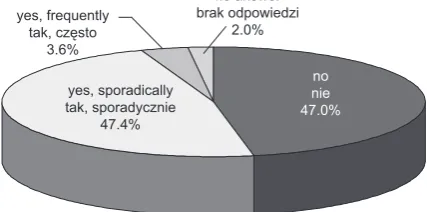
When asked whether nurses’ knowledge of contagious diseases and preparation for patient education on that subject is sufficient, 34.4% of the nurses surveyed responded that it is. Almost half of the nurses had never educated patients on that subject (Fig. 2). Only 18 individuals (3.6% of the
Table 1.Students’ contact with contagious patients at work
Tabela 1. Styczność studentów z zakaźnie chorymi w miejscu pracy
Responses
(Odpowiedzi) N %
Does not work
(Nie pracuje) 255 50.9 No contact at all
(W ogóle) 36 7.2 15.3 Sporadic contact
(Rzadko) 140 28.0 59.3 Frequent contact
(Często) 40 8.0 16.9 Very frequent contact
(Bardzo często) 20 4.0 8.5 No answer
(Brak odpowiedzi) 9 1.8
Fig. 1. Nurses’ contact with contagious patients at work Ryc. 1. Styczność pielęgniarek z chorobami zakaźnymi w miejscu pracy
Fig. 2. Nurses’ participation in educating patients regarding contagious diseases
Ryc. 2. Udział pielęgniarek w edukacji pacjentów na temat chorób zakaźnych
not at all w ogóle 11%
sporadically rzadko 67%
frequently często
14%
very frequently bardzo często
7%
no data brak danych
1%
no nie 47.0%
yes, frequently tak, często
3.6%
no answer brak odpowiedzi
2.0%
yes, sporadically tak, sporadycznie
nurses surveyed) stated that they had frequently provided that type of education. Usually those were individual discussions with patients (0.8%), intra-departmental training or discussions during routine procedures (0.6% each).
When asked what issues should be subjects of patient education, the most commonly men-tioned were: the prevention of contagious diseases (28.8%), theroutes by which infections are spread (14.6%), hygiene issues (12.2%), indications for vaccinations (3.6%), signs and symptoms of con-tagious diseases (2.4%), complications (2.2%) and therapeutic options (2%). In the opinion of 60.2% of the nurses surveyed, educational tasks should be carried out by epidemiological nurses. Just over one-third of the nurses stated that such tasks should be performed by all nurses, and one in four considered it the doctor’s job.
Another question was about students’ partici-pation in patient education regarding the occur-rence and prevention of contagious and parasitic diseases. Just over one-third of the students stated that they had participated in such education, the majority of them “sporadically”; almost 60% said they had never been involved (Figure 3).
The nurses’ self-evaluation of their knowledge of nosocomial infections was higher than in the case of contagious diseases. Almost half of them (45.4%) believe that their knowledge is sufficient. However, their activity in the field of providing in-formation about nosocomial infections to patients was as low as in case of contagious diseases. Only 48.4% had done it sporadically, 5.8% frequently and 45.4% never.
When asked what topics were fundamental in educating patients about nosocomial infections, among the topics that the nurses mentioned most frequently were: prophylaxis in the broad sense of the term (17.6%), the principles of hygiene (13.8%), the routes of infection (6.8%), behavior principles for the patients to follow during
hospi-talization (4.8%) and signs and symptoms of se-lected diseases, including AIDS, viral hepatitis and “dirty hands diseases” (1.6% each). The majority of the respondents stated that these educational tasks should be the responsibility of epidemiologi-cal nurses (58.6%); fewer stated that they should be performed by every nurse (33.2%) or by a doctor (23.6%).
The majority of students (63.4%) had never participated in patient education on the occur-rence and prevention of nosocomial infections, and 29% had participated sporadically (Fig. 4). Over half of the respondents stated believed that nursing students’ knowledge of nosocomial infec-tions was insufficient, and inadequate for patient education in that area.
Another question was whether nursing stu-dents’ knowledge is sufficient to educate patients regarding contagious and parasitic diseases. The students rated their knowledge of contagious dis-eases rather positively (42.2%), and only one in four (25%) believed that their knowledge was in-sufficient for patient education (Fig. 5).
Three-fourths of the nurses surveyed stated that they could provide examples of tropical dis-eases (75.2%); examples were actually provided by
Fig. 3. Students; participation in educating patients regarding contagious diseases
Ryc. 3. Udział studentów w edukacji pacjentów na temat chorób zakaźnych
no nie 59.%
yes, sporadically tak, sporadycznie
33.4% yes, frequently tak, często
5.2%
no answer brak odpowiedzi
2.2%
Fig. 5. Students’ knowledge of contagious diseases Ryc. 5. Wiedza studentów pielęgniarstwa na temat chorób zakaźnych
Is students’ knowledge of contagious diseases sufficient? Czy wiedza studentów na temat chorób zakaźnych jest wystarczająca?
yes tak 42.2%
no nie 25.2%
have no opinion nie wyrażam zdania
30.8%
no answer brak odpowiedzi
1.8%
Fig. 4. Students’ participation in educating patients regarding nosocomial infections
Ryc. 4. Udział studentów w edukacji pacjentów na temat zakażeń szpitalnych
no nie 63.4%
yes, sporadically tak, sporadycznie
29.2% yes, frequently
tak, często 5.0%
no answer brak odpowiedzi
72% of respondents. The diseases most often men-tioned were: malaria (61.4%), hemorrhagic fever (19.6%), typhoid fever (15.4%), cholera (14.8%), amoebiasis (12.6%), febra (11.4%), plague (9%) and leprosy (2.4%).
Almost three-fourths of the students could give an example of a tropical disease; most often they mentioned malaria (64%). Six individuals claimed to know examples of tropical diseases but gave none.
Over half of the surveyed nurses (53.6%) stated that they know prophylactic principles that should be applied before travelling to tropical countries; the one they mentioned most often was protective vaccination (53.2%).
Approximately half of the students surveyed (52.4%) stated that they know “some” prophylac-tic principles to follow before a trip to the tropics. Vaccinations were mentioned by 54% of them.
When asked what factors need to be consid-ered when making recommendations to a given individual who is planning to travel to a tropical country, 31.6% of the nurses provided answers: 9% mentioned the traveller’s general condition, 3% mentioned diseases known to be present in the given country and 2.8% mentioned the conditions likely to be encountered there (2.8%).
Only 33.8% of the nurses participating in the survey provided examples of actual recommenda-tions for travellers to follow en route to a tropical country; the ones most commonly mentioned were “sensible intake of food and beverages” (18.6%), “adequate hygiene” (7.6%), “appropriate cloth-ing” (1.6%), appropriate anti-insect agents (0.4%) and “thorough education on the possible dangers” (0.2%) (Table 2).
Among the students, 140 (28%) declared that they know prophylactic principles to follow before a trip to a tropical country, but only one in five (19.2%) were able to recall any (Table 3). A slightly
higher percentage of the students (20.4%) could provide recommendations to follow en route to a distant destination.
Awareness of recommended principles for the duration of a stay in the tropics was declared by 32% of the students surveyed, but only 28.6% of them provided examples; 22% mentioned caution regarding food and drink, and 5% mentioned ad-equate hygiene.
A relatively high percentage of the students (37.2%) could provide examples of principles to follow after coming back from the tropics. The most commonly mentioned principle (19%) was “doing basic laboratory tests”.
Among nurses, knowledge of recommenda-tions for the duration of a stay in the tropics was
Table 2. Nurses’ knowledge of recommendations to follow en route to a tropical country
Tabela 2. Znajomość zaleceń na czas podróży do krajów tropikalnych zgłaszanych przez pielęgniarki
Knowledge of recommendations to follow en route
(Znajomość zaleceń na czas podróży)
N %
Yes
(Tak) 169 (148) 33.8 (29.6) No
(Nie) 325 (346) 65.0 (69.2) No answer
(Brak odpowiedzi) 6 1.2%
Table 3. Students’ knowledge of prophylactic principles to follow before travelling to tropical countries
Tabela 3. Znajomość zasad profilaktyki przy wyjeździe do krajów tropikalnych zgłaszanych przez studentów pielę-gniarstwa
Knowledge of prophylactic prin-ciples to follow before travelling to tropical countries
(Znajomość zasad profilaktyki przy wyjeździe)
N %
Yes
(Tak) 140 (96) 28.0 (19.2) No
(Nie) 354 (398) 70.8 (78.6) No answer
(Brak odpowiedzi) 6 1.2 En-route recommendations
mentioned
(Wymieniane zalecenia na czas podróży)
N %
Sensible intake of food and bev-erages
(Uważanie na pokarmy, napoje) 93 18.6 Adequate hygiene
(Higiena) 38 7.6
Appropriate clothing
(Odpowiednie ubrania) 8 1.6 Travelling with essential drugs/
first-aid kit
(Niezbędne leki, apteczka) 6 1.2 Using appropriate anti-insect
agents
(Środki przeciw insektowe) 2 0.4 Thorough education on the
pos-sible dangers
(Wszechstronna edukacja na temat zagrożeń)
declared by 36.2%; their specific suggestions in-cluded caution regarding food and water (23%), adequate hygiene (5%), the use of protective cloth-ing (1.2%), prevention of bites and injuries (1%), taking appropriate drugs (0.6%) and choosing to stay only in places with high standards (0.4%).
Almost 40% of the nurses surveyed nurses could provide examples of recommendations for a person who had returned from a tropical coun-try. Those included: basic laboratory tests (16.6%), self-observation (12.6%), reporting to a special-ist for tests (3.6%), quarantine (2.6%) or a visit to a GP (0.2%).
Only 20% of the nurses stated that travel to tropical countries is popular, and 17.1% of them reported feeling they have insufficient information on issues related to travel to the tropics.One in six nurses (15.8%) stated that they would be inter-ested in undergoing practical training in a tropical country (Table 4). Only 9.2% of the nurses were interested in improving their qualifications in the area of tropical diseases.
Among the students surveyed, 62% expressed an interest in extra education in the area of tropi-cal medicine. It is notable that 28.5% of the indi-viduals interested in improving their knowledge wanted to do so in order to “broaden their knowl-edge”; another 15% gave “the popularity of travel to tropical countries” as the reason, and 10% stated that the knowledge would be useful for “providing information to travellers to tropical countries”.
The students’ interest in travel to a tropical country for practical training was rather high: Af-firmative answers were given by 219 individuals (43.8%), most of whom stated that the main rea-son was the possibility of broadening their medical knowledge (Table 5).
The majority of nursing students (65%) felt that education about tropical medicine is neces-sary for nurses nowadays (Fig. 6). The most com-mon reasons given for that opinion were that an “increasing number of people travel to the tropics” (10%) and that “a nurse has to be comprehensively educated” (9%) (Table 6).
Only a small percentage of professionally ac-tive nurses had been involved with educating pa-tients about tropical medicine for papa-tients (9.6%), and in most cases that involvement was sporadic (Table 7).
The majority of the nurses surveyed could not suggest any issues in that field that should be included in an educational program for healthy people. One person in five (17.6%) mentioned prophylactic principles as a potential subject.
In the opinion of the majority of the nurses surveyed, educating patients about tropical diseas-es should be the rdiseas-esponsibility of epidemiological
Table 4. Nurses’ interest in practical training in a tropical country
Tabela 4. Zainteresowanie pielęgniarek wyjazdem na praktykę do krajów tropikalnych
Nurses’ interest in practical training
in a tropical country (Zainteresowanie pielęgniarek wyjazdem na praktykę do krajów tropikal-nych)
N %
Yes
(Tak) 79 15.8
Useful experience
(Przydatne doświadczenie) 18 3.6 22.8 Urge to travel
(Ciekawość świata) 18 3.6 22.8 Good way to acquire
practi-cal knowledge
(Dobry sposób na zdobycie praktycznej wiedzy)
9 1.8 11.4
No reason given
(Nie podano uzasadnienia ) 34 6.8 43.0 No
(Nie) 246 49.2%
It’s dangerous
(Jest to niebezpieczne) 21 4.2 8.5 Family-related issues
(Ze względu na rodzinę) 14 2.8 5.7 Climate-related issues
(Ciężki klimat) 10 2.0 4.1 Age-related issues
(Ze względu na wiek) 6 1.2 2.4 I’m not interested in tropical
medicine
(Nie interesuje mnie ta tematyka)
4 0.8 1.6
I want practical training in Poland
(Chciałabym je odbyć w Polsce)
1 0.2 0.4
language barrier
(Brak znajomości języka) 1 0.2 0.4 Danger of tropical diseases
(Zagrożenie chorobami tropikalnymi)
1 0.2 0.4
No reason given
(Nie podano uzasadnienia) 188 37.6 76.4 I don’t know
(Nie wiem) 168 33.6 No answer
nurses (59%); a smaller percentage felt it should be the doctor’s responsibility (28%), or any nurse’s (19.4%).
Over half of the nurses (53%) statedthat in-service education in tropical medicine is needed for nurses(Fig. 7) and that they themselves have insufficient knowledge in that field (25.6%).
The majority of the nurses surveyed (84.4%) listed the Internet as a source of knowledge of tropical medicine. Other sources of information mentioned were training courses (28%), books and magazines (15.8%), intra-hospital training programs (15.6%) and special courses (12.8%).
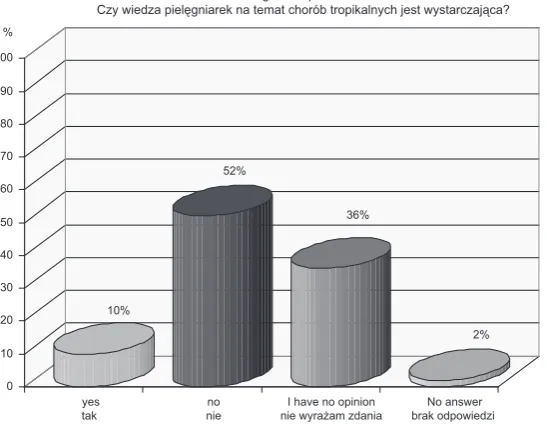
The survey indicated that the vast majority of students (90%) had not participated in any pa-tient education in tropical medicine. According to students (52%), nurses’ knowledge of tropical dis-eases is insufficient (Figure 8) and does not permit nurses to educate patients in that area.
Among the issues associated with tropical medicine that students would like to learn about
during their education and which should be a ba-sic subject in patient education, the one most fre-quently mentioned was prophylaxis (29%). In the opinion of half of the students (50%), patient education in this area should be dealt with by epi-demiological nurses; smaller percentages said it should be done by any nurse (37%) or by doctors (27%).
Just over one quarter of the surveyed students (28%) stated that their studies included “any” in-formation concerning tropical diseases, in the fol-lowing courses: parasitology (11%), epidemiology (7%), contagious diseases (2%) and hygiene and epidemiology (2%). Only a small percentage of the students (6.8%) believed that the information pro-vided during the course of their studies was suf-ficient. The participating students suggested that additional information on tropical diseases could be provided as a part of the existing epidemiology curriculum, or by establishing a new program in tropical medicine.
Table 5. Nursing students’ interest in practical training in a tropical country
Tabela 5. Zainteresowanie studentów pielęgniarstwa wyjazdem na praktykę do krajów tropikalnych
Nursing students’ interest in practical training in a tropical country
(Zainteresowanie studentów pielęgniarstwa wyjazdem na praktykę do krajów tropikalnych) N % Yes
(Tak)
(N = 219; 43.8%)
good way to acquire practical knowledge
(sposób na zdobycie praktycznej wiedzy) 66 13.2 30.1 useful experience
(przydatne doświadczenie) 36 7.2 16.4 urge to travel
(poznanie świata) 17 3.4 7.8
very interesting
(bardzo interesujące) 7 1.4 3.2 to help the people living there
(aby pomóc żyjącym tam ludziom) 1 0.2 0.5 No
(Nie)
(N = 132; 26.4%)
it’s dangerous
(jest to niebezpieczne) 18 3.6 13.6% climate-related issues
(ciężki klimat) 7 1.4 5.3
family-related issues
(ze względu na rodzinę ) 7 1.4 5.3 I want practical training in Poland
(chciałabym je odbyć w Polsce) 3 0.6 2.3 too little knowledge of tropical diseases and their
treatment
(mała wiedza o tych chorobach, leczeniu)
1 0.2 0.8
I don’t know
(Nie wiem) 143 28.6
No answer
Table 6. Students’ opinions on the importance of education about tropical medicine
Tabela 6. Opinie studentów na temat zasadności kształcenia z zakresu medycyny tropikalnej
Responses
(Odpowiedzi) N %
More and more people are travelling to tropical countries
(Coraz więcej ludzi wyjeżdża do tropików) 52 10.4 A nurse has to be comprehensively educated
(Pielęgniarka musi być wszechstronnie wykształcona) 46 9.2 I may encounter a patient with that type of disease in my ward
(Mogę zetknąć się z tak chorą osobą na oddziale) 13 2.6 It should be offered for those with a particular interest
(Ale dla osób zainteresowanych) 9 1.8 It may be useful in the future
(Może się przydać w przyszłości) 7 1.4 There are many people from tropical countries in Poland
(W Polsce jest wiele osób z tropików) 6 1.2 It should be offered, but only on a general level
(Ale tylko ogólnie) 5 1.0
No reason given
(Brak uzasadnienia swojego poglądu) 362 72.4
Fig. 6. Students’ opinions on the importance of educa-tion about tropical medicine
Ryc. 6. Opinie studentów na temat kształcenia z zakre-su medycyny tropikalnej
Is education regarding tropical medicine necessary? Czy kształcenie z zakresu medycyny tropikalnej jest konieczne?
yes tak 65%
no nie 4%
don't know nie wiem
29%
no answer brak odpowiedzi
2%
Fig. 7. Nurses’ opinions on the need for in-service edu-cation in tropical medicine
Ryc. 7. Opinie pielęgniarek na temat dokształcenia z zakresu medycyny tropikalnej
Do nurses need in-service education in tropical medicine? Czy dokształcenie z zakresu medycyny tropikalnej jest potrzebne?
don't know nie wiem
38%
yes tak 53%
no nie 8%
no answer brak odpowiedzi
1%
Discussion
Polish citizens are travelling more and more often to tropical countries. The extensive offers of travel agents, professional contacts, personal in-terests and the urge to travel to exotic places lead thousands of tourists to visit African, Middle East-ern and Far EastEast-ern countries [14].
At the beginning of the 20th century the opin-ion was formulated that it is possible to completely eliminate contagious diseases. That was supposed to be due to increasing progress in all fields, the improvement of sanitary conditions, the
develop-ment of protective vaccinations and the synthesis of new antimicrobial agents [6].
The share of contagious diseases in the global disease load (including perinatal diseases and mal-nutrition) is estimated at approximately 39% [15, 16]. Current statistical data indicate that conta-gious diseases remain the main cause of death of newborns worldwide (approximately 17 million deaths a year), especially in poor and developing countries [16].
diseases in their everyday work is disturbing, that under half of the nurses knew what could cause an epidemic outbreak in Poland, and that only 25% of those surveyed could give a correct definition of a sanitary cordon (although the term “quarantine” caused fewer problems); in the case of students, on-ly 15.6% could give a correct definition of a sanitary cordon, and 62.4% of “quarantine”. That could in-dicate a lack of basic knowledge of epidemiology.
Increasing globalization means an increase in migration and travel. The number of people who temporarily change their place of residence increased from 25 million worldwide in 1950 to an estimated one billion by 2010 [18]. Factors in-volved in the distribution, clinical presentation and spreading of contagious diseases, including tropical ones, are the geographic and climatic location of a country; its political and economic 10%
52%
36%
2%
0 10 20 30 40 50 60 70 80 90 100
yes
tak nieno nie wyrażam zdaniaI have no opinion brak odpowiedzi No answer
Is nurses' knowledge of tropical diseases sufficient? Czy wiedza pielęgniarek na temat chorób tropikalnych jest wystarczająca?
%
Fig. 8. Students’ opinions regarding nurses’ knowledge of tropical diseases
Ryc. 8. Wiedza pielęgniarek na temat chorób tropikalnych w opinii studentów
Table 7. Nurses’ participation in teaching patients about tropical medicine
Tabela 7. Udział pielęgniarek w szkoleniach dla pacjentów z zakresu medycyny tropikalnej
Participation in teaching patients about tropical medicine
(Udział w szkoleniach dla pacjentów z zakresu medycyny tropikalnej)
N %
No
(Nie) 438 87.6
I am not prepared
(Nie posiadam przygotowania) 41 8.2 9.4 No time
(Brak czasu) 8 1.6 1.8
The need hasn’t arisen
(Nie było takiej potrzeby) 119 23.8 27.2 No such program for patients has been offered
(Nie było takiego szkolenia) 35 7.0 8.0 No reason given
(Nie podano uzasadnienia) 235 47.0 53.7 Yes, sporadically
(Tak, sporadycznie) 48 9.6 Yes, frequently
(Tak, często) 2 0.4
No answer
situation; the organization and financing of the healthcare system; increasing population, includ-ing the overpopulation of cities; sanitary condi-tions, including access to fresh water, removal of waste, local cultural customs and behavior; stand-ards of sexual behavior; and the presence of drug addiction, alcoholism and crime [6]. For travellers to tropical countries, all those factors, combined with poor travel conditions within the country it-self, changes in food quality and eating habits, high temperature, high humidity, excessive physical ex-ercise in a hot and humid climate, and a lack of knowledge of numerous risk factors can constitute serious health threats [18].
Travel to tropical countries should be carefully considered and planned, and prophylactic recom-mendations should take into account the traveller’s age and health, the particular region and environ-ment, the climatic conditions during the given sea-son of the year, the conditions of the stay (hotel, tent, access to fresh water, etc.) and possible local risk factors, which are often difficult to foresee. It is necessary to have appropriate clothes and shoes for the climate and to protect against dangerous insects (particularly mosquitoes), arachnids and/ or other animals [19, 20].
It must be borne in mind that the equatorial climate can be very taxing for Europeans, partic-ularly for those who easily overheat and/or have insufficient respiration, for example obese individ-uals [21].Unfortunately, decisions to travel to dis-tant countries are often made impulsively, guided by advertisements, “last minute” offers, and usu-ally without appropriate medical preparation or knowledge of local health-related threats, evenby elderly people, patients with chronic respiratory or circulatory conditions, pregnant women and par-ents with young children [22].
For all of these reasons, there is an increasing need for a broader knowledge of tropical diseases and prophylaxis among medical personnel, includ-ing nurses. Therefore, addinclud-ing courses on
tropi-cal medicine to the curriculum in Polish nursing schools, and introducing post-diploma training in tropical diseases for nurses seems justified [23].
In the current study, approximately 17% of the nurses suggested that professional sources and mass media contain insufficient information on issues associated with tropical diseases. That is consistent with observations made by Buczyński et al., who noted that published reports about the epidemiology of diseases and injuries occurring in the Middle East are very scarce and of a general nature, both in world literature and in publications available in that region [12].
Castelli et al. showed that over 70 million peo-ple from industrialized countries travel to tropical countries every year and that over 50% of them suffer from various types of infections, from a mild diarrhea to severe forms of malaria [24]. Studies by other authors confirm a clear correlation between increased morbidity from parasitic diseases in hot climates and negligence of basic principles of hy-giene and prophylactics aimed at reducing the risk of getting sick [25]. It has also been demonstrated that parasitic diseases predominate among tropi-cal diseases; mortality from them is estimated at approximately 2.5 to 3 million a year [25]. Unfor-tunately, the level of knowledge of the risks en-countered in tropical countries is very low among travellers [26, 27]. The current study demonstrated that over half of the surveyed nurses and nursing students feel that extra education in tropical medi-cine is necessary, for they do not have adequate knowledge to offer patients much-needed educa-tion in that area.
The authors concluded that Polish nurses and nursing students have insufficient knowledge of contagious and tropical diseases and are interested in broadening their knowledge in these areas. Ex-panding nursing school curricula and introducing post-diploma training to provide education on tropical medicine in faculties seems necessary and justified.
References
[1] Paul M, Stefaniak J, Waśniowski A: Tropikalne choroby skóry u pacjentów podróżujących do Afryki Równikowej i Azji. Post Dermatol Alergol 2007, 24, 16–25.
[2] Waśniowski A, Rehlis N: Tropikalne muszyce skóry u pacjentów powracających z krajów o odmiennych warun-kach klimatycznych – opisy przypadków. Post Dermatol Alergol 2006, 23, 116–123.
[3] Barnett ED, MacPherson DW, Stauffer WM, Loutan L, Hatz CF, Matteelli A, Behrens RH: The Visiting Friends or Relatives Traveler in the 21st Century: Time for a New Definition. J Travel Med 2010, 17, 163–170.
[4] Van Geertruyden JP: Infectious diseases. Institute of Tropical Medicine, Antwerp 2008, 3–7.
[5] Fosi-Mbantenkhu J: Malaria. Eradicating the Scourge. From the African Grassroot Perspective. Kricona Publishers, Owerri 2010, 20–24.
[6] Simon K: Wczesne wykrywanie i leczenie oraz profilaktyka chorób tropikalnych. Przew lek 2008, 1, 250–254. [7] Colebunders R, Lynen L, Van den Enden E: Tropische Ziektenleer. Instituut voor Tropische Geneeskunde,
Antwerpen 2004, 116–127.
[9] Baggett HC, Graham S, Kozarsky PE, Gallagher N, Blumensaadt S, Bateman J, Edelson PJ, Arguin PM, Steele S, Russell M, Reed C: Pretravel Health Preparation Among US Residents Traveling to India to VFRs: Importance of Ethnicity in Defining VFRs. J Travel Med 2009, 16, 112–118.
[10] Behrens RH, Stauffer WM, Barnett ED, Loutan L, Hatz CF, Matteelli A, MacPherson DW: Travel Case Scenarios as a Demonstration of Risk Assessment of VFR Travelers: Introduction to Criteria and Evidence-Based Definition and Framework. J Travel Med 2010, 17, 153–162.
[11] LaRocque RC, Rao SR, Tsibris A, Lawton T, Barry AM, Marano N, Brunette G, Yanni E, Ryan ET: Pre-travel Health Advice-Seeking Behavior Among US International Travelers Departing From Boston logan International Airport. J Travel Med 2010, 17, 387–391.
[12] Buczyński A, Korzeniewski K, Bzdęga I, Jerominko A: Analiza epidemiologiczna występowania chorób paso-żytniczych u osób leczonych w szpitalu tymczasowych sił zbrojnych ONZ w libanie w latach 1993–2000. Przegl Epidemiol 2004, 58, 303–312.
[13] Akinsola HY: Behavioural Science for Nurses. Bay Publishing, Orita-Challenge, Ibadan, Oyo State 2002, 25–26. [14] Kacprzak E: Zagrożenia związane z podróżami do krajów tropikalnych. Kosmos 2005, 54, 115–122.
[15] Young H, Jaspars S: Nutrition, Disease and Death in Times of Famine. Disasters 2007, 19, 94–109. [16] Hammami N: Pediatrie. Instituut voor Tropische Geneeskunde, Antwerpen 2008, 10–35.
[17] Juckett G: Travel medicine 2005. W V Med J 2004, 100, 222–225.
[18] Provost S, Soto JC: Perception and Knowledge about Some Infectious Diseases among Travelers from Québec, Canada. J Travel Med 2002, 9, 184–189.
[19] Hill DR: Health problems in a large cohort of Americans traveling to developing countries. J Travel Med 2000, 7, 259–266.
[20] Christenson JC: Preparing families with children traveling to developing countries. Pediatr Ann 2008, 37, 806–813. [21] Rack J, Wichmann O, Kamara B, Günther M, Cramer J, Schönfeld C, Henning T, Schwarz U, Mühlen M,
Weitzel T, Friedrich-Jänicke B, Foroutan B, Jelinek T: Risk and Spectrum of Diseases in Travelers to Popular Tourist Destinations. J Travel Med 2005, 12, 248–253.
[22] Stauffer W, Christenson JC, Fischer PR: Preparing children for international travel. Travel Med Infect Dis 2008, 6, 101–113.
[23] Van Damme-Ostapowicz K, Krajewska-Kułak E, Olszański R, Nahorski W, Korzeniewski K: Propozycja wpro-wadzenia przedmiotu nauczania: Medycyna tropikalna i pielęgniarstwo w medycynie tropikalnej na studiach II stopnia, kierunek pielęgniarstwo. Pielęgniarstwo XXI wieku 2010, 1–2, 75–79.
[24] Castelli F, Capone S, Pedruzzi B, Matteelli A: Antimicrobial prevention and therapy for travelers’ infection. Expert Rev Anti Infect Ther 2007, 5, 1031–1048.
[25] Falase AO: An Introduction to Clinical Diagnosis in the Tropics. Spectrum Books limited, Ibadan Abuja Benin City Combe lagos Owerri Zaria 2007, 225–233.
[26] MacDougall LA, Gyorkos TW, Leffondré K, Abrahamowicz M, Tessier D, Ward BJ, MacLean JD: Increasing Referral of At-Risk Travelers to Travel Health Clinics: Evaluation of a Health Promotion Intervention Targeted to Travel Agents. J Travel Med 2001, 8, 232–242.
[27] Provost S, Soto JC: Predictors of Pretravel Consultation in Tourists from Quebec (Canada). J Travel Med 2001, 8, 66–75.
Address for correspondence:
Katarzyna Van Damme-Ostapowicz Department of Integrated Medical Care Medical University
M. Curie-Skłodowskiej 7a 15-096 Białystok
Poland
Tel./fax: +48 85 748 55 28
E-mail: [email protected]
Conflict of interest: None declared