The Journal of Threatened Taxa (JoTT) is dedicated to building evidence for conservation globally by publishing peer-reviewed articles online every month at a reasonably rapid rate at www.threatenedtaxa.org. All articles published in JoTT are registered under Creative Commons Attribution 4.0 International License unless otherwise mentioned. JoTT allows allows unrestricted use, reproduction, and distribution of articles in any medium by providing adequate credit to the author(s) and the source of publication.
www.threatenedtaxa.org
ISSN 0974-7907 (Online) | ISSN 0974-7893 (Print)
Building evidence for conservation globally
Journal of Threatened Taxa
For Focus, Scope, Aims, Policies, and Guidelines visit https://threatenedtaxa.org/index.php/JoTT/about/editorialPolicies#custom-0
For Article Submission Guidelines, visit https://threatenedtaxa.org/index.php/JoTT/about/submissions#onlineSubmissions
For Policies against Scientific Misconduct, visit https://threatenedtaxa.org/index.php/JoTT/about/editorialPolicies#custom-2
For reprints, contact <[email protected]>
Communication
Barilius torsai (Teleostei: Cypriniformes: Cyprinidae), a new
freshwater fish from the Brahmaputra drainage, India
Kavita Kumari, Manas Hoshalli Munivenkatappa, Archana Sinha, Simanku Borah & Basanta Kumar Das
26 November 2019 | Vol. 11 | No. 14 | Pages: 14808–14815 DOI: 10.11609/jott.4746.11.14.14808-14815
Partner
Member
Threatened Taxa
Publisher & Host
PLATINUM OPEN ACCESS
Communica
tion
DOI:https://doi.org/10.11609/jott.4746.11.14.14808-14815 | ZooBank: urn:lsid:zoobank.org:pub:591E7FA3-82AC-48DE-B249-F09BBC477BE2
Editor:Rajeev Raghavan, Kerala University of Fisheries and Ocean studies (KUFOS), Cochin, India. Date of publication: 26 November 2019 (online & print)
Manuscript details: #4746 | Received 05 December 2018 | Final received 09 September 2019 | Finally accepted 12 November 2019
Citation:Kumari, K., M.H. Munivenkatappa, A. Sinha, S. Borah & B.K. Das (2019). Barilius torsai (Teleostei: Cypriniformes: Cyprinidae), a new freshwater fish from the Brahmaputra drainage, India. Journal of Threatened Taxa 11(14): 14808–14815. https://doi.org/10.11609/jott.4746.11.14.14808-14815
Copyright: © Kumari et al. 2019. Creative Commons Attribution 4.0 International License. JoTT allows unrestricted use, reproduction, and distribution of this article in any medium by adequate credit to the author(s) and the source of publication.
Funding: Indian Council of Agricultural Research under the Project-REF/ER/12/01/02.
Competing interests:The authors declare no competing interests.
Author details: Kavita Kumari is scientist, Fish Genetics and Breeding at ICAR-CIFRI, Barrackpore and working on taxonomy, systematics and stock characterisation of fish along with assessment of ecosystem health using molecular tools. Manas Hoshalli Munivenkatappa is scientist at ICAR-CMFRI and working on marine fisheries management, stock assessment, fish biology and Fisheries policy. Archana Sinha is Principal scientist at ICAR-CIFRI and working on various aspects of small indigenous fish culture and conservation. Simanku Borah is scientist at ICAR-CIFRI Regional Centre, Guwahati and working in the field of Fishery Biology. He is also involved in research related to ecology and habitat characterization of rivers and wetlands. Basanta Kumar Das is Director, ICAR-CIFRI, Barrackpore and working on the aspects of Inland Fisheries Management.
Author contribution: KK—collected and analyzed specimens, examined the museum specimens, wrote final version of manuscript. MHM— analyzed specimens and
helped in the manuscript preparation. AS—supervised study, helped in the revision of the manuscript, SB—examined the museum specimens, helped in revision of the manuscript. BKD—supervised study, helped in the revision of the manuscript.
Acknowledgements: The authors are very grateful to Prof. A. P. Sharma, Former Director, ICAR-CIFRI and Dr. V. R. Suresh, Head of Division, Riverine Ecology and Fisheries for providing facilities for the work. We also thank Director, ZSI, Kolkata, Dr. L. Kosygin Singh, In-charge Freshwater Fish Section, Indian Museum, ZSI, Kolkata, Dr. Bikramjit Sinha, Officer-in-Charge, ZSI, Arunachal Pradesh, Dr. W. Vishwanath Singh, Professor, Department of Life Science, Manipur University and Dr Rameshori Yumnam, Assistant Professor, Department of Life Science, Manipur University for necessary permission and help to examine comparative material. The authors also acknowledge Dr. M.K. Mukhopadhyay retired scientist, ICAR-CIFRI for his guidance for the study.
Barilius torsai (Teleostei: Cypriniformes: Cyprinidae),
a new freshwater fish from the Brahmaputra drainage, India
Kavita Kumari 1 , Manas Hoshalli Munivenkatappa 2 , Archana Sinha 3 , Simanku Borah 4 & Basanta Kumar Das 5
1,2,3,5 ICAR-Central Inland Fisheries Research Institute, Monirampur (Post), Barrackpore, Kolkata, West Bengal 700120,
India.
2 ICAR-Central Marine Fisheries Research Institute Regional Centre, Andhra University (Post), Opposite SBI Kohinoor
Branch, Vishakapatnam, Andhra Pradesh 530003, India. 4 ICAR-CIFRI Centre, HOUSEFEED Complex, Dispur (Last gate), Guwahati, Assam 781006, India. 1 [email protected], 2 [email protected], 3 [email protected],
4 [email protected] (corresponding author), 5 [email protected]
Abstract: Barilius torsai is described from the Torsa, a tributary of Brahmaputra River system in West Bengal, India. The new species is distinguished from all its congeners by the presence of a complete lateral line with 52–53 scales, 29 pre-dorsal scales, pectoral fin notched, two well-developed pairs of barbels (rostral and maxillary), length of rostral barbel slightly larger than maxillary, which reaches the orbit. Tubercles on snout and lower jaw absent, 9–11 blue vertical bars along the body, dorsal fin hyaline with dark pigment concentrated along lower two-third of the dorsal-fin rays.
Keywords:Chedrini, Danioninae, taxonomy, Torsa, West Bengal.
ISSN 0974-7907 (Online) ISSN 0974-7893 (Print)
PLATINUM OPEN ACCESS
Barilius torsai - new species from Brahmaputra Kumari et al.
Journal of Threatened Taxa | www.threatenedtaxa.org | 26 November 2019 | 11(14): 14808–14815 14809
INTRODUCTION
Fishes of the genus Barilius Hamilton (Cyprinidae:Danioninae: Chedrini) are one of the dominant small-sized fishes occurring in hill streams and upland rivers throughout India, Bangladesh, Myanmar, Nepal, Sri Lanka, China, Iraq, and Thailand (Selim & Vishwanath 2002; Jayram 2010; Tejavej 2012; Qin et al. 2019). Barilius was erected as a subgenus
of Cyprinus with Cyprinus barila Hamilton, as the type (Qin et al. 2019). Howes (1980) identified two groups within Barilius (sensu lato), corresponding to the genera
Barilius and Opsarius (Rainboth 1991). These bariliine fishes are characterised by their relatively elongate, compressed bodies with round belly, vertical bars on the flanks, 9–17 anal-fin rays and sub-laterally placed lateral line (Hamilton 1822; Howes 1980; Talwar & Jhingran 1991; Tejavej 2012). Of the 36 valid species of bariliine fishes, 24 have been recorded in India (Fricke et al. 2019; Qin et al. 2019). Currently, most bariliine fishes, including all southeastern Asian species are assigned to
the genus Opsarius (Howes 1983; Rainboth 1991; Qin et al. 2019) and the genus Barilius is restricted to five species characterized by an extremely shallow body:
B. barila (Hamilton, 1822), B. evezardi Day, 1872, B. modestus Day, 1872 and B. vagra (Hamilton, 1822) from India, and B. mesopotamicus Berg, 1932 from the Tigris-Euphrates basin, based on the diagnosis of Barilius sensu
by Howes (1980), as well as morphological (Howes 1980; 1983) and molecular phylogenetic evidence (Tang et al. 2010; Liao et al. 2011; Qin et al. 2019).
During an ichthyological survey in the Torsa, a tributary of the Brahmaputra River during July and November 2015, a total of 83 individuals of a Barilius
species were caught by cast net of mesh size 15–20 mm at Jaldapara, Alipurduar District, West Bengal, India. Examination of the collected specimens in July 2015 and detailed re-examination in November 2015 following standard literature (Jayaram 2010; Arunkumar & Singh 2000; Nath et al. 2010; Dishma & Vishwanath 2012; Knight et al. 2015) revealed that 11 of the 83 specimens could not be assigned to any of the known species. The new species is described herein as Barilius torsai.
MATERIALS AND METHODS
Measurements were made with digital caliper with an accuracy of 0.1mm. Counts and measurements were made on the left side of the specimens wherever possible and based on standard methodsfollowing Dishma
& Vishwanath (2012). Colour pattern was recorded from fresh and preserved (10% formalin) specimens. Voucher specimens are deposited in the Museum of the Zoological Survey of India (ZSI), Kolkata and at the ICAR-Central Inland Fisheries Research Institute (CIFRI), Barrackpore.
Barilius torsai sp. nov. (Image 1)
urn:lsid:zoobank.org:act:79FEC835-A4FA-4D27-8EC1-2EDD65616A31
Type material
Holotype: ZSI FF5542, 12.xi.2015, 26.7290N & 89.3250E, 71.41mm SL, Torsa River, Jaldapara, Alipurduar District, West Bengal, India, coll. A. Roy Chaudhary.
Paratype: ZSI FF5543, 26.vii.2015, 26.7290N & 89.3250E, 74.56mm SL, data same as for holotype, coll. A. Mitra; CIFRI F10003-10010, 8 ex., 26.vii.2015, 71.46– 74.23 mm SL, data same as for holotype, coll. A. Mitra; CIFRI F10011, 12.xi.2015, 71.46mm SL, data same as for holotype, coll. A. Roy Chaudhary.
Diagnosis
Barilius torsai is distinguished from all other species
of Barilius by a combination of the following characters: lateral line complete with 52–53 scales, 29 pre-dorsal scales, pectoral fin notched, two well-developed pairs of barbels (rostral and maxillary), body with 9–11 blue vertical bars, dorsal fin hyaline with dark pigment concentrated along lower 2/3rd of dorsal-fin rays.
Description
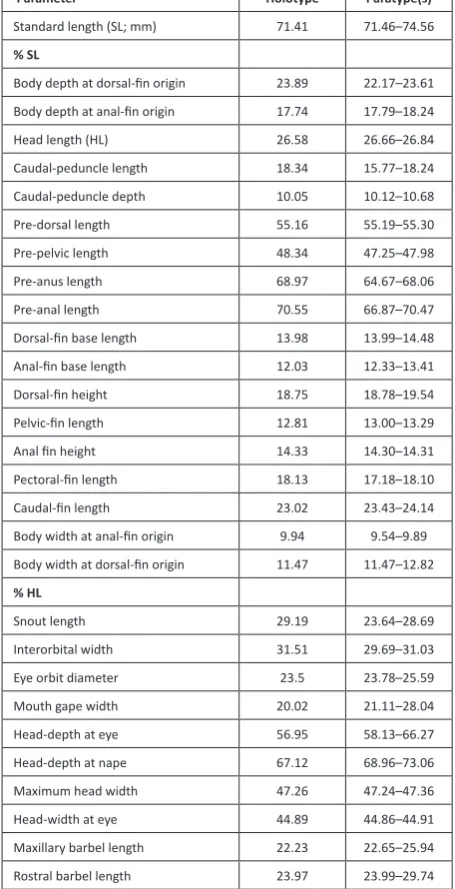
See Table 1 and Supplementary 1 for morphometric characters and image 1 for general appearance. Body shallow, its depth about one-fourth standard length (SL), laterally compressed with ventral profile more convex than the dorsal profile. Caudal peduncle long, narrower near the caudal base. Head small and compressed, length about one-fourth SL, snout slightly blunt. Mouth oblique, angle of gape not reaching vertical from the anterior margin of the orbit. No symphysial process in the lower jaw. Eyes large, situated in the anterior half of the head, diameter about one-fourth head length (HL). Nostrils closer to anterior margin of eye than the snout tip. Two pairs of well-developed barbels (rostral and maxillary), length of rostral barbel slightly larger than maxillary, which reaches the orbit. Tubercles on snout and lower jaw absent.
Figure 1. Type localty of Barilius torsai sp. nov.indicated in red.
with two simple and 11 branched rays, not reaching the pelvic-fin base, notched after third (between third and sixth ray). Pelvic fin with two simple and seven branched rays, its origin closer to the anal-fin than pectoral-fin origin, posterior tip not reaching anus/anal fin origin, muscular pad at base present. Anal fin with two simple and eight branched rays, its origin just below base of the last dorsal fin ray. Caudal fin deeply forked, lobes equal, with 17 principal rays. Scales cycloid and small. Lateral line complete, slightly curved, running along lower half of the body and passing almost through middle of the caudal base, with 52–53 scales in the lateral-line row up to the end of the caudal base. Scales in transverse line
on body 11/1/5between dorsal fin origin and pelvic fin base. 29 pre-dorsal scales.
Colour
Barilius torsai - new species from Brahmaputra Kumari et al.
Journal of Threatened Taxa | www.threatenedtaxa.org | 26 November 2019 | 11(14): 14808–14815 14811
Etymology
The specific name refers to theTorsa, type locality of the species, and a tributary of the Brahmaputra River System. An adjective.
Distribution
Presently known only from the Torsa River in West Bengal, India (Figure 1, Image 2).
DISCUSSION
Fifteen species of bariliine fish are found in the Brahmaputra basin, and the larger northeastern Indian region. They are Barilius vagra (Hamilton, 1822);
B. barila (Hamilton, 1822); Opsarius arunachalensis
(Nath et al., 2010); O. bendelisis (Hamilton, 1807); O.
howesi (Barman, 1986); O. lairokensis (Arunkumar & T. Singh, 2000); O. profundus (Mayanglambam & Vishwanath, 2012); O. radiolatus (Gunther, 1868); O.
Shacra (Hamilton, 1822); O. barna (Hamilton, 1822); O. chatricensis (Selim & Vishwanath, 2002); O. dimorphicus
(Tilak & Husain, 1990); O. dogarsinghi (Hora, 1921); O. ngawa (Vishwanath & Manojkumar, 2002),and O. tileo
(Hamilton, 1822). Barilius torsai sp. nov. is a member
of Barilius. It can be distinguished from members of
Opsarius sensu Howes (1980; 1983) in having a shallow body (vs. deep), two pairs of barbels (vs. a single pair or absent), elongated pelvic axial scales (vs. lobate or fleshy), and absence of parallel rows of tubercles on the dentary (vs. presence). Barilius torsai can be distinguished from all other congeners by the presence of notched pectoral fin, and from its northeastern Indian congeners by the presence of a complete lateral line with 52–53 scales, greater number of pre-dorsal scales and
Image 1. Holotype of Barilius torsai sp. nov. (ZSI FF5542; 71.41mm SL): A—lateral view | B—dorsal view. © Sujit Choudhury, ICAR-CIFRI,
Barrackpore.
Image 2. Torsa River, Jaldapara, West Bengal, habitat of Barilius torsai
hyaline dorsal fin with dark pigment concentrated along lower two-third of the dorsal-fin rays and lesser body depth at dorsal-fin origin except B. barila, O. shacra,
O. bendelisis, O. chatricensis (Table 2). Bariliustorsai
further differs from species of B. vagra and B. barila in
having greater number of predorsal scales (29 vs. 21–22
in B. vagra and 22 in B. barila), lateral line scales (52–53
vs. 40–45 in B. vagra and B. barila) and lesser number of branched pectoral fin rays (11 vs. 14–15 in B. vagra and
12 in B. barila).
In comparison to the species currently included within Opsarius sensu Howes (1980; 1983) Barilius torsai
is similar to O. shacra and O. arunachalensis in its dorsal
Table 1. Morphometric data of Barilius torsai sp. nov.
Parameter Holotype Paratype(s)
Standard length (SL; mm) 71.41 71.46–74.56 % SL
Body depth at dorsal-fin origin 23.89 22.17–23.61 Body depth at anal-fin origin 17.74 17.79–18.24
Head length (HL) 26.58 26.66–26.84
Caudal-peduncle length 18.34 15.77–18.24 Caudal-peduncle depth 10.05 10.12–10.68
Pre-dorsal length 55.16 55.19–55.30
Pre-pelvic length 48.34 47.25–47.98
Pre-anus length 68.97 64.67–68.06
Pre-anal length 70.55 66.87–70.47
Dorsal-fin base length 13.98 13.99–14.48
Anal-fin base length 12.03 12.33–13.41
Dorsal-fin height 18.75 18.78–19.54
Pelvic-fin length 12.81 13.00–13.29
Anal fin height 14.33 14.30–14.31
Pectoral-fin length 18.13 17.18–18.10
Caudal-fin length 23.02 23.43–24.14
Body width at anal-fin origin 9.94 9.54–9.89
Body width at dorsal-fin origin 11.47 11.47–12.82
% HL
Snout length 29.19 23.64–28.69
Interorbital width 31.51 29.69–31.03
Eye orbit diameter 23.5 23.78–25.59
Mouth gape width 20.02 21.11–28.04
Head-depth at eye 56.95 58.13–66.27
Head-depth at nape 67.12 68.96–73.06
Maximum head width 47.26 47.24–47.36
Head-width at eye 44.89 44.86–44.91
Maxillary barbel length 22.23 22.65–25.94
Rostral barbel length 23.97 23.99–29.74
and anal fin ray counts, but differs from O. shacra in
having lesser number of lateral line scales (52–53 vs. 59– 70), greater number of pre-dorsal scales (29 vs. 22–25), branched pectoral fin rays (11 vs. 14) and the dorsal fin with dark pigment along lower the two-third margin (vs. upper third). It differs from O. arunachalensis in having
a greater body depth at dorsal-fin origin (22.17–23.89% SL vs. 20.21–20.83% SL), greater number of lateral line scales (52–53 vs. 40–45) and presence (vs. absence) of barbels and vertical bars on body.
Barilius torsai differs from O. profundus and O. lairokensis in having lesser body depth (22.17–23.89% SL vs. 32.1–37.4% SL in O. profundus and 25.54% SL in O. lairokensis), greater number of lateral line scales (52–53 vs. 30–35 in O. profundus and 41–44 in O. lairokensis)
and greater number of predorsal scales (29 vs. 17–18
in O.profundus and 21 in O. lairokensis). Barilius torsai
further differs from O. bendelisis, O. howesi and O. radiolatus in having greater number of predorsal scales (29 vs. 18–20 in O. bendelisis,17–18 in O. howesi and
24-25 in O. radiolatus), lateral line scales (52–53 vs. 39–
46 in O. bendelisis, 42–43 in O. howesi and56–62 in O. radiolatus) and lesser number of branched pectoral fin rays (11 vs. 14 in O. bendelisis, 13 in O. howesi and 16 in
O. radiolatus).
Barilius torsai differs from O. barna, O. chatricensis,
O. dimorphicus, O. dogarsinghi, O. ngawa, and O. tileo
in having greater number of predorsal scales (29 vs.
15–16 in O. barna,15 in O. chatricensis, 25–27 in O. dimorphicus, 20 in O. dogarsinghi, 21–22 in O. ngawa,
and 28 in O. tileo), lateral line scales (52–53 vs. 36–42 in
O. barna, 38 in O. chatricensis, 60–66 in O. dimorphicus,
37–40 in O. dogarsinghi, 40–43 in O. ngawa, and 59+4 in
O. tileo) and lesser number of branched anal fin rays (8
vs. 10–11 in O. barna, O. dimorphicus and O. ngawa,10 in O.chatricensis and O. tileo, and 9 in O. dogarsinghi).
A new species of Barilius adds to our understanding
of the diversity of freshwater fishes of the Torsa River and the eastern Himalayan ecoregion. New discoveries such as this also shows that our understanding of diversity and conservation of freshwater fishes of this region needs to be improved and more exploratory surveys are required.
Comparative material
Barilius torsai - new species from Brahmaputra Kumari et al.
Journal of Threatened Taxa | www.threatenedtaxa.org | 26 November 2019 | 11(14): 14808–14815 14813
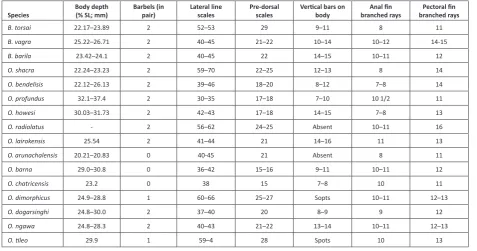
Table 2. Comparative measurements of body depth, vertical bars on body and meristic counts of Barilius torsai sp. nov. with related species
of Barilius and Opsarius.
Species Body depth(% SL; mm) Barbels (in pair) Lateral line scales Pre-dorsal scales Vertical bars on body branched raysAnal fin branched raysPectoral fin
B. torsai 22.17–23.89 2 52–53 29 9–11 8 11
B. vagra 25.22–26.71 2 40–45 21–22 10–14 10–12 14-15
B. barila 23.42–24.1 2 40–45 22 14–15 10–11 12
O. shacra 22.24–23.23 2 59–70 22–25 12–13 8 14
O. bendelisis 22.12–26.13 2 39–46 18–20 8–12 7–8 14
O. profundus 32.1–37.4 2 30–35 17–18 7–10 10 1/2 11
O. howesi 30.03–31.73 2 42–43 17–18 14–15 7–8 13
O. radiolatus - 2 56–62 24–25 Absent 10–11 16
O. lairokensis 25.54 2 41–44 21 14–16 11 13
O. arunachalensis 20.21–20.83 0 40-45 21 Absent 8 11
O. barna 29.0–30.8 0 36–42 15–16 9–11 10–11 12
O. chatricensis 23.2 0 38 15 7–8 10 11
O. dimorphicus 24.9–28.8 1 60–66 25–27 Sopts 10–11 12–13
O. dogarsinghi 24.8–30.0 2 37–40 20 8–9 9 12
O. ngawa 24.8–28.3 2 40–43 21–22 13–14 10–11 12–13
O. tileo 29.9 1 59–4 28 Spots 10 13
Barilius vagra: MUMF Uncat, 41.67–55.69 mm SL, Arunachal Pradesh, India.
Opsarius arunachalensis: APFS/ZSI/P-502, P-503, 110–140 mm SL, Agari River mouth, Pasighat, East Siang District, Arunachal Pradesh, India.
Opsarius barna: MUMF 27061–27064, 73.1–83.21 mm SL, Dikrong River, Arunachal Pradesh, India.
Opsarius bendelisis: ZSI FF1357, 79.71mm SL, Cauvery River, India; ZSI FF4269, 120mm SL, Torsa River, Cooch Behar, northern Bengal, India; ZSI FF4270, 37.21– 78.34 mm SL, Lataguri, Jalpaiguri District, northern Bengal, India.
Opsarius chatricensis: MUMF 503/1 (holotype), 86.43mm SL, Chatrickong River, 150km from Imphal, Ukhrul District, Manipur, India. Additional data from Selim & Vishwanath (2002).
Opsarius dimorphicus: Data from Tilak & Husain (1990).
Opsarius dogarsinghi: MUMF 207–210, 52.89–72.26 mm SL, Chakpi Stream, Manipur, India.
Opsarius howesi: ZSI FF2235, FF2236 61–70 mm SL, Jalpaiguri District, northern Bengal, India.
Opsarius lairokensis: MUMF 27075, 108.45mm SL, Moreh Bazar, Moreh, Chandel District, Manipur, India.
Opsarius ngawa: MUMF 149 (holotype), 96.56mm SL, Sherou River (tributary of Manipur river), 83km south of Imphal, Manipur, India; MUMF 27056–27058, 80.1–82.96 mm SL, Singda, Manipur, India.
Opsarius profundus: MUMF 27001 (holotype), 71.21mm SL, Koladyne River, Kolchaw, Lawntlai District, Mizoram, India.
Opsarius radiolatus: Data from Gunther (1868) and Nath et al. (2010).
Opsarius shacra: ZSI F12269, 51.15mm SL, Tribeni, Nepal; ZSI F13405/1, 38.78–73.19 mm SL, Teesta River drainage, Kalimpong Duars & Siliguri Terai, West Bengal, India; CIFRI F10001, 72.53–73.91 mm SL; Siang River, Pasighat, East Siang District, Arunachal Pradesh, India.
Opsarius tileo: MUMF 27076, 128.16mm SL, Umtrao
River, Byrnihat, Norbong, Ribhoi District, Meghalaya, India.
REFERENCES
Arunkumar, L. & H.T. Singh (2000). Bariline fishes of Manipur, India, with the description of a new species: Barilius lairokensis. Journal of the Bombay Natural History Society 97(2): 247–252.
Dishma, M. & W. Vishwanath (2012). Barilius profundus, a new
cyprinid fish (Teleostei: Cyprinidae) from the Koladyne basin, India. Journal of Threatened Taxa 4(2): 2363–2369. https://doi. org/10.11609/JoTT.o2838.2363-9
Fricke, R., W.N. Eschmeyer & R. van der Laan (2019). Catalog of Fishes: Genera, Species, References. http://researcharchive.calacademy. org/research/ichthyology/catalog/fishcatmain.asp Electronic version accessed 5 September 2019.
Günther, A. (1868).Catalogue of The Fishes in The British Museum,
Hamilton, F. (1822).An Account of the Fishes found in the River Ganges and its Branches. Archibald Constable and Company, Edinburgh & London, 405pp.
Howes, G.J. (1980). The anatomy, phylogeny and classification of bariliine cyprinid fishes. Bulletin of the British Museum (Natural
History) Zoology 37: 129–198.
Howes, G.J. (1983). Additinal notes on Bariliine cyprinid fishes. Bulletin
of the British Museum (Natural History) Zoology 45: 95–101.
Jayaram, K.C. (2010).The Fresh Water Fishes of the Indian Region,2nd
Edition. Narendra Publishing House, New Delhi, 616pp.
Knight, J.D.M., A. Rai, R.K.P. D’Souza & B. Vijaykrishnan (2015). Barilius ardens (Teleostei: Cyprinidae), a new species from the Western Ghats, India, with redescription of B. malabaricus and B. canarensis. Zootaxa 3926(3): 396–412. https://doi.org/10.11646/ zootaxa.3926.3.5
Liao, T.Y., E. Ünlü & S.O. Kullander (2011). Western boundary of the subfamily Danioninae in Asia (Teleostei, Cyprinidae): derived from the systematic position of Barilius mesopotamicus based on molecular and morphological data. Zootaxa 2880(1): 31–40. https:// doi.org/10.11646/zootaxa.2880.1.3
Nath, P., D. Dam & A. Kumar (2010). A new fish species of the
genus Barilius (Cyprinidae: Rasborinae), from river Siang, D’ering memorial wildlife sanctuary, Arunachal Pradesh, India. Records of the Zoological Survey of India 110(3): 19–33.
Rainboth, W.J. (1991). Cyprinids of South East Asia, pp. 156–210. In: Winfield, I. & J.S. Nelson (eds.). Cyprinid Fishes: Systematics, Biology and Exploitation. Chapman & Hall, London, 667pp.
Selim, K. & W. Vishwanath (2002). A new cyprinid fish species of Barilius Hamilton from the Chatrickong River, Manipur, India. Journal of the Bombay Natural History Society 99(2): 267–270.
Talwar, P.K. & A.G. Jhingran (1991).Inland Fishes of India and Adjacent
Countries,Vol. 1. Oxford & IBH Publishing Co. Pvt. Ltd., New Delhi, 541pp.
Tang, K.L., M.K. Agnew, M.V. Hirt, T. Sado, L.M. Schneider, J. Freyhof, Z. Sulaiman, E. Swartz, C. Vidthayanon, M. Miya, K. Saitoh, A.M. Simons, R.M. Wood & R.L. Mayden (2010). Systematics of the subfamily Danioninae (Teleostei: Cypriniformes: Cyprinidae).
Molecular Phylogenetics and Evolution 57: 189–214. https://doi. org/10.1016/j.ympev.2010.05.021
Qin, T., K.W. Maung & X.Y. Chen (2019).Opsarius putaoensis, a new
species of subfamily Danioninae (Actinopterygii, Cyprinidae) from the Irrawaddy River basin in northern Myanmar. Zootaxa 4615(3): 585–593. https://doi.org/10.11646/zootaxa.4615.3.11
Tejavej, A. (2012). Barilius signicaudas, a new species of cyprinid
Barilius torsai - new species from Brahmaputra Kumari et al.
Journal of Threatened Taxa | www.threatenedtaxa.org | 26 November 2019 | 11(14): 14808–14815 14815
Measurements
Holotype Paratype (s)
ZSI
FF5542 FF5543ZSI F10003CIFRI F10004CIFRI F10005CIFRI F10006CIFRI F10007CIFRI F10008CIFRI F10009CIFRI F10010CIFRI F10011CIFRI Standard length (mm) 71.41 74.56 71.46 71.67 71.89 72.15 72.17 72.98 73.17 74.23 71.46 Body depth at dorsal-fin origin 17.06 16.53 16.07 16.92 16.95 17.03 16.6 16.59 16.58 16.59 16.04 Body depth at anal-fin origin 12.67 13.6 12.71 12.91 12.81 12.89 12.97 12.99 13.1 13.4 12.98
Head length (HL) 18.98 20.01 19.1 19.17 19.21 19.24 19.31 19.51 19.57 19.89 19.18 Caudal-peduncle length 13.1 11.76 12.96 12.91 13.07 12.46 12.49 12.79 12.87 13.54 12.89
Caudal-peduncle depth 7.18 7.96 7.62 7.39 7.28 7.33 7.34 7.57 7.66 7.56 7.26
Pre-dorsal length 39.39 41.23 39.48 39.57 39.73 39.87 39.88 40.33 40.41 41.02 39.44
Pre-pelvic length 34.52 35.23 34.12 34.17 34.12 34.56 34.19 34.65 34.67 35.17 34.29 Pre-anus length 49.25 48.22 48.23 48.27 48.93 49.11 48.63 48.72 48.57 49.19 48.64 Pre-anal length 50.38 49.86 49.89 49.79 49.32 50.39 49.89 49.87 49.98 50.84 50.36 Dorsal-fin base length 9.98 10.8 10.01 10.17 10.06 10.2 10.43 10.31 10.27 10.53 10.02
Anal-fin base length 8.59 10 8.91 8.97 8.87 9.27 9.37 9.67 9.81 9.92 8.95
Dorsal-fin height 13.39 14.57 13.57 13.78 13.5 13.67 13.58 13.89 14.2 14.46 13.58
Pelvic-fin length 9.15 9.91 9.29 9.42 9.47 9.39 9.43 9.57 9.71 9.79 9.34
Anal-fin height 10.23 10.67 10.22 10.25 10.28 10.32 10.32 10.44 10.47 10.62 10.22 Pectoral-fin length 12.95 12.81 12.35 12.81 13.01 12.84 12.79 12.91 12.88 12.87 12.4 Cauda- fin length 16.44 18 16.74 16.83 16.97 17.31 17.29 17.57 17.54 17.88 16.94 Body width at anal-fin origin 7.1 7.11 6.99 6.98 6.95 6.97 6.98 6.97 7.01 7.34 7
Body width at dorsal-fin origin 8.19 9.56 8.2 8.89 8.39 8.78 9.14 9.27 8.74 9.5 8.25
Snout length 5.54 4.73 4.87 4.77 4.78 4.79 4.76 5.6 4.98 5.53 5.5
Interorbital distance 5.98 5.94 5.78 5.7 5.96 5.78 5.89 5.86 5.91 5.91 5.82
Eye orbit diameter 4.46 5.12 4.68 4.56 4.72 4.65 4.9 4.65 4.98 4.97 4.9
Mouth gape width 3.8 5.61 4.04 4.21 4.73 5.17 5.35 5.28 5.38 5.47 4.05
Head depth at eye 10.81 13.26 12.31 12.15 11.17 12.37 11.23 11.35 12.31 11.94 11.24 Head depth at nape 12.74 14.62 13.69 13.52 13.25 13.42 14.02 14.13 13.79 13.72 13.7
Maximum head width 8.97 9.46 9.03 9.08 9.08 9.09 9.146 9.24 9.25 9.4 9.06
Head width at eye 8.52 8.98 8.57 8.61 8.62 8.64 8.67 8.76 8.78 8.93 8.61
Maxillary barbel length 4.22 5.19 4.33 4.97 4.69 4.74 5.01 5.02 4.98 5.11 4.35
Rostral barbel length 4.55 5.95 4.59 4.6 4.7 5.12 5.32 4.79 4.89 5.39 4.62
Supplementary 1. Biometric data of Barilius torsai sp. nov.
ISSN 0974-7907 (Online) | ISSN 0974-7893 (Print)
November 2019 | Vol. 11 | No. 14 | Pages: 14787–14926 Date of Publication: 26 November 2019 (Online & Print)
DOI: 10.11609/jott.2019.11.14.14787-14926 www.threatenedtaxa.org
publishing peer-reviewed articles online every month at a reasonably rapid rate at www.threatenedtaxa.org. All articles published in JoTT are registered under Creative Commons Attribution 4.0 International License
unless otherwise mentioned. JoTT allows allows unrestricted use, reproduction, and distribution of articles in any medium by providing adequate credit to the author(s) and the source of publication.
Announcement
The Sally Walker Conservation Fund -- an appeal for support – P. 14787
Communications
Complementary bat (Mammalia: Chiroptera) survey techniques uncover two new country records for Nigeria
– Iroro Tanshi, Anthony Ekata Ogbeibu & Paul Jeremy James Bates, Pp. 14788–14801
Bone fractures in roadkill Northern Tamandua Tamandua mexicana (Mammalia: Pilosa: Myrmecophagidae) in Costa Rica
– Randall Arguedas, Elisa C. López & Lizbeth Ovares, Pp. 14802–14807
Barilius torsai (Teleostei: Cypriniformes: Cyprinidae), a new freshwater fish
from the Brahmaputra drainage, India
– Kavita Kumari, Manas Hoshalli Munivenkatappa, Archana Sinha, Simanku Borah & Basanta Kumar Das, Pp. 14808–14815
Butterfly diversity throughout Midnapore urban area in West Bengal, India – Surjyo Jyoti Biswas, Debarun Patra, Soumyajit Roy, Santosh Kumar Giri, Suman Paul & Asif Hossain, Pp. 14816–14826
Plant and fungi diversity of Devi Pindiyan Valley in Trikuta Hills of northwestern Himalaya, India
– Sajan Thakur, Harish Chander Dutt, Bikarma Singh, Yash Pal Sharma, Nawang Tashi, Rajender Singh Charak, Geeta Sharma, Om Prakash Vidyarthi, Tasir Iqbal, Bishander Singh & Kewal Kumar, Pp. 14827–14844
A checklist of rust fungi from Himachal Pradesh, India – Ajay Kumar Gautam & Shubhi Avasthi, Pp. 14845–14861
The distribution of blue-green algae (Cyanobacteria) from the paddy fields of Patan and Karad tehsils of Satara District, Maharashtra, India
– Sharada Jagannath Ghadage & Vaneeta Chandrashekhar Karande, Pp. 14862–14869
Short Communications
Cordia diffusaK.C. Jacob, the Kovai Manjack (Boraginaceae):a highly
threatened steno-endemic species from Coimbatore City, Tamil Nadu, India – S. Arumugam, K. Sampath Kumar, B. Karthik & V. Ravichandran, Pp. 14870– 14875
New distribution records in the orchid flora of Tripura, India – Arjun Adit, Monika Koul & Rajesh Tandon, Pp. 14876–14885
Notes on the extended distribution of Humboldtia bourdillonii (Fabales:
Fabaceae), an Endangered tree legume in the Western Ghats, India
– Anoop P. Balan, A.J. Robi & S.V. Predeep, Pp. 14886–14890
Notes
Vertebrate prey handling in the Indian Grey Hornbill Ocyceros birostris (Aves: Bucerotiformes: Bucerotidae)
– James A. Fitzsimons, Pp. 14891–14894
Impact of cyclone Fani on the breeding success of sandbar-nesting birds along the Mahanadi River in Odisha, India
– Subrat Debata, Pp. 14895–14898
First record of the micromoth Ethmia lineatonotella (Moore, 1867) (Lepidoptera: Depressariidae: Ethmiinae) from Bhutan
– Jatishwor Singh Irungbam & Meenakshi Jatishwor Irungbam, Pp. 14899–14901
Additional distribution records of the rare Nepal Comma
Polygonia c-album agnicula (Moore, 1872) (Insecta: Lepidoptera:
Nymphalidae) from Rara National Park, Nepal
– Sanej Prasad Suwal, Biraj Shrestha, Binita Pandey, Bibek Shrestha, Prithivi Lal Nepali, Kaashi Chandra Rokaya& Bimal Raj Shrestha, Pp. 14902–14905
A new distribution record of the gall midge Octodiplosis bispina Sharma (Diptera: Cecidomyiidae) from the Western Ghats of Tamil Nadu, India – Duraikannu Vasanthakumar, Radheshyam Murlidhar Sharma & Palanisamy Senthilkumar, Pp. 14906–14907
New recruitment of staghorn corals in the Gulf of Mannar - the emergence of a resilient coral reef
– Koushik Sadhukhan, Ramesh Chatragadda, T. Shanmugaraj & M.V. Ramana Murthy, Pp. 14908–14911
New records of coral diseases in the Persian Gulf
– Parviz Tavakoli-Kolour & Sanaz Hazraty-Kari, Pp. 14912–134913
Crepidium aphyllum (Orchidaceae), a new record from Bhutan
– Kinley Rabgay & Pankaj Kumar, Pp. 14914–14916
Rediscovery, after over a century, of the endemic climbing vine
Argyreia lawii (Convolvulaceae) from the Western Ghats of India
– Pramod R. Lawand, Rajaram V. Gurav & Vinod B. Shimpale, Pp. 14917–14920
Linostoma decandrum (Roxb. ) Wall. ex Endl. (Thymelaeaceae):
an addition to the flora of Andaman Islands, India – L. Rasingam & K. Karthigeyan, Pp. 14921–14922
On the floral biology and pollination of a rare Twining Liana
Sarcolobus carinatus Wall. (Asclepiadoideae: Apocynaceae) in
Coringa Mangrove Forest, Andhra Pradesh, India – A.J. Solomon Raju, Pp. 14923–14926