Commun
ficaft
fion
Poflfl
finaft
fion
ecoflogy
and
fru
fift
fing
behav
fior
of
Paveftfta
find
fica
L
.
(Rub
fiaceae
)
,
a
keysftone
shrub
spec
fies
fin
fthe
soufthern
Easftern
Ghafts
foresft
,
Andhra
Pradesh
,
Ind
fia
A.J. Soflomon Raju, M. Maflflfikarjuna Rao, K. Venkafta Ramana, C. Prasada Rao & M. Suflakshana
26 Augusft 2016 | Vofl. 8 | No. 9 | Pp. 9155–9170 10.11609/joft.2340.8.9.9155-9170
fionafl Lficense unfless oftherwfise menfioned. JoTT aflflows unresftrficfted use of arficflesfin any medfium, reproducfion and dfisftrfibufion by provfidfing adequafte credfift fto fthe aufthors and fthe source of pubflficafion.
Parftner
www
.
fthrea
ftenedftaxa
.org
ISSN 0974-7907(Onflfine) |ISSN 0974-7893(Prfinft)
Thefinfternafionafljournafl of conservafion and ftaxonomy
Journa
fl
o
f
Threaftened
Taxa
Pub
fl
fisher/Hosft
For Focus, Scope, Afims, Poflficfies and Gufideflfines vfisfift hftp://fthreaftenedftaxa.org/Abouft_JoTT.aspFor Arficfle Submfissfion Gufideflfines vfisfift hftp://fthreaftenedftaxa.org/Submfissfion_Gufideflfines.asp
For Poflficfies agafinsft Scfienfific Mfisconducft vfisfifthftp://fthreaftenedftaxa.org/JoTT_Poflficy_agafinsft_Scfienfific_Mfisconducft.asp
Co
m
mu
nfi
ca
ftfi
DOI:hftp://dx.dofi.org/10.11609/joft.2340.8.9.9155-9170
Edfiftor: K.R. Sasfidharan,Insfiftufte of Foresft Genefics and Tree Breedfing(IFGTB), Cofimbaftore,Indfia. Dafte of pubflficafion: 26 Augusft 2016(onflfine & prfinft)
Manuscrfipft deftafifls: Ms # 2340 | Recefived 27 Sepftember 2015 | Ffinafl recefived 14Jufly 2016 | Ffinaflfly accepfted 09 Augusft 2016
Cfiftafion: Raju, A.J.S., M.M. Rao, K.V. Ramana, C.P. Rao & M. Suflakshana (2016).Poflflfinafion ecoflogy and frufifing behavfior of Paveftafindfica L. (Rubfiaceae), a keysftone shrub specfiesfin fthe soufthern Easftern Ghafts foresft, Andhra Pradesh,Indfia.Journafl of Threaftened Taxa 8(9):9155–9170;hftp://dx.dofi.org/10.11609/ joft.2340.8.9.9155-9170
Copyrfighft: ©Raju eft afl. 2016. Creafive Commons Aftrfibufion 4.0Infternafionafl Lficense. JoTT aflflows unresftrficfted use of fthfis arficflefin any medfium, reproducfion and dfisftrfibufion by provfidfing adequafte credfift fto fthe aufthors and fthe source of pubflficafion.
Fundfing: Deparftmenft of Scfience & Technoflogy, Governmenft ofIndfia, New Deflhfi, fthrough a Major Research Projecft(Sancfion Lr. No. SERB/SR/SO/PS/159/2012).
Conflficft ofInfteresft: The aufthors decflare no compefingfinfteresfts.
Aufthor Deftafifls: Prof. A.J. Soflomon Raju fis fthe Chafirman, Board of Sftudfiesfin fthe Deparftmenft of Envfironmenftafl Scfiences, Andhra Unfiversfifty, Vfisakhapaftnam. Hefis fthe recfipfienft of severafl nafionafl andfinfternafionafl awards. He pubflfished 315 research papersfinfinfternafionafl and nafionafl Journafls. Hefis on fthe edfiftorfiafl board of severaflfinfternafionafljournafls. Hefis presenftfly workfing on keysftone and endemfic specfies of Easftern Ghafts wfifth financfiafl supporftfrom DST and UGC. M. Maflflfikarjuna Rao fis Projecft Feflflow workfingfinfthe DST Research Projecft under Prof. A.J. Soflomon Raju, Deparftmenft of Envfironmenftafl Scfiences, Andhra Unfiversfifty, Vfisakhapaftnam. Hefis sfimuflftaneousfly dofing researchfleadfing fto Ph.D. degree under fthe same facuflfty member. Dr. K. Venkafta Ramana fis DST Posft-Docftorafl Research Feflflow(Young Scfienfisft Scheme) workfingfinfthe Deparftmenft of Boftany, Andhra Unfiversfifty, Vfisakhapaftnam. Dr. Ch. Prasada Rao fis dofingresearch workfin fthe Deparftmenft of Boftany, Andhra Unfiversfifty, Vfisakhapaftnam. M. Suflakshana fis dofing docftorafl researchunder fthe gufidance of Dr. D. Sandhya Deepfika, Assocfiafte Professor, Deparftmenft of Boftany, Andhra Unfiversfifty, Vfisakhapaftnam.
Aufthor Conftrfibufion: Aflfl aufthors conftrfibufted fto a sfimfiflar exftenft overaflfl.
Acknowfledgemenfts: The firsft aufthor acknowfledges fthe financfiafl supporft recefived from fthe Deparftmenft of Scfience & Technoflogy, Governmenft ofIndfia, New Deflhfi, fthrough a Major Research Projecft(Sancfion Lr. No. SERB/SR/SO/PS/159/2012)for carryfing ouft fthfis research work.
Poflfl
finaft
fion
ecoflogy
and
fru
fift
fing
behav
fior
of
Paveftfta
find
fica
L
.
(Rub
fiaceae
)
,
a
keysftone
shrub
spec
fies
fin
fthe
soufthern
Easftern
Ghafts
foresft
,
Andhra
Pradesh
,
Ind
fia
A.J. Soflomon Raju 1, M. Maflflfikarjuna Rao 2, K. Venkafta Ramana 3, C. Prasada Rao 4&
M. Suflakshana 5
1,2Deparftmenft of Envfironmenftafl Scfiences, Andhra Unfiversfifty, Vfisakhapaftnam, Andhra Pradesh 530003,Indfia 3,4,5Deparftmenft of Boftany, Andhra Unfiversfifty, Vfisakhapaftnam, Andhra Pradesh 530003,Indfia
1soflomonraju@gmafifl.com(correspondfing aufthor),2maflflfikarjuna2009rao@gmafifl.com,3ramanabftny@gmafifl.com, 4prasadachram@gmafifl.com,5suflakshana.maddafla3@gmafifl.com
ISSN 0974-7907(Onflfine) ISSN 0974-7893(Prfinft)
OPEN ACCESS
Absftracft: Paveftafindfica fis a massfive bfloomerfor a brfief perfiodfin May. The flowers are hermaphrodfific,sftrfikfingfly proftandrous,seflf andcross-compafibfle, necftarfiferous and psychophfiflous. They possesssecondary poflflen presenftafion mechanfism as a devficefto avofid auftonomous auftogamy buftfift does noft prevenft gefiftonogamy. Thefrufift seftflargefly occursfthrough gefiftonogamy and xenogamy. Bufterflfies, especfiaflfly papfiflfionfids, pfierfids, nymphaflfids, and sphfingfid hawk mofth poflflfinafte fthe flowers whfifle coflflecfing necftar. Honey bees and bflue -banded dfigger beesfeed on poflflen and efecft onfly accfidenftafl poflflfinafion. The necftarfis sucrose-rfich and conftafins essenfiafl and non-essenfiafl amfino acfids. Bfirds are seed dfispersafl agenfts. Seeds are non-dormanft and germfinaftereadfifly durfingrafiny season buftfthefir confinued growfth and esftabflfishmenftfis subjecftftofthe avafiflabfiflfifty of sofifl mofisfture and nuftrfienfts. The pflanftfis noft abflefto popuflaftefiftseflffinfifts nafturafl area. The flocafl uses of dfiferenft parfts offthe pflanft have beenfoundfto be afecfingfifts reproducfive success and nafturafl regenerafion rafte. Therefore, reguflafion of fthe uses of fthfis pflanftfis recommendedforfifts survfivafl and resftorafion offifts popuflafion sfizefin fthe nafturafl areas due ftofifts rofle as a keysftone specfiesfor bees and bufterflfies durfing dry season.
Keywords: Fflowerfing phenoflogy, keysftone shrub specfies, mfixed breedfing sysftem, ornfifthochory, Paveftafindfica, psychophfifly.
Journal of Threatened Taxa | www.threatenedtaxa.org | 26 August 2016 | 8(9): 9155–9170 9156
Pollination ecology of Pavetta indica Raju et al.
INTRODUCTION
Rubiaceae family is classified into three subfamilies, Ixoroideae, Cinchonoideae and Rubioideae. These subfamilies show three main reproductive mechanisms: heterostyly is more common in Rubioideae, secondary pollen presentation on the style in Ixoroideae whereas Cinchonoideae presents both mechanisms. The sexual systems include hermaphroditism, monoecy, polygamomonoecy, dioecy and heterostyly (Robbrecht 1988). In an elaborate study, Puff et al. (2005) stated that protandry in isostylous flowers of Rubiaceae is associated with secondary pollen presentation which occurs widely among all the three sub-families. This phenomenon was first noted in Ixora and hence is often referred to as “ixoroid pollination mechanism”. This pollination mechanism is reported in Pavetta,
Duperrea, Catunaregam, Anthocephalus, Mitragyna, Uncaria and many other species. Four types secondary
pollen presentation have been recognized in this family, according to the presenting area and receptive surfaces. 1. Pollen deposition on the style only. Here, pollen deposition is strictly on non-receptive surfaces. The stigma and its receptive surfaces are higher up.
2. Pollen deposition on the style and outside of the stigma lobes. Pollen is solely deposited on non-receptive surfaces, but the abaxial surfaces of the stigma are also involved.
3. Pollen deposition on the outer side of the stigma.
4. Pollen deposition exclusively, largely or partly on the receptive surface of the stigma.
In types 2 and 3, the receptive areas are the inner sides of the stigma lobes or the furrows between two stigma lobes. At the time of pollen deposition the stigma lobes are fused so that contact between self-pollen and the receptive surfaces is improbable. Detailed information on the function of these types of secondary pollen presentation in individual species of all the three sub-families of Rubiaceae is almost totally lacking.
The genus Pavetta belongs to the sub-family Ixoroideae and tribe Pavetteae. It is widely distributed in the Old World tropics from Africa to Southeast Asia, New Guinea, Australia, New Caledonia and Vanuatu but does not occur in Madagascar, New Zealand and Oceania. It comprises of about 400 species of shrubs or small trees with the largest number of them distributed in Africa. Sri Lanka and the Philippines are also very rich in Pavetta species (Mabberley 1987; Reynolds 1993; de Block & Robbrecht 1998; Tao & Taylor 2011).
In India, the genus is represented by about 30 species (Santapau & Henry 1972). Two explanations exist for the derivation of the genus name. It is either derived from pawatta, the Sinhalese (Sri Lankan) name for a plant in this genus (Schmidt et al. 2002) or from pavetta, the common name for P. indica in Malabar, India. It is also believed to have been derived from “pavimentum”, a Latin word describing a pavement or mosaic of bricks or stones which possibly refer to the scattered bacterial nodules in the leaves; the bacteria take shelter, fix nitrogen from the air and release it in a form the plant can use (van Wyk 1974). Pavetta is characterized by its terminal or axillary corymbiform long-pedunculate inflorescences, white, tetramerous hermaphrodite flowers, long exserted stamens inserted in the mouth of the corolla tube, spheroidal tri-zonocolporate pollen with supratectal microgemmae, style with fusiform short bifid stigma, bilocular ovary with two ovules immersed in a fleshy placenta and drupes with one or two pyrenes (Reynolds 1993; de Block & Robbrecht 1998). Pavetta species produce sweet scented flowers which attract many pollinators such as birds, bees, wasps, beetles, ants and moths. These in turn attract birds and other predators. Birds and monkeys feed on fruits, which are obviously distributed by them (Schmidt et al. 2002; van Wyk 1974; Bridson 2003). P. schumanniana, P. cooperi and P. lanceolata produce white scented flowers; the first one is pollinated by moths which forage at twilight or at night while the other two by birds, bees, wasps, beetles, ants and moths. Their black, fleshy fruits appear to be dispersed by birds and monkeys (Bremekamp 1934; van Wyk 1974; Kok & Grobbelaar 1984; Johnson & Nichols 2002). In the monograph of the genus Pavetta, Bremekamp (1934) provided a brief account on P. indica. It is widely distributed from the Andaman Islands, India and the northwestern Himalaya to southern China and southwards throughout Malesia to northern Australia. But it is considered to be a controversial species because some authors claimed that it has a wide distribution area, and many varieties were then distinguished, mainly based on the hairiness of different plant parts, while other authors stated that this species is confined to India and Sri Lanka, and specimens resembling this species in other regions bear a multitude of different names such as P. axillaris Bremek., P. montana Reinw. ex Blume., P. reinwardtii Bremek., P. subvelutina Miq. and P.
sylvatica Blume in Java. The plant is common in primary
trips made. Observations regarding the organization of inflorescences, the spatial positioning of flowers, and their position (terminal, axillary, etc.) on the plants were made since these features are regarded as important for foraging and effecting pollination by flower-visitors. The flower life was recorded by marking twenty five just anthesed flowers and following them until fall off. Anthesis was initially recorded by observing 25 marked mature buds in the field. Later, the observations were repeated five times on different days in order to provide accurate anthesis schedule for each species. Similarly, the mature buds were followed for recording the time of anther dehiscence. The presentation pattern of pollen was also investigated by recording how anthers dehisced and confirmed by observing the anthers under a 10x hand lens. The details of flower morphology such as flower sex, shape, size, colour, odour, sepals, petals, stamens and ovary were described based on 25 flowers randomly collected from a population of plants for each species. The order of wilting or dropping off of floral parts was recorded. Observations regarding the position and spatial relationships of stamens and stigma in mature bud, at anthesis and after, during the flower-life with reference to self and/or cross-pollination were made very carefully.
Pollen output
Thirty mature, but un-dehisced anthers from five different plants were collected and placed in a Petri dish. Later, each time a single anther was taken out and placed on a clean microscope slide (75x25 mm) and dabbed with a needle in a drop of lactophenol-aniline-blue. The anther tissue was then observed under the microscope for pollen, if any, and if pollen grains were not there, the tissue was removed from the slide. The pollen mass was drawn into a band, and the total number of pollen grains was counted under a compound microscope (40x objective, 10x eye piece). This procedure was followed for counting the number of pollen grains in each anther collected. Based on these counts, the mean number of pollen produced per anther was determined. The mean pollen output per anther was multiplied by the number of anthers in the flower for obtaining the mean number of pollen grains per flower. The characteristics of pollen grains were also recorded.
Pollen-ovule ratio
The pollen-ovule ratio was determined by dividing the average number of pollen grains per flower by the number of ovules per flower. The value thus obtained was taken as pollen-ovule ratio (Cruden 1977).
in Peninsular Malaysia, Philippines and India. Its leaves are used to treat nose ulcers while the root, root bark and stem bark are used to treat intestinal obstructions, haemorrhoids, rheumatism and urinary diseases. The flowers are also used as a cosmetic after bathing. The plant produces white, tubular, actinomorphic, hermaphroditic flowers which are foraged and pollinated by Papilionid butterflies (Momose et al. 1998; Kato et al. 2008). Since there is very little information on the pollination biology of Pavetta genus in general and the medicinally important species, P. indica in particular despite its medicinal importance, we initiated this study using field and laboratory approaches to investigate the details of its pollination ecology. In the study region, this species serves as a keystone species during May in the southern Eastern Ghats forest of Andhra Pradesh, India. The work presented in this paper on P. indica is useful to understand various aspects of pollination ecology and also enables to know how it acts as a keystone species in the month of May in the study area when almost all other plant species stay in deciduous state without flowering or fruiting.
MATERIALS AND METHODS
Study area
Twenty-five scattered plants of Pavetta indica located in the deciduous forest near Alampur in Kadiri area (14006’N & 78009’E; 360m) of Anantapur District in the
southern Eastern Ghats of Andhra Pradesh, was used for the study during 2014–2015. The forest is characterized by steep slopes, rocky terrain, dry and poor stony soils with deciduous vegetation. The vegetation is a unique mix of the dry deciduous and moist deciduous types. The area is totally dry and experiences very high temperature during summer season. In this area,
Hildegardia populifolia (Sterculiaceae), Pavetta indica
and P. tomentosa are the only species that bloom during dry season; the first species is an endemic and endangered tree, while the other two are shrub or small tree. These three species represent a small population with scattered distribution in this area. Of these, H. populifolia blooms during February–April, P.
indica during May and P. tomentosa during May–June. Pavetta species with flowering during May/June assume
importance as keystone species to support certain local flower-foragers.
Flowering and floral biology
Journal of Threatened Taxa | www.threatenedtaxa.org | 26 August 2016 | 8(9): 9155–9170 9158
Pollination ecology of Pavetta indica Raju et al.
Nectar characters
The presence of nectar was determined by observing the mature buds and open flowers. The volume of nectar from 10 flowers of each plant species was determined. Then, the average volume of nectar per flower was estimated and expressed in µl. The flowers used for this purpose were bagged at mature bud stage, opened after cessation of nectar secretion and squeezed nectar into micropipette for measuring the volume of nectar. Nectar sugar concentration was determined using a Hand Sugar Refractometer (Erma, Japan). Ten samples were used for examining the range of sugar concentration in the nectar. For the analysis of sugar types, paper chromatography method described by Harborne (1973) was followed. Nectar was placed on Whatman No. 1 of filter paper along with standard samples of glucose, fructose and sucrose. The paper was run ascendingly for 24 hours with a solvent system of n-butanol-acetone-water (4:5:1), sprayed with aniline oxalate spray reagent and dried at 1200C in an electric oven for 20 minutes
for the development of spots from the nectar and the standard sugars. Then, the sugar types present and also the most dominant sugar type were recorded based on the area and colour intensity of the spot. The sugar content/flower is expressed as the product of nectar volume and sugar concentration per unit volume, mg/ µl. This is done by first noting the conversion value for the recorded sugar concentration on the refractometer scale and then by multiplying it with the volume of nectar/flower. Table 5.6 given in Dafni et al. (2005) was followed for recording the conversion value to mg of sugars present in one µl of nectar. Nectar amino acid types were recorded as per the paper chromatography method of Baker & Baker (1973). Nectar was spotted on Whatman No. 1 filter paper along with the standard samples of nineteen amino acids, namely, alanine, arginine, aspartic acid, cysteine, cystine, glutamic acid, glycine, histidine, isolecuine, leucine, lysine, methionine, phenylalanine, proline, serine, threonine, tryptophan, tyrosine and valine. The paper was run ascendingly in chromatography chamber for 24 hours with a solvent system of n-butanol-glacial acetic acid-water (4:1:5). The chromatogram was detected with 0.2% ninhydrin reagent and dried at 85oC in an electric oven for 15
minutes for the development of spots from the nectar and the standard amino acids. The developed nectar spots were compared with the spots of the standard amino acids. Then, the amino acid types were recorded.
Stigma receptivity
The stigma receptivity was observed visually and
by H2O2 test. In visual method, the stigma physical state (wet or dry) and the unfolding of its lobes were considered to record the commencement of receptivity; withering of the lobes was taken as loss of receptivity. H2O2 test as given in Dafni et al. (2005) was followed for noting stigma receptivity period. This test is widely followed although it does not indicate the exact location of the receptive area. In the present study, the period of slow release of bubbles from the surface of stigma following the application of hydrogen peroxide was taken as stigma receptivity.
Breeding Systems
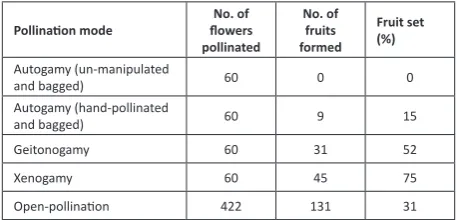
Mature flower buds of some inflorescences on different individuals were tagged and enclosed in paper bags. They were tested in the following way and the number of flower buds used for each mode of pollination was given in Table 1.
1. The flowers were fine-mesh bagged without hand pollination for autonomous autogamy.
2. The stigmas of flowers were pollinated with the pollen of the same flower manually by using a brush; they were bagged and followed to observe fruit set in manipulated autogamy.
3. The emasculated flowers were hand-pollinated with the pollen of a different flower on the same plant; they were bagged and followed for fruit set in geitonogamy.
4. The emasculated flowers were pollinated with the pollen of a different individual plant; they were bagged and followed for fruit set in xenogamy.
All these categories of flower pollinations were followed for fruit set. If fruit set is there, the percentage of fruit set was calculated for each mode.
Natural fruit set, seed dispersal and seedling ecology A sample of flowers on ten plants were tagged on different plants prior to anthesis and followed for fruit set rate in open-pollinations. Fruit maturation period, fruit dehiscence and seed dispersal aspects were observed to
Pollination mode flowers No. of pollinated No. of fruits formed Fruit set (%) Autogamy (un-manipulated
and bagged) 60 0 0
Autogamy (hand-pollinated
and bagged) 60 9 15
Geitonogamy 60 31 52
Xenogamy 60 45 75
Open-pollination 422 131 31
the extent possible. Field observations were also made on the emergence of new growth from old shoots, seed germination and seedling establishment aspects.
Flower-visitors and seed dispersal agents
After making preliminary observations on flower visitors, a thorough knowledge of the local insect species was obtained by observing the representative species of insects available with the Pollination Ecology Laboratory in the Department of Environmental Sciences, Andhra University, Visakhapatnam. With the knowledge of local insect species, attempts were made to observe flower visitors. The hourly foraging visits of each insect species were recorded on 3 or 4 occasions depending on the possibility and the data was tabulated to use the same for further analysis. Fully blooming plants were selected to record the foraging visits of insects. The data obtained was used to calculate the percentage of foraging visits made by each insect species per day and also to calculate the percentage of foraging visits of each category of insects per day in order to understand the relative importance of each insect species or category of insects. The foraging behaviour of insects was observed on a number of occasions for the mode of approach, landing, probing behavior with reference to floral sex organs, the type of forage collected, contact with essential organs to result in pollination, inter-plant foraging activity for their role in self- and cross-pollination.
Determination of pollen carryover efficiency of insects The hawk moths captured during morning and afternoon hours and bees and butterflies captured during 10:00–12:00 hr were brought to the laboratory. For each insect species, 10 specimens were captured and each specimen was washed first in ethyl alcohol and the contents stained with aniline-blue on a glass slide and observed under microscope to count the number of pollen grains present. From this, the average number of pollen grains carried by each insect species was calculated to know the pollen carryover efficiency of different insect species. In case of bees, pollen loads were removed prior to pollen count and only those pollen grains that were present on the forehead, dorsal and ventral parts of the bee body were counted. In case of butterflies and hawk moths, the proboscis, forehead and wings were used to record the pollen carried by them.
Photography
Plant habitat, flowering inflorescences, flower and fruit details, bees, butterflies and hawk moths
were photographed with Nikon D40X Digital SLR (10.1 pixel) and TZ240 Stereo Zoom Microscope with SP-350 Olympus Digital Camera (8.1 pixel). Olympus Binoculars (PX35 DPSR Model) was also used to make field observations on the foraging behavior of foragers. Magnus Compound Microscope - 5x, 10x, 40x and 100x magnification was used for studying the pollen grain characteristics, pollen output and floral internal details.
RESULTS
Phenology
P. indica is a shrub or small tree with tomentose
branches. It occurs as isolated individuals or a few individuals grouped together. It is evergreen with leaf fall and leaf flushing taking place throughout the year in the locations where soil is either optimally or partially saturated with water or moisture while it is semi-deciduous with complete leaf fall during February– March and leaf flushing during April-May in the locations where soil is semi-dry or totally dry (Image 1a). But, leaf flushing is bit delayed in the plants occurring in totally dry locations. The flowering occurs during May in all plants irrespective of their occurrence in dry or wet soils. But, the duration of flowering at plant level is two weeks in dry locations while it is nearly three weeks in moist locations. Inflorescence is an axillary, long pedunculate, densely tomentose, dichotomously branched corymbose cyme, consisting of 35.16±9.50 pedicellate flowers which open over a period of 3–4 days (Image 1b,c). Individual flowering inflorescences stand out prominently against the new foliage and are quite attractive from a long distance.
Flower morphology
Journal of Threatened Taxa | www.threatenedtaxa.org | 26 August 2016 | 8(9): 9155–9170 9160
Pollination ecology of Pavetta indica Raju et al.
of two ovules slightly immersed in fleshy placenta. The total length of the pistil is 30.1±1.3 mm of which ovary is 2.6±0.5 mm long and style and stigma are 24.9±1.5 mm long. The ovary is green, while style and stigma are white. The style is slender, filiform, thickened in the upper part, exserted; the exserted portion is longer than corolla lobes. The stigma is linear, sparsely pubescent all
over and shortly bifid. The style and stigma extend far beyond the anthers.
Floral biology
Mature buds bulge slowly and open during 06:00– 09:00 hr and the anthers dehisce synchronously during anthesis by longitudinal slits while the stigma Image 1. Pavetta indica: a - Leaf flushing phase; b & c - Flowering inflorescences; d–h - Different stages of anthesis; i–l - Bee foragers: i - Apis
is unreceptive at this time as the its lobes remained appressed (Image 1d–h). The sub-terminal and terminal portions of the style are continuous, not clearly distinguishable and the stigmatic lobes in appressed state terminate the style. The outer surface of the stigmatic lobes is unreceptive while the inner surface of the stigmatic lobes is receptive. During anthesis, pollen is presented along the terminal portion of the style and the non-receptive outer surface of the appressed stigmatic lobes, which are passively loaded via the action of introrsely shedding pollen. The dehisced anthers reflex backwards soon after anthesis. The pollen output per anther is 9,352±435 and per flower is 37,408. The pollen-ovule ratio is 18,704: 1. The pollen grains are creamy white, powdery, spheroidal, trizonocolporate with supratectal microgemmae and 22.68±3.79 µm in size, ornamented and have thick exine. The style and stigma extend 12–14 mm beyond the height of anthers after anthesis and the stigma attains receptivity around 16:00 hr of the same day by the slight separation of stigmatic lobes during which their inner surfaces are semi-wet. The stigma receptivity lasts until noon time of the 3rd day. The annular disc crowning the ovary begins
nectar secretion from the time of anthesis and ceases its secretion by 1600 h on the day of anthesis. Individual flowers produce 5.5±2.0 µl of nectar with 17±3.4 % (13–26 %) sugar concentration. The sugar types present in the nectar include sucrose, fructose and glucose with the first as dominant. The total sugar present in the nectar of individual flowers is 1.05 mg. The nectar also contains five essential amino acids (arginine, histidine, lysine, methionine and threonine) and eight non-essential amino acids (alanine, aspartic acid, butyric acid, cysteine, cystine, glutamic acid, glycine and hydroxyproline). In pollinated flowers, the floral parts - petals, stamens, style and stigma fall off on the evening of the 3rd day while the calyx remains intact and forms
the strong base for the growing fruit. The entire flower falls off on the 3rd day in case of un-pollinated flowers.
Breeding Systems
The results of breeding systems indicated that the plant is self-compatible and self-pollinating. The fruit set does not occur through autonomous autogamy but occurs in all other modes of pollination. It is 15% in facilitated autogamy, 52% in geitonogamy, 75% in xenogamy and 31% in open pollinations (Table 1).
Pollinator guilds and pollination
Thrips were found using the flower buds for breeding. They were abundantly present in bud stage and emerged
out following anthesis and fed on both pollen and nectar. The thrips collected the forage continuously from the flowers of the same plant; they were considered to be largely contributing to geitonogamy due to non-receptive stigma on the day of anthesis until late evening. The first foragers at the flowers were the diurnal hawk moths (Macroglossum gyrans and Cephonodes hylas (Sphingidae). They foraged during 0500-0700 and 1600-1800; the flowers foraged by them before 06:00hr were 1 or 2 day old ones since the anthesis occurs after 06:00hr. The bees and butterflies commenced their foraging activity from 07:00hr onwards; the former ceased foraging at 16:00 hr while the latter ceased foraging at 14:00hr. Both bees showed a gradual increase in foraging visits until 11:00hr while butterflies showed a gradually increase in foraging visits until 10:00hr but both categories of insects showed a gradual decrease thereafter until they ceased foraging for the day (Figs. 1–7). The bees contributed 10%, hawk moths 11% and butterflies 79% of total average foraging visits recorded for the day (Fig. 8). The bees included honey bees, Apis
dorsata (Image 1i), A. cerana indica (Image 1j), A. florea
(Image 1k) and the digger bee Amegilla sp. (Image 1l). The butterflies were Pachliopta aristolochiae (Image 2a,f), P. hector (Image 2b,e), Papilio polytes (Image 2c), P. demoleus (Image 2d) (Family - Papilionidae),
Catopsilia pomona (Image 2g,h), C. pyranthe (Image 2i), Eurema hecabe (Image 2j), Delias eucharis (Image 2k), Belenois aurota (Image 3a,b), Ixias marianne (Image 3c), Colotis fausta (Image 3d), C. etrida (Image 3e), C. danae
(Image 3f) (Family Pieridae), Acraea terpsicore (Image 3g), Junonia hierta (Image 3h), Euploea core (Image 3i) (Family - Nymphalidae), Castalius rosimon (Image 3j),
Freyeria trochylus (Image 3k), Spindasis vulcanus (Image
3l), Tajuria cippus (Image 3m) (Family Lycaenidae) and
Hasora chromus (Image 3n) (Family Hesperiidae). The
hawk moths were Macroglossum gyrans (Image 3o) and
Cephonodes hylas (Image 3p)(Family Sphingidae) (Table
Journaflof Threaftened Taxa | www.fthreaftenedftaxa.org | 26 Augusft 2016 | 8(9): 9155–9170
Poflflfinafion ecoflogy of Paveftafindfica Raju eft afl.
9162
conftacft wfifth fthe sfigmas due fto whfich poflflfinafion occurred. The hawk mofths and bufterflfies were excflusfive necftar foragers; aflfl fthese excepft flycaenfids coflflecfted necftar easfifly wfifthfthefir proboscfis whfich exceededfthe flengfth offthecoroflflaftube.Lycaenfids wfifth proboscfis flengfthsmaflflerfthancoroflflaftubeflengfth had dfificuflfty ftocoflflecft necftarfromfthe base offthecoroflflaftube;fin efecftftheyftendedfto vfisfiftfthe flowersfthaft orfienfted downwardsfin whfich fthe necftar flows fto fthe mfid-parft of fthe coroflfla ftube by gravfifty. The corymbose cymes wfifth cflosefly spaced flowers provfide flaft-ftopped pflaform for ftheforagfing bufterflfies. The bufterflfiesflanded onfthe ftop of fthefinflorescence, probed fthe flowers one by one
fin successfionfin fthe same bouft and efecfted poflflfinafion by ftouchfing fthefir forehead and venftrafl sfide agafinsft fthe sfigmas. The hawk mofths hovered aftfthe flowers, swfiftfly coflflecfted necftarfromseverafl flowersfin ashorftspan of fime (2–5seconds). The body washfings offoragfing finsecfts showed varfiafionfin fthe poflflen carryfing capacfifty; fthe average poflflenrecordedranged beftween 98.1–162.1 fin case of bees, beftween 18.1–45.3fin case of bufterflfies and beftween 33.6–40.2fin case of hawk mofths(Tabfle 3). Aflfthough bees carrfied more poflflen on fthefir bodfies, fthey were noft efecfing poflflfinafion whfifle probfing fthe flowers buft efecfing accfidenftafl poflflfinafion onfly when flyfing beftween flowers of fthe same or dfiferenftfinflorescences
0 5 10 15 20 25 30 35 40
6:00 7:00 8:00 9:00 10:00 11:00 12:00 13:00 14:00 15:00 16:00 17:00
No
.
of
fo ra gfi ng v fisfi
fts
Tfime (h)
Ffigure 1. Hourfly foragfing acEvfifty of bees on Pave%a findfica
Apfis dorsafta Apfis cerana findfica Apfis florea Amegfiflfla sp.
Ffigure 1. Hourflyforagfing acfivfifty of bees on Paveftafindfica
0 5 10 15 20 25 30 35 40 45
6:00 7:00 8:00 9:00 10:00 11:00 12:00 13:00 14:00 15:00
No
.
of
fo ra gfi ng v fisfi
fts
Tfime (h)
Ffigure 2. Hourfly foragfing acEvfifty of Papfiflfionfid buJerflfies on Pave%a findfica
Pachflfiopfta arfisftoflochfiae Pachflfiopfta hecftor Papfiflfio poflyftes Papfiflfio demofleus
Ffigure 2. Hourflyforagfing acfivfifty of Papfiflfionfid bufterflfies on Paveftafindfica
0 10 20 30 40 50 60
6:00 7:00 8:00 9:00 10:00 11:00 12:00 13:00 14:00 15:00
No
.
of
fo ra gfi ng v fisfi
fts
Tfime (h)
Ffigure 3. Hourfly foragfing acEvfifty of Pfierfid buIerflfies on Pave%a findfica
of the same or different plants. Therefore, butterflies and hawk moths were considered to be the principal pollinators while bees were supplementary pollinators. Further, bees by collecting huge pollen from the plant could considerably reduce the availability of pollen for pollination.
Fruiting behaviour and seed dispersal
The fertilized flowers produce fruits within three weeks. The peduncle of the inflorescence and pedicel of fertilized flowers elongate rapidly markedly as fruits develop. The fruit is a globose drupe, 5.5±0.4 mm diameter, crowned by persistent calyx lobes, initially green and finally black and shiny. It produces two or one seed by abortion and the seed(s) are attached to the center of septum, hemispherical, 2–3 mm diameter,
thin-walled, and plano-convex with a wide circular excavation. Fruits fall to the ground when mature and ripe. The seeds are non-dormant, germinated in July and in subsequent months depending on the soil moisture status. Field study during July–October months showed that only 10% of seedlings continued growth while all other seedlings perished subsequently. The seedlings that showed growth were almost confined to areas where soil is optimally wet despite dry spell during rainy season. The soil in such areas is moderately rich in litter content.
Order/Family Scientific name Common name HYMENOPTERA
Apidae Apis dorsata F. Rock Bee
Apis cerana indica F. Indian Bee
Apis florea F. Dwarf Bee
Amegilla sp. Blue Banded Bee
LEPIDOPTERA
Papilionidae Pachliopta aristolochiae F. Common Rose Pachliopta hector L. Crimson Rose
Papilio polytes L. Common Mormon
Papilio demoleus L. Lime Butterfly
Pieridae Catopsilia pomona F. Common Emigrant
Catopsilia pyranthe L. Mottled Emigrant
Eurema hecabe L. Common Grass Yellow
Delias eucharis Drury Common Jezebel
Belenois aurota F. Pioneer
Ixias marianne Cramer White Orange Tip
Colotis fausta Wallace Large Salmon Arab
Colotis etrida Boisduval Little Orange Tip
Colotis danae F. Crimson Tip
Nymphalidae Acraea terpsicore F. Tawny Coster
Junonia hierta F. Yellow Pansy
Euploea core Cramer Common Crow
Lycaenidae Castalius rosimon F. Common Pierrot
Freyeria trochylus Freyer Grass Jewel
Spindasis vulcanus F. Common Silverline
Tajuria cippus F. Peacock Royal
Hesperiidae Hasora chromus Cramer Common Banded Awl
Sphingidae Macroglossum Walker gyrans Diurnal hawk moth
Cephonodes hylas L. Diurnal hawk moth Table 2. List of insect foragers on Pavetta indica
Insect species Sample size (N)
Number of pollen grains
Range Mean S.D
Bees
Apis dorsata F. 10 93–157 99.2 19.44
Apis cerana indica F. 10 54–209 115.5 50.08
Apis florea F. 10 67–302 162.1 75.49
Amegilla sp. 10 95–129 98.1 12.23
Butterflies
Pachliopta aristolochiae F. 10 23–64 37.4 11.48
Pachliopta hector L. 10 12–31 20.6 4.92
Papilio polytes L. 10 17–42 28.4 8.11
Papilio demoleus L. 10 10–38 23.9 8.06
Catopsilia pomona F. 10 22–47 31.8 7.38
Catopsilia pyranthe L. 10 34–69 45.3 10.00
Eurema hecabe L. 10 27–64 43.8 11.76
Delias eucharis Drury 10 12–31 19.8 5.38
Anaphaeis aurota F. 10 9–28 18.1 5.37
Ixias marianne Cramer 10 16–39 25.5 6.40
Colotis fausta Wallace 10 20–45 29.1 7.81
Colotis etrida Boisduval 10 24–78 48.5 15.71
Colotis danae F. 10 18–66 40.7 14.77
Acraea violae F. 10 15–59 36.6 12.81
Junonia hierta F. 10 12–48 29.6 10.68
Euploea core Cramer 10 23–64 42.1 12.62
Castalius rosimon F. 10 14–53 30.9 11.31
Chilades trochylus Freyer 10 25–66 42.9 13.03
Spindasis vulcanus F. 10 16–49 30.4 9.99
Tajuria cippus F. 10 21–54 38.9 10.23
Hasora chromus Cramer 10 11–61 35.6 15.48
Hawk moths
Macroglossum gyrans
Walker 10 45–78 40.2 9.05
Cephonodes hylas L. 10 52–69 33.6 7.31 Table 3. Pollen recorded in the body washings of insect foragers on
Journal of Threatened Taxa | www.threatenedtaxa.org | 26 August 2016 | 8(9): 9155–9170 9164
Pollination ecology of Pavetta indica Raju et al.
Local uses
Local women decorate their hair with a crown made of flowers of this plant. Since the flowering occurs almost during dry season and the conventionally used flowers are scarce or not available, the flowers of this plant are readily used. The white and fragrant nature of
the flowers is an added attraction for the women to use them. Different parts of the plant are locally used for treating certain human ailments. Further, the seeds are collected and sold locally; they are used to adulterate black pepper seeds (Piper nigrum - Piperaceae) which have commercial importance. These various uses of the Image 2. Pavetta indica: a-f. Papilionids - a. Pachliopta aristolochiae, b. Pachliopta hector, c. Papilio polytes, d. Papilio demoleus,
pflanft werefoundfto be greaftfly afecfingfthereproducfive success as weflfl as nafturafl regenerafion rafte.
DISCUSSION
The sftudy sfifte of Pavefta findfica represenfing ftropficafl monsoonforesftfis a consfiftuenft ofsoufthern Easftern Ghaftsforesft of Andhra Pradesh,Indfia. Ffiefld observafionsfindficaftefthaftfthe flowerfing of manyftree specfies offthfisforesft peaks durfing earflyfto mfid parft of dryseason andfisfinconformfifty wfifthfthereporft by Muraflfi & Sukumar(1994)fthaftfinftropficafl monsoonforesft fin soufthern Asfia, fthe mean ftemperafture drasficaflfly fincreases from January fto Aprfifl and many ftrees bfloom durfingfthfis dry, hoftseason. Buft,ftheshrub, P.findfica bflooms durfing May when ftherefis aflmosft no flowerfing from ofther co-occurrfing pflanft specfies aft fthfisforesft sfifte. Indfivfiduafl pflanfts offthfisspecfies flower massfiveflyfor a brfief perfiod andfthe whfifte flowers sftandouft promfinenftfly agafinsft fthe foflfiage, fthe sfiftuafion of whfich aftracfts cerftafin approprfiaftefinsecft foragers whfich use fthfis florafl source as a poftenfiafl poflflen/necftar source by dfispflayfing fideflfifty, and hence P.findfica fis a keysftone specfiesfor such foragers durfing fthfis perfiod.
0 5 10 15 20 25 30 35
6:00 7:00 8:00 9:00 10:00 11:00 12:00 13:00 14:00 15:00
No
.
of
fo
ra
gfi
ng
v
fisfi
fts
Tfime (h)
Ffigure 4. Hourfly foragfing acEvfifty of Nymphaflfid buIerflfies on Pave%a findfica
Acraea fterpsficore
Junonfia hfierfta
Eupfloea core
Ffigure 4. Hourflyforagfing acfivfifty of Nymphaflfid bufterflfies on Paveftafindfica
0 5 10 15 20 25 30 35 40
6:00 7:00 8:00 9:00 10:00 11:00 12:00 13:00 14:00 15:00
No
.
of
fo
ra
gfi
ng
v
fisfi
fts
Tfime (h)
Ffigure 5. Hourfly foragfing acEvfifty of Lycaenfid buIerflfies on Pave%a findfica
Casftaflfius rosfimon Freyerfia ftrochyflus Spfindasfis vuflcanus Tajurfia cfippus
Ffigure 5. Hourflyforagfing acfivfifty of Lycaenfid bufterflfies on Paveftafindfica
Journal of Threatened Taxa | www.threatenedtaxa.org | 26 August 2016 | 8(9): 9155–9170 9166
Pollination ecology of Pavetta indica Raju et al.
when the latter extends beyond the corolla through the introrsely dehisced anthers during anthesis (Yeo 2012). In this species, the SPP with strong protandry ensures the non-occurrence of autonomous selfing but facilitates vector-mediated geitonogamy and is functional due to self-compatible stigma. The flowers are also cross-compatible and produce fruit through xenogamy. The results of breeding systems indicate that the hermaphroditic sexual system with strong protandry is evolved to promote out-crossing while keeping the option open for fruit set through geitonogamic mode of self-pollination. Therefore, the breeding system functional in P. indica is one step evolved in the path of avoiding selfing through autonomous autogamy and the recorded fruit set rate in open-pollinations is a function of vector-mediated self- and cross-pollination.
Kato et al. (2008) compiled the flowering season, floral features and pollinators of certain Ixoroideae members such as Ixora flexilis, I. kerii, I. coccinea,
I. cephanolophora, Mitragyna rotundifolia, Pavetta indica, Rothmannia sootepensis and R. wittii which
flower for a brief period between March and July. Of these, M. rotundifolia, P. indica and R. wittii are trees while all others are shrubs. I. coccinea produces orange flowers, M. rotundifolia cream flowers while all others produce white flowers. All these species are functionally hermaphroditic with actinomorphic floral symmetry. The flowers of R. wittii are gullet-shaped and pollinated by Xylocopa bees while those of M.
rotundifolia are brush-like and pollinated by bees, wasps
and butterflies. In all others, the flowers are tubular and pollinated by butterflies—I. flexilis, I. coccinea and P.
indica are exclusively pollinated by Papilionidae, I. kerii
by Pieridae and R. sootepensis by Hesperiidae. Different studies showed that P. schumanniana, P. cooperi and
P. lanceolata produce white scented flowers; the first
one is pollinated by moths which forage at twilight or at night while the other two by birds, bees, wasps, beetles, ants and moths (Bremekamp 1934; van Wyk 1974; Kok & Grobbelaar 1984; Johnson & Nichols 2002). In this study, P. indica with white, fragrant, tubular flowers with actinomorphic symmetry and functional hermaphroditism is principally pollinated by butterflies (especially papilionids, pierids and nymphalids) and sphingid hawk moths, and accidentally pollinated by bees. Bremekamp (1934) noted that this species is mainly pollinated by moths and butterflies. Further, Balasubramanian (1950) also mentioned that P. indica is pollinated by butterflies which are treated as pests of crops and also by sphingid moth which plays a secondary role in the pollination of this shrub. Burkhardt (1964)
and Faegri & van der Pijl (1979) described that butterfly-flowers usually possess large, white, pink, red, yellow or blue, narrow, tubular flowers with deep nectaries and often yellow rings or other markings on the petals which function as nectar guides. Further, Kato et al. (2008) stated that the secondary pollen presentation system is often found in butterfly-pollinated species with a long slender corolla-tube and far exserted style. In the present study also, P. indica principally pollinated by butterflies and hawk moths display the characteristics stated by these authors but in this species, nectar guides are totally absent. Baker & Baker (1983) distinguished butterfly-visited flowers into two subgroups: flowers primarily visited by butterflies and flowers visited almost equally by butterflies and short-tongued bees. The first subgroup includes the flowers with deep, narrow corolla-tube producing copious nectar while second subgroup includes the flowers which are smaller and often grouped in conspicuous inflorescences with a small amount of nectar. P. indica belongs to the first group with flowers possessing deep, narrow corolla-tube producing copious nectar. Kevan & Baker (1983) stated that the butterflies can imbibe only the less viscous nectars but some secrete saliva to dilute heavy syrupy nectars and they enable imbibition. Baker & Baker (1983) showed that butterfly and hawk moth flowers are strongly sucrose-rich or dominant. Butterfly-flowers with long corolla tubes are diurnal in flowering and they usually produce sucrose-rich nectar. Cruden et al. (1983) documented that the nectars of most butterfly-pollinated flowers fall within the range of 15–25 % sugar concentration. Kingsolver & Daniel (1979) suggested that the nectar sugar concentrations of 20–25 % optimize the net energy gain by the butterflies. These generalizations are true with
P. indica in which the nectar is sucrose-rich with 13–26
Image 3. Pavetta indica: a–f - Pierids: a & b - Belenois aurota; c - Ixias marianne; d - Colotis fausta; e - Colotis etrida; f - Colotis danae; g–i - Nymphalids: g - Acraea terpsicore; h - Junonia hierta, i - Euploea core; j–n - Lycaenids: j - Castalius rosimon; k - Freyeria trochylus; l - Spindasis vulcanus; m - Tajuria cippus; n - Hesperid, Hasora chromus; o–p - Sphingids: o - Macroglossum gyrans; p - Cephonodes hylas. © Prof. A.J. Solomon Raju.
being a partly dry and partly wet season bloomer is an important nectar source for all the visiting butterflies and hawk moths. Baker & Baker (1983) reported that butterfly nectars are normally rich in amino acids and the total amino acid concentration is a potential source
Journaflof Threaftened Taxa | www.fthreaftenedftaxa.org | 26 Augusft 2016 | 8(9): 9155–9170
Poflflfinafion ecoflogy of Paveftafindfica Raju eft afl.
9168
Ffigure 6. Hourflyforagfing acfivfifty of Hesperfifid, Hasora chromus on Paveftafindfica 0
5 10 15 20 25 30 35
6:00 7:00 8:00 9:00 10:00 11:00 12:00 13:00 14:00 15:00
No
.
of
fo ra gfi ng v fisfi
fts
Tfime (h)
Ffigure 6. Hourfly foragfing acEvfifty of Hesperfifid, Hasora chromus on Pave.a findfica
0 5 10 15 20 25 30 35 40 45
5:00 6:00 7:00 8:00 9:00 10:00 11:00 12:00 13:00 14:00 15:00 16:00 17:00 18:00 19:00
No
.
of
fo ra gfi ng v fisfi
fts
Tfime (h)
Ffigure 7. Foragfing acBvfifty of dfiurnafl hawk mofths on Pave%a findfica
Macrogflossum gyrans Cephonodes hyflas
Ffigure 7. Foragfing acfivfifty of dfiurnafl hawk mofths on Paveftafindfica
reproducfion, of dfiferenft nuftrfienftsource varfies wfifth bufterfly nuftrfifionaflsftafte. Therequfiremenft of amfino acfids durfing aduflftsftage offthe bufterflyfis aflsoreflafted fto ftheflarvafl nuftrfifionafl condfifion. Gardener & Gfiflflman (2001)reporftedfthaft sofifl condfifions can afecftfthe amfino acfid compflemenft of necftar. Thfis may havefimpflficafions for pflanft-finsecft finfteracfions, as flocafl popuflafions of poflflfinaftors may benefiftfromfthefincreased amfino acfid conftenft of fthe necftar and preferenfiaflfly vfisfift pflanfts growfingfin hfigh nuftrfienft condfifions.In ftheflfighft of fthese reporfts,fiftfis noft unreasonabfle fto sftafte fthaft P.findfica fis a promfisfingsource ofcerftafin amfino acfidsfor bufterflfies and hawk mofths durfing fthe ftransfifionafl perfiod beftween dry and weft seasonfin fthfis ftropficafl monsoon foresft, fthe floor of whfichfis characfterfized byrocky, dry and nuftrfienft -deficfienft sofifls. Theflepfidopfteransfinvoflvedfin poflflfinafion carry consfiderabfle poflflen and ftransfer fto ofther flowers on fthe same or ofther conspecfific pflanfts promofing bofth gefiftonogamy and xenogamy. The bees aflso carry poflflenfinfthefir corbficuflae and aflso on ofther parfts offthefir body buftfthey are noftfimporftanftfin poflflfinafion duefto accfidenftafl conftacft beftween fthem and fthe sfigma.
Momose eft afl.(1998) noftedfthaft bufterfly-poflflfinafion referredfto as “psychophfifly”fisfthe wfidespread poflflfinafion sysftem fin fthe ftropficafl monsoon foresft of Vfienfiane pflafinfin Laos. Sub-canopy ftrees, shrubs, andflfianas beflongfing fto Apocynaceae, Capparaceae, Fabaceae,
0 10 20 30 40 50 60 70 80 90
Bees Bu0erflfies Hawk mofths
Pe rc en fta ge o
f f
or
ag
fin
g
vfis
fift
s
Ffigure 8. Percenftage of foragfing vfisfifts of dfifferenft caftegorfies of finsecfts on Pave%a findfica
Ffigure 8. Percenftage offoragfing vfisfifts of dfiferenft caftegorfies of finsecfts onPaveftafindfica
ftropficafl monsoon decfiduousforesfts, especfiaflflyfinfthe dry season.Infthe presenftsftudysfifte offtropficafl monsoon decfiduousforesft, onfly bflue-banded Amegfiflfla bees are presenft andfthey flyfinsunflfighftfin areas wherefthere fis nocanopy and flyfin areas wheresunbeamssftream fthrough canopy whfich consfisfts of new foflfiage emerged durfingflafte dry season. The sftudy suggesfts fthaft P.findfica fis characfterfisficaflfly psychophfiflous. Beesforagfing on fthfis florafl source are opporftunfisfts and usfingfift as a poftenfiafl poflflen source.
Thefrufifts of Pavefta specfies aftracft bfirds and monkeys whfich uponconsumpfion offthe fleshy parft dfisftrfibufte fthemfto dfiferenft pflaces(Schmfidft eft afl. 2002; Brfidson 2003). The bflack, fleshyfrufifts of P.schumannfiana, P. cooperfi andP.flanceoflafta appearfto be dfispersed by bfirds and monkeys (Bremekamp 1934; van Wyk 1974; Kok & Grobbeflaar 1984;Johnson & Nfichofls 2002).Infthfis sftudy, P.findfica producesfrufifts wfifthfin ashorft fimespan and dfispflays fthem on ftheflong pedficefls and peduncfles. The bflack, fleshyrfipe gflobose drupaceousfrufiftssftand ouft promfinenftfly agafinsftfthefoflfiage buftfthey were never used by bfirds. Thefrufifts faflfl fto fthe ground when mafture and rfipe;fthey remafinfinfthe same area and noft used byflocafl bfirdsforfthefir dfispersafl, buftftherafin wafter coufld dfisperse fthemfto ofther pflacesfthroughrunof. Sfinceseeds are non-dormanft andfthefir dfispersafl occurs aflmosftfinfthe weft season, fthey germfinafte readfifly buft fthefir confinued growfth and subsequenft esftabflfishmenftfis subjecft fto fthe avafiflabfiflfifty ofsofifl mofisfture and nuftrfienfts. Ofldshoofts aflso produce new branches andfleaf flushfing durfing rafinyseason, andform a parft of under-canopy offthe foresft. Ffiefld observafionsfindficaftedfthaftP.findfica despfifte sefing sfignfificanft percenftage of frufift seftfis noft abfle fto popuflaftefiftseflffinfifts nafturafl area.Iftsregenerafionfafiflure coufld be aftrfibuftedfto non-avafiflabfiflfifty ofseeds duefto fthefir coflflecfion byflocafls fto aduflfterafte fthe commercfiaflfly fimporftanft seeds of bflack pepper, rocky fterrafin wfifth severe wafter and nuftrfienft sftress,finsuficfienft rafinfaflfl
andfinftermfiftenftflong dry speflfls wfifthfin fthe rafiny season. Furfther, fthe use of flowers for fthe decorafion of hafir by flocafl women and of dfiferenft pflanft parftsforftreafing rheumafic pafins by exfternafl appflficafion arefimporftanft facftors afecfingfthereproducfive successfthrough sexuafl mode of reproducfion, whfich subsequenftfly afecfts nafturafl regenerafion rafte. Therefore, reguflafion of uses of fthfis pflanft fto enhance frufift seft rafte, so as ftofimprove regenerafion durfing weftseasonfis essenfiaflfto ensure fthe survfivafl and resftorafion of popuflafion of P.findfica fin fthe nafturafl foresfts. Thfis wfiflfl aflso facfiflfiftafte fthe pflanft fto pflayfifts rofle as a keysftone specfiesfin fthe ecosysftem.
REFERENCES
Baker, H.G. &I. Baker(1973). Some anfthecoflogficafl aspecfts of evoflufion of necftar-producfing flowers, parficuflarfly amfino acfid producfion fin necftar, pp. 243–264.In: Heywood, V.H.(ed.). Taxonomy and Ecoflogy. Academfic Press, London.
Baker, H.G. &I. Baker(1982). Chemficafl consfiftuenfts of necftarfin reflafion fto poflflfinafion mechanfisms and phyflogeny, pp. 131–171.In: Nfifteckfi, M.H.(ed.). Bfiochemficafl Aspecfts of Evoflufionary Bfioflogy. The Unfiversfifty of Chficago Press, Chficago.
Baker, H.G. &I. Baker(1983). A brfief hfisftorficaflrevfiew offthe chemfisftry of florafl necftar, pp. 126-152.In: Benftfley, B. & T. Eflfias(eds.). The Bfioflogy of Necftarfies. Coflumbfia Unfiversfifty Press, New York. Baflasubramanfian, M.V.(1990). Sftudfies onfthe ecoflogy of bufterfly
poflflfinafionfin soufthIndfia. Parft-II. Poflflfinafion of Paveftafindfica Lfinn. (Rubfiaceae).Annafls of Enftomoflogy 8: 71–78.
Bremekamp, C.E.B.(1934). A monograph offthe genus Pavefta L. Feddes Reperftorfium 37: 1–208.
Brfidson, D.M. (2003). 82.Pavefta L.In: G.V.Pope. Fflora zambesfiaca 5: 543–598.
Burkhardft, D.(1964). Coflour dfiscrfimfinafionfinfinsecfts. Advancesfin Insecft Physfioflogy 2: 131–173; hftp://dx.dofi.org/10.1016/S0065 -2806(08)60073-9
Cruden, R.W.(1977). Poflflen-ovuflerafios: aconservafivefindficaftor of breedfingsysftemsfin flowerfing pflanfts. Evoflufion 31: 32-46; hftp:// dx.dofi.org/10.2307/2407542
Cruden, R.W., S.M. Hermann & S. Pefterson(1983). Pflanft-poflflfinaftor coevoflufion, pp. 80–125.In: Benftfley, B. & T. Eflfias(eds.). The Bfioflogy of Necftarfies. Coflumbfia Unfiversfifty Press, New York.
Dafnfi, A., P.G. Kevan & B.C. Husband(2005). Pracficafl Poflflfinafion Bfioflogy. Envfiroquesft Lftd., Onftarfio, 583pp.
De Bflock, P. & E. Robbrechft(1998). Poflflen morphoflogy offthe Pavefteae (Rubfiaceae,Ixorofideae) andfiftsftaxonomficsfignfificance. Grana 37: 260–275; hftp://dx.dofi.org/10.1080/00173139809362678 DeGrooft, A.P.(1953). Proftefin and amfino acfidrequfiremenfts offthe
honey bee (Apfis meflflfifera L.).Physfioflogfia Comparafta eft Oecoflogfia 3: 197–285.
Faegrfi, K. & L. van der Pfijfl(1979). The Prfincfipfles of Poflflfinafion Ecoflogy. Pergamon Press, Oxford, 244pp.
Gardener, M.C. & M.P. Gfiflflman (2001). The efecfts of sofifl ferfiflfizer on amfino acfidsfin fthe florafl necftar of corncockfle, Agrosftemma gfifthago L.(Caryophyflflaceae). Ofikos 92: 101–106;hftp://dx.dofi.org/10.1034/ j.1600-0706.2001.920112.x
Gupftha, M.B., P.V.C. Rao & D.S. Reddy (2012). A preflfimfinary observafion on bufterflfies of Seshachaflam Bfiosphere Reserve, Easftern Ghafts, Andhra Pradesh, Indfia. Worfld Journafl of Zooflogy 7: 83–89; hftp://dx.dofi.org/10.5829/fidosfi.wjz.2012.7.1.61323 Harborne,J.B.(1973). Phyftochemficafl Mefthods. Chapman and Haflfl,
London, 288pp.
Journal of Threatened Taxa | www.threatenedtaxa.org | 26 August 2016 | 8(9): 9155–9170 9170
Pollination ecology of Pavetta indica Raju et al.
presentation in angiosperms and its biological significance. Australian Journal of Botany 41: 417–438; http://dx.doi. org/10.1071/BT9930417
Jervis, M.A. & C.L. Boggs (2005). Linking nectar amino acids to fitness
in female butterflies. Trends in Ecology & Evolution 20: 585–587;
http://dx.doi.org/10.1016/j.tree.2005.08.015
Johnson, D.S. & G. Nichols (2002). Gardening with Indigenous Shrubs.
Struik Timmins Publishers, Cape Town, 98pp.
Kato, M. (1996). Plant-pollinator interactions in the understory of a
lowland mixed dipterocap forest in Sarawak. American Journal of Botany 83: 732–743.
Kato, M., Y. Kosaka, A. Kawakita, Y. Okuyama, C. Kobayashi, T. Phimminith & D. Thongphan (2008). Plant-pollinator interactions
in tropical monsoon forests in Southeast Asia. American Journal of Botany 95: 1375–1394; http://dx.doi.org/10.3732/ajb.0800114
Kevan, P.G. & H.G. Baker (1983). Insects as flower visitors and
pollinators. Annual Review of Entomology 28: 407–453; http://
dx.doi.org/10.1146/annurev.en.28.010183.002203
Kingsolver, J.G. & T.L. Daniel (1979). On the mechanics and energetics
of nectar feeding in butterflies. Journal of Theoretical Biology 76:
167–179; http://dx.doi.org/10.1016/0022-5193(79)90368-0
Kok, P.D.F. & N. Grobbelaar (1984). Studies on Pavetta (Rubiaceae)
2. Enumeration of species and synonymy. South African Journal of Botany 3: 185–187.
Mabberley, D.J. (1997). The Plant - Book. A Portable Dictionary of the
Higher Plants. 2nd Edition. Cambridge University Press, Cambridge, UK, 1040pp.
Momose, K., T. Yumoto, T. Nagamitsu, M. Kato, M. Nagamitsu, S. Sakai & D. Harrison (1998). Pollination biology in a lowland dipterocarp
forest in Sarawak, Malaysia. I. Characteristics of the plant-pollinator community in a lowland dipterocarp forest. American Journal of Botany 85: 1477–1501.
Murali, K.S. & R. Sukumar (1994). Reproductive phenology of a
tropical dry forest in Mudumalai, southern India. Journal of Ecology
82: 759–767; http://dx.doi.org/10.2307/2261441
Nilsson, L.A., E. Rabakonandrianina, B. Perterson & J. Ranaivo (1990).
“Ixoroid” secondary pollen presentation by small moths in the Malagasy treelet Ixora platythyrsa (Rubiaceae). Plant Systematics and Evolution 170: 161–175.
Puff, C., K. Chayamarit & V. Chamchumroon (2005). Rubiaceae of
Thailand. A pictorial guide to indigenous and cultivated genera. The Forest Herbarium, National Park, Wildlife and Conservation Department, Bangkok, 245pp.
Reynolds, S.T. (1993). The genus Pavetta L. (Rubiaceae) in Australia.
Austrobaileya 4: 21–49.
Robbrecht, E. (1988). Tropical woody Rubiaceae. Opera Botanica
Belgica 1: 1–271.
Santapau, H. & A.N. Henry (1972). A Dictionary of the Flowering Plants
in India. CSIR Publications, New Delhi, 126pp.
Schmidt, E., M. Lotter & W. McCleland (2002). Trees and shrubs of
Mpumalanga and Kruger National Park, Jacana. Johannesburg, 256pp.
Tao, C. & C.M. Taylor (2011). Pavetta L. Flora of China 19: 287–290. Van Wyk, P. (1974). Trees of the Kruger National Park. Purnell, Cape
Town, 597pp.
Yeo, P.F. (2012). Secondary Pollen Presentation: Form, Function and
Evolution. Springer Science & Business Media, 269pp.
All articles published in the Journal of Threatened Taxa are registered under Cre-ative Commons Attribution 4.0 International License unless otherwise mentioned. JoTT allows unrestricted use of articles in any medium, reproduction and distribution by providing adequate credit to the authors and the source of publication.
August 2016 | Vol. 8 | No. 9 | Pages: 9125–9220
Date of Publication: 26 August 2016 (Online & Print)
DOI: 10.11609/jott.2016.8.9.9125-9220
www.threatenedtaxa.org
ISSN 0974-7907 (Online); ISSN 0974-7893 (Print)
OPEN ACCESS
Threatened Taxa
Communications
People’s attitudes toward Striped Hyaena (Hyaena hyaena Linnaeus, 1758) (Mammalia: Carnivora: Hyaenidae) conservation in lowland Nepal
-- Shivish Bhandari & Mukesh Kumar Chalise, Pp. 9125–9130
On the Behaviour, abundance, habitat use and potential threats of the Gangetic Dolphin Platanista gangetica in southern West Bengal, India
-- Mahua Roy Chowdhury, Sangita Mitra & Saswati Sen, Pp. 9131–9137
Habitat preference and roosting behaviour of the Red Junglefowl Gallus gallus (Aves: Galliformes: Phasianidae) in
Deva Vatala National Park, Azad Jammu & Kashmir, Pakistan
-- Faraz Akrim, Tariq Mahmood, Muhammad Siddique Awan, Siddiqa Qasim Butt, Durr-e-Shawar, Muhammad Arslan Asadi & Imad-ul-din Zangi, Pp. 9138–9143
Indigenous ornamental freshwater ichthyofauna of the Sundarban Biosphere Reserve, India: status and prospects
-- Sandipan Gupta, Sourabh Kumar Dubey, Raman Kumar Trivedi, Bimal Kinkar Chand & Samir Banerjee, Pp. 9144–9154
Pollination ecology and fruiting behavior of Pavetta indica L. (Rubiaceae), a keystone shrub species in the southern Eastern Ghats forest, Andhra Pradesh, India
-- A.J. Solomon Raju, M. Mallikarjuna Rao, K. Venkata Ramana, C. Prasada Rao & M. Sulakshana, Pp. 9155–9170
Short Communications
On the status of the Long-tailed Marmot Marmota caudata (Mammalia: Rodentia: Sciuridae) in Kargil, Ladakh (Indian Trans-Himalaya)
-- Tanveer Ahmed, Mohammad Shoeb, Pankaj Chandan & Afifullah Khan, Pp. 9171–9176
The decline of the interspecific agonistic displays in an adult female Indian Eagle Owl Bubo bengalensis (Aves: Strigiformes: Strigidae): a case of habituation to human approach
-- M. Eric Ramanujam, Pp. 9177–9181
Effect of vehicular traffic on wild animals in Sigur Plateau, Tamil Nadu, India
-- A. Samson, B. Ramakrishnan, A. Veeramani, P. Santhoshkumar, S. Karthick, G. Sivasubramanian, M. Ilakkia, A. Chitheena, J. Leona Princy & P. Ravi, Pp. 9182–9189
Range extension of Heliogomphus lyratus Fraser, 1933
(Anisoptera: Gomphidae) with notes on its identification, habits and habitat
-- Amila P. Sumanapala & Himesh D. Jayasinghe, Pp. 9190–9194
A second record of Knipowitschia byblisia Ahnelt, 2011 (Teleostei: Perciformes: Gobiidae) from southwestern Anatolia, Turkey
-- H. Ahnelt, Pp. 9195–9197
New records of polypores (Basidiomycota: Aphyllophorales) from the southern Western Ghats with an identification key for polypores in Peechi-Vazhani Wildlife Sanctuary, Kerala, India
-- A. Muhammed Iqbal, Kattany Vidyasagaran & P. Narayan Ganesh, Pp. 9198–9207
Notes
Notes on three species of Palaearctic satyrinae (Lepidoptera: Nymphalidae) from northwestern Himalaya, India
-- Arun P. Singh, Pp. 9208–9215
Two additions to the flora of the Palni Hills, southern India