VOLUME 38, ARTICLE 46, PAGES 1389
,
1422
PUBLISHED 19 APRIL 2018
http://www.demographic-research.org/Volumes/Vol38/46/ DOI: 10.4054/DemRes.2018.38.46
Research Article
Intergenerational transmission of fertility timing
in Germany
Kathrin Morosow
Heike Trappe
This publication is part of the Special Collection on “The Power of the Family,” organized by Guest Editors Hilde A.J. Bras and Rebecca Sear.
© 2018 Kathrin Morosow & Heike Trappe.
This open-access work is published under the terms of the Creative Commons Attribution 3.0 Germany (CC BY 3.0 DE), which permits use, reproduction, and distribution in any medium, provided the original author(s) and source are given credit.
1 Introduction 1390
2 The eastern and western German context 1391
3 Potential mechanisms: Theory and empirical research 1393
4 Data, variables, and method 1396
4.1 Data 1396
4.2 Dependent variable 1397
4.3 Independent variables 1397
4.4 Method and analytical strategy 1401
5 Results 1402
6 Conclusion 1408
7 Acknowledgements 1411
References 1412
Intergenerational transmission of fertility timing in Germany
Kathrin Morosow1
Heike Trappe2
Abstract
BACKGROUND
Intergenerational transmission of completed fertility is widely confirmed for several societies. Less research, however, has focused on differences in the transmission effect of fertility timing and its underlying mechanisms in a regional context.
OBJECTIVE
The aim of this study is to examine the association between a mother’s age at her daughter’s birth and that daughter’s transition to first birth in eastern and western Germany, as well as its underlying mechanisms.
METHODS
Using data from the German Family Panel (pairfam), the intergenerational transmission of fertility timing between mothers and daughters born between 1971–1973 and 1981– 1983 is investigated using event history analysis. As an alternative to a mother’s age at first birth, a mother’s age at her daughter’s birth is used to determine her daughter’s transition to first birth.
RESULTS
Results show evidence for intergenerational transmission of young childbearing between mothers and their daughters in eastern and western Germany, though the association was weaker for eastern Germany. This intergenerational transmission effect cannot be explained by the measures used to capture the underlying mechanisms – socialisation, socioeconomic status transmission, and social control.
CONTRIBUTION
Our contribution to the ongoing discussion is to close a gap in research on the intergenerational transmission of fertility timing. By using the German context to analyse regional differences, we exemplify the varying strength of the intergenerational
transmission of fertility timing between eastern and western Germany that persisted beyond reunification.
1. Introduction
The intergenerational transmission of particular characteristics and behaviours has been of key interest to social science for some time (Pearson, Lee, and Bramley-Moore 1899), and was confirmed for various aspects such as union formation (Thornton 1991), divorce (Engelhardt, Trappe, and Dronkers 2002; Wolfinger 1999), poverty (Barber 2001; Manlove 1997), and gender attitudes (Cunningham 2001). Research has also consistently found intergenerational transmission of fertility behaviour from parents to their children across countries (Barber 2001; Murphy 1999; Murphy and Knudsen 2002). Moreover, while previous studies have established the effect of parent’s fertility timing and number of children on their children’s fertility patterns, they have also focused on the underlying mechanisms. However, contextual differences remain underexplored; hitherto, no studies have compared regional variation in intergenerational transmission of fertility timing.
A better understanding of contextual differences in intergenerational transmission of fertility patterns is important for two reasons. Firstly, in recent decades a change in the meaning of family took place, mainly explained by the individualisation of life forms (Beck 1992). The importance of a family varies by society due to cultural and structural context. These contexts can increase or weaken the association between a parent’s and their child’s fertility patterns (Fasang 2015). In societies with strong family ties, intergenerational transmission has shown to be higher (Engelhardt, Trappe, and Dronkers 2002; Murphy and Knudsen 2002). Secondly, the continuity of fertility patterns across generations is of importance beyond the individual level, as it affects long-term fertility at the macro level if populations increasingly consist of families with high or low fertility (Kolk, Cownden, and Enquist 2014; Murphy and Knudsen 2002).
patterns, and test mechanisms of socialisation, social control, and transmission through socioeconomic status. Our contribution to the ongoing discussion is to use the German context to analyse regional differences in intergenerational transmission of fertility timing and the underlying mechanisms. Furthermore, we close a gap in research by investigating fertility timing instead of completed fertility or fertility patterns, as has been done by Fasang (2015) and Van Winkle, Fasang, and Raab (2016).
Based on data from the German Family Panel (pairfam), we study daughters from two birth cohorts born in 1971–1973 and in 1981–1983 with a sample size of 4,599 women. We focus on women because the transmission effect seems to be stronger among daughters than among sons with different underlying mechanisms (Barber 2001). After providing an overview of the German context and the theoretical background, we use event history analysis to understand intergenerational transmission in an eastern and western German comparison.
2. The eastern and western German context
The German division into East and West Germany and the subsequent reunification has been considered a natural experiment (Mayer 2006). The Federal Republic of Germany (FRG) and the German Democratic Republic (GDR) were two countries with similar backgrounds, yet characterised by contradictory political and economic systems. Becker, Lois, and Nauck (2010) distinguish between three levels of differences regarding fertility behaviour in eastern and western Germany. Firstly, they display long-term cultural differences between the regions that can be traced back to the time before the separation. Secondly, Becker, Lois, and Nauck (2010) identify indirect influences due to different political systems in the GDR and FRG; these include varying family policies, policies on women’s labour force participation, child day care, and parental leave, as well as different attitudes, family models, and the importance of religion. Thirdly, the short-term effects after reunification are defined by a state of shock and economic and social instability in eastern Germany (Becker, Lois, and Nauck 2010). Once this state of shock had been overcome, and the economic situation stabilised, one would have expected eastern and western German fertility behaviours to converge. Instead, about 25 years after reunification, eastern and western Germany still differ in fertility timing, number of children, and the extent of nonmarital childbearing with a younger age of mothers at first birth, a slightly higher cohort fertility, and a considerably higher share of children born out of wedlock in eastern than in western Germany (Pötzsch 2012).
hindered the reconciliation of employment and family life. Having a large family in the GDR resulted in benefits such as priority access to housing, public holiday camps, extra holidays, and fewer working hours for working mothers. The ‘marriage loan’ may be one of the most significant settlements of the East German policies. According to that, married couples could apply for an interest-free loan of 5,000 East German mark,3
some of which could be paid off upon having children (Kreyenfeld 2006). Another significant difference between East and West German policies was regulations that addressed the integration of women into the labour market. Beyond that, the East German attitude was characterised by admiration of working mothers, whereas in West Germany, a mother’s participation in the labour force was more commonly associated with having negative impacts on children’s development (Kreyenfeld and Geisler 2006). These context specific differences between East and West Germany led to diverging life course patterns: very early family formation in East Germany on the one hand, and later and more varied family formation in West Germany on the other (Figure 1).
Figure 1: Mean age at first birth in East and West Germany4
Source: Pötzsch 2012.
3 This sum is roughly the equivalent to half a year of average net earnings at this time (Huinink et al. 1995). 4 Prior to reunification, age at first birth was recorded only within marriage in official statistics in the former
FRG, while in the GDR biological age at childbirth was recorded. After reunification, the FRG practice became the law until 2008. Since 2009, biological age at first birth is recorded in official statistics (legal change).
0 5 10 15 20 25 30 35
Analyses based on the two contexts of eastern and western Germany allow us to estimate and compare intergenerational transmission of fertility timing in different contexts. Diverging life course patterns and institutional structures in the two regions (with consistent early childbearing, higher women’s and mothers’ employment as well as higher rates of nonmarital childbearing in eastern Germany) indicate that the transmission of family timing across generations might differ. Using three different datasets, it has been shown that intergenerational transmission of family size and family formation is more pronounced in western Germany, while it is essentially non-existent in eastern Germany – concluding that transmission of fertility is absent under a communist regime and in post-communist eastern Germany (Fasang 2015; Raab 2017; Van Winkle, Fasang, and Raab 2016). Relatedly, Engelhardt, Trappe, and Dronkers (2002) found differences in the strength of intergenerational transmission of divorce with lower effects in eastern than in western Germany. In addition, Dronkers and Härkönen (2008) reported contextual differences for cross-national variation in intergenerational transmission of divorce.
3. Potential mechanisms: Theory and empirical research
The main theories discussed for intergenerational transmission of fertility patterns are based on transmission through (1) socioeconomic status, (2) socialisation, and (3) social control, which is connected to family instability theories. Genetic heritability has been an essential theory used in early intergenerational transmission research, but lost prominence in more recent studies (Anderton et al. 1987; Barber 2001; Bras, Van Bavel, and Mandemakers 2013; Reher, Ortega, and Sanz-Gimeno 2008; Wu and Martinson 1993). These mechanisms vary in their significance due to contextual differences. In the following, an overview of the three potential mechanisms is provided, as well as how these might create different intergenerational transmission patterns in eastern and western Germany.
than women who delayed childbearing; therefore a daughter’s timing of birth could be a consequence of intergenerational transmission of poverty or socioeconomic status (Manlove 1997). This reflects selection processes that cause the continuing relationship, because parents and children are exposed to similar opportunity structures. Results on this mechanism are contradictory: Although many studies show that socialisation is more important than the transmission of socioeconomic status (Kolk 2014), various studies consider the transmission of socioeconomic status as an explanation as well (Barber 2001; Jennings and Leslie 2012; Rijken and Liefbroer 2009). Some of them find that the transmission of socioeconomic status mediates the relationship between mothers’ and daughters’ fertility, while others report remaining intergenerational transmission net of socioeconomic status (Booth and Kee 2009; Dahlberg 2013; Murphy and Knudsen 2002; Rijken and Liefbroer 2009).
In the German context, status transmission across generations has been shown to be lower in East than in West Germany (Huinink et al. 1995), and remained lower even after reunification (Pollak 2011). Furthermore, previous research found that in Germany parental education and children’s educational mobility mediate the East–West differences in intergenerational transmission of family formation trajectories (Van Winkle, Fasang, and Raab 2016). Therefore, assuming that intergenerational transmission of fertility is driven by the transmission of status across generations, the relationship between parents’ and their children’s fertility should be weaker in eastern than in western Germany.
Netherlands, parental timing preferences are strongly related to their children’s preferences, yet these vary by parents’ religious background and education. Kolk (2014) supports this notion by stating that intergenerational transmission in Sweden is primarily due to the transmission of values and preferences. Likewise, Reher, Ortega, and Sanz-Gimeno (2008) imply a transmission of values, attitudes, and preferences rather than biological reasons for the found intergenerational transmission.
Intergenerational transmission of fertility has been shown to be stronger in societies or among groups with strong family influences (Engelhardt, Trappe, and Dronkers 2002; Murphy and Knudsen 2002), and for higher-parity families (Booth and Kee 2009). For the East–West German comparison, that means that even though the total fertility rate was higher in East Germany, higher parities were less common in East than in West Germany (Goldstein et al. 2010; Kreyenfeld 2004). Further, it has been shown that the transmission of values underlying family formation is stronger in more religious contexts like West Germany (De Valk and Liefbroer 2007; Van Winkle, Fasang, and Raab 2016). Assuming that value transmission in light of higher parity births and higher religiosity is stronger in western than eastern Germany implies that intergenerational transmission of fertility is stronger in western Germany as well.
A third mechanism of intergenerational transmission is social control. The underlying assumption here is that the degree to which parents are able to control their children’s dating and sexual behaviour affects children’s timing of childbearing (Barber 2001). This theory is mainly used for adolescents and teenage fertility and independent of preferences. Central to this hypothesis is that two-parent families have better opportunities to supervise and control their children than single-parent families do (Wu and Martinson 1993). It also refers mainly to children still living in the household of their parents. Moving out of the parental household reduces parental control, and as a consequence the effect of a mother’s age at birth could be mediated by the age at moving out of the parental home. Little current research on intergenerational transmission is able to capture the parental supervision aspect related to the social control theory. Nevertheless, Hogan and Kitagawa (1985) report a strong mediating effect of parental control of dating behaviour on adolescent pregnancies of black women in the United States.
social control was somewhat lower in East than in West Germany, again implying a lower transmission effect.
A complete distinction between these mechanisms is difficult due to overlaps and operationalisation issues. While the socioeconomic transmission theory is distinguishable from the socialisation and social control theories, the latter two are not. This is because the same characteristics of mothers who influence their ability to socialise also affect their ability to control their children (Barber 2001). For example, a large family size can lead to early childbearing of daughters because of socialised preferences or because of a mother’s inability to supervise a large number of children (Barber 2001). Typically socialisation is a requirement for social control; social control techniques are insignificant if a child is not socialised to value their mother’s approval (Barber 2000). However, they form at different life stages; socialisation typically starts in early childhood, whereas social control only becomes an effective means of fertility control during adolescence (Wu and Martinson 1993).
4. Data, variables, and method
4.1 Data
came down and were thus strongly affected by the collapse of state socialism in East Germany. All these women made their fertility decisions mainly after German reunification.
4.2 Dependent variable
To examine the transition to first birth, the event variable takes the value one when the event of having a first child occurred during the process time. In accordance with the reproductive phase of women, the process time starts at age 15 and ends at age 40, due to the observation period of the data. Data is censored if the event does not occur, respondents die, or withdraw from the survey prior to having a first child. For piecewise constant models, a baseline needs to be calculated, which depends on the process time. The baseline is included as a categorical variable and consists of four age groups (15– 19, 20–24, 25–29, 30–40); in each of these age groups the baseline hazard is assumed to be constant. This hazard rate is a measure for intensity and indicates the risk of having a first birth.
4.3 Independent variables
5 the sibling module was extended and information on a mother’s age at first birth became available for the respondents of that wave. Robustness checks have been conducted for the mothers’ age at first birth. For missing values on the mothers’ month of birth, the category midyear is used, yet most cases with missing values on month of birth also lack information on year of that mother’s birth, and are therefore excluded from the analysis. The mother’s age at her daughter’s birth has been categorised in the following age groups: under 20, 20–24, 25–29, 30–34, and 35–50. However, a categorisation using the variation in mothers’ age (youngest 25%, middle 50%, and oldest 25%) has been used for the Kaplan–Meier estimates.
Education is used as a control variable, categorised as low, medium, or high education. This categorisation is based on a combination of the highest school degree and highest vocational degree (Table A-1). Highest school degree has three categories: lower, intermediate, and higher. Respondents without a degree, other degree, and lower secondary education (Hauptschulabschluss or eighth- or ninth-grade polytechnic secondary school, Polytechnische Oberschule, in the GDR) are located in the lower school degree category. A high school diploma and the completion of the tenth grade of polytechnic secondary school in the GDR are considered intermediate school degrees. A university of applied sciences entrance qualification and a higher education entrance qualification (Fachhochschulreife andHochschulreife) are classified as a higher school degree. Highest vocational degree is divided into six categories: in school, no vocational degree, lower, middle, higher, and university/doctorate degree. A lower vocational degree includes apprenticeships (Lehre), a medium vocational degree includes professional and technical schools (Fachschule and Berufsfachschule), and a higher vocational degree includes college and school for officials (Beamtenschule and Fachhochschule). Although the age at graduation is not available, typical ages of finishing a certain degree in Germany are assumed to hold true according to Sieben, Huinink, and De Graaf (2001) to include this variable as time-varying (Härkönen 2014; Schneider 2008). A mother’s education is measured through that same combination of highest school and highest vocational degree, but time-constant. The combination of highest school and highest vocational degree additionally reduces the number of missing values in this variable. However, because the respondents were asked about their parents’ educational and vocational degrees, the number of missing cases remains quite high in this variable with 41%.
were coded as either West or East German, while respondents born outside of Germany were assigned to the region they were living in at wave 1.5
The time-varying variable marital status is based on the combination of the variables marriage and cohabitation status leading to three categories: not in a union (single and non-cohabiting), cohabiting union (nonmarital cohabitation), and married.
Control variables for cohort (1971–1973 and 1981–1983), migration background (no migration background, migration background including first and second generation, and missing), religion (Christian, other religion, no religion, and missing), and number of siblings (no siblings, one, two, three, and more siblings, and missing) are also included. Age at moving out of the parental home is calculated to the month and included as a time-varying dichotomous variable that differentiates between ‘still living at home’ and ‘moved out.’ In addition, a dummy variable is constructed that measures whether the respondent lived with both biological parents until age 18 or not. This control variable uses information from questions whether the respondent was living with their biological parents after birth and if that living arrangement had changed by age 18.
Overall, religion and number of siblings are used as proxies for socialisation, since pairfam does not cover attitudes and values for both the parent and the child generation. Number of siblings indirectly reflects family size preferences, while religious affiliation is argued to increase potential value transmission across generations. To get a better hold of social control as a mechanism, markers of the transition to adulthood are taken into account. These include age at moving out of the parental home, marital status to control for entering into partnerships, and living with both parents up to age 18. The latter variable is used as a proxy to measure the stability of the parents’ relationship as well as their ability to control their child according to social control theory. To test the mechanism of a transmission through socioeconomic status, a mother’s education is entered into the analysis. A summary of the variables can be found in Table 1.
5 We further assessed whether respondents moved between East and West Germany over the years covered by
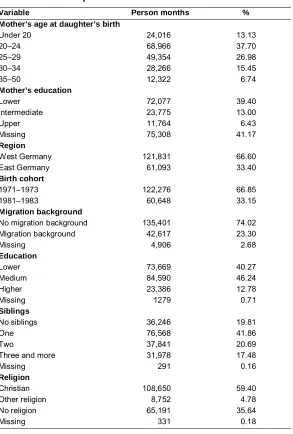
Table 1: Descriptive statistics
Variable Person months %
Mother’s age at daughter’s birth
Under 20 24,016 13.13
20–24 68,966 37.70
25–29 49,354 26.98
30–34 28,266 15.45
35–50 12,322 6.74
Mother’s education
Lower 72,077 39.40
Intermediate 23,775 13.00
Upper 11,764 6.43
Missing 75,308 41.17
Region
West Germany 121,831 66.60
East Germany 61,093 33.40
Birth cohort
1971–1973 122,276 66.85
1981–1983 60,648 33.15
Migration background
No migration background 135,401 74.02 Migration background 42,617 23.30
Missing 4,906 2.68
Education
Lower 73,669 40.27
Medium 84,590 46.24
Higher 23,386 12.78
Missing 1279 0.71
Siblings
No siblings 36,246 19.81
One 76,568 41.86
Two 37,841 20.69
Three and more 31,978 17.48
Missing 291 0.16
Religion
Christian 108,650 59.40
Other religion 8,752 4.78
No religion 65,191 35.64
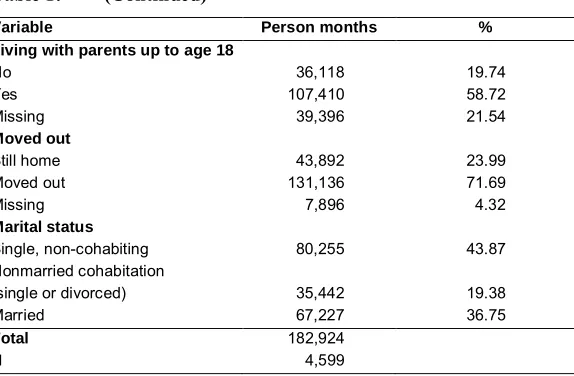
Table 1: (Continued)
Variable Person months %
Living with parents up to age 18
No 36,118 19.74
Yes 107,410 58.72
Missing 39,396 21.54
Moved out
Still home 43,892 23.99
Moved out 131,136 71.69
Missing 7,896 4.32
Marital status
Single, non-cohabiting 80,255 43.87 Nonmarried cohabitation
(single or divorced) 35,442 19.38
Married 67,227 36.75
Total 182,924
N 4,599
Source: Pairfam wave 1–3 and DemoDiff wave 1–2/3, own calculations.
4.4 Method and analytical strategy
mechanism measures6 are included in separate models to account for different
explanations in eastern and western Germany.
5. Results
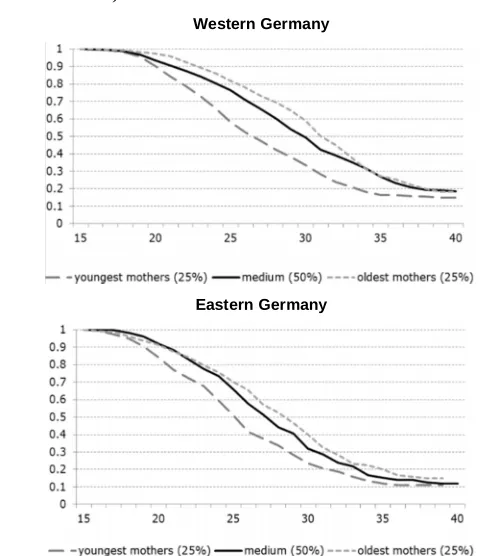
The KM survival estimates for the transition to first birth by a mother’s age at her daughter’s birth are shown in Figure 2. The categorisation shows very clear differences in daughters’ transition to motherhood by their mothers’ age at her birth in western Germany, yet the differences are less visible in eastern Germany. In line with previous research, daughters of the youngest mothers had their first child earlier than daughters of the oldest mothers in both regions. The medium 50% age group is closer to the oldest mothers, indicating that young motherhood in particular seems to influence their daughters. The KM survival curves suggest a somewhat more pronounced intergenerational transmission in western than in eastern Germany.
The median ages for a daughter’s transition to motherhood – comparing the youngest and oldest mothers – differ by four years in western Germany (youngest mothers: 27, medium: 30, oldest mothers: 31). In eastern Germany this difference amounts to only two years (youngest mothers: 26, medium: 27.5, oldest mothers: 28). The variation by a mother’s age is slightly higher when a mother’s age at first birth is considered instead of the age at her daughters’ birth – five years in western Germany and three years in eastern Germany (see Appendix Figure A-1).
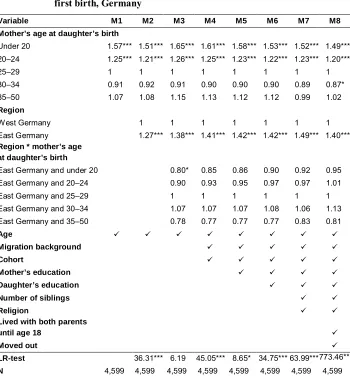
Table 2 shows the relevant results of the piecewise constant analysis using a mother’s age at her daughter’s birth (full models in Appendix Table A-2).7 Models 1
and 2 show the initial effect of eastern and western Germany and a mother’s age at her daughter’s birth, and Models 3 to 9 include the interaction term of these two variables. These models also display the mechanism variables included stepwise. Models 10 to 15 each include an additional interaction term between the region in Germany and the different variables capturing mechanisms.
6 Mechanism variables: mother’s education, number of siblings, religion, lived with both parents until age 18,
moved out, and marital status.
7 All models have been conducted with a mother’s age at first birth as well. The results are very similar with a
Figure 2: KM survival estimates for transition to first birth by mother’s age at daughter’s birth, western and eastern Germany (cohorts: 1971–1973, 1981–1983)
Western Germany
Eastern Germany
Source: Pairfam wave 1–3 and DemoDiff wave 1–2/3, own calculations. 0
0.1 0.2 0.3 0.4 0.5 0.6 0.7 0.8 0.9 1
15 20 25 30 35 40
youngest mothers (25%) medium (50%) oldest mothers (25%)
0 0.1 0.2 0.3 0.4 0.5 0.6 0.7 0.8 0.9 1
15 20 25 30 35 40
In examining whether intergenerational transmission can be found in eastern and western Germany, the results point to a transmission of fertility timing between mothers and daughters primarily in terms of young parenthood under the age of 25 in western Germany. This means that daughters whose mothers were younger than 25 have a significantly higher likelihood of having a first birth earlier than daughters of older mothers in western Germany. Daughters of mothers that were 25 years and older do not show differences in their transition to first birth. While overall women in eastern Germany are more likely to transition to motherhood than western German women, the interaction effect depicts only marginal differences in the effect of a mother’s age on her daughter in the two regions (Model 3). The results indicate a slightly weaker effect of mothers’ age on their daughters’ age at childbearing for eastern compared to western Germany, particularly among daughters of very young mothers. Consequently, if intergenerational transmission of fertility timing is stronger in western Germany, it is unlikely to bring about the still prevailing differences in age at first motherhood between both parts of the country.
In order to investigate the underlying mechanisms, various independent variables are included stepwise to observe the change in the effect of a mother’s age on her daughter’s transition to first birth (Models 5–9). In order to examine whether socioeconomic status transmission can explain the fertility transmission, controlling for the mother’s education reduces the impact of a mother’s age on her daughter’s transition to motherhood only negligibly in western Germany (Model 5). Hence, in these models, intergenerational status transmission cannot explain the fertility transmission – bearing in mind, however, that the high number of missing data in this category could be accountable for this result. It also indicates that having a higher educated mother leads to a reduced risk of first birth.8 However, this relationship
disappears when the daughter’s own education is included, pointing to a close interrelation between the parents’ and children’s education (Table A-2, Model 6).
Controlling for the socialisation proxies – number of siblings and religion – does not reduce the effect of a mother’s age at her daughter’s birth and therefore does not explain the intergenerational transmission in this analysis either (Model 7). Including these covariates, however, still improves the model fit significantly since growing up with three or more siblings has a large positive impact on daughters’ transition to motherhood (Kotte and Ludwig 2011). Usually, the remaining effect of a mother’s age on her daughter’s fertility is interpreted to be due to socialisation. That implies that controlling for socialisation aspects should reduce the effect of a mother’s age to some extent, which in this model they do not. This could either be due to other mechanisms
8 When additionally controlled for the father’s education, it seems that a higher education of the father in
that better explain the effect of a mother’s age on her daughter’s transition to parenthood, or it otherwise indicates that the measures used are insufficient to reflect socialisation; instead, actual information describing the mother’s and daughter’s values, norms, and preferences is necessary.
Whether and when women moved out of the parental home and whether they lived with both parents until age 18 is used to test for mechanisms underlying social control (Model 8). Results show that moving out of the parental home earlier increases the risk of a first birth significantly. The relationship weakens when marital status is included, pointing out that leaving the parental home is also associated with cohabiting/marrying earlier, but the effect remains high and significant (Table A-2, Model 9). Having lived with both parents until the age of 18 decreases the risk of a first birth slightly once marital status is accounted for. However, a mother’s age at her daughter’s birth is again only minimally affected by adding these covariates. The relationship between mothers’ and daughters’ timing of fertility cannot be explained by moving out of the parental home or the presence of both parents up until age 18, so according to these models the transmission of fertility timing cannot be explained through social control theory.
Table 2: Results of the piecewise constant analysis for daughter’s transition to first birth, Germany
Variable M1 M2 M3 M4 M5 M6 M7 M8
Mother’s age at daughter’s birth
Under 20 1.57*** 1.51*** 1.65*** 1.61*** 1.58*** 1.53*** 1.52*** 1.49*** 20–24 1.25*** 1.21*** 1.26*** 1.25*** 1.23*** 1.22*** 1.23*** 1.20***
25–29 1 1 1 1 1 1 1 1
30–34 0.91 0.92 0.91 0.90 0.90 0.90 0.89 0.87* 35–50 1.07 1.08 1.15 1.13 1.12 1.12 0.99 1.02
Region
West Germany 1 1 1 1 1 1 1
East Germany 1.27*** 1.38*** 1.41*** 1.42*** 1.42*** 1.49*** 1.40***
Region * mother’s age at daughter’s birth
East Germany and under 20 0.80* 0.85 0.86 0.90 0.92 0.95 East Germany and 20–24 0.90 0.93 0.95 0.97 0.97 1.01
East Germany and 25–29 1 1 1 1 1 1
East Germany and 30–34 1.07 1.07 1.07 1.08 1.06 1.13 East Germany and 35–50 0.78 0.77 0.77 0.77 0.83 0.81
Age
Migration background
Cohort
Mother’s education
Daughter’s education
Number of siblings
Religion
Lived with both parents
until age 18
Moved out
LR-test 36.31*** 6.19 45.05*** 8.65* 34.75*** 63.99***773.46** *
Table 2: (Continued)
Variable M9 M10 M11 M12 M13 M14 M15
Mother’s age at daughter’s birth
Under 20 1.27*** 1.28*** 1.26*** 1.28*** 1.27*** 1.26*** 1.26*** 20–24 1.15** 1.16** 1.15** 1.15** 1.15** 1.15** 1.14**
25–29 1 1 1 1 1 1 1
30–34 0.99 0.99 0.99 0.99 0.99 0.99 0.99
35–50 1.05 1.04 1.05 1.04 1.05 1.05 1.04
Region
West Germany 1 1 1 1 1 1 1
East Germany 1.39*** 1.46*** 1.27** 1.21* 1.66*** 1.24* 0.94
Region * mother’s age at daughter’s birth
East Germany and under 20 0.90 0.89 0.91 0.89 0.90 0.91 0.92 East Germany and 20–24 0.94 0.93 0.95 0.94 0.94 0.94 0.96
East Germany and 25–29 1 1 1 1 1 1 1
East Germany and 30–34 1.02 1.02 1.02 1.03 1.02 1.01 1.02 East Germany and 35–50 0.94 0.96 0.94 0.96 0.95 0.94 0.93
Age
Migration background
Cohort
Mother’s education
Daughter’s education
Number of siblings
Religion
Lived with both parents until age 18
Moved out
Marital status
Region * mother’s education
Region * no of siblings
Region * religion
Region * moving out
Region * both parents
Region * marital status
LR-test 2931.74** 4.44 5.18 12.26** 2.54 2.08 81.67***
N 4,599 4,599 4,599 4,599 4,599 4,599 4,599
Note:*** p<0.01, ** p<0.05, * p<0.1.
Finally, interaction terms between region and various variables accounting for the mechanisms have been included in the models (Models 10–15). None of these interaction effects explain or change the effect of a mother’s age at her daughter’s birth on her own transition to first birth in eastern or western Germany. Only two of the interaction effects improve the model fit and therefore add to the model: the interaction between religion and region, and between marital status and region. The interaction with religion shows that, in eastern Germany, women who say they are not religious are more likely to have a first child than nonreligious women in western Germany. While in western Germany Christian women display a higher transition rate than other women, religion does not seem to matter in eastern Germany (Table A-2, Model 12). Married western German women are considerably more likely to transition to first motherhood than single women or women in nonmarital cohabitation, while in eastern Germany women who are not married have a much higher likelihood of a first birth than their western German counterparts (Table A-2, Model 15). This indicates the decoupling of marriage and parenthood in eastern Germany and the still widespread child-centred marriage in western Germany (Goldstein et al. 2010). However, these interaction effects do not suggest differences in mechanisms that would explain the transmission of early parenthood in the two regions.
Consequently, intergenerational transmission of fertility timing was shown for early childbearing in western Germany; this relationship seems to be less pronounced in eastern Germany. Part of the explanation could be that the transition to adulthood (moving out of the parental home and starting a cohabitation/marriage) starts somewhat earlier in eastern than in western Germany, independent of a mother’s age. This also means that the more standardised life course in eastern Germany led to less variation and, therefore, fewer possibilities to be influenced by family background and that this pattern partly persisted even for younger cohorts after reunification. In western Germany, a mother’s age above 25 is not significantly associated with her daughter’s transition to first birth. This suggests that the transmission effect is limited to childbearing below the normative ages in particular. Having a first birth in their late twenties is nowadays the norm in western Germany, whereas earlier childbearing remains more prevalent in eastern Germany, partially as a result of greater social acceptance.
6. Conclusion
Germany, which may be caused by standardised life courses in eastern Germany that reduce intergenerational transmission of fertility timing. It appears that institutional transformation does not override established normative life course patterns entirely since younger cohorts in eastern Germany have not yet adopted the same patterns of intergenerational transmission as in western Germany. Consequently, we were able to confirm an intergenerational transmission effect of early childbearing for western and a mitigated effect for eastern Germany. This result complements previous research indicating a lack of intergenerational transmission for family size and family formation patterns in East Germany under the regulative regime of state socialism and thereafter (Fasang 2015; Van Winkle, Fasang, and Raab 2016), and adds to the knowledge that differences in the transmission of fertility timing are not as large as other family outcomes that have been studied before.
One limitation of the analysis at hand is a high number of missing data for a mother’s age at first birth, since it can only be based on wave 5 of the German Family Panel, and thus suffers from panel attrition. Therefore, a mother’s age at first birth was only used as a robustness check. Similarly, the missing data for a mother’s education is problematic; 41% of the data for mothers’ education is missing, which restricts the conclusions drawn on socioeconomic status transmission as a mechanism. Another limitation in this context is the operationalisation of socioeconomic status. Pairfam collects information on respondent’s parents including occupation and income; however, this information is only available at the time of the interview. To examine a daughter’s transition to first birth, however, their parent’s information is needed at the time of this transition or in their childhood. Consequently, our conclusions on the transmission of socioeconomic status need to be considered with caution. Finally, no obvious and correct way of operationalising socialisation exists. It is theoretically difficult to define and to measure without data on preferences.
The results presented, however, make three contributions to research on fertility determinants and intergenerational transmission. Firstly, referring to Balbo, Billari, and Mills’ (2013) review of fertility determinants, our results confirm the micro-level determinants of intergenerational transmission of behaviour from mothers to daughters at young ages. Based on our data, we cannot verify the effect of the socioeconomic status of the origin family as a fertility determinant. However, when analysing continuity of fertility, one should always have in mind that the two generations being compared live under different circumstances. Fertility depends on other determinants like partnerships, socioeconomic position, and uncertainties, which might create very different situations for the two generations and hinder transmission to a certain extent. Secondly, it has already been shown that the differences in previous policy and welfare measures between East and West Germany led to cross-country variation in fertility and life course patterns prior to reunification. Regional differences between eastern and western Germany were used to show how institutional contexts can mitigate intergenerational transmission of fertility for cohorts entering adulthood after reunification. Thirdly, the results contribute to the literature on regional differences in intergenerational transmission of fertility by focusing on fertility timing instead of family size or family formation trajectories.
regional differences will persist. Finally, the analysis was less insightful in explaining the underlying mechanisms of the transmission effect, which remains an important aspect for future research.
7. Acknowledgements
References
Anderton, D.L., Tsuya, N.O., Bean, L.L., and Mineau, G.P. (1987). Intergenerational transmission of relative fertility and life course patterns. Demography 24(4): 467–480.doi:10.2307/2061386.
Balbo, N., Billari, F.C., and Mills, M. (2013). Fertility in advanced societies: A review of research. European Journal of Population/Revue Européenne de Démographie29(1): 1–38.
Barber, J.S. (2000). Intergenerational influences on the entry into parenthood: Mothers’ preferences for family and nonfamily behavior. Social Forces 79(1): 319–348.
doi:10.1093/sf/79.1.319.
Barber, J.S. (2001). The intergenerational transmission of age at first birth among married and unmarried men and women. Social Science Research30(2): 219– 247.doi:10.1006/ssre.2000.0697.
Barber, J.S. and Axinn, W.G. (1998). The impact of parental pressure for grandchildren on young people’s entry into cohabitation and marriage. Population Studies 52(2): 129–144.doi:10.1080/0032472031000150336.
Beck, U. (1992).Risk society: Towards a new modernity. London: Sage.
Becker, O.A., Lois, D., and Nauck, B. (2010). Unterschiede in den Fertilitätsmustern zwischen ost- und westdeutschen Frauen: Differenzierung der Rollen des kulturellen Hintergrunds und des Transformationsprozesses. Comparative Population Studies – Zeitschrift für Bevölkerungsforschung35(1): 35–64. Blossfeld, H. (2010). Survival- und Ereignisdatenanalyse [Survival and event history
analysis]. In: Wolf, C. and Best, H. (eds.). Handbuch der sozialwissenschaftlichen Datenanalyse. Wiesbaden: VS Verlag für Sozialwissenschaften: 995–1015.doi:10.1007/978-3-531-92038-2_37.
Booth, A.L. and Kee, H.J. (2009). Intergenerational transmission of fertility patterns. Oxford Bulletin of Economics and Statistics71(2): 183–208. doi:10.1111/j.1468-0084.2008.00524.x.
Cunningham, M. (2001). The influence of parental attitudes and behaviors on children’s attitudes toward gender and household labor in early adulthood. Journal of Marriage and Family63(1): 111–122.doi:10.1111/j.1741-3737.2001.00111.x. Dahlberg, J. (2013). Family influences in fertility: A longitudinal analysis of sibling
correlations in first birth risk and completed fertility among Swedish men and women. Demographic Research 29(9): 233–246. doi:10.4054/DemRes.2013. 29.9.
Dahlberg, J. (2015). Social background and becoming a parent in Sweden: A register-based study of the effect of social background on childbearing in Sweden. European Journal of Population31(4): 417–444. doi:10.1007/s10680-015-9346-0.
De Valk, H.A.G. and Liefbroer, A.C. (2007). Timing preferences for women’s family-life transitions: Intergenerational transmission among migrants and Dutch. Journal of Marriage and Family69(1): 190–206.doi:10.1111/j.1741-3737.2006. 00353.x.
Dronkers, J. and Härkönen, J. (2008). The intergenerational transmission of divorce in cross-national perspective: Results from the Fertility and Family Surveys. Population Studies62(3): 273–288.doi:10.1080/00324720802320475.
Engelhardt, H., Trappe, H., and Dronkers, J. (2002). Differences in family policy and the intergenerational transmission of divorce: A comparison between the former East and West Germany. Demographic Research6(11): 295–324. doi:10.4054/ DemRes.2002.6.11.
Fasang, A.E. (2015). Intergenerationale Fertilitätstransmission in Ost- und Westdeutschland. Kölner Zeitschrift für Soziologie und Sozialpsychologie67(1): 11–40.doi:10.1007/s11577-015-0314-9.
Goldstein, J., Kreyenfeld, M., Huinink, J., Konietzka, D., and Trappe, H. (2010). Familie und Partnerschaft in Ost- und Westdeutschland: Ergebnisse im Rahmen des Projektes „Demographic differences in life course dynamics in Eastern and Western Germany” [electronic resource]. Rostock: Max-Planck-Institut für demographische Forschung. http://www.demogr.mpg.de/files/press/1832_ familie_und_partnerschaft_ost_west.pdf.
Härkönen, J. (2014). Birth order effects on educational attainment and educational transitions in West Germany. European Sociological Review 30(2): 166–179.
Hogan, D.P. and Kitagawa, E.M. (1985). The impact of social status, family structure, and neighborhood on the fertility of black adolescents. American Journal of Sociology90(4): 825–855.doi:10.1086/228146.
Huinink, J., Brüderl, J., Nauck, B., Walper, S., Castiglioni, L., and Feldhaus, M. (2011). Panel analysis of intimate relationships and family dynamics (pairfam): Conceptual framework and design. Zeitschrift für Familienforschung23(1): 77– 101.
Huinink, J., Mayer, K.U., Solga, H., Sørensen, A., and Trappe, H. (1995).Kollektiv und Eigensinn: Lebensverläufe in der DDR und danach [Collectivity and individuality: Life courses in the GDR and after reunification]. Berlin: Akademie Verlag.doi:10.1524/9783050071497.
Jennings, J.A. and Leslie, P.W. (2012). Differences in intergenerational fertility associations by sex and race in Saba, Dutch Caribbean, 1876–2004. The History of the Family18(2): 1–19.
Kolk, M. (2014). Understanding transmission of fertility across multiple generations: Socialization or socioeconomics? Research in Social Stratification and Mobility 35: 89–103.doi:10.1016/j.rssm.2013.09.006.
Kolk, M., Cownden, D., and Enquist, M. (2014). Correlations in fertility across generations: Can low fertility persist? Proceedings of the Royal Society of London B 281: 20132561.doi:10.1098/rspb.2013.2561.
Kotte, M. and Ludwig, V. (2011). Intergenerational transmission of fertility intentions and behaviour in Germany: The role of contagion. Vienna Yearbook of Population Research9: 207–226.doi:10.1553/populationyearbook2011s207. Kreyenfeld, M. (2004). Fertility decisions in the FRG and GDR: An analysis with data
from the German Fertility and Family Survey. Demographic Research S3(11): 275–318.doi:10.4054/DemRes.2004.S3.11.
Kreyenfeld, M. (2006). Family formation in East and West Germany before and after unification. In: Gustafsson, S. and Kalwij, A. (eds.). Education and postponement of maternity: Economic analyses for industrialized countries. Amsterdam: Springer: 225–236.doi:10.1007/1-4020-4716-9_9.
Liefbroer, A.C. and Elzinga, C.H. (2012). Intergenerational transmission of behavioural patterns: How similar are parents’ and children’s demographic trajectories? Advances in Life Course Research17(1): 1–10.doi:10.1016/j.alcr.2012.01.002. Manlove, J. (1997). Early motherhood in an intergenerational perspective: The
experiences of a British cohort. Journal of Marriage and the Family59(2): 263– 279.doi:10.2307/353469.
Mayer, K.U. (2006). After the fall of the wall: Living through the post-socialist transformation in East Germany. In: Diewald, M., Goedicke, A., and Mayer, K.U. (eds.).After the fall of the wall: Life courses in the transformation of East Germany. Stanford: Stanford University Press: 1–28. doi:10.11126/stanford/ 9780804752084.003.0001.
McLanahan, S. and Bumpass, L. (1988). Intergenerational consequences of family disruption. American Journal of Sociology94(1): 130–152.doi:10.1086/228954. Murphy, M. (1999). Is the relationship between fertility of parents and children really weak? Biodemography and Social Biology46(1–2): 122–145.doi:10.1080/1948 5565.1999.9988991.
Murphy, M. and Knudsen, L.B. (2002). The intergenerational transmission of fertility in contemporary Denmark: The effects of number of siblings (full and half), birth order, and whether male or female. Population Studies 56(3): 235–248.
doi:10.1080/00324720215937.
Müller, B. and Castiglioni, L. (2015). Attrition im Beziehungs- und Familienpanel pairfam [Attrition in the German family panel pairfam]. In: Schupp, J. and Wolf, C. (eds.). Nonresponse bias: Qualitätssicherung sozialwissenschaftlicher Umfragen. Wiesbaden: Springer: 383–408.doi:10.1007/978-3-658-10459-7_12. Nauck, B., Brüderl, J., Huinink, J., and Walper, S. (2014). The German family panel
(pairfam): GESIS data archive, Cologne, ZA5678 data file version 5.0.0. Mannheim: GESIS – Leibniz-Institut für Sozialwissenschaften. doi:10.4232/ pairfam.5678.5.0.0.
Pearson, K., Lee, A., and Bramley-Moore, L. (1899). Mathematical contributions to the theory of evolution – VI genetic (reproductive) selection: Inheritance of fertility in man, and of fecundity in thoroughbred racehorses. Philosophical Transactions of the Royal Society of London, Series A192: 257–330.doi:10.10 98/rsta.1899.0006.
Pollak, R. (2011). Soziale Mobilität [Social mobility]. In: Statistisches Bundesamt and Wissenschaftszentrum Berlin für Sozialforschung (eds.). Datenreport 2011: Ein Sozialbericht für die Bundesrepublik Deutschland. Bonn: Bundeszentrale für politische Bildung: 180–187.
Raab, M. (2017). Childhood family structure and early family formation in East and West Germany. Journal of Marriage and Family79(1): 110–130.doi:10.1111/ jomf.12333.
Reher, D.S., Ortega, J.A., and Sanz-Gimeno, A. (2008). Intergenerational transmission of reproductive traits in Spain during the demographic transition. Human Nature: An Interdisciplinary Biosocial Perspective 19(1): 23–43. doi:10.1007/ s12110-008-9032-6.
Rijken, A.J. and Liefbroer, A.C. (2009). Influences of the family of origin on the timing and quantum of fertility in the Netherlands. Population Studies63(1): 71–85.
doi:10.1080/00324720802621575.
Schneider, S.L. (2008). Applying the ISCED-97 to the German educational qualifications. In: Schneider, S.L. (ed.).The international standard classification of education (ISCED-97): An evaluation of content and criterion validity for 15 European countries. Mannheim: Mannheimer Zentrum für Europäische Sozialforschung: 77–102.
Schnor, C. and Bastin, S. (2014). Partners and babies: Partnership and fertility histories of the German family panel (pairfam/DemoDiff, waves 1–3) as an event history data set. München: Pairfam (Pairfam technical paper 03).
Sieben, I., Huinink, J., and De Graaf, P.M. (2001). Family background and sibling resemblance in educational attainment: Trends in the former FRG, the former GDR, and the Netherlands. European Sociological Review 17(4): 401–430.
doi:10.1093/esr/17.4.401.
Silbereisen, R.K., Schwarz, B., and Rinker, B. (1995). The timing of psychosocial transitions in adolescence: Commonalities and differences in unified Germany. New Directions for Child and Adolescent Development70: 23–38.doi:10.1002/ cd.23219957004.
Thornton, A. (1991). Influence of the marital history of parents on the marital and cohabitational experiences of children. American Journal of Sociology 96(4): 868–894.doi:10.1086/229611.
Proceedings of the International Conference on Sequence Analysis and Related Methods: Lausanne, June 8–10, 2016. Bern: Swiss National Science Foundation: 509–534.https://lacosa.lives-nccr.ch/sites/lacosa.lives-nccr.ch/files/ proc-lacosa2-vanwinklefasangraab_paper_57.pdf.
Wolfinger, N.H. (1999). Trends in the intergenerational transmission of divorce. Demography36(3): 415–420.doi:10.2307/2648064.
Appendix
Table A-1: Operationalisation of level of education based on highest school and vocational degree
Highest school degree Highest vocational degree
In school No vocational degree
Lower Middle Higher University/ doctorate
Lower L L L L M M
Intermediate L L M M H H
Higher M M M M H H
Note: L: lower education, M: medium education, H: higher education.
Figure A-1: KM survival estimates for transition to first birth by mother’s age at first birth, western and eastern Germany (cohorts: 1971–1973, 1981–1983)
Western Germany
Eastern Germany
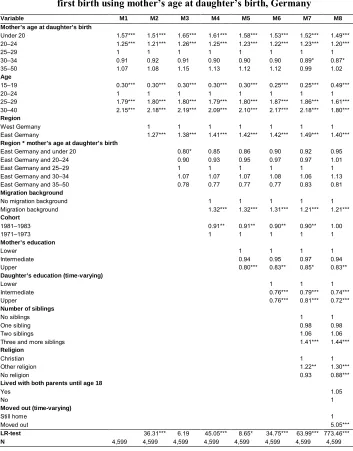
Table A-2: Results of the piecewise constant analysis for daughter’s transition to first birth using mother’s age at daughter’s birth, Germany
Variable M1 M2 M3 M4 M5 M6 M7 M8
Mother’s age at daughter’s birth
Under 20 1.57*** 1.51*** 1.65*** 1.61*** 1.58*** 1.53*** 1.52*** 1.49*** 20–24 1.25*** 1.21*** 1.26*** 1.25*** 1.23*** 1.22*** 1.23*** 1.20***
25–29 1 1 1 1 1 1 1 1
30–34 0.91 0.92 0.91 0.90 0.90 0.90 0.89* 0.87*
35–50 1.07 1.08 1.15 1.13 1.12 1.12 0.99 1.02
Age
15–19 0.30*** 0.30*** 0.30*** 0.30*** 0.30*** 0.25*** 0.25*** 0.49***
20–24 1 1 1 1 1 1 1 1
25–29 1.79*** 1.80*** 1.80*** 1.79*** 1.80*** 1.87*** 1.86*** 1.61*** 30–40 2.15*** 2.18*** 2.19*** 2.09*** 2.10*** 2.17*** 2.18*** 1.80***
Region
West Germany 1 1 1 1 1 1 1
East Germany 1.27*** 1.38*** 1.41*** 1.42*** 1.42*** 1.49*** 1.40***
Region * mother’s age at daughter’s birth
East Germany and under 20 0.80* 0.85 0.86 0.90 0.92 0.95
East Germany and 20–24 0.90 0.93 0.95 0.97 0.97 1.01
East Germany and 25–29 1 1 1 1 1 1
East Germany and 30–34 1.07 1.07 1.07 1.08 1.06 1.13
East Germany and 35–50 0.78 0.77 0.77 0.77 0.83 0.81
Migration background
No migration background 1 1 1 1 1
Migration background 1.32*** 1.32*** 1.31*** 1.21*** 1.21***
Cohort
1981–1983 0.91** 0.91** 0.90** 0.90** 1.00
1971–1973 1 1 1 1 1
Mother’s education
Lower 1 1 1 1
Intermediate 0.94 0.95 0.97 0.94
Upper 0.80*** 0.83** 0.85* 0.83**
Daughter’s education (time-varying)
Lower 1 1 1
Intermediate 0.76*** 0.79*** 0.74***
Upper 0.76*** 0.81*** 0.72***
Number of siblings
No siblings 1 1
One sibling 0.98 0.98
Two siblings 1.06 1.06
Three and more siblings 1.41*** 1.44***
Religion
Christian 1 1
Other religion 1.22** 1.30***
No religion 0.93 0.88***
Lived with both parents until age 18
Yes 1.05
No 1
Moved out (time-varying)
Still home 1
Moved out 5.05***
LR-test 36.31*** 6.19 45.05*** 8.65* 34.75*** 63.99*** 773.46***
Table A-2: (Continued)
Variable M9 M10 M11 M12 M13 M14 M15 Mother’s age at daughter’s birth
Under 20 1.27*** 1.28*** 1.26*** 1.28*** 1.27*** 1.26*** 1.26***
20–24 1.15** 1.16** 1.15** 1.15** 1.15** 1.15** 1.14**
25–29 1 1 1 1 1 1 1
30–34 0.99 0.99 0.99 0.99 0.99 0.99 0.99
35–50 1.05 1.04 1.05 1.04 1.05 1.05 1.04
Age
15–19 0.80*** 0.80*** 0.80*** 0.81*** 0.80*** 0.80*** 0.79***
20–24 1 1 1 1 1 1 1
25–29 1.15*** 1.15*** 1.15*** 1.15*** 1.15*** 1.15*** 1.16***
30–40 1.06 1.06 1.06 1.06 1.05 1.06 1.06
Region
West Germany 1 1 1 1 1 1 1
East Germany 1.39*** 1.46*** 1.27** 1.21* 1.66*** 1.24* 0.94
Region * mother’s age at daughter’s birth
East Germany and under 20 0.90 0.89 0.91 0.89 0.90 0.91 0.92
East Germany and 20–24 0.94 0.93 0.95 0.94 0.94 0.94 0.96
East Germany and 25–29 1 1 1 1 1 1 1
East Germany and 30–34 1.02 1.02 1.02 1.03 1.02 1.01 1.02
East Germany and 35–50 0.94 0.96 0.94 0.96 0.95 0.94 0.93
Migration background
No migration background 1 1 1 1 1 1 1
Migration background 1.01 1.02 1.02 1.02 1.02 1.01 1.01
Cohort
1971–1973 1 1 1 1 1 1 1
1981–1983 1.07* 1.07* 1.07 1.07 1.07 1.08* 1.06
Mother’s education
Lower 1 1 1 1 1 1 1
Intermediate 1.04 0.89 1.05 1.05 1.04 1.05 1.04
Upper 0.94 0.99 0.94 0.95 0.94 0.94 0.95
Daughter’s education (time-varying)
Lower 1 1 1 1 1 1 1
Intermediate 0.71*** 0.71*** 0.71*** 0.71*** 0.71*** 0.71*** 0.71***
Upper 0.70*** 0.70*** 0.70*** 0.70*** 0.70*** 0.70*** 0.71***
Number of siblings
No siblings 1 1 1 1 1 1 1
One sibling 1.00 1.00 0.95 1.00 1.00 1.00 0.99
Two siblings 1.04 1.04 1.00 1.04 1.04 1.04 1.04
Three and more siblings 1.33*** 1.33*** 1.28** 1.32*** 1.33*** 1.34*** 1.31***
Religion
Christian 1 1 1 1 1 1 1
Other religion 0.73*** 0.73*** 0.73*** 0.75*** 0.73*** 0.74*** 0.71***
No religion 0.97 0.97 0.97 0.85** 0.97 0.97 0.96
Lived with both parents until age 18
Yes 0.91* 0.92* 0.92* 0.91* 0.91* 0.86* 0.92*
No 1 1 1 1 1 1 1
Moved out (time-varying)
Still home 1 1 1 1 1 1 1
Table A-2: (Continued)
Variable M9 M10 M11 M12 M13 M14 M15 Marital status (time-varying)
Single, no cohabitation 0.05*** 0.05*** 0.05*** 0.05*** 0.05*** 0.05*** 0.04*** Nonmarital cohabitation 0.26*** 0.26*** 0.26*** 0.26*** 0.26*** 0.26*** 0.20***
Married 1 1 1 1 1 1 1
Region * mother’s education
East Germany and lower 1
East Germany and intermediate 1.21
East Germany and upper 0.84
Region * no of siblings
East Germany and no siblings 1
East Germany and one sibling 1.12
East Germany and two siblings 1.10
East Germany and three + siblings 1.10
Region * religion
East Germany and Christian 1
East Germany and other religion 0.79
East Germany and no religion 1.35**
Region * moved out
East Germany and still home 1
East Germany and moved out 0.82
Region * lived with both parents until age 18
East Germany and yes 1.15
East Germany and no 1
Region * marital status
East Germany and single, no
cohabitation 2.27***
East Germany and nonmarital
cohabitation 1.94***
East Germany and married 1
LR-test 2931.74*** 4.44 5.18 12.26** 2.54 2.08 81.67***
N 4,599 4,599 4,599 4,599 4,599 4,599 4,599
Note: Controlled for missing categories. *** p<0.01, ** p<0.05, * p<0.1. Source: Pairfam wave 1-3 and DemoDiff wave 1-2, own calculations.
Table A-3: Daughter’s median age at moving out, at first cohabitation/marriage, and at first birth by mother’s age at her daughter’s birth for western and eastern Germany
Mother’s age at daughter’s birth Moving out Cohabitation/marriage First birth
West East West East West East
Youngest 25% 20 19 23 21 27 26
Medium 21 20 24 22 30 27.5
Oldest 25% 21 20 24 22 31 28