STUDENTS: EVALUATION OF A SOCIAL INTEGRATION PROGRAM
by
James David Jensen
A dissertation
submitted in partial fulfillment of the requirements for the degree of
Doctor of Education in Curriculum and Instruction Boise State University
DEFENSE COMMITTEE AND FINAL READING APPROVALS
of the dissertation submitted by
James David Jensen
Dissertation Title: Increasing Retention Among First-Year Master’s in Counseling Students: Evaluation of a Social Integration Program
Date of Final Oral Examination: 16 November 2017
The following individuals read and discussed the dissertation submitted by student James David Jensen, and they evaluated his presentation and response to questions during the final oral examination. They found that the student passed the final oral examination. Aida Midgett, Ed.D. Co-Chair, Supervisory Committee Diana M. Doumas, Ph.D. Co-Chair, Supervisory Committee Raissa Miller, Ph.D. Member, Supervisory Committee Regina R. Moro, Ph.D. Member, Supervisory Committee Claudia Peralta, Ph.D. Member, Supervisory Committee
iv
This dissertation is dedicated with love to my family and friends, whose prayers and encouragement provided me the strength and endurance to push through to the finish line whenever I felt unable to complete this dissertation. The texts, messages, phone calls, and hugs helped more than you know.
A special thanks goes to my parents, David and Carol. Thank you for your unwavering support, as well as the coffees, snacks, and willing fulfillment of countless other requests that aided me throughout the last few years.
To my children, Lauryl and Lacey, thank you for being patient with the times I couldn’t be there to help with homework, be home for dinner, or attend performances. I’m grateful for the strong relationships we have and I am proud of the strong, amazing young women you have grown to become.
Finally, to my wife, Erin, thank you for continuing to support me when I was not emotionally or physically present. You built a house and moved us, took care of finances and household tasks, and often functioned as a single parent for over three years. I know my program was more difficult for you than it was for me, for you not only witnessed my challenges; you experienced and compensated for them every day. Thank you for picking me up when I was down (literally!), and for sticking by my side every step of the way.
v
Thank you to each member of my committee for the time you invested into helping me reach the completion of this journey. Your suggestions, insight, and support were instrumental in the completion of this dissertation.
Without the patience and expert guidance of my co-chairs, Drs. Aida Midgett and Diana Doumas, this dissertation would never have been possible. I cannot thank you enough for all of the time you spent with (and without) me helping to improve the logistics of this research, encouraging me to submit papers for publication, responding to my emails at all hours, and polishing each page of this manuscript. Together, we worked through challenges and celebrated accomplishments. You provided me exactly what I needed to be successful in reaching this goal.
vi
vii
viii
ix
DEDICATION ... iv
ACKNOWLEDGEMENTS ...v
AUTOBIOGRAPHICAL SKETCH OF AUTHOR ... vi
ABSTRACT ... vii
LIST OF TABLES ... xiv
LIST OF ABBREVIATIONS ...xv
CHAPTER ONE: INTRODUCTION ...1
1.1 Introduction ...1
1.2 The Problem of Retention ...3
1.3 Reasons for Program Discontinuation ...4
1.4 Tinto’s Integration Model ...5
1.5 Application of Tinto’s Model to Retention in Graduate Programs ...6
1.6 Application of Tinto’s Model to Retention in CE Programs ...7
1.7 The Social Integration Program ...8
1.7.1 Orientation Dinner ...8
1.7.2 Summer Community Project...9
1.7.3 Peer-Mentoring Program ...9
1.7.4 Fall Picnic ...9
x
CHAPTER TWO: ENHANCING PROGRAM SATISFACTION AND RETENTION AMONG FIRST-YEAR MASTER OF ARTS IN COUNSELING STUDENTS: A
QUALITATIVE STUDY ...15
Abstract ...17
2.1 Introduction ...18
2.2 Retention and Sense of Belonging ...19
2.3 The Current Study ...21
2.4 Methods...22
2.4.1 Participants ...22
2.4.2 Procedures ...23
2.5 Data Analysis ...23
2.6 Results ...24
2.6.1 Connection with Students in Cohort ...25
2.6.2 Trusting Relationship with Faculty ...26
2.6.3 Social Integration Activities ...26
2.6.4 Classroom Activities and Personal Growth ...28
2.7 Discussion ...29
2.8 Limitations and Directions for Future Research ...30
2.9 Counselor Education Implications ...31
2.10 References ...32
CHAPTER THREE: EVALUATION OF THE IMPACT OF A SOCIAL INTEGRATION PROGRAM ON SENSE OF BELONGING AMONG MASTER’S COUNSELING STUDENTS...35
xi
3.2 The Current Study ...41
3.3 Methods...41
3.3.1 Participants ...41
3.3.2 Procedures ...42
3.3.3 Instruments ...42
3.3.4 Social Integration Program ...43
3.3.5 Orientation Dinner ...44
3.3.6 Summer Community Project...44
3.3.7 Peer-Mentoring Program ...44
3.3.8 Fall Picnic ...45
3.3.9 Individual Advising Meeting ...45
3.4 Statistical Analysis ...46
3.5 Results ...46
3.6 Discussion ...47
3.6.1 Limitations and Directions for Future Research ...48
3.7 Conclusion ...48
3.8 References ...50
CHAPTER FOUR: EVALUATION OF A PROGRAM DESIGNED TO INCREASE RETENTION IN COUNSELOR EDUCATION...55
Abstract ...57
4.1 Introduction ...58
4.2 The Current Study ...61
xii
4.3.2 Procedures ...63
4.3.3 Instruments ...64
4.3.4 Retention Activities ...64
4.3.5 Orientation Dinner ...65
4.3.6 Peer-Mentoring Program ...65
4.3.7 Summer Community Project...65
4.3.8 Fall Picnic ...66
4.3.9 Individual Advising Meeting ...67
4.4 Data Analysis ...67
4.5 Results ...68
4.5.1 Retention from Orientation to Fall Year 2 ...68
4.5.2 Retention from Orientation to Fall Year 1 ...68
4.5.3 Retention from Fall Year 1 to Fall Year 2 ...68
4.6 Discussion ...69
4.6.1 Limitations and Directions for Future Research ...70
4.6.2 Implications for Counselor Education ...71
4.7 Conclusion ...73
4.8 References ...74
CHAPTER FIVE: SUMMARY ...80
5.1 Summary ...80
APPENDIX A ...83
xiii
xiv
xv
ACES Association for Counselor Education and Supervision CACREP Council for the Accreditation of Counseling and Other
Related Programs
CE Counselor Education
CSJ Counselors for Social Justice
MA Master of Arts
SOBS Sense of Belonging Scales
CHAPTER ONE: INTRODUCTION 1.1 Introduction
This dissertation is comprised of three separate manuscripts that represent different aspects of a study involving a program designed to increase retention among master’s level Counselor Education (CE) students. Each manuscript stands alone, but is also integrated with the other manuscripts in this dissertation to address the overarching topic of student retention in master’s level CE programs. As the chapters progress, they provide additional depth into an analysis of a program designed to increase student satisfaction, sense of belonging, and ultimately, retention. Chapters Two, Three and Four include articles that were written for publication in CE journals. These chapters contain abstracts that detail the premise of each article.
suggest it may be helpful for faculty to engage first-year students in social integration activities to increase satisfaction, with the ultimate goal of increasing retention.
Chapter Three contains a study entitled, “Evaluation of the Impact of a Social Integration Program on Sense of Belonging among Master’s Counseling Students.” In this manuscript, the impact of the Social Integration Program on sense of belonging among first-year master’s students enrolled in a CE program is examined. In this study, sense of belonging was compared between first-year students from two cohorts (program cohort and control cohort) using a quasi-experimental design. Findings did not support our hypothesis that students who participated in the Social Integration Program would report a higher sense of belonging compared to the control cohort. Methodological limitations of the study, however, may have contributed to the lack of differences between the cohorts and these are discussed at the end of Chapter Three.
Chapter Four is a manuscript entitled “Evaluation of a Program Designed to Increase Retention in Counselor Education.” This manuscript is theoretically grounded in Tinto’s (1975) well-established integration model, which examines students’
perceptions of fit or sense of belonging to the institution in relation to the likelihood of completing their education. There is a gap in the literature in identifying programs
control cohort. This manuscript discusses possible implications describing the importance of peer relationships in CE programs, especially during the first year of a program.
1.2 The Problem of Retention
Student retention is an ongoing concern on college campuses across the United States (Barefoot, 2004; Braxton, 2008; Hamshire, Willgoss, & Wibberley, 2013;
Mckendry, Wright, & Stevenson, 2014). While precise percentages vary from year to
year, national survey data indicate the retention rate for graduate education is 71-75%
(ACT, 2016), suggesting nearly one quarter of graduate students do not complete their program of study. This represents a reduction in future opportunities for personal and educational growth among students (Engstrom & Tinto, 2008), as well as a substantial
financial loss to institutions of higher education (Barefoot, 2004; Hamshire, Willgoss &
Wibberley, 2012; Nandeshwar et al., 2011). Student attrition is especially concerning for
smaller programs that depend on student tuition and fees to remain viable (Raisman, 2013). As higher education experiences a reduction in funding from traditional resources, student attrition in smaller, more specialized areas of study, like those found in graduate programs, may lead to program discontinuation if corrective steps are not implemented. Thus, there is a need to investigate effective retention practices to increase graduate student degree completion rates (Casstevens, Waites, & Outlaw, 2012).
Although attrition can occur at any point, the first year is often recognized as the
most critical time to determine if students will persevere and obtain their degree
(Hamshire et al., 2012; Stagg & Kimmins, 2014; Tinto, 2006). Researchers have found
that the first year is the most significant time for the establishment of important
These relationships can be formed inside or outside of the classroom, with other students, faculty, or additional representatives from the educational setting (Tinto, 2006).
1.3 Reasons for Program Discontinuation
The reasons why students do not continue their education are multifaceted and are impacted by overlapping and inter-related interpersonal, social, and environmental (e.g. campus) variables (Hausmann, Ye, Schofield, & Woods, 2009). Family expectations can deter a student from collegiate pursuits or result in a sense of obligation for completing a college degree. Other factors that may prevent students from obtaining a college degree include difficulties obtaining financial aid, working long hours (Hernandez & Lopez, 2004), and perceived usefulness and applicability of one’s college degree (Park, Boman, Care, Edwards, & Perry, 2008). Faculty/staff-student interactions outside the classroom, mentoring, and student organization involvement also contribute to a student’s
integration and degree completion (Hernandez & Lopez, 2004).
These are important factors to consider when attempting to understand reasons for program discontinuation for this population.
1.4 Tinto’s Integration Model
Because retention is a significant area of interest across college campuses, many philosophies of why students persevere in their education have been postulated. Of the multiple theories that describe persistence and withdrawal behavior in higher education, one of the most comprehensive and well respected is Tinto’s integration model (Tinto, 1975, 1997, 2006). Based on over 40 years of research, Tinto’s work has been the foundation for much of what is known about retention in colleges and universities today (Kalsbeek & Zucker, 2013). Tinto’s early writings focused on how institutional settings and characteristics interact with the attributes of students to impact attrition (Tinto, 1975, 1993). His later work focused more specifically on differences in retention and
completion rates based on educational setting (Tinto, 2012).
Tinto’s integration model explores how students’ perceptions of fit or sense of belonging to the university contributes to retention. Tinto’s model suggests that students enter college with a collection of unique traits that play a role in the decision to stay or leave the educational setting. Some of these characteristics include socioeconomic status, education level of parents, family expectations, race, gender, and personal academic ability. Prior educational experiences may also play a role in college success. Awareness of the personal characteristics that factor into retention provides insight into potential student risk factors, although implementing a plan of action to address individual
Tinto’s model emphasizes the need for social integration, which includes building relationships with peer groups or cohorts, activities inside and outside the classroom, and connections with faculty. The model links academic and social engagement to student success (Tinto, 1975), as well as providing an understanding of the importance of experiences within the classroom (Tinto, 2006). In addition to social engagement, which involves clubs and the social network of college life, academic engagement includes interaction with faculty, classmates, and other campus personnel (Tinto, 1993). Academic engagement has a clear connection with degree completion, while the connection
between social engagement or “interpersonal relatedness” and retention is more
ambiguous (Flynn, 2014). Research investigating Tinto’s model indicates this feeling of “interpersonal relatedness” has an impact on retention, although the pathway to
experiencing this sense of connection is not clear (Hoffman et al., 2002).
1.5 Application of Tinto’s Model to Retention in Graduate Programs Research supports the importance of social integration in graduate student retention (Braxton, 2008; Casstevens et al., 2012; Hamblet, 2015; Gardner & Barnes, 2007; Stagg & Kimmins, 2014). Students in graduate programs report wanting greater partnerships with academic units, as well as more consistent and accurate communication from program faculty (Pontius & Harper, 2006). Additionally, connecting with other students and program faculty can deter non-traditional graduate students from departing from their programs by buffering them from feeling marginalized (Gardner, 2008).
embedding socialization activities within coursework during the first year of a graduate program is associated with increased opportunities to build peer networks (Casstevens et al., 2012), as well as increased confidence and self-esteem (Stagg & Kimmins, 2014). Further, researchers have found when graduate students engage in meaningful discourse and strategic planning with university professionals, faculty, and staff both inside and outside the classroom, they experience a greater sense of community that is associated with student persistence to graduation (Pontius & Harper, 2006).
1.6 Application of Tinto’s Model to Retention in CE Programs
A handful of studies have been conducted with doctoral CE students (Baltrinic, Waugh, & Brown, 2013; Burkholder & Janson, 2013; Hoskins & Goldberg, 2005; Protivnak & Foss, 2009), with findings consistent with Tinto’s integration model (Tinto,
1975, 1997). Specifically, researchers have found it is important for CE faculty to
understand personal issues, such as stamina, role transition, financial difficulties, as well as other life obligations to support doctoral students in overcoming barriers to program completion (Protivnak & Foss, 2009). Retention is also related to faculty mentoring (Burkholder & Janson, 2013; Protivnak & Foss, 2009), positive student-faculty
relationships (Baltrinic et al., 2013; Burkholder & Janson, 2013; Hoskins & Goldberg, 2005), a feeling of sense of community (Hoskins & Goldberg, 2005), and support from peers (Burkholder & Janson, 2013).
Although there are some studies suggesting an association between social
focused on the ethical practice of removing underperforming students from CE programs (Brown, 2013; Swank & Smith-Adcock, 2014; Ziomek-Daigle & Christensen, 2010) rather than reasons for self-initiated program discontinuation. Increasing retention is important to maintain viability for master’s programs in Counselor Education. Because of the dearth of literature in this area, the purpose of this dissertation was to design,
implement, and evaluate a program based on Tinto’s social integration model to increase satisfaction, sense of belonging, and retention among first-year students in a master’s level CE program.
1.7 The Social Integration Program
The program designed for this dissertation is based on Tinto’s integration model (Tinto, 1975, 1997). The program activities were designed to connect first year students with one-another, current students from other cohorts, and program faculty. These activities included 1) a spring orientation dinner attended by all students in the program and faculty 2) a formal connection to a mentor in the 2nd year of the program, 3) a
summer Counselors for Social Justice student organization community service project, 4) a fall picnic for first-year students, their families, and faculty, and 5) a fall meeting with the faculty advisor.
1.7.1 Orientation Dinner
1.7.2 Summer Community Project
In partnership with the Department of Counselor Education Counselors for Social Justice (CSJ) student organization, a community service project was held during the summer prior to students beginning their course work. CSJ officers selected an agency with the mission to address local community needs by providing a sustainable model of food training and educational programs. The community service project took place in July and concluded with a meal for all student participants.
1.7.3 Peer-Mentoring Program
In partnership with the local chapter of Chi Sigma Iota, a student a peer-mentor was assigned to each incoming student. Students currently enrolled in their second year in the program served as peer-mentors. The purpose of the mentoring relationship was for incoming students to have an opportunity to develop a meaningful relationship with another student who could provide information about the program, as well as support. Program faculty requested that peer-mentors and mentees plan on follow-up times throughout the semester.
1.7.4 Fall Picnic
1.7.5 Individual Advising Meeting
Incoming students in the program cohort completed a survey during orientation. The survey included items assessing employment responsibilities outside of school, desire to complete the program, campus involvement, and previous educational experience. The faculty advisor used this information to guide conversations with
students during required individual advising meetings conducted during the fall semester. The studies in this dissertation were designed to evaluate the Social Integration
Program using both qualitative and quantitative research designs. Chapter Two contains
an article examining the impact of this program using a qualitative design with data
collected in a focus group format. Chapter Three builds upon this work by examining the
impact of the program on sense of belonging using a quasi-experimental design,
comparing the program cohort to a control cohort. Finally, Chapter Four builds upon this
work by examining the effectiveness of the program on increasing retention by
comparing the program cohort to a control cohort using a quasi-experimental design and
1.8 References
ACT (2016). Retention trends 1983-2016. National collegiate retention and
persistence-to-degree rates. Retrieved from: https://www.ruffalonl.com/documents/shared/ Papers_and_Research/ACT_Data/ACT_2016.pdf
Baltrinic, E. R., Waugh, J. A., & Brown, S. (2013). Faculty and student perspectives on what helps counselor education doctoral students towards program completion.
The International Journal of Q Methodology, 36, 253-271.doi:10.15133/j.os.2012.014
Barefoot, B. (2004). Higher education's revolving door: Confronting the problem of student drop out in US colleges and universities. Open Learning, 19, 9–18. doi.org:10.1080/0268051042000177818
Braxton, J. M. (2008). Toward a scholarship of practice centered on college student retention. New Directions in Teaching and Learning, 115,
101-112.doi.org:10.1002/tl.328
Brown, M. (2013). A content analysis of problematic behavior in counselor education programs. Counselor Education and Supervision, 52, 179–192.
doi:10.1002/j.1556-6978.2013.00036.x
Burkholder, D., & Janson, C. (2013). Supporting PhD completion: Student and faculty perspectives. The International Journal of Q Methodology, 36,
272-287.doi:10.15133/j.os.2012.015
Casstevens, W. J., Waites, C., & Outlaw, N. (2012). Non-traditional student retention: Exploring perceptions of support in a social work graduate program. Social Work Education, 31, 256-268. doi:10.1080/02615479.2011.556188
Crombie, A., Brindley, J., Harris, D., Marks-Marin, D., & Thompson, T. M. (2013). Factors that enhance rates of completion: What makes students stay? Nurse Education Today, 33, 1282-1287. doi:10.1016/j.nedt.2013.03.020
Engstrom, C., & Tinto, V. (2008). Access without opportunity is not opportunity.
Flynn, D. (2014). Baccalaureate attainment of college students at 4-year institutions as a function of student engagement behaviors: Social and academic student
engagement behaviors matter. Research in Higher Education, 55, 467-493.doi:10.1007/s11162-013-9321-8
Gardner, S. K. (2008). Fitting the mold of graduate school: A qualitative study of socialization in doctoral education. Innovative Higher Education, 33, 125-138.doi:10.1007/s10755-008-9068-x
Gardner, S. K., & Barnes, B. J. (2007). Graduate student involvement: Socialization for the professional role. Journal of College Student Development, 48,
369-387.doi:10.1353/csd.2007.0036
Hamblet, E. C. (2015). Understanding the myriad factors affecting student attrition.
Disability Compliance for Higher Education, 20, 6. doi:10.1002/dhe.30047
Hamshire, C., Willgoss, T. G., & Wibberley, C. (2012). “The placement was probably the tipping point” – The narratives of recently discontinued students. Nurse
Education in Practice, 12, 182–186. doi:10.1016/j.nepr.2011.11.004
Hamshire, C., Willgoss, T. G., & Wibberley, C. (2013). Should I stay or should I go? A study exploring why healthcare students consider leaving their programme. Nurse Education Today, 33, 889–895. doi:10.1016/j.nedt.2012.08.013
Hausmann, L. R. M., Ye, F., Schofield, J. W., & Woods, R. L. (2009). Sense of belonging and persistence in White and African American first-year students.
Research in Higher Education, 50(7), 649–669. doi:10.1007/s11162-009-9137-8 Hernandez, J. C., & Lopez, M. A. (2004). Leaking pipeline: Issues impacting Latino/a
college student retention. Journal of College Student Retention: Research, Theory and Practice, 6(1) 37-60. doi:10.2190/FBLY-0UAF-EE7W-QJD2
Hoskins, C. M., & Goldberg, A. D. (2005). Doctoral student persistence in counselor education programs: Student-program match. Counselor Education &
Supervision, 44, 175-188. doi:10.1002/j.1556-6978.2005.tb01745.x
Kalsbeek, D. H., & Zucker, B. (2013). Reframing retention strategy: A focus on profile.
New Directions for Higher Education, 161, 15-25. doi:10.1002/he.20042 Mckendry, S., Wright, M., & Stevenson, K. (2014). Why here and why stay? Students’
voices on the retention strategies of a widening participation university. Nurse Education Today, 34, 872–877. doi:10.1016/j.nedt.2013.09.009
Nandeshwar, A., Menzies, T., & Nelson, A. (2011). Learning patterns of university student retention. Expert Systems with Applications, 38, 14984–
14996.doi:10.1016/j.eswa.2011.05.048
Park, C. L., Boman, J., Care, W. D., Edwards, M., & Perry, B. (2008). Persistence and attrition: what is being measured? Journal of College Student Retention: Research, Theory and Practice, 10(2), 223–233. doi:10.2190/CS.10.2.g Pontius, J. L., & Harper, S. R. (2006). Principles for good practice in graduate and
professional student engagement. New Direction for Student Services, 115, 47-58. doi:10.1002/ss.215
Protivnak, J. J., & Foss, L. L. (2009). An exploration of themes that influence the counselor education doctoral student experience. Counselor Education & Supervision, 48, 239-256. doi:10.1002/j.1556-6978.2009.tb00078.x
Raisman, N. A. (2013). The cost of college attrition at four-year colleges & universities: An analysis of 1669 U. S. institutions. The Educational Policy Institute. Retrieved from http://www.educationalpolicy.org/pdf/1302_PolicyPerspectives.pdf
Stagg, A., & Kimmins, L. (2014). First year in higher education (FYHE) and the coursework post-graduate student. The Journal of Academic Librarianship, 40,
Swank, J. M., & Smith-Adcock, S. (2014). Gatekeeping during admissions: A survey of counselor education programs. Counselor Education and Supervision, 53, 47–61. doi:10.1002/j.1556-6978.2014.00048.x
Tinto, V. (1975). Dropouts for higher education: A theoretical synthesis of recent research. Review of Educational Research, 45, 89-125.
doi:10.3102/00346543045001089
Tinto, V. (1993). Leaving college: Rethinking the causes and cures of student attrition. Chicago: University of Chicago Press.
Tinto, V. (1997). Classrooms as communities. The Journal of Higher Education, 68, 599–623. doi.org:10.2307/2959965
Tinto, V. (2006). Research and practice of student retention: What next? Journal of College Student Retention, 8, 1–19. doi:10.2190/4YNU-4TMB-22DJ-AN4W Tinto, V. (2012). Completing college: Rethinking institutional action. Chicago:
University of Chicago Press.
CHAPTER TWO: ENHANCING PROGRAM SATISFACTION AND RETENTION AMONG FIRST-YEAR MASTER OF ARTS IN COUNSELING STUDENTS: A
QUALITATIVE STUDY
This chapter is published by the American Counseling Association (ACA) Knowledge Center in VISTAS 2016 and should be referenced appropriately.
Reference:
Jensen, J. D., Doumas, D. M, & Midgett, A. (2016). Enhancing program satisfaction and retention among first-year master of arts in counseling students: A qualitative study. In Ideas and research you can use: VISTAS 2016. Available from http://counseling.org/knowledge-center/vistas
Reproduction/modified by permission of the American Counseling Association.
Enhancing Program Satisfaction and Retention Among First-Year Master of Arts in Counseling Students: A Qualitative Study
James D. Jensen Diana M. Doumas
Aida Midgett Boise State University
Author Note
James Jensen, Department of Counselor Education, Boise State University; Diana Doumas, Department of Counselor Education, Boise State University; Aida Midgett, Department of Counselor Education, Boise State University.
James Jensen is a Doctoral candidate in the College of Education with a focus in Counselor Education and Supervision. He currently works as the Director of Academic Advising for the College of Education.
Special thanks goes to Dr. Julianne Wenner for her guidance and support in helping this paper come to fruition.
Correspondence concerning this article should be addressed to James Jensen, Career Services, 1910 University Drive, Boise, ID 83725-1150. E-mail:
Abstract
Student satisfaction and retention are key issues that have been understudied in graduate education programs. More specifically, it is unclear if the known factors that impact retention and satisfaction at the undergraduate level are similar for counselor education programs. This article presents results from a qualitative study exploring a first-year social integration program designed to impact program satisfaction and retention among students in their first year of a Master of Arts in Counseling Program. Implications for graduate education programs are discussed.
Enhancing Program Satisfaction and Retention Among First-Yearmaster of Arts in Counseling Students: A Qualitative Study
2.1 Introduction
Student satisfaction and retention are key issues for college campuses across the country and have been written about extensively in the literature (Barefoot, 2004; Hamshire, Willgoss, & Wibberley, 2013; Mckendry, Wright, & Stevenson, 2014). National average retention rates fall in the 50% range for undergraduate populations (Nandeshwar, Menzies, & Nelson, 2011), with the first year being identified as the most critical time for students to determine if they are going to continue their education
(Hamshire, Willgoss, & Wibberley, 2012). Although higher than undergraduate rates, the national retention rate for public university graduate programs of 69.9% (ACT, 2015) is still concerning. Not only does the loss of students reduce opportunity for personal and academic growth in society, attrition is a significant financial loss to colleges and universities (Barefoot, 2004; Hamshire et al., 2012; Nandeshwar et al., 2011).
education programs as they may differ from findings associated with undergraduate programs.
The counselor education admission process is both time-intensive and critical to ensure the most highly qualified candidates are chosen each year to begin the program. The application generally includes a letter of interest, verification of academic aptitude and related experience, letters of reference, and an interview (Swank & Smith-Adcock, 2014). Once students have been accepted into a program with limited enrollment, it is important for students to want to stay enrolled and graduate. Thus, the purpose of this study is to identify factors that positively impact program satisfaction and the intention to continue in the program among first year Masters of Arts of Counseling students
completing their first semester in the program.
2.2 Retention and Sense of Belonging
with peer groups or cohorts, activities outside of the classroom, and connections with faculty. Researchers investigating Tinto’s model indicate this feeling of “interpersonal relatedness” has an impact on retention; however, the pathway to experiencing this feeling is not clear (Hoffman, Richmond, Morrow, & Salomone, 2002).
The decision to leave an institution of higher education can take place at any time, but rates of attrition are highest in the first year (Hamshire et al., 2012). Researchers have found that the first year is also the most significant time for relationships to be
established (Hamshire et al., 2012; Nandeshwar et al., 2011). These relationships may be formed outside of the classroom with other students and faculty, but they can also be formed in the classroom, which is an often overlooked domain. Students that take a more passive role in their education tend to be at greater risk for attrition; for students that are involved with multiple obligations outside of school, the classroom may be the only place where they build those relationships with students and faculty (Tinto, 1997).
The reasons why students do not continue their education are multifaceted and are impacted by overlapping and inter-related interpersonal, social, and environmental (e.g. campus) variables (Hausmann, Ye, Schofield, & Woods, 2009). Family expectations can deter a student from collegiate pursuits or can result in a sense of obligation for
completing a college degree. Other factors that may prevent students from obtaining a college degree include difficulties obtaining financial aid, working long hours
Studies at the graduate level support the positive influence of social and academic integration. In graduate programs, students want to experience partnerships with other academic units as well as receive consistent and accurate communication (Pontius & Harper, 2006). Social integration is especially critical for those students that do not fit into the traditional graduate student template since they may feel marginalized and may choose to depart from their degree program (Gardner, 2008).
2.3 The Current Study
The majority of the literature studying retention in higher education has focused on undergraduate students (Crombie, Brindley, Harris, Marks-Marin, & Thompson, 2013). While multiple studies examined the ethical practice of removing
underperforming students from counselor education programs (Brown, 2013; Swank & Smith-Adcock, 2014; Ziomek-Daigle & Christensen, 2010), there is comparatively little research on student-initiated program discontinuation in counselor education programs. Tinto’s (1975) core concepts of academic and social integration at the undergraduate level are well-established, but have also strongly influenced student commitment to the continuation of education at the graduate level (Ethington & Smart, 1986). Tinto (1993) stated that the social communities established in doctoral programs are more highly related to academic integration than at the undergraduate level and not only relate to intellectual development, but also to program completion. The body of research into retention at the graduate level is still incomplete, however, and in particular, it is unclear if Tinto’s social integration model is applicable to graduate students in counselor
2012), creating activities to increase social integration among first-year graduate students may also be important. Thus, the purpose of this study is to extend the literature by examining how first-year program activities designed to increase social integration impact program satisfaction and the intention to continue in the program among students in their first year of a Masters of Arts in Counseling Program.
To achieve this aim, all first-year students were invited to participate in a series of activities designed to increase social integration. These activities included a) a spring orientation dinner attended by all students in the program and faculty b) a formal connection to a mentor in the second year of the program, c) a summer Counselors for Social Justice student organization community service project, d) a fall picnic for first-year students, their families, and faculty, and e) a fall meeting with the faculty advisor. First-year students were then invited to participate in focus groups in which they were asked about their experiences in these activities, as well as other aspects of the program, as they relate to program satisfaction and intention to continue in the program.
2.4 Methods 2.4.1 Participants
Hispanic and 4% Asian American. Of the students, 50% identified as first-generation college students.
2.4.2 Procedures
First-year students were recruited through a required fall semester course. The lead author, who is also a doctoral student, explained the purpose of the study to the participants, provided a sign-up sheet, and instructed students to sign up for a group of their choice based on students’ schedule availability. Students were informed that participation was voluntary. Two 50-minute focus groups (n = 12; n = 6) were held across 2 consecutive weeks. The lead author conducted the informed consent process and explained the purpose of the study, procedures for audio recording and transcription, and methods to protect confidentiality. In each group, the lead author asked participants four open-ended questions: 1) Tell me about what you believe has contributed to your desire to continue in the counselor education program; 2) Describe the activities so far that have impacted your sense of satisfaction with the counselor education program; 3) What other activities or experiences outside of the ones offered have contributed to your desire to stay in the counselor education program?; and 4) What other activities or experiences outside of the ones offered have contributed to your sense of satisfaction with the counselor education program?
2.5 Data Analysis
community service project, a first-year picnic, and faculty advising. In vivo coding referenced the exact wording used by participants to describe their individual and shared experiences. The recordings were transcribed word for word, distinguishing participants only by gender. Participants’ names that were stated in the focus groups were not listed in the transcripts to maintain confidentiality.
The constant comparative approach (Glaser, 1965) was used to analyze the data. This approach includes comparing one statement or theme to other statements or themes to assure that all data produced will be analyzed rather than potentially disregarded on thematic grounds (O’Connor, Netting, & Thomas, 2008). Data were examined by noting themes and recurrences, which included repeated coding, comparing, and disaggregating and re-aggregating data into themes, resulting in a final set of identified themes when no new themes emerged through this process (Creswell, 2013).
2.6 Results
The focus groups provided opportunity for students to share feelings and experiences about the program from orientation to the end of the first semester of their program. The focus groups were transcribed and analyzed for common themes and comments from students in the groups. Four core themes emerged during analysis of the transcriptions:
Connection with students in their cohort
Trusting relationship with faculty
Social integration activities
2.6.1 Connection with Students in Cohort
Overall, the responses regarding the relationships that students have formed with each other permeated most of the discussion in the groups.
I have actually grown to really love this group and I just feel privileged to
be among them because I’m learning so much from them just human being
to human being.
In a weekend class, we had an opportunity to hear everyone speak so we
were able to get a feel for each other. That’s where the relationships
started and connections started to be made for me. We’re all here for the
same reason and the same goal.
We’re a large group with different perspectives, but feeling comfort with
people allows you to fully express how you feel and if I thought there was
going to be a lot of judgment it would be harder to open up and it
wouldn’t feel safe.
I feel being part of a cohort like this is a great way to learn counseling
skills together. We’re nice to each other, we try to take in everybody’s
values without judgment, and it’s a great preparation for us to be
counselors.
We are all different and think differently and that’s a huge benefit.
Differences are actually beneficial in creating unity.
I want everyone to succeed and if someone is struggling, I want to help
When I talk to other people, I use the words “My Cohort” and I think it’s
awesome that we have that name and we’re going to be friends for the
next three years and we’ll have a fountain of people to choose from for
future professional consultation.
I like the cohort system. I interviewed at another university that doesn’t do
a strict cohort system and that’s one reason why I chose this program.
2.6.2 Trusting Relationship with Faculty
Students commented about the positive aspects of the different instructors that were teaching their classes their first semester.
All of our professors are very genuine and they want to help us succeed
and learn and do well.
The faculty provide a classroom experience that is very collaborative and
that’s been really fun.
The instructors are great and create an environment for us where we
really bonded. I was able to let my guard down a little bit and got to know
my classmates better.
I feel like the instructors take care of us and they ensure that we’re going
to be successful with the program.
2.6.3 Social Integration Activities
The picnic was a good way to be introduced into the caring, welcoming
atmosphere of the program. This program is unlike most others on
campus.
I really liked the service activity (community service) because that’s where
I got to meet so many other classmates. To be able to do the service
project (community service) with so many future classmates made coming
to class the first time less scary.
I thought that the service activity (community service) was the most
beneficial experience I had outside the classroom.
I feel that the service activity (community service) helped to solidify the
bond that we have. I feel like the more I get to know my cohort and the
peers that I’m around – I’m around them as much as I’m around my
husband, and so I appreciate getting to know them differently in a setting
other than the classroom.
Something I really liked about the picnic was that I got to meet the
families, spouses, boyfriends, girlfriends and kids that are influencing our
cohorts’ lives.
The picnic was great because my wife got to meet some people and she
really clicked with people there and it was really fun for her and the kids.
In class you tend to gravitate toward people who are very similar to you
and the picnic was a chance to hang out with people you wouldn’t
2.6.4 Classroom Activities and Personal Growth
Students indicated the content of the courses, as well as the emphasis on personal growth, were also highlights of the program.
Being in the program and actually learning about the field and the
profession has really increased my desire to want to continue in the
program.
I learn something in one class and then something else in another class
and it snowballs and I want to learn more and more. We’re building a
great foundation and I’m looking forward to building on it.
The program is very hands on and relevant to what we’ll be doing in
future classes and in our careers.
The program really advocates for individual clients, systematic changes,
and the counseling profession in general. I think that’s really cool.
Everything is like a puzzle. It all just starts to fit together even though at
the beginning you have all these pieces and you don’t know where
anything goes. As the semester continued, the puzzle pieces just kinda
started to get in place. That’s what I like about how this program is built.
At my work we did an activity where we had to write down our happiest
moments from the last week. The ones that came up for me were times in
my counseling courses. This is making me happy and is what I want to do.
That insight is also motivating me to continue in the program.
We talk a lot about being genuine and being congruent and this program
It’s putting me in the right direction and it makes me want to finish this
program so I can help other people with that as well.
I feel that I’m learning a lot and have more insight about who I am and
why I’m doing the things I’m doing. Trusting the process and being okay
with that is something I’ve never done before in my life and I can’t wait to
see who I will be at the end of the program.
I used to consider myself pretty judgmental and I find that I’m testing
myself more on my own belief systems. I’m excited about learning skills
and techniques.
The amount of personal growth is really satisfying and exciting.
2.7 Discussion
The purpose of this study was to explore factors related to program satisfaction and retention among first-year Master of Arts in Counselor Education students. During the focus group experience, students reflected upon program activities as they related to satisfaction and intention to continue the program. The primary themes of connection with other students in their cohort, relationships with faculty, classroom activities, and the emphasis on personal growth emerged. Student comments reflected the importance of “social belonging” fostered through activities promoting connections with peers and faculty both inside and outside of the classroom. Thus, results provide support for the application of Tinto’s social integration model (Tinto, 1975, 1997, 2006) to counselor education students.
project as the most helpful in fostering connections to faculty and students in their cohort. These results are consistent with the undergraduate literature (Hernandez & Lopez, 2004), identifying a positive relationship between student-faculty interactions outside of the classroom and student organization involvement. Student comments also reflected the importance of classroom experiences, placing less emphasis on the one-to-one advising meetings. Contrary to the literature (Hernandez & Lopez, 2004), results did not indicate a relationship between the formal mentoring program and a sense of social belonging, program satisfaction, or the intention to continue in the program. The all-student program orientation dinner was also underrepresented in comments regarding social integration. Instead, students identified the cohort model as instrumental in feeling connected to other students in the program.
2.8 Limitations and Directions for Future Research
Although this study contributes to our understanding of factors that enhance program satisfaction and retention among counselor education students, several
measure the unique impact of different activities on satisfaction and actual rates of retention would add to the literature in this area.
2.9 Counselor Education Implications
This study has important implications for counselor education program. Findings indicate that program activities created to increase program satisfaction and retention need to foster a sense of connection with others. Relationships with other students in their class, relationships with faculty, and the emphasis on personal growth within the
classroom were key factors that influenced student connection to the program. Further, being part of a cohort emerged as one of the most prominent indicators of feeling
connected to other students. Peer mentorship by second-year students and the all-student program orientation dinner were seen as less valuable, suggesting intra-cohort student activities may be more effective in promoting satisfaction and retention than inter-cohort activities. Additionally, results suggest that it is the relationship and sense of
connectedness, not the specific activities, that increase program satisfaction and intention to continue in the program. Findings indicate that students establish meaningful
2.10 References
ACT (2015). 2015 Retention/Completion Summary Tables. Retrieved from: http://www.act.org/research/policymakers/pdf/2015-Summary-Tables.pdf Barefoot, B. (2004). Higher education's revolving door: Confronting the problem of
student drop out in U.S. colleges and universities. Open Learning, 19, 9–18. doi:10.1080/0268051042000177818
Brown, M. (2013). A content analysis of problematic behavior in counselor education programs. Counselor Education and Supervision, 52, 179–192.
doi:10.1002/j.1556-6978.2013.00036.x
Creswell, J. W. (2013). Qualitative inquiry and research design: Choosing among five
approaches, (3rd ed.). Thousand Oaks, CA: Sage.
Crombie, A., Brindley, J., Harris, D., Marks-Marin, D., Thompson, T. M. (2013). Factors that enhance rates of completion: What makes students stay? Nurse Education Today, 33, 1282-1287. doi:10.1016/j.nedt.2013.03.020
Ethington, C. A., & Smart, J. C. (1986). Persistence to graduate education. Research in Higher Education, 24, 287-303.
Gardner, S. K. (2008). Fitting the mold of graduate school: A qualitative study of socialization in doctoral education. Innovative Higher Education, 33, 125-138. doi:10.1007/s10755-008-9068-x
Glaser, B. G. (1965). The constant comparative method of qualitative analysis. Social Problems, 12, 436–445.
Hamshire, C., Willgoss, T. G., & Wibberley, C. (2012). “The placement was probably the tipping point” – The narratives of recently discontinued students. Nurse
Education in Practice, 12, 182–186. doi:10.1016/j.nepr.2011.11.004
Hausmann, L. R. M., Ye, F., Schofield, J. W., & Woods, R. L. (2009). Sense of belonging and persistence in White and African American first-year students.
Research in Higher Education, 50, 649–669. doi:10.1007/s11162-009-9137-8 Hernandez, J. C., & Lopez, M. A. (2004). Leaking pipeline: Issues impacting Latino/a
college student retention. Journal of College Student Retention: Research, Theory and Practice, 6, 37–60. doi:10.2190/FBLY-0UAF-EE7W-QJD2
Hoffman, M., Richmond, J., Morrow, J., & Salomone, K. (2002). Investigating “sense of belonging” in first-year college students. Journal of College Student Retention: Research, Theory and Practice, 4, 227–256. doi:10.2190/DRYC-CXQ9-JQ8V-HT4V
Mckendry, S., Wright, M., & Stevenson, K. (2014). Why here and why stay? Students’ voices on the retention strategies of a widening participation university. Nurse Education Today, 34, 872–877. doi:10.1016/j.nedt.2013.09.009
Mullen, A. L., Goyette, K. A., & Soares, J. A. (2003). Who goes to graduate school? Social and academic correlates of educational continuation after college.
Sociology of Education, 76, 143-169. doi:10.2307/3090274
Nandeshwar, A., Menzies, T., & Nelson, A. (2011). Learning patterns of university student retention. Expert Systems with Applications, 38, 14984–14996. doi:10.1016/j.eswa.2011.05.048
O'Connor, M. K., Netting, F. E., & Thomas, M. L., (2008). Grounded theory: Managing the challenge for those facing institutional review board oversight. Qualitative Inquiry, 14, 28-45. doi: 10.1177/1077800407308907
Park, C. L., Boman, J., Care, W. D., Edwards, M., & Perry, B. (2008). Persistence and attrition: What is being measured? Journal of College Student Retention: Research, Theory and Practice, 10, 223–233. doi:10.2190/CS.10.2.g Pontius, J. L., & Harper, S. R. (2006). Principles for good practice in graduate and
Roach, L. F., & Young, M. E. (2007). Do counselor education programs promote wellness in their students? Counselor Education and Supervision, 47, 29–45. doi.org:10.1002/j.1556-6978.2007.tb00036.x
Saldana, J. (2009). The coding manual for qualitative researchers. Thousand Oaks, CA: Sage.
Swank, J. M., & Smith-Adcock, S. (2014). Gatekeeping during admissions: A survey of counselor education programs. Counselor Education and Supervision, 53, 47–61. doi:10.1002/j.1556-6978.2014.00048.x
Tinto, V. (1975). Dropouts for higher education: A theoretical synthesis of recent research. Review of Educational Research, 45, 89-125.
doi:10.3102/00346543045001089
Tinto, V. (1993). Leaving college: Rethinking the causes and cures of student attrition
(2nd ed.). Chicago, IL: The University of Chicago Press.
Tinto, V. (1997). Classrooms as communities. The Journal of Higher Education, 68, 599–623. doi.org:10.2307/2959965
Tinto, V. (2006). Research and practice of student retention: What next? Journal of College Student Retention, 8, 1–19. doi:10.2190/4YNU-4TMB-22DJ-AN4W Ziomek-Daigle, J., & Christensen, T. M. (2010). An emergent theory of gatekeeping
CHAPTER THREE: EVALUATION OF THE IMPACT OF A SOCIAL INTEGRATION PROGRAM ON SENSE OF BELONGING AMONG MASTER’S
COUNSELING STUDENTS
This chapter is currently under review for publication. Reference:
Jensen, J. D., Midgett, A., & Doumas, D. M. (2017). Evaluation of the impact of a social integration program on sense of belonging among master’s
counseling students. Manuscript submitted for publication.
Evaluation of the Impact of a Social Integration Program on Sense of Belonging Among Master’s Counseling Students
James D. Jensen Aida Midgett Diana M. Doumas Boise State University
Author Note
James D. Jensen, Counselor Education Department, Boise State University; Aida Midgett, Counselor Education Department, Boise State University; Diana M. Doumas, Counselor Education Department, Boise State University.
This research is part of a doctoral dissertation by the lead author with support from the Counselor Education Department at Boise State University.
Abstract
This study evaluated a Social Integration Program designed to increase student sense of belonging among first-year Masters of Arts (MA) in Counseling students (N = 30). The program consisted of a series of activities developed to increase social
integration with both students and faculty. Results of this quasi-experimental study indicated no difference in sense of belonging between the students in the cohort that participated in the program relative to students in a control cohort. Methodological implications of this study and direction for future research are discussed.
Evaluation of the Impact of a Social Integration Program on Sense of Belonging Among Master’s Counseling Students
3.1 Introduction
As primary funding sources in public higher education have shifted from state allocations to student fees, student retention has become critical to program viability and an important area of research in higher education (Barefoot, 2004; Hamshire, Willgoss, & Wibberley, 2013; Mckendry, Wright, & Stevenson, 2014). The first year at an institution is often considered to be the most important time in determining if students will persist and obtain their degree (Hamshire, Willgoss, & Wibberley, 2012; Stagg & Kimmins, 2014; Tinto, 2006). For students enrolled in graduate programs, studies show first to second year retention rates are 70.4% for public institutions (ACT, 2016), suggesting institutions of higher education are losing over one-fourth of their student population during the first academic year. This high level of attrition results in significant financial loss to institutions of higher education (Barefoot, 2004; Hamshire et al., 2012;
Nandeshwar, Menzies, & Nelson, 2011), as well as the reduction of future opportunities for educational and personal growth for students who leave the university (Engstrom & Tinto, 2008).
Researchers have examined many theoretical models in an attempt to explain the root cause of student retention (Attewell, Heil, & Reisel, 2011; Braxton, 2008; Gazza & Hunker, 2014; Hamblet, 2015). For example, Tinto’s (1997) theory of integration, one of the most noteworthy foundational models of academic persistence, describes a
Tinto, 1975; 1997; 2006). Specifically, when students are actively engaged with the institution of higher education, develop relationships with advisors and faculty, and form study groups with classmates, they are more likely to persist and obtain their degree (Flynn, 2014; Tinto, 1993). Additionally, Tinto (1975; 1997; 2012) emphasized the importance of social connections such as becoming involved in campus events, clubs, sporting events, or performance activities outside of the classroom setting to increase students’ sense of belonging to the institution.
Although Tinto’s model (1975; 1993; 1997; 2012) adds to a large body of research investigating the relationship between social integration and retention among undergraduate students (Attewell, Heil, & Reisel, 2011; Crombie, Brindley, Harris, Marks-Marin, & Thompson, 2013), only a few studies have examined the association between these two variables at the graduate level (Curtin, Stewart, & Ostrove, 2013; Gardner & Barnes, 2007). One explanation for the relationship between social integration and retention is that students who engage in activities that promote social integration experience a heightened sense of belonging. Researchers have found that when graduate students develop connections with faculty, they gain confidence to seek out opportunities to become involved in their chosen profession at the local and national level (Gardner & Barnes, 2007). Additionally, embedding socialization activities within coursework during the first year of a graduate program is associated with increased opportunities to build peer networks (Casstevens, Waites, & Outlaw, 2012), as well as increased confidence and self-esteem (Stagg & Kimmins, 2014). Further, researchers have found when graduate students engage in meaningful discourse and strategic planning with university
greater sense of community that is associated with student persistence to graduation (Pontius & Harper, 2006).
Preliminary evidence indicates an association between social integration and sense of belonging at the graduate level (Casstevens, Waites, & Outlaw, 2012; Gardner & Barnes, 2007; Pontius & Harper, 2006; Stagg & Kimmins, 2014). Very little research, however, has examined the relationship between these two variables for students enrolled in Counselor Education graduate programs, and the few studies conducted with
Counselor Education students have been at the doctoral level (Baltrinic, Waugh, & Brown, 2013; Burkholder, 2012; Burkholder & Janson, 2013; Hoskins & Goldberg, 2005; Protivnak & Foss, 2009). Findings, however, indicate the most important factor in persistence to graduation for Counselor Education doctoral students is developing
relationships with program faculty based on understanding and flexibility (Baltrinic et al., 2013; Burkholder & Janson, 2013). Further, researchers have found it is important for Counselor Education faculty to understand personal issues, such as stamina, role transition, financial difficulties, as well as other life obligations to support doctoral students in overcoming barriers to program completion (Protivnak & Foss, 2009). Mentoring and program “fit” are also associated with doctoral student retention in Counselor Education (Hoskins & Goldberg, 2005). Although there are some studies suggesting an association between social integration and sense of belonging for doctoral students in Counselor Education, there is a gap in the literature investigating the
3.2 The Current Study
The purpose of this study is to extend the literature by examining the impact of a program designed to increase social integration on sense of belonging among first-year master’s level Counselor Education students. To achieve this goal, we used a quasi-experimental design, comparing two cohorts (program and control) on sense of belonging at the end of the first year of their program. Because research findings indicate students’ first year is the most crucial for predicting persistence to graduation (Casstevens, Waites, & Goutlaw, 2012; Hamshire, Willgoss, & Wibberley, 2012; Stagg & Kimmins, 2014; Tinto, 2006, 2012), we chose to develop a program specifically for first-year master’s students. We hypothesized that students participating in the program would report higher levels of sense of belonging at the end of their first year compared to students in a control cohort. Specifically, we examined overall sense of belonging, perceptions of faculty understanding of student concerns, perceptions of peer support, and perceptions of classroom comfort.
3.3 Methods 3.3.1 Participants
The sample included 30 students (82.8% female, 17.2% male) who completed their first year of a Master of Arts in Counseling Program at a university in the
Northwestern United States. The sample consisted of students in two consecutive years who completed the first year of the program and attended the orientation meeting for students entering the second year of their program (control cohort n = 10; program cohort
school counseling students (63.3%) and addiction counseling students (36.7%). There were no significant differences in age, t(28) = -.33, p = .48, gender, 2(1) = 2.72, p = .10,
or ethnicity, 2(2) = 2.15, p = .34, between the control and program cohorts. 3.3.2 Procedures
This study is part of a larger study examining a program designed to increase retention among Counselor Education master’s students (Jensen, Doumas, & Midgett, 2016). For the control cohort, a member of the research team met with students at second year orientation to explain the purpose of the study, collect student consent forms, and then provide the survey used in the study. For the program cohort, a member of the research team met with the students at first year orientation to explain the purpose of the study and collect student consent forms. The member of the research team then met with the program cohort the next year at second year orientation to provide the survey used in the study. For both cohorts, the consent process was conducted by a doctoral student member of the research team to minimize the possibility of coercion. All students agreed to participate and signed informed consent forms. The University’s Institutional Review Board approved all study procedures.
3.3.3 Instruments
Understanding/Comfort (7 items; α = .89), b) Perceived Peer Support (6 items; α = .84), and c) Perceived Classroom Comfort (3 items; α = .93). The authors report convergent validity between the 16-item inventory and the original 26-item assessment (Tovar & Simon, 2010).
We chose the 16-item version of the SOBS because the factor structure of the shortened scale did not statistically differ from the 26-item scale for undergraduate students (Tovar & Simon, 2010). Examples of items from the SOBS include: “I feel comfortable talking about a problem with faculty,” “I have developed personal
relationships with other students in class,” and “I feel comfortable volunteering ideas or opinions in class” (Hoffman et al., 2002; Tovar & Simon, 2010). Items are rated on a 5-point Likert Scale ranging from 1 (completely true) to 5 (completely untrue). Cronbach's alpha for the current sample was α = .88 for Perceived Faculty Understanding/Comfort, α = .80 for Perceived Peer Support, α = .79 for Perceived Classroom Comfort, and α = .88 for the Total Scale.
3.3.4 Social Integration Program
3.3.5 Orientation Dinner
The orientation dinner occurred after an hour and a half advising meeting. Program cohort students had an opportunity to meet one-another, current students from other cohorts, and program faculty and staff at a dinner provided by the Counselor Education Department held at the university’s student union at the conclusion of the mandatory orientation.
3.3.6 Summer Community Project
The researchers partnered with the program’s Counselors for Social Justice (CSJ) student organization to coordinate a community service project held during the summer prior to students beginning their course work. In collaboration with CSJ members, researchers sent an email to all new students inviting them to participate along with a survey to help organize the project (e.g., selecting a time and date for the project). CSJ officers selected an agency with the mission to address local community needs by providing a sustainable model of food training and educational programs. Students worked in the agency’s kitchen preparing a meal from sustainable farming practices while staff taught students about food production, hand labeling and packaging, and other issues related to sustainable farming and food training. After students completed their tasks in the kitchen, they worked together on a farm engaging in a variety of activities such as creating farm signage, painting, woodwork, and basic farm needs. The project concluded with a meal for all student participants.
3.3.7 Peer-Mentoring Program
program served as peer-mentors. The purpose of the mentoring relationship was for incoming students to have an opportunity to develop a meaningful relationship with another student who could provide information about the program, as well as support. Program faculty worked with Chi Sigma Iota officers on the peer-mentoring program, and students were paired based on cognate (i.e., school or addiction) areas. First-year students met their peer-mentor during orientation through an icebreaker activity prepared by the honor society officers. Program faculty requested that peer-mentors and mentees plan on follow-up times throughout the semester. Often, these meetings occurred at coffee shops or over lunch.
3.3.8 Fall Picnic
Researchers coordinated a picnic for first-year students, their families, and program faculty and staff in a city park adjacent to the university. First-year students and their families, faculty, and staff interacted during unstructured time in a setting away from campus. Icebreaker questions were available on tables as an option to encourage socialization while eating a catered meal provided by the Counselor Education
Department. Students were able to meet the spouses, partners, parents, and children of their classmates and faculty, providing opportunity for a more personal connection to take place.
3.3.9 Individual Advising Meeting
Incoming students in the program cohort completed a survey during orientation. The survey included items assessing employment responsibilities outside of school, desire to complete the program, campus involvement, and previous educational
reviewed responses and provided the faculty advisor with information regarding areas individual students endorsed which could be potential risk factors in retention. The
purpose of providing this information to the faculty advisor was to guide her conversation with students during individual advising meetings conducted during the fall semester.
3.4 Statistical Analysis
We used SPSS version 24.0 to conduct all analysis. We first examined the data for missing data and outliers. Missing data were imputed using linear interpolation in SPSS and there were no outliers. The distribution for all outcome variables did not substantially deviate from the normal distribution. All outcomes variables were in the normal range for skew and kurtosis. The researchers conducted independent sample t-tests on three
subscales and total scale of the SOBS to assess for differences between the program cohort and control cohort. Effect size was measured by Cohen’s d. A p-value of < .05 was set for statistical significance.
3.5 Results
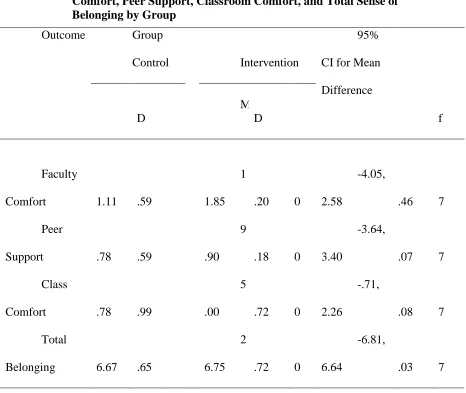
Table 3.1 presents means and standard deviations, confidence intervals, t-values, and p-values for the control cohort and program cohort. Results indicated no significant difference in sense of belonging between the program and control groups for Perceived Faculty Understanding and Comfort, t(27) = -0.46, p = .65, Cohen’s d = -0.19, Perceived Peer Support, t(27) = -0.07, p = .94, Cohen’s d = -0.03, Perceived Classroom Comfort,