THE WORLD OF DON SANTO
by
Veiko Valencia
A thesis
submitted in partial fulfillment
of the requirements for the degree of
Master of Fine Arts, Visual Arts
Boise State University
DEFENSE COMMITTEE AND FINAL READING APPROVALS
of the thesis submitted by
Veiko Valencia
Thesis Title:
The World of Don Santo
Date of Final Oral Examination:
01 March 2017
The following individuals read and discussed the thesis submitted by student Veiko
Valencia, and they evaluated his presentation and response to questions during the final
oral examination. They found that the student passed the final oral examination.
Stephanie, Bacon, M.F.A.
Chair, Supervisory Committee
Chad Erpelding M.F.A.
Member, Supervisory Committee
Lily Lee, M.F.A.
Member, Supervisory Committee
Kate Walker, M.F.A.
Member, Supervisory Committee
iv
DEDICATION
v
ACKNOWLEDGEMENTS
Because this thesis wouldn’t have been possible without the help of such great people,
thank you Everyone, to Richard and Cheryl who I consider my artistic parents. To Dan,
who I guess will be my artistic Uncle, thank you for always being there to help me clarify
my ideas. To my committee for their constant criticism and support, thank you Stephanie
for starting a sincere dialogue with Don Santo. To Kate for encouraging me to make Don
Santo real, thank you Lily and Chad for offering different solutions to my work when I
was stuck. To Jill for helping me create the first cheap version of Don Santo. To Shawn
for giving the voice to La Matriz. Thank you to Craig and Niharika for always sharing
specific essays and books related to Don Santo. Thank you to all my classmates for
sharing the studios and not locking your doors. Entering to each of your studios was like
entering into a Pandora’s box every day, lots of ideas to copy. I want to thank my
undergrad classmates as well, because with your questions you also helped me to unlock
some problems in my work. To Laurie for your confidence in me to teach the labs, and to
my good friend Don Winiecki who taught me an interesting definition of being an
vi
ABSTRACT
vii
ACKNOWLEDGEMENTS ... V
ABSTRACT ... VI
LIST OF FIGURES ... IIX
LIST OF ABBREVIATIONS ... X
PROLOGUE ... 1
INTRODUCTION TO THREE VOICES ... 3
[ INTRODUCTION TO COLONIAL PHOTOSHOP MANUAL ] ... 6
I ) [ INSTALLING COLONIAL PHOTOSHOP ] ... 9
II ) [ STEPS ] ... 9
1.- FILE INFO… ... 9
2.- DISTORT AND TRANSFORM. ... 9
3.- CROP MARKS. ... 10
4.- FIND AND REPLACE. ... 10
5.- SAVE AS TEMPLATE. ... 11
6.- EXPORT… ... 11
7.- OVERWRITING THE SYSTEM . ... 12
III) [ RESTART THE SYSTEM ] ... 12
[OTHER DATA ]... 12
viii
1) [ OPEN THE SOFTWARE ] ... 13
3) [ VIEW RECENT IMPORTED FILES ] ... 13
V ) [ EXPORTED FILE ] ... 14
VI ) [ FREQUENTLY ASKED QUESTIONS ] ... 14
TRANSCRIPT: ... 15
ix
x
CPS
Colonial Photoshop Software
DS
Don Santo
LM
La Matriz
U
User
BS
Bigger Software
PROLOGUE
Everything started when my wife and I were coming back from an art show in Las
Vegas. In our return we decided to skip the highway and instead we took a short cut.
During our trip, there were no cars behind or ahead of us. We were alone most of time. It
was all desert. That’s when it occurred to me that it would be nice if there was a
monument or landmark to visit, like the Spiral Jetty in Rozel Point. Suddenly, I had the
idea that only a statue or an image of a saint could remind people that this was a sacred
place. I wanted to stop and explore the land for possible locations, but at that moment I
did not have a statue or an image of a saint to leave there. I never stopped thinking about
that idea. Those empty places were perfect locations to set some Saints, I thought. But the
idea that bothered me the most, was that I did not know what kind of Saint to leave there.
Should it be female, like Santa Rosa de Lima? Black, like San Martin de Porres? Native
American? And the more I thought about it the more I was rejecting the project. It was
too stressful. I started to regret the idea but that’s when it occurred to me, why not make
my own Saint? It was a ridiculous idea, but just to think about the many possibilities that
this option could offer me encouraged me even more.
Therefore, once I was back in town I was walking around thrift stores. I was
looking for a subject or theme to make a painting. I was not completely sure what I was
looking for either. I just knew that I needed to keep looking. That’s when I saw it. It was
in the kitchen section among dishes, cups and utensils. I remember that my first thought
was, this is so bad. It was a tiny, disproportionate sculpture of what seemed to be a
Roman soldier with an old nude man. What made me laugh was that the Roman soldier
seemed to be posing and looking at a camera with one eye bigger than the other. And the
old man had one arm larger than the other.
combination again. That’s how Don Santo was born. It is the result of the copy of the
copy.
Not that long ago, I discovered that the statue of the Roman soldier with a nude
man belonged to an already popular saint. In Latin America this popular Saint is known
as San Martin Caballero, although, a friend told that it could also be the painting from
Zacatecas, Mexico, ‘San Martin Obispo y Confesor’ by Geronimo de Leon painted in
1894.
Figure 1. Geronimo de Leon, San Martin Obispo y Confesor. 1894. Oil on tin 14” x 11”.
But doing my research I found out that it is probably ‘Saint Martin and the Beggar’ by el
Greco or maybe by Anthony Van Dyck. This is a difficult task, hard to decipher. But it is
clear that before San Martin Caballero was San Martin Caballero it was Saint Martin de
Tours. However, all the information that we can obtain from Saint Martin de Tours
comes from his hagiographer, Sulpicius Severus c. 363 – c. 425. According to the stories,
Severus might have invented Saint Martin de Tours to promote his own ideas.
iThen,
Saint Martin de Tours was also a fictional character. At the beginning I was sad to hear
that my saint was a copycat of San Martin Caballero. But when I discovered that I was
not the first one, that at some point Saint Martin de Tours was like Don Santo, I saw new
possibilities. It is when I started to look at this project differently, that I started to
INTRODUCTION TO THREE VOICES
[“The trickster reminds us there is no single way to play…literally fooling around to discover
new paradigms and even new logics.”] Mythical Trickster Figures:
Contours, Contexts, and Criticism
This project is a theoretical and historical study of the notion of the copy. The
intention of exploring the copy this way is to demonstrate that when the copy is
continuously copied, it can reach a point where it can not be connected to the first source
or original anymore. Once it reaches that point, the copy will have become its own
original. The reasons this occurs, is because in the act of copying, when the copy is being
copied, it enters into a subtractive and additive process. It also builds a new body of
stories or anecdotes around it and the combination of these activities eventually will build
the way to the original copy.
However, in order to explain this idea of the copy of the copy as a new original, I
need to establish some ground. Therefore, I explore the colonial paintings of Latin
America, because Latin America was conquered by copies and myths. During the process
of colonization the colonizers wanted to insert Catholicism in the Americas. They found
the way to do it through images. These images were paintings of European saints.
However, they did not send the original paintings, instead they sent copies of copies of
these original saints. That’s why today there is a copy of Caravaggio in a Church in
Mexico.
iiNot only that, the colonizers also made up some myths and legends about the
Trying to portray the idea of the copy of the copy and the methods of colonization
has been very difficult. I wanted to find a metaphor that allowed me to represent this
project historically and at the same time contemporarily, because colonization hasn’t
stopped, it has transformed. Therefore, this project is the metaphorical representation of
the Holy Trinity combined with computer software.
The Holy Trinity is a Catholic belief where God embodies three different persons.
As with this Catholic belief, this project contains three different voices in a single body.
And the computer software is called Colonial Photoshop, because the main job of the
process of colonization in Latin America was to overlay the locals’ culture with theirs.
This computer software is the vivid representation of how the generation of information
actually works. For instance, the illusion of a paper in your screen is right in front of you.
Some buttons or icons intend to convince you that they have an actual relief, and that a
source of light is coming from one side of your screen. And beneath the illusion there is
another world of codes that contain how the information is collected and organized. This
world of codes is nothing without the illusion. It simply can’t exist. However, the
combination of these two are nothing if they do not have the User, someone that activates
them. The User who thinks it is in control of everything when in reality this User is being
utilized by La Matriz and persuaded by the illusion (Don Santo). This User only adapts
its knowledge to the other two.
This is how I arrive at the idea of the Holy Trinity. This computer software was
designed by three different voices: Don Santo, La Matriz, and the User. Don Santo is the
seller and designer of the illusion of the software. He is the one who has to persuade the
customer into purchasing this product. He is the layer that everyone sees. He is the fiction
world or as we call it today, the alternative fact. He is in charge of making you
understand the real world through the fiction, as Miguel de Cervantes did when he wrote
Don Quixote
iii. The second voice is La Matriz. This one belongs to the world of the
Finally, the third voice is called User. This voice is the one that exist in between
the real and fake world. It is the one that absorbs both worlds. It exists in an interactive
zone. It has the information of historical facts, domestic experiences, and fictional events.
In this interactive zone one can experience the combination of the real and the fake. This
combination is the fabrication of a new real-fake world. It is in this world where the
process of decolonization can actually begin. But it can not exist without the three layers.
As in the Saint Trinity, ‘One God in three divine Persons’.
In the name of father,
And of the Son,
And of the Holy Spirit,
Amen,
[ INTRODUCTION TO COLONIAL PHOTOSHOP MANUAL ]
[ “He who controls the past controls the future. He who controls the present controls the
past.” ]
George Orwell. 1984
(CLICK HERE)
Dear Valued Customer,
As with any computer in the world, in order to function societies also need an operating
system. This operating system is the software that controls and defines how the
computer performs each of its tasks. Through history we have seen how these
softwares operate. We have seen them fail and disappear. Others are obsolete waiting
to be reactivated, while others are still active due to their modernization. The majority
of computers or societies of today tend to stay with the same operating system. The
pressure from other operating systems that become more sophisticated obligates them
to change or update their software. This pressure comes at a high price that sometimes
the user can’t afford to pay.
Hello, my name is Don Santo and I am the creator of the Colonial Photoshop software. I
am part of the local team that works together with other smaller groups of operating
systems. I have appeared because many of the older and smaller operating systems out
there are being arbitrarily isolated and absorbed by bigger ones.
1(CLICK HERE)
Due to
this pressure and forms of control from Bigger Software, the market was expanding,
but this expansion was at the cost of the Smaller Softwares.
This situation left the users
with fewer chances to obtain technical support in case of problems, forcing these
clients to avoid consuming the products of the smaller softwares. That’s why I designed
the C.P. software. I am offering you a new product in the market that will help to reduce
the power of Bigger Software. However, in order to avoid being overwhelmed by the
Bigger Software, the C.P. software looks for a space in the market by copying the
methods and conventions of Bigger Software.
2(CLICK HERE)
This is how the C.P. software operates. It drains the power of Bigger Software in order
to survive, because we understand that to compete at the same level with Bigger
Software is almost impossible. It basically owns the market. That’s why the C.P.
software’s foundations are a copy of Bigger Software’s foundations.
In our local team we understand that we do not have the reputation and reviews that
Bigger Software has. We also do not have the resources to distribute our product as
Bigger Software. Also, there is little information in the web about us, and about our
product. That’s why I have uploaded the C.P. software on the web to be downloaded for
free at any time. You can try it out for 30 days, free of charge. Besides, if you are not
satisfied, you can always delete it at any moment. No strings attached. We also
understand that it can be a little stressful and complicated to download a new product
from the web. That’s why my team and I have provided you with the easiest way to
guide you through this process. For instance, for the installation process there are only
seven steps to follow. I even gave you some information about what to expect when the
software is refreshing in your system.
However, as any other software the C.P. software is not immune from being infected by
viruses. Sometimes invalid and fake links camouflage themselves during the
installation process, and manage to access the system. Again, my team and I are aware
of this situation that’s why I have provided you with a list of common viruses to look at.
Also, the C.P. software comes with a free cure that is active at all times. This cure will
automatically start scanning and eliminating any sort of virus, hourly, weekly, monthly,
it is up to you. That’s right, with the C.P. software you will have full control of the
information that comes in and out of your hardware.
It is important that you know this information because every operating system controls
the information that is being saved and deleted. This is what Bigger Software does not
tell you. It never asks for your opinion every time it uninstalls other software.
Therefore, it is crucial that you follow the steps carefully. For instance, most of the
Bigger Software downloads files automatically, but sometimes some of these files are
checked erroneously as dangerous and are omitted from the system without you
knowing. This is the kind of event that you won’t experience with the C.P. software,
because it will tell you every time a new software enters into the market. It will
immediately make a copy of this new software, so you can review it later at your
convenience.
Now that you are aware of the reasons of why my team and I created the C.P. software,
please do not forget to check the last pages of the manual with the FAQ. In here you
can find information of your interest. Not only about the C.P. software, but about other
related information and other softwares as well. It is also very important that you check
our website for current updates. This is up to you but if you want to avoid viruses we
have a link with different cures. Also, do not forget to renew your subscription to get
new information about our new products. With no more information to give you, In the
name of my team and myself, I want to congratulate you for starting this new journey
with the C.P. software.
I ) [ INSTALLING COLONIAL PHOTOSHOP ]
Great! You have definitively taken the first step on this amazing journey. First, you need
to go to our website and download the file to install the C.P. software. I have copied a
direct link to the file in here:
http://colonialphotoshop.blogspot.com/
Once you download the file you will have a series of archives that will need to be
installed in a predetermined order. Opening and navigating through these different
files can get a little complicated, but do not worry; I will guide you through the whole
process of the installation.
3(CLICK HERE)
II ) [ STEPS ]
1.- FILE INFO…
Now that the file has been successfully downloaded into the system go to your
Desktop and open My Documents. Then, open the Downloads folder and search for
the following file:
There_were_no_Coincidences_Everything_was_Rigorously_Planned_CP.ZIP
This is the file that contains all the archives of the C.P program. Double click on it and it
will start unpacking all the different archives into your system. Just click YES to
everything. This process will take a few minutes because it is a large file.
4________________________________________________________________________
2.- DISTORT AND TRANSFORM.
Once the installation is completed and all the information from the C.P. software has
been unpacked, open the C_P_Archive folder and you will see a series of files in it. Be
careful here because these files are not in order. You have to install them in a proper
order. Search for the following file and double click on it.
Nothing_was_in_Vain_As_in_a_Puzzle_Every_Piece_Matters.SWP
Something to notice here is that once you double click on that file it will tell you that
this file is not compatible with the system. Just click IGNORE TO ALL and it will
continue with the application.
5________________________________________________________________________
3.- CROP MARKS.
Since the C.P. software is not a dependable software, it won’t be compatible with any
general system. That’s why, it is important that you go back to the C_P_Archive folder
and search for the following file:
Once_Everything_is_Settled_the_Territory_Needs_to_be_Secured.MAX
Open the file and wait until the installation is fully completed. Failing to do this can lead
to either an incomplete installation or failure to operate the program completely with
all its properties.
6________________________________________________________________________
4.- FIND AND REPLACE.
Aside from the general requirements, to run the C.P. software, it requires you to do an
unusual step. Go one more time to your C_P_Archive folder and search for the
README folder. Open it and search for the following file:
Fake_Stories_are_the_Best_Way_to_Distract_the_People_from_the_Major_issues.TX
T
Open this file and a message will pop up telling you that this file contains important
information about the C.P. software. It will also tell you to read the information before
to continuing with the installation. Just click ACCEPT to all of them, then the file will
open on a README text page. Go through that page, skimming it and right before the
text ends there will be hidden serial number that looks like this: CODE: XXX-000-XXX.
Remember, this code is unique and it can’t be shared with anyone. The C.P. software
always adapts to the local system generating a new code each time. Now copy it and
save it in your clipboard. You will need it for the next step. Again, failing to obtain this
code won’t let you continue with the installation of the C.P. software.
7________________________________________________________________________
5.- SAVE AS TEMPLATE.
Once the initial requirements have been met, make sure that all other unnecessary
programs are not running. Don’t worry, you are almost there, two more steps and you
will be done. To continue with the next step, go to your C_P_Archive folder one more
time, and search for the following file:
Fiction_Can_Become_a_Fact.U3P
This is the file that goes through the whole local hardware and updates the information.
Click on it and a message will open asking you, “Are you sure you want to run this file?”
Just hit YES, and it will immediately start updating all the information. Just hang in
there, because right before it ends a new message will pop up asking you for the 9 digit
code. This is the number from the previous step. Paste it, click YES, and the application
will finalize updating the files.
8________________________________________________________________________
6.- EXPORT…
Now that the setup wizard has been set, it needs to be launched, at this point it won’t
work because its content needs to be unpacked from the C_P_Archive. Once you open
the folder search for the following file:
Facts_Become_Traditions.PAF
This is the file that unpacks all the information from the wizard setup. Simply follow the
prompts until the installation process is completed. It is important to not interrupt this
process, because this file is exporting the major application to install the C.P. software.
Any interruption can damage the installation, and will require you to start all over
again.
9_______________________________________________________________________
7.-[ OVERWRITING THE SYSTEM ].
After the completion of the previous step. Go to your C_P_Archive folder for one more
time, and search for a new file in capital letters:
SETTING_CULTURAL_CONTAMINATION.APP
This is the final file that you will open. Remember, once you open this file the C.P.
Software can’t be stopped. Open it and run the setup program to execute the setup
wizard and this will handle the automatic installation of the C.P. software. After the
installation procedure has been completed and the setup wizard has been terminated,
it is very important that you reboot your system before launching the newly installed
software, Colonial Photoshop.
10________________________________________________________________________
III ) [ RESTART THE SYSTEM ]
[OTHER DATA ]
Once your system is restarting the C.P. software collects all the information from the
previous system and starts matching it with the new files from the C.P. software.
Remember, the C.P. software does not back up your files, but doesn’t delete them
either. It encrypts your entire drive or data from the previous software with other data.
Therefore, if you try to recover the previous data it is not going to be easy, because this
encryption is robust and complex to decipher. Although, with the right software and
patience, erased media or data can be reused.
11(CLICK HERE)
________________________________________________________________________
IV ) [ RUNNING THE PROGRAM ]
Now that the C.P. software has been installed, let’s create a decolonized file to see if it
was properly installed.
(CLICK HERE)
[ TEST ]
1) [ OPEN THE SOFTWARE ]
First, you need to go to the main toolbar, and click on the start button. Or you can
press CTRL + V + P to access faster. Once you are in the toolbar options scroll down and
select C.P. Software. Double click on it and a new window will open overlaying the four
angles of your screen. Look on the right corner and select the “ARCHIVE” icon. Open it
and a small page will appear on the bottom of your screen.
12(CLICK HERE)
2) [ IMPORT FILE ]
Now that you have opened the IMAGES folder locate the following file and click on it:
La_Sagrada_Imagen_del_Señor_de_Huanca_EXE.
In the IMAGES folder you can find all kinds of information. We have information about
representational images, 3D work, and even non-representational objects. It is most
important that they are ready to be exported. Each one already has a package. The C.P.
Software task is to unpack this information and fill out the gaps for you automatically
once it is exported. Also, this archive of images is not static. The C.P. Software has a
system to update the archive periodically. In case you know this already. You only need
to select to where you want to import the file according to the following: country,
location, and medium.
For example, I will select the country: Peru, the city: Arequipa, and as a medium I will
choose Painting. Click on the IMPORT button and wait for the C.P. software to upload
the file.
133) [ VIEW RECENT IMPORTED FILES ]
Once the file is done uploading, go back to the C.P. Software main screen and look on
the toolbar for the HISTORY button. Click on it and this will open several options and
properties. Scroll down and click now on VISUAL ETYMOLOGY ARCHIVE and select
VIEW RECENT IMPORTED FILES.
(CLICK HERE)
V ) [ EXPORTED FILE ]
The file that you just converted will be there with the following name:
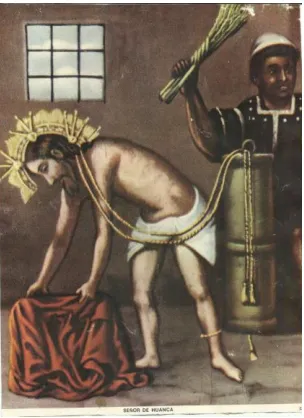
14La_Sagrada_Imagen_del_Senor_de_Huanca_AVE.
Click on it and the file will open for you.
Figure 2.- “Lord of
Huanca” Anonymous
Artist, Personal Photograph, unknown source.
VI ) [ FREQUENTLY ASKED QUESTIONS ]
The following is an interactive zone where the three entities, Don Santo (DS), La Matriz
(LM), and the User (U) will interact with each other and our followers in the following
interview.
________________________________________________________________________
Thanks for joining us. I am Don Santo. In this episode I bring you a rebroadcast of our
interview with La Matriz. This interview was conducted by the User. (To Listen to the
recording of the Audio, please CLICK HERE.)
________________________________________________________________________
TRANSCRIPT:
U: After the first stroke. History was transformed. It became more compulsive, and
obsessive. Much of the work History produces is fragmented. Although, its fragmented
work did not change its goal. History stayed together. It has been shown in different
places. Now, it is the subject of many books. But what happens to its core when the
fragments start manifesting themselves?
ivU: Don Santo, La Matriz, welcome to the show. I am the User and today we are going to
interact with our followers by answering their questions about the new software that it is
in the market called: “Colonial Photoshop”.
U: I want to start with you La Matriz.
U: We have a question from Stephanie from Queens. “You have given us much to consider
regarding the ways that the Spanish exerted colonial dominion and influence over the
indigenous people of Peru. What about the influence moving in the other direction? Were
the colonizers changed by the indigenous culture that they sought to influence, and how
does that complicate the traffic between them?”
LM: Yes, the locals influenced the colonizers. The former changed the colonizers’
economy, nature, and identity. There is a lot of evidence of how the gold exported from
Peru to Spain sustained its religious wars and ambitious goals of expansion.
vThe
DS: Yes to build on that: “You think you know who you are because you know yourself,
however, you ignore the fact that you know yourself because of us. Before us, you
didn’t exist either, you were incomplete, and we completed you. You don’t want to
admit that because you are so afraid of losing your position, [but] that’s why you
created the Casta paintings.”
viiiU: Our second question is also from Queens. I have installed Colonial Photoshop in my
operating system, but now it refuses to quit. How can I get it to quit?
DS: First of all, thank you for buying our product. We will continue working to offer you
a better experience. We hope that you can return to us in the future. To answer your
question, trying to make the C.P.Software quit is not going to work. You can not do
that. Colonial Photoshop never quits. It can only be replaced using the same methods
with which it was installed. If you do not want the C.P. software in your system, you
have to activate Bigger Software again. This will immediately overlay and bury the C.P.
software in the hardware. There will be some leftovers and residues here and there, but
nothing to worry about it. One more thing, trying to eliminate it completely will be
frustrating and time consuming. I would recommend you to just leave it there. Those
files are harmless.
U: We have another question from the border, El Paso Texas: Don Santo in the manual you
mentioned that you will provide a cure with the C.P. software and a list of the most
common viruses, but you have not mentioned anything about it. [ Can you address this?]
U: Chad From Iowa is asking, “How does your work relate to the work of Sherrie Levine?
She is not addressing colonialism but she is using copies to address authorship and
creativity.”
DS: Our project is different than Levine’s because we are not interested in the question
about originality, if it exists or not. Our interest is to identify the copies in the world but
not to demonstrate that nothing is original in the world. Instead the purpose is to show
how these copies have liberated themselves from the power of the original.
LM: I think another aspect is that Levine’s work recognizes the authorship of the
appropriated objects. However, the C.P. software uses work from anonymous
individuals.
DS: It is also about the process of the copy of the copy and not just the copy of one
famous artist. Which, as La Matriz mentions, reinstates the authorship of the original
even more.
U: We have another question from Iowa. “[H]ave the colonizers also become copies of
copies? Is Spain a Simulacr[um] now?”
DS: I don’t think that they can become something that they already were. Spain was
always a copy of a copy. They were always a simulacrum, for sure. They were occupied
by the Moors for more then 700 hundreds years. Their culture is another Photoshop.
LM: However, this does not mean that the copy of the copy has one direction only. It
also used by the colonizer. Once a group of the society gets into power, it does not
want to lose its position. It wants to maintain its power. In order to do this, it must
silence the previous one. Therefore, it also utilizes the copy of the copy as a method to
conquest and overlay what was beneath. For instance, there is not much evidence but
the Incas were also colonizers. They conquered their neighbors and perhaps they also
replaced their Gods through the same process of copies of copies and overlaying Gods.
U: A follower just sends us another question. From New Zealand, Kate is asking, [I believe
this question goes to La Matriz.] “ Why do you need to reason, "The objects that denied the
colonized of its history can now be used to [build] its own history..." Perhaps this sounds
LM: It is important to reinstate that, because the problems of the copy are the
problems of the colonized. How can the colonized build its own identity without the
colonizers presence? It can’t. It is too difficult, if not impossible. Because it is arbitrary
to resuscitate a presumed identity that has not been contaminated by the colonizers.
We are going to have to adapt it to our modern world. But doing this will cause its
contamination. However, if we don’t do this, we will still be playing within the same
rules of the colonizers. The first option is a mistake, but it is even worse to keep playing
within the colonizers’ rules. The risk of failing is inevitable. But through the process of
the copy of the copy it is possible. The goal is not to find a pure identity, but to keep
building. This is what we argue with Don Santo. We can use the same tools and
methods as the colonizer and still obtain different results.
DS: yes, even though the colonizers gave us the mirror, we are still in charge of the
reflection.
LM: For instance, look at the image of the Virgin of Guadalupe in Mexico. This is an
image that has its origins in the Black Madonna.
ixIt is an object that came to deny and
obscure the history of the Aztecs. However, it ended up playing a different role.
Through the process of the copy of the copy this image became a symbol much more
powerful than its first source. It embraced and allowed the participation of any other
local element.
U: Our last participant is from Pullman, Washington. Lily comments that Photoshop as
a metaphor is a bit confusing because Photoshop is more related with the manipulation
of images, but the comparison of software to colonization is more about the coding
which would relate to any software. She suggests that perhaps just a search engine
would be an easier thing to compare because it is something accessible that nearly
everyone uses frequently in our daily lives.
DS: I would like to thank her for her suggestion. I agree with her comment, we do
compare it more with the coding. However, our intention is to give our followers access
to our system, something that Bigger Software will never do. In this aspect we are
That’s why Photoshop comes after those codes because it mimics the way History
functions. But again, it needs the help of a User. It does not function by itself.
U: I want to thank you both so much for talking with us. I am sure followers will appreciate
it.
U: Thank you, Don Santo. Thank you, La Matriz.
DS: Thank you for your invitation.
LM: Thank you so much USER.
U: Don Santo is the author of [the] new small local software called, "Colonial Photoshop."
You can read [about] it on our website where you will also find a link to La Matriz Codex.
U: Coming up, our guest, Veiko Valencia will tell us about his para-fictional encounter with
Don Santo. He created a body of work where he tells us about his visions and the
apparitions of Don Santo.
(CLICK HERE)
APOCRYPHAL BOOK
FIRST VISION
The following conversation is about the first apparitions of Señor de Huanca in
the county of Mariano Melgar in Arequipa, Peru.
________________________________________________________________________
{Señor de Huanca: It is one of the most popular Catholic images in Peru. I would even
dare to say that it can be as popular as the Virgin of Guadalupe is in Mexico. Every year
people travel from different places in Peru to Cuzco just to visit the temple of Señor de
Huanca. I remember that my mother and I visited the temple in Cuzco a long time ago, I
believe I was 8 years old. It wasn’t a safe trip for sure. It wasn’t as fun either because the
last bus to return home left us and we were the last ones in the temple. We were just
waiting and I was tired of playing around with the wax from all the candles that people
left. It took a while for a new bus to arrive, I think it was after hours, it was getting dark.
I remember that when we were returning I was so scared when I saw from our window a
blue bus on the bottom of the river down the cliff. It was destroyed but you could still
recognize some parts of the bus. The curves on the road were so narrow that many buses
fell of the cliff.}
{Señor de Huanca: it was always an enigma for me. I never understood why the Jesus of
Señor de Huanca was being punished by an Afro-Peruvian? It didn’t make any sense
because in all the Christian movies we watched the people who punished Jesus were
{Señor de Huanca: I found out that the image of Señor de Huanca comes from the popular
Catholic theme of “Christ Gathering his Garments.”
xI remember telling my mom about
this when we were having dinner. She was surprised. I told her that according to a study
about the origins of this biblical theme the image of Señor de Huanca is considered one of
the many versions that exists about it. In a research conducted on this theme by Antonio
Fernandez and Ruben Sanchez, they said that the images of Christ gathering his
garments has been represented so many times that it needed to be categorized into five
groups. The characteristics are based on the composition of the event and posture of
Christ. He can be on his knees resting, or reaching his garments, bending with his body
parallel to the floor, or stretching his arms, or sometimes layering them on the floor.
xiVarious versions of “Christ Gathering his Garments after being Punished” are readily
available today including renderings by Alberto Cano, Ribera, Zurbaran, and many
anonymous ones as well. I believe that the version of Zurbaran is the original and Señor
de Huanca is its copy. I know that there is not strong evidence that proves this but the
visual similarities open the door for speculations. In fact, the city of Seville was the city
that exported most of the artwork to the Americas.
xiiIt could be possible that Zurbaran’s
work made it to the Americas and the Señor de Huanca is the result of a bad copy of
Zurbaran’s version.}
{Señor de Huanca: While we were still having dinner I told my mom that the church
where the image was located was in fact planned by the priests. They studied the culture
of the Incas. There is an essay written by Michael Sallnow about the Image of Señor de
Huanca. Sallnow argues that the mountain of Pachatusan in Huanca, Cuzco, where the
image of Señor de Huanca appeared, was already a sacred place for the Incas.
xiii}
{Señor de Huanca: The Spanish also made up myths about this mysterious apparition to
apparitions documented. The image of Señor de Huanca appeared around 1700. The first
two apparitions occurred to a peasant worker named Diego Quispe in a Mountain in
Cuzco. It is not certain why this person was in that mountain, many stories said that he
was running away from the Spanish soldiers, and it is here that the image appeared to
him to offer him peace and protection. The other two apparitions occurred when a wealthy
worker, Pedro Valera saw Christ as a doctor in his town. According to the stories, Valera
was ill and it was this doctor who healed him when no one else could. Valera wanted to
pay him but the doctor told him to visit him in this place that was located in a mountain
instead. Valera went to the mountain looking for this strange man. When he arrived to
the mountain, he saw for the second time the image of Señor de Huanca on a rock. Years
after, once the myth was confirmed by the members of the church a small temple was built
as evidence of this image.
xiv}
{Señor de Huanca: During my research I also found that the image of Señor de Huanca
functioned as a conciliatory factor. During the 17
thcentury Peru had a hostile
environment towards colonizers. The Andeans were resisting and fighting back.
Eyzaguirre argues that the only way to deal or control these uprisings was through
spirituality because the Andeans were a very religious society. In order to accomplish this
transition the Spanish made it look like Christ, the new god, appeared to both groups by
writing the myths, first to Diego Quispe (representing the Locals because it had an Incan
last name) and second to Pedro Valera (representing the colonizers because it had a
Spanish last name).
xvThis shows that the myths constructed around the images were to
persuade the Andeans and made them believe that there was a divine order behind the
colonizers occupation.}
{ Señor de Huanca: Nobody knows for sure who painted the image of Señor de Huanca. I
only found out that in the 1600s the Jesuits were in charge of the locals’ education by
17
thcentury a Jesuit, Diego Alvarez de la Paz was one of the most important theologians
and members of the church in Peru. He studied religion at the College Maximo de San
Pablo of Lima to later become the Dean of the Jesuit School, first in Lima then in Cuzco
and Quito. I am not saying that he is the author of the painting. But we can speculate
again about how the idea originated. The Jesuits were focused on two aspects, the
formation of the person by teaching the locals values and morals, and the formation of the
faith by practicing lessons, sermons, and prayers.
xviThen, they were the artist and the
historical materialist.}
SECOND VISION
{Señor de Huanca de Mariano Melgar: My mother didn’t know all the details with
certainty. She remembered vaguely. She doesn’t remember what year it was when
everything started. All she knew was that she wanted to start the tradition at home. To do
this she needed a painting of Señor de Huanca. Therefore, she hired a local painter to
make a copy of the image of Señor de Huanca from Cuzco. But of course, this artist didn’t
go all the way to Cuzco to paint the image. He probably painted the image using a
photograph as a reference of the original Señor de Huanca from Cuzco. Once, she got the
painting, she needed to have it blessed, so she took the 39” x 59" canvas on the bus to
Cuzco to see the original Señor de Huanca. She needed to have the copy blessed by the
priest in front of the original because otherwise it wouldn’t work. When she returned
with the copy already blessed, she still needed to get other accessories. That’s why she
hired a local woodcarver. He was in charge of designing the ornamented golden frame, as
the first indigenous painters did during the colonial period. I remember that I used to
carry the painting around the house, but once it got dressed with the frame it became too
hired a carpenter to design a cart to put the image on. It was very geometric and did not
have decorations as the frame.
Once the image was well equipped, it needed still its own home, a small temple. It
was awkward to have it in the garage or in the living room, so my mom built a small
chapel on the second floor of our home with a view to the street. It was a small square, big
enough to fit the image with the frame included. She even decorated it with small
paintings on the wall, a few flowers here and there and some candles. I remember that the
window with the view to the street was very modern in comparison to the neighbors’
houses. The corners were rounded. It was the 90s in Peru, but to have this type of
window was an original touch in the neighborhood. It was like seeing a small cheap
modern version of the original Señor de Huanca from Cuzco.
I remember that every September 14
th, with the help of my family and friends, my
mom organized the ceremony for the day of the image of Señor de Huanca in our house.
(This was my district or county). It was a big party, a mass, fireworks, and a feast.
Always an impressive event in our neighborhood, a lot of people used to come and wait
outside. The best thing was the fireworks. My brother and I used to go to the third floor to
have a closer view of the big tower of fireworks, we called them castles. Since then, we
never returned to the temple of Cuzco. There was no need; we had our own temple at
home. And we were always so busy on September 14
th. People used to write their names
to contribute with fireworks or money for the next year. It became a solid tradition. The
whole street turned into a temporal market as well. On the morning of the 14
th, the street
vendors already marked their territory to sell their products later at night: caramel
apples, candy, local drinks, sandwiches, etc.
The party was so big and odd that even the Catholic church that was just behind
my house wanted to stop our tradition. They didn’t like it. It was like if Jesus was jealous
of our Señor de Huanca. Perhaps Jesus was jealous because he couldn’t accept the fact
hard for us to get a priest to direct the mass in our temporary temple, usually our garage.
I remember that one time the priest canceled the mass. He was not coming. It was a big
mess, no priest-no party, everyone was so worried. Everything was in place, the castle,
the street vendors, the food, and the image of Señor de Huanca was all decorated, too. The
desperation was so big that even a neighbor was already saying that he could direct the
mass. He argued that he had seen it so many times and that he was a priest helper as a
kid. I wished he had done it.
Stories like these are the ones that helped build the tradition and increased the
importance around our copy of Señor de Huanca. We even had our own local myth when
our image suffered the terrible accident and was almost consumed by the fire. It needed to
be repaired. When it was returned to us, it was completely different. The face and body of
Jesus was whiter and larger, the colors were saturated, and the details were gone from the
small window. It looked simpler to me. But nobody cared. In fact, more people came to see
it. I remember people coming to the house bringing flowers and donations again. This
was the last step that our copy has to go through before it became an original copy. It
wasn’t Señor de Huanca of Cuzco anymore. It was the Señor de Huanca of Mariano
Melgar. The one that survived the fire. Probably, ours wasn’t as historic as the one from
Zurbaran. But ours gained something else. Ours could and can concede you a miracle,
while the version of Zurbaran ”Christ Gathering his Garments after being punished”
[ Additional Text ]
[ CODEX MANUAL ]
C:\> ORWELL.EXE.
Don Santo is using Orwell’s famous quote to set the parameters of
the Colonial Photoshop software. The present does not miss the
future because its happiness is in the past.xvii And whoever
controls the past, controls what is built after. That is why the
C.P.Software and Don Santo leaned towards the exploration of the
files in the Archive.
C:\> INTRODUCTION.EXE
1.:\>LOCAL_VS_GLOBAL>.
In Foucauldian terms the history of the world is the
history of the struggle of forces. Within this struggle there is
the hidden history of the oppressed. The unfortunates who had a
voice now can only exist as old artifacts. In one of his
lectures, Michel Foucault states that one of the characteristics
of the last 15 years (50’s or 60’s) is the rebellion of the
subjugated knowledges against the global theories. He attributes
this uprising to the inability of the global theories to solve
the problems at the local level.xviii Therefore, this new proposal
should not be dismissed rapidly. There are many more proposals
similar to this one, and they will continue appearing. It cannot
be the last attempt, many more have to come.
2.:\>COPYING:\>.
I agree with Don Santo when he says that this new proposal
must challenge the legacy of colonization from within. He
recognizes that it is really hard to escape from this legacy
software is almost impossible because it basically controls the
market.”xix(C.P. Software) Therefore, this new proposal advocates
for a project of self-colonization using the same methods
practiced by the colonizers.
It has become very complicated to propose something without
affecting others. Or as Foucault would argue, every time we try
to bring a subjugated knowledge back to the surface, we need to
ask ourselves what are we replacing? What are we removing? Are we
bringing a new knowledge back to the surface based on the global
terms?xx Therefore, Don Santo and I believe that instead of
looking for the most suitable answer we should construct a
response that is obviously meant to fail. We need to find some
kind of form that functions as a camouflage to help us navigate
in the field of the colonizer. We believe that this camouflage
can be found within the process of copying the copies left by the
colonizers. This process of copying will eventually create a new
option based on a ‘real-fake’ answer. This seems to be the most
suitable way to respond, since Latin America was invented using
real-fake facts.
#<!--[COLONIAL_PHOTOSHOP]#[MANUAL]>
X. C:\> INSTALLING C.P. SOFTWARE>.
1:\> PARAFICTION.EXE.
When Don Santo asks you to download the information from
the web, he is asking you to unpack the world of colonization. He
knows that in order to deceive the users he needs to copy the
aesthetics and the style of major institutions and of
colonization.xxi Because the answer to decolonization must come
from the parafiction world “…like a paramedic as opposed to a
medical doctor, a parafiction is related to but not quite a
member of the category of fiction…it remains a bit outside…but
parafiction world where Don Santo can find the camouflage that he
needs in order to avoid the referees and the colonizers’
surveillance.
X [ STEPS ]
1:\> FILE INFO.EXE.
[ According to the Peruvian journalist Jose Carlos Mariategui,
there was too much coincidence about the apparitions of European
Saints in Peru. Mariategui mentions that the Catholic Church
adapted their own traditions to blend with the locals.xxiii The
Mexican writer Carlos Fuentes also argues something similar in
relation to the Virgin of Guadalupe. Fuentes states that there is
a strong coincidence about where the image of the Virgin
appeared, similar to what happened in Peru. This place was a
sacred location as well.xxiv In the project of Colonization nothing
was accidental. Before the colonizers touched or removed
something in the locals’ land, they studied it. One of the
architects behind this project was King Phillip II, even though
there are no records that demonstrate that he went to the
Americas. He was also knowledgeable of the locals’ culture;
“…upon hearing that the people of Peru still adored the sun, the
Gods of the mountains and mother earth, he ordered various images
be made for Cusco. Among these images he commissioned a large
beautiful Christ with a copper color and features that would
allow the Indians to recognize themselves in it.”xxv This
knowledge was used to accommodate their culture within the
locals’ culture; for instance, they knew that nudity was
considered a form of disgrace in the Andes. In order to avoid
conflict, the images of Christ needed to be dressed, even though
the Catholic Church agreed that Christ had been crucified without
clothes.xxvi Knowing and understanding the foundations of the
locals’ culture facilitated the process of invasion.
[ Many of the imported images that came from Europe were already
prepared to fit in specific places in the Americas. The intention
behind this was to replace the locals’ deities with equivalent
European religious versions. In Bolivia, for instance there are
paintings of angels that appear next to natural elements that
were sacred for the Andeans. “In one way or another, the
religious in America became aware of this relationship between
angels and celestial phenomena, and created the series of angels
with these names, so as to encourage the substitution of star
idolatry within the Christian faith.”xxvii The plan of overlapping
Gods was also achieved through the process of association.
Another example can be seen in the engraving of the Virgin of
Remedios. The graphic shows how the Virgin emerging from of a
local plant,xxviii altering the relationship of the local with
nature. After which they understood their land through the
combination of foreign and local symbols. By making the foreign
look local they calmed down the spirits of revolution in the
locals’ minds.]
3:\> CROP MARKS.EXE
[ Once the European images were placed on top of the locals’
deities, the environment needed to be altered. Many churches and
altars were built on the locations where these images apparently
appeared. “…Just as the sanctuaries of these cult figures were
often situated at the margins of cities, between urban and openly
rural places, in places where people of all classes and
conditions would come together, so the legends and the stories
were inclusive, combining native elements with others of European
origin.”xxix The purpose of building churches was to solidify the
colonizers’ presence. These new landmarks functioned as factories
and bunkers. They operated as a surveillance system to maintain
control of the society and to produce more images. Their goal was
past. As it happens today in the territory of Palestine, “many
Palestinian villages that once existed in what is now Israel…have
become parks, and other open spaces, erasing the existence of
their prior inhabitants from public memory.”xxx Even though this
is an indication of a direct form of colonization, it does not
mean that a direct colonization is still practiced today as it
was in the past.]
4:\> FIND AND REPLACE.EXE
[ The colonizers knew that the simple alteration of the locals’
environment wouldn’t be enough to control them. Therefore, they
created myths around the apparitions of these images.xxxi The idea
was to convey the message that this transition was not a mundane
affair, but a divine order. “Like Christ of the earthquakes,
Viracocha was believed to be the cause of seismic and
meteorological events, and as we have seen, the cathedral may
have been built over the palace of the Inca ruler Viracocha.”xxxii
As with the Christ of the earthquakes, many other images of
Saints and Virgins have appeared in Peru and in the Americas on
specific sacred locations, all of them with their well
constructed stories of how the apparitions occurred.
Given the veracity of the apparitions in this location of the
Christ of the Earthquakes, one of the legends states that on May
13th there was an earthquake in that place. The church suffered
all the damages and only the figure of Christ was intact.
Therefore, according to this legend, it takes the name of Christ
of the Earthquakes.xxxiii As a result of this natural event, the
survival of the image was considered a miracle, particularly for
one detail. Due to the earthquake, the crown of Christ fell off
to his neck, and when they tried to put it back again to its
place more aftershocks occurred. So they decided to leave it like
that.xxxiv]
[ Once the myths and legends were already set, and in order to
preserve and spread them all over the land, the colonizers
started to document their myths. Evidence of this can be found in
the Ex Voto paintings. These paintings are the literal
representation of miracles. “…The miracle painting…expresses
gratitude…also drew on an Andean formula of reciprocity between
deity & worshiper.”xxxv These kind of paintings also functioned as
a form of propaganda. Since they were small they were easier to
reproduce, collect, and transport. The documentation of miracles
through text could not compete against the Ex-Voto paintings,
because the Ex-Voto paintings offered more variety than text.
They could also be represented on murals. xxxvi This activity of
documenting and spreading the miracles gave the locals something
to produce and to consume. It created a local market for them.
but it also started to push away the colonizers presence in the
locals’ territory.]
6:\> EXPORT…EXE
[ The fabrication of new traditions was a device to maintain
control over the locals’ minds.xxxvii The intention was to
normalize the colonizer’s culture in the eyes of the locals.
“…the public procession painting, which served to legitimate the
cult by inserting it to official religious life, and the
subsequent local healing miracles, encouraged devotion and
testified to the efficacy of the image.”xxxviii Traditions like this
started to appear all over the Americas. They became very popular
because they allowed people to become part of the traditions.
Attending these events was also a way to display their social
status.]
7:\> OVERWRITING THE SYSTEM.EXE
[ So far the process of Colonization was meant to attract viewers
into the illusion of painting, churches, and myths. This last
their identity by associating the locals’ culture with what was
considered the visual representation of evil. The colonizers
expected to erase the locals’ identity from their culture,
distorting their self. Ramon Mujica Pinilla argues that the
depiction of hell in the Andes eliminated the local identity of
the locals, because it matched their Inca qualities and customs
with depictions containing demons and fire, making the locals’
culture look like a sin. “…There is a symbolic correlation
between the indigenous military tradition of undressing defeated
enemies and the Christian representation of the damned portrayed
naked in hell. Devoid of clothes, Andeans lost all sense of
identity, lineage, and social, political and religious
affiliation. Since pre Hispanic times and throughout the colonial
period, wounded and dead soldiers were dressed and undressed in
the battlefield. In hell, the damned, without clothes, were
similarly outcast from the religious order.”xxxix Another example
of silencing the locals’ identity through association can be
found in the drawing of Luis Antonio de Oviedo y Herrera y Rueda
“The image alludes to the seventh chant of the Poema Heroyco,
which argued that the devil had transferred his center of
operations to Peru for fear that he would lose the austral lands
with the birth in the Americas of Saint Rose of Lima. The south
was the last stronghold of his decadent monarchy that the Inca in
Peru and Moctezuma in Mexico had faithfully defended and
preserved for him.”xl This was a perfect technique for the
colonizers purposes because it used the local’s visual
iconography as a way to access their minds and to corrupt their
beliefs.]
XXX [ RESTART THE SYSTEM ]
The following is the foundation of the legacy of colonialism.
When Don Santo talks about the creation of a new layer
without deleting the current one, he is actually referring to
what Baudrillard defines as the first order of Simulacra.
Baudrillard mentions that during the 16th century, the ‘Jesuits’
and the Counter Reformation were the main makers of simulacra.xli
Evidence of this can be seen on the steps from 1 to 7 on the C.P.
Software. The construction of churches, the replacement of
deities, the creation of myths, etc. All with the purpose to
replace the previous knowledge with a brand new one.
This is the reason why Don Santo is creating the C.P.software.
If colonization is another form of simulacra then there is the
possibility of reversing its power by attacking it, not from
reality but directly from its own simulacra, to fool the legacy
of colonization in its own terms, in its own world of fantasy.
Baudrillard states that the use of simulacra is not something
accidental or about progress. It is an issue of desire or
necessity to control and to maintain the power.xlii In Don Santo’s
case it is a necessity and desire to recover the power. As in the
short tale “On Exactitude in Science” of Borges which Baudrillard
uses to describe the Simulacrum. “…the cartographers of the
Empire draw up a map so detailed that it ends up exactly covering
the territory…”xliii Perhaps, these cartographers were the
colonizers, and the map they created was Catholicism, and its
hyperreality is the legacy of colonization. Now the Colonial
Photoshop comes to reverse this process one more time. Because it
will create a new map that will end up covering the legacy of
Colonization.
[ RUNNING THE PROGRAM ]
How is Don Santo going to reverse the power of the
Colonizers? How is it that the C.P. software converts the
colonizers file in favor of the colonized? Or as Krista A.
colonized its history be used now to produce its own history?xliv
This is the question that Don Santo and I try to respond to with
the use of copies of copies of incomplete copies. However, we
recognize the irony behind our claims. This process of copying
also operates under the same umbrella like the colonizers,
because we borrow all our information and knowledge from the
colonizers. The question is then, if we borrow everything from
the colonizers, why are we so different? The answer is because we
drain our energy to respond from a different source, the metis.
For James C. Scott, the metis is a Greek term that comprehends
all these sets of skills such as, intuition, common sense, folk
wisdom, etc. xlv which pejoratively are labeled as informal
knowledge by Bigger Software. The rejection of this informal
knowledge is what Scott sees as the biggest problem of today. Any
formalization or institutionalization of knowledge lacks the
ability to solve the problems at a local level, because those
local places where this informal knowledge governs are too
complex and undecipherable for the formal or global knowledge to
comprehend. “Metis resists simplification into deductive
principles which can successfully be transmitted through book
learning, because the environments in which it is exercised are
so complex and nonrepeatable that formal procedures of rational
decision making are impossible to apply.”xlvi Don Santo and the
C.P. software fall into this category. They are part of the
informal or local knowledge. In fact, they are the product of
local knowledge, they rely on intuition to collect their sources
from folk culture. They produce their work using local items as
well. Everything is fabricated at a local level. Any element that
is alien to them is absorbed and reconstructed according to their
local terms. There is simply no jurisdiction from the global
theory to there.