Introduction
The impact of
-
The constant changes which occur leave
C O R I ~ ~ ~ U ~
ng education
library professionals with.no alternative but toprogrammes on
1
adapt their services in response to economic,political, technological, educational and social
and information
developments. Professionals must also bescience professionals
equipped to respond to:service management changes;
Chennupati
K.
Ramaiah
and
A. Lakshmm
Moorthy
Chennupati K. Ramalah is Assistant Professor, Division of Information Studies, School of Computer Engineering, Nanyang Technological University, Singapore.
E-mail: [email protected],sg
A. Lakshman Moorthy is Joint Director, DRDL, Defence Research and Development Organisation, Ministry of Defence, Hyderabad, India.
E-mail: [email protected]
Continuing education, Academic libraries, Training, Librarians, Skills
Changes in libraries and the expectations of their clientele are related aspects of LIS training. Those changes, like the use of IT, computers, communications, Internet and multimedia, increase expectations of users about the quality of the library services. This article describes the need and impact of continuing education programmes (CEP) for library and information saence (LIS)
professionals in India, particularly for college librarians. For this, a survey was conducted to asess the irnpaa of CEP courses organised hy different agencies in the field af LIS. The results of the survey are
resented in
this paper.reduced funding levels;
introduction of new technologies; anticipating and satisfying the expectations of users; and
exploring new possibilities for hiproving service deliveries.
These changes also affect individuals' lives and their profissional growth. They need to update their knowledge, acquire new skills, and maintain basic competencies. These requirements can only be achieved through the availability of enabling situations, which respond to the needs and interests of employers, employees, professional bodies, and providers of learning opportunities. The responsibilities and roles, though varied, are not mutually exclusive. Employers need competent st&, employees need job satisfaction and career growth, professional bodies seek to maintain the status quo of the workforce as well as ensure high standards of service, and educ~tors maintain that where professional education ends training competencies begin.
What
is
continuing edueation?
Continuing education by definition is the provision of opportunities for people to continue their learning.
If
continuingeducation is to facilitate the development of
a
learning society, then the society must provide a rich educational environment with a
--
-
wide range of diverse resources andopportunities for learning not only through The research register for this journal is available at formal systems but also through informal http'Jlwww.emeraldinsight.cmlresearc~isters systems. Continuing education depends on
The cumnt issue and full text archive of this journal is the literacy people; it also rests On the
available at provision of resources and opportunities for
http:llwww.emeraldinsiqht.comIOOZ4-2535. further learning. The richer and more diversified the learning environment, the
-
----
PA--m greater will be opportunity for continuir~gLibrary Review education. The informal system has an
Volume 51
.
Number 1.
2002 pp. 24-31The impact of continuing education programmes Library Review Chennupati K. Ramaiah and A. Lakshman Moorthy Volume 51
.
Number 1.
2002.
24-31 procedures but the two are not identical. Thenon-formal system is an alternative provision to help educationally-deprived adults to reach standards that are equivalent to those in the formal sector. But continuing education is a provision for life.-long education to ehrich their standard of living and to equip them for meeting the challenges of their livelihood.
Several training/educational experts call this non-formal training by different names such as adult education, continuing education, further education, lifelong education (Javis,
1983; Knowles, 1980; Rogers, 19861. Another group of experts call it vocational training, industrial training and labour education. However, nowadays the more popular teams we come across are continuing education and lifelong learning.
Use of c o n ~ ~ g education programmes (CEPs)
Use of CEPs for better transfer of technology, for improved economic and social
development, for coping successfully with
social and professional problems, and for meeting the challenges of diverse livelihoods should be a key priority of planners and those who are engaged in the literacy movement. Continuing learning is poised to equip the potential manpower to meet squarely the challenges of coming days of rapid technological and scientific changes and advancement. They would be able to develop an integrated personality, with a desire to seek, learn and perform better at every level (Nelson, 1979; Chaudhry, 1993; Stone, 1986; Wilkinson and Murray, 1988).
Demand for
CEP
courses in the
LIS
field
Demand for CEP courses arises fkom a number of areas such as developments in the external environment, internal organisation factors, or individual requirements. External factors often become indirect stimuli and many drive the organisational response.
influenced mining for all levels of the profession. This area illustrates the pressing need for continuing acquisition of extended knowledge and enhanced skills to that gained in initial education.
Change in the sophistication of users and their expectations influences staff needs at all levels, while management policies such as emphasis on accountability and efficiency place performance requirements on library managers and supervisors. Individual
requirements are a critical factor in CEP. The need is also for the individual to maintain and extend professional skills as their part of the career path in a deliberate manner and view CEP as an essential element of professional development.
Need for CEP courses in the area of LIS
Today's
U S
professionals deal with greater quantities of idormation than earlier, and adapt more quickly to ongoing changes than ever before. With the increase of pressure on information professionals to keep up-to-date, and to maintain and improve productivity, CEP courses for U S professionals are required fkom time ta time. Internalorganisational factors also stimulate the need for CEP courses; for example:
restructuring of
an
organisation; workplace changes relating ro technological developments;introduction of staff appraisal and staff development policies; and
an organisation's policy on training.
CEP comes are required due to new trends and developmerits such as:
Introduction of new technologies inclcding IT, Internet, cc4mmunications, multimedia, networking.
Changing job requirements. Adoption of new theories of management.
T o keep up with knowledge related to latest tools, technologies, and techniques in the LIS profession.
These factors may relate to areas such as The goal of the CEP is the provision of technological development, economic successful professional development situation, social values and educational opportunities and continuing education change. Rapid developments in information courses to information professionals, both and communication technologies have raised librarians and archives/records specialists as the need for CEP in the field of library and well as the wider information community. information science (LIS). These New trends in information sources,
developments have affected resources as well technology, users' needs and management of as the means of service provision, and so have libraries and information services emphasise
The impact of continuing education programmes Libraty Review
Chennupati dC Ramaiah *and A. Lakshlaan Moarthy Volume 51
.
Number 1.
ZOO2.
24-31the requircment for continuing education and retraining.
Institutions actively involved in conducting CEPs in India
In the LIS profession, national and international bodies are arranging CEP for professional develapment. The International Federation of Librarv Associations and Institutions (IEU), the American Library Association (ALA), the Library Association U j , London and others are contributing at internationai level. At the national level, the following bodies are contributing to CEPs in India:
National institutions - Defence Scientific Information and Documentation Centre (DESIDOC), National Social Science Documentation Centre (NASSDOC), National Medical Library (NML), All Indian Institute of Medical Sciences (AIIMS), National Information System for Science and Technology (NISSAT).
Libraries
-
Indian Institute of Sciences (ISSc), Indian Institute of Technology(IITs), Central Universides.
Professional associations
--
I d i m Library Association (U), Indian Association of Special Libraries and Information Centres (IASLIC), Society for Information Systems (SIS).Library schools and training centres
-
allLIS Schools, Indian National Scientific
an6
Docurnentation Centre (INSDOC), Document Research and Trdning Centre (DRTC).
UGC
-
academic staff colleges ofdifferent universities, INTLIBNET. Consultants
-
retired people of the profession.Library networks
-
Delhi Library Network @ELNIX), Ahmadabad Information Network (ADINET),Mysore Library Network
(MYLIBNET), Pune Library Network
(PUNENH'F), Bombay Library Network (BONET), Madras Litsraxy Network (MALIBNET), etc.
To assess the impact of these CEP courses on LIS professionals in India, a survey was conducted and the results are presented
Sample
The subjects for this sukey were the 40 participants of a CEP 'course organised by Dr Baba Saheb Arnbedkar Marthwada
(Dr
BAM) University, Aurangsbad. The majority of them were librarians (mainly from colleges and a few from universities), except two, of whom one was an assistant librarian and the other was a senior lecturer from an LIS school. Their age ranged from 35-57 yearr, ss given in Tabla I.Of 40 participants, 29 mere males and 11
were females. Of these, 35 were working in various colleges and five were working
in
the universities of Maharastra state. All the people possessed a masters degree as their basic qualification (MA or MGom or MSc) as well as a professional degree in LIS.Regarding professional qualifications3 all the participants had a bachelors degter; 17 also had a masters degree and two l a d diploma in
LIS. All the participants had similar professional knowledge, though some had different levels of prior professional
experience. Table I1 provides the breakup of
participants by their experience.
Data analysis
The sample consisted of two participants who were promoted fioni clerks to librarians. Six participants worked as assistant librarians before being promoted as librarians. All other people had worked as librarians from the
Table I Participants by their age
Age group
-
Per cent of participants35-40 15
41-45 30
46-50 37.5
51-55 12.5
> 55
---
5Table II Participants by their experience
Years of experience Per cent of participants
----
1-5 2.5
6-1 0 10
11-15 17.5
16-20 27.5
21-25 17.5
26-30 20
31-35 5
The inpad of continuing education programmes
----
Library Review thennupati K Ratmiah and A. Lakshman Moorthy Vollrme 51.
Number 1.
2002.
24-31beginning either in small organisations and to train junior st& (2.5 per cerrt); mcl shifted to colleges or are continuing to work in to improve services in the library the same library. During the last five years, (37.5 per cent).
20 per cent of participants attended at least one CEP course, while 32 per cent attended two courses each, 15 per cent attended four courses each and only 5 per cent did not attend wen a single course. The nature of the programmes attended during the last five years included:
training courses (15 per cent); workshops (40 per cent); seminars (45 per centj; conferences (40 per cent); and refresher courses (90 per cent)
arid a few (5 per cent) did not attetid any murses.
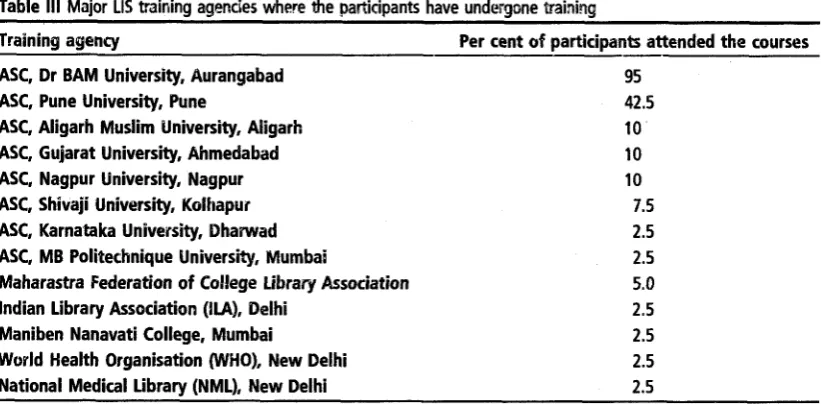
shows that a majority of the pmisiparrts are updating their professional skills through CEP courses organised by different institutions, ASCs, professional associations and other bodies. The organisations that were involved in organising the refkesher courses are given in Table 111.
Table 111 shows that the academic st& colleges are actively involved in imparting training to college and university librarians in India. Other organisations include
IEA,
Maharastra Federation of College Library Association, WHO and NML. The reasons far attending the CEP course are:
to acquire new skills ( J . 5 per t ~ ~ l t j ; to update knowledge or basic education (27.5 per cent);
Almost half of the participants are attending these courses basically to improve basic knowledge/skills and improve the sewices in their libraries. When the participants were asked ta give their other considerations to attending the CEIJ course, 35 per cent of them are attending to purchase new books for their library and also sightseeing, and only 25 per cent of them were coming only for the course. The other reasons for attending the CEP course include:
personal work (12.5 per cent);
office-related work (7.5 per cent); and shopping (2.5 per cent).
It is interesting to know that 95 per cent agreed that they have achieved their objectives of attending the CEP course. When they were asked to tell what they gained from the CEP courses, they have expressed many
improvements achieved out of these courses (see Table IV).
However, a few mentioned that they did not achieve the objectives of attending the course. The reasofis why they did not achieve their objectives of atte~ding these progrmnmes were poor organisadan of the course, inadequate facilities and mismatch of +he c~rriculum with their needs. Table V shows the major organisations that are organising LIS CEP courses in India.
More than 80 universities have LIS to get trained in the latest technologies programmes either at bachelor or masters
(20 per cent); level. Of these, many have academic staff
to set up new syxtems in the library colleges (ASCs) which are providing
(17.5 per cent); continuing education to college teachers and
Table Ill Major LIS training agencies where the participants have undergone training
Training agency Per cent a0 participants attended the courses
ASC, Dr BAM University, Aurangabad ASC, Pune University, Pune
ASC, Aligarh Muslim University, Aiigarh ASC, Gujarat University, Ahmedabad ASC, Nagpur University, Nagpur ASC, Shivaji University, Kolhapur ASC, Karnataka University, Bhawad ASC, MB Politecknique University, Mumbai
Maharastra Federation of College Library Association Indian Library Association ([LA), Delhi
Maniben Nanavati College. Mumbai
The impact of continuing education pmgrammes
---
Library Review-
Chennupati # Rafiaiah and A. Lakshman Mawthy Vuiuinr 5 i.
Number 1.
2OC2.
24-31Table IV irnpmv~meirts achieved
---
Improvement Per cent of partidpants
Getting acquainted with the latest technologies 30
Updating knowledge in the field of LIS 30
Improving the library services 22.5
Acquainting with latest IT 17.5
Acquiring new skills 17.5
New tools and techniques in the area of library management 12.5
Getting tpained to train the junior staff 5.0
Purchasing ne'dv equipment to library 2.5
Starting library automation 2.5
Knowing about latest software 2.5
Table V Major training agencies in the field of 1.1s
Per cent of participants
Agency
-
attendedAcademic staff colleges 65
Universities 22.5
ILA 7.5
NISSAT 7.5
INSIDOC 5
DESIDOC 2.5
AIIMS 2.5
DRTC 2.5
lack of cooperation in the teaching staff
(12.5 per cent); and
the university administration gives lesdno importance to the LIS discipline
(20 per cent).
It is interesting to know that the participants were satisfied w t h the courses organised by ASC and other government agencies such as INSDOC and DESIDOC. It is because they have enough experience ana also adequate infrastructure to conduct these courses. Other
NML 2.5 professional associations such as
ILA
andIASLIC neither have idkastructure nor people from
rhe
public and private sectors to experienced manpower to conduct the course, upgrade their skills to perfsrm their jobs so the participants did not rate their courses effectively. UGC is actively participating in very highly.this activity and sponsoring the ASCs to conduct CEP courses in various disciplines,
including LIS. When they were asked to rate
Probable areas of CEP courses
the courses organised by various trainingorganisations, about two-thirds liked the CEP courses organised by the ASCs and UGC. Rofessional organisations such as
ILA,
training organisations including INSDOC, DESIDOC, national organisations such as NISSAT, NML and AIIMS are also conducting CEP courses in LIS.Slightly more than half of the respondents felt that the courses offered by the LIS schools were adequate; however, 37.5 per cent of them felt that they were inadequate. The reasons they mentioned why the LIS schools are unable to deliver the latest training include:
old curriculum (25 per cent);
lack of trained reachers in the latest areas
(30 per cent);
lack of computers and other equipment
(45 per cent);
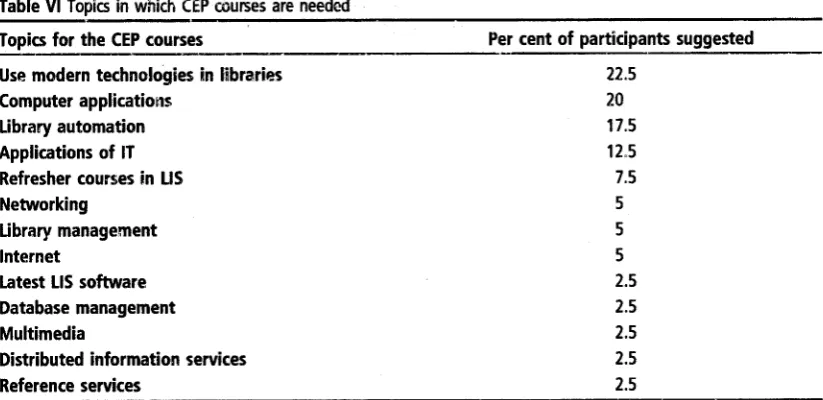
All the participants were asked to suggest the topics of oxrent interest on which CEP courses are to be organised. Table VI shows the list of topics in which they are interested. Many respondents did not opt for the latest technologies such as use of modern
techiologies in libraries, library automation,
IT and computer applications, because they are still using manual procedures in operating their librarv services. The major concerns of the participants seem to be library automation and networking as well as introducing the latest technologies in their libraries. Though UGC started INFLIBNET, an all-India university libraries automation and
The impact of continuing education programmes Library Revien .
--
Chennupati K. Rarnaiah and A. Lakshrnan Moorthy Volume 51.
Number 1 20;?2.
24-31Table VI Topics in which CEP courses are needed
Topics for the CEP courses
--
Per cent of participants suggested-
Use modern technologies in libraries 22.5
Computer applications 20
Library automation 17.5
Applications of IT 12 5
Refresher courses in LIS 7.5
Networking 5
Library management 5
Internet 5
Latest LIS software 2.5
Database management 2.5
Multimedia 2.5
Distributed information services 2.5
Reference services 2.5
How to organise the CEP course?
Several studies have already been conducted (Hanson, 1981; Katz, 1990; Woolls, 1993) about the standards of practice in the design and evaluation of CEPs. Two weeks is the minimum time and four weeks is the
maximum time duration the participants can spend for a CEP course. However, 25 per cent of the respondents showed interest to attend longer duration courses, such as six to 56 weeks. It was found that most of the ASCs are conducting CEP courses of two to four weeks' duration only. Persons who are interested in six to 12 month courses may better go for full-time university courses, as no Indian training organisation is running a course for such a long duration.
The majority of the participants agreed that the medium of instruction in the CEP courses should be English; however, half of them also showed interest in local languages (Marathi) and one-quarter of them opted for Hindi, the national language. The method sf insmnction opted for by them includes:
classroom lectures (62.5 per cent); lectures followed by hands-on (47.5 per cent);
provided in the form of a publication or CD-ROM to take back and read at their leisure. ? l e y need hands-on experience on latest technologies. For a rnajority of the participants, the composition of the CEP course should be 50 per cent theoretical and 50 per cent hands-on. About one-quarter of them opted for 75 per cent theoretical classes and 25 per cent hands-on instruction. Practicals (hands-on) make the participants well-versed with the technologies. The more the hands-on, the inore they become confident to operate on their own in their libraries. An ideal mix could be 60 per cent theoretical and 40 per cent hands-on.
It is interesting to h o w that the
participants prefer manned training courses (75 per c a t ) over distance education (25 per cent) through the Internet. The reasons for preferring the instructor-based courses include:
lack of interamon in machine-based training (47.5 per cent);
live interaction (35 per cent);
collaborative instruction (1 7.5 per cent); and
non-availability of good instructional packages (5 per cent).
CD-ROM/multimedia-based training
Though many foreign universities and
(62.5 per cent); and
professional agencies are arranging CEP Web-based training (20 per cent).
comes through the Internet, they did not It was felt that ASCs should take the initiative show any interest towards them. Some of the in developing some of their insrructional reasons for this are:
materials, such as multimedia courseware, to high course fees;
provide effective training. Since all these inappropriate course time; participants are adults, mature m d language;
experienced, they do not require basic dings traveling time; and to explain. So, all the basic materials way be expenses, etc.
The impact of continuing education programmes Library Review
Chennupati K. Rmaiah and A. Lakshman Moorthy Voh~me 51
-
Number 1 -2002 -24-31In the case of Indian training agencies, the courses are organised in college holidays and also the come fee is affordable by their institution. The most suitable period for arranging CEP courses for the majority is May- June, while for some it is October-November. Almost two-thirds of the people agreed that the present CEP fee charged by the ASCs is moderate; however, 20 per cent of them felt it is too high. They also felt that Rs. 1,000 is the maximum fee that their institutions can afford for a five-day CEP course and a few of them agreed up to Rs. 2,000 but not beyond. It is noticeable that the main reason for attending the CEP course is for getting the next promotion (67.5 per cent). It is true that
UGC is insisting that college librarians upgrade their professional skills by attending refresher courses conducted by ASCs and various training agencies. Only for one- quarter of them, it was not essential for their next promotion but was required to improve their library services. Since CEP is a regular ongoing activity, more than two-thirds of
them felt that there should be a national agency for this activity to conduct and coordinate these courses in all the disciplines. For this, the majority of them preferred UGC as the right organisation to perform this function at a national level.
Impact of CEP on LIS professionals
The main impact of a CEP course on
LIS
professionals is three-fold:(1) to fill the gaps in their university learning (17.5 per cent);
(2) to keep up-to-date with the technology (87.5 per cent); and
(3) to help in getting promotions (27.5 per cent).
It is interesting to know that only 50 per cent of them have adequate infrastructure and computers to use and implement the training skills acquired during CEP courses. Less than half of them agreed that they do not have enough infrastructure to implement the latest technologies in their libraries. So, funding was the main problem in many colleges and universities to equip their libraries with the latest technologies to provide quality services. This problem needs to be resolved by the authorities so that libraries in colleges can
In general, it was noticed that some of the participants do not take lectures and training seriously. The main reasons for this is that they are out of touch with classroom- based instruction. A few had language problems. Since some of the participants are very old and some are nearing retirement age, it is difficult for them to sit in the lectures like fresh college students.
However, they are compelled to attend these courses to get their promotions. Their main concern in attending these courses was getting the CEP course certificate to fulfill the minimum requirements of their organisations to get the next promotion. More than half of them (62.5 per cent) agreed with assessment after completing the CEP course. The organisers of CEP courses may conduct an assessment test and reflect the grading in their training certificate. This will compel the participants to interact and involve themselves more lively in the training programme leading to improved learning and using the acquired skills at the institution library.
Conclusions
CEPs are one of the main means through which Indian college and university librarians
are keeping up-to-date in their profession. ASCs of the Indian universities are playing prominent roles in imparting CEP courses to LIS professionals along with national
The impad of continuing education programmes Library Review thennupati K. Ramaiah and A. Lakshman Moortlry Volume 51
.
Number 1.
2002 24-31courses on
LIS
professionals is to keep up-w- date with latest technologies, fill the gaps of their university learning and help in getting promotions.References
Chaudhry, A.S. (1993)' "Development and implementation of an in-house continuing education program in an academic library", Education for Information, Vd. 11 NO. 1, pp. 47-56.
Hanson, AL (1981), "Use of 'standards of practice' in the design and evaluation of a continuing education program", American lwmal of fiannaceutical Education, Vol. 45 No. 1, pp. 56-60.
Javis, P. (1 983), Adult and Continuing Education: Theory and Practice, Crwm Helm, London.
Ka'l, B. (Ed.) (1990), Continuing Education of Reference Librarians, The Haworth hers, New York, NY.
Knowles, M.S. (1980). The Modern Practice of Adult Education: From Pedagogy to Andragogy, Prentice-Hall, Englewood Cliffs, NJ, pp. 24-39. Nelson, J.A. (1979), "Continuing education", Journal of
Education for Librarianship, Vol. 20 No. 2, pp. 16265.
Rogers, A. (1 986), Teaching Adults, Open University, Milton Keynes.
Stone, E.W. (1 986), "The growth of continuing education", Library Trends, Vd. 34 No. 3, pp. 489-513. Wilkinson, J. and Murray, C. (1988), "Continuing education for librarianship: who benefits and why?", Canadian Libraryloumal, Vd. 45 No. 1, pp. 42-6.