1 Abstract:
The purpose of this paper is to address the current issue of Energy requirement and an alternative solution for it. The principle focus will be on concept of nuclear energy its need and threats. Today’s world is undoubtedly facing a danger posed by continuously depletion of non-renewable sources of energy, which may possibly get finished within few years. Such utilization is depleting the sources like coalmines, natural oil reserves; which are responsible for global warming due to increased rate of carbon dioxide and several other environmental problems related to air environment. And on other hand renewable energy sources like solar, wind, geothermal
energy are very dilute sources of energy and requires more land and money for setup of energy plant or sectors. Nuclear energy is fairly cheap and can be produced required amount of energy to fulfill the requirement . In this paper nuclear power plant situated in Gujarat at Bhavnagar is taken as case study, which is a 3 stages nuclear power plant based on advancement of Nuclear power reactor. Keywords: Non-renewable sources, Nuclear energy, Global warming, nuclear power plant.
1.Introduction
Energy is the fundamental requirement of
every element present on the Earth to sustain
its existence. As well it leads an important
role in development of mankind. After a
civilization by 18th century there is continuous increasing demand of energy due
to vast industrialization. Current demand of
energy is possible to get doubled in coming
few years. It is estimated that over few years
it will result into several pollution problems
unless the pattern changes. Because current
requirement of energy is fulfilled by the run of turbines with hot steam obtained after
burning coal and natural oil. Generally energy
is obtained by burning of fossil fuels majorly
Coal
Which produces energy but releases harmful
gases like carbon monoxide, nitrogen dioxide,
and sulfur dioxide, which are responsible for
greenhouse effects, global warming and
degradation of air quality. But as compared to
Nuclear energy; it can become a good
alternative for energy demand because it is
cheap to produce and it is a clean energy
source.
International Journal of Research Publications
Volume-3, Issue-1,April 2018
Accepted and Published Manuscript
NUCLEAR ENERGY: THE DEPENDABLE OPTION
Saurabh Joshi,Mr.Kiran Kangle, Mr.Pramod Jadhav, Mr. Ravi Nikam
PII : Saurabh Joshi.100315201898
DOI: 100315201898
Web: http://ijrp.org/paper_detail/99
To appear in: International Journal of Research Publication (IJRP.ORG)
Received date: 26 Apr 2018
Accepted date: 28 Apr 2018
Published date: 06 May 2018
Please cite this article as: Saurabh Joshi,Mr.Kiran Kangle, Mr.Pramod
Jadhav, Mr. Ravi Nikam , NUCLEAR ENERGY: THE DEPENDABLE
OPTION , International Journal of Research Publication (Volume: 3,
Issue: 1), http://ijrp.org/paper_detail/99
This is a PDF file of an unedited manuscript that has been accepted for
publication. As a service to our customers we are providing this final
version of the manuscript.
1
NUCLEAR ENERGY: THE DEPENDABLE OPTION
Mr.Saurabh Joshi1,Mr.Kiran Kangle2, Mr.Pramod Jadhav3, Mr. Ravi Nikam4
1Assitant Professor Department of Environmental Engineering KIT’s College of Engineering, Kop.
2 Assitant Professor Department of Environmental Engineering KIT’s College of Engineering, Kop.
3 Assitant Professor Department of Environmental Engineering KIT’s College of Engineering, Kop.
4Associate Professor Department of Environmental Engineering KIT’s College of Engineering, Kop.
Abstract:
The purpose of this paper is to address the current issue
of Energy requirement and an alternative solution for it.
The principle focus will be on concept of nuclear energy
its need and threats. Today’s world is undoubtedly
facing a danger posed by continuously depletion of
non-renewable sources of energy, which may possibly get
finished within few years. Such utilization is depleting
the sources like coalmines, natural oil reserves; which
are responsible for global warming due to increased
rate of carbon dioxide and several other environmental
problems related to air environment. And on other hand
renewable energy sources like solar, wind, geothermal
energy are very dilute sources of energy and requires
more land and money for setup of energy plant or
sectors. Nuclear energy is fairly cheap and can be
produced required amount of energy to fulfill the
requirement .
In this paper nuclear power plant situated in Gujarat at
Bhavnagar is taken as case study, which is a 3 stages
nuclear power plant based on advancement of Nuclear
power reactor.
Keywords: Non-renewable sources, Nuclear energy,
Global warming, nuclear power plant.
1. Introduction
Energy is the fundamental requirement of
every element present on the Earth to sustain
its existence. As well it leads an important
role in development of mankind. After a
civilization by 18th century there is
continuous increasing demand of energy due
to vast industrialization. Current demand of
energy is possible to get doubled in coming
few years. It is estimated that over few years
it will result into several pollution problems
unless the pattern changes. Because current
requirement of energy is fulfilled by the run
of turbines with hot steam obtained after
burning coal and natural oil. Generally energy
is obtained by burning of fossil fuels majorly
Coal
Which produces energy but releases harmful
gases like carbon monoxide, nitrogen dioxide,
and sulfur dioxide, which are responsible for
greenhouse effects, global warming and
degradation of air quality. But as compared to
Nuclear energy; it can become a good
alternative for energy demand because it is
cheap to produce and it is a clean energy
source.
2
2. Current world scenario of energy sources
and utilization
Energy is obtained from different sources;
each has its different characteristics. Based on
it these sources are classified on two major
categories as,
1) Conventional
2) Non-Conventional energy sources
Conventional energy sources are Fossil fuel
that are coal, natural oil natural gas which on
the way to running out due to rapid increase
in energy consumption.
And other non convectional sources of energy
that are solar, wind geothermal biomass and
wave energy which are clean energy sources
but are very dilute because of lack of
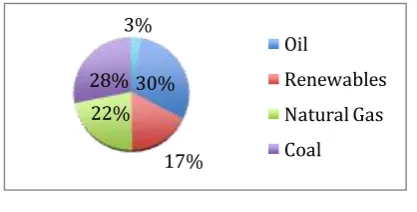
technology to get its full benefits. Following
figure shows the current requirement of
sources in the world.
30%
17% 22%
28% 3%
Oil
Renewables Natural Gas Coal
Fig No1. : Current requirement of sources in
the world.
According to above figure it is clear that more
than 70% energy is generated by
non-renewable energy sources and remaining is
generated either by remaining sources.
Energy consumption in India
India has more than 1.2 billion population and
India is worldsfourth highest energy consumer
after USA, China and Russia and India is 5th
biggest GHG emitter in the world. In India
energy is obtained by nonrenewable sources
like Fossil fuels and renewable sources like
solar, wind power, geothermal and biomass
energy. But currently in India energy is
generated either by using coal, natural oil and
natural gas. In India plenty of coal is available
(84,396 million tons) which can last up for 240
years only. Crude Oil consumption account
more than 36% of the energy and together coal,
natural gas and oil makes 70% of energy
generation. While renewable energy sources
requires costly infrastructure, land and money.
Following char shows energy installments in
India
Table No. 1:Energy installments in India.
Energy Type Installment
Thermal Energy 64.6%
Hydroelectric 24,7%
Nuclear Energy 7.7%
Renewable Energy 2.9%
But still there is crisis in energy supply. Hence
there is need of cleaner and concentrated energy
source to meet the demand, and the good
alternative can be‘Nuclear Energy’
3. Why nuclear energy should be preferred?
3
• Clean source
• Sustainable source of energy
• Less air pollution problems
• Decreases dependency on fossil fuel
• Saving of land use
• Higher efficiency
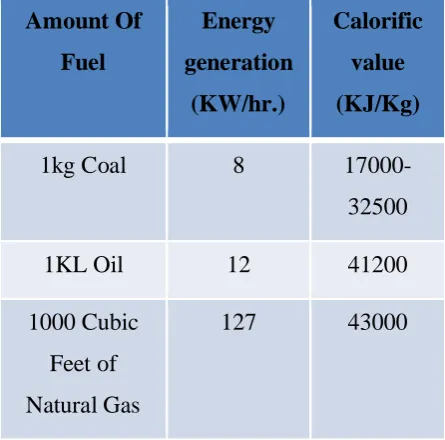
Comparison between Nuclear fuel and
fossil fuel.
Table No.2: Calorific value of fuel
Table No.3: Calorific value of U235
Fuel
Uranium-235
Fuel Type Calorific
value
1Kg Recycled 500GJ/Kg
1Kg Natural 650GJ/Kg
1Kg Enriched 3900GJ/Kg
Current utilization of energy in India
India holds 4th rank in utilization of nuclear fuel
for energy generation. Presently in India there
are total 21 nuclear reactors, which produces
5780MW energy. While 4 are under
construction which will be able to produce 4300
MW energy and newly proposed reactors will be
able to generate 28364MW energy by 2020. The
plant installed in India is pressurized nuclear
reactor, boiling nuclear reactor and free breeder
nuclear reactor heavy water reactor, light water
reactor. In which FBR reactor is based on
generation of energy with the help of Plutonium
formed during fission reaction. While remaining
reactors utilizes Uranium-235. Hence
combination of conventional reactor and FBR
can able to produce more energy with less
fuelling of rector.
Nuclear energy and working of rector
Initially nuclear reactor works on nuclear fuel,
which emits thermal energy in from of different
emission waves after bombarding of neutron on
pellets containing nuclear fuel.
Working of nuclear reactor and handling of
nuclear waste
A nuclear reactor is a system that contains and
controls sustained chain reaction. In which 1st up
all thermal power is generated by bombarding
neutron on uranium, which undergoes nuclear
Amount Of
Fuel
Energy
generation
(KW/hr.)
Calorific
value
(KJ/Kg)
1kg Coal 8
17000-32500
1KL Oil 12 41200
1000 Cubic
Feet of
Natural Gas
127 43000
4
fission reaction and emits energy in a form of
heat. During this reactor vessel holding chain
reaction gets heated more enough to generated
pressurized steam and vapors by using water to
cool down vessel, which are able to rotate
turbine attached to generator, which converts
heat energy to kinetic energy. Engineered safety
features added to rector for the emergency
shutdown of control-rod-system which reactor
operates vessel with cooling systems to avoid ant
misshapen during reaction process.
Generally coolants used to control
temperature of reactor vessel are water,
CO2, Graphite and heavy water. The
coolant used serves to purposes it
removes excess heat and provides
intrinsic safety. And after a typical fuel
cycle fuelling of reactor is done by
replacing spent pellets by new pellets.
The spent pallets are then removed and
sent to handling and disposal unit.
Benefits and threats of nuclear energy
Benefits
• Relatively low cost
• Stable energy generation load
• Low air pollution only thermal
• Sustainable energy source
• Cleaner source
• High energy density
• Useful by product (plutonium, thorium)
• Medical health care instruments, UV
radiations, security scanners.
Threats
Accidents may happen
• London Three Mile Island (March 28,
1979). It was caused by partial meltdown
of cooling system.
• Chernobyl Disaster (April 26, 1986)
It took place due to failure of system
during testing of nuclear vessel and
turbine.
• Fukushima (March 11, 2011)
It took place due tsunami occurred near
to plant which had damaged the
emergency cooling system of plant.
Radioactivity
• Storage of nuclear fuel and waste
• Ecological Hazards like Mutation,
accumulation, magnification,
Bio-concentration, Alteration of nuclei.
• Social problems due to past evidences. Hence
proper handling and storage of nuclear fuel is
required to avoid any threat related to nuclear
contamination.
Handling and disposal of nuclear waste
Handling of nuclear waste after spent is
carried out by different methods;
In which methods like
1. Dilute and Disperse,
2. Delay and Decay and
5
3. Concentrate and Contain
Are used, based on concentration level of
waste low, medium and high respectively.
After desired decrease in radioactivity and
concentration waste containing
anti-radioactive containers are disposed of either
by gullwing metods
1. Incineration,
2. Compaction in soil,
3. Cementation
4. Verification.
• Handling practice at Yucca Mountain
Yucca Mountain is located near Las
Vegas in the desert of Nevada. It is 6 mile
long 1,200 feet high and it is able to store
more than 70,000 tons of radioactive
material packed in container. In this
waste handling of nuclear waste is
carried out by storing spent pallets in
carbon or stain steel- zirconium iron
containers. Inside yucca mountain 3
tunnels are constructed which are
parallel to main rail cart transportation
lane which transports spent nuclear
pallets packed in container to suitable
tunnel depending upon type of waste
low, medium and high level waste. And
after storage has done entrance of Yucca
Mountain in closed with the help of thick
anti-radioactive door during this all
system is operated with the help of
automatic sensing system to avid any
human contact with radioactive waste.
Fig. No. 2: Yucca Mountain
Fig. No. 3: Tunnels of Yucca Mountain
Fig. No. 4: Tunnels of Anti-radio activedoor
Case Study: Advancement in nuclear
power plant ( Ref.:EIA Report )
In India most commonly operated reactors are
Pressurized Nuclear Reactors ad Boiling
water Reactors Fast reactors. Moderation
provided by these reactors use either natural
6
uranium or enriched uranium, which
undergoes continuous chain reaction. Hence
whenever nuclear fuel that is uranium-235 is
used it keeps chain reaction continuous until
splitting of uranium into plutonium and
thorium occurs. When spiting of uranium
takes place, then new pellets are replaced
spent pallets. These spent pellets still contain
nuclear energy potential hence it is termed as
High-level nuclear waste. Due to lack of
technology energy potential of uranium
isotopes cannot be recovered because the
design of reactor is based on only energy
extradition from uranium. But on other hand
if combination of Uranium reactor and
thorium reactor is done then continuous
energy extraction with least fuelling can be
done. One good example of this option is
Three-stage nuclear power plant which is
under construction.
Three stage nuclear power plant
India is pursuing Three-stage nuclear power
plant in Gujarat at Mithivirdi Bhavnagar;
under execution of Government of India and
Nuclear Power Corporation Of India
Limited(NPCIL). In which total 6 reactors are
designed having capacity of 1000MW per
reactor. There are total 6 reactors in which 3
reactors are PHWR and 3 are FBR (Fast
Breeder Reactor). The plant is consisting of 3
stages in which both uranium and its isotopes
can be used for extraction of energy.
First Stage- In this step naturally occurring
uranium is obtained and used as a fuel, after
enrichment of fuel in ordinary pressurized
water reactor.
Second stage- The second stage of program
comprise of application of Fast Breeder
Reactor using plutonium obtained from spent
fuel of uranium pellets in 1st PHWR reactor
which forms plutonium and thorium isotopes
are used to convert isotope Thorium into
Uranium U-233 as a fissile material.
Third Stage- The third stage of the program
involves the use of U-233 obtained from
second stage of FBR and thorium as blanket
there by producing continuousenergy
generation with use and recovery of spent
nuclear fuel.
Cooling system
For cooling purpose, water is extracted from
Arabian Sea, which is dense in nature and
used to generate steam after cooling down of
nuclear vessel. After generation of energy
steam is recovered as water by condensation
and used as coolant for next cycle of energy
generation.
Handling of nuclear waste
After nuclear potential is extracted from fuel
the spent pellets are stored in thick
stainless-steel container with obstruction of
radioactivity through container. This waste
contains low radioactivity due to extraction of
fuel hence it causes less radioactivity and
7
nuclear contamination. After a drop of desired
concentration nuclear waste is incinerated at
site by using special furnace to follow onsite
waste management, due to extracted energy
potential waste disposal by incineration is
safe from environmental point of view. The
special furnace is used for incineration with
required pollution control devices. These
control devices are required to minimize the
air pollution caused only by fuel containing
pellets, which are manufactured to hold
nuclear fuel.To avoid any misshapen coolant
systems including anti nuclear materials are
used like graphite, zirconium, CO2and water.
Conclusion
Rapid economic growth has created a growing
for supplies of energy. Current population in
India is 1.21 billion, which is likely to touch
1.5 billion in 2030,and sparing of land for
installment of other renewable energy sources
by solar panels, wind farms and construction
of hydroelectric energy generators will
ultimately result in damage to original
characteristics including biotic and abiotic
components of land due to alteration caused in
huge area required for installment. On other
hand, India has vast nuclear fuel sources of
Thorium and Uranium, which are capable of
feeding of Nuclear Power Generation. Hence
by utilizing both uranium and by converting
thorium into uranium from spent uranium can
act as dual purpose, one by utilizing energy
potential and another by recovering uranium
from spent fuel can lead to decrease in storage
and handling of nuclear waste if proper care is
taken. Hence India can become a capable to
fulfill its requirement by utilizing nuclear fuel
as its resource for energy, which will help to
the Sustainable and Clean Development of
India for long time.
References :
Research paper, reports and journals referred
Journal of Elsevier – Progress in Nuclear Energy
And Sustainability by combination of nuclear fuel,
fossil fuel and renewable energy sources
By-Charles W. Forsberg.
Atoms For Peace Nuclear Energy and peace
By-MohamadZakaria.
Prospects for U.S. Nuclear Power After
Fukushima by- Lucas W. Davis.
A research report of the International panel on
fissile materials-The future of Nuclear Energy By-
Frank Vol Hipper
IDSA Task Force report on Development of
Nuclear Energy Sector in India
The journal of AkshyaUrjja- The future Of
Nuclear Energy In India By- Neil Crawford, Gray
Ktazoff, TalhaRiaz, Victoria Stutz.
Websites Refereed
htpp://geoinfo.nmt.edu/resources/uranium/power.
html
htpp://www.nucleartouirst.com/basics/cost.htm
8
htpp://energyinformative.org/nuclear-energy-prosp-and-cons/
htpp://oldphartte.blogspot.in/2013/04/17-april-blogs-im-following.html
htpp://www.whatisnuclear.com/
htpp://www.greenpeace.org/india/en/what-we-
do/nuclear-unsafe/safe/nuclear-power-in-india/q-and-a-civillian-nuclaer-sector-in-india