DEVELOPMENT OF FACE RECOGNITION SYSTEM AND
FACE DISTANCE ESTIMATION USING STEREO VISION
CAMERA
1EDY WINARNO, 2AGUS HARJOKO, 3ANIATI MURNI ARYMURTHY, 4EDI WINARKO 1Faculty of Information Technology, Universitas Stikubank, Semarang, Indonesia 2Associate Professor, Department of Computer Science and Electronics, Universitas Gadjah Mada,
Yogyakarta, Indonesia
3 Professor, Faculty of Computer Science, Universitas Indonesia, Depok, Indonesia 4Associate Professor, Department of Computer Science and Electronics, Universitas Gadjah Mada,
Yogyakarta, Indonesia
E-mail: [email protected], [email protected], [email protected], [email protected]
ABSTRACT
The research of face recognition and face distance estimation is a study that is being developed nowadays. This research proposes a model of face recognition by combining wavelet decomposition, PCA and Mahalanobis distance. This method will provide a better of recognition rate and will improve the computation time of face recognition. We also develop the measurement of distance between the face and the camera on the proposed face recognition system. We propose real-time distance estimation on face recognition system using stereo vision camera. We calculate the distance using stereo vision camera based on stereo triangulation method using two lenses. The two lenses of stereo vision camera are used to capture a face image and to determine the 3 dimensional points projected from 2 dimensional points. The calculation of distance is determined by the projection from stereo vision camera. The proposed system is capable to calculate the distance beetween face and camera on the proposed of face recognition. This research also suggests a correlation between recognition rate and the distance estimation beetween face and camera. The recognition rate of the proposed of face recognition can work well in the range of 50-350 cm in real-time conditions.
Keywords: Face recognition, face distance estimation, stereo vision, wavelet, PCA, Mahalanobis
1.
INTRODUCTIONFace Recognition System is an application of computer technology that can be used to detect and recognize human faces from images or moving images such as video from a camera. Generally, a face recognition algorithm can classify human faces and recognize the identity of the detected faces. Some previous researches on face recognition system have been done by several researchers. Turk and Pentland [1] have developed a face recognition system using eigenfaces method. A face recognition system using a comparison between the features and templates has been developed by Brunelli and Poggio [2]. Another face recognition system using discrete cosine has been developed by Hafed and Levine [3]. Kelsey et al. [4] conducted research on face recognition using eigenfaces algorithm and
histogram equalization. Zhichao and Meng [5] conducted a research using illuminance reduction prior to extraction in face recognition process. Kato
et al. [6] have developed a research in face recognition using real-time angle and illumination-aware based on artificial neural network.
camera. Several researches on distance measurement using a camera have been done earlier by several researchers. Lamża et al. [7] have developed a method for depth estimation using a single camera for video surveillance system. Joglekar et al. [8] conducted a study on a depth estimation using monocular camera. Saxena et al.
[9] have developed a depth estimation system using monocular and stereo cues. Fanelli et al. [10] conducted a study to determine the estimated real time head pose from consumer depth cameras.
Research development using stereo vision camera in face detection and face recognition has been developed by several researchers before. Lin
et al. [11] used stereo vision technique to obtain the distance of face from camera. Budiharto et al. [12] used stereo vision camera to obtain the depth between camera and a face as a service robot. Chen
et al. [13] have developed a new method of face recognition and face tracking using stereo vision camera for its implementation in robot platform.
From the previous researches, there is no study on the recognition of a movement face and the determination of the real-time distance between the face and camera. Therefore, this study implements both face recognition and real-time distance calculation between the face and the camera at once.
The rest of the paper is organised as follows. Section 2 decribes our research method. Section 2.1 explains about face recognition model. The distance estimation model is explained in Section 2.2. Section 3 discusses the results and analysis of our experiments. Our conclusions are presented in Section 4
.
2.
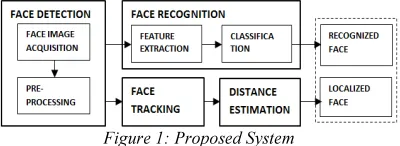
RESEARCH METHODA face recognition system developed in this study is equipped with real-time distance estimation using stereo vision camera. The proposed system is used to find out who is detected on the camera and to determine the distance of the face captured by the camera. A stereo vision camera that has two lenses (right-left) are used to measure the distance to the object.
The distance calculation is done firstly by transforming the object in the image coordinate system to the object in the real world system. There are three steps to calculate an estimated distance between the camera and the face:
(1)Capturing a face image by a camera. (2)Conducting the process of face detection
using Haar method.
(3)Determining the distance of the face using two points in the face image.
[image:2.595.307.507.227.300.2]The calculation of distance and face recognition process can produce a real-time model of distance estimation on face recognition using stereo vision camera. Generally, the proposed system is shown in Figure 1.
Figure 1: Proposed System
2.1. Face Recognition
In this study, we used a feature extraction model using wavelet decomposition level 3 and PCA. We use Mahalanobis distance as the method of classification. There are four steps to perform the process of face recognition :
(1) We conduct the image acquisition process and preprocessing of face detection (2) We reduce the dimension of the image
using wavelet decomposition level 3 (3) We use Principal Component Analysis
(PCA) as feature extraction
(4) We use Mahalanobis distance as classification
2.1.1 Preprocessing
We use Haar cascade classifier to localize the face area [14]. We combine four steps: (1) We crop the face image in the face detection, (2) We change the RGB face image to grayscale, (3) We resize the face image in 160×160 pixels, (4) We normalize
the contrast and brightness using histogram equalization.
2.1.2 Feature extraction
Figure 2. Face Images From Wavelet Decomposition Until Level 3 (160x160, 80x80, 40x40, 20x20) Of Pixels
2.1.3 Classification
In the classification process, we use Mahalanobis distance to produce an accurate and optimal value of face recognition. Mahalanobis distance is also used to anticipate differences in illumination and variations of face expression. If x
is vector data, C-1 is inverse covariance matrix, T is vector to be transposed, is vector of mean of variables and then we can obtain the Mahalanobis distances formula (D2) as shown in Equation 1.
(1)
2.2 Distance Estimation
In the distance estimation process, we use stereo triangulation as a technique to measure the distance in stereo vision system. We use a stereo vision camera with two lenses as a face image capture and to determine the 3D points projected from camera lens. The image from the camera is further processed using face tracking and distance estimation. We use a stereo vision camera that has maximum resolution of 800 x 600 pixels and
equipped with 2 lenses. The distance between the left and the right lens is 6 cm, this camera has a maximum focal length in 10 cm and the maximum image capture on the camera is 30 fps (frames per second). A 2D (two-dimensional) object captured by stereo vision camera will be projected into a 3D (three-dimensional) points to estimate the distance of the object from the camera.
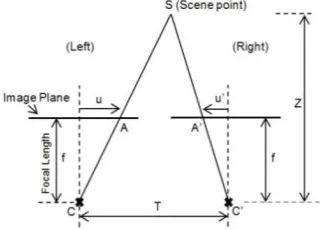
[image:3.595.84.509.96.455.2] [image:3.595.326.487.297.412.2]To obtain a point of image projection from 2 different angles, we use 2 lenses from a stereo vision camera to determine the distance estimation of the object. The stereo triangulation model of image projection from stereo vision is shown in Figure 3.
Figure 3: Stereo Triangulation Model Of Image Projection In Stereo Vision Camera
Figure 3 shows that stereo vision camera has 2 lenses (C, C'). Both lenses are capable to capture images of objects at the same point S (Scene point). The location of point from 2 position of the image is denoted by A and A'. f is the focal length of the camera and T is the distance between two of lenses. The difference in distance between lines A or A' with the normally axes of the camera is denoted by
u and u'. To determine the distance (Z), we can obtain from Equation 2.
(2)
In the stereo image processing model, 3D point
Figure 4: Projection Model On Stereo Vision Camera
Stereo vision camera is used to obtain the position of the moving object's face in the picture, and then do the calculation to estimate the distance of the object’s moving faces. Z is a 3D point of estimated distance, A and A’ is the position of the camera image on the right and the left cameras. a is the distance between the midpoint of each camera, f
is the focal length. To determine the distance from the camera denoted as Z, we can reconstruct using 2D point projections as shown in Equation 3.
(3)
3. RESULT AND ANALYSIS
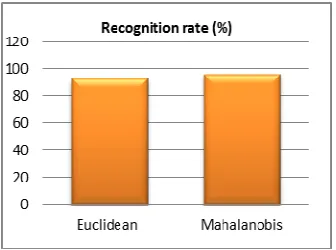
[image:4.595.305.499.117.285.2]In the face recognition process, we use 36 different faces of person and each face is taken in 10 times pose retrieval. We use 160x160 pixels of source image and comparing using Euclidean and Mahalanobis in each level of wavelet decomposition. The result is shown in Figure 5.
Figure 5: Comparison Of Recognition Rate
Figure 5 shows that the proposed system using Mahalanobis provides better face recognition rate about 95.56% than Euclidean that only provides 91.94%.
In the comparison of computation time, we use Mahalanobis and Euclidean as classification to
compare the testing computation time. The result is shown in Figure 6.
Figure 6: Comparison Of Computation Time
We can see that the testing computation time of the proposed system using Mahalanobis is better than Euclidean. Mahalanobis distance provides 5.56 ms of computation time while Euclidean distance can provide only 6.24 ms of computation time in average.
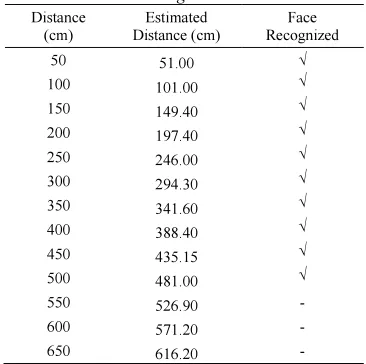
[image:4.595.106.274.539.664.2]Table 1: Results of Distance Estimation and Face Recognition
Distance
(cm) Distance (cm) Estimated Recognized Face
50 51.00 √
100 101.00 √
150 149.40 √
200 197.40 √
250 246.00 √
300 294.30 √
350 341.60 √
400 388.40 √
450 435.15 √
500 481.00 √
550 526.90 -
600 571.20 -
650 616.20 -
[image:5.595.97.280.145.327.2]In the next experiments, we have been testing the face recognition based on the distance estimation by comparing between the proposed system and PCA-Euclidean. The results show that the proposed system is better than the PCA-Euclidean. The results of the experiments showed that the difference of the distance between face and camera will affect to the results of the face recognition rate. The ideal distance of face recognition using the proposed system is in range of 50 to 350 cm. The best result of recognition rate is in range of 50 to 150 cm and the average of the results of recognition rate will achieve recognition rate is 96.49%. The experimental results of face recognition based on the distance are shown in Table 2.
Table 2: Recognition Rate based on Distance (Comparison between PCA-Euclidian and proposed
system)
Distance (cm)
Estimated Distance (cm)
Face Recognition Rate (%)
PCA-Euclidean
Proposed System 50 51.00 92.11 94.74 100 101.00 92.11 97.37 150 149.40 89.47 97.37 200 197.40 86.84 92.11 250 246.00 78.95 84.21 300 294.30 71.05 76.32 350 341.60 65.79 68.42 400 388.40 52.63 63.16 450 435.15 47.37 52.63 500 481.00 36.84 42.11
From Table 2, we can conclude that there is a correlation between distance estimation and
recognition rate of face recognition system as shown in Figure 7.
Figure 7: Correlation between Distance Estimation and Recognition Rate of the Proposed System
From Figure 7, we can determine a relationship equation between distance estimation (d) and recognition rate (R) as shown in Equation (4).
R = -2.0679d2 - 1.5399d + 101.58 Where:
R = recognition rate (%)
d = distance of face (m)
4. CONCLUSION
[image:5.595.84.292.560.713.2]REFERENCES:
[1] M. A. Turk and A. P. Pentland, “Face recognition using eigen faces,” in
Proceedings of the IEEE Computer Society Conference on Computer Vision and Pattern Recognition (CVPR ’91), pp. 586–591, June 1991.
[2] R. Brunelli and T. Poggio, “Face Recognition: Features versus Templates”,
IEEE Trans on PAMI, 15(10), pp 1042-1052, 1993.
[3] Z. M. Hafed and M. D. Levine, “Face Recognition Using the Discrete Cosine Transform”, International Journal of Computer Vision, 43(3), 167–188, 2001 [4] R. Kelsey, C. Daniel and O. Jesús, “A Face
Recognition Algorithm using Eigenphases and Histogram Equalization”, International Journal of Computers, Issue 1, Volume 5, 2011.
[5] L. Zhichao and J. E. Meng, “Face Recognition Under Varying Illumination”,
New Trends in Technologies: Control, Management, Computational Intelligence and Network Systems, ISBN: 978-953-307-213-5, 2010.
[6] H. Kato, G. Chakraborty, and B. Chakraborty, “A Real-Time Angle and Illumination-Aware Face Recognition System Based on Artificial Neural Network,” Applied Computational Intelligence and Soft Computing, vol. 2012, Article ID 274617, 9 pages, 2012. doi:10.1155/2012/274617
[7] A. Lamża, Z. Wróbel and A. Dziech, “Depth Estimation in Image Sequences in Single-Camera Video Surveillance Systems”,
Multimedia Communications, Services and Security Communications in Computer and Information Science, Volume 368, pp 121-129, 2013.
[8] A. Joglekar, D. Joshi, R. Khemani, S. Nair and S. Sahare, “Depth Estimation Using Monocular Camera”, International Journal of Computer Science and Information Technologies (IJCSIT), Vol. 2 (4) , 1758-1763, 2011.
[9] A. Saxena, J. Schulte and Y. Andrew, “Depth Estimation using Monocular and Stereo Cues”, International Joint Conferences on Artificial Intelligence (IJCAI), 2007.
[10] G. Fanelli, T. Weise, J. Gall, and L. V. Gool, “Real Time Head Pose Estimation from Consumer Depth Cameras,” DAGM'11 Proceedings of the 33rd international conference on Pattern recognition, Pages 101-110, 2011.
[11] J. Lin, K. Jiang and M. Chang, “A Novel Solution for Camera Occlusion in Stereo Vision Technique,” Advances in Mechanical Engineering, vol. 2013, Article ID 253794, 8 pages, 2013. doi:10.1155/2013/253794 [12] W. Budiharto, A. Santoso, D. Purwanto and
A. Jazidie, “Multiple Moving Obstacles Avoidance of Service Robot using Stereo Vision”, TELKOMNIKA Vol. 9, No. 3, December 2011 : 433 – 444, 2011.
[13] Y. Chen, J. Sheu, C. Cheng, and W. Tsai, “Implementation of Robot Platform in Face Detection and Tracking Based on a New Authentication Scheme,” Advances in Mechanical Engineering, vol. 2014, Article
ID 839753, 9 pages, 2014.
doi:10.1155/2014/839753
[14] R. Padilla, Filho C.F.F.C. and M.G.F. Costa, 2012. Evaluation of Haar cascade classifiers designed for face detection. World Academy Sci. Eng. Technol.