MOBILE-ASSISTED INSTRUCTIONAL FOR DOMESTIC
MAID (MAID-M)
1TEH PHOEY LEE, 2 GEOFFREY MUCHIRI MUKETHA, 3 GU YIN XIN
1Senior Lecturer, Department of Information Systems, Sunway University.
2Senior Lecturer, Department of Information Technology, Meru University of Science and Technology. 3School of Information Technology, UCSI University.
E-mail: [email protected] , 2[email protected], [email protected]
ABSTRACT
Statistics from Immigration Department of Malaysia has shown that the foreign workers have increased tremendously over the past 4 years. Different nationalities of foreign maids usually speak in their own mother languages from their home countries. A certain level of communication barrier between the Malaysia’s employers and the foreign workers were identified in the previous study. The misunderstanding of tasks requested to their domestic maid had led to the communication barrier. The study confirmed positively that this communication barrier has occurred between the employer and the maid. In this paper, the Mobile-Assisted Instructional for Domestic Maid (MAID-M) is proposed and presented both conceptually and physically. Feedbacks of the proposed application is collected and tested.
Keywords: Mobile Assistant, Mobile Development and Mobile Application.
1. INTRODUCTION
One of the most common problems with hiring foreign workers in Malaysia are they cannot communicate in either Bahasa Melayu or English (Eugene Mahalingam, 2011). Most of the communication conflicts happened is resulting from the unclear task instructions to worker. According to The Malaysian Insider (2013), there are now about 230,000 Indonesian maids in Malaysia and the number could reach 300,000 if Indonesian Maids continue to return to the country.
A journal published on TheStar online reported that Malaysia’s current employment has about 320,000 legal foreign maids, which most of them are from Indonesia, Sri Lanka, the Philippines, Cambodia and Thailand. (TheStar online, 2010). Philimore Sdn Bhd’s managing director Liew in Yip, 2008, who reported that the employment of Cambodian maids had increased over the past two years. He also pinpointed that the Cambodian maids are more preferable as most of them presented a better quality of working attitude even though the first weakness are due to the language barrier. (Yip Yoke Teng, 2008).
This study aims to confirm the existing of communication barrier existing between the foreign maids with their employers in Malaysia, following by confirming the need of a solution for this
problem. After developing a solution on mobile application, the apps is tested and verified.
The following parts of this paper are presenting on the statistic of language barrier occurring to foreign domestic maids in Malaysia. The data analysis and interviews outcomes are presented in supporting on the solution proposed in reducing the communication barrier. Both conceptual and physical developments of the solution are presented, and feedbacks for system testing are attached. The mobile-assistant for foreign maids understand their tasks in reducing the miscommunication are implemented using video assistant.
2.1 Foreign Maid Language
Another case in this journal also proves the same problem: Insurance agent Mrs Yew, 51, also said it was hard communicating with her maid Nit Trak, 25, at the beginning. “I would show her how to do something and she would nod, but she would do it differently,” said Yew. (Shaun Ho, 2010).
One report cited a case happened to Filipino maid worked for a Chinese family. A senior executive of a foreign-funded enterprise said her maid was very hardworking, however, the language barrier eventually became too much to handle. (Kimberly Jane T. Tan, GMANews.TV, 2008).
"She could not speak Mandarin, not to mention Cantonese. My mother found it almost impossible to communicate with her," she said in the report. (Kimberly Jane T. Tan, GMANews.TV, 2008) In addition, the language barrier often exists between the elderly and Filipino maids said Joseph Lee from Agensi Pekerjaan Raswell Resources Sdn Bhd. (Chok Sim Yee, 2011).
Malaysian Association of Foreign Maid Agencies (Papa) president Alwi Bavutty said most Cambodian maids had little or no education and their skills and language levels were low. And Employers need to be patient with them. (Shaun Ho, 2010).
3. METHODOLOGY
A survey was performed close to Taman Connaught, Kuala Lumpur, Malaysia and at one of the shopping complex near Taman Segar. The reason of doing this preliminary survey before designing the system is to understand the specific problem and the needs of maid employers, and also knowing some opinions of building a mobile application from the respondents. During the survey, the researcher used questionnaire to collect data, and also interviewed the respondents and some selected cases will be given in later content. The main objective is to identify employers’ actural needs from their foreign maids and the market potentiality of MAID system.
The distribution and collection of questionnaires took about four days at places where the population flow was high in frequency. For instance, the researchers sampled respondents from in and out side popular shopping malls, cinemas, restaurants such as Chilli, fast food restaurant like MacDonald’s, coffe store like Starbucks etc.
There were 100 copies of questionnaires collected from those who once hired or are currently hiring maid. Only respondents who had the experience of hired/hiring maids were qualified to do the survey and interview. And our main focus groups are on parents, white collars, people who are capable of hiring maids, ages between 25 to 55 years old, or to those who are accompanied by their maids.
The preliminary questionnaire is a brief questionnaire which contains about only 6 questions for respondents to complete. A brief questionnaire was usually more acceptable than long content questionnaires. Using the special designed questions, the result could identify the specific problem and make clear about the source reason. The type of question was single choice question, they were mainly asking about employers’ personal background and their satisfactions or attitudes on their maids.
2.2 Related Mobile Assistant
Various related mobile assistant works are summarized in Table 1. It is to understand the benefit of mobile-assistant as well as to verify the gaps among the applications from their limitations. The mobile travel assistant by Torrens et. al. (2004) integrates context-aware computing and brings a convenience to passengers for checking traveling status; the mobile personal assistant by Nagata and et. al. (2004) supports an intelligent interface that consists of a service concept characterized an interaction between the user and virtual assistant during mobile web tasks. The mobile shopping assistant by Wu and Natchetoi (2007), enables users accessing data exchange and asynchronous communication; the mobile assistant for disabled air passengers (PMA) by Darvishy et.al. (2008) concerns about in-house guidance within the airport for passengers with visual disabilities. The mobile solutions are all thoughtfully designed for the problems that the researchers have defined.
4. RESULTS ANALYSIS
Figure 2: Statistic Of Nationalities Of Maids
Figure 2 shows the statistic of maid nationalities hired/hiring among our 100 respondents. It consists of Indonesian (32%) and Chinese maids (28%) as well as Cambodian maids (14%). This included few of other nationalities maids, for instance Vietnamese, Iranian, Filipino, etc, who works for Malaysian families.
However, this pie chart is just a figure of population, which does not represent any communication barrier. Therefore, the respondents were asked in the next question whether their maids speak English. Figure 3 shows that 58% of maids do not speak English.
There are over a half of total (58%) do not speak English language. Figure 3 illustrates the pie of the communication barrier Vs. the English Speaking. Out of the 58% (58 respondents) of the 100% (100 respondents) of foreign domestic maids who do not speak English, 55% (32 respondents) of their employer does not have communication problem with them. The communication problem does exist between foreign domestic maids and their employers are 45% (26 respondents) only.
In this study, the term “communication barrier” is refer to the misunderstanding on an unclear instruction by the employer which causing the misunderstanding of tasks requested to their domestic maid. The pie chart above proved that communication barrier does not highly depend on language problem.
Figure 3: English Speaking Vs. Communication Barrier
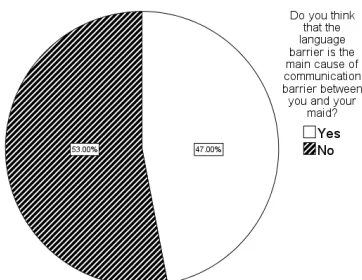
[image:3.612.326.507.330.470.2]Respondents were asked if the language is the main cause of their communications barrier with their maid. Figure 3 shows that 53% of them refuse that language is the main problem of their communication barrier. However, communication problem still occurred among the employer and the maid as according to Figure 4. What is the main reason causing this communication barrier if it was not referring to language problem?
Figure 4: Language Caused The Communication Barrier
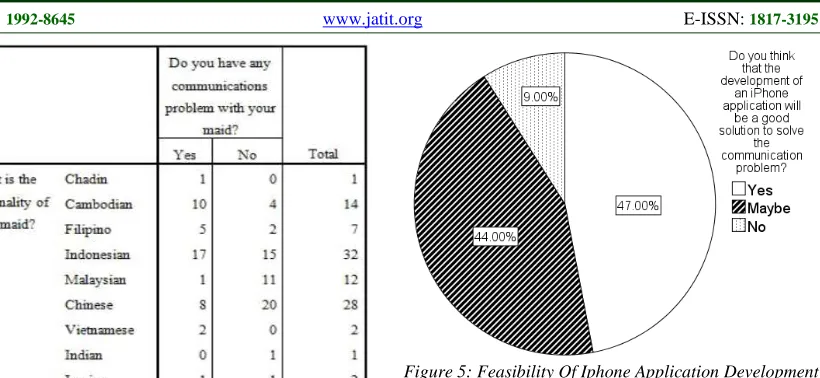
Table 1: Nationalities Vs. Communication Problem
Besides that, Table 1 shows that 10 (71%) respondents who had hired Indonesia maids have communication problem with their maid. Follow by 17 (53%) of who had hired Cambodian maids have communication problem with their maid. And the other 5(71%) of those who hired Filipino maids have communication problem with their maid. The women at the barber shop is also included on those who hired Cambodian maid.
[image:4.612.112.522.72.261.2]A 50-year-old Malaysian-Chinese woman mentioned that the Cambodian maid she once hired was actually educated. The maid had a bachelor degree, and was working for a trading company before she became a maid in Malaysia. The Cambodian maid can speak fluent English and also understand Malaysian language. The woman said that she has no language barrier with the maid, but she eventually still dismissed her cause of the maid’s poor working performance. Finally, this survey answered that the employers actually have difficulty in communication with their maid, and assistant is needed. If a tool such as computer software or mobile application that can work as the assistant for the employer to provide instruction to the maid, it will serve a better life. With this, the last question of this survey were to verify with the assumption to the respondents that if a mobile application is produced, do they think that will be good to solve the communication problem?
Figure 5: Feasibility Of Iphone Application Development
Figure 5 shows that 47% of the overall respondents replied positively toward the development of iPhone Application, while 44% reluctantly agreed that the iPhone application will be a good solution. Only 9% replied that solution is not a good solution to solve the communication problem. However, before asking this question to our respondents, this study had assumed that all the respondents understood what iPhone is and what iPhone application is. According to Figure 6, there are 80% of iPhone users in Asia until May 2010 (AdMob Mobile Metrics, 2010).
A survey based on 963 respondents in February 2010 shows the average number of paid/free application downloaded per user per month reaches 80% (AdMob Mobile Metrics, 2010). Therefore, both figures support that this question is valid to ask for this study. A stationary shop manager who is also a new birth mother mentioned during the survey: “it’s too hard to imagine tasks for maid to be assigned with an iPhone application”. A middle aged couple said: “That must be very complicated to use, it might take even more time to deal with it.” One other said something similar. However, from the outcome presented in Figure 5, 47% of people believed that this solution can work and it would be effective.
5. INTERFACE DESIGN
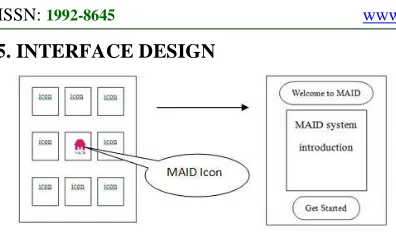
Figure 6 Starting Maid Conceptual Design
[image:5.612.94.297.337.435.2]As Figure 6 displays about how to start the system. Users may start the system by clicking on the MAID icon and enter the user welcome page. The system will take users to the next view by clicking “Get Started” button. Figure 7 shows the next view which is the main task menu that contains six sub menus. Clicking on “Cloth” for example, a list of tasks related to cloth are presented for user to choose. Users may scroll down and up to view the complete list.
Figure 7 Main Task Menu And Sub Menu Conceptual Design
Employers may choose any item they want their maids to do. In Figure 8, the researcher uses “Ironing” as the employers’ option. An image with an iron is presented on the screen, and employer may show this image to his or her maid without using any language communication, the maid would realize iron cloth is the task she should do. Two buttons at the bottom of this page for maid to check if the maid still doesn’t understand the meaning of the image. Video button has complete demonstration of how to fulfill the task and Description button includes literal explanation in maids’ own language. Indonesian language is used for first design and testing.
Figure 8 Detail Views Conceptural Design
6. PHYSICAL DEVELOPMENT
In order to write software for iPhone, the programmer used Intel-based Macintosh running Leopard (OS X 10.5.6 or later). (Dave Mark & Jeff LaMarche, 2009). Thus, the hardware for developing this system is a Mac laptop, and developing software is iPhone Xcode 3.2.4 and iOS SDK 4.1.
Figure 9 shows the physical design of starting the system. The main menu is on the first left one in Figure 10, each line on the table contains an image and an accessory button. The Indicator button is used as accessory button to extend the main menu view to its submenu view.
There are three types of accessory buttons in Xcode programming: indicator button, disclosure button and check mark. The researcher didn’t use the other two buttons because disclosure button is for executing direct actions such as: call a number, delete, connect to WiFi or Bluetooth and etc.; check mark is for checking a single item or multiple items so that the system can execute certain actions to the checked data. The indicator button is used to push a view to another view, so here using indicator button is the best choice. And it is same to the submenu view, because the submenus also need something to push to the image view.
[image:5.612.92.298.648.732.2]Figure 9 Starting Maid Physical Design
Figure 10 Main Task Menu And Sub Menu Physical
[image:6.612.328.507.392.496.2]Design
Figure 11 Video And Description Physical Design
7. SYSTEM EVALUATION/TESTING
The reviewers of this system were 22 students in that class were those who used the application. The reason of doing this survey among programming students was because they had the programming knowledge, background of application designing and problem solving perceptions. It is a better choice than organizing a group of randomly picked users to see and comment on the system. Besides, doing evaluation test among these students is cost saving. The figures below are the feedbacks
collected from students depending on User Evaluation Form designed by the researcher.
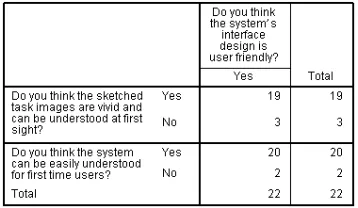
Table 3 shows respondents’ attitude towards the design of MAID. 100% of them think that the interface design is user friendly. That is a very supportive amount to the researcher’s designing concept. There are 19 students out of 22 thought that the task images applied in the system are vivid and are directed understood at first sight, but 3 of them did not. This feedback is very significant in the function of MAID. Because of maids will depend on the images to understand their employers meaning. If the images reflect confusing ideas, then it makes the solution more complicated and the solution should be considered as failed. Therefore, 19 against 3 indicate positive agreements for the images.
20 people agreed that the idea and structure of MAID can be easily understood. This question is to exam the first impression of users to this system, and to measure the acceptance of user friendly design. According to the amount of this feedback item, the whole system is satisfied to users.
Table 3 Maid Interface Design Feedback
Table 4 reflects the user feedback based on MAID’s functionalities. 16 people thought this system needs to be modified for future development. This is a very practical and honest opinion for the researcher. The users found the system is very useful but still needs further creations and development.
There are 20 people agreed that this solution is very effective for language barrier and 21 of them has no problem or doubts to that. These two figures are close to 100% positive agreement, which reflects the practical use and effectiveness of the solution in users’ opinion.
[image:6.612.106.285.440.561.2]feel about solving language barriers without the system. Figure 16 and Figure 17 display their feedbacks.
Table 4 Maid Function Feedback
[image:7.612.96.258.420.549.2]Figure12 Feedback On Design Complication
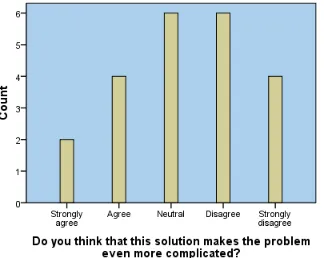
Figure 13 Maid Solution Feedback
Figure 12 indicates how many of the respondents felt the system is quite complicated while using it. 13.64% of them do feel it is confusing, and 40.91% out of 22 didn’t have the feeling. However most of them, 45.45% in 22 people, feel a little but not seriously. From this feedback, the researcher understands that the current system is not completely ready to put in practical use. Therefore, the researcher will keep this feedback to future development and modifications.
Besides requesting users’ opinions on the design of the system, the survey also collected ideas about whether the solution itself is complicated. Figure 13
exams the users’ recognition towards the solution. 10 of them did not think the solution makes the problem more complicated (6 disagree plus 4 strongly disagree). That is almost a half of the participants. In addition, suppose we ignore the Neutral option, there were 6 of them chosen agree or strongly agree that it is more complicated (2 strongly agree plus 4 agree). 10 against 6 of the amount indicate that there are more people believed the solution is useful and simple in use.
8.CONCLUSION AND RECOMMENDATIONS
Form the results, we found that some employers will not fire their maids, instead of letting the communication barrier troubling them, they somehow pondering around for the different types of solution. Result shows that 47% of the respondents from the preliminary survey positively looking forward for the creation of this mobile solution and 44% intermediately looking forward for it, only 13% are not demanding an application as the solution.
The study has also verified that the major problem of communication barrier with foreign domestic maids usually start with misunderstanding that lead to their work performance. Thus, the solution that is proposed should include items that able to minimize the misunderstanding, either by providing pictures to each tasks, videos to show the sequence of action for a task, or perhaps some simple sign language to assist in instructing the domestic tasks. Therefore, pleasant results imply the feasibility of developing this project. Data shows that it is very likely for MAID to gain favorable market shares in domestic service business. And in mobile assistant application field, it is also a particular innovative among other existed applications as compare to those reviewed in literature.
Below states the limitations that come with recommendations for future work:
9. LIMITATIONS AND
RECOMMENDATIONS FROM SURVEY REVIEWERS/RESPONDENTS:
i. Real pictures should be replaced onto the sketched pictures. Some of the respondents suggested that real pictures are more vivid than sketched. It will make the application more delicate and perfect.
ii. Some respondents suggested that the videos should be prepared in different languages (use maid languages) and also the system is better to be applied in other types of phones, for example, Android etc.
Both of the limitations are under consideration on future research. The current foreign language applied in the system is using Indonesian languages. Prototype for testing purpose are to confirm the research question, thus those suggestion will be recorded for future reviews for upgrading purposes.
Besides the above, this study aims to proceed with the next application that come with the below suggestions.
1. Adding tasks/housework instructions
Some of the housework requires technique skills, for example, how to hold a baby to comfort him/her from crying; how to cook a dish; how to check if the baby is sick; how to effectively wash off the dirt on cloth etc. The instructions can be describe with the maid’s specific language to reduce communication barrier.
2. Expand the system field from household to other fields in future.
This recommendation is considered for future development. The “future” here indicates when the theme of “household works” is completely modified and successfully entered the market. And to be reused as another solutions.
REFRENCES:
[1]. T.S. Bhatti, R.C. Bansal, and D.P. Kothari, “Reactive Power Control of Isolated Hybrid Power Systems”, Proceedings of International
Conference on Computer Application in Electrical Engineering Recent Advances
(CERA), Indian Institute of Technology
Roorkee (India), February 21-23, 2002, pp. 626-632.
[2]. The Malaysia Insider (2013), Maid problem continues to plague Malaysia – Sin Chew Daily. Retrieved on 19 March 2013 from http://www.themalaysianinsider.com/litee/side views/article/maid-problem-plagues-malaysia-sin-chew-daily/
[3]. TheStar online, Eugene Mahalingam, 2011, Local Put off by ‘dirty, demeaning and dangerous’ Low-end Jobs. Retrieved December 10, 2011, from
http://biz.thestar.com.my/news/story.asp?file=/ 2011/2/19/business/8070096&sec=business [4]. Department of Statistics Malaysia, Bureau of
Library and Information Service, International Labor Organization, (2010), Table on Labour Force Statistics, Malaysia, Labor Force Statistics, Malaysia 2008 & Labor Force Statistic, Malaysia 2009. Retrieved February
10, 2011, from
http://www.statistics.gov.my/portal/index.php? option=com_content&view=article&id=199%3
Afree-download&catid=61&Itemid=53&lang=en [5]. TheStar online, Bernama(2010), Timor Leste
wants to send maids to Malaysia. Retrieved January 11, 2011, from
http://thestar.com.my/news/story.asp?file=/201 0/1/22/nation/20100122140718&sec=nation [6]. Yip Yoke. Teng (2008), Rising demand for
Cambodian maids. Retrieved January 23, 2011, from
http://thestar.com.my/news/story.asp?file=/200 8/2/29/central/20225358&sec=central
[7]. Shaun Ho, 2010, Cambodian maids pose language woes. Retrieved May 31, 2011, from http://thestar.com.my/news/story.asp?file=/201 0/11/18/nation/7440350&sec=nation
[8]. Kimberly Jane T. Tan, GMANews.TV, 2008. Chinese Employers Shun Filipino Maids due to Language Barrier.Retrived December 10, 2011, from
http://www.gmanetwork.com/news/story/1413 73/pinoyabroad/chinese-employers-shun-filipino-maids-due-to-language-barrier-report [9]. Chok Sim Yee, 2011, Indoesian Maids May be
Available by August, Retrieved December 10,
2011, from
http://www.theborneopost.com/2011/03/25/ind
[10]. AdMob Mobile Metrics, (2010), May 2010 Mobile Metrics Report, from http://metrics.admob.com/
[11]. Erven B. L., (2009), Overcoming Barriers to Communication, Department of Agricultural, Environmental, and Development Economics,Ohio State University, AEDE. [12]. Ho S., (2010), Cambodian maids pose
language woes. Retrieved May 31, 2011, from http://thestar.com.my/news/story.asp?file=/201 0/11/18/nation/7440350&sec=nation.
[13]. Torrens M., Hertzog P., Pu P., and Faltings B., (2004) Towards an Intelligent Mobile Travel Assistant. SAC ‟04 Proceedings of the 2004 ACM symposium on Applied computing. ACM. New York, NY, USA. [14]. Nagata S. F., Oostendorp H., and Neerincx
M.A., (2004), Interaction Design Concepts for a Mobile Personal Assistant. Dutch HCI ‟04 Proceedings of the conference on Dutch directions in HCI. ACM. New York, NY, USA.
[15]. Wu H. and Natchetoi Y., (2007), Mobile Shopping Assistant - Integration of Mobile Applications and Web Services. Montreal. Proceeding of the 16th international conference on World Wide Web, ACM. New York, NY, USA.
[16]. Darvishy A., & Hutter H. P., & Früh P , & Horvath A, & Berner D., 2008, Personal Mobile Assistant for Air Passengers with Disabilities (PMA), Switzerland, ACM Vol. 5105.
[17]. Ngai E.W.T. and Gunasekaran A (2007), A Review for Mobile Commerce Research and Applications, HongKong, Decision Support System 43. Volumn 3(15).