PEER REVIEWED JOURNAL, JULY-AUG, 2018, VOL- 6/46
Copyright © 2017, Scholarly Research Journal for Interdisciplinary Studies UNDERSTANDING THE PERCEPTION OF HUMAN RESOURCE
PROFESSIONALS REGARDING THE CHANGES IN EMPLOYMENT PATTERN IN THE POST LIBERALIZATION ERA. WITH SPECIAL REFERENCE TO ENGINEERING INDUSTRY IN PUNE
N. S. Kumar1 & Dhananjay B. Bagul2, Ph. D.
Research Student Director -Saibalaji International Institute of Management Sciences,
Survey No 54, Nere Dataawadi Near Rajiv Gandhi Infotech Park, Hinjeadi Phase 2 Pune
It is interesting study of pre and post New Economic Policy of 1991, which is popularly referred to as Liberalization, Privatization and Globalisation (LPG) or structural changes. Post LPG Indian economy has grown phenomenally and marching towards becoming one of the largest economies in the world. Indian economy is becoming more of knowledge economy than manufacturing economy. Though economy is growing still there is no growth in employment in organized manufacturing sector. Even quality of employment is deteriorating and wage disparity is increasing between skilled and unskilled. Through the study efforts have been made to focus on the reasons of changes in business environment and employment pattern in post liberalization era. This study also highlighted the various challenges faced by HR professionals specifically in post liberalization era and threats to employees about job security.
Keywords- Liberalization, Globalization, GDP, FDI, Employment.
I) Introduction
Growth is indeed an important aspect without which resources cannot be generated for
investment, but growth has to be inclusive with shared benefits. In order to ensure that
growth be broad based and inclusive, there is need to implement effective public policies and
strategies that bring more people into mainstream, promote and increased participation of
poor men and women in economic decision making, reduce poverty and disparities, and
enhance equitable access to benefits of growth. It is now increasingly realized that
development goals need to be expressed in explicit and real term so that the fruits of
development are widely shared. This ought to be an important policy objective, and rightly so
where a large segment of population is marginalized, and socially and economically
excluded. Where social security is an integral part of the governance, it becomes an effective
strategy in carrying out both protective and promotional security measures. It would, Scholarly Research Journal's is licensed Based on a work at www.srjis.com
Copyright © 2017, Scholarly Research Journal for Interdisciplinary Studies
therefore, be imperative to empower them through a protective social security. Indeed, the
provision of employment is the most powerful instrument to provide social security to the
people of any country.
It is well known that employment has been a central issue of development planning that has
profound implication on the wellbeing of the people. This is more so in the globalised regime
where nature, pattern and form of employment are changing very fast primarily due to close
links across countries.
It has been observed that pattern of employment are changing fast and contractorisation is
emerging in several of economy, business and industry, which is largely non protective with
abysmally low wages and precarious working and leaving conditions. A large part of such
employment is occurring in the unorganized or informal sector.
The present study has focused on the changed employment pattern in large and medium scale
engineering industries in the post liberalization era. These industries currently facing the
transitional phase, on one side more and more capital investment is being done for technical
up gradation while on the other hand uncertain demand, market slowdown and global
competition has forced to offer better product at reasonable and competitive price. Though in
the post liberalization era lots of job opportunities are being created the tendency of
employing temporary or casuals or contractual labours have been grown substantially. In
view of the transition it is aimed to study the impact of Globalisation, liberalization and
privatization on employment pattern specifically in large and medium scale engineering
industries and try to find out the major factors that forced this change. This study also
highlighted the various challenges faced by HR professionals specifically in post
liberalization era and threats to employees about job security.
ii) Literature Review
Sanket V. Ravan, (2014), has stated that economic reforms introduced in 1991 by the Indian Government was due to economic crisis on defaulting on foreign loans and foreign exchange
reserve. These changes are popularly called as “Structural adjustment” or “Liberalization
Privatization and Globalization” (LPG). While dealing with positive impact author has stated
that GDP rate has shown growth from 1.1% in 1991 to 7.5 % in 2015. While increase in FDI
was unparallel, in 1991 Rs. 408 Crores which increased to Rs. 1, 65,146 Crores in 2011-12
and Rs. 1,06,693 Crores in 2015. Increase in per capita income in 1991 was Rs. 11235 but in
2011 it was Rs, 64,316 and in 2015 Rs. 85533 because of increase in job opportunity. Further
Copyright © 2017, Scholarly Research Journal for Interdisciplinary Studies
slight increased in 2012, 13 and 2014 to 3.6%. While contribution of the agriculture sector to
GDP has been declining year after year and even overall employment. Further it is also
observed that post liberalization income disparity is widening and also widened the gap
between the rich and poor.
Raghunath, (2017), has studied the impact of liberalization on Indian economy which is growing. Policy Change had huge impact not only on economic front but also on the mindset
of people. Negative side is drastic increase in child labour and role of public sector was
reduced. Industries in private sector are only for earning profits. Agriculture was backbone
but Government in post policy period neglected this sector. Globalization has generated
problems like contractual jobs and social insecurity. The increasing insecurity leads to social
evil like crimes and unemployment. Even author has many suggestions to offer and one of
them is related to skill. To substantiate this claim the author has quoted the Labour Bureau
Report-2014, wherein it is mentioned that the current size of India’s formally skilled
workforce is only 2%. One more glaring anamoly is employability of large section of
conventionally educated youth.
Swaminathan S. Anklesaria Aiyar, (2016), has stated that economic reforms of 1991 have transformed India. Once poor and slow growing Indian economy is now 3rd largest economy
in Gross Domestic Product (GDP) in term of purchasing power parity, another featured is
Indian economy is the fasted growing major economy in the world. But all this has happened
due to success of private sector and many Indian companies not only survived but become
multinational. India once was object of pity and now become an object of envy among the
developing nations and aptly called as potential superpower. But post liberalization during
the period of 7 years (2004-05 to 2011-2012) 13.80 Crores Indians rose above poverty line
i.e. 15.7% fell in all India poverty. Even these changes have impacted the education sector.
G.S.Bhalla, (2008), has also tried to understand the impact of globalization on employment, income distribution and poverty in developing countries. Further it is observed that
globalization affects the employment situation and reduces power of trade unions and
encourages informal contractualisation. Those who advocate the globalization takes help of
economic theory which supports the views that economic growth due to technology and
Foreign Direct Investment (FDI) will lead to significant increase in employment. Introducing
technology will lead to loss of jobs for unskilled laboures. Author has expressed concern for
neglecting agriculture sector in globalization process and its decreasing contribution in Gross
Copyright © 2017, Scholarly Research Journal for Interdisciplinary Studies
Bishwanath Golder and Amit Sadhukhan, (2015), has studied the phenomena of Indian manufacturing sector in terms of employment generation and wages in the post liberalization
era. At the time of liberalization the prediction was that the growth of economy and
consequently growth in employment in manufacturing sector will be substantial. It will also
increase the wages of workers especially less educated and less skilled. But when we look
back the performance during 1993-94 to 2011-12, it revealed that growth rate in real Gross
Domestic Product is around 8% while employment growth is just 2.45%, but during 93-94 to
99-2000 the growth in employment in manufacturing was modest. The organized sector is
considered to be better job provider, usually through higher formal wages and range of no n
wage benefits than the unorganized sector indicates that the overall quality of employment
has not improved significantly. While qualitative aspect shows that contractualisation has
increased substantially during 1990 to 2015 gradually from 14% to 44%. But this growth has
happened post 2000 and data shows that average growth of 10% per annum during the period
of 2000- 2010.
Prachi Verma, (2015), carried an article on temporary labour and pointed out that about 6 lakh new flexi staffing jobs are likely to be created in India, the highest so far according to
the estimates by the placement companies. The most alarming fact in the article is “in the last
10 years, about 50 lakh temporary jobs were created in various sectors” As per Chakraborthy
of Teamlease staffing is expected to grow from 17 lakhs workforce to 90 lakhs by 2025.
iii) Significance of the Study
Indian manufacturing industry has undergone a paradigm shift post 1991 that is the beginning
of Liberalization, Privatization, and Globalization era. The term globalization has touched all spheres of life such as economy, education, technology, cultural phenomenon, social aspect
etc. The term economic globalization refers to the free movement of goods, capital,
resources, services, technology and information.
The present study is helpful to understand the changed employment pattern in the engineering
industry in the post liberalization era, its consequences and an impact on the long term
manpower planning. As well on individual and organization performance and productivity,
this may be useful for correcting this phase and increase the effectiveness of the organization.
This will helps to understand the significance of estimated research work and its utility for
Copyright © 2017, Scholarly Research Journal for Interdisciplinary Studies
The present study is contributing to the body of knowledge to the HR Managers/ Heads of
Units / Chief Executive Officers of different organizations. Apart from this the present study
will provide the insight of an impact of changed employment pattern on individual
performance and organization productivity and by providing results to enhance the good
career opportunities.
This problem has been the focus of attention for large number of Human Resource
professionals who are trying to help organizations to solve these potential problems. No
systematic research has been done on the interaction between individual level and
organizational level determinants and their effects on organization long term plan.
iv) Objectives of Study
1. To understand the perception of Human Resource Professionals about reasons of
changes in business environment in post Liberalization era.
2. To understand the perception of Human Resource Professionals about impact of
Volatility, Uncertainty, Competitive and Ambiguity (VUCA) on employment pattern
in post Liberalization era.
3. To focus on the various challenges faced by Human Resource Professionals in post
Liberalization era than the pre Liberalization era.
4. To understand the perception of Human Resource Professionals about increased threat
to employees job security due to change in business environment.
v) Research Design and Methodology
The topic selected for the study is an existing phenomenon in medium and large scale
engineering industries in Pune. Descriptive research design has been adopted for purpose of
the study. Primary information has been collected directly from the 50 HR professionals
engaged in large and medium scale engineering industries in Pune. For the purpose of
primary data collection well structured interview schedules have been prepared. The question
and responses have been codified to represent the data in tabular form. The SPSS software for
data processing has been used. Following table indicates the selected HR professionals.
Selection of Sample
Type of Manufacturing Industry
No of
respondents
Large Scale 20
Medium Scale 30
Copyright © 2017, Scholarly Research Journal for Interdisciplinary Studies vi) Scope and Limitations of the study
1. The present study deals with the changes in employment pattern in the large and
medium scale engineering industries in post liberalization era.
2. The study was confined to understand the impact of Volatility, Uncertainty,
Competitive and Ambiguity (VUCA) on employment pattern in post Liberalization
3. The study was confined to HR professionals engaged in engineering industry in the
pre and post liberalization era and challenges faced by them.
4. There was problem of inadequacy of secondary information pertaining to impact of
Liberalization, Privatization and Globalization on employment pattern.
5. Survey of the study is confined to limited area i.e. Pune only.
6. The present study is limited only to study the impact of liberalization on employment
pattern in medium scale (250 to 500 employment), whereas large scale (above 500
employment) engineering industries located in Pune.
[image:6.595.88.507.415.533.2]vii) Results and Discussion
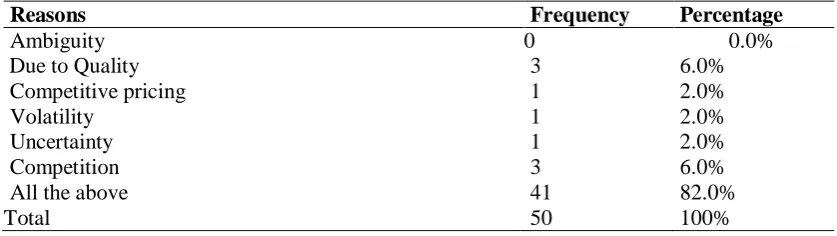
Table No 1, To understand the perception of Human Resource Professionals about reasons of change in business environment in the post liberalization era.
Reasons Frequency Percentage
Ambiguity 0 0.0%
Due to Quality 3 6.0%
Competitive pricing 1 2.0%
Volatility 1 2.0%
Uncertainty 1 2.0%
Competition 3 6.0%
All the above 41 82.0%
Total 50 100%
6% of the respondents have stated that quality has played major role in bringing about the
change, whereas another 6% feels it is competition and rest majority of the respondents 82%
feels all the above factors that is quality, competitive pricing, volatility, uncertainty,
competition, ambiguity has brought about the changes in the business environment in the
post liberalization era. It shows that post liberalization era the industrial environment has
undergone paradigm shift, which has opened gates to world i.e. from protected domestic
industry to open market economy. Hence market has flooded with qualitative, innovative,
world class products at competitive pricing. At the same time up and down in the global
market started impacting Indian market. Hence, the volatility, uncertainty, competition,
ambiguity (VUCA) has become buzz word in the Indian industry. Now Indian economy is
Copyright © 2017, Scholarly Research Journal for Interdisciplinary Studies
because of huge domestic consumption pattern. The Government has allowed 100% FDI in
[image:7.595.95.503.675.753.2]major areas, hence more and more MNC are investing heavily in the domestic market
Table No.2 To understand the perception of Human Resource Professionals about impact of Volatility, Uncertainty, Competitive and Ambiguity (VUCA) on employment
pattern in post Liberalization era.
Reasons Frequency Percentage
Recruitment of Casuals 00 0.0
Contract Labours 00 0.0
Outsourced 00 0.0
Job work 00 0.0
Earn & Learn 00 0.0
NEEM 00 0.0
All the Above 50 100%
Total 50 100%
Above table shows that volatility, uncertainty, complexity and ambiguity (VUCA) have
impact on the employment pattern existed in the post liberalization era and hence in this
context 100% respondents have multiple responses. According to them the change occurred
in the employment pattern due recruitment of casuals, contract, job workers, Earn and learn
and National Employment Enhancement Mission etc. This has evolved new employment
pattern.
In the Pre liberalization era the economy was protected and hence economy was not open to
outside threats. Post liberalization economy is more open to outside threats. Now economy is
opened beyond country borders (world market). For example change in policy of VISA by
the American Government, impacts the whole Indian IT industry because, USA is the biggest
market for IT and ITES industries. Likewise the fluctuation in crude price will impact on the
world’s economy, possibility of war between any two countries or 3rd
world war will impact
the whole economy (including manufacturing sector) even bumper crop in any part of the
world can adversely impact on Indian crop price. Due to various factors happening across
globe, Indian business gets impacted on regular intervals. This is best explained by the sensex
of BSE or NSE.
Table No.3 To focus on the various challenges faced by Human Resource Professionals in post Liberalization era than the pre Liberalization era.
Reasons frequency Percentage
Manpower planning 11 22.0%
Training and development 06 12.0%
Appraisal and Reward system 10 20.0%
Copyright © 2017, Scholarly Research Journal for Interdisciplinary Studies
Retention, Others 05 10.0%
All of the above 12 24.0%
Total 50 100.0%
22% of the respondents have stated that there is a huge challenge in manpower planning,
whereas according to 12% respondents the challenge is in training and development.
Incidentally 20% respondents feel that the challenge is in appraisal and reward system, 6%
feels in work life balance and 10% in retention. Whereas 24% have felt that all the above are
the challenges in the post liberalization era.
It shows that the more and more industries felt the need of restructuring or to say they were
forced to change their age old business practices. Incidentally Human resource activity has
also undergone see change and is facing more and newer challenges. Human Resource have
to hunt for right kind of talent as well retain the required talent is a herculean task. In the
changed employment pattern manpower planning is very crucial; it will make or break the
[image:8.595.107.491.395.514.2]industry in the challenging environment.
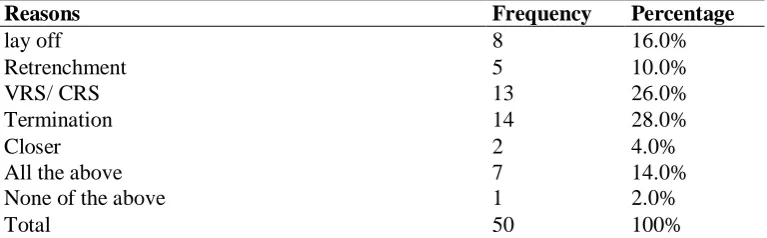
Table No.4 to understand the perception of Human Resource Professionals about increased threat to employee’s job security due to change in business environment.
Reasons Frequency Percentage
lay off 8 16.0%
Retrenchment 5 10.0%
VRS/ CRS 13 26.0%
Termination 14 28.0%
Closer 2 4.0%
All the above 7 14.0%
None of the above 1 2.0%
Total 50 100%
The respondents feel that layoff contributes to 16% whereas retrenchment 10%, VRS/CRS
26% and 14% respondents agrees that all the above items add to the threats to their job
security. It can be seen that more and more industries are adapting to these methods to down
size or right size the manpower.
viii) Conclusion
On the basis of collected information and literature review it is observed that paradigm shift
has taken place in the business environment in the post liberalization era. The introduction of
New Economic Policy in 1991 has changed the total face of Indian economy and over the
period the mindset of Indian business people. It shows the phenomenal growth in GDP, FDI,
per capita income, and increased share of service sector in GDP, while reduced rate of
poverty. While increased participation of private sector in Indian economy, on the other hand
Copyright © 2017, Scholarly Research Journal for Interdisciplinary Studies
neglected in the process of liberalization. Though manufacturing sector is growing with the
help of technology but failed to generate employment. The globalization has increased not
only competition but also uncertainty, quality and volatility in the business environment. To
overcome these factors industry has stopped taking permanent liability in term of permanent
labour and started engaging flexi manpower. This has lead to increasing trend of temporary
employment and contractualisation and these kinds of jobs do not have any stability,
certainty, continuity and social benefits hence by and large job security is no more assured in
the changed business environment post LPG era. Even under the pretext of rightsizing
industry has introduced VRS, layoffs, termination and closer, which is threat to job security.
This changed employment pattern has even posed challenges before the HR professionals in
terms of manpower planning, training and development, reward and retention.
References
Sanket V. Ravan (2014) “Impact of LPG on Indian Economy” Prime International Research Journal, Vol.1, Issue 4.
Raghunath, (2017), “Globalization and its Impact on Indian Economy”, International Journal of Research Granthaalayah, Vol.5, Issue 6
Swaminathan S. Anklesaria Aiyar, (2016), “ Twnety Five years of India Economic reform- A story of Private Sector Success, Government Failure and Institutional wealness” CATO Institute’s Centre for Global Liberty and Prosperity, Policy Analysis 2016 No 803.
G.S.Bhalla (2008 ) “ Globalization and Employment Trends in India” The Indian Journal of Labour Economics, Vol.51, No.1
Bishwanath Golder and Amit Sadhukhan, (2015), “Employment and wages in Indian manufacturing: post reform performance” Working paper No.185, ILO, Geneva.
Prachi Verma, (2015), “Ache Din for Many” The Economic Times, Mumbai, page 1, Dated 30th May 2015.
Rashmi Banga & Abhijit Das (Ed)(2012) “Twenty Years of India’s Libralisation Experiencs and Lessons” United Nations Publication (UNCTAD),Geneva.
Namrata Anand (2014) “An Overview of Indian Economy (1991-2013)” IOSR-Journal of Economics and Finance, Vol 3, Issue 3(march-April)
Dr.Manoj K Sharma and Kuldeep Singh (2015) “Impact of Changing Socio-Economic Environment on Business in India” International Journal of Research in Business Studies and Management, Vol.2, Issue 4
Clair Brown, Barry Eichengreen and Michael Reich (Ed)(2010) “Labour in the era of Globalization”, Cambridge university Press.
Sonia Bhalotra (2003) “The Impact of Economic Liberalization on Employment and Wages in India, Working paper No.12, Policy Integration Department, International Policy Group, ILO, Geneva.
Copyright © 2017, Scholarly Research Journal for Interdisciplinary Studies
Eddy Lee and Marco Vivarelli (2006) “The Social Impact of Globalization in the Developing Countries” Discussion paper No. 1925, ILO, Geneva.
T.S.Papola (2004) “Globalization, Employment and Social Protection: Emerging Perspectives for the Indian Workers” Published in The Indian Journal of Labour Economics, Vol.43, No 3
N.M.P. Verma & I.C.Awasthi (Ed)(2010) “ Contractual Employment in Indian Labour Market” Concept Publishing Company, Pvt. Ltd, New Dehli.
Rohini Hensman (2001) “The Impact of Globalization on Employment in India and Responses from the Formal and Informal Sectors” CLARA working paper No 15, Amsterdam