.
,
...
~
.
.
'CI
.
.. '.,
•
"
"~
,
,.
.
~
~
1/1
WRITING FOR THE READER
by John O'Rourke
of
Digital Software Publications
prepared by
CONTENTS
IS THIS BOOK FOR YOU? v
1. TECHNICAL WRITING AS COMMUNICATION 1-1
A Verbal Communication System; The Sender; The Means of Transmission; The Receiver; Noise
2. WHAT THE EXPERTS SAY ABOUT THE
WRITER... 2-1
Gunning's Warning to Technical Writers; The Gulf Between Writers and Readers; Wrong Attitude; Right Attitude; The Writer's Purpose; Other Faults Noted by the Experts; Conclusion
3. WHAT THE EXPERTS SAY ABOUT THE
READER... 3-1
One Reader Profile; Another Reader Profile; Writer's Grammar versus Reader's Grammar; Factors Impeding Comprehension; Long Sen-tences and Long Words; Sentence Structure; Position of Information in a Paragraph; Posi-tion of Adverbial Clauses in a Sentence; One Clause Instead of Two; Changes in the Logi-cal Order of Your Exposition; Subject Com-plements Instead of Object ComCom-plements; Factors Increasing Comprehension; Principle of Least Effort; Understanding and Misunder-standing
4. CURING THE FIRST MAJOR ILL: THE
UNORGANIZED PARAGRAPH. . • . . . • • • • . • 4-1
Unity; Coherence; The Haystack Paragraph; The Ideal System
5. CURING THE SECOND MAJOR ILL: AN
ABSTRACT STYLE. . • • . . . • . . .. .. .. • .. 5-1
CONTENTS (Cont.)
6. CURING THE THIRD MAJOR ILL:
SENTENCE COMPLEXITY .••...•... 6-1
Required Memory Level; Sentence Length; Some Suggestions for Reducing Complexity
7. CURING THE FOURTH MAJOR ILL:
OVERUSE OF THE PASSIVE VOICE .•...•• 7-1
Recognizing the Passive; The Case Against the Passive; The Case for the Passive; The Passive in Literature and Technical Writing; Shifting from the Passive to the Active
8. CURING THE FIFTH MAJOR ILL: FAST
PACING AND DENSITY ....•.•.•.••••••• 8-1
What is Density? Adjective Strings; Stuffed Paragraphs; Unexplained Series; Lumpy Paragraphs; Summary of Effects and Remedies
9. CURING THE SIXTH MAJOR ILL: FOGGY WORDS... 9-1
Jargon; Big Words; Deadwood; Summary·
REFERENCES... ...•. R-l
IS THIS BOOK FOR YOU?
You should answer this question before you turn to Chapter 1.
This book is for you if you are, first of all, a person who has a firm grasp of a technical subject but is rela-tively weak in the principles of written communi-cation. That is not to say that you have no back-ground in English. Rather, you've had the usual high school English courses, with perhaps two addi-tional courses in college or technical school. So you know clauses and sentences and parts of speech. And you either have at your fingertips the accepted rules of punctuation and usage or know where to get such information when you need it.
Too, you are no stranger to writing: you've written letters and memos and reports. But you are new to this task of writing technical manuals for a large and varied readership. So you need a book of tips on how best to write for that body of readers. You need a book of ideas and principles. On the other hand, you don't want to be burdened with rules to memorize and exercises to do.
CHAPTER 1
TECHNICAL WRITING
AS COMMUNICATION
On the ,West Coast they tell the story of a plumber who started using hydrochloric acid on clogged pipes. Though he was pleased with the results, he wondered if he could be doing something wrong. So he wrote to Washington to get expert advice on the matter. In six weeks he received the following reply:
"The efficacy of hydrochloric acid in the subject situation is incontrovertible, but its corrosiveness is incompatible with the integrity of metallic substances."
The plumber, who was short on formal education but long on hope, was elated. He shot a thank-you letter back to Washington. He told them he would lose no time in informing other plumbers about his discovery. Five weeks later he got another message:
"In no case can we be presumed responsible for the generation of pernicious residues from hydro-chloric acid, and we strongly recommend, there-fore, than an alternative method be utilized."
The plumber was delighted. He sent his third letter in the next mail. In it, he said that about 15 plumbers in his city were now using hydrochloric acid for pipes. All of them liked it. Now he wondered whether the good-people in Washington could help him spread the news of his discovery to plumbers throughout the country. At this point, the correspondence fell into the hands of a rare Washington bureaucrat - one who knew how to write to plumbers. Within a week the plumber was reading these words:
"Stop using hydrochloric acid. And tell your friends to stop too. It eats the hell out of pipes."
to the new technical writer: Write so your reader can understand.
*****
The chief function of a technical writer is to inform - to supply the reader with technical facts. Thus, each sentence you write must be aimed at the reader. If your sentences are not so aimed, you fail as a technical writer. Your message is like an arrow shot blindly into the air. It will fall somewhere. But the chances are that it will not hit the target.
In other words, you, as a technical writer, cannot concern yourself merely with putting words on paper, as does the writer of a diary or the ill-fed poet in a garret. These people can enjoy the luxury of self-expression. They can exist without readers. Or they can, if they Wish, write to parade their knowledge before the reader rather than to convey it to him. But you must concentrate on how best to convey meaning to the reader; you must strive to make your sentences mean the same to him as they do to you.
It's too bad, in a way, that the term technical writer is
used at all. The writer part of it has lost most of its
meaning. Doesn't everyone write? The answer to that question is all around you. Programmers write, managers write, marketing people write, secretaries write. Look at the mountain of memos and reports these people produce. As each day brings a stream of such papers across your desk, you're forced to strain eye and mind to discover meaning amid the welter of words. Sure, everyone can write. But daily experience tells you only a few can communicate.
In this book we will often use the term communicator
instead of writer. In doing so, we realize we're replacing a word of two syllables with one of five, but we think the longer term is more descriptive of the unique skill of the technical writer. Consider for a moment the origin of the word communicator. It comes from the Latin
communis, which means common. And as we've already
emphasized, the main business of the technical writer is to communicate: to pass technical information along to the reader so that it becomes the common property of
The remainder of this chapter will continue the emphasis on communication as the key to the whole art of technical writing. First you will see a verbal communi-cation system in operation. Then you will get a closeup of each element of that system.
A VERBAL COMMUNICATION SYSTEM
Figure 1 is a simple diagram of a communication system, as seen in communication theory.
SENDER
~
RECEIVERMeans of transmission
Figure 1. A Verbal Communication System
Each system has a sender, a receiver, and a means of transmission. The sender is the writer; the receiver is the reader. The means of transmission, represented by the broken line in the diagram, is in our case written language. The wavy line stands for noise. Noise is anything in the system that changes or distorts the meaning being transmitted. In all transmission, you the communicator try constantly to eliminate noise.
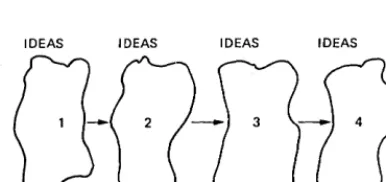
Since clear, accurate meaning is what the communicator always strives to transmit, you can get some idea of the difficulty of the task by looking at Figure 2. It shows the four forms of meaning operating in the communi-cation of technical information.
IDEAS IDEAS IDEAS IDEAS
SOURCE SENDER LANGUAGE RECEIVER
[image:10.282.30.220.149.205.2] [image:10.282.25.218.384.475.2]The source is the meaning in specifications, flow-charts, schematics, oral and written reports, and any other documents you use to get the facts for your writing. This meaning will always be different from the meaning (2) that lodges in your head after reading those documents. The degree of difference depends on your skill in interpreting the language of the source. Notice in Figure 2 that the size of 1 and 2 is roughly equivalent. The difference occurs mainly around the edges. This happens whenever words are used in the source, for words are variable in meaning. Thus, you will interpret some words right and others wrong. But the greater your skill in decoding the language of the various documents, the more the data in your head will approximate that of the source.
You further distort and lose meaning when you start to write. For one thing, you aim to write only what the reader needs to know. Thus, you must select certain facts from the array in your head and reject others. Secondly, since most of the words you choose have multiple meanings, you always send additional - if unintentional - meaning along with your technical facts. For these reasons, 3 in the diagram is different from 2. Happily, in this instance it is only slightly different.
Finally, the receiver, or reader, extracts a different meaning (4) from your written language, because it is impossible for all the words to mean the same to him as they do to you. Thus the meaning that ultimately resides in the reader's head is different in various respects from. the other three meanings.
All these things considered, we can rightly call the communication in Figure 2 effective because the reader's head contains a sizable chunk of the meaning originally in the source. You can, however, further improve the communication. Whenever you get feedback from the reader, you modify the wording of the language (3).
avoid the defective communication of the secretaries, managers, etc. mentioned at the beginning of this chapter. A diagram of their faulty communication appears below (Figure 3).
IDEAS IDEAS IDEAS IDEAS
-DB-a
SOURCE (if any)
SENDER LANGUAGE RECEIVER
Figure 3. Faulty Communication of Ideas
THE SENDER
The blunt truth about the job of communication is that the entire burden of it rests on the writer's shoulders. You are the only one to blame if the process fails. Hence, yours is a vital role. And here is a partial list of what is expected of you as the sender in the communi-cation system. (You will get a detailed view of yourself in Chapter 2, WHAT THE EXPERTS SAY ABOUT THE WRITER.)
1. You are totally responsible for getting clear, accurate information from the source. 2. You must gather the data on the experience
and background of the reader so that you will use terms and other symbols the reader will understand.
3. You're expected to have a firm grasp of the needs of the reader so that you will know which facts to communicate.
[image:12.280.37.220.112.236.2]what you want them to mean in the mind of the reader.
6. You must realize that language does not have to be elegant. You have to see it correctly as a tool for transferring ideas. 7. You must constantly monitor your
docu-ments to ensure that self-expression does not take the place of informative writing. 8. You must remember that the deeper the
subject, the harder you must work to make it understandable.
9. You must never lose sight of your overall goal: to simplify the complex for the reader.
THE MEANS OF TRANSMISSION
The written language of the verbal communication system is called exposition. It is the link between the outside world and the ideas in your mind. Since its purpose is to inform, it appeals to the reader's intellect, not to his feelings or imagination. Ideally, you should make it clear and unambiguous, sending ideas by the shortest, most efficient route. It should always give the reader all he needs to know about the subject. Above all, you should write it on a level that the reader can understand. Remember the Washington experts who didn't know how to write to the plumber.
THE RECEIVER
The receiver of your exposition is the reader. He comes to your writing to learn some technical facts. That learning may be a knowledge of ideas and their relationships. Or it may be a grasp of procedure: knowledge of the steps to follow to do a certain task. In either event, communication takes place when he ex-tracts from your writing the meaning you put into it; that is, when his interpretation of the meaning closely approaches yours. Only then can he perform the procedure you wrote about, or discuss the ideas you expressed.
time he goes astray because of the various kinds of noise
accompanying the message.
NOISE
In communication theory noise is any unnecessary or misleading information conveyed by your writing. Like static or other interference on radio or television, noise impedes communication. It prevents the reader from getting the meaning intended.
The reader experiences noise as a lack of clearness. Such unclearness can range from slight trouble in standing a word or phrase, to total inability to under-stand any of the message. A lot of noise, or unclearness, causes the loss of meaning shown in Figure 3.
Noise can originate in the writer's failure to extract clear, accurate information from his source. Most of the time, however, noise is caused by the writer's style. It
arises from the six major ills of technical writing discussed in Chapters 4 through 9 of this book:
1. Poor organization of paragraphs. 2. Excessive use of abstract words. 3. The fog of sentence complexity. 4. Overuse of the passive voice.
S. Bunching t.ogether of too many technical terms.
CHAPTER 2
WHAT THE EXPERTS SAY
ABOUT THE WRITER
All exposition, according to the experts, is written on two different levels: the level of literacy and the level of competence. Literacy has to do with the so-called mechanics of writing - with punctuation, usage, and grammar, for example. (And you'll note that the mechanics lend themselves to testing and measurement.)
Do you know what a sentence is? If so, you have mastered one phase of literacy. Can you tell nouns from verbs and prepositions? Can you use periods and question marks correctly? Do you know the difference between principle and principal? Do you start each sentence with a capital letter? Can you detect and correct a run-on sentence? Are you a good speller?
Such questions test your knowledge on the literacy level. But answering them all in the affirmative does not make you a good writer. Regardless of the emphasis that schools nowadays put on literacy, it is not the really important level of writing. In fact, at least one authority implies that literacy is not a part of good writing at all.
The important level of writing involves the ability to move ideas from your head to the reader's. This level is what Edwin R. Clapp of Western Washington State College calls the level of competence.
Competence in writing, then, has to do with how well you can pass technical facts along to the reader. Unlike literacy, it doesn't lend itself to objective tests or measuremen ts.
thinking? In other words, can you show one idea as the effect of the other? Is one the whole and the other a part? Can you show this relationship in writing? Does one follow the other? How do you express that sequence? Can you similarly express likenesses and differences among your ideas? How about equality and subordination? Are you proficient in writing definitions and classifications of your ideas? Can you develop theories or laws or principles from them?
These questions show that competence in writing is connected with competence in thinking. In fact, they cannot be separated. Thus a writer can never be both skillful on the competence level of writing and fuzzy in his thinking. He can, however, be very skillful on the literacy level of writing and very incompetent in his thinking.
Notice that the experts mentioned in the following sections are concerned only with competence. They don't stoop to deal with literacy at all. Rather, they harp on clearness, organization, exactness, relevance, and effectiveness. These are the marks of competence in writing.
GUNNING'S WARNING TO TECHNICAL WRITERS About thirty years ago articles in the popular magazines were dry statements of fact backed up by cold statistics. The style was consistently stiff and dull, and the competence of the writing was low. So readers, finding them hard to read, sent loud complaints to the maga-zines. Not only did the readers voice their dislike of the articles, but they also specified what they wanted in place of them. The result is the modern article, which in contrast with the old is highly competent because it is highly readable.
The point is that magazine articles changed because the magazines themselves responded to reader dis-satisfaction.
Such, in Gunning's OpInIOn, is not the case with technical writing. The technical audience cannot simi· larly make its demands felt because it cannot go elsewhere for its technical information. Thus, the tech· nical writer can afford to write in a vacuum. But this situation will not last forever. Eventually, the demand for more readable technical writing will be as effective as was the demand for more readable magazine articles.
THE GULF BETWEEN WRITERS AND READERS
When talking about writers, Gunning pulls no punches. He boldly asserts that the writer has created a wide gulf between himself and the reader - a gulf impeding the communication of ideas. And he goes on to describe the distressing situation.
"The gulf between writers and readers is very great. Readers want careful organization in what they read. They desire concreteness to help them picture and apply ideas. They like variety, it maintains their interest. They prefer short but variable sentences and not too rich a mixture of hard words.
"Writers, on the other hand, enjoy self·expression. They would as lief use abstractions to which they give their own special meanings. And a writing job goes easier and faster if you can simply set down the facts without the exacting thought needed for careful organization."
Here, Gunning is speaking about writers in general. But another author singles out the technical writer for his part in creating the gulf. In ANALYTICAL WRITING, Thomas Johnson caIls the technical writer to task for (1)
lack of organization, (2) impersonal style, (3) use of big words, and (4) reluctance to state an idea directly.
WRONG A ITITUDE
Johnson implies that the writer creates the gulf delib· erately. A better explanation blames the writer's attitude - his view of the writing task. As you will see later, Gunning supports this view.
all. In the role of speaker he is usually logical and straightforward. But when he sits down to write, he changes. He is not himself. His natural directness disappears; he becomes stiff and formal, and, striking a pose, proceeds to erect a wall of artificiality between himself and the reader. Whereas in speaking he would say:
"You must learn the operating system before you start working as a data base administrator."
In writing it becomes:
"Familiarity with the operating system must be acquired prior to attempting the undertaking of the role of Data Base Administrator." (DEC Manual)
What transforms a clear speaker into a murky writer? The experts offer a number of reasons. Robert Gunning, for one, has strong feelings about the matter:
"Many writers who are set the job of writing for a technical group believe their first task is to lengthen sentences and increase the mixture of polysyllables. They read technical communications in the new field, noting all odd departures from standard English. Thus in addition to picking up the technical vocabulary they are after, they absorb the bad habits of written expression that have impeded communication for years."
Another view is that the new writer wants to impress the reader with his knowledge of the English language. He chooses to forget that writing and speaking have the same goal: to move ideas from one head to another. So he abandons the level of competence he used to good effect in speaking and descends to the level of literacy.
A third body of opinion says that the new writer is stiff and formal because he wants to play safe. Observing the style of other technical documents, he fears his will seem unprofessional if written differen tly.
simplify it for the reader. In other words, he refuses to work for competence in his writing.
RIGHT ATTITUDE
Well, that's the ailment. What's the cure? The experts offer the following suggestions:
1. Always remember that your chief concern is to get your content across.
2. Often ask yourself "What am I doing?" Be honest in your answer. If your answer is that you are trying to impress the reader, then in the interest of competence you must change. 3. Put your voice in your writing. This is Gunning's famous dictum. He says that when you talk you use your own voice, which is as uniquely you as your finger· prints. When you write, however, you forget your voice, with the result that your writing is not you .. Competent writing, he says, has "voice" in it; if you know the writer, you can easily imagine him speaking to you as you read his writing.
4. Copy the good pOints of conversational style. Use short sentences and short words. Divide ideas into small pieces and give the reader one or two pieces per sentence. Avoid inverted sentences. (Here is an example of an inverted structure that does not normally appear in conversation: "Sure he was that it wouldn't happen." You will be more effec· tive if you change it to the normal subject-verb·complement format of conversation: "He was sure that it wouldn't happen.") 5. Use a 4·step approach to writing in order to
Note tha t these suggestions hel p you to acquire com-petence in writing. They help you transfer ideas from your head to the reader's.
THE WRITER'S PURPOSE
A lot of writing misses the mark, experts say, because the writer takes his eye off the target. In other words, he forgets his purpose.
You should have the purpose of your document clear in your mind before you begin to write. Write it down in a single sentence and post it where you can look at it often. For example, you may write it as follows: "I want to explain all the duties of a data base administrator to a manager." Or, "I intend to describe all the components of this operating system so that a manager will under-stand what they are and what they do." Or, "I will explain SNOBOL so that the reader will be able to write a practical program after he finishes reading the manual."
All these purposes have to do with enlarging the reader's knowledge or giving him a new skill. As such, they are your chief concern as a technical writer. But you should also be aware of other purposes. You have to consider your manual in relation to those of competitors. Is a prospective customer likely to turn to a competitor because your manual does not explain DEC's software as well as the competitor's manual does his? Too, are you interested in gaining the largest possible readership for your document?
If either of these purposes applies in your case, then you'd better aim to make your document highly readable. This is the suggestion of George Klare, author of the book MEASUREMENTS OF READABILITY. Not only will highly readable writing get the reader to accept your manual over another, but ''it will also attract more readers. He says that readers like readable writing because they can read it faster and get more out of it.
competence in writing or, rather, the lack of it. For each fault, we have included at least one example from a DEC manual.
1. The writing is dull and dry because words do not say what they mean and syntax gives false cues that force the reader to go back and read again. "Reading in that case," says Jacques Barzun and Henry Graff "is like wading through a swamp."
(Example) "All flles are subject to being compressed with the exception of installed task files, the checkpoint file, and the save image file. Because of system linkages, these tasks (Which are already contiguous) are left in their original position."
(Comment) To what does the phrase these tasks refer? To the task files? Or to all three fIles? The reader has to reread because reference is unclear.
(Example) "All privacy locks and keys are assigned by the Data Base Administrator, and the strictest security must surround their use. They should not, for instance, appear in the DBD or any other document which may be viewed by more than one user or multiple personnel."
(Comment) What does mUltiple persollnel mean? Is it different from more than one user? The reader has to reread looking for clues to the meaning. Unfortunately, there are no clues in the entire paragraph.
(Comment) Two stumbling points are the word beginning and the phrase in addition. Beginning, the minor fault, should have the
in front of it to prevent people from reading
it as meaning starting something. In addition
poses another problem. Since the previous fact was negative the reader is set for another negative fact when he reads "in addition." And when he learns it isn't negative, he has to go back to verify that the mistake isn't his.
(Example) "Occasionally, you may want to calculate a function, for example, the square of a number. Instead of writing a small program to calculate this function, BASIC provides functions as part of the language, some of which are described in Chapter I."
(Comment) Because the word writing modi-fies BASIC, the reader thinks BASIC can do two things: (l) write small programs to calculate and (2) provide a function. This he ' realizes is illogical, so he has to back up and read again.
2. The writer is addicted to abstract words, passive constructions, long words and vague words.
(Example) "Sophisticated application speci-fications thus might require complex data structures involving many interrelation-ships."
(Comment) Sophisticated application speci-fications is long, abstract and vague, as are the words complex and interrelationships.
(Example) "Many computer languages are currently in use, but BASIC is one of the simplest of these because of the small number of clearly understandable and easily learned commands that are required, its easy application in solving problems, and its practicality in an evolving educational environment."
precise meaning: clearly understandable, readily learned, easy application in solving problems, practicality, and, last but by no means least, evolving educational environ-ment. In addition, the sentence is confusing at the word but. At that point the reader is set for a contrast involving the idea of being in use. He expects something like "but when BASIC goes to the field most of them will no longer be in use."
3. The writing reveals an inner confusion of thought.
(Example) "Strings can be concatenated by means of the plus sign opera tor (+). The plus sign can be used to concatenate string formulas wherever a string formula is legal, with the exception that information cannot be stored by means of LET or CHANGE statemen ts in concatenated string variables."
(Comment) The exception talks about the storage of string variables; whereas the main assertion talks about the use of the plus sign to concatenate string variables. The excep-tion is irrelevant.
(Example) "BASIC is a problem-solving lan-guage that is easy to learn 21nd conver-sational, and has wide application in the scie n t ific, business, and educational communities."
(Comment) The language says that these ideas ("easy to learn and conversational" and "wide application in the scientific, business, and educational communities") are equal. Actually, in thought they should be related as cause and effect. The sentence should begin with because or one of its synonyms.
conver-for the reader: conversational and easy to learn.
(Example) "This software provides features which allow more than one run-unit to concurrently retrieve the data in the data base even while one run-unit is updating it."
(Comment) Although this is a much less serious offense than the previous two, it still causes the reader to wonder what is going on in the writer's mind. Concurrently and even while have the same meaning. Writers should delete concurrently and even.
4. The writer fails to put his main idea at the beginning of the paragraph. "Suspense," according to Thomas Johnson, "defeats the purpose of exposition. The information the reader needs to know should be at the beginning ... "
(Example) "This mode should be used with caution. When this option is assembled in the module, GTRCAL and DISSKP are used in combination to determine what is to be done to the display file. This mode is provided for the careful user who has one or more curves being displayed and wishes to change one or more of them without turning off the display while it is being done. To do this, the user must first create the display file with GTRCAL set to 1 and DISSKP set to 1 in all INIT/DISPLAY tables. To recalcu-late the display file, set GTRCAL to -1 and for any INIT-DISPLAY table which is not to be calculated, clear DISSKP. DISSKP will be reset to 1 upon return. The user in effect is saying that the space required for recalcula-tion of each curve will not exceed that required initially ... "
(Comment) The first two sentences do not contain the main idea of the paragraph. The third one does. It should be the first sentence in the paragraph.
of technical writing," Thomas Johnson says, "no matter how difficult, the opening para-graphs should be intelligible to every inter-ested reader. Don't avoid technical terminology, but simplify the language around it."
(Example) (This is the paragraph labeled "Introduction" in Chapter 3 of a DEC document.)
"The AFC 11 and ADO 1 devices are used for industrial and laboratory analog data acquisition. The AFCll is a flexible, high performance, multi·channel analog to digital (A/D) converter. Under program control the AFCll performs a 13-bit A/D conversion at a rate of 200 channels/second. The AFC 11 can multiplex a maximum of 1024 differen-tial input analog signals. The ADOI is also a multi-channel A/D converter; however, it differs from the AFC 11, in that it multi-plexes up to 64 analog signals. In the following sections, the AFC 11 device handler task is discussed first, and then the ADOI device handler is described."
(Comment) Actually, this patagraph of introduction causes more reader pain than the technical description of the AFC 11 device handler task that follows it.
6. The writer's presentation of detail is so dense that reader cannot absorb all the ideas at his normal reading pace.
(Example) The paragraph in No.5 illustrates this fault.
(Comment) The word de/lSe refers to the clustering of ideas. In the preceding para-graph density appears in such expressions as
CONCLUSION
CHAPTER 3
WHA T THE EXPERTS
SAY
ABOUT THE READER
"Who is my reader?"
This question will plague you every time you begin a writing task. And rightly so. As we have already indicated, the reader is by far the most important element in a verbal communication system. Indeed, he is the reason it exists. He influences the ianguage of the technical document, its forma t, illustrations, typography - everything about it. To ignore his needs, then, is to endanger your very prospects as a technical writer. On
th~ other hand, if you create an accurate image of him, and choose your words well according to that image, you greatly increase your chances for success.
In this chapter you will observe the reader as if he is under a microscope. You will see the two profIles of him created from the findings of many experts in the fields of reading and writing. As far as we know, this is the first time such information has been assembled in a book for writers. Most of it is scattered among some 20 research projects conducted under the auspices of the U.S. Office of Education.
ONE READER PROFILE
George Klare, longtime reading researcher and author of the book MEASUREMENT OF READABILITY, strongly urges the writer to construct a detailed profile of the reader. Here are questions that Klare says can help you form this detailed reader image.
programmer for 4 years. Is it educational or work experience? Or a combination? Spell it out in kind and years. Does he understand technical terms or must you simplify them for him? Remember that material difficult for the general reader may be perfectly understandable by a person with a spe-cialized background.
2. Educational level. What was the last grade
completed in school? This is crucial because a high correlation exists between grade completed and the individual's reading level. Thus the language chosen for a high school graduate would ordinarily be simpler than that chosen for a reader with a college education. Besides, readability tests give ratings in terms of grade level. So if your writing is to undergo a readability test, you should have the grade level of the reader firmly in mind before you write. If your book is targeted for the general reader, Klare's statistics on the median number of years of schooling completed by American adults could help you:
1940 - between 8 and 9 1950 - between 9 and 10 1957 - between 10 and 11 1960 - about 11
1970 - around 12
At any rate, he suggests that sometimes you may want to use U.S. Census data to get a better picture of the educational level of your readership.
3. Motivation. Does he have a strong desire to
4. Intellectual level. Is the reader smart? How smart? Smarter than you? Smarter than the communicator in the next office? Take a guess at his I.Q. 11O? 120? How do you know he's smart? What does he do that indicates high intelligence? Reads the clas-sics? Writes poetry? Plays chess? What does he do in his spare time? Granted, you can't answer all these questions. But by asking them, you can get a better notion of your reader's brain power. Don't forget that your words have to percolate through his mind in order to be understood.
5. Interests. All the experts agree that you communicate more effectively when you use terms and examples familiar to the reader. If
he's interested in inventories and payrolls and you give him examples from the world of finance and banking, you'll very likely lose him. Ask yourself: When he learns the \ subject, how is he going to apply it? This is one indication of his interests.
6. Attention to the material. Where and under what circumstances will he be reading your document? If he is to read it in the computer room, seeking information to use in a panic situation, then lists, examples, outlines, boldface typography, and quick-reference tables will dominate in your presentation. However, you can resort to a ·different strategy if he can give it undivided attention in a relatively calm atmosphere. In this case you can furnish longer explanations and repeat information to aid his compre-hension. Exactly what is the reader's situa-tion? Visualize it. Wrilt it down. Take it into account.
Another expert, Herbert Michaelson, adds two more categories to the reader profile.
know less than you about the general field your topic is in? If he does, simplify it.
However, if he's an expert - superior to you in knowledge - give him the full technical treatment.
8. Administrator or technical person. Again tone is a factor. The administrator is inter-ested in concepts, significance, responsi-bilities, and potential. He is, in a word, your subordinate in teclmical knowledge. For him you must select and combine data to teach him what he needs to know to understand the software. The technical person, however, gets the full load of technical details - all he needs to know in order to use the software.
And Tyler Hicks, prolific engineer-turned-writer, adds a directive to complete your reader image.
9. Select a particular reader. From all the flesh-and-blood people you know, choose one person who represents the readership you're aiming at. Keep that person's name constantly in mind as you write. Paste it on the wall near your desk. Use him as the test of everything you write. Ask: Can he under-stand this? If not, rewrite it so he can. (And it wouldn't be a bad idea to let your typical reader review the entire manuscript when it's finished.)
There you have all you need to create a good reader image. To be sure, you won't use all these categories for the template of your particular reader. You should use what you need. That's the spirit in which they are given - as principles to guide your imagination, rather than as rigid rules to hamper it.
ANOTHER READER PROFILE
For instance, in 1970 J .R. Bormuth of the Department of Education at the University of Chicago wrote a monograph entitled "Illiteracy in the Suburbs." In it he asserted:
1. That 51 % of the students graduating from American middle-class suburban high schools cannot read and understand the textbooks in their classes, and
2. That 41 % cannot read and understand ordi-nary newspapers and magazines.
Before looking at the implications of these statements, we want to emphasize two facts. Mr. Bormuth is no sensation-seeking newspaperman. He is a highly spected educator, a painstaking researcher, and a re-nowned interpreter of facts. Secondly, he has limited his observations to "middle-class suburban high schools," where the quality of education has usually been con-sidered better than in the teeming cities. In other words, he's talking about the so-called better schools. If he had
included the big cities, the percentages would have been higher.
What do Bormuth's percentages mean in concrete numbers? Well, each year American high schools grad-uate about 3 million students. (In fact, in 1969, the year immediately preceding Bormuth's report, our high schools graduated 2,839,000 students.) Of the nearly 3 million graduates - remember that Bormuth's percentages would likely be higher if he considered the cities
-at least half cannot read their textbooks. And wh-at's
even more jolting, these students are in a situation where they can get help in reading their texts!
And when you add the number of illiterate graduates this year to that of last year and the year before, and so on, you should gather that at least half the adult population of the United States has trouble reading. Such people have a difficult time getting meaning from written material. They are likely to misunderstand big words and misinterpret long complex sentences.
Another view of American readers, almost as startling as Bormuth's, was given by Helen R. Lowe in an article in the November 1959 issue of ATLANTIC MONTHLY. She worked for many years with superior tenth-, eleventh-, and twelfth·grade students. She found them making such disturbing reading errors as the follOWing:
Word Appearing in Book delicacy bivouac timid grocery man hurricane bos'n neurosurgeon phosphate hydride God knows antiseptic Oxonian inert industrial imbecility Solomon
Word Read by Student delinquency bifocals diminished clergyman hammer cow trapeze phosphorous hydroxide good news adhesive example inherent interna tional implicitly salami
To darken the picture still more, she said this is just a sample from a list of some 100,000 errors by excellent students all the way up to the college level. Add to these misreadings the errors in comprehension arising from distorting the tenses of verbs and applying modifiers to the wrong words, and the picture of reader inefficiency gets even worse.
· The second point concerns your choice of words. Choose many-syllable words only if you want to run the" risk of missing your reader. Granted, you as a writer have a perfect right to use words like inert, antiseptic,
and hydride. But if your reader is likely to read them as inherent, adhesive, and hydroxide, what have you
gained? One thing is certain, you've failed to inform the reader, you've failed to communicate. Anything you think you've gained is trivial beside the failure to communicate. A purely practical point shedding addi-tionallight on this topic comes from the experiments of E.B. Coleman and C.R. Miller. They found that college sophomores learned the most from instructional ma-terials written on the fifth grade level. Moral: to communicate the most, use small words and short sentences.
One thing we know with absolute certainty about readers is that they all get a somewhat different meaning from a piece of writing. This is so partly because each one judges your words by his own unique experience. Moreover, they adapt your words to their own expecta-tions, limitaexpecta-tions, and ignorance. To illustrate this truth, Helen Lowe tells the story of the studen t who con-stantly read elephant house for elephant cage. The writer
made a mistake, she said when asked for an explanation: elephants live in houses not cages. Another one con-tinually read supper for dinner, because people eat
supper at night, not dinner.
It would indeed be helpful if you could tell the good reader from the bad by looking at him. But this of course is impossible. You cannot even tell one from the other by observing their eye movements and reading speed.
As educator George Klare points out, in cases where experimenters used a camera, they could not differ-entiate the reading habits of normal people and the feebleminded. Both groups read at the same speed and with the same kind of eye movements. Only a compre-hension test can tell which is which.
WRITER'S GRAMMAR VERSUS READER'S GRAMMAR
Thus, your writing may be grammatically perfect. Yet it may fail to communicate because the inefficient reader habitually distorts the grammar. Donald Dansereau found this- to be so in his research for the Department of Health, Education, and Welfare. (Helen Lowe said pretty much the same thing in her article in ATLANTIC MONTHLY.)
Dansereau's readers - who go all the way'up to the college level - were insensitive to structural cues in written material. For example, they got no sense of time whatsoever from the ·ed on a verb in a sentence like the following:
He hurried to keep all his appointments.
Perhaps the sentence would communicate better if the writer inserted the word yesterday.
The net result is clearly pictured in the words of Helen LO,WJl:
"In addition to these spectacular distortions, most students make many less startling errors through constant deviations in tenses and pronouns and by omissions, interpolations, paraphrases, conjectures, and complete improvisations, so that paragraph
~Her paragraph reaches their minds garbled, blurred, altered, vitiated - and ungrammatical."
F ACTORS IMPEDING COMPREHENSION
Researchers in reading and writing have proved in experiment after experiment that certain factors tend to interfere with a reader's understanding of written rna· terial. Some of the latest findings on this subject appear below. Others appear in Chapters 4 through 9 of this book.
Long Sentences and Long Words
length of the word affects word recognition, he says; so the longer the word the slower the word recognition time. This means the reader must invest more time and energy in learning what you are trying to say. Klare also contends that long sentences place a greater burden on the reader's memory span. The longer the sentence, the more the reader has to remember till he gets to the end of it.
But the most telling indictment of long sentences and long words comes from a scholar of the 19th century: Herbert Spencer. In his PHILOSOPHY OF STYLE appears the following passage:
"A reader or listener has at each moment but a limited amount of mental power available. To recognize and interpret the symbols presented to him requires part of this power; to arrange and combine the images suggested requires a further part; and only that part which remains can be used for realizing the thought conveyed. Hence, the more time and attention it takes to achieve and understand each sentence, the less time and attention can be given to the contained idea; and less vividly will that idea be conceived ... "
Sentence Structure
Your sentence structure may seIVe to burden the poor reader. We will say more about this in Chapter 6, but here we want to relate some interesting observations by Ernst von Glasersfeld. He points out that a lot of split-second internal processing takes place when the reader sees a sentence that begins with the words:
The coding she did ...
At this point the reader has to pull two possible interpretations into temporary mental storage. One of them is that the structure is a relative clause equal to "The coding that she did" in case the sentence is:
The coding she did was praised by her supervisor.
The coding she did but the documentation she refused to do.
Von Glasersfeld labels such sentences "prospective am-biguity." They make for greater difficulty than normal sentences, he says, because two or more different interpretations have to be made and kept in temporary storage during processing of the sentence. Since they do indeed cause greater reading difficulty, the writer should question whether the reader can derive enough benefit to warrant their use.
Of course, the sentence structure in the example appears infrequently in technical writing. But the same cannot be said of the conditional clause without the word if. It
appears often and has just as much "prospective am-biguity" as von Glasersfeld's example. Here is one such sentence from a DEC manual:
"Should the Data Base Administrator, or any user, suspect that a privacy key has become public knowledge, the Data Base Administrator should immediately issue a new unique lock/key com-bination to replace the one in question."
At the word should the reader must be prepared for (l)
a question or (2) a conditional clause. And he must keep these alternatives in mind until he reaches the word that.
Truly, the conditional without if - especially if the clause is long - serves to burden the poor reader.
Position of Information in a Paragraph
memory over a period of time and merge with the information in the topic sentence.)
This information is important when you write tutorial, or instructional, material. Remember you defeat your own purpose when you put the most important data in the middle or at the end of a paragraph.
Position of Adverbial Oauses in a Sentence
An adverbial clause at the beginning of a sentence is more difficult to understand and remember than one at the end. Many researchers (notably H. Clark, K. Smith,
L. McMahon, and V.M. Holmes) have proved, for example, that the first of these two sentences poses the greater comprehension difficulty to the reader:
1. When Tom arrived everybody cheered. 2. Everybody cheered when Tom arrived.
The reason for this really doesn't matter. (Suffice it to say it concerns the reader's memory span and the way the human mind processes information.)
The importan t thing is its significance to you as a communicator: You reduce your chances of communi-cating when you place adverbial clauses at the beginning of sentences.
Bearing in mind the information in the preceding section, you triply reduce your chances of communi-cating if:
1. You put adverbial clauses at the beginning of sentences.
2. You make those adverbial clauses long. 3. You fill them with long words.
As Lois van Rooy points out, readability decreases as clause length increases.
One Clause Instead of Two
1. If you knew the Mississippi, it would be helpful.
2. A knowledge of the Mississippi would be helpful.
And to hark back to the statements in the preceding section, you can improve comprehension still more by revising sentence 1 as follows:
1. It would be hel pful if you knew the Mississippi.
Once again, we want to emphasize that you compound the difficulty of sentence 2 when you add words. Thus, the writer of this sentence inflicts much pain on the reader:
2. A comprehensive knowledge of the salient facts about the Mississippi from its discovery to the extensive government dam-building projects of the 20th century would be helpful.
Changes in the Logical Order of Your Exposition Experiments with college students by E.K. Darnell in 1963 proved that changes in the logical order of a piece of writing interferes with comprehension. This means that you as a writer can expect a diminishing of reader comprehension if you alter the logical order you have led him to expect. For example, suppose someone had written a piece about the American Revolution for the Bicentennial. In writing about the events leading up to the outbreak of hostilities, he treated them in the following order:
1. Stamp Act (1765) 2. Declaratory Act (1766) 3. Boston Massacre (1770) 4. Boston Tea Party (1773) 5. Destruction of the Gaspee (1772) 6. Intolerable Acts (1774)
him to follow that order. The writer's move to 1773, then 1772, and then to 1774 disturbs his comprehen-sion. Later, the reader will experience difficulty in recalling facts 4, 5, and 6.
Subject Complements Instead of Object Complements Look at these two sentences:
1. Your suggestion that the programmer should do the user manual seemed to alarm him. 2. He seemed alarmed by your suggestion that
the programmer should do the user manWif.
In Sentence 1 the underlined clause is called a subject complement. In Sentence 2 it is called an object complement.
Although the clauses are identical, the one in Sentence 1 is, in the words of V.M. Holmes, "significantly more difficult" to understand. His explanation focuses on the occurrence of the main verbs. In Sentence 2, the main verb comes early, so you know the main idea of the sentence as soon as you reach the third word. In Sentence 1, the main verb comes late, so the reader has to carry from 10 to 12 words in temporary memory before the meaning of the sentence is resolved for him.
Processing the main clause first, Holmes concludes, decreases perceptual complexity and increases comprehension.
FACTORS INCREASING COMPREHENSION
Here are some tips on how you can help the reader comprehend your exposition.
1. Be logical in your presentation. Decide on a systematic order - and stick to it.
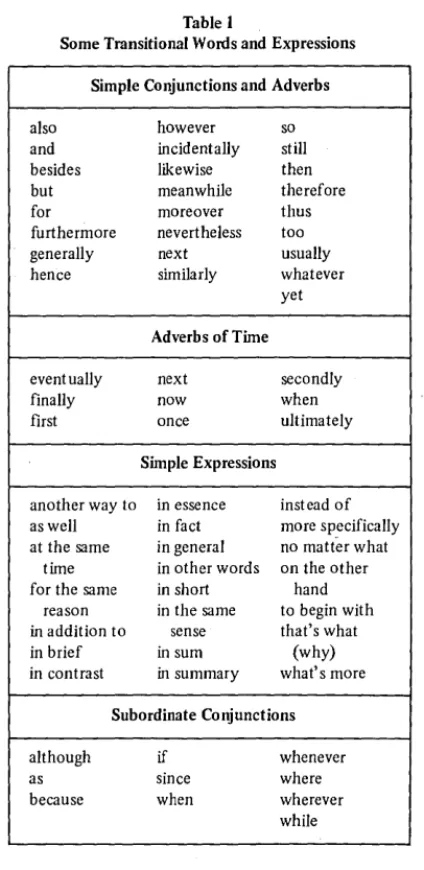
2. Use explaining links such as because, there-fore, so, if . .. then, as a result, etc. They
call attention to the logic of your thinking by pointing out a cause, means or result. (Chapter 4 tells you more about links, or transitions.)
4. Let daylight into your copy. Long para-graphs have an unfavorable psychological effect on the reader. Break them up. Maybe 3 or 4 paragraphs a page would be a realistic goal. As Robert Gunning says: "Readers like periods and white space."
5. Make your writing readable: write shorter sentences and smaller words.
6. Use structural paragraphs throughout your document. Structural paragraphs serve to introduce, summarize, or review a topic for a reader. Usually appearing at the beginning or end of a section, they help orient the reader. They give perspective.
PRINCIPLE OF LEAST EFFORT
Stated simply, the principle of least effort says that
an
individual will invariably choose to get to his goal by the route involving the least work. Applying this to reading, George Klare says the reader prefers readable material over the difficult because it requires less effort on his part. Klare observed that people will read two grades below their level when reading for pleasure. Sometimes they will tackle material above their grade level, but their motivation must be powerful. Usually this happens when the subject matter is very interesting or very necessary, as in the case of health information, or when the reader has a strong urge to learn.There's a moral here_ Don't get the notion that you can "challenge" the reader with difficult passages. If he sees there's too much effort involved, he'll drop your book and get the information elsewhere. Perhaps he'll tele-phone the software specialist to get it orally. At any rate, you can be sure he'll take the easy road.
that your manual is garbage, because the burden of communicating rests squarely on you.
CHAPTER 4
CURING THE FIRST MAJOR ILL:
THE UNORGANIZED PARAGRAPH
One sure way to help your reader is through strong organization of the paragraphs you write. This advice is especially apt when your ideas are totally unfamiliar to him or when his background in the subject is weak. In either case, the tighter you make the organization, the better the transfer of ideas.
This view has the unqualified support of prominent professionals in the field of verbal communication. Two such professionals LudWig Mosberg and Fred Shima -tell of an experiment that typifies the beneficial effect of tight structure on communication. Although the experiment had to do with oral rather than written discourse, the findings are applicable to both. In the experiment, college students listened to speeches rated low, moderate, high, and very high in structure or organization. (Incidentally, the very high speeches con· tained transitional words and phrases and summaries of the main points.) After each speaker delivered his speech, the students took a 3D·item test. Final results showed that all students, without exception, scored higher as the speech structure increased.
This chapter tells you how to gain such organization in your technical writing. The chief emphasis is on two guiding principles: unity and coherence. In reading about these, you will learn about topic sentences, connectives, and the concept of motion. You'll also learn how to recognize the foremost example of unor-ganized writing: the haystack paragraph. All the examples used to highlight the discussion of unity, coherence, and the haystack paragraph are from DEC software manuals.
UNITY
effect, tells him: "The paragraph will discuss the topic, or idea, presented in this sentence." When he reads the first sentence, he decides what the topic of your paragraph is. Thereafter, he expects you to live up to the contract: to stick to your topic. You break the contract - and risk losing his attention - when your first sentence discusses one topic, and any part of the paragraph discusses another.
Thus, you focus his attention with the first sentence. Then you hold his attention by making your paragraph stick to the topic in that sentence. We call the first sentence the topic sentence. In writing other than exposition the topic sentence can appear anywhere in
the paragraph.
Consistency in sticking to the topic throughout the paragraph is called unity. Briefly, a paragraph is unified when all its sentences discuss the topic appearing in your opening sentence. When you give such unity to a paragraph you take the first step in organizing it.
Here are some examples of good, unified paragraphs from DEC software documentation.
"The programmer must write a program, which is a list of instructions for the computer to follow to arrive at a solution for a given problem. This list of instructions is based on a computational method, sometimes called an algorithm, to solve the prob-lem. The list of instructions is placed in the computer memory to activate the applicable cir-cuitry so that the computer can process the problem. This chapter describes the procedure to .' be followed when writing a program to be used on
the PDP-8 family of computers."
The first sentence tells us the paragraph will discuss a program, or list of instructions. This is the essence of the writer-reader contracfin this paragraph. And the writer fulfills the contract not only by discussing the topic in each sentence but also by specifically mentioning it in
Another good example from the same manual:
"A program written to perform a specific opera-tion often includes sets of instrucopera-tions which perform intermediate tasks. These intermediate tasks may be finding a square root, or typing a character on a keyboard. Such operations are often performed many times in the running of one program and may be coded as subroutines. To eliminate the need of writing the complete set of instructions each time the operation must be performed, the JMS Gump to subroutine) instruc-tion is used. The JMS instruction stores a pointer address in the first location of the subroutine and transfers control to the second location of the subroutine. After the subroutine is executed, the pointer address identifies the next instruction to be executed. Thus, the programmer has at his disposal a simple means of exiting from the normal flow of his program to perform an intermediate task and a means of return to the correct location upon completion of the task. (This return is accomplished by using indirect addressing, which
is discussed later in this chapter.) The following example illustrates the action of the JMS in-struction. "
Here the writer promises to talk about sets of instruc-tions which perform "intermediate tasks." And the promise is kept all the way through the paragraph. A new paragraph could have been started at "To eliminate the need of writing," but that would be a stylistic choice of the individual doing the writing. Actually, the material on the JMS instruction is wholly relevant because that instruction is intimately related to inter-mediate tasks. Notice how the writer repeated the term
intermediate task in the third-last sentence to reinforce
the unity of the subject matter. (The term was first used in Sentence 2.) Notice too that the one sentence that is slightly off the topic is properly placed within paren-theses. Notice, fmally, how the last sentence carried the reader smoothly into the relevant example.
pessimistic view of technical writing. And remember that we are now analyzing the paragraph for unity only. We're saying nothing about it being clear and exact. Nor do we mention the skillful use of transitional words
(these, such, after, thus, etc.) to tie the whole paragraph
together. Taking all these things into account, both Gunning and Thomas Johnson would have to conclude that this is good technical writing.
The final example is a unified paragraph from a different DEC manual - this time a programmer's reference manual.
"PI REX (peripheral executive), a component of the UNICHANNEL-IS (UCIS) Software System, is described in Chapters 3 and 4 of this manual. PlREX is a multiprogramming peripheral processor executive executed by the PDP-II. It is designed to accept any number of requests from programs on the PDP-IS or PDP-ll and process them on a priority basis while processing other tasks concur-rently (e.g., spooling other I/O requests). PIREX services all input/output requests from the PDP-IS in parallel on a controlled priority basis. Requests to busy routines (tasks) are automatically entered (queued) onto a waiting list and processed when-ever the task in reference is free. In a background environment, PIREX is also capable of supporting up to four priority-driven software tasks initiated by the PDP-IS or the PDP-II."
The one defect in this paragraph is slight: for a moment the reader is in doubt as to the topic of the paragraph. It
could be a thumbnail sketch of PIREX, or a short overview of Chapters 3 and 4. The first word in Sentence 2, however, resolves the doubt. Again, as in the previous paragraphs, the writer makes a contract and abides by it.
But sometimes we break faith with the reader. Look at the following paragraph, for example:
by a method requiring only minutes of computer time. Therefore, computers are used when the time saved by using a computer offsets its cost. Further, because of its capacity to handle large volumes of data in a very short time, a computer may be the only means of resolving problems
where time is of the essence. Because of the advantages of high speed and high capacity, computers are being used more and more in business, industry, and research. Most computer applications can be classified as either business
uses, which usually rely upon the computer's capacity to store and quickly retrieve large amounts of information, or scientific uses, which require accuracy and speed in performing mathe-matical calculations. Both of these are performed on general purpose computers. Some examples of computer applications are given below."
Analysis of this paragraph shows that the writer prom-ised in the topic sentence to talk about how a computer "does certain tasks better and more efficiently than humans." That's his contract with the reader, and in the second and third sentences he lives up to his obligation. Sentence 4, however, breaks the contract. It talks about computer use in relation to cost. The next sentence moves to still another topic: computer use in business, industry, and research. A wholly new topic - computer applications - confronts us in the last three sentences. These needless shifts of topic destroy the unity of the paragraph and disturb the reader. (They also interfere with reader comprehension. As a test of this last statement, reread the paragraph, then wait five minutes before trying to recall the facts in it.)
Another instance of breach of contract appears in the following paragraph.
for instance, might require data from an existing data base which could possibly cause conflicts with the current users' interests. These differences must be reconciled. The Data Base Administrator has the responsibility to see that the data base is an effective, efficient tool for all users."
Looking at the first sentence, you discover the topic to be the long-range plans of the administrator's organiza-tion and the long-range needs of the user. But Sentence 4 introduces a new topic: short-range user plans or needs. What the writer needs to do to improve this paragraph is to move his last sentence up front. Certainly it wears the trappings of a topic sentence. Then he should change the second sentence to read:
To do this he must be aware of both the long-range plans of his organization and the long-range needs of the users.
The result will at least be a unified paragraph.
The final paragraph comes from a different manual.
"The text Editor (EDIT) is used to create and modify ASCII source files so that these files can be used as input to other system programs such as the assembler or BASIC. Controlled by user com-mands from the keyboard, EDlT reads ASCII fIles from a storage device, makes specified changes and writes ASCII files to a storage device or lists them on the line printer or console tenninal. EDIT allows efficient use of Vf-ll display hardware, if this is part of the system configuration."
The breach of contract appears in the last sentence in this paragraph. There, the writer introduces "the effi-cient use of Vf-l1 display hardware" as a topic to compete with the one in the first sentence.