
AN ANALYSIS OF ENERGY MODELS FOR MOBILE AD
HOC NETWORKS
1
N. KUMAR, 2SURESH GNANA DHAS
1Research Scholar, Karpagam University, Coimbatore, TamilNadu, India
2Professor, Department of Computer Science and Engineering, Vivekananda College of Engineering for
Women, Tiruchengode, TamilNadu, India
E-mail: [email protected] , [email protected]
ABSTRACT
Energy must be significantly conserved in Mobile Ad hoc Networks (MANETs) by employing energy models. Majority of the energy models address only the hidden terminal issue, but result in higher power consumption due to increased collisions during packet transfer. The proposed energy model for MANET involves an Energy-efficient Optimized Link State Routing (EE-OLSR) protocol and a path maintenance scheme. The EE-OLSR energy model is based on a progressive search for the most energy-efficient path. This model reduces the routing overhead and path setup delay, and enhances the network lifetime. The existing energy models for MANET are based on OLSR protocol and DE (Differential Evolution) – OLSR protocol with features like QoS (Quality of Service) optimization, accuracy of energy states, distributed clustering, and energy-efficient clustering. The survey analysis involves the comparison of the proposed EE-OLSR model with the existing energy models. The EE-OLSR model consumes lesser energy compared to the existing energy models, with respect to nodal speed, packet size, average connection arrival rate, number of nodes, grid size and packet inter-arrival time.
Keywords: Adjacent Cluster (AC), Cluster Head (CH), Immediate Neighbor (IN), Mobile Ad hoc Network
(MANET), Optimized Link State Routing (OLSR), and Topology Control (TC).
1. INTRODUCTION
Mobile ad hoc network (MANET) is a self-configuring network of interconnected mobile devices. The energy consumed by the devices in the MANET is an important aspect which is handled by designing various energy-efficient routing protocols. The conventional minimum energy routing protocols involve transmission of signal packets to decrease the hidden terminal issue, as a consequence of using asymmetric transmission powers from different neighboring nodes. The signal packets consume higher power due to increased collisions during the packet transfer.
The proposed energy model for MANET involves an Energy-efficient Optimized Link State Routing (EE-OLSR) protocol and a path maintenance scheme. The energy consumptions due to various factors are tracked to improve the performance during the path performance. The proposed scheme searches for the most energy-efficient path progressively and maintains that route continuously. This significantly reduces the routing overhead, path setup delay, and enhances the peer-to-peer process.
The remaining part of the paper is organized as follows: Section II involves the works related to the energy models for a MANET. Section III involves the detailed analysis of the existing and proposed energy models for a MANET. Section IV involves the survey analysis and comparison of the existing and proposed energy models for a MANET. The paper is concluded in Section V.
2. RELATED WORK
Dimokas, et al., proposed an energy-efficient distributed clustering model for improving the energy conservation in MANETs[4]. The clustering process forms a hierarchical structure over a flat MANET. The distributed clustering model is based on the residual energy of each node and the topological features of the nodes. Minming, et al., proposed an energy-efficient clustering method for MANETs [5]. Residual energy, neighbor’s topology, relative mobility, and relative location of the nodes in a MANET, determine the capability of a node being a cluster head (CH). The cluster maintenance is performed by Distance Estimation Broadcasting, which estimates the distance between a cluster member and its CH. The least distance leads to lesser energy consumption during data transmission. An Off-Duty Threshold metric is used to restart the clustering operation.
Mian, et al., proposed an energy-efficient protocol for MANETs using IEEE 802.11 MAC (Medium Access Control) protocol[6]. The energy constraints for performing a random walk in the MANET are reduced by using a distributed next hop selection algorithm.Wei, et al., proposed a framework for heterogeneous MANETs known as Device-Energy-Load Aware Relay (DELAR) [7]. A heterogeneous MANET consists of normal nodes and powerful nodes. A cross-layer structured DELAR scheme is used to save energy by power control, a hybrid transmission scheduling, and power-aware routing. The power-aware routing protocol integrates the information regarding device heterogeneity, nodal load, and residual energy, to save energy. The hybrid transmission scheduling is an integration of contention-based and reservation-based MAC schemes. Mini-routing is imposed into the data layer and an asymmetric MAC (A-MAC) method supports the MAC-layer acknowledgments. The end-to-end delay performance is enhanced by a multi-packet transmission technique.
Wang, et al., an energy-efficient location service protocol is proposed for MANETs[8]. The efficiency of the location service protocol depends on the accuracy of position information of the destination node. The location service protocol is based on hierarchical hashing. The distance traversed by the query packets and location update is optimized by this protocol, which reduces the
energy consumption.Tavli and
Heinzelmanproposed an energy-efficient real-time multicast routing protocol for MANETs [9]. The real-time multicasting architecture is known Multicasting through Time Reservation using
Adaptive Control for Energy Efficiency (MC-TRACE). The architecture is an integrated cross-layer design between network cross-layer functionality and MAC layer functionality. A passive mesh is used to enclose an active multicast tree in a MANET. Frequent sleeping periods and less redundant data receptions increase the energy efficiency.
Nand and Sharmaproposed a probability based broadcasting for AODV (Ad hoc On-demand Distance Vector) routing protocol in MANETs [10]. This broadcasting scheme improves the network lifetime, by decreasing the energy consumption. The probability of rebroadcast is dynamically computed using threshold random delay and a node’s remaining energy. The energy information of nodes is estimated from the route request packet of AODV routing protocol. The total amount of energy consumed to receive a control message during a broadcast operation is greater than the amount of energy depleted to transmit the message [11].
De Pellegrini, et al., proposed optimal monotone forwarding schemes in delay-tolerant MANETs with multiple node classes[12]. Altman, et al., proposed optimal monotone forwarding methods in delay-tolerant MANETs [13]. The tradeoff between delay and energy consumption is modeled as an optimal control problem. The energy-delay tradeoff is modeled as an optimization problem on the basis of a fluidic approximation. The forwarding scheme provides a time-constrained delivery of a message under total energy expenditure constraints.
Díaz-Báñez, et al, analyses the problems in min-energy broadcast for MANETs [17]. For a given set of stations, the min-energy transmission range assignment is computed. Jin-Hee, et al, surveys the various trust management systems for MANETs [18]. A trust system must be asymmetrical and balance reliability, scalability, fault tolerance, and energy consumption.
Jinhua and Xin proposed a model and protocol for energy-efficient routing over MANETs [19]. This model enhances the energy efficiency by decreasing the routing setup time and routing overhead. An energy-efficient routing method known as Progressive Energy Efficient Routing (PEER) is proposed to enhance the performance during the path discovery process.Urgaonkar and Neely proposed a cell-divided model of a delay-tolerant MANET for analyzing the minimum energy function and network capacity region [20].
3. ANALYSIS OF VARIOUS ENERGY MODELS FOR MANET
Several energy models are applied in MANETs, which are based on features like QoS optimization [1], accuracy of energy states [2], distributed clustering [4], and energy-efficient clustering [5]. The proposed EE-OLSR energy model and other existing energy models are described in this section.
3.1 Proposed EE OLSR Energy Model
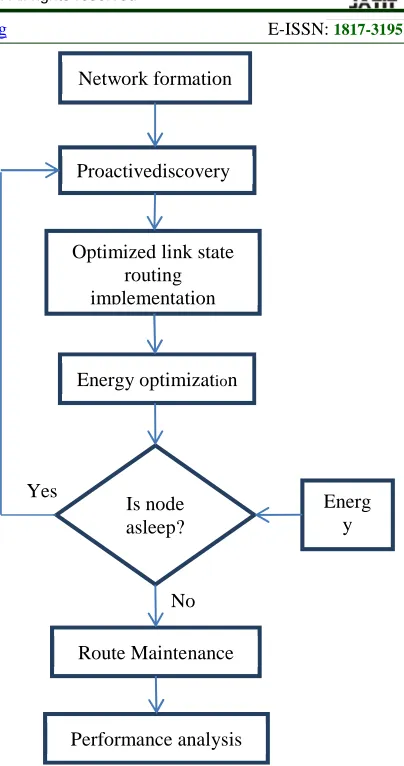
The flow of the proposed Energy-Efficient-OLSR (EE-OLSR) energy model is given in Fig. 1. The major functions of the energy model are neighbor sensing and route maintenance. EE-OLSR protocol has an advantage of high mobility and low bandwidth. The nodes periodically exchange the topology information to determine the routes from any source to any destination. The transmission of the control messages in the network is limited by a multipoint relay (MPR) technique, involving the tracking of the information about the neighbors and topological information about the network.
Each node maintains a routing table based on the information on neighbors and the topology of the network. The computation of the routing table is based on Dijkstra’s algorithm. The entries in the routing table consist of destination address, next-hop address, and the estimated distance to destination. Whenever a variation occurs in the network, the routing table is updated.
3.2 Green communications in a VANET
An energy-efficient routing protocol based on OLSR is used for VANET [1], [2]. The QoS is optimized by the OLSR protocol in terms of Average End-to-End Delay (E2ED), Packet Delivery Ratio (PDR), and Normalized Routing Load (NRL) of the data packets in VANETs. The Differential Evolution (DE) optimization algorithm is combined with the OLSR configuration to optimize the real coded parameters with various ranges.
The states of a node can be classified as transmit, receive, idle or sleep. The energy consumption model is based on electrical characteristics such as, current, power supply during the different node states, packet size, and bandwidth consumption.
Yes
No Is node asleep? Network formation
Proactivediscovery
[image:3.612.320.522.67.450.2]Optimized link state routing implementation
Fig. 1. Working Of Proposed EE-OLSR Energy Model.
Energy optimization
Route Maintenance
Performance analysis
3.3 QoS-related state information for Energy-efficient routing in MANETs
The accurate state information of the nodes in a network is required for the energy-efficient routing[3]. The QoS is provided in terms of reduced energy levels, which are used for routing decisions. The accuracy of the state information can be quantified by propagating the QoS-related state requirements throughout the network.
A new message type is defined to carry the QoS-related state information and can be included in the OLSR protocol messages to be available to other nodes in the network. The OLSR protocol messages are Hello messages and TC (Topology Control) messages. The QoS-related state affiliated with a node can be stored by adding a new field to the topology information base and the neighborhood information base maintained by the OLSR protocol. The extended Hello messages containing an address list of neighbors, and most recent QoS-related state affiliated with those neighbors,are broadcast to all one-hop neighbors. These messages also contain the QoS-related state of the sender node during the generation of the messages.
The topology information is spread across the entire network by broadcasting the extended TC messages and retransmitting the MPRs. The extended TC messages contain an address list of a node’s MPR selectors, and the QoS-related state affiliated with the specified nodes. The extended TC messages also contain the QoS-related state of the initiator node during the generation of the messages.
A timestamp is associated with each data point in the databases to modify the local repositories and control messages. When the timestamp is used to compare values initiated from the same node, time synchronization is not required.
The 1-hop neighbors are iteratively added to maximal residual energy level to the set of MPRs until all 2-hop neighbors are linked. The path determination algorithm in this model assigns each link with the reciprocal value of the sender’s residual energy level. The algorithm does not require artificial thresholds to estimate when a node’s residual energy level is low to assign the link with a higher weight.
3.4 Distributed clustering for energy-efficient routing in MANET
A distributed clustering protocol is applied to the energy-efficient routing in MANETs[4]. A distributed clustering protocol means that the nodes can make autonomous decisions without any main
control. The distributed clustering protocol used in this model is energy-efficient and avoids the excessive communication overhead due to retransmitted messages. The distributed clustering protocol known as GEodesic Sensor Clustering (GESC) uses the residual energy of neighboring nodes and local network characteristic to extend the network lifetime. The cluster coordinators for the distributed clustering protocol are determined from the energy-efficient nodes which lie in a significant part of the links connecting the other nodes.
A MANET is modeled as a graph G(V, E), where V is the set of vertices, and E is the set of edges of the graph. The set of neighbors of a node x is represented by N1(x) = {x : (y, x) ∈E}. The set of
two-hop nodes of node x (nodes which are the neighbors of node x’s neighbors) is represented by N2(x) = {z : (z, x) ∈E, where z ≠ x, z∉ N1, and (y, x)
∈E}. The combined set of one-hop and two-hop neighbors of x is denoted as N12(x). The length of a
selected path is the number of intervening edges along the path. The minimum length of any path connecting the nodes y and zin a graph Gis denoted by dG(y, z).
The clustering protocol consists of cluster formation and network operation.TCF is the time required for cluster formation and the duration of the network operation TNO is the time interval between two consecutive TCF intervals. The cluster formation process is triggered at beginning of each round of the clustering protocol, to choose the optimum cluster heads (CH) for each individual node. The network operation involves the transfer of data from nodes to cluster heads and information sink through multi-hop paths.
The Hello messages contain the list of the neighbors and their residual energy. Time slots are assigned to the sensor nodes to avoid interference, using D2-coloring algorithm. The exchange of Hello messages with the list of one-hop neighbors are performed only during the cluster formation of the first round of the network operation, since the nodes are immobile.
The clustering is performed for every TCF + TNO seconds to choose the new cluster heads. The process of cluster formation integrates the structural features of the local graph with the residual energy for neighboring nodes, to attain the optimum selection of cluster heads for each node. A one-hop neighbor x is designated as a cluster head node when x covers at least one two-hop neighbor.
enhance the common signal and decrease the uncorrelated noise among the signals. The received messages are aggregated and the new data item is sent to the cluster heads. When a cluster head transmits a message, the one-hop neighbors are checked for broadcast. The sensor nodes are equipped with a local cache to avoid rooting loops. The cluster head which is a two-hop neighbor of the information sink chooses the one-hop neighbor with the highest residual energy that is also a one-hop neighbor of the information sink to retransmit the message. This attains the load balancing of the energy dissipation in the one-hop neighbors of the information sink.
3.5 Energy-efficient clustering for MANETs
An energy-efficient clustering mechanism based on distance estimation broadcasting is used for MANETs [5]. A sensor node can in any of the three states namely, ideal, cluster head, and cluster member. The sensor nodes in this node are mobile and every node uses i different transmission power levels.
Two tables are maintained namely, adjacent cluster (AC) table and immediate neighbor (IN) table. The AC table records the information of every node’s neighboring CHs, ID of adjacent CH, CH’s approximate location, and the corresponding gateway node to reach the sensor node. The IN table contains the information of a node’s one-hop neighbors like, 1-hop neighbor’s ID, cluster head ID, sensor state, approximate location, and residual energy. The Hello packet is always transmitted with a constant power level.
The Hello packet is transmitted by the sender and when the IN table contains the sender the corresponding entry will be updated. The sender will be inserted into the IN table as a new neighbor when the sender is not in the IN table. The entries of the IN table are affiliated with a timer tX whose value is merely above the period of Hello packet broadcasting. The timers are reset as soon as the sender’s packet arrives. These sets of operations are referred to as Check-Update-Reset operation. When the timer expires before the arrival of the corresponding Hello packet, the element will be discarded from the IN table.
The weight of a node x for the selection of the initial CHs is given by:
௫ ଵ௫ ଶ௫ ଷ௫ ସ௫, (1)
whereα1 + α2 + α3 + α4 = 1, and
௫ |௫ |/ ; (2)
௫ 1 ௫ି௦ௗ௨/௧; (3)
௫ /௫ ௫; (4)
௫ ∑ ௫ ௫/௦. (5)
γx is the normalized difference between the number of node x’s adjacent neighbors nx and the predefined number of cluster members that a CH can ideally handle nh. N is the number of nodes in the network. Ex gives the residual energy status of node x.Ex – residual is the amount of residual energy contained in the recent Hello packet of node x. Einitial is the energy of the fully charged battery. ௫is the average of the relative speeds between node x and its 1-hop neighbors. smax is the maximum speed permitted in the network. The parameter α4Nx is used to save the cluster’s energy consumption by selecting node with near neighbors to be the cluster head. The parameter nxr defines the number of nodes in the region r, when node x is the CH. Pr defines the energy used to transmit one data unit to CH, when the sender is in the region r.pr is the probabilities of a node present in all the regions.Ps is the statistical probability of energy consumption for a cluster member sending a data unit to its CH.
௦ ∑ . (6)
The nodes pack its residual energies into the Hello packet and transmit the packet with the highest power level. An ideal status time ti is used for the broadcasting. The receiver’s IN table is searched for the sender’s ID upon the reception of the Hello packet. This is followed by the Check-Update-Reset operation.
When a cluster member obtains a Hello packet from a CH, the CH’s details will be updated in the receiver’s AC table. When the sender is a CH and the receiver is an ideal node, the ideal node will join the cluster. When ti expires before a node changes its ideal status, the node will prepare itself to be a CH and a new cluster is formed. But, when a Hello packet is sent by a CH to another cluster head, then the two CHs enter a contention period, after which the node with smaller will contribute to be a final CH.
different power levels in short time intervals. A node can alter its transmission power level according to the number of receiving special broadcast packets.
The Off-Duty Threshold (Eoff) defines a very low residual energy level of a CH. When the residual energy of a CH is below Eoff, the CH is not suitable to be a CH anymore. Then, the states are exchanged between the corresponding CHs and cluster members. The transmission interval in this clustering scheme is the duration between two special broadcasts during the Distance Estimation Broadcasting. The local re-clustering occurs when the residual energy is lesser than the estimated energy.
4.PERFORMANCEANALYSIS
The proposed EE-OLSR energy model is modeled in a network of 150 nodes arranged with a density of 94 nodes per square kilometer. The existing energy models considered for the survey analysis are DE-OLSR [1], [2], Energy-efficient proactive routing [3], Energy-efficient distributed clustering method [4], Random Walk with
Distribution Selection algorithm (RW-DS) [6], DELAR [7], MC-TRACE [9], hierarchical identity based key management method [14], and PEER [19].
The nodal speed is varied from 1 m/s to 25 m/s. The EE-OLSR energy model is analyzed in terms of energy consumption for a set of nodal speeds, packet sizes, and connection arrival rates. The energy dissipation analysis for a set of nodal speeds is performed per packet, per node and on an average basis. The energy consumption of the system is analyzed for the specified number of nodes and grid size. The EE-OLSR energy model is also analyzed in terms of nodal energy consumption for a given set of packet inter-arrival time, and network lifetime for a given set of nodes.
The total energy consumed during the system modeling by DE-OLSR scheme [1], [2] is 6684.708 J, and by that of the proposed EE-OLSR scheme is 6023.342 J. The amount of energy consumed by the
7 9 11 13 15 17 19
6 8 10 12 14 16
A
v
er
a
g
e
en
er
g
y
c
o
n
su
m
p
ti
o
n
p
er
n
o
d
e
(m
J
)
Nodal speed (ms-1) DELAR [7]
MC-TRACE [9]
Proposed EE-OLSR
[image:6.612.103.527.382.695.2](a )
Fig. 2. Energy consumption analysis for a set of nodal speeds, (a) per packet analysis in the proposed OLSR scheme and PEER scheme [19], and (b)average energy consumption per node in the proposed
EE-OLSR scheme, DELAR scheme [7], and MC-TRACE scheme [9].
2.9 3.1 3.3 3.5 3.7 3.9 4.1
0
3
.5 6 8 10
1
2
.5 14 16
1
7
.5 20
E
n
er
g
y
c
o
n
su
m
p
ti
o
n
p
er
p
a
ck
et
(
m
J
)
Nodal speed (ms-1)
PEER [19] Proposed EE-OLSR
(b)
x10
radio to operate the transmitter or receiver (Eelec) is 50 nJ/bit by Energy-efficient distributed clustering method [4], and 43.23 nJ/bit by the proposed EE-OLSR scheme. The amount of energy required to operate the transmitter amplifier (Eamp) is 100 pJ/bit per m2 by Energy-efficient distributed clustering method [4], and 95.23 pJ/bit per m2 by the proposed EE-OLSR scheme.
4.1 Energy consumption with respect tovarious parameters
The energy consumption is analyzed in the various energy models with respect to parameters
like nodal speed, packet size, average connection arrival rate, number of nodes, grid size and packet inter-arrival time.
1) Nodal speed
The energy consumption per packet is analyzed in terms of various nodal speeds for the proposed EE-OLSR scheme and PEER scheme [19]. The average energy consumption per node is analyzed in terms of nodal speed for the proposed EE-OLSR scheme, DELAR scheme [7] and MC-TRACE scheme [9]. The comparative analysis is given in Fig. 2.
3.5 3.55 3.6 3.65 3.7 3.75 3.8 3.85
20 25 30 35 40
E
n
er
gy
c
on
su
m
p
ti
on
p
er
p
ac
k
et
(
m
J)
Average connection arrival rate (per hour) PEER [19] Proposed EE-OLSR
[image:7.612.98.523.258.450.2](a)
Fig. 3. Energy Consumption Analysis In The Proposed EE-OLSR Scheme And PEER Scheme [19], (A) For A Set Of Packet Sizes, And (B)For A Set Of Average Connection Arrival Rates.
2 2.5 3 3.5 4 4.5 5 5.5
400 500 600 700 800
E
n
er
gy
c
on
su
m
p
ti
on
p
er
p
ac
k
et
(
m
J)
Packet size (bytes)
PEER [19] Proposed EE-OLSR
(b)
x10
-x10
-50 10 20 30 40 50
4 6 8 10 12 14 16
M
ea
n
c
o
n
su
m
ed
s
y
st
em
e
n
er
g
y
(J
)
Grid size
RW-DS [6]
Proposed EE-OLSR
(a)
Fig. 4. Mean Consumed System Energy In The Proposed EE-OLSR Scheme And RW-DS Scheme [6], (A) For Various Numbers Of Nodes, And (B)For Various Grid Sizes.
0 5 10 15 20 25 30 35 40 45 50
60 70 80 90 100 110 120 130 140
M
ea
n
c
o
n
su
m
ed
s
y
st
em
e
n
er
g
y
(J
)
No. of randomly placed nodes
RW-DS [6] Proposed EE-OLSR
[image:7.612.100.524.498.695.2]2) Packet size and connection arrival rate
The energy consumption is analyzed per packet in the proposed EE-OLSR scheme and PEER scheme [19], for a set of packet sizes (bytes) andaverage connection arrival rates (per hour),and compared in Fig. 3.
3) Number of nodes and grid size
The mean consumed system energy for various numbers of nodes and grid sizes is analyzed in the proposed EE-OLSR scheme and RW-DS scheme [6] and compared in Fig. 4.
4) Packet inter-arrival time
The nodal energy consumption rate is analyzed for a set of packet inter-arrival times in the proposed EE-OLSR scheme and Energy-efficient proactive routing technique[3]and compared in Fig. 5.
4.2 Network lifetime
The network lifetime is analyzed for various numbers of nodes in the proposed EE-OLSR scheme and hierarchical identity based key management method [14]and compared in Fig. 6.
5.CONCLUSION
[image:8.612.238.515.44.364.2]The conventional energy models for a MANET address only the hidden terminal problem, but fail to decrease the energy consumption due to the increased collisions during the packet transfer. The proposed energy model for MANET involves an Energy-efficient Optimized Link State Routing (EE-OLSR) protocol and a path maintenance scheme. The efficiency of the energy model is enhanced due to a progressive search for the most energy-efficient path. This model reduces the routing overhead and path setup delay, and enhances the network lifetime. The existing energy models for MANET are based on OLSR protocol and DE–OLSR protocol with features like QoS optimization, accuracy of energy states, distributed clustering, and energy-efficient clustering. The survey analysis involves the comparison of the proposed EE-OLSR model with the existing energy models. The EE-OLSR model consumes lesser energy compared to the existing energy models, with respect to nodal speed, packet size, average connection arrival rate, number of nodes, grid size and packet inter-arrival time.
Fig. 5. Comparison Of Nodal Energy Consumption Rate In The Proposed EE-OLSR Scheme And Energy-Efficient Proactive Routing Scheme [3] For
Various Packet Inter-Arrival Times.
0.76 0.81 0.86 0.91 0.96 1.01
0.04 0.09 0.14 0.2
N
od
al
e
n
er
gy
c
on
su
m
p
ti
on
r
at
e
(Js
-1)
Packet inter-arrival time (s) Energy-efficient proactive routing [3]
Proposed EE-OLSR
Fig. 6. Comparison Of Network Lifetime In The Proposed EE-OLSR Scheme And Hierarchical Identity Based Key Management Scheme [3].
100 150 200 250 300 350 400 450 500 550 600
6 8 10 12 14 16 18 20 22 24 26 28 30
A
ve
rage
n
et
w
or
k
l
if
et
im
e
Number of nodes
Energy-efficient proactive routing [3]
[image:8.612.90.297.330.588.2]REFERENCES:
[1] J. Toutouh and E. Alba, "An efficient routing protocol for green communications in vehicular ad-hoc networks," presented at the Proceedings of the 13th annual conference companion on Genetic and evolutionary computation, Dublin, Ireland, 2011.
[2] J. Toutouh and E. Alba, "Green OLSR in VANETs with differential evolution," presented at the Proceedings of the fourteenth international conference on
Genetic and evolutionary computation
conference companion, Philadelphia,
Pennsylvania, USA, 2012.
[3] T. Kunz and R. Alhalimi, "Energy-efficient proactive routing in MANET: Energy metrics accuracy," Ad Hoc Networks, 2010, vol. 8, no. 7, pp. 755-766.
[4] N. Dimokas, et al., "Energy-efficient distributed clustering in wireless sensor networks," Journal of Parallel and Distributed Computing, 2010, vol. 70, no. 4, pp. 371-383.
[5] N. Minming, et al., "An Energy Efficient Clustering Scheme for Mobile Ad Hoc Networks," in Vehicular Technology Conference (VTC 2010-Spring), 2010 IEEE 71st, 2010, pp. 1-5.
[6] A. N. Mian, et al., "A robust and energy efficient protocol for random walk in ad hoc networks with IEEE 802.11," International
Journal of Parallel, Emergent and
Distributed Systems, 2010, vol. 25, no. 5, pp. 363-379.
[7] L. Wei, et al., "DELAR: A Device-Energy-Load Aware Relaying Framework for Heterogeneous Mobile Ad Hoc Networks," Selected Areas in Communications, IEEE Journal on, 2011, vol. 29, no. 8, pp. 1572-1584.
[8] Z. Wang, et al., "Energy-efficient location services for mobile ad hoc networks," Ad Hoc Networks, 2013, vol. 11, no. 1, pp. 273-287.
[9] B. Tavli and W. B. Heinzelman, "Energy-Efficient Real-Time Multicast Routing in Mobile Ad Hoc Networks," Computers, IEEE Transactions on, 2011, vol. 60, no. 5, pp. 707-722.
[10] P. Nand and S. C. Sharma, "Probability Based Improved Broadcasting for AODV Routing Protocol," Procedia Engineering, 2012, vol. 50, no. 2012, pp. 222-231.
[11] N. Meghanathan, "A location prediction based routing protocol and its extensions for multicast and multi-path routing in mobile ad hoc networks," Ad Hoc Networks, 2011, vol. 9, no. 7, pp. 1104-1126.
[12] F. De Pellegrini, et al., "Optimal monotone forwarding policies in delay tolerant mobile ad hoc networks with multiple classes of nodes," in Modeling and Optimization in Mobile, Ad Hoc and Wireless Networks (WiOpt), 2010 Proceedings of the 8th International Symposium on, 2010, pp. 497-504.
[13] E. Altman, et al., "Optimal monotone forwarding policies in delay tolerant mobile ad-hoc networks," Performance Evaluation, 2010, vol. 67, no. 4, pp. 299-317.
[14] F. R. Yu, et al., "A Hierarchical Identity Based Key Management Scheme in Tactical Mobile Ad Hoc Networks," Network and Service Management, IEEE Transactions on, 2010, vol. 7, no. 4, pp. 258-267.
[15] J. Yi, et al., "Multipath optimized link state routing for mobile ad hoc networks," Ad Hoc Networks, 2011, vol. 9, no. 1, pp. 28-47. [16] L. Gallina, et al., "A Probabilistic
Energy-Aware Model for Mobile Ad-Hoc Networks," in Analytical and Stochastic Modeling Techniques and Applications. vol. 6751, K. Al-Begain, S. Balsamo, D. Fiems, and A. Marin, Eds., ed: Springer Berlin Heidelberg, 2011, pp. 316-330.
[17] J. M. Díaz-Báñez, et al., "Min-energy broadcast in mobile ad hoc networks with restricted motion," Journal of Combinatorial Optimization, 2012, vol. 24, no. 4, pp. 413-426.
[18] C. Jin-Hee, et al., "A Survey on Trust Management for Mobile Ad Hoc Networks," Communications Surveys & Tutorials, IEEE, 2011, vol. 13, no. 4, pp. 562-583.
[19] Z. Jinhua and W. Xin, "Model and Protocol for Energy-Efficient Routing over Mobile Ad Hoc Networks," Mobile Computing, IEEE Transactions on, 2011, vol. 10, no. 11, pp. 1546-1557.
![Fig. 2. Energy consumption analysis for a set of nodal speeds, (a) per packet analysis in the proposed EE-OLSR scheme and PEER scheme [19], and (b)average energy consumption per node in the proposed EE-OLSR scheme, DELAR scheme [7], and MC-TRACE scheme [9](https://thumb-us.123doks.com/thumbv2/123dok_us/8914138.960862/6.612.103.527.382.695/energy-consumption-analysis-analysis-proposed-average-consumption-proposed.webp)
![Fig. 3. Energy Consumption Analysis In The Proposed EE-OLSR Scheme And PEER Scheme [19], (A) For A (a) Set Of Packet Sizes, And (B)For A Set Of Average Connection Arrival Rates](https://thumb-us.123doks.com/thumbv2/123dok_us/8914138.960862/7.612.100.524.498.695/consumption-analysis-proposed-scheme-packet-average-connection-arrival.webp)
![Fig. 5. Comparison Of Nodal Energy Consumption Rate In The Proposed EE-OLSR Scheme And Energy-Efficient Proactive Routing Scheme [3] For](https://thumb-us.123doks.com/thumbv2/123dok_us/8914138.960862/8.612.90.297.330.588/comparison-energy-consumption-proposed-scheme-efficient-proactive-routing.webp)
