ARTIFICIAL BEE COLONY ALGORITHM, ITS VARIANTS
AND APPLICATIONS: A SURVEY
1,3ASAJU LA’ARO BOLAJI, 1AHAMAD TAJUDIN KHADER, 1,2MOHAMMED AZMI AL-BETAR
AND 1MOHAMMED A. AWADALLAH
1School of Computer Sciences, Universiti Sains Malaysia, 11800, Pulau Pinang, Malaysia.
2Department of Computer Science, Jadara University , P. O. Box 733 Irbid, Jordan.
3Department of Computer Science, University of Ilorin, Ilorin, Nigeria.
E-mail: {abl10 sa0739@student, tajudin@cs, mohbetar@cs, mama10 com018@student}.usm.my
ABSTRACT
Artificial Bee Colony Algorithm (ABC) is nature-inspired metaheuristic, which imitates the foraging behavior of bees. ABC as a stochastic technique is easy to implement, has fewer control
parameters, and could easily be modify and hybridized with other metaheuristic algorithms. Due to its
successful implementation, several researchers in the optimization and artificial intelligence domains have adopted it to be the main focus of their research work. Since 2005, several related works have appeared to enhance the performance of the standard ABC in the literature, to meet up with challenges of recent research problems being encountered. Interestingly, ABC has been tailored successfully, to solve a wide variety of discrete and continuous optimization problems. Some other works have modified and hybridized ABC to other algorithms, to further enhance the structure of its framework. In this review paper, we provide a thorough and extensive overview of most research work focusing on the application of ABC, with the expectation that it would serve as a reference material to both old and new, incoming researchers to the field, to support their understanding of current trends and assist their future research prospects and directions. The advantages, applications and drawbacks of the newly developed ABC hybrids are highlighted, critically analyzed and discussed accordingly.
Keywords: Artificial Bee Colony Algorithms; Nature-Inspired Metaheuristics; Swarm Intelligence Algorithms; Optimizations
1. INTRODUCTION
The last few decades have witnessed the introduction of several optimization algorithms developed based on nature-inspired ideas. Some examples of such algorithms include ant colony optimization [1], evolutionary algorithm [2], particle swarm optimization [3], harmony search [4] etc. Most of these algorithms are metaheuristic-based search techniques and generally referred to as multipurpose optimization algorithms because of their applicability to a wide range of problems. In a similar context, Artificial Bee Colony algorithm (ABC) was initially published by Karaboga in 2005 as a technical report for numerical optimization problems [5]. Its development was motivated by simulating the intelligent foraging behaviour of honey bees in their colony and its performance was initially measured using benchmark optimization function.
The major advantages which ABC holds over other optimization algorithms include its:
• Simplicity, flexibility and robustness [6,
7]
• Use of fewer control parameters
compared to many other search techniques [8].
• Ease of hybridization with other
optimization algorithms [7].
• Ability to handle the objective cost with
stochastic nature [9].
• Ease of implementation with basic
mathematical and logical operations.
solve environmental/ economic dispatch problems [18] and many others, as reported on the ABC
website1. ABC is thus a relatively a new iterative
improvement search paradigm, which has proven to be an efficient algorithm for solving combinatorial problems [7, 19]. Since it was developed, different variations to the original have been developed in line with recent applications across a wide range of disciplines. These variations are also evaluated in the present paper.
The main objective of this current paper is to present an extensive (but not exhaustive) summary of developments and variants to the original ABC. The overall intention is to provide a good beginning document for researchers with interest in developmental knowledge of ABC and its applications. Furthermore, suggestions for possible future investigations in ABC are also highlighted.
The remaining parts of the paper are organized as follows: The fundamentals of ABC are briefly outlined in Section II, while the growth of ABC is discussed in Section III. Section IV provides the review of applications of ABC by discipline, while section V discusses the theory of ABC and its variants as applied to optimization problems. Finally, the conclusion and future research directions in terms of the applications of ABC to optimization problems are outlined in Section VI.
2. FUNDAMENTALS TO THE
ARTIFICIAL BEE COLONY
A. Artificial Bee Colony: Analogy
The ABC algorithm is a swarm based, meta-heuristic algorithm based on the model first proposed by [20] on the foraging behaviour of honey bee colonies. The model is composed of
three important elements: employed and
unemployed foragers, and food sources. The employed and unemployed foragers are the first two elements, while the third element is the rich food sources close to their hive. The two leading modes of behaviour are also described by the model. These behaviours are necessary for self organization and collective intelligence: recruitment of forager bees to rich food sources, resulting into positive feedback and simultaneously, the abandonment of poor sources by foragers, which causes negative feedback [10].
1http://mf.erciyes.edu.tr/abc/publ.htm
The ABC consists of three groups of artificial bees: employed foragers, onlookers and scouts. The employed bees comprise the first half of the colony whereas the second half consists of the onlookers. The employed bees are linked to particular food sources. In other words, the number of employed bees is equal to the number of food sources for the hive. The onlookers observe the dance of the employed bees within the hive, to select a food source, whereas scouts search randomly for new food sources. Analogously in the optimization context, the number of food sources (that is the employed or onlooker bees) in ABC algorithm, is equivalent to the number of solutions in the population. Furthermore, the position of a food source signifies the position of a promising solution to the optimization problem, whereas the quality of nectar of a food source represents the fitness cost (quality) of the associated solution.
Algorithm 1 Schematic pseudocode of ABC procedure
Initialize the ABC and problem parameters Initialize the Food Source Memory (FSM) repeat
Send the employed bees to the food sources. Send the onlookers to select a food source. Send the scouts to search possible new food. Memorize the best food source.
until (termination criterion are met)
B. Artificial Bee Colony: Procedure
The procedure of ABC could be described in the following seven steps:
1) Initialization of ABC and optimization problem parameters:
In general, optimization problem could be formulated as follows:
} | { ) (
min f x = x x∈X (1)
0 ) ( and 0 ) ( to
subject g x < h x =
where f(x) is the objective function to be
minimized; x is the set of decision
variables {xi |i = 1, . . ., N}. X is the
possible range for each decision variable, where X = {X1 , X2 , . . . , XN} and Xi ∈
(LBi , U Bi ) and LBi and UBi are the lower
and upper bound values for the variable xi.
N represents the number of decision
variables and, g(x) and h(x) are the
inequality and equality constraints,
respectively.
Additionally, ABC consists of three control parameters:
a) Population size (SN) is the number of food sources (or solutions) in the population. SN is equal to the number of employed bees or onlooker bees. b) Maximum Cycle Number (MCN)
refers to the maximum number of generations.
c) Limit is used to diversify the search, to determine the number of allowable generations for which each non-improved food source is to be abandoned.
2) Initialization of the Food Source Memory (FSM):
The Food Source Memory (FSM) is an
augmented matrix of size SN×N
comprised in each row, a vector
representing a food source as in (2). Note
that the vectors in FSM are sorted in ascending order, according to proximity cost function values.
= ) ( ) 2 ( ) 1 ( ) ( ) 2 ( ) 1 ( ) ( 2 ) 2 ( 2 ) 1 ( 2 ) ( 1 ) 2 ( 1 ) 1 ( 1 SN x f x f x f N SN x SN x SN x N x x x N x x x FSM (2)Generally, each vector is generated as follows:
r i LB i UB i LB i j
x ()= +( − )× (3)
) , , 2 , 1 ( ), , , 2 , 1
( SN i N
j∈ ∀ ∈
∀
Note that r~(0,1) generates a uniform
random number between 0 and 1.
3) Assigning employed bees to the food sources:
In this step, each employee bee is assigned to its food source and in turn, a
new one is generated from its
neighbouring solution, using equation (4) as shown algorithm 2:
,
) ( ) ( ( ) ( ) (' i xj i r xj i xk i
x = ± − (4)
) 1 , 0 ( ~ and ), , , 2 , 1
( SN k j r
k∈ ≠
∀
Algorithm 2 :Employed Bee Phase
1: for j =1SN do
2: for i=1N do
3: x'(i)= xj(i)±r(xj(i)−xk(i)
,
∀k∈(1,2,,SN), k≠ jandr ~(0,1)4: end for
5: Calculate f x( i)
6: if (f(x')≤ f(xi)) then
7: xi = x'
8: f(xi)= f(x')
9: end if
10: end for
a) assign for each employed bee a selection probability p j as follows:
∑
= =SN
k k
f j f
j p
1 ) (
) (
x x
b) the food source of the employed
bee with the highest fitness is selected by the onlooker bee, based on its selection probability and adjusted as shown in algorithm (3).
In the algorithm, sum_prob is the
accumulated probability of all the
employed bees; where the sum_prob of
solution xj;{j=1,,SN}is unity
Algorithm 3 :Onlooker Bee Phase
1: for i=1SN do
2: r~(0,1) 3: sum_prob = 0 4: j = 0
5: while (sum prob ≤ r) do 6: sum prob = sum prob + p j
7: j = j + 1
8: for k =1N do
9: x'(j)=xj(k)±r(xj(k)−xj(m)
,
∀m∈(1,2,,SN)10: end for
11: Calculate f x( j)
12: if (f(x')≤ f(xj)) then
13:
j
j x'
x =
14: ( ) ( ' ) j f j
f x = x
15: end if
16: end for
1) Sending the Scout to search for possible new food sources: The scout bee carries out a random search to replace the abandoned food sources, using
equation (3). The abandoned food
source is one that cannot be improved upon after certain number of cycles, as determined by the limit parameter. Algorithm (4) describes the process of t he scout bee;
In algorithm (4), Scout (i) is a vector of size (SN), which contain information related to the improvement of any of the food source during search.
Algorithm 4: Scout Bee Phase
1: for i=1SN do
2: if (scout(i) = limit) then
3: generate
j
x using equation (3)
4: end if
5: end for
2) Memorizing the best food source: This involves memorizing the fitness and
position of the best food source,xbestfound
so far in FSM.
3) Stop condition: Steps 3 to 6 are repeated until a stop criterion is met. This is
originally determined by the MCN value.
3. THE GROWTH OF ABC ALGORITHM
IN THE LITERATURE
In 2005, ABC was developed and evaluated, using multidimensional and multivariable optimization problems [5]. Later on in 2006, the performance of ABC was compared to Genetic
Algorithm (GA) on numeric functional
optimization [21] and was later used in 2007 for the training of artificial neural networks [10, 22]. Subsequently in 2007, its performance on different problems was extensively studied and the results compared with other well known, successful
algorithms such as GA, Particle swarm
optimization (PSO), particle swarm inspired evolutionary (PS-EA), differential evolution (DE), back propagation (BP) algorithms [23, 9, 24]. Similarly in 2008, the performance of ABC was compared with DE, PSO and EA with regards to multidimensional numeric problems [25]. It is important to note that most work carried out on ABC from year 2005 to 2008 were by Karaboga and his colleagues.
Year 2009 witnessed major studies on ABC across different disciplines, where different modifications and hybridizations were attempted by various researchers [26, 27] to tackle various problems in engineering [28, 19, 29], digital image processing and pattern recognition [30, 14], protein structure predictions [17], numerical, real parameter and complex optimization [8, 27, 31, 32, 33, 34, 7], information technology [35, 36], to name the major ones.
42, 43, 44, 45, 46], engineering design and applications [47, 13, 48, 49, 50], information and applied technology [51, 52], and protein structure prediction [53]. Modifications based on best global algorithm for numerical function were also reported in the same year [54].
In the year 2011, tremendous increase in the number of ABC publications was witnessed, where series of applications, modifications, parameters tuning and hybridization with different optimization algorithms were used to enhance the performance ABC across various fields [15, 12, 55, 56, 57, 58, 59, 60, 61, 62, 63, 64, 65, 66, 67, 68, 69, 70 and 71].
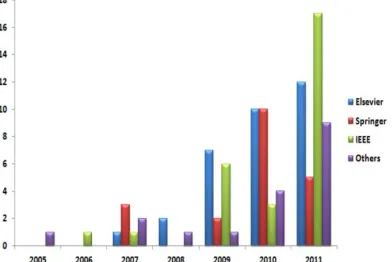
Figure 1 show the number of published papers by various researchers from year 2005 to 2011 on ABC and its variants, based on the different databases where these are reported; Elsevier,
Springer, IEEE and others2. The distribution of
[image:5.612.318.520.77.239.2]published research articles on ABC with respect to applications, hybridizations and modifications is shown in Fig. 2.
Fig. 1: Number Of ABC Published Papers By Elsevier, Springer, IEEE And Others, Per Annum (2005 To 2011).
4. APPLICATION OF ABC BY AREA OF DISCIPLINE
Many applications of ABC algorithm to real world and benchmark optimization problems have been reported, whereas substantial portion of the publications also compared the performance of ABC with other optimization algorithms. In the following subsections, some areas to which ABC was applied are discussed in detail. These areas
include benchmark optimization, scheduling,
bioinformatics, image processing, clustering, economic dispatch problem, engineering design and applications.
2
This is based on the search conducted by the authors using ABC as the keyword till June, 2011
Fig. 2: The Distribution Of Published Research Articles On ABC
A. Benchmarking Optimization
[image:5.612.95.291.364.495.2]Existing and new optimization techniques are evaluated using numerous benchmark problems that turned out to be de facto standards. Some examples of these optimization problems include continuous and discrete variables, constrained and unconstrained, and unimodal and multi-modal. The original ABC was evaluated by Karaboga in 2005 using unimodal and multimodal problems whereas other variations of ABC developed were evaluated using different benchmark optimization problems [7, 66, 72].
The adaptive analysis of the parameters of ABC for multi-dimensional numeric problems was carried out by Karaboga and Basturk [25]. The behavior of ABC was analyzed using various control parameters such as colony size and limit. ABC was noted to produce better results as the population size increases. The results obtained were better when the scout worked with moderate limit value. The results obtained by ABC were also better when compared with DE, EA and PSO. It was also claimed that the ABC technique could be used to effectively tackle multimodal engineering problems of high dimension.
The application of ABC to integer programming problems was considered by Akay and Karaboga [31]. The performance of ABC was monitored against variants of PSO, Branch and Bound technique. The results of the experiment showed that ABC handled the problems efficiently, where statistical calculations such as mean, median and standard deviation proved that the algorithm is very robust.
The Traveling Agent Problem (TAP) was solved using ABC algorithm [73]. Three heuristics functions were incorporated with ABC as follows: Blaze (BA), Reconnaissance (RA) and Follow (FA) roles. Agents or bees share information to adopt their own individual paths, in order to acquire more efficient paths during migration for the whole group. The performance of the algorithm was experimented on agent migration and when compared with the classical ant colony optimization (ACO), it performed better.
Karaboga and Akay [8] conducted a study comparing ABC to PSO, DE, Evolutionary Strategy (ES) and a Genetic Algorithms (GA) on a larger set of numerical test functions. The results showed the performance of ABC to be at least similar to or better than all these algorithms, with a smaller number of parameters to tune.
El-Abd applied ABC for tackling Black-Box Optimization Benchmark (BBOB) for Noiseless Function Testbed [74]. The performance of ABC was tested using the noise-free 2010 testbed benchmark. The simulation results revealed that ABC performs better, particularly for separable and weak structured functions.
A comparative study to evaluate the
performance of the basic ABC was compared to BA and DE on unimodal and multimodal problems [40] . The results of the experiment
demonstrated that DE showed competitive
performance on unimodal problems, followed by BA. However, the performance of BA was better with multimodal problems, followed ABC.
B. Bioinformatics application
In the field of computational biology and bioinformatics, ABC was utilized for protein structure prediction, using the three-dimensional hydrophobic polar model with side-chains (3DHP-SC) [53]. Two parallel approaches similar to master-slave and hybrid-hierarchical relations were implemented by the authors. The master-slave approach is a universal single population system where the master procedure passes the processing load to several slave processes, each one running on
different processor of a cluster-based processing environment. The execution of the Hybrid Hierarchical (HHABC) system consisted of two levels (i.e. higher and lower), with the higher level comprised of multiple- population coarse grained islands (such as a multi- hive model) and the lower level made up of global single-population master-slaves. The aim of this combination was to take the benefits of both models in a single technique. The ABC parameter was tuned and load balance adjustments were carried out in the course of the experiment. The performance of the proposed parallel models on 4 benchmark instances was compared with a sequential version and it was shown from the results that the parallel models achieved good level of efficiency, where the proposed hybrid-hierarchical approach improved the quality of solutions obtained.
Gonza´lez-A´ lvarez et al. [65] utilized multi-objective ABC (MOABC) to solve motif discovery problem (MDP), which had major application in the specific task of discovering novel Transcription Factor Binding Sites (TFBS) in DNA sequences.
MOABC results obtained showed significant
improvement than those previously published.
C. Scheduling Applications
Scheduling application is the process of sourcing for the best sequence of events to be assigned to limited resources or equipment, to basically minimize the total production cost or time. For this purpose, Ajorlou et al. [75] studied the performance of ABC for tackling a Mixed Integer Non- linear Programming Model (MINLP). The model was developed to generate optimal sequence of jobs and Work In Progress (WIP) levels in a series of Constant Work In Progress (CONWIP) production line, thus facilitating reduction in the overall completion time. In order to solve the problem, the authors fixed the WIP level in each run, and then used ABC to generate the optimal job sequence. The performance of ABC was successful on real world problems involving machines, large number of parts and production lines.
D. Clustering and Mining Applications
between the elements of different clusters. In this regard, ABC was utilized for sensor deployment problem [29]. This was modeled as a data clustering problem and the centroid of each cluster represented the position of a sensor node to be deployed. The authors compared a regular ABC with rectangular area with different, irregular shaped terrain areas to compare their performance with the actual theoretical results. ABC was able to obtain optimal solution for the deployment problem and the quality of solution obtained showed that the approach was good and robust.
Karaboga and Ozturk utilized ABC for multivariate data clustering to solve benchmark problems [35]. For this purpose, the performance of ABC was tested on thirteen classical test data
sets from the UCI Machine Learning Repository3.
The authors compared the results of ABC with PSO algorithm and nine other classification approaches from the literature, where the simulation results obtained demonstrated that ABC algorithm is able to tackle the problem efficiently.
The sensor deployment problem was
formulated as a clustering problem [51]. In this case, ABC was used to generate the optimal locations for sensor deployment. The method was experimented on a large region and for a large number of sensor nodes, in order to evaluate its performance. The sensing range was analyzed by the authors through the variation in the number of sensor nodes. Additionally, a sensitivity analysis test was carried out to find out the variation in the
sensing range. Results of the simulation
demonstrated that ABC algorithm could be used to generate suitable solutions.
The application of ABC to dynamic
deployment of stationary and mobile sensor networks was put forward by Ozturk et al. [76], with the aim of increasing the network coverage area, to achieve better performance. The authors simulated a wireless sensor network containing 20 mobile and 80 stationary sensors, to test the
performance of the probabilistic detection
technique. For comparative evaluation, results produced by ABC outperformed those by PSO, where the performance revealed that the technique achieved better results in the dynamic deployment of wireless sensor networks.
ABC approach for the classification of data mining (ABC-Miner) was proposed by Celik et al.
33
http://archive.ics.uci.edu/ml/datasets.html
[77]. In this model, the performance of ABC-Miner was evaluated using Breast, Wisconsin and Zoo benchmark datasets from UCI Machine Learning Repository (Frank and A. Asuncion, 2010). The authors of this approach compared the results of ABC-Miner with that for PSO rule classification algorithm and C4.5 algorithm, where the efficiency of the ABC-Miner became clearly manifest.
Dutta et al. on the other hand, applied ABC to data obtained by an electronic nose, to distinguish between various scores of black tea [78]. The authors divided the dataset obtained from the electronic nose into two; the training and the testing sets, such that 80% of the data for a particular Tea Taster Score was for training set and the remaining was for the testing set. The ABC and fuzzy C- Mean (FCM) were used to determine the possible cluster centers and the results showed that ABC satisfactorily classified the two types of tea with Taster Scores of 3 and 6, whereas FCM was unable to do so.
E. Image processing Applications
Several difficult problems exist in pattern recognition and image processing research areas. Searching for efficient optimization algorithm to address these problems has been the focus of much of active research. Unfortunately, the research outcome in this direction is still unsatisfactory. Some examples of these unresolved problems include image thresholding, image segmentation, object recognition etc. Application of ABC for recognition of an object within certain images was presented [14]. The objective of their work was to find a pattern or template (reference image) of an object anywhere on a target scene. The experimental results, using gray scale and color images, showed that the performance of ABC was faster in finding a pattern than a comparable technique such as EA.
objective function. The performance of the ABC method was compared with that for artificial fish swarm (AFS) and Genetic Algorithm (GA) based segmentation methods, with the simulation results showing that ABC method achieve better quality in terms of accuracy of segmentation and time.
Edge detection using Cellular Neural networks (CNNs), which is based on image sensor was
proposed by Parmaksızog˘lu and Alc¸ı [79]. ABC
algorithm was used to aid the image sensor in a novel cloning template design. In the study, the process of edge detection for coding applications, identification and segmentation was achieved with the aid of CNN structures. The authors used ABC algorithm for designing the cloning template of goal-oriented CNN architecture. The performance analysis of ABC was observed on CNN template, generated and tested on artificial and real test images. The simulation results were compared with well-known standard edge detection algorithms and other CNN based edge detector cloning templates in the literature. The output produced by the ABC- CNN technique was found to be better than all other existing techniques.
A novel path planning technique, combining the ABC algorithm with time rolling window approach was used for dynamic path planning of mobile robot [80]. The important features of ABC algorithm which include the ability for global optimization and rapid convergence were used to plan the local path. The experimental results proved that ABC has great accuracy and efficiency for solving that kind of problem.
Zhang and Wu [81] proposed the use of ABC to solve multi-level thresholding model for image segmentation. They used ABC to overcome the time-consuming problem encountered during the execution of an exhaustive algorithm. The results of their experiment showed that the Tsallis entropy performed better than standard maximum entropy thresholding, maximum between class variance thresholding and minimum cross entropy thresholding. Also, the execution time of ABC was demonstrated as faster than both GA and PSO.
The limitation of the traditional technique of 2D-3D based feature posed estimation problems, leading to the introduction of a six-point template by Zhang and Wu [82]. The authors solved the six-point template with a novel chaotic artificial bee colony algorithm based on ABC and Rossler attractor. Experiments were conducted on 40 different poses and when compared with both genetic algorithm and particle swarm optimization,
it was shown that the CABC method performed better was more robust and accurate than GA and PSO, in terms of three rotational angles’ errors.
The development of ABC for the automatic selection of image threshold was formulated as an optimization problem [83]. The authors tested the performance of ABC on several images and compared the results with the classical Otsu algorithms. The results showed that the performance of the ABC method was comparable with Otsu Algorithm. A new multilevel MET technique based on maximum entropy-based ABC thresholding (MEABCT) method was proposed [63]. The ABC was applied to search for the multilevel thresholds of images and the MEABCT was tested using three different images. The author compared the results generated by MEABCT with existing techniques in the literature and implemented exhaustive search method, to derive the optimal solutions. The result from MEABCT was close to that for the exhaustive search method and competitive with the other three techniques.
F. Economic Dispatch Problems
The economic dispatch problem (EDP) is an essential job in the electric power industry, where the operation and planning of power system is required. The main objective of EDP is the scheduling of output of assigned generating systems. This is in order to meet the required load demand within the limit of constraints by minimizing the operational cost of the generating system. ABC has been applied to EDP in both single and multi-objective optimizations. The implementation of ABC for solving economic load dispatch problems (ELDP) with valve-point effect was presented [84]. In the experiment, the
objective function was formulated as a
Sonmez [18] utilized ABC to solve multi- objective environmental economic dispatch (EED) problem. For this purpose, the author used cost penalty function by converting multi-objective EED into a single-objective form. The performance of the technique was tested on different load demands, to observe its efficiency and feasibility. When com- pared, the results obtained with FCGA and NSGAII proved that the technique produces better results than both algorithms, showing reduction in terms of fuel cost and emission effect for different load demands.
The application of ABC for the design of economic optimization of shell and tube heat ex- changers was also presented [59]. The authors used ABC to minimize the total cost of equipment, annual energy expenditure and tube heat exchange. The results were compared with those achieved by GA, and Coulson and Richardson’s chemical engineering, showing that the ABC technique is faster, most accurate and able to solve the problem successfully.
G. Engineering Designs and Applications The success of ABC has stimulated the interest of researchers to investigate its performance on a variety of engineering problems such as
network reconfiguration, power related and
structural problems, where the requirements for choosing materials, sizes, configurations and conditions for synthetic systems are necessary. Application of ABC to the network reconfiguration problem in a radial distribution system was proposed [6]. The objectives considered in the problem include minimization of real power loss, profile improvement of voltage and feeder load balancing. The techniques was tested on 14, 33 and 119 bus systems and when the results of the experiment was compared with other existing
algorithms, the ABC outperformed other
techniques, in terms of the solution quality and efficiency.
Okdem et al. studied the performance of ABC on routing operations in Wireless Sensor Network (WSNs) [16]. The researchers carried out performance tests and complexity analysis of CWA routing technique based on ABC algorithm. Results showed that the ABC method outperformed other direct transmission and LEACH algorithms.
The consideration of a new technique based on ABC for designing low and higher order digital IIR filters was a l s o t e s t e d [30]. The performance of ABC was compared to LSQ-nonlin and PSO, with the results showing the
capability of the ABC to tackle the problem and is employed as an alternative technique for designing digital IIR filters.
The ABC was also used in the extraction of small signal equivalent circuit model parameters of GaAs metal extended semi-conductor field effect transistor (MESFET) devices [47]. The performance of the ABC algorithm with that PSO was compared with respect to computational time and the quality of solutions (QoS). The results of the technique demonstrated that 16-element small signal model parameters of MESFET could be extracted accurately. The effectiveness of this was shown by the high quality fitness between the measured and modeled S-parameter data over a frequency range of 0.5-25GHz.
Investigation of the use of ABC for optimal combinations of different operating parameters for three non-traditional machine (NTM) methods was highlighted [61]. The three NTM processes investigated include electrochemical discharge
machining, electrochemical machining and
electrochemical micro machining processes. A single and multi- objective ABC was used for the NTM processes. The experimental result obtained using parametric optimization was compared to that in the literature and demonstrated that ABC is capable and suitable to improve the performance measures of the NTM processes considered.
Bernardino et al. [11] utilized ABC to solve non-split Weighted Ring Arc-Loading Problem (WRALP). The objective of the technique was to standardize the routing for each demand, to lower the maximum arc load. The performance of the algorithm was thus compared with three other techniques as follows: tabu search (TS), classical GA and a Local Search Probability Binary PSO (LS- PBPSO). The results proved that the proposed ABC technique is an efficient tool capable of producing satisfactory results in terms quality and execution time of the WRALP, where the ABC achieved better results for larger problems. When Shortest Path Algorithm was used to generate the initial solutions or to produce scout bees however, best solution was obtained even faster.
also taken into consideration. The ABC method was also tested with a core design optimization problem previously resolved with GA and PSO algorithms. The simulation results showed the method to be very promising in terms of reliability and convergence rate. When compared with GA and PSO however, the ABC method was comparable, showing its potentiality for other optimization techniques in the nuclear engineering domain.
Ozturk et al. [86] tackled Reactive Power Optimization (RPO) problem with the aid of ABC algorithm. The authors used RPO to correct the voltage deviations of buses, active power losses and reactive power generator costs. The enhancement was carried out with ABC, where the authors tested the performance of their approach on ten bus systems and compared the experimental results with the improvement strength of Pareto EA. The results with ABC improved the power system to run more effectively and economically.
The problem of a conventional thermal power system equipped with automatic voltage regulator, integral controlled automatic generation control loop and IEEE-type dual input power system stabilizer (PSS) PSS3B was considered [48]. ABC was applied to optimize different tunable parameters of a proposed model of hybrid power system. The optimal solutions generated by the ABC algorithm were comparable with those produced by genetic algorithm (GA). The authors reported in a published paper that the optimization performance of the ABC was better for that specific application, when compared to that of GA.
Manoj and Elias [60] proposed the design of a multiplier-less Non-uniform filter bank trans- multiplexer (NUFB TMUX) with continuous filter coefficients, where the authors synthesized the filter coefficients in CSD format. This was formulated as an optimization problem, where ABC was proposed to tackle it. Results showed that the performance of ABC for optimizing multiplier-less NUFB TMUX was much better than that obtained by rounding the continuous coefficients of filters to the nearest CSD number, where it also out-performed GA and PSO.
Investigations into using ABC to solve design optimization of mechanical draft counter flow of wet-cooling tower was carried out [55], where the objective cost was to minimize the total annual cost for specific heat duty requirement. The authors optimized three design variables: mass velocity of air, mass velocity of water and water to air mass ratio for minimum total annual cost under a given set of constraints. The performance of the
method was tested using six examples and it was compared with existing techniques such as General Algebraic Modeling System (GAMS), where
experimental results with ABC achieved
considerable improvement for cooling tower
optimization compared to that of GAMS
optimization package.
The integration of ABC with random keys
called ABCRK for solving In-Core Fuel
Management Optimization Problem (ICFMO) was put forward [87]. The objective of ICFMO was to obtain the best arrangement of fuel in the nuclear reactor core, to allow for maximization of the operating time. The authors applied ABCRK to optimize the ICFMO problem of a Brazilian “2-loop” Pressurized Water Reactor (PWR) of a Nuclear Power Plant (NPP). The results obtained by ABCRK was compared with those for GA and PSO and proved that the performance of the ABCRK has the advantage of employing fewer control parameters and was better than or similar to that of GA and PSO.
Yeh and Hsieh utilized a penalty guided ABC to solve a reliability redundancy allocation problem (RAP) [38]. The maximization of the reliability of the system was achieved through the investigation of nonlinearly mixed-integer reliability design problem. This was done by simultaneously deciding for each sub system, the number of redundant components and the corresponding reliability. Results showed that the ABC is able to achieve a global or near global solution for each of the tested examples. The ABC results were better than the state-of-the- art solutions such as integer programming, variable neighbourhood, immune system, GA etc.
Karaboga et al in [88] applied ABC to determine certain parameters of Schottky barrier
diode (SBD) Model from synthetic and
TABLE 1: Summary Of Applications Of ABC Across Field Of Discipline
Problems References
Benchmark Bioinformatics Scheduling Clustering Image Processing Economic Dispatch Problem
Engineering Problem
[7, 8, 25, 31, 73,74] [53, 65]
[75]
[29, 35, 51, 76, 77, 78] [14, 62,79, 80, 83, 82, 81] [18, 59, 84]
[6, 16, 47, 61, 11, 85, 86] [48, 30, 60, 55, 87, 38, 88]
5. ABC THEORIES
Since its first introduction in 2005, ABC continues to attract the interest of investigators from diverse disciplines across the globe. This has resulted into a variety of modifications and hybridizations to the basic ABC. In the following subsections, the modified and hybrid versions of ABC are presented, together with algorithms and other search techniques.
A. Recent Modifications of ABC algorithm This subsection presents different variations of the basic ABC by different researchers in terms of modifications and parameter tuning, in order to enhance or improve its performance.
The concept of introducing constrained handling procedure to the original ABC was proposed by [23] to tackle constrained optimization problems. The workers used Deb’s rules of handling constrained strategy in the ABC selection process, instead of greedy selection procedure. The performance of new variation of ABC was then compared with state-of-the-art methods such as PSO and DE, where the results clearly showed the performance of ABC as being comparable.
ABC algorithm was a l s o applied to solve large scale optimization problems [13]. The constraint handling technique was introduced into the selection phase of ABC such that feasible regions of entire search space could be achieved. These authors incorporated the Deb’s rules into the selection of employed and onlooker bees. The technique was tested on nine well-known large scale unconstrained tests, as well as five well-known constrained engineering problems. The performance of ABC algorithm in these trials was based upon the experimental results being compared with those of state-of-the-art algorithms.
ABC algorithm was also integrated with an adaptive penalty function approach (ABC-AP), to minimize the weight of truss structures [90]. The
adaptive penalty function method was used for constraint handling within ABC to enhance the effect of Deb’s and the static penalty function methods. The efficiency of the ABC-AP was studied in five truss examples with fixed-geometry and up to 200 elements were used to demonstrate that it is an effective technique in the construction of an optimal design for truss structures. When the results of the ABC-AP were compared with other optimization methods in the literature, it was shown that the approach is efficient as an optimization technique for structural designs.
Karaboga and Akay modified the ABC
algorithm to solve constrained optimization
problems [66]. The authors hybridized the constraint handling technique of ABC with Deb’s rules, consisting of three simple heuristic rules for comparing two solutions. These heuristics include a selection probability strategy for choosing feasible solutions based on fitness qualities and infeasible solutions based on number of violations. The performance of the modified ABC algorithm against those of state-of- the-art algorithms was compared and tested using thirteen well-known test problems. The results from these tests demonstrated that the algorithm was able to handle the problem.
A modification of the ABC algorithm to solve real-parameter optimization problems was introduced by [91]. The authors modified basic ABC by introducing a new concept of control parameters such as modification rate (MR), scaling factor (SF) and limit. The introduction of MR was used to enhance the convergence rate of ABC, while the modification to the ABC variance operator i.e. SF was used to verify the magnitude of changes when generating a neighboring solution. These control parameters were employed to investigate the performance of the ABC algorithm on real-parameter optimization and the performance of the
modified version was compared with the
standard ABC and other state-of-the-art techniques and showed promising results on hybrid functions.
An enhanced ABC named Interactive Artificial Bee Colony (IABC) algorithm was proposed for numerical optimization problems [72]. These authors modified the movement of onlooker bees using the theory of universal gravitation force by [92]. The idea was used to enhance the exploitation capability of the original ABC. The performance of the IABC with varied number of employed bees was tested on five numerical benchmark functions and the results were compared with the original ABC and PSO, where the IABC performed better.
selection strategies was carried out by [33] for numerical benchmark optimization. The authors modified the selection of food sources by onlooker bees in order to prevent premature convergence and increase population diversity. These selection strategies include rank selection based selection (RABC), tournament selection (TABC) and disruptive selection (DABC). The performance of the modified ABC was compared with the basic ABC and the results showed that the modified ABC with three different selection
strategies improved population diversity and
prevented premature convergence. In general, the modified ABC outperformed the basic ABC, based on three different selection techniques.
Two variants of the ABC known as ABCgBest and ABCgBestDist were proposed by Aderhold et al. [41]. In the ABCgBest variant, the global best equation from PSO was incorporated whereas global best and distance based reference selection were incorporated into the ABCgBestDist. The position of the artificial bees in both variations were updated and controlled based on the selection of reference locations. The influence of population size and the relative number of onlooker bees in the artificial bee population were investigated, to evaluate performance. Both variations were tested on six standard benchmark functions and the performance compared against each other, where the ABCgBestDist slightly outperformed ABCgBest. The authors compared the results of both variants with standard ABC, where both outperformed. When compared against other algorithms such as PSO, two forms of the hierarchical PSO (H-PSO and WH-PSO), DE and ACO, the best ABC variant was shown to perform better or at a comparable rate to all the tested algorithms on all test functions, except the performance of WH-PSO which was better in only two test functions.
Luo et al. [46] proposed a parallelized ABC for large scale benchmark functions, where the
authors combined ABC with a ripple
communications strategy called PABC-RC. The artificial agents were divided into independent sub-populations and the ripple communications strategy was used for the exchange of information between the subpopulations. The performance of PABC-RC in terms of the convergence behavior, accuracy and speed was tested on the benchmark functions and the experimental results showed that PABC-RC increased the accuracy and speed of convergence of finding the near best solution over ABC by 53% and 9%, respectively.
ABC algorithm was also adapted to solve
data clustering problems to optimally partition N objects into K clusters [50]. The Deb’s rules were used by the authors to direct the search path of each candidate solution. The authors tested the approach using numerous renowned real datasets and compared the results with other heuristic methods of clustering such as ACO, GA, SA, TS, and a K-NMPSO algorithm which was recently proposed. The computational results in terms of the solution quality and the required processing time showed the performance of ABC using Deb’s rule to be encouraging.
Wang et al. proposed a suboptimal method based on the modification of ABC called ABC-PTS for peak to average power ratio (PAPR) for
orthogonal frequency division multiplexing
(OFDM) signals [49]. The neighbourhood equation (4) of the original ABC was modified with the introduction of new variables, proposed to search a better combination of phase factors. The authors compared the ABC-PTS with other existing PAPR reduction methods such as PSO-PTS and MDGA and showed that the technique is able to simultaneously achieve major PAPR reduction and significantly reduce the computational complexity for larger PTS sub-blocks.
The performance of ABC algorithm with the integration of Greedy Randomized Adaptive Search Heuristic and shift neighbourhood structures for a generalized assignment problem was investigated by [93]. ABC was modified by the authors through the integration of the employed and onlooker phases
with shift neighbourhood structures applied
sequentially. The experimental results showed that this new ABC variant was very effective when applied to small and medium sized generalized assignment problems. The authors claimed that their technique easily finds optimal solutions for all the instances tested when compared with 12 other techniques.
Partial transmit sequences (PTSs) based on ABC for peak-to-average power ratio reduction in multicarrier code division multiple access systems was also proposed [94]. In a paper, the authors utilized ABC for the reduction of PAPR, where the idea was to minimize the complexity of computations of the PTS in MC-CDMA systems. They modified the continuous nature of ABC by first transforming the initialized solutions from continuous vector into discrete vector spaces. They first truncated continuous vectors and subsequently switched to binary numbers, where finally, those with negative signs and zeros were changed with
demonstrated that the proposed ABC-PTS approach
recorded significant improvement in PAPR
reduction performance, with low computational complexity.
Kashan et al. [68] proposed a new modification to the classical ABC called (DisABC) for binary optimization problems. Instead of utilizing a typical vector subtraction operator as is the practice in the classical ABC algorithm, a new differential expression was used in their study, which utilizes a measure of dissimilarity between the binary vectors. The effectiveness of DisABC algorithm was tested on a set of 15 benchmark problem instances of uncapacitated facility location problem (UFLP). The result of their technique was compared with two other state-of-the-art binary optimization methods, i.e., binDE and PSO algorithms. The evaluation of the results showed the performance of the technique as good and promising.
An optimization algorithm based on the ABC for discrete optimum design of truss structures was put forward [12]. The author modified ABC by using the indexes of the decision variables instead of their values, to improve the performance of the algorithm. The effectiveness of the modified
algorithm was tested using four structural
problems with up to 582 truss members and 29 design variables. When the results were compared with the results of other well- known methods like SA, GA, HPSO and ACO, the modified ABC demonstrated effectiveness and robustness for the discrete optimization design of truss structural problems.
El-Abd [95] also modified the classical ABC with the concept of opposition number based optimization for black box optimization benchmark data. This modification of the concept involved two stages namely; opposition based population initialization and generation jumping. In opposition-based initialization, the opposite population of solutions was generated after solutions were randomly initialized. The idea of using generation jumping was to ideally jump from the current location to a fitter location in the search space. This was carried out probabilistically, based on a new parameter known as the jumping rate (JR). The author tested and compared the performance of OABC with that of ABC and ODE using Black-Box Optimization Benchmark data (BBOB). The results of the technique revealed better performance than ABC, which was also comparable with ODE.
The investigation of parallelization of ABC
was carried out [44]. These workers implemented and compared the performance of four variants of ABC: an enhanced sequential ABC with local search and three parallel models: master slave technique in which the processing load was divided into several processors; a multi-hive technique which encourages periodic migrations between independent sub populations and a hierarchical technique which involved the hybridization of two previous techniques named ES-ABC, MS-ABC,
MH-ABC and HH-ABC respectively. The
performance of the three parallel techniques and the enhanced ABC were evaluated using three numerical benchmark data. The experimental results demonstrated that the quality of solutions found was improved with intensive local search and the multi-hive approaches achieved better results with less computational effort than t he others.
Pampara and Engelbrecht utilized three new versions of ABC to solve binary optimization problems [96]. The authors proposed three adaptations: binary ABC (bin-ABC) which was based on the idea of binary PSO developed by [97], normalized ABC (norm-ABC) based on the concept of normalized DE of [98] and the angle-modulated ABC (AMABC), based on the angle-modulated PSO and DE by [99, 100]. The authors evaluated the performance of these three variants on two sets of well-known binary optimization problems. The AMABC outperformed bin-ABC and norm-ABC and when compared with AMPSO and AMDE, their performances were com- parable.
Zhang et al. [101] considered a modified ABC for numerical optimization. In their paper, three modifications were proposed and named
ABC1, ABC2 and ABC3. In the ABC1, new
solution was generated using two processes, considering the present and previous solutions.
Similarly in ABC2, the sensibility technique was
used to replace the random selection of the solution
by the onlooker while ABC3 considered the
integration of ABC1 and ABC2. The authors
evaluated the performance of the three modified ABC using numerical benchmark problems. When the performances and convergence rates of the three methods were compared with that for the classical ABC, it was shown that the three modified ABC enhanced the rate of convergence and global search capability for some of the problems tested.
permutations and applied them to discrete operators, to produce new food sources. The authors used a variant of NM heuristic to generate the initial population and incorporated local search with DABC, to enhance the local exploitation. This was tested on a well-known flow shop benchmark and the results were compared with hDDE, TS and TS+M, showing the superiority of DABC over all t h e others tested.
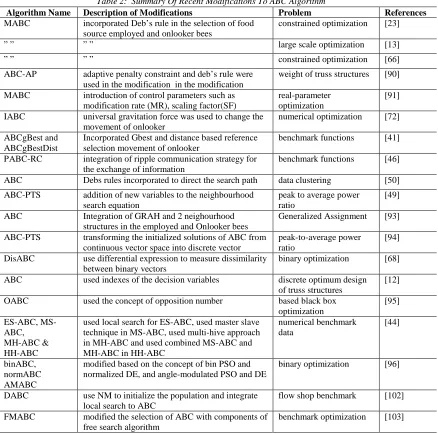
An improved ABC called fast mutation ABC was proposed for benchmark optimization functions (FMABC) [103]. The authors modified the ABC selection strategy with a pheromone and sensitivity model from free search algorithm and replaced the scout behaviour with a mutation strategy from opposition- based learning. The performance of FMABC was evaluated with seven benchmark functions and compared with that for basic ABC. The results showed the performance of FMABC as better than that for the basic ABC. Summary of the main features of the modified ABC algorithm are as shown in Table II.
B. Hybridization of Artificial Bee Colony Algorithm
The idea of hybridization is fast growing in computational intelligence, where the major aim of enhancing the weaknesses of the algorithm is by
hybridizing it with other techniques. The
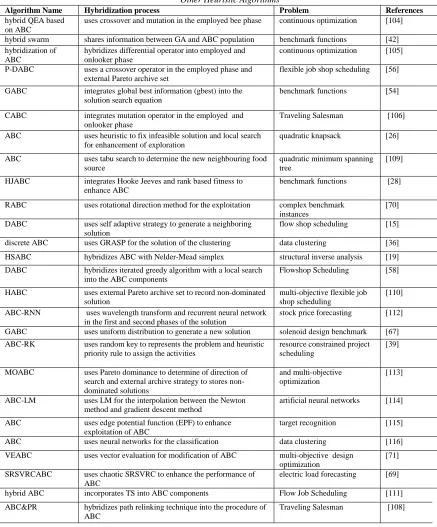
performance of ABC was improved by researchers through the integration of other popular rules and metaheuristic algorithms such as selection, mutation and crossover of GA, DE etc. Review of the hybridization of ABC to other component metaheuristic techniques is presented in the following subsections:
1) Hybridization of ABC with Population-based Algorithms: A wide range of population-based algorithms, such as EA, GA, DE and PSO have been developed, studied and hybridized by researchers to enhance their performance on a variety of problems. In this context, ABC has
been hybridized with components of other
population-based algorithms to improve its
performance in tackling complex optimization problems. An overview of the attempts made to hybridize ABC with other population-based algorithms is summarized in this section.
Zhu and Kwong [54] proposed a hybrid ABC and called it gbest-guided ABC (GABC) by integrating the global best information (gbest) into the solution search equation (4) of employed and onlooker bees, to enhance the ABC exploitation capability. The authors tested the performance on
six numerical benchmark functions, where the results of their experiment showed that it outperformed the original ABC in most of the experimental functions.
The hybridization of ABC and Quantum Evolutionary Algorithm (QEA) was proposed for solving continuous optimization problems by [104]. ABC was adopted to enhance the capacity of the local search and increase the randomness of the population. The crossover and mutation strategies of the QEA were integrated into the employed bee phase, to produce a new food source. The performance of the proposed hybrid QEA and ABC algorithm was compared with two other QEAs with classical crossover operation and the QEA with 2-crossover techniques, using a set of renowned benchmark continuous optimization problems. The experimental results demonstrated that the hybrid QEA based on ABC was suitable to solve the problem.
ABC was used to suggest the lowest free energy conformation in the protein conformational search space was proposed by Bahamish et al. [17]. In their study, the protein conformations were made the food sources and were evaluated using energy function, whereas torsion angles were made the decision variables. The authors embedded four different types of moves into the components of ABC, in order improve the conformations (food sources) and incorporated haploid crossover into the onlookers, to generate new food sources. The results demonstrated that ABC able to find the lowest free energy conformation of -12.910121 kcal/mol, using ECEPP/2 force field.
A novel hybrid swarm intelligent method which integrated ABC and GA was proposed by [42]. The main idea of the model was to share information between the population of GA and the colony of ABC. The scout phase of ABC was made to accept individuals with high fitness from GA in the first stage. Subsequently, a small number of high fitness individuals were randomly selected from the population of GA and the colony of ABC simultaneously in the second stage. The selected solutions were matched in pairs and crossed over, where the newly generated solutions were then added to the GA population. The authors evaluated their method with 4 benchmark functions of different dimensions and the results were compared with simple GA and basic ABC and showed that the method was effective and accurately improved performance better than that for SGA and ABC.
algorithm to enhance the convergence attributes and prevent ABC from getting stuck in t h e local optima. The workers incorporated differential operator into components of ABC and split the technique into two: EDABC if the differential
[image:15.612.96.534.161.595.2]operator was carried out by the employed bees or LDABC w h e n carried out by the onlooker bees. This was done to enhance the diversity of the solutions in the population and the capability of global search with the differential
Table 2: Summary Of Recent Modifications To ABC Algorithm
Algorithm Name Description of Modifications Problem References
MABC incorporated Deb’s rule in the selection of food source employed and onlooker bees
constrained optimization [23]
” ” ” ” large scale optimization [13]
” ” ” ” constrained optimization [66]
ABC-AP adaptive penalty constraint and deb’s rule were used in the modification in the modification
weight of truss structures [90]
MABC introduction of control parameters such as modification rate (MR), scaling factor(SF)
real-parameter optimization
[91]
IABC universal gravitation force was used to change the movement of onlooker
numerical optimization [72]
ABCgBest and ABCgBestDist
Incorporated Gbest and distance based reference selection movement of onlooker
benchmark functions [41]
PABC-RC integration of ripple communication strategy for the exchange of information
benchmark functions [46]
ABC Debs rules incorporated to direct the search path data clustering [50]
ABC-PTS addition of new variables to the neighbourhood search equation
peak to average power ratio
[49]
ABC Integration of GRAH and 2 neighourhood structures in the employed and Onlooker bees
Generalized Assignment [93]
ABC-PTS transforming the initialized solutions of ABC from continuous vector space into discrete vector
peak-to-average power ratio
[94]
DisABC use differential expression to measure dissimilarity between binary vectors
binary optimization [68]
ABC used indexes of the decision variables discrete optimum design of truss structures
[12]
OABC used the concept of opposition number based black box optimization
[95]
ES-ABC, MS-ABC, MH-ABC & HH-ABC
used local search for ES-ABC, used master slave technique in MS-ABC, used multi-hive approach in MH-ABC and used combined MS-ABC and MH-ABC in HH-ABC
numerical benchmark data
[44]
binABC, normABC AMABC
modified based on the concept of bin PSO and normalized DE, and angle-modulated PSO and DE
binary optimization [96]
DABC use NM to initialize the population and integrate local search to ABC
flow shop benchmark [102]
FMABC modified the selection of ABC with components of free search algorithm
benchmark optimization [103]
operator since it obeys uniform distribution and creates candidate solution position that could fully represent the search space. They compared the performance of EDABC and LDABC with ABC and both techniques outperformed ABC, whereas EDABC was better than the LDABC. When the results of EDABC were compared with other techniques such as GA, PSO, DE and EDA, its performance was shown proved to be better.
Hybridization of Pareto-based operators with
discrete ABC (P-DABC) to solve the multi-objective flexible job shop scheduling problem was presented [56]. Each solution or food source in the hybridization consisted of two elements: the routing and the scheduling elements. The authors hybridized a crossover operator into the operator of employed bees in order to share information between them. The proposition of an external Pareto archive set to store non-dominated solutions found in the population and a fast Pareto set
computational time. The performance of hybrid algorithm was tested on well-known benchmark instances and the results compared with other recently published techniques. The experimental results showed that the P-DABC algorithm was more competitive than the other techniques.
Karaboga and Gorkemli [106] used
combinatorial ABC (CABC) for traveling salesman problem (TSP). In the study, the authors integrated a new mutation operator from GSTM (Albayrak and llahverdi, 2011) into the search phases of employed and onlooker for finding new neighborhood food sources. The performance of CABC was tested on 2 benchmark problems; KroB150 which contained 150 cities and KroA200 with 200 cities and compared the results with GA, making use of eight different genetic mutation operators. The results showed the CABC to
produce good solutions for the problems
considered.
A hybridization of ABC with evolutionary programming called ABC programming (ABCP) for numerical benchmark functions was studied [107]. The authors modified the selection strategy of ABC with randomized selections. Similarly, they hybridized a bit mutation operator into the components of ABC similar to that for differential mutation, in order to produce a new food source and the global search capability of the basic ABC was improved with Layer Noisy Crossover. The performance of ABCP was evaluated on fifteen benchmark optimization problems, where it was shown that ABCP performance was better than for traditional ABC and a variant of DE (SaDE).
Hybridization of ABC with path re-linking (ABC&PR) for traveling salesman problem was also proposed by [108]. The workers embedded PR method into the procedure of ABC, to improve the quality of solutions. Similarly in their paper, the convergence towards high-quality was enhanced by limiting the frequency of use of the path-relinking through the adoption of dynamic updating technique of the reference set and the criterion function. The performance of ABC&PR was tested using well- known TSP benchmark instances and was compared with state-of-the-art methods. The results showed that ABC&PR was better than other methods.
2) Hybridization of ABC with Local-search- based algorithms: The combination of ABC with a greedy heuristic and local search for the quadratic knapsack problem was studied [26]. In this approach, the heuristic was used to fix the
infeasible solution generated by ABC, whereas local search was used to enhance the aspect of its exploration. The binary tournament selection was further used to select food sources from the population. The performance of the proposed algorithm was tested on standard quadratic knapsack problem instances and compared with other existing heuristic methods, where results obtained showed the approach to outperform the mini-swarm technique in terms computational time and the quality of solution, while its performance was comparable with that for a hybrid evolutionary approach named HSSGA.
Sundar and Singh [109] tested ABC algorithm to solve quadratic minimum spanning tree problem (Q-MST). The potential cost associated with each edge was defined by the authors for the purpose of initialization, while tabu search strategy was used to determine a new neighbouring food source. The
authors compared the computational results
generated by the ABC with the two best performing GA techniques, and found that the ABC performance in a local search was better than other comparative approaches.
A novel hybridization of the Hooke Jeeves pattern search method with ABC algorithm called HJABC was presented by [43], where the Hooke Jeeves was integrated purposely to enhance the exploration capability of ABC. Rank-based fitness transformation was used to improve the selection strategy of the onlookers, to overcome the problem of population diversity and premature convergence. The proposed hybrid algorithm, which was tested on 7 benchmark functions of various dimensionality produced results of numerical computation, showing the approach as having the capability to solve the tested problems in terms of success rate, convergence speed and solution accuracy.
The combination of ABC with Rosenbrocks rotational direction technique called RABC was also considered [70]. In this model, the rotational direction method was used to accomplish the exploitation phase while the exploration of the solution space was achieved by ABC. The performance of RABC algorithm was tested using a complete set of complex benchmark instances with a different range of dimensionality. A comparative evaluation conducted with other existing algorithms revealed results showing the RABC algorithm as effective in terms of accuracy, efficiency, convergence speed and success rate.