S T U D Y P R O T O C O L
Open Access
The effect of manual therapy and exercise
on age-related lung function: study
protocol for a randomised controlled trial
Roger Engel
1*, Sandra Grace
2and Suzanne Broadbent
3Abstract
Background:Ageing is associated with a range of anatomical and physiological changes. Establishing whether a change is part of‘normal’ageing or the early signs of disease will affect management strategies. Progressive stiffening of the thoracic spine, decreasing chest wall compliance and declining lung function begin as early as 40 years of age. Administering an intervention such as manual therapy, which has the potential to mitigate age-related changes in the thoracic spine and chest wall, has the potential to improve thoracic compliance and lung function. The aims of this trial are to investigate whether manual therapy can mitigate the effects of age-related changes in lung function and whether there is a difference in effect between different forms of manual therapy.
Methods:The study design is a randomised controlled trial of 372 people with no history of respiratory disease between the ages of 50 and 65 years. The cohort will be divided into three equal groups. The first group will receive a simple 10-min treadmill walking program (Ex). The second group will receive joint mobilisation (MB) of the thoracic spine and ribs plus the same walking program (MB + Ex). The third group will receive joint manipulation (MT) of the thoracic spine and ribs plus the same walking program (MT + Ex). All interventions will be administered a total of six times over a 3-week period. The primary outcome measure is lung function: forced expiratory volume in the 1st second and forced vital capacity. The secondary outcome measures include chest wall expansion (tape measurements) and quality of life measurements (36-Item Short Form Health Survey). Outcome measurements will be taken by blinded assessors on four occasions over a 9-week period. Adverse event data will be gathered at the beginning of each intervention session.
Discussion:This randomised controlled trial is designed to investigate whether manual therapy can mitigate the effects of age-related changes in lung function and whether there is a difference in effect between different forms of manual therapy. This is the first fully powered trial designed to test this hypothesis on healthy males and females in this age range.
Trial registration:Australian New Zealand Clinical Trials Registry (ANZCTR), 12616001317482. Registered on 20 September 2016.
Keywords: Ageing, Manual therapy, Spinal mobilisation, Spinal manipulation, Exercise, Randomised controlled trial, Lung function, Trial protocol
© The Author(s). 2019Open AccessThis article is distributed under the terms of the Creative Commons Attribution 4.0 International License (http://creativecommons.org/licenses/by/4.0/), which permits unrestricted use, distribution, and reproduction in any medium, provided you give appropriate credit to the original author(s) and the source, provide a link to the Creative Commons license, and indicate if changes were made. The Creative Commons Public Domain Dedication waiver (http://creativecommons.org/publicdomain/zero/1.0/) applies to the data made available in this article, unless otherwise stated. * Correspondence:[email protected]
1Department of Chiropractic, Macquarie University, North Ryde, Sydney, NSW
2109, Australia
Background
Ageing is associated with a range of anatomical and physiological changes involving the cardiovascular, pul-monary and musculoskeletal systems [1–3]. Establishing whether a change is part of ‘normal’ageing or the early signs of disease is, however, often difficult. In the case of the musculoskeletal system,‘normal’age-related changes in the thoracic spine and chest wall include a reduction in spinal muscle thickness, costal cartilage calcification, osteoporosis and spondylosis [4–6]. These changes start to manifest as early as 40 years of age and can lead to progressive stiffening of the spine, decreasing chest wall compliance and declining lung function [5,7].
As chest wall compliance is a major determinant of static lung volumes, improving compliance leads to im-provements in lung volumes. Lung volume is usually assessed using functional lung assessments such as forced vital capacity (FVC) and forced expiratory volume in the 1st second (FEV1).
If an intervention designed to improve chest wall com-pliance was administered before the age-related muscu-loskeletal changes in the thoracic spine and chest wall became irreversible, it could mitigate those changes and therefore have an impact on lung function [4–7].
Sandoz was the first to test this concept in 1976 when he proposed that altering the’dynamic capabilities’of the thor-acic kyphosis would improve lung function [8]. In his sem-inal work, Sandoz administered a 6-week course of manual therapy (mobilisation or manipulation) to the thoracic spines of 20 women between the ages of 60 and 65. He found that both interventions produced clinically meaning-ful increases in lung function with manipulation producing a greater increase than mobilisation. Interestingly, he noted that the maximum improvement in lung function was reached after 3 weeks of either intervention, with no add-itional improvements achieved following a further 3 weeks of manual therapy. This means that there may be a func-tional limit to the effect that manual therapy can have on the reversibility of age-related declining lung function.
Others have repeated this experiment on younger people (18–28 years) with similar results [9–11]. However, those studies were conducted on small sample sizes and did not address Sandoz’s central issue of the reversibility of age-related lung function. This is the first fully powered trial designed to test this concept on healthy older people.
The aims of this trial are to investigate whether manual therapy can mitigate the effects of age-related changes in lung function and whether there is a difference in effect between two different forms of manual therapy.
Methods/design
Study design
The trial is designed as a randomised controlled trial and fulfils the requirements of the Standard Protocol
Items: Recommendations for Interventional Trials (SPIRIT) checklist [12] (Additional file 1). The trial will evaluate 372 participants randomly allocated to three equal groups. Participants in Group 1 (Ex), the active control, will undertake a simple exercise program involv-ing a standardised 10-min walkinvolv-ing program performed on a treadmill. Participants in Group 2 (MB + Ex) will have manual therapy in the form of joint mobilisation (MB) administered to their thoracic spine and ribs prior to performing the same exercise regime as Group 1. Mo-bilisation consists of a pre-determined series of manoeu-vres (mobilisation protocol) designed to increase joint mobility in the thoracic spine and rib cage (Grade III–IV mobilisation as per Maitland [13]). Participants in Group 3 (MT + Ex) will have manual therapy in the form of joint manipulation (manipulation protocol) administered to their thoracic spine and ribs prior to performing the same exercise regime as Group 1. Manipulation (MT) consists of two separate manipulations (Grade V mobil-isation as per Maitland [13]), each involving a high vel-ocity low amplitude (HVLA) thrust directed at the inter-vertebral, costo-vertebral and costo-transverse joints. The first manipulation will be delivered at the level of the upper/middle thoracic spine, while the sec-ond will be at the level of the middle/lower thoracic spine. Two different manipulation techniques are avail-able under the trial’s manipulation protocol: supine and sitting. The supine technique, referred to as the‘ Opposi-te-side thenar/transverse drop’[14] or‘Supine wing’[15] technique, can be delivered with the participant’s thor-acic spine in flexion or extension. The sitting technique, referred to as a ‘Long-axis distraction’ [14] or ‘Sitting winglift’[15] technique, can be delivered using an axilla or elbow hold. The choice of technique will be deter-mined by the treating clinician based on biomechanical factors such as the patient-to-practitioner size ratio. All MT intervention will be administered as non-specific, multi-joint (group) manipulations. Administering MT in this way reduces the total number of manipulations re-quired to address the thoracic spine within a single intervention session, as each manipulation has the po-tential to affect several thoracic vertebrae and their asso-ciated ribs simultaneously. All Ex will be performed immediately after MB and MT intervention, as this has been shown to enhance the synergistic effect of combin-ing the two interventions [9, 16–18]. All intervention sessions will last between 15 and 20 min.
Gold Coast. The two sites will run sequentially with enrolment at the Gold Coast site not commencing until completion of the trial at the Lismore site. The main reasons for conducting the trial in this manner are recruitment and quality assurance. As Lismore is a medium-sized town in rural New South Wales (population 27,000), it is unlikely that the Lismore site will be able to generate sufficient participants for full enrolment. Adding the Gold Coast site, with its higher proportion of people over the age of 50, will improve the possibility of full enrolment. As the two sites are located approximately 98 km apart, achieving an acceptable level of quality assurance with the re-sources available mandates that the two sites be run consecutively.
Outcome measurements
The primary outcome measure is lung function: FEV1 and FVC. The secondary outcome measures include chest wall expansion (tape measurements) and quality of life measurements (36-Item Short Form Health Survey, SF-36). The metric for these measures is mean change from baseline. All outcome measurements will be taken by blinded assessors on four occasions over a 9-week period: at baseline and then at weeks 3, 6 and 9.
Participant characteristics
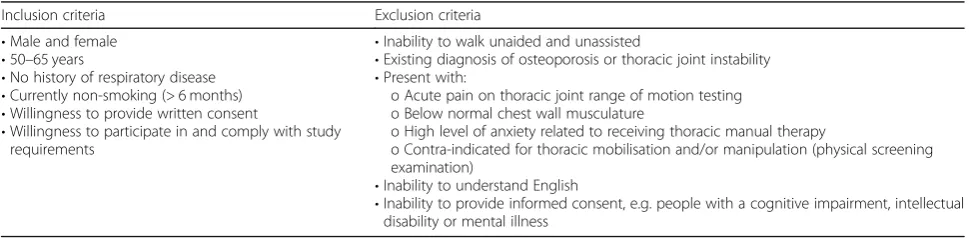
The trial includes both males and females between the ages of 50 and 65 years with no history of respiratory disease. Participants will be excluded if they have a his-tory of respirahis-tory disease, are currently smoking, cannot walk unaided and unassisted, have an existing diagnosis of osteoporosis or thoracic joint instability, present with acute pain on thoracic joint range of motion testing, have below normal chest wall musculature for their age and gender, exhibit a high level of anxiety related to re-ceiving thoracic MB or MT or are contra-indicated for MB or MT as determined by a physical screening exam-ination. Inclusion and exclusion criteria are described in Table1.
Protocol description
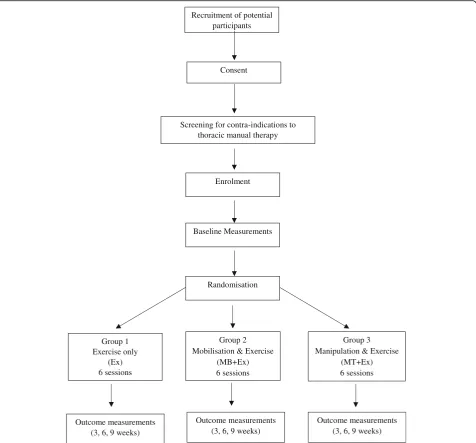
Volunteers who meet the inclusion criteria will be given an information sheet and asked to provide written con-sent to participate in the trial. They will then undergo a physical examination screening for the presence of other contra-indications to thoracic MB or MT such as thor-acic spine surgery or recent trauma followed by an infor-mation session designed to familiarise them with the use of a treadmill. After a volunteer has successfully com-pleted these tasks, baseline measurements will be taken. These include age, height, weight, blood pressure, heart rate, lung function assessment (spirometry), chest wall expansion (tape measure) and quality of life scores (SF-36). A participant is then enrolled in the trial, given a trial-specific identification (ID) number and allocated to a group on a sequential basis using a computer-gener-ated random sequence list drawn up prior to the start of the trial by a person not involved in any other aspect of the trial. Participants will be directed to not reveal their group allocation to the blinded assessor during assess-ment. The study protocol flow of participants is outlined in Fig.1.
All outcome measures will be taken by an assessor who is blinded to a participant’s group allocation. Lung function measurements (spirometry) will be measured in the standing position and include FEV1 and FVC. The initial treadmill walking speed will have been determined at the information session conducted in conjunction with the physical screening examination. This speed is set at a participant’s‘comfortable walking pace’as agreed to at that screening session. The SPIRIT figure showing the respective time points for enrolment, interventions and assessments is provided as Fig.2.
All MB and MT will be administered by students en-rolled in the Masters of Osteopathic Medicine program at Southern Cross University who have been trained in the relevant manual therapy techniques used in this trial. They will be under supervision at all times by a regis-tered osteopath.
[image:3.595.56.541.613.732.2]A manipulation will be deemed successful by the pres-ence of an audible release. All releases will be recorded on the participant’s file by the treating intern as either
Table 1Inclusion and exclusion criteria for participation
Inclusion criteria Exclusion criteria
•Male and female
•50–65 years
•No history of respiratory disease
•Currently non-smoking (> 6 months)
•Willingness to provide written consent
•Willingness to participate in and comply with study requirements
•Inability to walk unaided and unassisted
•Existing diagnosis of osteoporosis or thoracic joint instability
•Present with:
o Acute pain on thoracic joint range of motion testing o Below normal chest wall musculature
o High level of anxiety related to receiving thoracic manual therapy
o Contra-indicated for thoracic mobilisation and/or manipulation (physical screening examination)
•Inability to understand English
‘absent’(0),‘single’(1), or‘multiple’(2) for each manipu-lation. Should a deviation from the intervention protocol occur, the supervisor will be on hand to either approve the deviation or ensure a return to protocol. Any proto-col violations, whether for clinical or non-clinical rea-sons, will be recorded on the participant’s file by the treating intern at each intervention session.
Consent process
The consent process followed in this trial will be the same for all participants. Potential participants will re-ceive the patient information and consent form (PICF) explaining the trial’s processes and procedures, including
consent to publish, and what is expected from them dur-ing the trial. Each participant will be given the oppor-tunity to ask questions about their involvement in the trial and to have those questions answered by a re-searcher associated with the trial prior to providing con-sent. The trial ID number will be used when gathering and recording all information about a participant. A list containing the contact details of all participants and their corresponding ID numbers will be kept separate from all other data. All paper copy forms will be stored in a locked filing cabinet in the relevant clinical facility during the trial. Once involvement in the trial is completed (post-week 9), all data from these files will be scanned and transferred to a password protected Recruitment of potential
participants
Consent
Screening for contra-indications to thoracic manual therapy
Enrolment
Baseline Measurements
Randomisation
Group 1 Exercise only
(Ex) 6 sessions
Outcome measurements (3, 6, 9 weeks)
Group 2 Mobilisation & Exercise
(MB+Ex) 6 sessions
Group 3 Manipulation & Exercise
(MT+Ex) 6 sessions
Outcome measurements (3, 6, 9 weeks)
Outcome measurements (3, 6, 9 weeks)
[image:4.595.61.538.88.531.2]encrypted file and stored on the university computer of principal investigator 1 (RE). These electronic files will be backed up on an external hard drive and stored in a locked filing cabinet in the university office of principal investigator 2 (SG). The trial was approved by the Hu-man Research Ethics Committee (HREC) of Southern Cross University, approval number ECN-16-211.
Sample size calculation
Sample size calculation was based on change in FVC and the ability to detect a difference in lung function from baseline. The minimum clinically important differ-ence (MCID) for FVC is 200 ml with a standard devi-ation of 48 ml obtained from previous studies on people with and without a history of respiratory disease [9, 16,
17]. With a power of 0.8 (80%), an alpha of 0.05 and an MCID for FVC of 200 ml, the minimum sample size per group was calculated to be 112. Assuming a drop-out rate of 10%, the minimum cohort size required is 372 (three groups of 124).
Statistical analysis
Data will be reported as group means, standard deviations and 95% confidence intervals. Analysis will be performed as an analysis of covariance (ANCOVA) for difference be-tween groups with baseline as a covariate. Standard errors will be calculated using a non-parametric bootstrap to allow for the different error variances for each group. Ap value of < 0.05 has been set for statistical significance. For outcomes found to be statistically significant, the propor-tion of participants with a change greater than the MCID will be calculated for each outcome. The number needed to treat will be calculated using Bender’s method for confi-dence intervals. Missing data will be accounted for by using an intention-to-treat analysis with data from sub-jects lost to follow-up imputed using the multiple imput-ation method.
Data monitoring
The data safety monitoring board (DSMB) appointee who will oversee the study is the Osteopathy Professional
STUDY PERIOD
Enrolment Allocation Post-allocation (weeks)
TIMEPOINT -1 0 1 3 6 9
ENROLMENT:
Eligibility screen X
Informed consent X
Physical examination X
Allocation X
INTERVENTIONS:
Exercise (Ex)
Mobilisation + Exercise (MB+Ex)
Manipulation + Exercise (MT+Ex)
ASSESSMENTS:
Vitals:
heart rate, blood pressure, height, weight
X X X X
Spirometry:
FEV1, FVC X X X X
Chest wall expansion X X X X
Quality of life: SF-36 X X X X
Adverse event monitoring
[image:5.595.59.537.88.431.2]Experience Learning Co-ordinator in the School of Health and Human Sciences at Southern Cross University. The DSMB appointee will meet with one or more of the prin-cipal investigators on a regular basis to review the study data. As this trial includes the administration of manual therapy by supervised interns, the meetings with the DSMB appointee will focus on safety by reviewing adverse event (AE) data as it is collected during the trial. While se-vere or unexpected AEs are reported to the relevant Ethics Committee (Institutional Review Board) as a matter of standard procedure in any clinical trial, the DSMB meet-ings in this trial will track the rate of expected AEs, i.e. the mild to moderate AEs, as a way of monitoring whether participants are being placed at ‘additional’ risk by being treated by interns.
Adverse events
The risks of harm or discomfort to participants in this project primarily relate to the potential for AEs resulting from MT intervention. The majority of reported AEs as-sociated with these interventions are mild (muscle sore-ness and local discomfort), self-limiting, require no further medical attention and resolve within 48 h [19]. Moderate AEs, such as fracture, have also been reported following spinal manipulation and have been estimated to occur at a rate of 1 in 40,000 [20]. Reports of major or catastrophic AEs resulting from spinal manipulation have appeared in the literature with nearly all associated with neck (cervical) manipulation. This trial involves manipulation of the thoracic spine and ribs only and does not include any neck manipulation. The MT tech-niques used in this trial are similar to the ones used in three previous studies on people with chronic obstruct-ive pulmonary disease (COPD) [16, 17, 21]. There were no major or moderate AEs reported in those studies. Mild AEs associated with MT intervention were re-ported at a rate of 15% (18 out of 112) in the study on patients with moderate COPD (average age 56.1 years) [16], at a rate of less than 1% (2 out of 403) in the study on patients with moderate to severe COPD (average age 65.5 years) [17] and at a rate of 29% (21 out of 72) in the case series on patients with moderate to severe COPD (average age 79.1 years) [21]. As the trial reported here is being conducted on healthy participants with no history of respiratory disease, it is reasonable to predict that the risk of harm or discomfort to participants will be less than that in the previous studies on people of a similar age with respiratory disease. However, as this trial in-cludes the administration of manual therapy by clini-cians with limited clinical experience (interns), we have used an incident rate of 41% for mild AEs, taken from Carnes et al. [19], as the threshold for triggering an automatic halt to the study.
Discussion
Ageing is characterised by changes in the thoracic spine and chest wall. These changes result in a decrease in chest wall compliance that is associated with declining lung function. Improving compliance carries with it the potential for increasing lung function. Administering manual therapy in an attempt to improve chest wall compliance is not a new concept. However, previous studies have only administered the intervention for this reason to young healthy cohorts with and without the presence of identified restricted thoracic joint mobility [9–11, 22, 23] or to older people with chronic diseases that directly impact lung function such as ankylosing spondylitis [24–26] or COPD [16–18,27–31]. One study has investigated the effect of manual therapy on healthy, older individuals, but that study was not adequately powered, only involved women and did not include a control group for comparison [8].
The importance of being able to mitigate the age-related decrease in chest wall compliance lies in the flow-on effect it has on lung function and the ability to maintain activity levels as a person ages. With physical inactivity now seen as a public health priority globally, coordinated change is required at a social, cultural, en-vironmental and policy level to reverse the growing trend towards inactivity [32, 33]. Improving chest wall compliance in order to facilitate an increase in activity levels in older people is one approach to achieving this. Using lung function as an outcome measure is a simple, cost-effective and reliable way to measure the effective-ness of this approach.
We hypothesise that administering manual therapy to improve chest wall compliance will ultimately help to maintain activity levels as people age by mitigating one of the drivers of inactivity, declining lung function. The fully powered randomised controlled trial being reported in this manuscript will achieve this by examining the ef-fect of manual therapy on lung function in 372 healthy people between the ages of 50 and 65 years.
3.1. Trial status
Recruitment for the trial is ongoing at the time of submission.
Additional file
Additional file 1:Standard Protocol Items: Recommendations for Interventional Trials (SPIRIT) 2013 checklist. Recommended items to address in a clinical trial protocol and related documents. (DOC 120 kb)
Abbreviations
AE:Adverse event; ANCOVA: Analysis of covariates; COPD: Chronic obstructive pulmonary disease; DSMB: Data safety monitoring board; Ex: Exercise; FEV1: Forced expiratory volume in the 1st second; FVC: Forced
low amplitude; ID: Identification; MB: Mobilisation; MCID: Minimum clinically important difference; MT: Manipulation; PICF: Patient information and consent form; SPIRIT: Standard Protocol Items: Recommendations for Interventional Trials
Acknowledgements
In-kind support for the trial was provided by Macquarie University.
Funding
This trial is supported by a 2017/2018‘Research Grant’(reference number not available) from Osteopathy Australia and a 2017‘Seed Grant’(reference number not available) from the School of Health and Human Sciences at Southern Cross University.
Availability of data and materials
Not applicable.
Authors’contributions
RE, SG and SB designed the study. RE and SG prepared and edited the manuscript. All authors read and approved the final manuscript.
Ethics approval and consent to participate
The study conforms to the Declaration of Helsinki. The study has been approved by the Human Research Ethics Committee (HREC) of Southern Cross University, approval number ECN-16-211. All participants gave written informed consent.
Consent for publication
Written informed consent was obtained from each participant for publication of their individual details and accompanying images in this manuscript.
Competing interests
The authors declare that they have no competing interests.
Publisher’s Note
Springer Nature remains neutral with regard to jurisdictional claims in published maps and institutional affiliations.
Author details
1
Department of Chiropractic, Macquarie University, North Ryde, Sydney, NSW 2109, Australia.2School of Health and Human Sciences, Southern Cross University, Lismore, Australia.3School of Health and Sports Sciences, University of the Sunshine Coast, Sippy Downs, Australia.
Received: 18 September 2017 Accepted: 27 February 2019
References
1. Roh J, Rhee J, Chaudhari V, Rosenzweig A. The role of exercise in cardiac aging: from physiology to molecular mechanisms. Circ Res. 2016;118:279–95.
2. Hassel E, Stensvold D, Halvorsen T, Wisloff U, Langhammer A, Steinshamn S. Association between pulmonary function and peak oxygen uptake in elderly: the Generation 100 study. Respir Res. 2015;16:156–64. 3. Hearon C, Dinenno F. Regulation of skeletal muscle blood flow during
exercise in ageing humans. J Physiol. 2016;594:2261–73.
4. Hochhegger B, Meirelles GS, Irion K, Zanetti G, Garcia E, Moreira J, Marchiori E. The chest and aging: radiological findings. J Bras Pneumol. 2012;38:656–65.
5. Sharma G, Goodwin J. Effect of aging on respiratory system physiology and immunology. Clin Int Aging. 2006;1:253–60.
6. Janssens JP. Aging of the respiratory system: impact on pulmonary function tests and adaptation to exertion. Clin Chest Med. 2005;26:469–84 vi-vii. 7. Goh S, Tan C, Price RI, Edmondston SJ, Song S, Davis A, Singer KP. Influence
of age and gender on thoracic vertebral body shape and disc degeneration: an MR investigation of 169 cases. J Anat. 2000;197:647–57.
8. Sandoz R. Some physical mechanisms and effects of spinal adjustments. Ann Swiss Chiropr Assoc. 1976;6:91–141.
9. Engel R, Vemulpad S. The effect of combining spinal manipulation with mild exercise on the respiratory function of normal individuals: a randomized control trial. J Manip Physiol Ther. 2007;30:509–13.
10. Gosling C, Williams KA. Comparison of the effects of thoracic manipulation and rib raising on lung function of asymptomatic individuals. J Osteopath Med. 2004;7:103. 11. Miller JA, Bulbulian R, Sherwood WH, Kovach M. The effect of spinal manipulation
and soft tissue massage on human endurance and cardiac and pulmonary physiology—a pilot study. J Sports Chiropr Rehabil. 2000;14:11–5 46–7. 12. Chan A-W, Tetzlaff JM, Altman DG, Laupacis A, Gøtzsche PC, Krleža-JerićK,
Hróbjartsson A, Mann H, Dickersin K, Berlin J, Doré C, Parulekar W, Summerskill W, Groves T, Schulz K, Sox H, Rockhold FW, Rennie D, Moher D. SPIRIT 2013 Statement: defining standard protocol items for clinical trials. Ann Intern Med. 2013;158:200–7.
13. Hengeveld E, Banks K, editors. Maitland’s vertebral manipulation. 8th ed. Edinburgh: Churchill Livingstone; 2013.
14. Bergmann TF, Peterson DH. Chiropractic technique: principles and procedures. 3rd ed. St. Louis: Elsevier; 2011.
15. Esposito S, Philipson S, Downie A. Spinal adjustment technique: the chiropractic art. Sydney: Philipson & Esposito; 2005.
16. Engel RM, Vemulpad SR, Beath K. Short-term effects of a course of manual therapy and exercise in people with moderate chronic obstructive pulmonary disease: a preliminary clinical trial. J Manip Physiol Ther. 2013;36(8):490–6. 17. Engel RM, Gonski P, Beath K, Vemulpad S. Medium term effects of including
manual therapy in a pulmonary rehabilitation program for chronic obstructive pulmonary disease (COPD): a randomized controlled pilot trial. J Man Manip Ther. 2016;24:80–9.
18. Zanotti E, Berardinelli P, Bizzarri C, Civardi A, Manstretta A, Rossetti R, Fracchia C. Osteopathic manipulative treatment effectiveness in severe chronic obstructive pulmonary disease: a pilot study. Complement Ther Med. 2012;20:16–22.
19. Carnes D, Mars TS, Mullinger B, Froud R, Underwood M. Adverse events and manual therapy: a systematic review. Man Ther. 2010;15(4):355–63. 20. Ernst E. Adverse effects of spinal manipulation: a systematic review. J R Soc
Med. 2007;100(7):330–8.
21. Dougherty PE, Engel RM, Vemulpad S, Burke J. Spinal manipulative therapy for elderly patients with chronic obstructive pulmonary disease: a case series. J Manip Physiol Ther. 2011;34:413–7.
22. Wall BA, Peiffer JJ, Losco B, Hebert JJ. The effect of manual therapy on pulmonary function in healthy adults. Sci Rep. 2016;6:1–5.
23. Shin D, Lee Y. The immediate effects of spinal thoracic manipulation on respiratory functions. J Phys Ther Sci. 2016;28:2547–9.
24. Mengshoel AM, Robinson HS. Clinical significance of specific spinal mobilization for patients with ankylosing spondylitis evaluated by quantitative assessments and patient interviews. Disabil Rehabil. 2008;30:355–64. 25. Widberg K, Karimi H, Hafström I. Self- and manual mobilization improves
spine mobility in men with ankylosing spondylitis: a randomized study. Clin Rehabil. 2009;23:599–608.
26. Lange U, Sperling M, Richter K, Dischereit G, Muller-Ladner U, Tarner IH. The effects of manual mobilisation on the mobility of the thoracic spine in patients with ankylosing spondylitis. J Musculoskeletal Dis Treat. 2016;2:1–7. 27. Noll DR, Johnson JC, Baer RW, Snider EJ. The immediate effect of individual
manipulation techniques on pulmonary function measures in persons with chronic obstructive pulmonary disease. Osteopath Med Prim Care. 2009;3:1–12. 28. Bhilpawar P, Arora R. Effects of osteopathic manipulative treatment in
patients with chronic obstructive pulmonary disease. Indian J Physiother Occup Ther. 2013;7:196–201.
29. Rocha T, Souza H, Brandão DC, Rattes C, Ribeiro L, Campos SL, Aliverti A, De Andrade AD. The manual diaphragm release technique improves diaphragmatic mobility, inspiratory capacity and exercise capacity in people with chronic obstructive pulmonary disease: a randomised trial. J Physiotherapy. 2015;61:182–9.
30. Yelvar GDY, Çirak Y, Demir YP, Dalkilinç M, Bozkurt B. Immediate effect of manual therapy on respiratory functions and inspiratory muscle strength in patients with COPD. Int J Chron Obstruct Pulmon Dis. 2016;11:1353–7. 31. Cruz-Montecinos C, Godoy-Olave D, Contreras-Briceño F, Gutiérrez P,
Torres-Castro R, Miret-Venegas L, Engel R. The immediate effect of soft tissue manual therapy intervention on lung function in severe chronic obstructive pulmonary disease. International COPD. 2017;12:691–6.
32. Kohl HW, Craig CL, Lambert EV, Inoue S, Alkandari JR, Leetongin G, Kahlmeier S. The pandemic of physical inactivity: global action for public health. Lancet. 2012;380:294–305.