The Influence Of Using Snake And Ladders Game
Media Against Learning Outcomes Of Fourth Grade
Elementary School
Dessy Cahayaning Margi Utami1, Maria Veronika Roesminingsih2, Ari Wahyudi3
1Postgraduate Student in Elementary Program, State University of Surabaya, Indonesia 2
Lecturers of Elementary Program, State University of Surabaya, Indonesia 3
Lecturers of Elementary Program, State University of Surabaya, Indonesia 1
Email: [email protected]
DOI: 10.29322/IJSRP.9.06.2019.p9030
http://dx.doi.org/10.29322/IJSRP.9.06.2019.p9030
Abstract: The study aims to improve student learning outcomes through the use of snake and ladders game media. Research location is at Budi Luhur Elementary School, Banyuurip Lor I Surabaya. The research approach used is quantitative. The research conducted was Quasi Experimental with the design of Nonequivalent Control Group Design. The study population was all fourth grade students at Budi Luhur Surabaya Elementary School and the sample of this study was IVA class amounting to 32 children as experimental class and IVB class as the control class amounted to 27 children. Data collection techniques used tests in the form of pretest and posttest questions as many as 20 items. The data analysis technique used is the validity test, reliability test, normality test, homogeneity test, t-test test. The results showed that snakes and ladders games had an influence on student learning outcomes. This can be seen from the T-test test results indicating that Thitung amounted 5,728 > ttabel 2,023. So it can be concluded that the use of snake and ladders games to improve the learning outcomes of fourth grade SD Budi Luhur Surabaya.
Keywords: Media, Snake and Ladders Game, Learning Outcomes
INTRODUCTION
The task of educators and education personnel who are obliged to create an educational atmosphere that is meaningful, fun, creative, dynamic, and dialogic and has a professional commitment. Learning in schools has many subjects, one of which is social science subjects which often make it difficult for students to learn the material. Social science is integration or combination of subjects in history, geography, and economics, as well as other social science subjects (Sapriya, 2015, p. 06). In addition, according to Saidiharjo (1996, p. 4) that social science is the result of a combination of a number of subjects such as: geography, economics, history, sociology, anthropology and politics. Social science various disciplines of social science and humanities as well as human activities that are packaged scientifically in order to provide insight and deep understanding to students, especially at the elementary and secondary levels (Susanto, 2015, p. 137).Basically the essence of social scienceis a study of humans and their world (Hidayati, 2008, p. 1.19). The nature of social science in elementary schools provides knowledge and skills as a medium of training for students in forming character as citizens as early as possible. Social science learning in elementary schools is a subject that students follow aimed at knowing knowledge about humans and the social environment around them. Knowledge in social science is done in a special way, namely, by observing, experimenting, inferring, compiling theories, and so on. So that social science learning is carried out to foster a mindset, and communicate as one part of the activity. A teacher in a school must be able to find alternative media learning that allows students to be able to develop and have good learning outcomes in the classroom learning process. In addition, the use of learning media must be interesting and creative according to the needs and abilities of the students.
Thus the efforts to carry out the learning process, so that students are more understanding, interested, and mastering social science materials appropriately, and can present the atmosphere of a learning process that is exciting, motivating, exciting, and intellectual, so the need to use creative learning media so that it can support the success of learning in social studies subjects well for students at the school. Media is any aid tool as a communication or channeling tool between teachers and students to achieve learning goals. According to Sudjana and Rivai (2013, p. 02) explain that the benefits of learning media include: learning will attract attention, learning materials will be more meaningful, teaching methods will vary, and students will do more learning activities. Whereas according to Daryanto (2013, p. 05) generally explains the benefits of media namely: clarifying the message so that it is not too verbalitis, overcoming the limitations of space, time, and sensory power, arousing passion for learning, and allowing children to learn independently.So in this study, researchers will use learning media with Elementary School game. This snake and ladders includes simple games, players can have more than one person to finish until the last box or finish, the game uses dice to determine which player steps and has a snake image to go down, the stairs to go up are connected boxes. According to Sidik (2008, p. 24) the snake and ladders is game where players occupying a snake box are required to go down and players occupying a ladder box will rise. In addition, the snake and ladders game media can also be designed according to your own creations as a medium of learning in the classroom, of course with changes to the rules of the game in accordance with the material delivered by the teacher. The use of snake and ladders game media that is creatively designed can help students in understanding the material that has been taught, such as answering questions, in the form of questions according to the learning objectives, namely increasing social studies learning outcomes in fourth grade students. The game can be used in learning to provide a pleasant experience for students, because there is interaction or communication between players, can provide a basis for the achievement of various skills to solve problems about learning delivered. Snake and ladder game is a game that is now much forgotten and abandoned most elementary school age students. Therefore, the researcher chose the snake and ladders game media to aim to improve students' social studies learning outcomes in the learning process in the fourth grade, and to introduce students to the snake and ladders game better. The researcher wants students to be able to memorize the Social science material correctly and create a pleasant, joyful atmosphere so that students are able to compete and cooperate with each other in understanding the social studies learning materials provided by a teacher. Therefore, from the problems presented above, the researcher will conduct a study entitled “the ınfluence of using snake and ladders game media against learning outcomes of fourth grade elementary school”.
METHOD
The research approach used is quantitative. Quantitative research is a way to get and solve problems faced and carried out systematically, and all data collected can be in the form of a series (Nasehudin, 2012, p. 68). The type of research used is experiment. The type of quantitative research that will be applied aims to measure the influence of independent variables namely snakes ladders creationsgame media and the dependent variable is social studies learning outcomes. The research design used was quasi-experimental. With the research conducted is nonequivalent control group design. The location of the research and data collection conducted in class IVA and IVB at Budi Luhur Elementary School Surabaya, which is located at Banyuurip Lor I, Sawahan District, Surabaya City. In the experimental group (IVA) learning was done using snake and ladders game media, while for the control group (IVB) using conventional learning methods. The time of study in April 2018 is in the even semester of the 2017/2018 academic year.
The sampling technique in this study is purposive sampling, which is the determining the sample by considering certain objectives. The study population consisted of 4 study groups in class IV, the selected sample were IVA class student as experimental class numbering 12 female and 20 male students, So the total 32 children, while IVB class as control class was 19 female and 8 male students, So the total 27 children. All students of IVA and IVB class at SD Budi Luhur Surabaya average age 11-12 years, with the majority of ethnic Javanese.
The instruments used were test sheets, namely pretest and posttest. The data collection that is to be obtained in this study is data on student learning outcomes in cognitive assessment. Before the treatment is carried out, students are given a pretest and after the treatment students are given a posttest question, as data collection. Data analysis techniques in this study include:
Test the validity of using the product moment correlation the following formula (in Arikunto 2010, p. 213):
Reliability uses the Cronbach's Alpha the following formula (in Arikunto 2010, p. 231):
The normality test uses the Chi-square the following formula (in Winarsunu, 2015, p. 81):
Next is the hypothesis test, in the form of a t-test and normalized gain. T-test is used to prove whether the hypothesis is accepted or rejected. Because the number of N1 and N2 is not the same, The t-test is carried out using the following formula (in Sugiyono, 2015, p. 273):
RESULT
The validation test of the pretest and posttest questions was carried out before the study to the expert validator which aimed to determine the validity of the questions used during the study. Validation tests also use SPSS 21 for Windows. The following results obtained by the pretest questions amounted to 20 and the posttest questions amounted to 20. According to (Sundayana, 2014, p. 68) as for signs of a valid question in processing with SPSS 21 for windows indicated by a sign * or ** processing item validity. Before conducting research, researchers first test the validation of learning media and the validation of learning devices to expert lecturers and find that learning media and learning devices are appropriate for use in research. Furthermore, the researchers also tested the feasibility of the items which aimed to determine the validity and reliability of the items. Based on the calculation results of 20 items, it is said that all are valid after being tested. Instruments about the pretest and posttest students produce a correlation value of more than 0.3061, then it meets the requirements that Rcount > Rtable. So, all question items are declared valid and the next stage is the reliability test. Reliability testing shows instruments that can be trusted as data collection tools. For the results of testing the reliability of the instrument as follows:
Table 1.Result of Pretest Reliability
Source: secondary data proceed, 2017
Based on table 4.2 above, the magnitude of Cronbach's Alpha is 0.823. Where the value of Rtable at the significance level of 5% is 0.3061. It shows that the pretest problem used is reliable because of Rcount > Rtable which is 0.823 > 0.3061.
Table 2. Result of Posttest Reliability
Source: secondary data proceed, 2017
Based on table 4.4 above, the size of Cronbach's Alpha is 0.794. Where the value of Rtable at the significance level of 5% is 0.3061. Shows that the posttest question used is reliable, because Rcount > Rtable is 0.770 > 0.3061. So from that, it can be concluded that the instrument on learning outcomes is reliable, so that it is appropriate to be used for research.
1. Data on Student Learning Outcomes
In this study the pretest and posttest questions were given in IVB class as a control class and in the IVA class as an experimental class, namely the use of snake and ladders game media at Budi Luhur Surabaya Elementary School. Data on learning outcomes can be obtained from the pretest and posttest values in the control class and the experimental class. The results of the pretest and posttest values were conducted aimed at knowing the level of material understanding in students towards the learning process. Comparison of the average value of the results of the two classes is shown in the diagram below:
Diagram 1. Average Control Class and Experimental Class
From diagram 4.1, it can be seen that there is an increase in the value of student learning outcomes at the pretest and posttest, namely the control class and the experimental class. In the control class the average value of the pretest was 55.83 and the posttest value with an average value of 62.72, while the experimental class had an average pretest score of 51.65 and the posttest average value was 75.18.
Reliability Statistics
Cronbach's Alpha Cronbach's Alpha Based on Standardized Items N of Items
.823 .812 20
Reliability Statistics
Cronbach's Alpha Cronbach's Alpha Based on Standardized Items
N of Items
2. Analysis of Test Data Results Normality Test
[image:4.595.151.445.127.225.2]In this study using the normality test using Chi-square. If the chi-kuadrat count is smaller than the chi-kuadrat table, then the data is normally distributed, but if the value of chi-kuadrat count is greater than the chi-kuadrat table, then the data is abnormally distributed.
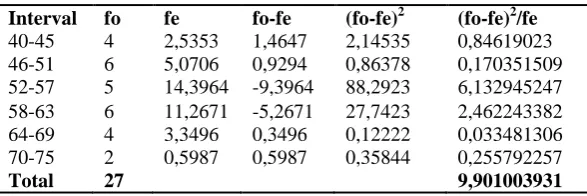
Table 3. Pretest Control Class Normality Test
Source: secondary data proceed, 2017
Based on the results of calculations in table 4.4, then Chi-square can be obtained a significant value of the pretest results in the control class with 9,901 < 11,070 declared normal distribution.
Table 4. Pretest Normality Test Experiments
Source: secondary data proceed, 2017
Based on the calculation results in table 4.5, then Chi-square can be obtained a significant value from the pretest results in the experimental class with a result of 10,444 < 11,070, stated to be normally distributed.
Homogeneity Test
The homogeneity test was carried out aimed to find out whether the control class in conventional learning used the student activity sheet and the experimental class that used media as an evaluation in learning had the same variance or not. The calculated data are pretest and posttest data, namely in the control class and experimental class. The homogeneity test calculation is as follows: Homogeneity of pretest control class:
= 9,1615
Homogeneity of pretest experimental class:
= 9,4121
= 1, 0546
From the results of the above calculations, the results obtained are that Tcount is 1.0546 and Ttable at the level of 5% = 0.05 Ttable value (26.31), which is the result of Tcount < Ttable with the results obtained that is equal to 1.0546 < 1.8573, so it can be concluded that the calculation of the data is declared homogeneous, that is, the hypothesis Ha is accepted and Ho is rejected.
Homogeneity of the posttest control class:
Homogeneity of the posttest experimental class:
= 1,7578
Based on the results of the above calculations, it can be obtained the results of Tcount of 1.7578 and Ttable at the level of 5% = 0.05 Ttable value (26.31), that is with the results of Tcount < Ttable with the results obtained that is equal to 1.7578 , so that it can be concluded that the calculation of data, declared homogeneous posttest control class and experimental class, hypothesis Ha is accepted and Ho is rejected.
Interval fo fe fo-fe (fo-fe)2 (fo-fe)2/fe 40-45 4 2,5353 1,4647 2,14535 0,84619023 46-51 6 5,0706 0,9294 0,86378 0,170351509 52-57 5 14,3964 -9,3964 88,2923 6,132945247 58-63 6 11,2671 -5,2671 27,7423 2,462243382 64-69 4 3,3496 0,3496 0,12222 0,033481306 70-75 2 0,5987 0,5987 0,35844 0,255792257
Total 27 9,901003931
Interval fo fe fo-fe (fo-fe)2 (fo-fe)2/fe
36-41 5 3.4944 1.5056 2.26683136 0.648704029 42-47 7 5.4912 1.5088 2.27647744 0.414568298 48-53 7 15.7344 -8.7344 76.28974336 4.848595648 54-59 5 12.096 -7.096 50.353216 4.162798942 60-65 5 4.2464 0.7536 0.56791296 0.133739864 66-71 3 2.2688 0.7312 0.53465344 0.235654725
T-test Test
T-test is used to prove whether the hypothesis is accepted or rejected. The hypothesis in the t-test includes if Tcount < Ttable, then Ha is accepted and Ho is rejected, and if Tcount < Ttable, then Ho is accepted and Ha is rejected. In the t-test with the calculation of SPSS 21 assistance at the level of 5% as a significant level to obtain the results determine how much chance to make the risk of making a mistake in making the decision to reject the hypothesis correctly (Siregar, 2013, p. 41). The following are the results of the t-test test with the help of SPSS 21 as follows:
Table 5. T-test Test
Source: secondary data proceed, 2017 Based on the calculation of the SPSS 21 assisted test, if at a significant level below 0.05 it means there is influence. The t-test t-test conducted obtained a significant value of 0,000, it can be concluded that Ha is accepted and Ho is rejected, then there is the influence of the use of media snake and ladders game on student learning outcomes.
DISCUSSION
This study aims to determine whether there is influence of snakes and ladders game media on social studies learning outcomes of fourth grade students at Budi Luhur Surabaya Elementary School. The study was conducted at Budi Luhur Surabaya Elementary School by using two classes namely IVA class as the experimental class and IVB class as the control class. The study was conducted for 1 day from each of the two classes. This test is done twice namely the pretest and posttest. Learning outcomes are abilities that students have before and after the learning process. This is supported by the explanation of Dimyati and Mudjiono (2009, p. 3) which states that learning outcomes are the results of an action from the learning process. Student learning outcomes in this study focus on cognitive aspects obtained through test. This was stated by Arifin (2014, p. 226) a test is a measurement technique in which there are various questions and statements that must be done by respondents or students. Learning media can instill true and concrete, and realistic basic concepts (Asnawir and Usman, 2002, p. 14). Before conducting research, researchers conduct media and learning tools to expert validators. After obtaining approval and suggestions from expert validators, the researchers conducted an instrument trial. Furthermore, the validation test carried out was the validation of the pretest and posttest. Based on the calculation results that the learning outcomes test questions in the form of multiple choice questions consisting of 20 items obtained were declared valid, the test questions using SPSS 21 help. Then test the reliability of the instrument using the Cronbach's Alpha formula. Reliability test based on calculations with the help of SPSS 21 obtained results at the pretest of 0.834, Rtable with a level of 0.05 with N = 20 which is 0.3061, then Rcount > Rtable which is 0.823 > 0.3061, then declared reliable. The reliability test on the posttest question was 0.770, the Rtable value at a significant level of 0.05 with N = 20 was 0.3061, which showed that the posttest question used was reliable because of Rcount >Rtable which was 0.770 > 0.3061.
Based on the analysis of the results of the research presented, the discussion of this chapter discusses the results of the research and focuses on the findings obtained by justifying the findings with the study of theory. Before treatment using snake and ladders game media, students were given a pretest with the aim of how far the students' knowledge of the material to be taught about ethnic and religious diversity in my country, then given treatment, and after the treatment was given a posttest sheet aimed at knowing student social studies. After conducting the research, then the data collection process was carried out by pretest and posttest in the control class and experimental class. The results obtained by the average value of the control class pretest were 55.83 and the posttest value was 62.72. In the experimental class the average value of the pretest was 51.65 and the posttest average value was 75.18. This shows that there is a difference in the increase in the average value of the two classes.
5% = 0.05 Ttable value (26.31), that is, Tcount < Ttable with the results obtained are equal to 1.7578 < 1.8573, so it can be concluded that the calculation of the data is declared homogeneous.
Based on the results of this study shows that the use of snake and ladders game media in further material understanding may affect student learning outcomes. Other findings supporting this study were conducted by Nachiappan (2014) and research conducted by Golchai (2012) that the use of snakes and ladders game in delivering material to students, so as to show good results and Optimality. Another opinion that is corroborating and in line with this research is that proposed by Kunandar (2011, p. 62) states that learning outcomes are a certain ability in the affective, cognitive, psychomotor realms of students that have been achieved from the learning process. Supported also by previous research from Istuningsih, Baedhowi, and Sangka (2018) that improve student learning outcomes by using learning media, one of the effective ways in accordance the implementation of curriculum 2013 Implementing scientific approach to teaching and learning activities to achieve student-centered learning.
Based on the results of the calculations obtained in t-test Tcount 5,728 > Ttable 2,023, then Ho is rejected and Ha is accepted. In the 5% t-test as a significant level to obtain the results determine how much chance to make the risk of making a decision to reject the hypothesis correctly (Siregar, 2013, p. 41). Based on the calculation of the SPSS 21 assisted t-test, if at a significant level below 0.05, it means there is influence. It can thus be concluded that there is significant difference between the learning outcomes of the experiment class and the control class. Supported by previous research from Kusumatuty, Baedhowi, and Murwaningsih (2018) that learning outcomes used lower conventional learning compared to learning outcomes using E-Book media. So, effective and creative learning media is suitable for improving the learning outcomes of elementary school students. So learning to use snakes and ladders game media is effective to improve student learning outcomes, this is evidenced by the existence of significant differences in learning outcomes between the experimental class and the control class.
CONCLUSION
Based on the results of the research and discussion the results of the study can be concluded, among others: snake and ladders game media that deserves to be used to improve student learning outcomes in Elementary School. Based on the research results there is a significant value of 0.000 < 0.05. It is based on the results of t-test, where the value of Tcount 5,728 > Ttable 2,023, it can be concluded that Ha is accepted and Ho is rejected. It can be concluded that learning using the snake and ladders game media is effective to improve student learning outcomes, because there significant differences in learning outcomes between experimental classes and control classes. Then it can be concluded, that is the influence snake and ladders game media of learning outcomes of fourth grade between before treatment (pretest) and after treatment (posttest). Based on the results of data analysis and conclusions, it can be suggested a number of suggestions including in the learning process the use of instructional media is expected to be improved not only snake and ladders game media, but also other media to encourage students to learn and in this study still have many short comings. media design so that further researchers are expected to add more interesting media updates.
REFERENCES
Arifin, Z. (2014). Penelitian Pendidikan Metode dan Paradigma Baru. Bandung: PT REMAJA ROSDAKARYA. Arikunto, S. (2010). Prosedur Penelitian Suatu Pendekatan Praktik. Jakarta: PT Rineka Cipta.
Asnawir, H., Usman, M, & Basyiruddin. (2002). Media Pembelajaran. Jakarta: Ciputat Pers. Daryanto. (2013). Media Pembelajaran. Yogyakarta: Gava Media.
Dimyati, & Mudjiono. (2009). Belajar dan Pembelajaran. Jakarta: Rineka Cipta.
Golchai, B. (2012). Snakes And Ladders A New Method For Increasing Of Medical Students Excitement. Procedia-Social and Behavioral Sciences. Guilan University of Medical Sciences (GUMS). Educational Vice chancellor, Shahid Azodist. Rasht, Guilan/Iran, 47(4), 2089-2092.
Hidayati, M, & Anwar, S. (2008). Pengembangan Pendidikan IPS SD. Jakarta: Direktorat Jendral Pendidikan Tinggi Departemen Pendidikan Nasional.
Istuningsih, W., Baedhowi., & Sangka, K.B. (2018). The Effectiveness of Scientific Approach Using E-Module Based on Learning Cycle 7E to Improve Students’ Learning Outcome. International Journal of Educational Research Review, 3(3), 75-85.
Kunandar. (2011). Langkah Mudah Penelitian Tindakan Kelas Sebagai Pengembangan Profesi Guru (Edisi Revisi). Jakarta: Raja Grafindo Persada.
Kusumatuty, A,J., Baedhowi., & Murwaningsih, T. (2018). The Implementation of Problem Based Learning (PBL) Based E-Book to Improve The Learning Outcome of Vocational High School (VHS) Students. International Journal of Educational Research Review, 3(4), 103-110.
Nachiappan, et al. (2014). Snakes and Ladder Games In Cognition Development On Students With Learning Difficulties. Review of Arts and humanities. Published Journal by American Research Institute or Policy Development, 3(2), 217-229. Nasehudin, S. (2012). Metode Penelitian Kuantitatif. Bandung: Pustaka Setia
Nasution. (2011). Kajian Pembelajaran IPS di Sekolah. Surabaya: Unesa University Press.
Saidihardjo., & Sumadi HS. (1996). Konsep dasar Ilmu pengetahuan Sosial. (Buku 1). Yogyakarta : FIP IKIP. Sardiman. (2004). Interaksi dan Motivasi Belajar Mengajar. Jakarta: PT Raja Grafindo Persada.
Sidik, R. (2008). Efektivitas Permainan Snakes Ladders dalam Meningkatkan Penguasaan Kosakata Bahasa Jepang. Skripsi. Bandung: FPBS UPI.
Siregar, S. (2013). Metode Penelitian Kuantitatif. Jakarta: PT Fajar Interpratama Mandiri.
Sudjana, N., & Rivai, A. (2010). Media Pengajaran (Penggunaan dan Pembuatannya). Bandung: Sinar Baru Algensindo. Sugiyono. (2015). Metode Penelitian Pendidikan (Pendekatan Kuantitatif, Kualitatif, dan R&D). Bandung: Alfabeta. Sundayana, R. (2014). Statistika Penelitian Pendidikan. Bandung: Alfabeta.
Susanto, A. (2015). Teori Belajar dan Pembelajaran di Sekolah Dasar. Jakarta: Prenadamedia Group.