Moderating Effect of Gender Role Orientation on the
Relationship between Organizational Commitment and
Self Efficacy
Dr. Bhavana Arya
*, Mridula Sharma
**, Shriparna Singh
***
Department of Psychology, The IIS University, Jaipur
**
Department of Psychology, The IIS University, Jaipur
Abstract- Employees are very valuable resource of any organization and especially the committed employees. Thus, exploring organizational commitment and its correlates is of immense importance. Current study attempts to explore the relationship between organizational commitment and self efficacy and the moderating effect of gender role orientation. Results showed a positive correlation between organizational commitment and self efficacy. Regression analysis indicated gender role orientation along with self efficacy to be the strongest predictor of organizational commitment among employees.
Index Terms- Gender role orientation, organizational commitment, self efficacy
I. INTRODUCTION
en and women differ in their perceptions about themselves and in their efficacy level and in the commitment they show towards their organizations.
Present day work culture values the committed employees most, as they are an important asset for any organization to grow and succeed in this competitive world. Human achievements and commitment towards the work as well as workplace needs an optimistic sense of personal worth and efficacy.
Organizational commitment is the relative strength of an individual's identification with and involvement in a particular organization (Mowday, Porter and Steers, 1979).
Organizational commitment as defined by Porter et al. (1974) has three major components: (1) a strong belief in and acceptance of the organization's goals, (2) a willingness to exert considerable effort on behalf of the organization, and (3) a definite desire to maintain organizational membership.
Organizational commitment seems to be quite important organizational construct as it is a leading determinant of an employee’s association with any particular organization. Several researches have shown that commitment is a predictor of employee’s retention (Porter et al., 1974; Koch and Steers, 1978) and employee effort and performance (Mowday et al., 1974, 1979).
Self efficacy, i.e., one’s belief about one’s own capabilities, is a crucial aspect of one’s self system. According to Albert Bandura, self-efficacy is “the belief in one’s capabilities to organize and execute the courses of action required to manage prospective situations” (1995, p. 2). Bandura described these
beliefs as determinants of how people think, behave, and feel (1994).
Self efficacy as a social cognitive construct affects one’s social and professional interactions in almost every way. It also influences one’s productivity, one’s approach to face various goals and challenges and one’s overall well being (Bandura, 1994).
Self efficacy has a strong connection with an individual’s work / organizational behaviour, as people with high self-efficacy in a task are more likely to make more of an effort, and persist longer, than those with low efficacy (Bandura, 1994). Individuals with higher self efficacy would have an obviously greater confidence in their ability to tackle difficult situation and would be more likely to engage in perseverant behaviour. Moreover these individual would be more likely to devote continuing efforts when dealing with adversity which means that they will be less likely to be affected by the adverse effects of stress and to withdraw from the job (Bandura, 1997). Gender role is defined that “all those things that a person says or does to disclose himself or herself as having the status of boy or man, girl or woman, respectively”. Gender role orientation refers to how masculine or feminine a person perceives or identifies him/herself (Bem, 1979). In general, masculinity is referred for dimensions of instrumentality and agency for masculinity, which is linked with independence, self reliance, goal orientation, and coordination and adaptation of family needs with the outside world (Archer & Lloyd, 2002). Here, agency involves maintenance of the individual organism, assertiveness, self-protection and expansion, and an urge toward mastery (Cook, 1985).
Femininity, on the other hand, is being conceptualized in terms of expressiveness and communion (Archer & Lloyd, 2002). Expressiveness includes general sensitivity to others, concern for interpersonal relationships, nurturance and emotional expressiveness, and maintenance and regulation of the family. Feminine or expressive traits make an individual quite emotional, sensitive to needs of others, understanding and an interpersonal orientation towards others. While masculine people show more assertiveness, aggressiveness, and competitiveness, which make it difficult to pay attention to any detail of people’s emotional reactions. Androgynous men and women, masculine men, and masculine women view themselves as most likely to succeed and both men and women who perceived themselves as being higher in instrumentality received greater peer ratings than did subjects who saw themselves as low on masculinity (Dimitrovsky, Singer, and Yinon, 1989).
Hypotheses:
H1 Self efficacy will be significantly related to organizational commitment.
H2 Gender role orientation will significantly moderate the relationship between self efficacy an organizational commitment.
Method Sample
The sample comprised 100 IT professionals. The sample had 50 male and 50 female software engineers. Among them, 30 male (30%) were software developers and 20 male (20%) were software test engineer. Almost similar number of developers and tester were taken for females with 36 software developers and 14 software test engineers. These engineers had an experience of 2 to 5 years in the same organization (M = 3.4 years). The age of these professionals ranged between 25 to 35 years (M = 29.6 years). The sample was drawn from IT companies of Jaipur city. ```
Measures
Organizational Commitment Questionnaire or OCQ - (Mowday, Steers, and Porter, 1979) is a 15-item questionnaire, used to measure the commitment of employees towards their organization. The respondents answer items like,” I am proud to tell others I am part of this organization; I really care about the fate of this organization” etc. on the seven-point Likert-type scale with responses ranging from 1 for ‘strongly disagree’ to 7 for ‘strongly agree’. Internal consistency reliability of the scale is quite high with an alpha coefficient ranging from .82 to .93 with a median of 0.90. In this test high scores reflect higher levels of organizational commitment.
Self Efficacy Scale (Schwarzer, R., & Jerusalem, M., 1995) was created to assess a general sense of perceived self-efficacy. The scale is unidimensional. It consists of ten items e.g. “It is easy for me to stick to my aims and accomplish my goals; I am confident that I could deal effectively with unexpected events” and their response categories are from 1 to 4, where 1 means not at all true and 4 means exactly true. This is a likert type scale. High scores reflect higher levels of self efficacy. Reliability was measured in samples from 23 nations, was found to be Cronbach’s alphas ranged from .76 to .90, with the majority in the high .80s. for Criterion-related validity, positive coefficients were found with favorable emotions, dispositional optimism, and work satisfaction. Negative coefficients were found with depression, anxiety, stress, burnout, and health complaints (Scholz, U., Gutiérrez-Doña, B., Sud, S., & Schwarzer, R., 2001).
Bem Sex Role Inventory or BSRI - (Bem, 1974) is one of the most frequently used instruments for measuring gender
stereotypes, or gender identity. Number of items is 60 (e.g. Acts as a leader, Affectionate, Aggressive), twenty regarding masculine characteristics, twenty feminine, and twenty neutral are there in BSRI-Short form. The scale ranges from 1 ‘never or almost never true’ to 7 ‘always or almost always true’. A composite score is obtained on the basis of which the testee may be categorized into masculine, feminine, androgynous, and undifferentiated. Internal consistency was obtained with coefficient alphas being computed for each subscale; all values were over α = .75 (Bem, 1978). Adequate convergent and discriminate validity have been noted for the BSRI in numerous studies over time (Chung, 1996; Holt & Ellis, 1998; Ramanaiah & Martin, 1984; Taylor & Hall, 1982; Wilson & Cook, 1984). Test-retest reliability was found to be ranged between .89 and .93 (Bem, 1978).
Procedure
In order to study the relationship between the two constructs under study, data were collected from software engineers by means of questionnaires. While collecting data, the first step was to seek the permission from the HR managers of the IT companies to administer certain psychological test on their employees. Once access had been granted, the questionnaires were supplied to human resources department at the organization. A participant information sheet outlining the research and explaining its purpose was attached to each questionnaire. Employees willing to participate in the research were asked to leave their completed questionnaires in a closed sealed box on HR executive desk. The completed questionnaires were collected.
[image:2.612.33.516.624.729.2]II. RESULTS
Table 1: Showing means and SDs of self efficacy and organizational commitment (N=100)
Variables Mean SD
Self efficacy 29.6667 4.76595
Organizational commitment
42.4242 3.96178
Pearson’s product-moment correlation coefficients (r) were conducted to determine whether a relationship existed between self efficacy and organizational commitment
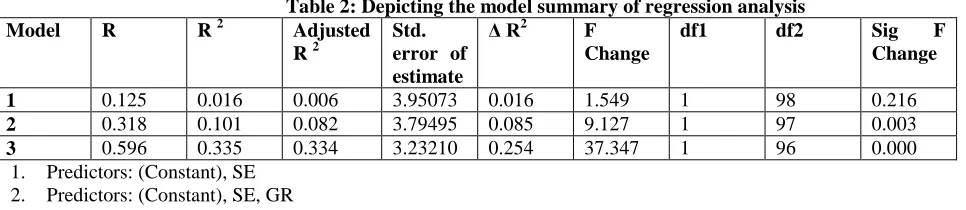
Table 2: Depicting the model summary of regression analysis
Model R R 2 Adjusted
R 2
Std. error of estimate
Δ R2 F
Change
df1 df2 Sig F
Change
1 0.125 0.016 0.006 3.95073 0.016 1.549 1 98 0.216
2 0.318 0.101 0.082 3.79495 0.085 9.127 1 97 0.003
3 0.596 0.335 0.334 3.23210 0.254 37.347 1 96 0.000 1. Predictors: (Constant), SE
2. Predictors: (Constant), SE, GR
This shows three steps in analysis.
At the first step, self efficacy explains 1.6% of the variance in organizational commitment
(R sq. = 0.016, p = 0.216), which is not much significant to explain variance.
At second step, gender role orientation explains 10.10% of the variance in organizational commitment (R sq. = 0.101, p = 0.003), which is a strong explanation.
[image:3.612.45.575.54.279.2]At third step, gender role orientation interacting with self efficacy explains 33.50% variance in organizational commitment (R sq. = 0.335, p = 0.000), which is again a strong explanation for variance in organizational commitment.
Table 3: ANOVA4
Model Sum of
Squares
Df Mean
Square
F Sig.
1
Regression
24.180 1514.002
1 98
24.180 15.608
1.549 0.216
Residual Total
1538.182 99
2
Regression Residual Total
155.621 1382.561 1538.182
2 97 99
77.811 14.402
5.403 0.06
3
Regression Residual Total
545.765 992.417 1538.182
3 96 99
181.922 10.446
17.415 0.000
1. Predictors: (Constant), SE 2. Predictors: (Constant), SE, GR
3. Predictors: (Constant), SE, GR, INTERAC 4. DV: OC
This shows that the variance explained by interaction between moderator (gender role orientation) and predictor (self efficacy) is significant (F 17.415, p = 0.000)
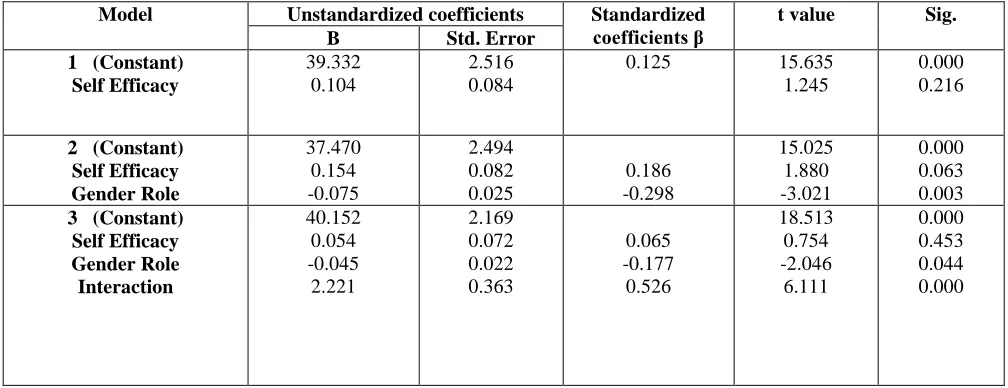
Table 4: Multiple linear regression analysis with Self Efficacy as the dependent variable
Model Unstandardized coefficients Standardized
coefficients β
t value Sig.
B Std. Error
1 (Constant) Self Efficacy
39.332 0.104
2.516 0.084
0.125 15.635 1.245
0.000 0.216
2 (Constant) Self Efficacy Gender Role
37.470 0.154 -0.075
2.494 0.082 0.025
0.186 -0.298
15.025 1.880 -3.021
0.000 0.063 0.003 3 (Constant)
Self Efficacy Gender Role Interaction
40.152 0.054 -0.045 2.221
2.169 0.072 0.022 0.363
0.065 -0.177 0.526
18.513 0.754 -2.046 6.111
0.000 0.453 0.044 0.000
The regression coefficients at step one show that Self Efficacy is positively but not very significantly related to organizational commitment (β = 0.125, p = 0.216).
Gender role orientation is significantly (negatively) related to organizational commitment
(β = -0.298, p = 0.003). The beta for interaction effect of gender role orientation with self efficacy is significant.
As the degree of relationship between self efficacy and organizational commitment has been changed from less significant to highly significant, with the emergence of moderator variable (gender role orientation), so the condition for moderation has been met and it can be said that gender role orientation acts as a moderating variable between self efficacy and organizational commitment.
III. DISCUSSION
The major objective of the present study was to advance the literature by examining the organizational commitment of
information technology professionals’ in relation to their self efficacy. And further to examine the moderating effect of gender role orientation on the relationship between self efficacy and organizational commitment. Self-efficacy (one's belief in one's capability to perform a task) affects task effort, persistence, expressed interest, and the level of goal difficulty selected for performance. Despite this, little attention has been given to its organizational implications.
[image:3.612.29.533.312.506.2]Brief and Aldag (1981) proposed a model of the "self" in work organizations that addressed the role self-beliefs play in task performance. Subsequent studies have shown that self-beliefs predict motivation and task performance in organizational settings.
The relationship between the construct can be explained by the social cognitive theory (Bandura, 1994). Individuals with higher self efficacy would have an obviously greater confidence in their ability to tackle difficult situation and would be more likely to engage in perseverant behaviour. Moreover these individual would be more likely to devote continuing efforts when dealing with adversity which means that they will be less likely to be affected by the adverse effects of stress and to withdraw from the job.
Further explanation of the relationship between these two constructs can be provided by cognitive appraisal theory, which says that emotions are extracted from our evaluations (cognitive appraisals) of events that cause specific reactions in different people. People with higher self efficacy would be expected to appraise any stressful situation as a challenge and would better deal with it. This attitude and belief would definitely help in dealing with difficult situations at work place, thus leading to a better work performance and better sustenance.
Pygmalion effect, an effect on enhanced learning or performance resulting from the positive expectations of other, also provides an explanation for relationship self efficacy and organizational commitment. This phenomenon has been observed in organizations (Rosenthal R., Jacobson L., 1968). Self-efficacy may be involved in the Pygmalion effect through the persuasive influence of others holding positive expectations. Persuasion is an important source of efficacy information (Bandura, 1984).
Results have also confirmed that gender role orientation has a moderating influence on the relationship between self efficacy and organizational commitment.
It has been found that self efficacy and gender role orientation alone has a very less predictability for organizational commitment, but when they were taken together in the model, a strong prediction can be made for organizational commitment. This implies that self efficacy when studied in the light of gender role orientation can better tell about organizational commitment. Results also reveal that self efficacy and organizational commitment are differentially found in different types of gender role orientations. Feminine people have found to bear low self efficacy as compared androgynous and masculine people. In a study, Robins (1986) found a significant positive relationship between self-reported masculinity and self-efficacy, whereas perceived femininity was found to be unrelated to self-efficacy. Other researchers have obtained similar findings in their studies (Warner 1999; Abdalla 1995; Lapan and Jingeleski 1992). Thus, employee commitment is a multifaceted concept and its components display some significant relationship with those of self efficacy constructs.
IV. CONCLUSION
The hypothesis framed for the current study has been supported by the findings implying that self efficacy and organizational commitment are related to each other significantly
and in positive direction. Research on self-efficacy generally has supported a high correlation between efficacy perceptions and subsequent performance. The following implications for selection, leadership, training, and vocational counseling are offered in light of that research.
REFERENCES
[1] Abdalla, I. A. (1995). Sex, sex-role self-concepts and career decision-making self efficacy among Arab students. Social Behavior and Personality, 23(4), 389-401.
[2] Archer, J., & Lloyd, B. (2002). Sex and gender. Cambridge, United Kingdom: Cambridge University Press.
[3] Bandura, A. (1984) Recycling misconceptions of perceived self-efficacy.
Cognitive Therapy and Research, 8, 231-255.
[4] Bandura, A. (1994). Self-efficacy. In V. S. Ramachaudran (Ed.), Encyclopedia of human behavior, 4. New York: Academic Press, pp. 71-81. [5] Bandura, A. (1995). Self-Efficacy in Changing Societies. Cambridge
University Press.
[6] Bandura, A. (1997). Self-efficacy: The exercise of control. New York: Freeman and Company.
[7] Bem, S.L. (1974). The measurement of psychological androgyny. Journal of Consulting and Clinical Psychology, 42, 155-162.
[8] Bem, S.L. (1978). Bem sex-role inventory and professional manual. Palo Alto, CA: Consulting Psychological Press.
[9] Bem, S. L. (1979). Theory and measurement of androgyny: A reply to the Pedhazur- Tetenbaum and Locksley-Colten critiques. Journal of Personality and Social Psychology, 37, 1047-1054.
[10] Brief, A. P., & Aldag, R. J. (1981) The "self" in work organizations: A conceptual review. Academy of Management Review. 6, 75-58.
[11] Chan, D. W. (2004). Perceived emotional intelligence and self-efficacy among Chinese secondary school teachers in Hong Kong. Personality and Individual Differences, 36, 1781-1795.
[12] Chung, B. (1996). The construct validity of the Bem Sex-Role Inventory for heterosexual and gay men. Journal of Homosexuality, 30, 87-97.
[13] Cook, E. P. (1985). Psychological Androgyny. New York: Pergamon. [14] Dimitrovsky, L., Singer, J., & Yinon, Y. (1989). Masculine and feminine
traits: Their relation to suitedness for and success in training for traditionally masculine and feminine army functions. Journal of Personality & Social Psychology, 57(5), 839-847.
[15] Gundlach, M.J., Martinko, M.J., & Douglas S.C. (2003). Emotional intelligence, causal reasoning, and the self-efficacy development process.
International Journal of Organizational Analysis, 11, 229-246.
[16] Humphreys, J., Brunsen, B., & Davis, D. (2005). Emotional structure and commitment: Implications for health care management. Journal of Health Organization and Management, 19, 120-129.
[17] Holt, C. L., & Ellis, J. B. (1998). Assessing the current validity of the Bem Sex-Role Inventory. Sex Roles, 39, 929-941.
[18] Koch and Steers, 1978 Koch, James L., and Richard M. Steers 1978 "Job attachment, satisfaction,and turnover among public sector employees." Journal of Vocational Behavior, 12: 1 19-128.
[19] Lapan, R. T., & Jingeleski, J. (1992). Circumscribing vocational aspirations in junior high school. Journal of Counseling Psychology, 39(1), 81-90. [20] Luthans, F., Zhu, W., & Avolio, B.J. (2006). The impact of efficacy on
work attitudes across cultures. Journal of World Business, 41, 121- 132. [21] Meyer, J.P., Stanley, D.J., Herscovitch, L., & Topolnytsky, L. (2002).
Affective, Continuance, and Normative Commitment to the Organization: A Meta-Analysis of Antecedents, Correlates, and Consequences. Journal of Vocational Behavior, 61, 20-52
[22] Mowday, Richard T., Lyman W. Porter, and Robert Dubin 1974 "Unit performance, situational factors and employee attitudes in spatially separated work units." Organizational Behavior and Human Performance. 12. 231 -248.
[24] Porter, LymanW, Richard M, Steers, Richard T. Mowday, and Paul V. Boulian 1974 "Organizational commitment, job satisfaction, and turnover among psychiatric technicians." Journal of Applied Psychology, 59: 603-609.
[25] Ramanaiah, N. V., & Martin, H. J. (1984). Convergent and discriminate validity of selected masculinity and femininity scales. Sex Roles, 10, 493-504.
[26] Robins, C. J. (1986). Sex role perceptions and social anxiety in opposite-sex and same sex situations. Sex Roles, 14(7-8), 383-395.
[27] Rosenthal, R.; Jacobson, L. (1968). Pygmalion in the classroom. New York: Holt, Rinehart & Winston.
[28] Salami, S.O. (2007). Relationships of Emotional Intelligence and Self-Efficacy to Work Attitudes Among Secondary School Teachers In Southwestern Nigeria. Essays in Education, 20, 43-56.
[29] Schwarzer, R., & Jerusalem, M. (1995). Generalized Self-Efficacy scale. In J. Weinman, S. Wright, & M. Johnston, Measures in health psychology: A user’s portfolio. Causal and control beliefs (pp. 35-37). Windsor, UK: NFER-NELSON.
[30] Scholz, U., Gutiérrez-Doña, B., Sud, S., & Schwarzer, R. (2001-submitted). Is perceived self-efficacy a universal construct? Psychometric findings from 25 countries.
[31] Schyns, B. & Collani, G. V. (2002). A new occupational self-efficacy scale and its relation to personality constructs and organizational variables.
European Journal of Work and Organizational Psychology, 11, 219-241.
[32] Taylor, M., & Hall, J. (1982). Psychological androgyny: A review and reformulation of the theories, methods, and conclusions. Psychological Bulletin, 92, 347-366.
[33] Warner, P. K. (1999). The role of perceived gender-related personality traits in initial supervisory relationships. Dissertation Abstracts International, 60-4B, 1904.
[34] Wilson, F. R., & Cook, E.P. (1984). Concurrent Validity of four androgyny instruments.Sex Roles, 11, 813-837.
AUTHORS
First Author – Bhavana Arya, PhD, Asst. Professor, Dept. of Psychology, ICG - The IIS University, Jaipur
Second Author – Mridula Sharma, M.Sc., Asst. Professor, Dept. of Psychology, ICG - The IIS University, Jaipur
Third Author – Shriparna Singh, M.Phil., Lecturer, Department of Psychology, ICG - The IIS University, Jaipur