Users’ Information Seeking Behaviours, their Interactions
and Experience with the Academic Library Web Interface
Talal R. Alazemi
Salford Business School
College of Business & Law
University of Salford, Manchester, UK
Submitted in Partial Fulfilment of the Requirement of the
Declaration:
‘This is a declaration that the work in this Thesis is my own work and was carried out in accordance with the regulations of the University of Salford. The work is original, except where indicated by special references in the text, and no part of the Thesis has been submitted for any other degree. The Thesis has not been presented to any other University for examination either in the United Kingdom or elsewhere’.
Signed: Date: 5th June 2015
I
Abstract
The websites provided by academic libraries are challenged by the rapid developments in information and communication technology (ICT). These developments have created diverse options and channels for information sources that can be accessed easily by users through the Internet. Because of these alternate sources, many users no longer physically visit the library. Instead, they depend on the library’s website to obtain information online, or they use Internet searches to obtain the information they require.
This research addresses the following question: How do the users of academic libraries search for information and interact with the libraries’ web interfaces? The research draws on models from the disciplines of information-seeking behaviour (ISB) and human-computer interaction (HCI). A unified model based on the models in ISB and HCI is created and investigated. In addition, a qualitative study has been conducted to investigate users’ information needs, information-seeking behaviours, and difficulties and experiences with the websites of academic libraries. Interpretive case studies were conducted at two universities, one in the UK and one in Kuwait. Qualitative data were collected in interviews, focus groups, and observations of diverse groups of library users. Furthermore, a content analysis approach was applied to analyse the data.
The findings revealed seven steps taken in searching for information and interacting with academic libraries’ web interfaces, but exposed variance in the order in which users executed these steps. The findings also revealed several issues regarding the use of library websites to search for information. In particular, these concerned the complexity of finding information, the content organisation of the library websites and the use of incomprehensible terms on the library websites. As a result, the library users relied heavily on Google to find information. The thesis concludes with suggested guidelines for how academic library interfaces can best support the way users search for information, as well as their interactions, experiences and needs.
II
Acknowledgment
This study could not have been completed without the support and guidance of some very special people. I wish to express my sincere gratitude to my supervisor, Dr. Maria Kutar for her support, encouragement, guidance and for providing constructive and detailed feedback that led me to the completion of this thesis.
I would like to thank staff and colleagues at University of Salford Business School for their support and encouragement.
I would also like to thank the Kuwaiti government for their financial support for my PhD. In particular, I am indebted to the Public Authority for Applied Education and Training (PAAET) for giving me the opportunity to pursue my higher education.
I wish I could give individual acknowledgment to all those who have contributed somehow to this work, but I can’t, so I am very grateful to all of the study participants for their time and willingness to share their views. Your contributions are highly appreciated.
III
Dedication
To my late father, Raja Alazemi, who died in the middle of my research journey, but whose worthy words and lovely memories have remained alive in my memory over and over as my research journey has progressed. God bless his soul.
To my mother, for her love, prayers, support and encouragement. To my brothers and sisters, for care and support all the time. To my wife, for her love, and patience with me.
IV
Table of Contents
Abstract ... I Acknowledgment ... II Dedication ... III List of Abbreviations ... XI List of Figures ... XIII List of Tables ... XIV
Chapter 1: Introduction ... 1
1.1 Background ... 1
1.2 Motivation ... 2
1.3 Aim and Objectives ... 3
1.4 Significance of ISB and HCI for Academic Library Web Interfaces ... 4
1.5 The Academic Library and Its Users ... 5
1.6 Scope and Focus of the Thesis ... 6
1.7 Contributions to Knowledge ... 6
1.8 Structure of the Thesis ... 7
1.9 Conceptual Model of the Thesis ... 9
Chapter 2: Literature Review ... 10
2.1 Introduction ... 10
2.2 Information-Seeking Behaviours ... 11
2.2.1 Brief History of User Studies ... 11
2.2.2 Information Seeking: Terms and Definitions ... 13
2.2.3 Information-Seeking Models ... 19
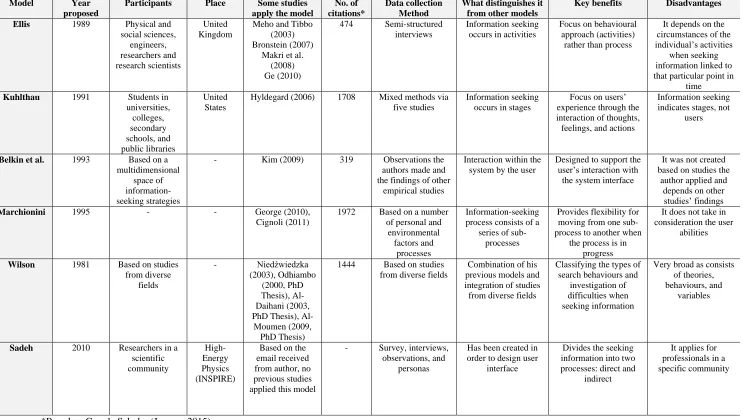
2.2.4 Summary of the Models ... 37
2.3 Human–Computer Interaction ... 37
2.3.1 Historical Background ... 37
2.3.2 Definition of Human–Computer Interaction ... 38
2.3.3 Human–Computer Interaction and Related Fields ... 39
2.3.4 Goals and Importance of Human–Computer Interaction ... 42
2.3.5 Interaction Design... 44
2.3.6 Terms in the Interaction Models ... 45
V
2.4 User Studies ... 55
2.4.1 Information Needs ... 57
2.4.2 Information-Seeking Behaviours ... 65
2.4.3 User Experiences ... 72
2.4.4 Users’ Difficulties with Academic Library Websites ... 76
2.5 Summary ... 83
Chapter 3: ISB and HCI... 84
3.1 Introduction ... 84
3.2 Significance of ISB and HCI for Academic Library Web Interfaces ... 84
3.3 Rationale for Selecting the Models ... 87
3.4 Potential Synergy between ISB and HCI Models in Identifying the Steps Users Take When Looking for Information and Interacting with the Interface ... 87
3.4.1 Commencement ... 90
3.4.2 Exploration ... 91
3.4.3 Decision making ... 93
3.4.4 Inference and interpretation ... 95
3.4.5 Expression ... 97
3.4.6 Conclusion ... 99
3.5 Summary ... 101
Chapter 4: Research Methods ... 102
4.1 Introduction ... 102
4.2 Research Method Considerations ... 102
4.3 Research Philosophy ... 103
4.3.1 Positivist Paradigm ... 104
4.3.2 Interpretivist Paradigm ... 105
4.3.3 Critical Paradigm ... 106
4.3.4 Paradigm Choice... 107
4.4 Research Approach ... 109
4.5 Methodological Choice ... 110
4.6 Research Strategy ... 111
4.6.1 Design and Creation ... 111
4.6.2 Surveys ... 112
4.6.3 Experiment... 113
VI
4.6.5 Ethnography... 114
4.6.6 Grounded Theory ... 115
4.6.7 Case Study ... 116
4.7 Data Sources ... 121
4.7.1 Interviews ... 122
4.7.2 Focus Groups ... 122
4.7.3 Observations ... 125
4.8 The Think Aloud Technique ... 127
4.9 Participants ... 128
4.9.1 Recruitment of Participants ... 129
4.10 Techniques Applied to Carry Out Interviews, Focus Groups and Observations ... 130
4.11 Piloting ... 130
4.12 Summary ... 131
Chapter 5: Data Analysis of Interviews ... 132
5.1 Introduction ... 132
5.2 Preparation for Analysis ... 132
5.3 Data Analysis Approach... 133
5.3.1 Using Quotes in Analysis ... 134
5.4 The Analysis Process ... 135
5.5 Librarians’ Interviews ... 136
5.5.1 Library Resources ... 137
5.5.2 Library Services ... 138
5.5.3 Finding Information outside the Library ... 140
5.5.4 Obstacles and Difficulties ... 141
5.5.5 Librarians’ General Experience ... 145
5.5.6 Librarians’ Suggestions ... 150
5.6 Academics’ Interviews ... 151
5.6.1 The Purpose of Seeking Information ... 152
5.6.2 Methods and Places in Looking for Information ... 153
6.6.3 Library Resources ... 154
5.6.5 Reasons for Use or Non Use the Library Website ... 155
5.6.6 Library Services ... 156
5.6.7 Obstacles and Difficulties ... 157
VII
5.6.9 Academics’ General Experience ... 161
5.7 Academics’ Suggestions ... 165
5.8 Summary ... 165
Chapter 6: Data Analysis of Focus Groups ... 167
6.1 Introduction ... 167
6.2 The Purpose of Seeking Information ... 168
6.3 Methods and Places in looking for Information ... 168
6.4 Library Resources ... 171
6.5 Reasons for Use or Non Use of the Library Website ... 171
6.6 Library Services ... 173
6.7 Obstacles and Difficulties ... 174
6.8 Finding Information outside the Library ... 175
6.9 General Experience ... 176
6.9.1 General Experience with the Library Website ... 176
6.9.2 General Experience of the Library System ... 177
6.9.3 General Experience with Other Websites ... 178
6.10 Participants’ Suggestions ... 178
6.11 Summary ... 179
Chapter 7: Data Analysis of Observations ... 180
7.1 Introduction ... 180
7.2 Method and Process of Analysis ... 180
7.3 Pre-Task Questions ... 184
7.4 Tasks Analysis... 188
7.4.1 Task One ... 188
7.4.2 Task Two ... 188
7.4.3 Task Three ... 189
7.4.4 Task Four ... 190
7.4.5 Task Five ... 191
7.4.6 Task Six ... 191
7.4.7 Task Seven ... 192
7.4.8 Task Eight ... 192
7.5 Observations of All Tasks and the Participants’ Comments ... 193
7.5.1 Both Universities ... 193
VIII
7.5.3 The University of Salford ... 195
7.6 Post-Task Questions ... 196
7.7 Summary ... 201
Chapter 8: Findings and Discussion ... 202
8.1 Introduction ... 202
8.2 Information Needs and Information-Seeking Behaviours ... 202
8.2.1 Information Needs ... 203
8.2.2 Information-Seeking Behaviours ... 208
8.3 Steps Used to Search for Information and Interact with the Library’s Web Interface . 213 8.3.1 Step One: Scan and Explore the Interface Options ... 215
8.3.2 Step Two: Choose an Option ... 216
8.3.3 Step Three: Formulate the Queries and Execute the Search ... 217
8.3.4 Step Four: Explore the Results ... 219
8.3.5 Step Five: Read and Verify the Information (Metadata) of the Results ... 219
8.3.6 Step Six: Select (Click on) the Result to Examine and Confirm It ... 221
8.3.7 Step Seven: Make a Decision ... 222
8.4 Experience and Difficulties ... 223
8.4.1 Lack of Organisation ... 223
8.4.2 Lack of Findability ... 226
8.4.3 Complex Terminology ... 231
8.4.4 Lack of Resources ... 232
8.4.5 Lack of Access... 233
8.4.6 Complexity of Website and Searching Characteristics ... 234
8.4.7 Google ... 236
8.5 Summary ... 238
Chapter 9: Guidelines ... 239
9.1 Introduction ... 239
9.2 Guidelines... 239
9.2.1 Provide Sufficient Metadata ... 239
9.2.2 One Single Search Tool for all Library Resources and Services ... 242
9.2.3 Increase the Findability of Searching ... 242
9.2.4 Avoid Incomprehensible Terms ... 242
9.2.5 More Supportive Services for Searching ... 243
IX
9.2.7 A Unified Interface ... 245
9.2.8 Drop down Menus ... 245
9.2.9 Easy and Instant Access to Resources ... 245
9.2.10 Avoid Technical Problems ... 246
9.2.11 Provide Useful Information about Databases ... 246
9.2.12 Increase the Functionality of Services Online ... 246
9.3 Summary ... 247
Chapter 10: Conclusions ... 248
10.1 Introduction ... 248
10.2 Evaluation of the Research ... 248
10.3 Main Findings ... 250
10.3.1 Purpose of Seeking Information and Using the Library Websites ... 250
10.3.2 The Most Frequently Needed Resources and Services ... 252
10.3.3 Locations of Searches ... 252
10.3.4 Methods (Strategies) for Searching ... 253
10.3.5 Steps Used to Search for Information and Interact with the Libraries’ Web Interfaces ... 253
10.3.6 Experiences and Difficulties ... 254
10.4 Contributions to Knowledge ... 259
10.5 Limitations of the Study and Suggestions for Further Research ... 259
10.7 Conclusions ... 260
Appendices ... 262
Appendix 1: Kuwait University and its Libraries ... 263
Appendix 2: The University of Salford and its Libraries ... 267
Appendix 3: Kuwait University Library Website ... 270
Appendix 4: University of Salford Library Website ... 285
Appendix 5: Interviews’ Questions (Librarians) ... 302
Appendix 6: Interviews’ Questions (Academics) ... 303
Appendix 7: Focus Group Questions (Postgraduate Students) ... 304
Appendix 8: Tasks for Observations (Postgraduate Students) ... 305
Appendix 9: Confidentiality and Ethical Considerations ... 307
Appendix 10: Invitation Letters ... 308
Appendix 11: Information Sheet ... 311
X
XI
List of Abbreviations
ACM Association for Computing Machinery DEFF Denmark’s Electronic Research Library GCC Gulf Cooperation Council
HCI Human-Computer Interaction HEP High-Energy Physics
IB Information Behaviours
ICT Information and Communication Technology
IICTs Information and Communication Technologies/resources ILS Integrated Library System
INSYDER INternet SYstem DE Recherche IR Information Retrieval
IS Information System
IS Information Science
ISB Information-Seeking Behaviour ISB Information-Searching Behaviour ISO International Standards Organisation ISP Information-Search Process
ISSs Information-Search Strategies IT Information Technology
LAC Library Assessment Committee LIS Library and Information Science MIS Management Information System NHS National Health Services
OCLC Online Computer Library Centre
XII OED Oxford English Dictionary
OPACs Online Public Access Catalogues PDF Portable Document Format RIN Research Information Network
RSS Rich Site Summary
SCONUL Society of College, National and University Libraries SOLAR Search Our Library’s Academic Resources
TA Task Analysis
UX User Experience
XIII
List of Figures
Figure Page
Figure 1.1: Overall Conceptual Model of the Thesis 9
Figure 2.1: Wilson’s nested model adapted to academic library users’ practices 17
Figure 2.2: Kuhlthau’s information-search process 23
Figure 2.3: Belkin et al.’s four dimensions of interaction 25
Figure 2.4: Marchionini’s information-seeking model 27
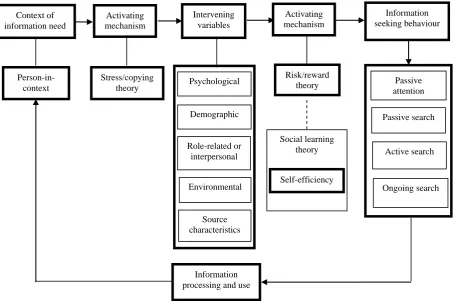
Figure 2.5: A revised model of information-seeking behaviour 30 Figure 2.6: Sadeh’s model of information-seeking behaviours 33 Figure 2.7: Sadeh’s model of information-searching behaviours 34
Figure 2.8: Human–computer interaction 39
Figure 2.9: Disciplines that involve human–computer interaction 40
Figure 2.10: Norman’s cycle model phases and sub-stages 46
Figure 2.11: Interface elements that correspond to and are supported by information-seeking stages from the selected models
49
Figure 2.12: General interaction framework 50
Figure 2.13: Translations between components 50
Figure 2.14: The revised framework 51
Figure 2.15: Model of interaction in information access 54
Figure 2.16: Model created to identify factors that affect students’ information behaviour
81 Figure 3.1: The new model based on the models selected in this research 101 Figure 4.1: Basic types of designs for multiple case studies 119 Figure 4.2: Embedded for multiple case studies design in Kuwait and Salford
Universities’ Libraries
120 Figure 4.3: How data sources are used to investigate the research aim and objectives 121
Figure 5.1: Example of the analysis and coding process 135
Figure 7.1: Salford Library website interface 186
Figure 7.2: Salford SOLAR interface 187
Figure 7.3: SOLAR and library website options in students’ channel interface at Salford
187 Figure 8.1: Salford library’s interface when queries are spelled incorrectly 229 Figure 8.2: Kuwait library’s interface when queries are spelled incorrectly 230 Figure 8.3: Google’s interface when queries are spelled incorrectly 230
Figure 8.4: Salford SOLAR News’ blog page 237
Figure 9.1: Image of the book on the Amazon website with an option to look inside 240 Figure 9.2: The way to display the book and its contents on the Amazon website 240 Figure 9.3: Option to preview more information about the article in the Emerald
Insight Database
241 Figure 9.4: How the information (abstract) of the article is displayed in the Emerald
Insight database
XIV
Figure 9.5: Online assistance on the Microsoft Store’s website 243
List of Tables
Table Page
Table 2.1: Examples of browsing goals by domain interests, goal type, and terminology
18 Table 2.2: A comparison summary of each model of information seeking selected in
this study
36
Table 2.3: Topic classification scheme 41
Table 2.4: Studies investigated in this section 56
Table 2.5: Resources identified as most important by researchers 62
Table 2.6: Locations to search for information 66
Table 2.7: Approaches to finding information 68
Table 2.8: How postgraduate students examine information 70
Table 3.1: The steps users take when looking for information and interacting with the system based on the models selected in this research
88 Table 3.2: The steps applied in the ISB and HCI models, and the similarities and
differences between the selected models
89
Table 3.3. Step 1: Commencement 90
Table 3.4. Step 2: Exploration 91
Table 3.5. Step 3: Decision making 93
Table 3.6. Step 4: Inference and interpretation 95
Table 3.7. Step 5: Expression 97
Table 3.8. Step 6: Conclusion 99
Table 4.1: The basic questions to identify the inquiry paradigms 104 Table 4.2: Characteristics of Positivist, Interpretivist, and Critical Research 107
Table 4.3: Interpretive Paradigm and Assumptions 109
Table 4.4: Differences between deductive and inductive approaches to research 110
Table 4.5: Participants from both universities 128
Table 5.1: Information and codes referring to librarians at Kuwait University 136 Table 5.2: Information and codes referring to librarians at the University of Salford 137 Table 5.3: Services most frequently requested by postgraduate students and
academics based on the librarians’ responses
138 Table 5.4: Librarians’ methods (strategies) to find information outside the Library 140 Table 5.5: Obstacles and difficulties that postgraduate students and academics
encounter based on the librarians’ responses
XV
Table 5.7: Librarians’ general experience with the library system 148 Table 5.8: Information and codes referring to academics at Kuwait University 151 Table 5.9: Information and codes for academics at the University of Salford 152 Table 5.10: Academics’ methods (strategies) in looking for information 153 Table 5.11: Obstacles and difficulties that academics encounter when using the
library website
157 Table 5.12: Academics’ methods (strategies) to find information outside the Library 159 Table 5.13: Academics’ general experiences with the library website 161 Table 5.14: Academics’ general experience with the library system 163 Table 6.1: Information and codes referring to participants at Kuwait University 167 Table 6.2: Information and codes referring to participants at the University of Salford 167 Table 6.3: Postgraduate students’ methods (strategies) in looking for information 168 Table 6.4: Obstacles and difficulties that postgraduate students encounter when using
the library website
174 Table 6.5: Postgraduate students’ methods (strategies) of finding information outside
the library
1
Chapter 1: Introduction
1.1 Background
Remarkable advances in information and communication technology (ICT), as well as the expansion of electronic resources, have changed many aspects of information resources, services and library environments. Moreover, libraries have undergone many changes and encountered numerous challenges related to their procedures, objectives and services because of the rapid development of ICT. The diverse needs of users, in terms of access to information resources and services in the digital age, require new methods for keeping pace with these developments. Muqueem and Ambedkar (2007) pointed out that in order to keep pace with technological advances, libraries have begun converting data into digital formats and presenting them via library interfaces. Libraries and their users are now confronted with new forms of delivering electronic information, such as electronic documents, electronic journals and e-books, which are available only via networks and databases. Thus, many libraries have recognised the need to adapt their resources, services and techniques to the current requirements of users. By providing wider access to information services and resources, libraries can offer optimal services to information seekers.
2
public face because it is the user’s first contact with the collections, the services and to some extent, the library staff.
1.2 Motivation
The websites provided by academic libraries are challenged by rapid developments in information and communication technology (ICT). These developments have created diverse options for information sources and channels that can be accessed easily by users of the Internet. Because of these alternate sources, many users no longer physically visit the library. Brown and Swan (2007) noted that the number of researchers visiting libraries has declined since 2001, a trend that is expected to not only continue, but also accelerate. Instead, they depend on the library’s website to obtain information, or they use search engines on the Internet to obtain the information they require. However, the number of users who take advantage of library websites is also decreasing because of the availability of other diverse options for information sources and channels on the Internet. According to Haglund and Olsson (2008, p. 57), ‘libraries spend huge amounts of time and money to work on the structure and content of the library web page, while few researchers use it as a starting point for information searching’. Therefore, in order to encourage users to use the library web site, academic libraries need to increase the efficiency, usability and effectiveness of their web interface. Swanson and Green (2011) pointed out that library web interfaces are important in adding value to the library’s resources and services because they increase the accessibility of information.
3
For these reasons, this research aims to address the steps that users of an academic library take when they search for information and interact with the web interface. The academic library websites of two universities (Kuwait University and the University of Salford) will be examined. Furthermore, the research will investigate the information needs and information seeking behaviours of different groups of users of the websites of these academic libraries, as well as the difficulties and obstacles they experience and encounter by using the library website. This is done by investigating two main areas; Information science (in particular, studies on user needs and models of information-seeking behaviours [ISB]) and human-computer interaction (HCI) (especially interaction design models, usability studies and user experience) in order to achieve the research aim and objectives.
1.3 Aim and Objectives
This research aims to address the following question:
“How do the users of academic libraries search for information and interact with the libraries’ web interfaces?”
In seeking to address this research question, this study adopts the following objectives:
1. To develop a unified model combining the ISB and HCI models in order to investigate whether these could facilitate the understanding of how users search for information and interact with the web interface when they use the academic library website.
2. To investigate the information needs of different groups of users of the two academic libraries.
3. To understand the information-seeking behaviours of different groups of users in using the web interfaces of the academic libraries.
4. To investigate the difficulties and experiences of different groups of users of the academic libraries’ websites.
4
1.4 Significance of ISB and HCI for Academic Library Web Interfaces
ISB is concerned with the methods that users follow to obtain the information they require, while HCI is the study of human interaction with computer systems. These fields are significant for design of user interfaces and in making the information system easy to use. Hearst (2009) asserts that it is necessary to understand the human information-seeking process in order to design successful user interfaces for searches, including the strategies people employ when engaged in an information search.
Human information-seeking behaviour involves both information processing and their interactions with information resources and, nowadays this includes technological systems. Studies of such behaviours contribute to the design of new systems and tools for organisation of knowledge and utilisation of information in academic and scientific contexts, as well as in organisations (Steinerova and Susol, 2005). Furthermore, information systems are intended to help users retrieve specific items that they require from the volume of information available. Consequently, understanding information-seeking behaviour is necessary to identify user search techniques and preferences for information resources (Rowley and Hartley, 2008). This can help design and implement a convenient user-centred information system or services (Rafiq and Ameen, 2009). In addition, Connaway and Dickey (2010) argue that information systems need to be supported by the entire process for information-seeking needs. On the other hand, Miller (2002) indicates that any improvements in HCI require a deep understanding of human behaviours and needs, which is the most helpful information with regard to evaluating any new technology. Ahmed et al. (2009) suggest that more user-centred studies with web-based systems are needed for significant improvements in the design of user interfaces for such systems.
5 1.5 The Academic Library and Its Users
Hoare (2003, p. 3) defined the academic or university library as ‘attached to academic institutions above the secondary or high school level, serving the teaching and research needs of students and staff’. The academic library is the most important of all types of libraries because it serves a wide range of users, unlike most other libraries. According to Brophy (2005), the many different types of users of the academic library include the following:
- Undergraduate students. - Postgraduate taught students. - Postgraduate research students. - Teaching staff.
- Research staff.
- University management, including heads of academic departments and senior management.
- Former students (alumni).
- Members of the local business community.
- Members of the public, including organised community groups.
- Higher education funding councils (which provide much of the library funding and require the library to be accountable).
- Distance learners.
- Members of government.
- Local or regional library communities, including specialised and public libraries and other academic libraries that rely on cooperative agreements.
- Users with special needs.
- National and international research communities, especially in relation to special collections and services.
- National and international communities, especially in relation to interlibrary loans and other cooperative arrangements.
- Library and information professions. - Posterity (future generations of users).
6
related to their scholarly activities (e.g. assignments, dissertations and theses). Academics were chosen because of their frequent usage of the library website in order to research or prepare lectures for their students (e.g. articles, books and proceedings). The library staff was chosen based on the expectation that they would provide invaluable data due to their use of the library system (website) to guide users in finding and accessing information. Library staff are keenly aware of the resources and services that users have at their disposal. Fox (2014) argues that librarians intimately know the users of their libraries.
1.6 Scope and Focus of the Thesis
The scope of the thesis is summarised in the main research question: How do the users of academic libraries search for information and interact with the libraries’ web interfaces? Thus, the scope of the thesis comprises two main fields: information science (IS) and human-computer interaction (HCI). The research combines two main areas in these fields: models of information-seeking behaviour (the IS field) and models of interaction (the HCI field). In addition, the existing literature is used as the foundation of the research. Previous studies are reviewed in order to establish the context of this study and to develop a unified model based on the existing ISB and HCI models.
The introduction provides background information about ISB and HCI. The analyses of the ISB and HCI models will emphasise their applicability to the research question. Accordingly, a unified model is created and investigated to determine whether it could aid in understanding how users search for information and interact with the web interface when using the academic library website. Also, the thesis will provide a review of the extant literature on various topics including, the purpose for seeking information and the reasons for using or not using the library, the predominant requirements for academic library resources and services, the methods (strategies) used to search for information, the locations of searches, and the difficulties and obstacles experienced and encountered in using the academic library website, which reflect usability issues.
1.7 Contributions to Knowledge
7
- This study is the first to provide a unified model based on the ISB and HCI models. - This study is the first to identify the steps that academic library users take when they
search for information and interact with the web interfaces at two universities in two different countries (i.e. Kuwait University and the University of Salford).
- The study provides valuable data on diverse areas, because no previous study has investigated different users from two diverse case study universities to determine their needs for information (including the purpose for seeking information and the reasons for using or not using the library), their information-seeking behaviours (including the location from which the searches are conducted and the methods [strategies] employed to seek information) and the difficulties and obstacles they experienced and encountered in using the academic library website, all of which relate to usability.
- The research presents guidelines for how academic library websites can best support users in their search for information, as well as facilitate their interactions, improve their experiences and meet their needs. Thus, the proposed guidelines could be useful for the websites of other academic libraries around the world, especially because they have been developed based on the findings of investigations conducted at two universities in two different countries (i.e. Kuwait and the United Kingdom).
1.8 Structure of the Thesis
Chapter 2: Literature Review. This chapter reviews and discusses the relevant literature, which provides the context of the research. It is divided into three sections:
Section 2.2 reviews ISB studies. It provides a brief history of these studies, gives terms and definitions in the ISB field (i.e. information use, information needs, information behaviours, information-seeking behaviours, information-searching behaviours and information retrieval), and explains the importance of information-seeking studies and information-seeking models.
Section 2.3 reviews HCI studies and provides a brief history of HCI. It also gives a definition of HCI, its related fields, its goals and importance, interaction design, terms used in HCI models and in models of interaction.
8
requirements for library resources and services, the methods (strategies) used to search for information, the locations of searches, user experiences, and users’ difficulties encountered and experienced in using the library website.
Chapter 3: ISB and HCI. This chapter discusses the significance of the ISB and HCI fields, as well as the rationale for selecting the models used in this study. Moreover, this chapter combines the selected models to identify their similarities and differences regarding the ways that users search for information and interact with the web interface. This leads to a unified model based on ISB and HCI models.
Chapter 4: Research Methods. This chapter describes the research methods and their implementation. It reviews and identifies the research philosophy, methodological approach, strategy, data collection procedures and techniques, as well as the data sources.
Chapter 5: Data Analysis of Interviews. This chapter describes the approach used to analyse the data and the method of analysis. It then presents the analysis of the data collected in interviews conducted with the academics and librarians.
Chapter 6: Data Analysis of Focus Groups. This chapter presents the analysis of the focus groups conducted with the postgraduate students.
Chapter 7: Data Analysis of Observations. This chapter describes the method and the process of analysis of the observations, and then presents the analysis of the data gathered from the postgraduate students.
Chapter 8: Findings and Discussion. This chapter summarises the research aim and objectives. It presents and discusses the findings that emerged from the analysis of the interviews, the focus groups, and the observations. Moreover, it explains how these findings relate to previous studies and the unified model derived from combining the ISB and HCI models.
Chapter 9: Guidelines. This chapter provides guidelines for how academic library interfaces can best support the way users seek information, as well as their interactions, experiences and needs.
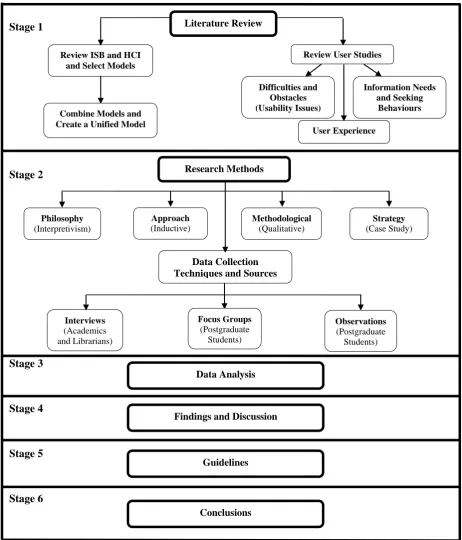
9 1.9 Conceptual Model of the Thesis
[image:26.595.71.534.111.652.2]Stage 1 Stage 2 Stage 3 Stage 4 Stage 5 Stage 6
Figure 1.1: Overall Conceptual Model of the Thesis
Review User Studies Review ISB and HCI
and Select Models
Information Needs and Seeking Behaviours Difficulties and Obstacles (Usability Issues) Combine Models and
Create a Unified Model
User Experience Research Methods Methodological (Qualitative) Approach (Inductive) Philosophy (Interpretivism) Interviews (Academics and Librarians) Staff) Observations (Postgraduate Students) Strategy (Case Study) Data Collection Techniques and Sources
Focus Groups (Postgraduate Students) Literature Review Data Analysis Guidelines Findings and Discussion
10
Chapter 2: Literature Review
2.1 Introduction
This chapter presents the relevant literature to provide a context for the current research. This chapter is divided into three sections:
Section 2.2 provides in-depth information regarding information-seeking behaviours on the following points:
- Brief history of information-seeking studies.
- Information-seeking terms and definitions (information use, information needs, information behaviours, information-seeking behaviours, information-searching behaviours, information retrieval, related concepts).
- Importance of information-seeking studies. - Information-seeking models.
Section 2.3 provides in-depth information regarding human–computer interactions on the following points:
- Historical background. - Definition.
- Related fields.
- Goals and importance. - Interaction design.
- Terms in the interaction models. - Models of interaction.
11 2.2 Information-Seeking Behaviours
2.2.1 Brief History of User Studies
In library and information science, user studies are considered to be the most researched areas and have shaped a considerable amount of literature in the discipline (Siatri, 1999). User studies developed in the late 1940s, when the Royal Society Scientific Information Conference triggered the interest of researchers in this field (Siatri, 1999; Wilson, 2000). Subsequent to this, many studies were carried out to identify which approaches researchers were using to obtain the information they needed. One such study was Bernal’s (1948) study; it aimed to discover from active scientists what they read as well as how and why they obtained their information. Wilson (1994) described how, as a result of the Royal Society conference, the field expanded from a study of library systems to a study of the behaviours and attitudes of information users in general. According to Siatri (1999, p. 133), ‘earlier user studies were mainly related to scientists involved with biochemistry, medicine, engineering, physics etc. The high concentration of user studies in these sciences can be partially attributed to the fact that the publication of professional and scientific information in these disciplines was much more developed at the time in comparison with the humanities. This resulted in the earlier development of information handling tools, like abstracts and indexes’. Starting in the early 1960s, the number of user studies escalated quickly (Siatri, 1999). Writing in 1998, Eskola mentioned that the importance of such studies had increased in the previous decades, partly as a result of the increasing number of students enrolling in institutions of higher education and partly due to the fact that libraries were committed to meeting the requirements of their users and satisfying their needs in the most appropriate way possible. According to Eskola, many studies regarding students’ trends in the use of university libraries were being conducted across several countries.
In the 1980s, user studies started to focus not only on people’s needs for information, but also on their information-seeking behaviours. Since that time, a number of studies have been conducted, leading to many models that described and investigated diverse groups of users’ seeking behaviours (e.g. Wilson, 1981; Ellis, 1989).
12
1. Sixties to the mid-eighties: During this period, attention was paid to the provision and quality of information services.
2. Mid-eighties to the mid-nineties: Several empirical studies were conducted during this period, and the first activity models of information-seeking processes were created. 3. Mid-nineties until the present period (2003): This period was represented by
endeavours to design comprehensive models that integrate information seeking with information retrieval.
Since 2003, research in information-seeking behaviours, such as that carried out by George et al. (2006), Vezzosi (2009), Haines et al. (2010), Thani and Hashim (2011), Al-Moumen (2012), and Sapa et al. (2014), covered particular or different groups of users in various specific disciplines.
With the development of technology, academic libraries have started to provide users with advanced web-based systems that help them integrate the task of looking for resources with the services they require. As a result, Al-Muomen (2009) argued that users have options for new information delivery systems, with a broad array of information sources and channels, and are able to obtain information anytime and anywhere. However, providing information resources and services for users as well as making them available online does not mean that this is sufficient or that users will be satisfied. It must be considered that users’ experiences and requirements are constantly changing and they look for information according to developments in the technological fields.
13 2.2.2 Information Seeking: Terms and Definitions
2.2.2.1 Different Terms and Definitions
The evolution of user studies has presented some terms, such as information use, information needs, information behaviour, information-seeking behaviours, information-searching behaviours and information retrieval. Hughes (2006) argued that these terms overlap and their interpretations vary. In addition, a number of related words and concepts exist, such as browsing, scanning, and encountering. In order to clarify the terminology, definitions and an explanation of key terms used in this thesis are provided.
2.2.2.2 Information Use
According to Wilson (2000, p. 50), ‘information use behaviour consists of the physical and mental acts involved in incorporating the information found into the person’s existing knowledge base. It may involve, therefore, physical acts, such as marking sections in a text to note their importance or significance, as well as mental acts that involve, for example, comparison of new information with existing knowledge’. However, Sadeh (2010) pointed out that, although Wilson’s definition might be useful, it fails to relate to an information need that might have been triggered by the search process (a person can find information useful even if they previously had not perceived a need for it).
Recently, and in a deeper explanation, Kari (2010) analysed literature from the field of information studies in order to conceptualise the use of information and its meaning. Kari argued that there are seven main concepts relating to information use:
- Information practices: this involves human interaction with information.
- Information search: the procedures for information seeking and information retrieval. - Information processing: information is explained, analysed, and modified.
- Knowledge construction: mental constructs are formed or designed as a basis for thought.
- Information production: creating an expression of knowledge which can be viewed by other people.
- Applying information: information works as a resource in some process.
14 2.2.2.3 Information Needs
A considerable amount of literature has been published on information needs. Information needs are often understood in information science as evolving from a vague awareness of something missing and culminating in locating information that contributes to understanding and meaning (Kuhlthau, 1993). Belkin (2005) explained an information need as an anomalous state of knowledge, meaning that the user’s state of knowledge is in some way insufficient with respect to enabling the person to attain an objective, while Drevin and Nilan (1986) argued that an information need is a gap in an individual’s knowledge in a sense-making situation. Wilson (1997) highlighted that, when a person experiences an information need, a motive must be present before behaviour will ensue. Case (2012) pointed out that information need is the recognition that your knowledge is inadequate to satisfy a goal that you have. Finally, Weigts et al. (1993) provided three categories with regard to the information need concept: the need for new information, the need to clarify the information already held, and the need to corroborate information held.
2.2.2.4 Information Behaviours
Wilson (2000, p. 49) explained that ‘information behaviour is the totality of human behaviour in relation to sources and channels of information, including both active and passive information seeking, and information use. Thus, it includes face-to-face communication with others, as well as the passive reception of information as in, for example, watching TV advertisements, without any intention to act on the information given’.
A similar definition was provided by Case (2012, p. 5), who proposed that information behaviour ‘encompasses information seeking, as well as the totality of other unintentional or passive behaviours (such as glimpsing or encountering information), as well as purposive behaviours that do not involve seeking, such as actively avoiding information’.
15 2.2.2.5 Information-Seeking Behaviour
According to Wilson (2000, p. 49), ‘information seeking behaviour is the purposive seeking for information as a consequence of a need to satisfy some goal. In the course of seeking, the individual may interact with manual information systems (such as a newspaper or a library), or with computer-based systems (such as the World Wide Web)’. Case (2012, p. 5) agreed with Wilson when he provided another definition for information seeking, defining it as ‘a conscious effort to acquire information in response to a need or a gap in knowledge’. According to Ingwersen and Järvelin (2005, p. 21), information-seeking behaviour is ‘human information behaviour dealing with searching for or seeking information by means of information sources and (interactive) information retrieval systems’.
2.2.2.6 Information-Searching Behaviours
Wilson (2000, p. 49) has a different approach, as he distinguished between seeking and searching behaviours. According to him, ‘information searching behaviour is the “micro-level” of behaviour employed by the searcher in interacting with information systems of all kinds. It consists of all the interactions with the system, whether at the level of human– computer interaction (for example, use of the mouse and clicks on links) or at the intellectual level (for example, adopting a Boolean1 search strategy, or determining the criteria for
deciding which of two books selected from adjacent places on a library shelf is most useful), which will also involve mental acts, such as judging the relevance of data or information retrieved’.
Sadeh (2010) mentioned that searching and seeking are regarded as synonymous in some studies, beings based on the definition provided by Ingwersen and Järvelin (2005), who do not differentiate between information seeking and searching. However, Sadeh (2010, p. 20) pursued Wilson’s point of view regarding the difference between seeking and searching, mentioning that ‘information searching behaviour is, then, the aspect of information-seeking behaviour that deals especially with active, directed searching in information systems for data that can be specified to some degree’.
16 2.2.2.7 Information Retrieval
According to De Campos et al. (1998, p. 53), ‘information retrieval (IR) is concerned with the identification of documents in a collection that are relevant to a given information need, usually represented as a query containing terms or keywords, which are supposed to be a good description of what the user is looking for’. Similarly, Manning et al. (2008) described IR as a broad term; however, they declared that in the academic field it can be defined as finding materials (usually documents) in an unstructured nature (usually text) thereby accomplishing the need to glean information from big collections (usually stored on computers). Based on this definition, only a few people can engage in IR—namely, reference librarians, paralegals, and similar professional searchers. However, as global technological changes have led many people to engage in information retrieval in their everyday lives using web search engines or searches in their emails, IR has become the dominant form of information access. In fact, IR supports users when they browse or filter document collections or further processing of a set of retrieved documents.
17
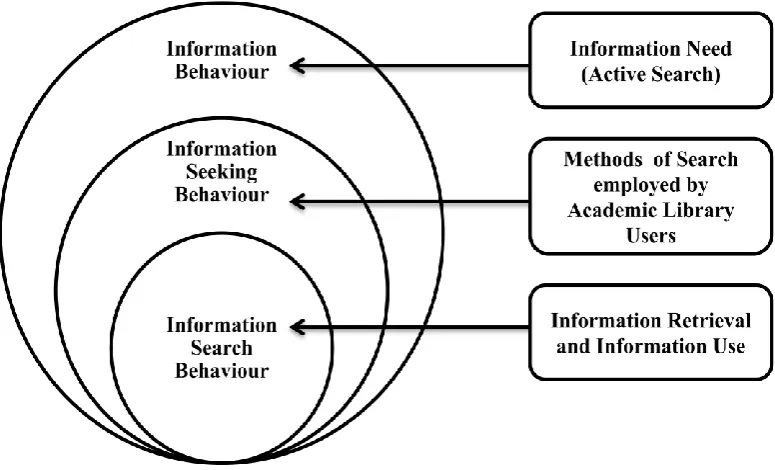
Figure 2.1: Wilson’s nested model adapted to academic library users’ practices (Wilson, 1999b)
2.2.2.8 Related Concepts
Case (2012) stated that the most general terms used to describe the phenomena of seeking and searching for information are “browsing” and “scanning”.
Browsing is definitely the central, and now considered older, concept, superseded by a diversity of terms used to indicate informal or unplanned search behaviours. The meaning of browsing has been broadened to include terms like scanning and encountering. Several authors deem browsing to be a type of information seeking, although the browser might be seeking nothing in particular.
Bates (2007) analysed empirical research results as reported by earlier researchers. Based on the issues obtained from this research, the components of browsing were closely analysed and developed. According to Bates, browsing is composed of four steps:
- Glimpsing a field of vision.
- Selecting or sampling a physical or informational object within the field of vision. - Examining the object.
- Acquiring the object (conceptually and/or physically) or abandoning it.
18
following definition for browsing: ‘browsing is the activity of engaging in a series of glimpses, each of which may or may not lead to closer examination of a (physical or represented) object, which examination may or may not lead to (physical and/or conceptual) acquisition of the object’.
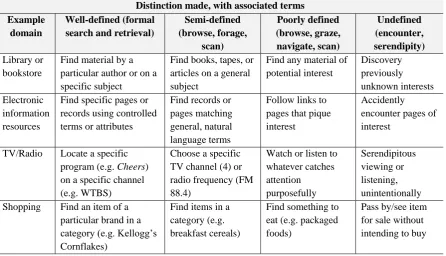
[image:35.595.77.524.282.538.2]Case (2012) presented a table of browsing goals, depending on domain of interest, goal type, and terminology adapted, taken from a study by Chang and Rice (1993), who investigated problems and issues in browsing behaviour. The table consisted of four domain examples: library or bookstore, electronic information resources, TV/radio, and shopping.
Table 2.1: Examples of browsing goals by domain interests, goal type, and terminology (Case, 2012, p. 103)
Distinction made, with associated terms Example
domain
Well-defined (formal search and retrieval)
Semi-defined (browse, forage, scan) Poorly defined (browse, graze, navigate, scan) Undefined (encounter, serendipity) Library or bookstore
Find material by a particular author or on a specific subject
Find books, tapes, or articles on a general subject
Find any material of potential interest Discovery previously unknown interests Electronic information resources
Find specific pages or records using controlled terms or attributes
Find records or pages matching general, natural language terms
Follow links to pages that pique interest
Accidently encounter pages of interest
TV/Radio Locate a specific program (e.g. Cheers) on a specific channel (e.g. WTBS)
Choose a specific TV channel (4) or radio frequency (FM 88.4)
Watch or listen to whatever catches attention purposefully Serendipitous viewing or listening, unintentionally Shopping Find an item of a
particular brand in a category (e.g. Kellogg’s Cornflakes)
Find items in a category (e.g. breakfast cereals)
Find something to eat (e.g. packaged foods)
Pass by/see item for sale without intending to buy
2.2.2.9 Importance of Information-Seeking Studies
The study of information-seeking behaviours plays a crucial role in user studies and is indispensable for libraries that seek to raise their level of performance and improve the level of services provided to their users. Turnbull (2001) identified the following nature and features of information-seeking behaviours:
- Having a user focus.
19
- Suggesting that information is searched for to enhance knowledge. - Pursuing a more opportunistic, non-premeditated search strategy. - Including identifying relevant information.
- Anchoring on an interactive approach, thereby making browsing easy.
This kind of study helps provide information for the categorisation of users, and Fine (1984) outlined the following points:
- Determine the categories of users that have benefited from available resources of information in the library and then identify and select the resources they have been using to guide the library in providing for them.
- Identify categories of users who have widely used the information resources available in the library to assist the library in providing suitable collections for them.
- Identify categories of users who do not make use much of the information resources available in the library, as this will help in designing programmes that will make these users interested in the library resources.
- Identify the level of user satisfaction regarding resources and services provided by the library and the reasons for this satisfaction.
Wilson (2008, p. 463) further highlighted the importance of research in information seeking: ‘It seems likely that the need to understand how people search for and use information services will continue to develop, as the understanding gained may become more and more important for the effective design of systems and services’.
The variety of information-seeking behaviours has led many authors to present models to explain the process behind such behaviours.
2.2.3 Information-Seeking Models
20
2.2.3.1 Ellis’s Model of Information-Seeking Behaviour
This model was originally designed to investigate information retrieval from the social science perspective. Its chief aim was to suggest a behavioural approach rather than a cognitive one. This model was based on interviews with different groups of researchers from various academic disciplines, including social sciences (Ellis, 1989), engineers and research scientists in industrial environments (Ellis and Haugan, 1997), and physicists and chemists (Ellis et al., 1993) as well as non-academic disciplines, such as English literature researchers using interview data (Smith, 1988) which Ellis analysed to validate the model.
Ellis et al. (1993, p. 359) argued that ‘the models do not attempt to define the interactions and interrelationships between the categories or the order in which they are carried out. The nature of the relationship between the features of the models can only be described in relation to specific information seeking patterns. Therefore, although it is possible to describe relationships between the features at a general level, the exact relationship of the features of the models depends upon the circumstances associated with the information-seeking behaviour of a particular individual at a particular time’. However, Ellis (2005) stated that he found similarities in general and in detail between the groups of researchers, even though they were from different disciplines. Ellis identified the following characteristics:
- Starting/Surveying: refers to activities which embrace preliminary searches for information, forming the initial point for the search.
- Chaining: the next step, whereby an initial resource is used as a reference point to carry out follow-up efforts. This is backward chaining, while forward chaining involves using other resources as reference points (e.g. follow references cited in the document or references citing the document).
- Browsing: the third stage, in which the individual uses pointers, such as contents, lists of titles, subject headings, and summaries, to narrow the search.
- Filtering: ‘characterised by use of certain criteria or mechanisms when searching for information to make the information as relevant and as precise as possible’ (Ellis, 2005, p. 140).
21
by the searcher’s previous knowledge of the sources and by hearsay information gleaned from others.
- Monitoring: keeping up to date with the details of changes in a specific area, with particular attention given to a core set of sources.
- Extracting: the process of working through the resources and selecting materials of interest; this can take place through direct investigation of the resource or less directly through bibliographies, indexes, and online databases.
- Verifying: determining that information is accurate. - Ending: ending the process at the end of a project.
This model was tested in several studies, and subsequent modifications were made. Meho and Tibbo (2003) applied Ellis’s model to the evaluation of a social science faculty conducting research into stateless nations. The study outcomes agreed with Ellis’s model, but contributed additional features—namely, accessing, networking, verifying, and managing information. Using these findings, a new model was developed with four interrelated stages: searching, accessing, processing, and ending. These studies adopted a triangulation research method involving interviews, data collection, and surveys. The new behaviours identified (accessing, networking, verifying, and managing information) should inform future improvements to current information systems and services.
Meho and Tibbo’s (2003) findings are comparable to those of Ge (2010), who assessed and evaluated Ellis’s model in relation to modern reliance on electronic resources. The author concluded with a confirmation of the model’s pertinence in both the traditional environment and the modern electronic information environment. A number of participants noted that the model’s stages might occur out of sequence or simultaneously with the adoption of other characteristics, depending on the individual’s circumstances. Ge’s study added two new characteristics, “preparation and planning” and “information management”, to Ellis’s permanent characteristics (starting, chaining, browsing, monitoring, differentiating, and extracting). These two characteristics cover the research methods that the social sciences and humanities utilise in finding information. These factors indicate an interest in acquiring additional research tools and in ensuring greater flexibility and ease-of-use in information systems.
22
proposed a revision to Meho and Tibbo’s (2003) version of Ellis’s model. Bronstein’s proposed revision provides an inclusive view of the dynamic stages of the information-seeking process through the information-information-seeking activities used in every phase of the research:
- Initial phase: starter references, browsing, extracting.
- Current awareness phase: monitoring activities, monitoring electronic materials, monitoring printed materials, networking, citation tracking.
- Final Phase: ending.
Ingwersen and Järvelin (2005) mentioned that Ellis’s characteristics might make different types of activities available that the user needs to use, although they were confident that those characteristics did not contribute any design specifications to an interactive system.
Ellis considered that the sequences of behavioural characteristics might be diverse which occur in different sequences with dissimilar users (Wilson, 1999b). In addition, it does not specify the exact order and relationships within the set of eight characteristics of information-seeking behaviour (Sadeh, 2010).
2.2.3.2 Kuhlthau’s Information-Search Process
Kuhlthau’s information-search process (ISP) focuses on intellectual access to information and ideas as well as the process of seeking meaning. ISP describes the process of information seeking as one of construction, focusing on users’ experience through the interaction of thoughts, feelings, and actions, which Kuhlthau (2005) represented in six stages:
- Initiation: a person starts searching; he/she becomes aware of inadequate knowledge or understanding of the topic.
- Selection: a general idea is identified, and the person is able to start his/her search. - Exploration: doubt and confusion increase as inconsistent information is encountered. - Formulation: uncertainty decreases, and confidence increases as a perspective is
formed.
- Collection: the gathering of relevant information diminishes the uncertainty, resulting in greater interest, while participation in the project deepens.
23
Figure 2.2: Kuhlthau’s information-search process. Reproduced from Kuhlthau et al. (2008)
24
Kuhlthau’s ISP model. Individual behaviour is impacted by social and contextual factors which will in turn affect the group process.
The validity of Kuhlthau’s model was supported through the undertaking of a thorough investigation, where the model was validated in numerous settings. A study by Kuhlthau et al. (2008) led to the claim that the ISP model is still valid, based on their research applied with school students and utilising both qualitative and quantitative methods. The researchers concluded that the model is useful for clarifying students’ information-seeking behaviours when the tasks require knowledge construction. In addition, the model is useful as a research tool when used to design, frame, and analyse information-seeking behaviour in complex tasks and also for designing user-centred information services and systems, especially for students in research projects.
Furthermore, a study conducted by Thani and Hashim (2011) aimed to identify the information needs and information-seeking behaviours of social science postgraduate students of four local Malaysian universities. Using closed-ended questionnaires, the researchers found that the majority of students, when searching for information, followed Kuhlthau’s six stages of the information-search process.
Regardless of the users, Kuhlthau’s model determines the information seeking in order of its stages (Wilson, 1999b). This model is also important as it focuses on users’ experience through the interaction of thoughts.
2.2.3.3 Belkin et al.’s Information-Seeking Strategies
Belkin et al. (1993) outlined the following information-seeking strategies: - Browsing:defined as scanning a resource.
- Learning: defined as expanding knowledge of one’s goal and the problem, the system and the resources, and the topic.
- Recognition: defined as identifying relevant items through stimulated association (e.g. display).
25
Belkin et al. claimed that a variety of behaviours can be identified when people engage in searching for information in a knowledge resource. Examples include locating identifiable, known items; searching for items already identified; browsing for interesting items; perusing their contents; locating useful items through inspection; and looking over item descriptors and item organisation schemes. These information-search strategies (ISSs) are some, but not all, of the possibilities and may be interchangeable, but are also exclusive of each other. In one ISS, the interaction between the user and the elements of the information-retrieval (IR) system can be observed, and Belkin proposed an IR interface design, based on the above interaction and the behaviours of information-seeking individuals as well as the reciprocal movement between them.
Belkin et al. (1995) discussed how their concept can be used to design effective interaction and provided a theory of interactions, built on information-seeking strategies. Specifically, they presented a model of information-retrieval system designs based on the following concepts:
- A multi-dimensional space of information-seeking strategies - Dialogue structures for information seeking
- Cases of specific information-seeking dialogues - Scripts as distinguished in prototypical cases
Belkin et al. (1995) suggested that any single information-seeking interaction is a complex activity which can be described according to its relationship to the four identified dimensions and can also be characterised based on its values on a comparatively small number of factors or dimensions. The researchers proposed four dimensions of ISS according to the observations they made and the findings from other empirical studies.
26
Belkin et al.’s (1995) dimensions can be explained as follows:
- Method of interaction: This includes a range of variations, from searching for an identified item to scanning for an interesting item.
- The goal of the interaction: This involves either learning something about an item or resource or selectinguseful ones for retrieval.
- Mode of retrieval: This can be divided into two modes: specification, which is seeking for identified items, and recognition, which is identifying relevant items through stimulated associations.
- Resource considered: The interaction with the items of information themselves might differ from the interaction with meta-information, which describes the structure and contents of the objects of information.
Belkin et al. pointed out that information-seeking behaviour is considered an action that moves from one strategy to another in the course of a single information-seeking episode and as the problematical situation of the person changes. ‘Having ISSs described by, and located in, the kind of space we suggest gives us a means to describe movement from ISS to ISS, as well as to describe the individual ISSs, and potentially the means to understand such movement well enough to devise methods for supporting it in a principled fashion. From this point of view, we can consider ISSs as types of user interactions within the IR system, rather than as queries or demands put to that system’ (p. 7). This model is important for the context of this study as all information-seeking episodes can consist of different types of interactions.
2.2.3.4 Marchionini’s Information-Seeking Model
27
Figure 2.4: Marchionini’s information-seeking model. Reproduced from Marchionini (1995)
Information seeking starts with the recognition and acceptance of the problem and continues until the problem is solved or abandoned.
The sub-processes of Marchionini’s model can be explained as follows:
1. Recognise and accept an information problem: users should be aware of the problem with which they will engage in the information-seeking process. The problem might be suppressed or accepted, and the system design plays an important role in affecting the user’s decision.
2. Define and understand the problem: this process depends on the information seeker having an understanding or knowledge of the task field, and this will remain as part of the process for the duration of information seeking. Furthermore, it can be affected by the setting.
3. Choose a search system: information seekers at this point look to their previous experiences with the task field. Their range of information infrastructures and expectations regarding the answer are shaped as they define the problem and the task. As all users (information seekers) are different, their information retrieval techniques will also be different; their previous experiences will be reflected in this process. At this point, information seekers will attempt to map the search task in relation to one or more search systems and in accordance with their constraints relating to domain knowledge, their general cognitive conditions, and their previous search experiences.